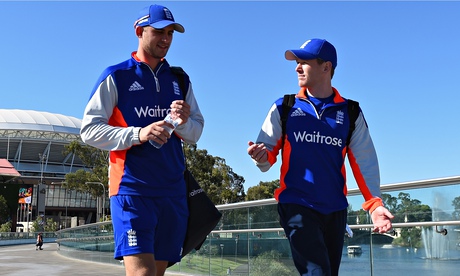
There is one simple, dreaded outcome. If England do not beat Bangladesh in Adelaide on Monday they are out of the World Cup. They would depart – after completing their obligations against Afghanistan – ridiculed and unloved. The something-must-be-done brigade would, understandably, be on the march, picking up masses of recruits from every quarter along the way.
But even if England win there are no guarantees. Then they must beat Afghanistan and trust that New Zealand, in their last pool match, defeat Bangladesh. No wonder there is a bit of tension in the air.
England are quite capable of losing this kind of match. They did so in the last World Cup against Bangladesh after a tepid display in Chittagong. Less than 12 months ago they contrived to lose to the Netherlands in the World T20 – although by that stage they were already out of the tournament. Within three weeks Ashley Giles was out of a job and replaced by Peter Moores, who was described by Paul Downton as “the outstanding coach of his generation. This is the future”. Downton might hesitate to use such language just now.
The implications of an England defeat in Adelaide could be wide-ranging. The new ECB chairman, Colin Graves, a successful businessman like his predecessor, is not the sort of man to shirk taking decisive action if the product is failing. For all his good cheer he may have more in common with Henry VIII than Harry Hill. He tends to get what he wants.
Moores has not been in his post for 12 months, but if England, with all their resources, fail to make the quarter-finals Graves might take a view. He could easily bracket Moores alongside Mickey Arthur (when in charge of Australia), Iain Duncan Smith and David Moyes as a leader unlikely to deliver and dispense with him swiftly. If that were the case Downton would not be sitting too comfortably either.
If this sounds a cold and ruthless course of action, there may be some consolation for Moores, who was sacked by the ECB after 18 months at the helm in 2009, especially if he ponders the words of Tommy Docherty, who once said: “In football, with a good contract and a bad team you’re made for life.” It’s not quite that simple in cricket, where the salaries are not so mouth-watering, but Moores would, at least, be compensated for any early departure. Or given another job.
Moores would much prefer a passage to the quarter-finals, after which anything, theoretically, is possible even though this England side has been roundly thrashed, rather than just defeated, by every Test nation they have encountered. There are uncomfortable decisions to be made before the match against Bangladesh. Gary Ballance, catapulted into the side for the first game against Australia, has failed four times. That punt, to which the tour selectors have obstinately adhered, has not worked.
They will have to replace him, presumably with Alex Hales who has been banished to the sidelines for most of the past two months. It is a lot to ask of Hales, but England find themselves with little alternative. To give him the best chance of success he surely has to be given a familiar role – unlike on the tour of Sri Lanka – as an opening batsman. An alliance with Moeen Ali should encourage spectators in Adelaide to turn up promptly because anything could happen.
Moreover, Bangladesh do not possess the most potent of opening bowlers in the tournament. In this case Ian Bell would drop down to No3.
There is more agonising to be done over the bowling attack, which has been devoid of variety and vim, let alone the discipline one expects from experienced internationals. This week Stuart Broad, with unusual candour, shared how he has suffered since being hit on the head when batting against Varun Aaron of India last summer. “I have had nightmares about it,” he said. “Times when I have felt the ball just about to hit my head in the middle of the night.” He has been working with a sports psychologist to try to resolve this problem.
This helps to explain how Broad seems to have lost his nerve when facing pace bowling. His innings against New Zealand in Wellington was one of a rank tailender. Thus Broad is a diminished cricketer and he should be assessed differently. He is now a specialist bowler full stop and as such he cannot be considered an automatic choice. In this tournament he has two wickets at 92 apiece and an economy rate of 6.27 (mind you, Jimmy Anderson’s numbers are almost the same).
In Broad’s case the knowledge that he has the yips as a batsman is bound to affect his overall confidence, even when he has the ball in his hand. Indeed, the news of his plight, one that deserves much sympathy since it requires considerable bravery just to go out there when the nerves are shredded, poses the question whether he should have been included in the squad at all.
There is certainly a case for Eoin Morgan having some variety at his disposal in the field. This might mean including James Tredwell or even Ravi Bopara and Chris Jordan, who have not played for weeks.
In contrast to England Bangladesh can turn up with uncluttered minds, fresh from a calm run-chase against Scotland. In Nelson on a benign surface, not so different from the one anticipated in Adelaide, their bowling was not threatening, but their experienced batsmen were. Tamim Iqbal suggested that he was coming into form, while Mahmudullah, the impish Mushfiqur Rahim and the imperturbable Shakib al Hasan all played with a freedom and flair, which has generally eluded the England camp in this tournament.