In sport the notion of a honeymoon period is a bit of a myth. If the team loses, it receives stick. There is no such thing as a free game. But England embark on their ODI series with New Zealand with a bit more leeway than usual. They have a caretaker coach, Paul Farbrace, in charge; they are playing the World Cup finalists; they have picked a young, unproven side, in which the only man over the age of 30 is Grandpa Plunkett. One player (Sam Billings) is uncapped; three of them – Mark Wood, Jason Roy and David Willey – made wet debuts against Ireland a month ago. There is not even the Pietersen imperative.
There may be an argument, albeit a rejected one, for his inclusion in the Test team but this does not apply in the 50-over game, where England are seeking to discover players who might excel in the 2017 Champions Trophy or the 2019 World Cup.
It may well be that Farbrace and Eoin Morgan, who has retained the one-day captaincy, will use some of the above to encourage the new young charges to play with freedom and fearlessness. That was the mantra before the World Cup campaign but it never happened. They will have to be persuasive because there is always pressure when the results are bad.
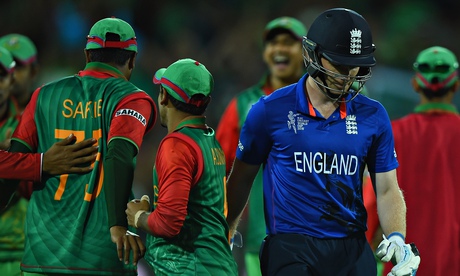
Morgan knows that better than most since his position is under particular scrutiny. He may have been relieved when he got the nod from Andrew Strauss that he would continue as captain despite his poor recent record. Strauss might have turned to Joe Root for the brave new world. Morgan needs runs as well as the odd victory. In his past eight innings in ODI cricket he has mustered 92. Meanwhile, his record as captain is modest. He has led England 19 times. Eleven matches have been lost; there have been seven victories, four of which have been against Ireland (twice), Scotland and Afghanistan, and one no result. It is no wonder that expectations for this series are low. England have never been such underdogs against New Zealand.
Jimmy Anderson and Stuart Broad have been dropped – we have been informed that only Moeen Ali out of the absentees from the World Cup squad has been rested – and this leaves England with a raw bowling attack. Wood, who has promised much in two Tests, has played 19 List A matches in his life.
The evidence of the recent World Cup demonstrates the latest development in ODI cricket. There was a time when there was quite a gaggle of specialist one-day bowlers. Nathan Bracken of Australia played 116 ODIs and five Tests. Ian Austin of Lancashire played nine ODI matches for England; his name would never have been mentioned when considering a Test team. Nor would those of Alex Wharf, Dimitri Mascarenhas, Michael Yardy or Jade Dernbach. It seems as if the days of the specialist ODI bowler are fading.
Now the trend is to play the Test bowlers, even if they are not the most economical ones available. The ability to take wickets is deemed to be critical. No matter how accurate a bowler is he will be shunted all around the field in the final overs if the opposition has wickets in hand. Hence there is the preference for the wicket-takers, the Test bowlers. New Zealand had Trent Boult, Tim Southee and Matt Henry, a replacement for Adam Milne, in their World Cup final team. Australia put their trust in Mitchell Johnson, Mitchell Starc and Josh Hazlewood, all of whom have been playing in their Test side against West Indies in Dominica.
By the same token, if any of the bowlers involved impress in ODIs their chances of making the Test team are enhanced even though it is such a different form of the game. In the England squad there are six pace bowlers and only one of them, Willey, has yet to play Test cricket. All of them may have noted that against New Zealand the pace attack was sometimes creaking. Meanwhile, there is the solitary specialist spinner, Adil Rashid. Presumably he will play a fair proportion of the games. It would be cruel, having taken him all around the Caribbean without giving him a game on spin-friendly surfaces, not to play him a few times here.
Likewise the young batsmen, while desperate to cement their ODI status, might have an eye on the Test team. Runs for Gary Ballance and Ian Bell have been in short supply this summer, though it is anticipated that this pair will survive for the start of the Ashes series. But if Alex Hales and James Taylor shine they may emerge as alternatives.
The white and red ball games were once reckoned to be poles apart. However, after watching the Kiwis in the recent Test series maybe that gulf is not so wide as it once was. Expect New Zealand to have eight of their victorious side at Headingley in their ODI team at Edgbaston on Tuesday. At most England can field four survivors from Leeds.