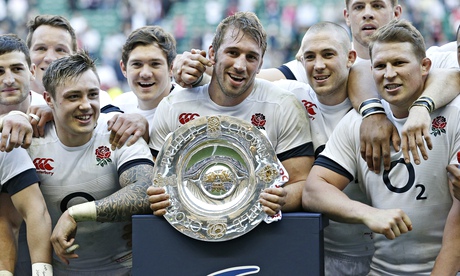
It is possible to take the RBS Six Nations championship for granted. The grand old tournament has occupied the same annual slot for donkey’s years, as reliable an indicator of the gradual ascent from winter to spring as the first daffodil in the hedgerow. The best way to measure its health is to imagine life without it: all those long, gloomy February weekends in DIY hell, the reduction of laughter, the post-Christmas doldrums of dull normality. Six Nations rugby is a glorious antidote; it may even be its raison d’etre.
True, it might be even more alluring in April and May: endless Roman sunshine, the Scottish Borders without three overcoats, Dublin in shirtsleeves. Perhaps one day, if a global season ever materialises, it may come to that. For the time being we relish the cosy rituals and rhythms as we count down to a tournament which, thanks to its climatic vagaries, geographical contrasts, home-and-away fluctuations and historical enmities, remains as hard to predict as anything in sport.
This year is no exception. With a Rugby World Cup kicking off in September, it is not merely England, the hosts, who have sky-high hopes for 2015.
Ireland were champions in their first season under Joe Schmidt’s expert guidance. How will they fare now he has his eye in? Warren Gatland’s settled Wales side seem to enjoy this time of year more than the autumn. Scotland, with Vern Cotter in charge, are beginning to stir. France have some interesting new individuals and no lack of incentive. Italy are no one’s pushovers, particularly at home.
It is England, though, who have most to lose – and gain – over the next seven weeks. In 2003 under Clive Woodward – not yet a knight at that point – there was also a World Cup approaching and critical momentum to be generated. Then, as now, the previous red rose grand slam was a distant memory and a statement of intent was widely demanded.
Woodward’s men whipped through the card, culminating in a 42-6 thumping of a decent Ireland side at Lansdowne Road. If their players had any doubts about rising to the occasion in Australia, that day in Dublin sandblasted them clean away.
Do England have that calibre of player now? It will be deeds, not soothing words, which ultimately supply the answer. Stuart Lancaster has also worked hard to create a strong collective culture which, he hopes, will compensate for the lack of a Johnson or a Wilkinson or a Robinson, once-in-a-generation players whose careers happened to overlap. What England do have, unquestionably, is desire. They all know this is the year of their lives. Now is not the moment to step meekly aside from the chariot and allow a rival to steal their place.
In that respect the World Cup will have a direct effect on the Six Nations. In past years a direct link between championship victors and World Cup supremacy has proved elusive, for the simple reason the southern hemisphere’s finest do not compete in it. France won a grand slam in 1987 and reached the World Cup final. So did England in 1991. But England in 1995, Scotland in 1999, France in 2007 and England again in 2011 all found it impossible to scale similar heights after winning the championship. Only Johnson’s all-star squad of 2003 – the only European side to win a World Cup – have conquered the twin peaks of grand slam and Webb Ellis Cup in the same calendar year.
It is worth remembering, too, that England have won one grand slam since 1995. There have been an awful lot of “could haves” and “what ifs” but Lancaster and his fellow coaches are determined to avoid yet another sombre post-mortem. “I think the cycle of the team has reached a point where the development bit stops; it’s about the winning,” Lancaster said recently, fully aware the Six Nations is no ordinary challenge. England’s meagre recent record is as much down to rugby as the tribal passions the white jersey stirs among their opposition, particularly on Celtic soil. Few Englishman on the streets of Cardiff after Wales’s stunning 30-3 victory two years ago were left in much doubt where they could park their chariot overnight.
This intense neighbourhood watch experience is all part of the tournament’s unique attraction. Cotter will be merely the latest New Zealander to be taken aback by the swirling crowds and plentiful away support which makes the Six Nations so different to anything in the southern hemisphere.
But what is the point of Test rugby if it does not test the individuals involved? This is a huge moment for George Ford, England’s young fly-half and goalkicker, who has yet to start a championship game. If he can help get England off to a flyer at the Millennium Stadium, behind a dominant visiting pack, it will be a huge psychological bonus for all involved. The coaches will feel vindicated and emboldened and the pressure of an iffy autumn will recede. England, with injury problems complicating Lancaster’s life, do not scare opponents as yet; a confident, settled successful England with the benefit of home advantage at a World Cup just might. Manu Tuilagi, Courtney Lawes, Ben Morgan, Owen Farrell, Brad Barritt, Kyle Eastmond, Geoff Parling and Tom Wood may be injured but a lack of choice has never been English rugby’s problem. Those who take their places will still be expected to win immediately, whoever they are.
Gatland, always in search of a psychological edge, is taking a different tack. Never mind what happens now, he argues, it’s the World Cup pool game at Twickenham on 26 September that really matters to Wales. He has hinted about not showing his full deck, of keeping something hidden for the autumn and saving the heavenliest Welsh bread for another day. It deflects a little flak should they lose and, potentially, frees up his players to play without fear of reprisals. For that reason alone the opening Six Nations game will be a colossal occasion. If Leigh Halfpenny kicks even half as accurately as he has done for Toulon lately, England will do well to win.
The more you look down the list of fixtures the more enticing the whole tournament becomes. Ireland will not have Jonathan Sexton, their fly-half orchestrator, available for their opening game in Italy but Schmidt has few peers when it comes to tailoring specific gameplans to specific opponents. As well as England they play France in Dublin and, historically, do not mind playing in Cardiff. They won a grand slam in an “odd year” in 2009 when their fixtures were not dissimilar to this season, with England visiting on the middle weekend. Only injuries will cool their optimism. It has been an attritional winter in the Irish provinces.
France? It is the easiest prediction of all: they will look capable of conquering the world one minute and lose to someone ridiculous the next. How telling it is, given the emergence of the Top 14 as a magnet for the world’s best players, that the French national team have won one Six Nations title since 2007.
Considering the players who have played for France over that period it is impossible not to highlight the club v country tug of war has been a major factor. Nathan Hines, the Scotland and Sale forward who has played at Perpignan and Clermont, honestly thinks it is all in the mind. “With the French it’s a mindset thing, a temperament thing. I think French people have pretty much resigned themselves to the fact a Six Nations before a World Cup means absolutely nothing at all. Even last week’s form means nothing. Historically with the French there has been a tendency to turn up one week and not the next. The battle for them is to get some consistency.”
Maybe that is why Philippe Saint-André has cast his net wider than ever, looking for expats who might prove slightly more reliable. Scott Spedding at full-back, the scrum-half Rory Kockott and the flanker Bernard Le Roux could yet prove among the more influential championship newcomers; all of them grew up in South Africa but could become integral to France’s World Cup campaign.
With three away games to navigate, though, it still requires a considerable leap of faith to see France taking the title despite the flickers of encouragement they displayed in November. They have a particularly dangerous first game; Scotland have a fresh sense of purpose and Cotter’s lengthy spell in charge of Clermont ensures he knows the opposition inside out.
If the Scotland pack are sufficiently competitive at set pieces there are some good young players – among them Stuart Hogg, Mark Bennett, Jonny Gray and Sam Hidalgo-Clyne – who could flourish this year given a slice or two of luck. Cotter, a good friend and former colleague of Schmidt’s, will point the team in the optimum direction and three of their five games are at Murrayfield. Their first two games, away in Paris and at home to Wales, will determine to what extent such cautious optimism is misplaced.
Italy, too, may just have found a half-decent fly-half in the New Zealand-born Kelly Haimona to help them build on the solid foundations their pack generally lay. There is no more rousing sight and sound in the tournament for neutrals than the Italian anthem and, particularly in Rome, the Azzurri can be hard to resist. If Sergio Parisse is on his game – as he generally is – there are few better No8s to watch in world rugby, the All Black totem Kieran Read included. France, remarkably, are seeking to avoid their third successive Six Nations defeat on Italian soil.
Add it all together and the brew remains as intoxicating as ever. Much, admittedly, will depend on the weather and the underfoot conditions; it is extremely hard to score stunning tries when your wings are up to their ankles in mud or dislodged turf. Murrayfield, though, will provide a better surface this year and, as the more successful teams in the European Cup have shown, playing with tempo is the quickest way to unsettle big defenders. The lack of a runaway favourite should also encourage everyone to chance their arm at some stage; territorial kicking is a key part of the modern international game but creating and exploiting gaps is fundamental, too.
So where to invest granny’s fiver? It basically depends on your view of England: a stirring giant or a stalled chariot? If it is the former, back them. Wales and France will do well to win three away games apiece, Ireland have injury issues and Scotland are going to struggle to win in Paris and Twickenham. England for at least a share of the title would be my best hunch. If, on the other hand, you prefer to be guided by the law of sod, it will be Wales’s title. Imagine the ripple effect that would have in a World Cup year.