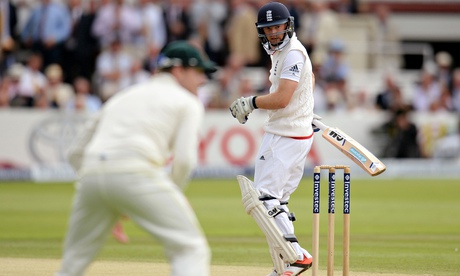
It may not feel like it but it is only 1-1. England’s defeat at Lord’s by 405 runs was so much more emphatic than the hosts’ victory at Cardiff – by a mere 169 – that it is easy to fear the worst. Last Sunday afternoon on a slow, low track England were catapulted back to the humiliations of the 2013-14 tour with Mitchell Johnson causing havoc alongside any other Australian bowler who happened to get his hands on the ball.
It was one of those days when the England and Wales Cricket Board could count their lucky stars that the Test match was not available on terrestrial television. The spectacle of English batsmen going back and forth was gruesome, suitable only for restricted viewers.
To lament England’s “inconsistency” is as euphemistic as bemoaning Attila the Hun’s “intolerance”. This was a landslide, a gut-wrenching defeat, which must have reopened a few scars. It must also have been an eye-opener for Trevor Bayliss, the new England coach, who looks the sort who might appreciate Joni Mitchell (“I’ve looked at life from both sides now, from win and lose and still somehow …”). It is just as well Bayliss is now renowned for his calmness.
Is there any way back? Well, of course there is. There is always a chance. Just to cheer everyone up, contemplate this list of English cricketing calamities in Ashes encounters for a while. And then recall how, on each occasion, a dire defeat was followed by a barely credible victory.
At Headingley in 2009 England lost to Australia by an innings and 80 runs, an outcome that squared the series. On the first morning Andrew Strauss’s side were bowled out in 33.5 overs for 102, with Peter Siddle taking five for 21. England lasted 61.3 overs in their second innings with Johnson snatching five for 69. Any thoughts of regaining the Ashes at the Oval were suddenly restricted to devotees of Hans Christian Andersen and, just possibly, Jimmy of roughly the same name.
What happened a fortnight later? England regained the Ashes.
They did not make wholesale changes for that Oval Test. With echoes of today, they dropped their No3 (Ravi Bopara) and invited Ian Bell to go up the order and take his place (Bell would hit an important 72 in the first innings at the Oval). Jonathan Trott was given a Test debut at No5 and Andrew Flintoff returned to the side after injury for his last Test. On a crumbly surface Graeme Swann took nine wickets in the match, while Australia did not pick a specialist spinner, which meant that Marcus North bowled 43 overs.
Thus the Ashes were won even though there had been eight Australian centuries to England’s one in the series, even though the Australian bowlers had taken 80 wickets compared with England’s 67. It was quite a heist and the feeling now is that England will have to produce something just as clever and unlikely to prevail in 2015. But there is the precedent.
There have been other numbing Ashes defeats followed by a dramatic victory in this century. In 2005 Australia won by 239 runs at Lord’s. England kept the same team for Edgbaston, a luxury not afforded Australia, and Michael Vaughan’s side won by two runs. In Perth in 2010 England, tormented again by Johnson, lost by 267 runs. They replaced Steven Finn with Tim Bresnan in Melbourne and this time the England victory was a little more emphatic – an innings and 157 runs (this was probably not just because of the presence of Bresnan but he did take six wickets in the match).
In each instance almost the same XI managed to recover from a shocking defeat. So I assume everyone is cheered up now. However, it is probably prudent not to take an England victory at Edgbaston for granted on the basis of these precedents.
At Lord’s we witnessed very poor play, first and foremost, but also very poor planning by someone. The pitch favoured the tourists even if it looked as if it was designed to neuter Johnson and Mitchell Starc. It was too bland for England’s bowling attack but the Australians, with their greater pace, were able to take the pitch out of the equation in England’s first innings by bowling fast, full and swinging the ball. In the second innings they could have bowled England out with an orange, so inept was the batting.
The Australians, stunned and then galvanised by the Cardiff defeat, were invigorated by the injection of youth. Mitchell Marsh and Peter Nevill had good games. Marsh is bound to stay and he will be joined in the team by his brother, Shaun, if Chris Rogers has not recovered fully from those dizzy spells. Whether Brad Haddin returns is more debatable; perhaps it was significant that Nevill batted above him at Derby.
England will be determined to retain an aggressive outlook. This does not mean trying to smash every ball for four; that is not what Alastair Cook is for. It does mean being true to oneself. So with Gary Ballance dropped, his replacement, Jonny Bairstow, will surely be encouraged to play his natural, forthright game, which has seen him average more than 100 for Yorkshire in Championship cricket. No doubt he will be swiftly reminded of the gulf between county and Test cricket, which has seldom seemed wider.
Meanwhile, the selectors must contemplate a choice between Finn and Mark Wood. Finn revels on bouncy surfaces but the likelihood of one of those at Edgbaston is slight. The microscope will also home in on Adam Lyth and Ian Bell, both of whom need runs to retain their places. Bell is England’s sole survivor from the 2005 game and, given that the camp has recently decided to welcome past players into the dressing room to recall times gone by, perhaps it is appropriate for old Belly to share his memories of the Edgbaston Test of 10 years ago. That would surely cheer everyone up.