Roy Hodgson has managed England to home-and-away friendly victories against Scotland and now he is hoping to have the chance to repeat the feat competitively, after the teams were paired in the same 2018 World Cup qualifying section. The two home nations were drawn in Group F along with Slovakia, Slovenia, Lithuania and Malta. Wales, meanwhile, were drawn in Group D with the Republic of Ireland, plus Austria, Serbia, Moldova and Georgia. Northern Ireland will have to face Germany, the world champions, in Group C along with the Czech Republic, Norway, Azerbaijan and San Marino.
The fear beforehand for England and their fellow top seeds Wales was that they could have been handed games with France or Italy. Instead they must play their neighbours and Roy Hodgson told the BBC: “There was always a chance we were going to get a local derby with Scotland, Northern Ireland and the Republic of Ireland all a possibility. The Scotland fixture really does excite people. We have got recent experience of what the atmosphere will be like. The games will excite the public, get people in the mass media excited too. It is a good draw all round – I think Scotland will be happy with it and we are happy with it.”
Hodgson’s contract expires after the Euro 2016 finals next July and the 67-year-old said he would love to be given the chance to coach the national side in the World Cup qualifying campaign. He said: “It’s not something I want to give up lightly but, if the FA want me to stay on, I would be delighted to do so.”
He added: “It is a very fierce rivalry and that’s good. It’s not fierce on the field as the games are played in absolutely the right spirit. Both the game at Wembley and the game at Celtic Park were played in a very competitive manner and were extremely intense but there was certainly nothing untoward, there was not a bad foul in either of the two games. So let’s make certain we keep talk of fierce and intense rivalry to the many fixtures back in the past that people refer to.”
Hodgson rejected suggestions that England should be regarded as outright favourites to win the group. He said: “We need to be careful before we start describing ourselves as overwhelming favourites. We have to make certain we respect all our opponents and remain fully conscious that every time we don’t go on the field and do our job to 100% we could lose.
“We have had two very highly competitive friendlies against Scotland over the last year. For the mass media that’s the fixture that is going to capture the imagination. England v Scotland fixtures go back a long, long way in history and there has been many a fierce encounter along the way.
“Slovenia are a good team as are Slovakia, Lithuania and Malta are experienced at this level so I think it will be a very competitive group. We are happy with the group. It’s just a question now of trying to make certain that the players can handle it.”
His Scottish opposite number, Gordon Strachan, said: “It is a draw that has made a lot of people happy. The coaching staff are happy because we’ve got a lot of teams we haven’t faced recently and there are a lot of delirious fans here because it is a fantastic fixture and I think the whole of Scotland and England will be looking forward to it.”
Wales will have high hopes of reaching the finals for the first time since 1958. “We’ve really improved in the last three years and we fancy ourselves against anyone,” Wales’s coach, Chris Coleman, said. “We’ve had a bit of fun being in pot one. It’s new for us. We’ve really enjoyed it.”
Martin O’Neill, the Republic of Ireland manager, expressed puzzlement at Wales’s ascent from pot six of the World Cup qualifying draw alongside the minnows four years ago. “It’s been a remarkable rise. To go from sixth into the top seeds,” said O’Neill, whose team was in pot four despite having played at the 2012 European Championship under Giovanni Trapattoni.
“I’m happy that we are not playing against Italy and France,” the Germany business manager, Oliver Bierhoff, said after coming out in Northern Ireland’s group. “We can be satisfied about that.”
Meanwhile, Spain and Italy will meet in Group G along with Albania, Israel, Macedonia and Liechtenstein. Things do not look so straightforward in Group A where Holland and France face tricky opponents in Sweden, Bulgaria, Belarus and Luxembourg.
The other groups look open, with Portugal, Switzerland and Hungary in Group B, Romania, Poland and Denmark in Group E, Belgium and Bosnia in Group H and Croatia, Iceland, Ukraine and Turkey in Group I.
Uefa has sought to maximise income by placing Germany, France, England, Italy, Spain and Holland – the leading television markets – in six-team sections. The nine group winners qualify automatically for the finals while the eight best runners-up will go into play-offs. Russia qualify as hosts, to make it 14 European qualifiers in all.
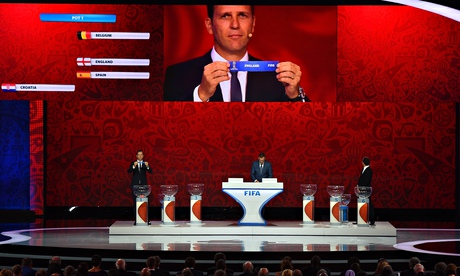
Despite his notorious lateness to official functions, Russia’s president, Vladimir Putin, took the stage promptly at 6pm with Sepp Blatter to kick off the drawing ceremony, which lasted nearly two hours. The Fifa president used his speech to stress that the governing body was fully behind Russia holding the 2018 World Cup, despite calls from some former officials to strip the country of the event following its support for separatists in Ukraine and the US and Swiss corruption probes into the bidding process. This week Charlie Scharf, the chief executive of leading Fifa sponsor Visa, attacked the football organisation’s reaction to corruption allegations and said “no meaningful reform” could be made while Blatter is president.
“Yesterday, and I’m so happy to announce it to you, Mr President, and for the Russian people, Fifa’s executive committee expressed again its trust and confidence in Russia for the organisation of this competition,” Blatter said. “Trust in Russian authorities, organising committee, and in the Russian people.”
Putin for his part did not refer directly to the scandals but he once again stressed his support for the embattled Fifa leader, whom he has previously suggested was the victim of an American smear campaign. “We see what is happening around football, but I know how you regard this and we are grateful that you are concentrating your attention primarily on sport,” Putin said.
The ceremony itself was marked by often stilted dialogue between the emcees, officials and the football stars enlisted to help. In a particularly awkward exchange, the host, Natalia Vodianova told a grinning Fifa general secretary, Jérôme Valcke, that she had forgotten how many times they should kiss when greeting each other. Valcke gallantly told the supermodel he was French and kissed her three times.
After Vodianova asked Ronaldo and Diego Forlán what they dreamed of now their sterling careers were over, the Brazil legend said he dreamed of a world free of violence hunger and poverty. Forlán replied that he dreamed of his side Uruguay making the 2018 World Cup.
Musical numbers broke up the drawing rounds, with one number full of traditional Russian dancers and a small orchestra with large and small balalaikas doing a cover of Pink’s Get the Party Started.