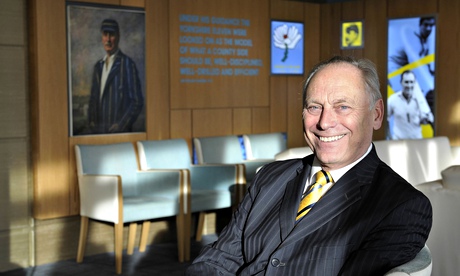
There have been less eventful first days at the office. Colin Graves, the new chairman of the England and Wales Cricket Board, pitched up for his first day at the crease already feeling battered and bruised by the all‑encompassing Kevin Pietersen saga that threatens to suck the whole of the sport into its vortex.
When he agreed to take the job as part of the internal round of musical chairs in which Giles Clarke became the ECB’s first president, Graves probably did not expect to spend his first day evading the questions of a dogged BBC reporter at Lord’s.
For the past week it is as though the ECB has been in competition with the Labour party to see which can crash to the ground fastest.
Graves, who likes to think of himself as a straight talker, has endured a baptism of fire ever since he responded to a few gentle looseners from the BBC’s Garry Richardson in early March by saying that Pietersen could only be considered for an England recall if he was consistently scoring runs in county cricket. I was in the Sportsweek studio that Sunday morning and, at the time, it sounded like an honest answer to a reasonable question rather than a clanging gaffe. Pietersen, sensing his chance, shot through the crack of a door that had been reopened just slightly and within two hours was on Sky saying he would have to consider whether to take him up on the offer.
Graves should have stopped there. But for reasons best known to himself he then went further in an interview with the Telegraph in which he said “what happened in the past is history”. For good measure, he added: “If he does that and then comes out and scores a lot of runs they can’t ignore him I would have thought but that is up to him.”
So whatever Graves says now, anyone reading those comments would reasonably assume Pietersen had a decent chance of a recall if he returned to county cricket and scored bags of runs. To be absolutely fair to Graves, he also consistently said that it wasn’t him that selected the team.
An ECB spokesman hurriedly added that “nothing had changed” and introduced an addendum to the effect that Pietersen would have to also be seen as “a positive influence”. Muddy waters. Since then, of course, much has changed. The departures of Paul Downton and Peter Moores and the arrival of Andrew Strauss as director of cricket have shifted the terms of the debate yet again.
Graves is angry that his integrity had been called into question by a perception that Pietersen had interpreted his comments as a cast iron guarantee he would win a recall if he scored runs in the County Championship. Clear? The only trouble is, scan through the thousands of words that Pietersen has written and tweeted on the subject and he doesn’t really say that. The closest he came was after hitting 170 for Surrey last month, when he said of his phone conversation with Graves: “He just said to me he wants his best players playing for England and it’s a clean slate.”
Go back to Pietersen’s emotional missive on Wednesday and the charges of “deceit” are as much aimed at the new chief executive, Tom Harrison, who he says led him to believe the meeting with Strauss would not be bad news, as Graves.
All of this semantics and parsing of previous interviews and statements for meaning, hidden or otherwise, doesn’t get us very far. Both sides have at times interpreted, or misinterpreted, the other to suit their agenda.
Pietersen has definitively won the sympathy of the wider public by playing a blinder in PR terms. The ECB, meanwhile, has muttered about legal restrictions and consistently returned to the notion there may still be a role for Pietersen in the future. It is this element of the ECB’s public rhetoric this week that has been most puzzling.
First, Pietersen was told that he was almost certainly finished as an England cricketer and then offered an “ad hoc consultancy role” with the one-day side. Then Graves insisted on returning to the theme: “Despite everything, he can work with us to rebuild the relationship and make a further contribution to English cricket.” Er, right.
At best, the new ECB chairman can console himself with the fact that things can’t get much worse. And one can only hope, for his own sake, that media training comes as standard with the job. His success in business and profile as Yorkshire chairman will not have prepared him for a firestorm such as this.
“I want to look to the future,” concluded Graves. Don’t we all. But that still seems impossible when the ECB seems so incapable of dealing with the recent past.