Picking the bones out of a defeat takes longer than savouring the filet of victory, So, while Wales, who never knowingly rush the examination of a bad smell, take their samples and send them to be tested for toxic contamination, England can plan quickly ahead, no longer a collection of injury-cursed strangers but game-hardened pioneers surveying a richly illuminated landscape.
Dave Attwood and George Kruis, two second-rows that might not have been a fourth-choice pairing a month ago, were at the heart of the all-conquering forward effort in the second half. A centre pairing that had not played a Test together looked strong and yet inventive. Jonathan Joseph was so light on his feet that he left Dan Biggar (no mean tackler) in a spin, and then went from stock-still to flat out so electrifyingly that George North (not his finest defensive moment) was left clutching at air. Joseph’s partner, Luther Burrell, gave the pass – having scooped one from Chris Robshaw off his toes – that gave Mike Brown the space to kick ahead for Anthony Watson to score.
With their two tries, England unveiled skills in tight space and under severe time constraint from four of their five three-quarters. Jonny May did not score, but showed enough willingness to come off his wing to suggest that his time will come.
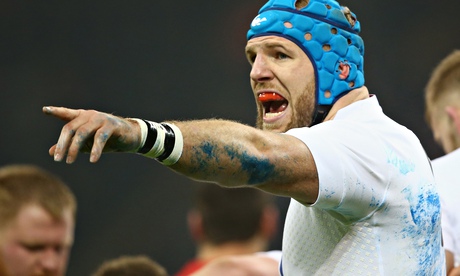
Nick Easter, at 36 years of age, came on for a little galloping cameo, and the other veteran of World Cups past, James Haskell, recovered from his miss on Taulupe Faletau to be the most conspicuous player on the field. If he was not choking the life – or at least the ability to recycle the ball – out of an opposing runner, he was on the hoof himself, heading for the posts. Such was his exuberance that he tried to persuade Jérôme Garcès that he had touched down against the base of the upright. The noble Haskell was telling a little fib, his “touchdown” landing about three foot above sea level.
Whatever the downright strangeness of the atmosphere in the England camp in 2011 – and Haskell and Easter had to absorb some flak for their part in its making – it would appear that Stuart Lancaster has changed it for a wholesome desire to be part of a special World Cup this time round. Old lags, given an unexpected opportunity to live the dream again, can play with a singular determination.
Perhaps it is the Aviva Premiership that breeds them this way. Perhaps the intensity of the Wales camp – there is little sign of the fire in the eye of Shaun Edwards cooling – can no longer overcome the inadequacies of the Pro12. On the other hand, none of the players who left Wales to play in the supposedly superior Top 14 of France has improved. The Racing Métro stable of Jamie Roberts, Dan Lydiate (now back at Ospreys) and Mike Phillips are making less of an impact now than they first did as employees in Wales. Jonathan Davies of Clermont Auvergne looks the most adversely affected of them all.
Only Luke Charteris, also of Racing, added a little late vim off the bench. There is a serious case to be made for upgrading the largest player in the squad – but also one of the smartest – to the starting team to face Scotland away, the exception that proves the rule that France may not be all it is cracked up to be.
How did it go so horribly wrong up for Wales? Perhaps the leak from the gym that they had been pumping weights by the megaton had some truth. Did they leave their second-half strength back at the bench press? In the first half, the game went well, Biggar ending it with a drop goal. It concluded another striking all-round contribution from the outside-half, 40 minutes of whole-hearted and clear-headed generalship. His half-back partner, Rhys Webb, had scored his try – after a prodigious effort by Faletau to turn retreat at a scrum into a try-making advance – and the hope that this 8-9-10 axis might be the navigation system to steer Wales into the next stage of their golden age under Warren Gatland seemed to have foundation.
But after the break, the strength vanished. Not so long ago Wales kicked in desperation to defend a tight margin in the last few minutes; here they put boot to what little ball they could win from the very start of the second half.
Perhaps in Biggar’s case there was a delayed reaction from his clash with the particularly heavy-plated cranium of Gethin Jenkins – a knock-on effect rather than a simple knockout blow – to explain his lack of influence. Perhaps it was just the timeless, unbending law: that damage caused by pressure up front is magnified the further the ball is shipped by hand away from the initial point of pain.
Presumably Wales will be selling themselves the weights line. Pump for the World Cup, the only thing that matters (there are three away games in what remains of this blasted Six Nations, this disturbance to the long-term planning).
Or do they regroup, just as they did in 2013 after defeat to Ireland at home in round one? Where to turn; what to do? Problems, problems. And England? Purr about Joseph and Attwood and Haskell and Easter and everyone else. And think big. The whole year opens up, full of wonderful possibilities.