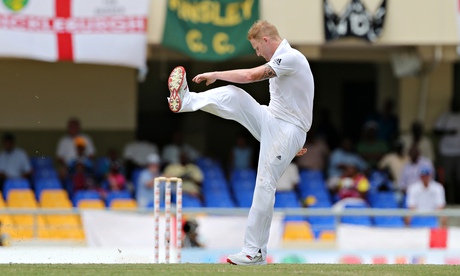
One can never hypothesise, in a Sliding Doors kind of way, what might have happened if a bowler had not been deprived of a wicket by sending down a no-ball but in the most simplistic analysis the two such that Ben Stokes has bowled in his brief career have been costly.
Around 17 months ago in Adelaide, when he was making his debut and before he had a Test wicket, Stokes induced an edge from Brad Haddin, who had 51 at the time, and after the no-ball was revealed by the third umpire’s obligatory check, the batsman went on to 118. Then last Tuesday, in Antigua, when he had made 21, Jermaine Blackwood edged Stokes to Alastair Cook at slip, the bowler was shown to have overstepped once more and the batsman made an unbeaten 112. So twice in five matches he and England have been frustrated by his straining an extra couple of inches that in reality make so little difference (would he have found the edge if a fraction further back?) as to be discounted.
This second occasion apparently stirred up the Twittersphere, and Stokes, unwisely, seemed to react by implying that overstepping the crease was the inevitable collateral damage of trying hard and straining for pace. What it is, actually, is unprofessional in the same way that a batsman running short might be.
At the other end of the spectrum it seemed that Jimmy Anderson, who has as rhythmically athletic a run as any in his time, always seems to land perfectly, the crease running beneath the arch of his foot. In fact a check revealed that the last time Anderson was called was, as it happens, in Stokes’ first game and further investigation shows that since then, and including that match, England bowlers have been called 27 times in 12 matches, of which Stokes, in those five games, has contributed 15, two of them detrimental. So in those terms he has a relative problem.
Here, though, the umpires are not helping. When Stokes found the edge of Haddin’s bat, he was already into his 11th over, and an estimate from the television coverage suggested that he had already delivered perhaps a dozen that were not called by Marais Erasmus. So while not trying to excuse the transgression, it is patently unfair to let a bowler believe he is bowling legitimately and then penalise him for doing precisely the same thing when a wicket falls. Some of this reticence to call no-balls may come from the distance back officials now stand, perhaps 12 feet or more (presumably an ICC imperative for some reason) which, allowing for parallax, means they would have trouble seeing anything marginal.
The evidence, too, is that where an umpire would once have a quiet word to the bowler (“you’re pushing it a bit, best come back or I’m coming up to the stumps”) they say nothing now, which is zero tolerance and turning a blind eye at the same time. Why the third umpire cannot contribute to policing this is unclear and indeed the non-striker should be keeping an eye on it too.
All this may in some way be yet another consequence of the decision review system, with the number of no-balls registered having fallen dramatically since its inception. So, for example, there are 34 instances of 30 or more no-balls being bowled in an innings, and not one has been since DRS was first trialled in 2008. It is the same for total no-balls in a match, the record for which one must go back to Bridgetown in 1977, when West Indies and Pakistan shared 103, which, in those days, was the best part of a session in extra deliveries. England played at home against West Indies in 1995 and bowled 21 in the six-Test series. West Indies, who never seemed to pay much heed to the line back then (this was Curtly Ambrose, Courtney Walsh, Ian Bishop and Kenny Benjamin) racked up a startling 139. Would this astounding number of extras have accrued these days? The evidence suggests not, unless the no-balls were extreme or took a wicket.
The England bowlers had the day off in Grenada after their exertions on the flat-top in Antigua, so there was no chance for Stokes to work on this problem, as work he must. But a run-up is not as simple as just noting what works in practice and measuring it precisely. A conversation not long since with an England bowler revealed that he said he knew the length of his run to the centimetre and measured it out religiously with a tape. This is just flawed thinking except as a base point around which to work.
To give two extremes: a run down the hill from the Kirkstall Lane End with a following breeze will be different from into a gale at the Basin Reserve. Stokes, at the time of his latest no-ball, was bowling with the stiff cross-breeze slightly ‘hurting’ as a golfer might say. Such things do have an effect and in the end it really does come down to feel and rhythm. The cameras watched closely and he did not transgress again, despite the effort he put in and desire to bowl faster. He will learn.