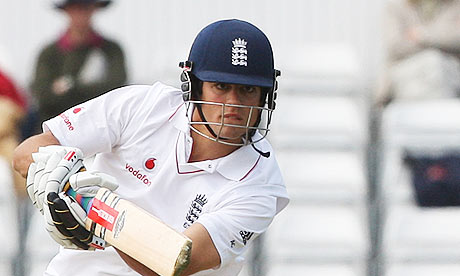
Without even a hint of debate or uncertainty, English cricket is heading inexorably towards an Alastair Cook captaincy. With every week that passes, the assumption grows that he will lead England in Bangladesh next spring. Nobody has thought to inquire whether this is actually a very good idea.
Now regarded as a "leader in-waiting", he was asked about the captaincy again after a coaching session at Lord's this week. "Hypothetically, if it was the case, I'd love to give the captaincy a go but it's not my only goal in cricket," he said, listing experience at Bedford School, Essex age-group sides and their Seconds, as well as a brief fill-in role for the county before a burgeoning England career put an end to any county captaincy ambitions. He assures us: "I like being at the forefront of making decisions – always have done."
Cook is unfailingly polite and, merely out of respect to Andrew Strauss, can hardly start a campaign for a stand-in role that is not officially available yet. But if he gets it, I wonder how much the desire burns within him. It would all seem too automatic, an honour that he has never had to fight for.
England have been blessed with three excellent captains in the past decade. Nasser Hussain was feisty, impatient, demanding. Michael Vaughan, shrewd and self-possessed, inherited a more capable side and taught England to relax and back their ability. Then came Strauss, appointed later than he should have been, and a diplomat for troubled times.
Cook's qualities, outside the dressing room at least, remain a mystery. He might be vice-captain in name but it is Paul Collingwood, as senior pro and Twenty20 captain, who the media, subconsciously perhaps, assumes fulfils that role.
Elsewhere, alternatives are hard to find. Ian Bell is shrewder than the world would have it and Stuart Broad is not short of trenchant opinions and strong ambitions that should hold him in good stead, but that is about that.
What drives Cook, nobody outside his closest circle really knows. His cricket columns, despite the best efforts of his ghosts, have been as bland as any in this dubious genre, and the imminent release of his (first) autobiography is unlikely to deliver much more. After 48 Tests, as far as the public is concerned, his captaincy CV remains a blank page.
That Strauss should be given a break from an exhausting international schedule should be readily accepted. The ECB has gradually slipped the idea into the public domain over the past couple of months, to test the reaction, and discovered that the belief that England play too much cricket is now so universal that the idea of giving Strauss a break has so far been accepted without a murmur.
In fact, don't stop at Strauss. For the Test series at least, consider Jimmy Anderson, Collingwood, even Broad. Bangladesh can be a demanding tour but if England are serious about becoming the No1 Test team in the world then they should not be fretting about coping without three or four of their top players.
But a Cook captaincy? That is another matter altogether. Maybe I am missing something – a shrewd tactical contribution from the gully, a tendency for stirring dressing room speeches, or a deep and meaningful appreciation of the game and its place in English history, but the thought of Cook as England captain so far leaves me cold.
In any case, it is illogical. England's chief selector, Geoff Miller, is uncomfortable with split captaincy and Cook is not in England's one-day side. That would lead to Strauss having to play in the one-day series or to Cook being picked just so he can captain, amid predictable comments about how England wish to take the opportunity to see if he can play a more expansive game.
There is one convincing reason to give Cook the England captaincy – to search for hidden depths, to try to stir him into a response. He seems the same player, and the same person, that he did when he made his England Test debut at 21 around 3½ years ago. He made a hundred on debut in Nagpur and scored so prolifically that he became the fastest England player to 2,000 Test runs, but a moderate Ashes series last summer suggested that, as bowlers have worked him out, he has struggled to hold such high ground.
The England captaincy, if it comes, would seem disturbingly pre-ordained. It may or may not be the making of him; it should be the testing of him. It needs to be earned.