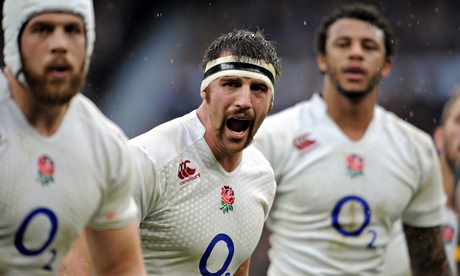
Crisis? What Crisis? The former prime minister James Callaghan has been attributed with the words after landing in London having attended a summit meeting in Guadeloupe at the beginning of 1979 and being asked for his views on the state of Britain in the face of mounting industrial unrest, rubbish piling up in the streets and all that.
The suggestion of a crisis was put to the England head coach Stuart Lancaster this week after defeats in successive weeks to New Zealand and South Africa that saw his side drop to fifth in the world rankings (they will climb to fourth at the weekend if they defeat Samoa with the two teams immediately above them, Ireland and Australia, facing each other in Dublin).
When the C word was put to Callaghan all those years ago, his response was: “I promise if you look at it from the outside, I don’t think other people in the world would share the view that there is mounting chaos”. Lancaster’s response was similar. “I do not subscribe to the fact that because we lost on Saturday, there is suddenly a big problem looming.”
On the surface, three-point defeats to the top two teams in the world rankings, matches in which England led at half-time in the first and were level in the third quarter in the second, should not be fuel for panic. They have not beaten South Africa since 2006 and they have defeated New Zealand once since 2003. The scorelines were not unexceptional, glossed by very late England tries in both matches.
England are competitive and resilient, as they should be given the players they can draw on the time they spend together in a hi-tech training environment, but are they any closer to New Zealand and South Africa than they were when Lancaster took over following the 2011 World Cup?
In many aspects of forward play, the answer tilts towards yes. Despite the absence of the likes of Alex Corbisiero, Dan Cole, Joe Launchbury, Geoff Parling and Tom Croft, England have been strong in the set-pieces and they were especially effective at the breakdown against the All Blacks, for the most part.
They have over the years been strong when it comes to organisation. The one time they were in the ascendant against South Africa was when they achieved position through penalties, and a botched call by the touch judge, and turned line-outs into tries by keeping the ball among the forwards. When the New Zealand hooker Keven Mealamu talked this week about touring Europe, he said that no matter who the All Blacks played, they knew they would be tested physically.
But not mentally, unless the mood takes France, which it has rarely done recently. When it comes to using possession, rather than winning it, England are no closer to the southern hemisphere’s best than they were a few years ago. Their attacking strategy behind has come under scrutiny this month, but they do not have the ball-handlers in the tight five that New Zealand, and Australia, possess.
Lancaster talked this week about how he would define a crisis: a team that had no belief in what it was doing, had no sense of direction, had a group of players that was not aligned with what the coaches were trying to do and not agreeing with where they were going and had a poor discipline on and off the field. “At the moment, I do not see any traits in this team,” he said.
An hour after the match against South Africa, the flanker Tom Wood ruminated on the defeat. He lamented a “meandering in midfield” and a lack of the “clarity and direction we needed.” He wondered why England did not put the ball into the corners and put pressure on South Africa deep in their own half. “We got a bit lost in midfield which was frustrating because it was our downfall the previous week as well.”
Before the start of the 2012 autumn series Mike Catt, who had been appointed attack coach, talked about where he saw England being by the time the 2015 World Cup started. He had been on that summer’s tour to South Africa in a temporary capacity, but as Lancaster looked to turn a side that had proved difficult to beat into one that took a game to opponents, it made sense to keep on someone who as a player was known for his quick thinking and rugby intelligence.
“It is about seeing the game and what is happening in it, living in the moment and players being able to adapt to what is in front of them,” said Catt. “The keywords are pace, tempo and variety; we have to get on the front foot and have accuracy in everything from rucking to distribution. The reason New Zealand are so good is that they are accurate. We have the players to move on our attacking game. What we as coaches have to ensure that the players understand the game and that we play to their strengths. The key to success in international rugby is having guys with the X factor and this group has the ability to emulate what England achieved in 2003.”
He later referred to how the scrum-halves Danny Care and Ben Youngs were both on top of their game, but last season the latter was behind Lee Dickson and did not feature at all in the Six Nations while the former was this week released back to his club with Richard Wigglesworth promoted to join Youngs in the 23 for the match against Samoa on Saturday.
At outside-half, Owen Farrell is set to be shifted to inside-centre, where he started his international career in 2012, to accommodate George Ford, who will be starting his first Test. Freddie Burns and Danny Cipriani, who featured on the New Zealand tour, are nowhere. With such vacillation, is it surprising that England are meandering behind?
The recall of Wigglesworth, even if he only makes the bench, would suggest a return to more of a territory game given his box-kicking ability. That strategy would be more of an alignment, to use Lancaster’s word, between forwards and backs. Wood was clearly frustrated that England played from deep against South Africa and New Zealand rather than setting up camp in opposition territory, but that decision should have been made on the field once none of England’s midfield put little kicks on the floor behind the rushing defence.
Whatever was said in the dressing room at half-time in each game went unheard because England conceded a try quickly after the start of the second period. While in the 2003 World Cup senior England players could stand up, question the coaches and change the way the team prepared and played, the current squad is not at that point.
It s likely to be back to basics this week and next while the book on attacking play is rewritten. As long as England put defensive ability far above what Lancaster calls points of difference, the reason why Brad Barritt has been chosen at 13 and why finishers like Christian Wade and Chris Ashton are not in the squad, it will have to be that way. Reality, not a dream.
• This is an extract taken from the Breakdown, the Guardian’s weekly rugby union email. To subscribe, click here.