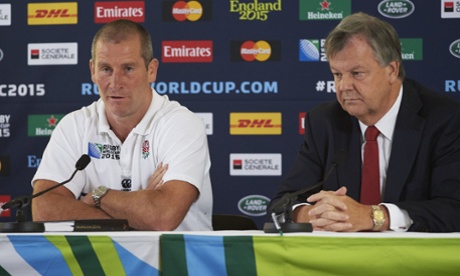
So the sun came up regardless. It lit up Pennyhill Park, the plush country hotel where England have made their headquarters and the site, this Sunday morning, of their desperately bleak morning-after press conference. It was held in a white marquee in a car park.
Stuart Lancaster arrived at 10am, the bags under his eyes betraying his sleepless night and his state of mind. He had already been up a while, watching a recording of the game. Alongside him was Ian Ritchie, the chief executive of the Rugby Football Union, perfectly fluent in management-gabble.
Two confused and apologetic men at a trestle table in a drafty old tent, fronting up to the depressed English press. Everyone exhausted. Outside, all quiet. A few players out strolling around the grounds, stewing. “It’s going to sit with us all forever,” Lancaster said, a line likely to be picked out in Monday’s headlines, “players, coaches and management.” One thing no one need question is how bad the coach is feeling. It was written right across his face.
A few miles east, away in London, the World Cup was rolling on into its 17th day. The Australian players were probably in the swimming pool doing recovery work. Their fans, those able to get up that early, were stumbling around the city, trying to thread their way through the crowds to do a little sightseeing.
Ritchie had the good sense to say that, as the host nation, England have a responsibility not to let the fallout from their own poor performances overshadow everything else that happens. “Part and parcel of being hosts for the tournament”, he called it. “The event, despite our not progressing, is in a good place.”
So it is. The competition is only just coming to the boil, and England fans should find themselves a second team to support.
In truth, the England team and the RFU will probably be glad to have the distraction. It is going to take a long time to tidy up the mess they made, and right now they are still in shock. “We need to be clear this is not a time for knee-jerk reaction,” Ritchie said. “It is not a time to rush into things. It’s a time for calm, rational reflection about what we can learn and how we can move forward. What do we need to do to improve? We will only do that in a calm, considered and rational manner.”
Lancaster will also need time to think. He was lost for an explanation. When pressed, his talk turned, again, to just how inexperienced his team was.
“Ultimately, a lot of it comes down to players maturing, developing and getting more experience. We’ve always tried to develop the team from 2011 to get it ready for 2015 but ultimately that’s not happened,” he said. “Australia had 750 caps in their starting team and we had 450. We can go through the whys and wherefores of that, but we would have to go back to 2011 and the fact that we had so many other players over 30 in that squad.”
Trouble being, of course, that regardless of what happened in 2011, it was his job to get the team ready for this tournament. If experience was at a premium, the decision to drop two regular players, Luther Burrell and Billy Twelvetrees, for men who only made their debuts in the month before the tournament started, Henry Slade and Sam Burgess, becomes all the more baffling.
This is just one of the many inconsistencies in England’s thinking. Another little one would be the selection of Nick Easter, singled-out, scapegoated, after the 2011 World Cup as the personification of what had gone wrong with the culture of the team after he was allegedly overheard saying “that’s £35,000 down the toilet” when England were knocked out. So he was dropped for four years. Only to be summoned back into the team last February, then called up into the World Cup squad as a late replacement and, ultimately, thrown into the game against Australia with 20 minutes to play.
Easter is 37. When a player is that age, you would hope a coach would have a pretty clear idea about whether he wants him in his team or not. Seems Lancaster just wasn’t quite sure.
Easter’s selection didn’t swing anything. But his situation seems to cut to the heart of the matter, in that it summed up the clash between the pressing need to pick a team that can win the next match, and England’s desire to overhaul their entire rugby culture, to create a side that might thrive in the future. Lancaster has never managed to balance the two.
“We’ve looked back at decision making and the process of selection and how we’ve prepared for the tournament, the trip to Denver, all the logistics and planning and I compare that to 2011 and I see a very strong structure that has been put in place,” he said. “I see good players who have been well developed by good coaches in a good environment.”
And then, in the very next breath: “We lost two games but they were crucial games and ultimately that let us down.” It was, he admitted, “what we’ll be judged on and I understand that‚” but at the same time, “the rest of it, I think, is in good shape, personally.”