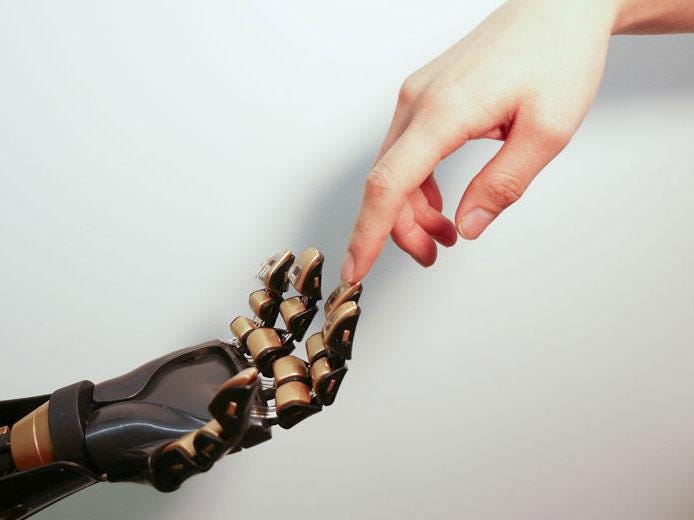
Engineers have created an artificial skin that can tell how hard it is being pressed and send that information straight into the brain.
The researchers hope that the creation of the new sensor could be another step towards creating an entire virtual skin — a flexible fabric full of sensors that could be put over a prosthetic limb, making it work something real skin.
"This is the first time a flexible, skin-like material has been able to detect pressure and also transmit a signal to a component of the nervous system," said Zhenan Bao, a professor of chemical engineering at Stanford, in a statement.
Bao has spent the last decade attempting to make a material that matches the characteristics of skin. Our bodies have the ability to flex freely, heal, and can send very fine information about what they touch to the brain — all qualities that have proved difficult to replicate in artificial ways.
The new sensing skin is made up of two layers: a sensing mechanism on top, and a bottom layer that sends the electric signals that are generated to the brain, in a way that it can understand them. It is maed up of “waffled nanotubes”, which are a series of tiny structures that get pushed together when pressure is applied, allowing more electricity to be conducted.
At the moment, pressure is all that the skin can sense — and there are six different sensing mechanisms in the hand. The engineers behind it hope that they can develop others that will allow the artificial skin to feel texture and differentiate between different materials, for instance, or detect temperature.
Because of the two-layer approach, engineers say that they will be able to add more sensing capabilities as they develop them.
"We have a lot of work to take this from experimental to practical applications," Bao said in a statement. "But after spending many years in this work, I now see a clear path where we can take our artificial skin."
The research is published in Science this month, under the title ‘A skin-inspired organic digital mechanoreceptor’.