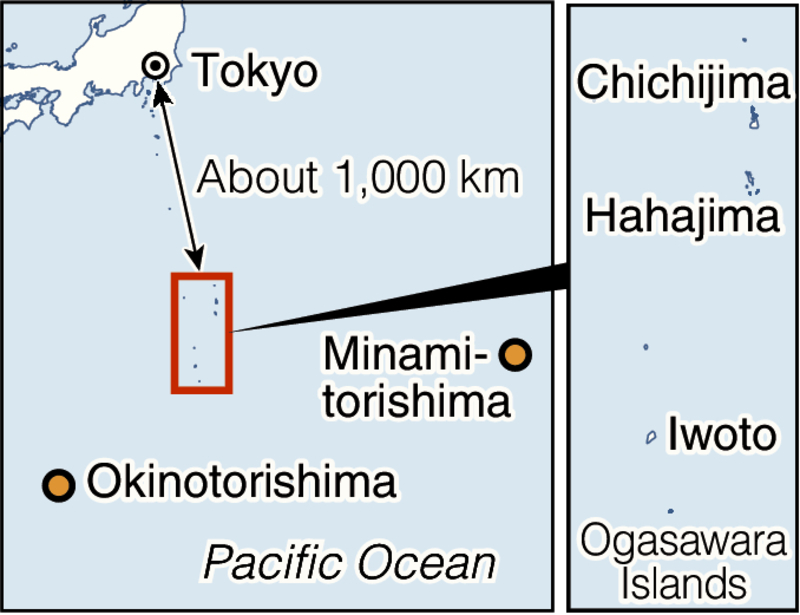
June 26th marked the 50th anniversary of the day the Ogasawara Islands (see below), approximately 1,000 kilometers south of central Tokyo, were returned to Japan by the United States. The roughly 30 islands dotting the Pacific Ocean have developed their own unique nature and culture, even as they were torn between Japan and the United States. We would like to convey the journey of the islands' residents over the past half-century and their thoughts for the future. This is the first installment of a series.
A tombstone inscribed with a white cross and the name HERBERT WASHINGTON stands in a graveyard on a hill in Chichijima. "This is my grandfather's grave," said Reo Ohira, 33.
Ohira never met his grandfather, who died at age 50 in 1972. But he wants to record the island's history, tracing the paths forged by his grandfather and other islanders of Western descent. In addition to working as a teacher at a nursery, he is also producing a documentary with his friends.
According to the village of Ogasawara, Tokyo, there are records showing that the islands were discovered by a Spanish ship in 1543. The warlord Ogasawara Sadayori, for whom the islands were named, landed in 1593. In 1830, the islands were settled by five Westerners and about 20 Hawaiians, and became a thriving whaling base.
The islands formally became Japanese territory in 1876, and Japanese settlement increased. However, with the start of the Pacific War, many of the islands' approximately 7,700 inhabitants were forcibly evacuated to mainland Japan.
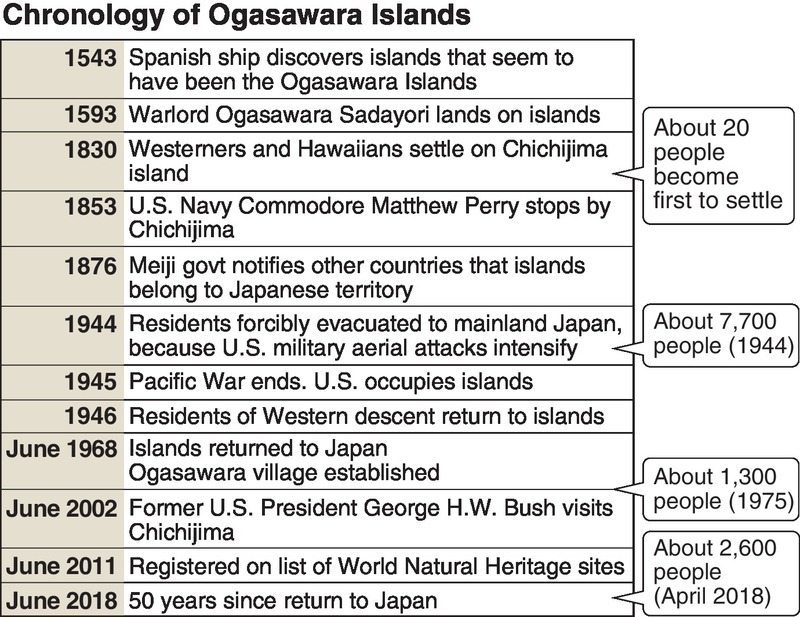
According to the village, George H.W. Bush, the 41st president of the United States, shared his recollections when he visited Chichijima island in 2002, saying that his bomber was hit by anti-aircraft fire and went down in the ocean near Chichijima. Bush, then a pilot for the U.S. Navy, was shot down near Chichijima in September 1944 and was rescued by a submarine. His two crewmates were never found.
Around five months later, Japan and the United States clashed at Iwojima (now Iwoto) about 300 kilometers away. The battle lasted roughly a month and claimed the lives of over 20,000 Japanese and approximately 6,800 U.S. soldiers.
After the war, the Ogasawara Islands were occupied by the United States, and eventually returned to Japan in June 1968, over 20 years later. After meeting the residents of Chichijima, Bush said that he was really moved by the fact that the people of Ogasawara had more than just Japanese traditions, and that there were people with American ancestry as well.
Hideo Morishita, 66, who runs a diving company in Chichijima, lost his uncle at Iwojima. But he said that when he saw Bush throw flowers into the sea to pay his respects: "He looked like he was removing a thorn from his heart. I could feel that the age of Japan and the United States' quarrels was over."
Although the islands have been at the mercy of history, they have attracted many young people who see them as a paradise steeped in rich natural beauty and unique culture, and the population has risen by about 10 percent in the past decade. About 100 of the villagers are known to have Western ancestry.
Ohira's filmmaking group calls themselves the "News Bonin Time." "Bonin," likely a corruption of the word that means "uninhabited" in Japanese, is another name for Ogasawara. The group is conducting interviews with island elders to edit into a 45-minute video, which they plan to screen in September.
Ohira said: "There's an atmosphere here that you can't find anywhere else, born out of Japanese and Western cultures mixing on islands which hadn't been inhabited before. I want to take the 50th anniversary of the return as a chance to look back at our history."
-- Ogasawara Islands
A group of islands that make up the village of Ogasawara, Tokyo, including Okinotorishima (the southernmost point in Japan) and Minamitorishima (the easternmost). The village has a population of approximately 2,600, who live on Chichijima and Hahajima. The islands hold 30 percent of the total area of Japan's exclusive economic zones, and future development is expected to yield fishing and ocean floor resources. The islands were registered on the list of World Natural Heritage sites in 2011. With no civilian airport, the islands are linked to the Japanese mainland by a regular ocean liner route that takes 24 hours each way.
Read more from The Japan News at https://japannews.yomiuri.co.jp/