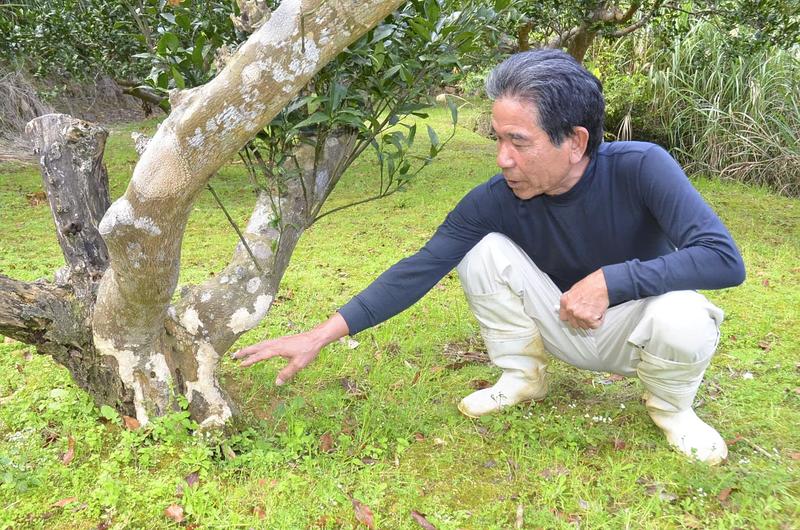
KAGOSHIMA -- Amami-Oshima Island and Tokunoshima Island in Kagoshima Prefecture, both nominated as World Natural Heritage sites, have been hit hard by the Amami rabbit, Pentalagus furnessi, a special natural treasure of Japan, which has been nibbling at trees that grow citrus "Tankan oranges."
Farmers and local governments have been tormented by the unexpected formidable foes since it is in principle prohibited to capture them without permission, and the ecology of this species is largely unknown.
Koji Takayama, associate professor of the Faculty of Agriculture at Kagoshima University, obtained footage of Amami rabbits.
He installed a camera in the Boma area in the town of Tokunoshima and captured images that included a rabbit that stood up on its back legs in a field, clinging to a young tree and breaking its branches. In some instances, two rabbits appeared simultaneously in the footage.
The owner of this field, Katsuo Yoshimoto, 66, was perplexed.
"The damage started about three years ago. Some young trees have died off," he said.
Even after protective fences were set up, rabbits were believed to have hopped over or passed through openings in the barrier and caused damage to 30-40 trees up to now.
Takayama said rabbits like to gnaw on items that are firm, but he doesn't know why Tankan trees are targeted so much.
Amami rabbits have been attacked by non-indigenous mongooses so that they have often been portrayed as "victims."
According to the prefectural government, however, damage to Tankan trees has been documented in the town of Tokunoshima, and the village of Yamato in Amami-Oshima Island since about 2017. The damage increased from an area of 1.1 hectares in fiscal 2017 to 2.2 hectares in fiscal 2018.
In the village of Yamato, hundreds of saplings are said to have almost annihilated.
"I never thought that [an animal designated as] a natural treasure would cause crop damage. I don't know the details of their habits, and we haven't been able to find any effective measures against them," said Shimpei Fukumoto, deputy chief of the village industry promotion division.
According to the Environment Ministry, the Amami rabbit population was estimated to be 2,000-4,800 in Amami-Oshima Island and about 200 in Tokunoshima Island in 2003. It has been on the rise since that time.
It is believed that projects to control mongooses have been successful and because of this, the Amami rabbit population has been growing.
Since May 2018, the prefectural government has held occasionally task force conference about Amami rabbit with local governments and Kagoshima University. The prefectural government also set up fences and conduct on-site inspections.
To be registered as a World Natural Heritage site, it is essential to protect rare animals such as the Amami rabbit.
"The Amami rabbit is the property of the island. We have no choice but to figure out -- as quickly as possible -- ways to coexist and prosper," an official of the prefectural government's Oshima branch said.
Read more from The Japan News at https://japannews.yomiuri.co.jp/