With the phase-out beginning this month of feed-in tariffs (FIT, see CLIP) -- in which power utilities buy back excess electricity generated by residential solar panels -- businesses are beginning to roll out new home storage batteries and buy-back services.
Various companies are marketing products and services to households looking for ways to use the electricity they generate or sell it to new customers.
Cheap, long-lasting
According to the Natural Resources and Energy Agency, about 530,000 households will "graduate" from FIT this year. About 1.65 million households will do so by 2023.
These households can continue to sell their electricity to power companies. However, while the buy-back price per kilowatt-hour for households that entered the program in 2009 was 48, yen TEPCO Energy Partner Inc.'s standard plan offers a buy-back price of only 8.5 yen.
As buy-back prices decline, consumers will apparently have greater opportunities to stop selling to power companies, and instead install storage batteries so they can use the power at home or search for buyers willing to offer higher prices.
30% cut
Electronics manufacturers are increasing their lineups of household storage batteries.
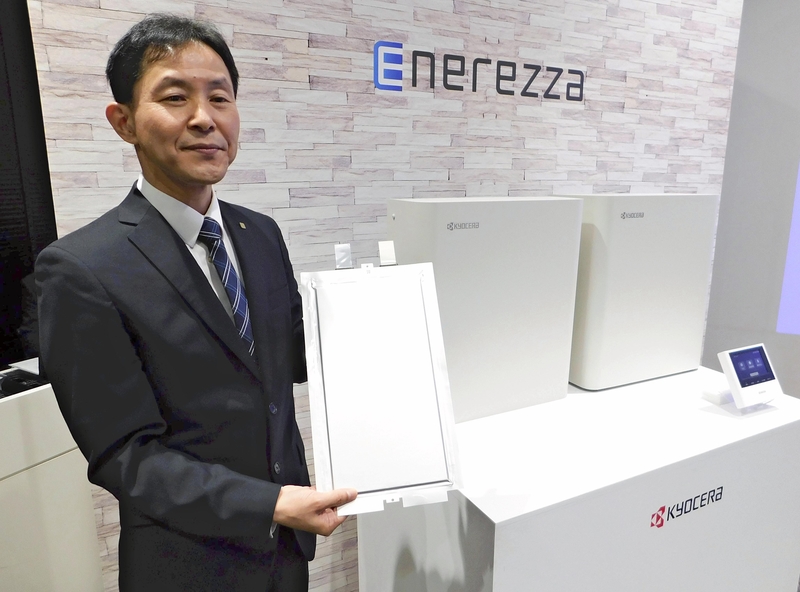
Kyocera Corp. is planning to release in January a storage battery the company developed jointly with a U.S. firm. Although retailers can price the units as they see fit, Kyocera said its proprietary technology helped reduce production costs by 30 percent.
"We're aiming for about 10 percent of the market," the deputy chief of the company's solar energy business unit said at a press conference in October.
Panasonic Corp. began accepting orders in October for small storage batteries that can be expanded later depending on family structure and living space. In June, Omron Corp. introduced a storage battery the company says will maintain at least 70 percent of its capacity even after 15 years of repeated use.
Market prices for storage batteries are in the 2 million yen to 3 million yen range, though Tesla Inc., a major U.S. manufacturer of electric vehicles, plans to release one that will cost about 1 million yen next spring.
Annual shipments of storage batteries are expected to increase from about 70,000 units in fiscal 2018 to 158,000 units in fiscal 2022, according to research firm Seed Planning Inc.
Point offers
Some companies are trying to market their products and services by offering higher buy-back prices and other sweeteners.
NTT Smile Energy, in collaboration with Panasonic, plans to offer up to 16 yen per kilowatt-hour. This would apply to households that purchase Panasonic storage batteries or other products.
Aeon Co. and Shikoku Electric Power Com. plan to launch a service that will grant WAON points, Aeon's form of electronic money, for power sold to the utility.
Competition like this over the surplus electricity produced by households is expected to heat up going forward.
However, many households will likely balk at buying high-priced storage batteries. An executive of a major electronics company said that inquiries from consumers remained sluggish even into the beginning of November.
The question seems to be whether consumers will feel they can benefit from these new storage batteries and services.
CLIP: Feed-in tariff (FIT)
A system in which power companies purchase electricity generated by renewable energy sources such as solar and wind at government-determined prices. The predecessor to the current program was the surplus power buy-back system launched in November 2009. The program lasted 10 years and will begin winding down this month, a process that has been dubbed "FIT graduation."
Read more from The Japan News at https://japannews.yomiuri.co.jp/