The Bon holiday may provide families with a good chance to discuss plans for the end of life, including their preferences as to tombs and funeral services. Even elderly people can use smartphones very well in everyday life these days, and as coronavirus infections spread, information technology has attracted attention. To find out more, The Yomiuri Shimbun visited places where IT is being utilized to help in end-of-life planning.
"This is a chamber in which an individual cinerary urn can be placed while contained in a plain wooden box. Can you see the back of the chamber?"
This explanation was heard from a smartphone, on the screen of which a charnal house featuring colorful autumn leaves was seen.
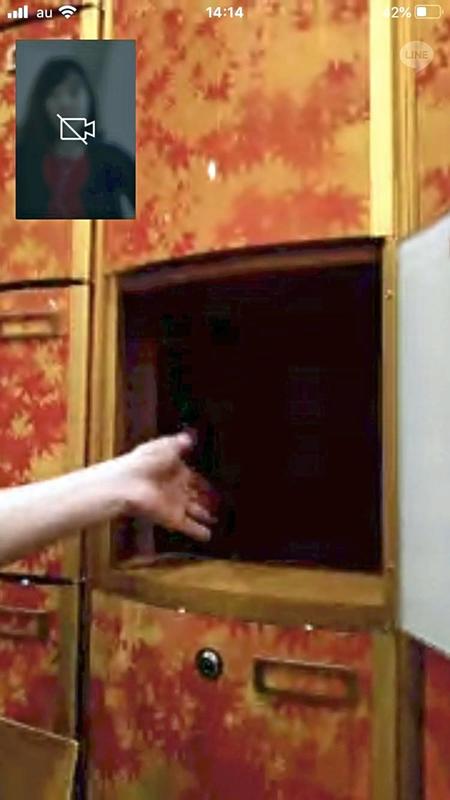
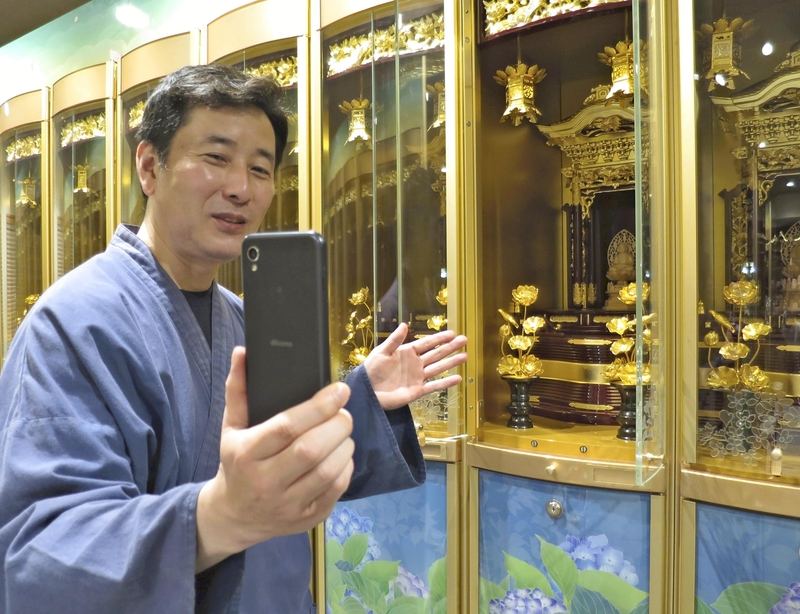
This is an online viewing service that was started at the end of April by Aoyama Reibyo, the charnel house of Jissouji temple in Minato Ward, Tokyo. Takatomo Iwata, a staff member of the temple's charnel house management office, gives tours via video call with the free LINE app.
The charnel house was built nine years ago when the temple was repaired. It houses about 600 spaces for cinerary urns that can be used by individuals, married couples and family members. The price for a partitioned vault ranges from 240,000 yen to 6 million yen, depending on the size and the duration of storage.
Since the charnel vaults are not cheap, on-site viewing is indispensable. But given the fact that an increasing number of people have voluntarily refrained from going out amid the pandemic, the temple began providing online viewings. Iwata said he got the idea when he saw a visitor explaining about a chamber via smartphone. Iwata quoted the visitor as saying, "I want to show it to my mother back home in the countryside."
The writer of this story actually experienced the on-site viewing, and found the ambience and size of the charnel house could be conveyed more vividly than imagined. The online tour included hearing about the history of the temple and the background behind the charnel house being built. Greetings could even be exchanged with the temple's chief priest via the smartphone screen. "I hope that the service will provide clients with the opportunity to see various types of charnel chambers," Iwata said.
The website e-ohaka.com operated by Kamakura Shinsho, Ltd. introduces cemeteries and charnel houses that can be viewed online. Mieko Kaji, a housewife from Chiyoda Ward, Tokyo, took an online video tour of a charnel house with many vaults inside a building in which each person's ashes are stored individually. "It felt like visiting an actual tomb," she said.
The tomb of the grandfather of Kaji's husband is located in Tokushima Prefecture so she is consulting with her family on a plan to transfer his ashes to a graveyard in Tokyo. The ambience of the neighborhood a cemetery is in cannot be grasped without visiting, she said, before adding, "We'll make a final decision after visiting graveyards in person, but the online video tour is worthwhile for investigating."
--Diversity of services
Triggered primarily by the coronavirus outbreak, online services to help with end-of-life planning have diversified.
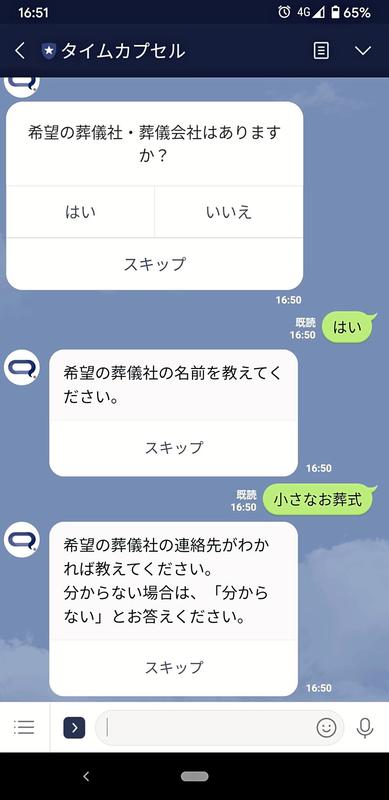
Uniquest Inc. in Osaka, which is involved in funeral-related businesses, launched the Time Capsule service in March for people to write wills with the use of LINE.
Wills can be written after answering simple questions, including whether the person wants life-prolonging treatment and how much they have in deposits and savings. The will has no legal validity but can be shared with family members and relevant people. It is also possible to make arrangements for disclosing the will posthumously. About 17,000 people, mainly those in their 40s and 50s, have registered with the service.
The service Iei Banku (Bank of photos of deceased persons), provided by Asukanet Co. in Hiroshima City, is useful for preparing photos for a funeral. Photos that a person wants used can be stored online.
It is necessary to tell family members that the photos have been deposited with the service, but it can save them the time and effort of finding photos later to use during the funeral. Messages can also be left. An Asukanet official in charge said, "It is hoped that these messages will be used as the online version of wills."
--Funerals being downscaled
Using IT in funerals and mourning services has been progressing as well. There have been more and more instances of funerals being attended only by close kin and the video being broadcast to relatives living far away.
The downscaling of funeral services had been progressing as cases of holding family-only funerals and one-day farewell services have prevailed. But the coronavirus crisis has accelerated this trend. A system has been also spread in which news of someone's death is conveyed via social media and condolence money is paid online.
Such moves could deal a blow to temples that have been forced to cancel Buddhist memorial services as part of measures to prevent virus infections.
A survey of temples conducted from April to May by the Japan Buddhist Federation, a public interest incorporated foundation, found that about 80% of 364 respondents had suffered a drop in their operating revenue compared with the same period in a usual year.
Analyzing the survey results, a federation official said: "The coronavirus crisis, which broke out when society was already seeing a trend away from religion and temples, has led to more people thinking that religious events should be further simplified and even considered unnecessary. There are many situations in which such concern cannot be eliminated."
Read more from The Japan News at https://japannews.yomiuri.co.jp/