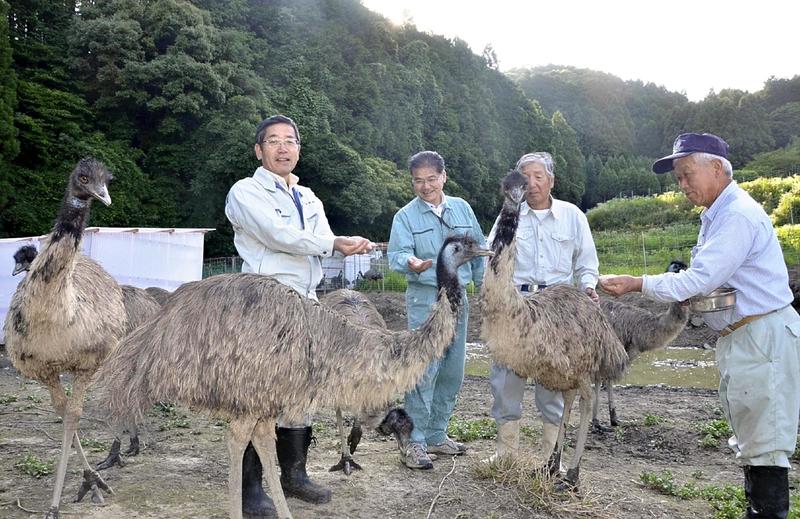
SAGA -- Old folk houses could be seen while passing through a settlement, but a more surprising sight awaited further along an agricultural road that stretched through a landscape of largely disused farmland toward a small mountain.
On one section of the land, huge ostrich-like birds were eating grass or running around. They were emus, a species native to Australia.
Much of the farmland spreading out at the foot of a mountain in Kiyama, Saga Prefecture, was choked with weeds as tall as people.
But in an enclosed space of about 2,500 square meters, where about 50 emus were kept, the brown surface of the soil was bare.
Local people say that 30 emus can eat up the weeds on about 1,000 square meters of land in about a month.
Mainly because of the aging of local farmers, abandoned farmland in the town has increased year by year, and the total has risen to about 43 hectares.
Yoshiharu Torikai, 60, who runs a construction company in the town, and others turned to emus to revive abandoned farming land.
On land where emus are kept outdoors, the birds trample the soil and make it difficult for weeds to grow. Emus' excrement also serves as a fertilizer. A member of the project said, "After six months, the land becomes arable again."
Torikai cooperated with three farmers to establish Kiyama Farm, an agricultural corporation, in July 2015. Using a subsidy from the prefectural government, the corporation purchased 25 emu chicks.
About 18 months later, the chicks had grown to adults about 1.7 meters tall and weighing about 50 kilograms. In February this year, they hatched about 100 chicks.
Takeshi Yoshida, 65, who is in charge of keeping emus, said, "Just giving them food and water is enough for them to grow up, and the birds usually don't attack, so it's easy to breed them."
On a plot of about 1,000 square meters that was revived by emus, farmers cultivated Jerusalem artichokes, a root vegetable also known as kikuimo, harvesting about one ton in 2017.
When they were sold in a parking area on the Kyushu Expressway, they sold out. Visitors appreciated them, saying they had a nice, crunchy texture. It was such a success that other farmers asked for Jerusalem artichoke seeds.
Town administrators are also assisting with the attempt to vitalize the local community using emus. In May this year, the town government opened a slaughter facility at a cost of about 30 million yen so that emu meat can be provided to restaurants.
The facility can also slaughter boars, which are culled to prevent the animals from damaging crops.
The town government plans to develop local specialty cuisines in which the meat of emus and boars is combined.
Continuing the project will be difficult unless keeping emus can be made profitable, in addition to reviving abandoned farmland. The agricultural corporation has teamed up with local companies and others to produce commercial goods using emus.
In November 2015, they began selling accessories made of emu feathers, and in June 2017, they began selling beauty lotions made with emu fat.
Kiyama Farm has attempted to develop a system to carry out all the processes -- getting emus to lay eggs, raising the birds, processing their meat, producing related goods and shipping the products -- on its own.
It also aims to sell emu chicks to companies and other entities that want to begin keeping emus as a new revenue source.
Torikai said: "It's meaningless to only revive abandoned farmland. We want to raise the added value of related products, make our business one that combines primary, secondary and tertiary industries, and contributes to the vitalization of our local community."
Cooperating for added value
Vitalizing local communities by using emus attracted attention through the efforts of Tokyo Nodai Bioindustry, a company that was established in 2004. The company was started by the Faculty of Bioindustry of the Tokyo University of Agriculture, which has a campus in Abashiri, Hokkaido.
The faculty, which has studied the ecology of emus, began breeding the birds in cooperation with local residents so that construction workers and farmers who did not have jobs during winter would be able to earn an income.
The university venture firm cooperated with local firms and others, and developed such products as emu meat, which is rich in protein but low in calories, and skin care oil that has excellent moisturizing properties.
Tetsuya Satomi, 55, secretary general of the company, said, "It's important to raise the added value of emus to vitalize the local community."
Population doubles
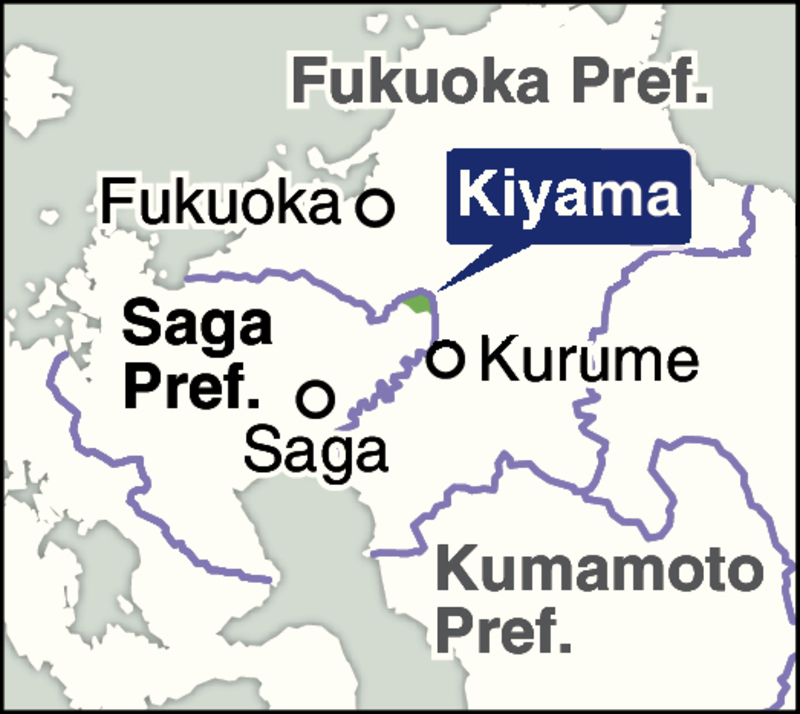
Kiyama is a town at the eastern tip of Saga Prefecture, on the border of Fukuoka Prefecture.
The Kyushu Expressway and the JR Kagoshima Line run through the eastern part of the town. The Nagasaki Expressway runs through the south, and the Kyushu Shinkansen line runs through the west.
Kiyama and neighboring Tosu thus form a key traffic intersection of Saga Prefecture.
Although the town is compact, covering only about 22.15 square kilometers, big cities such as Saga city, Fukuoka city and Kurume, Fukuoka Prefecture, are located within a 30-kilometer radius. Thus, in the 1970s to the 1990s, residential areas were developed in the town as "bedroom suburbs" of the cities.
The town's population, which numbered 9,735 in 1970, nearly doubled to 19,176 in 2000. As of the end of May this year, the population was 17,350.
Read more from The Japan News at https://japannews.yomiuri.co.jp/