The traditional boundaries between professional studios and bedroom producers have completely dissolved in 2026, largely due to the democratization of sophisticated musical technology. Many independent artists find themselves trapped in a cycle of creative blocks or limited by their technical knowledge of complex digital audio workstations. By utilizing a high-performance AI Music Generator, these creators can break through these barriers, using artificial intelligence as a collaborative partner rather than a replacement for human ingenuity. This shift is fostering a new era of experimental music, where the focus is on the "magic" of the idea rather than the "math" of the production process.
In my observation, the true potential of these tools lies in their ability to act as a "harmonic sketchpad." Instead of starting with a blank screen, a musician can now generate a dozen unique variations of a chord progression or a melody in seconds. This allows for a much faster iteration process, enabling artists to explore unconventional genres and sonic textures that they might not have considered otherwise. The result is a more diverse musical landscape where the unique perspective of the individual remains the driving force behind every composition.
Expanding The Creative Horizon With Advanced Text To Music Synthesis
Bridging The Gap Between Initial Inspiration And Professional Production
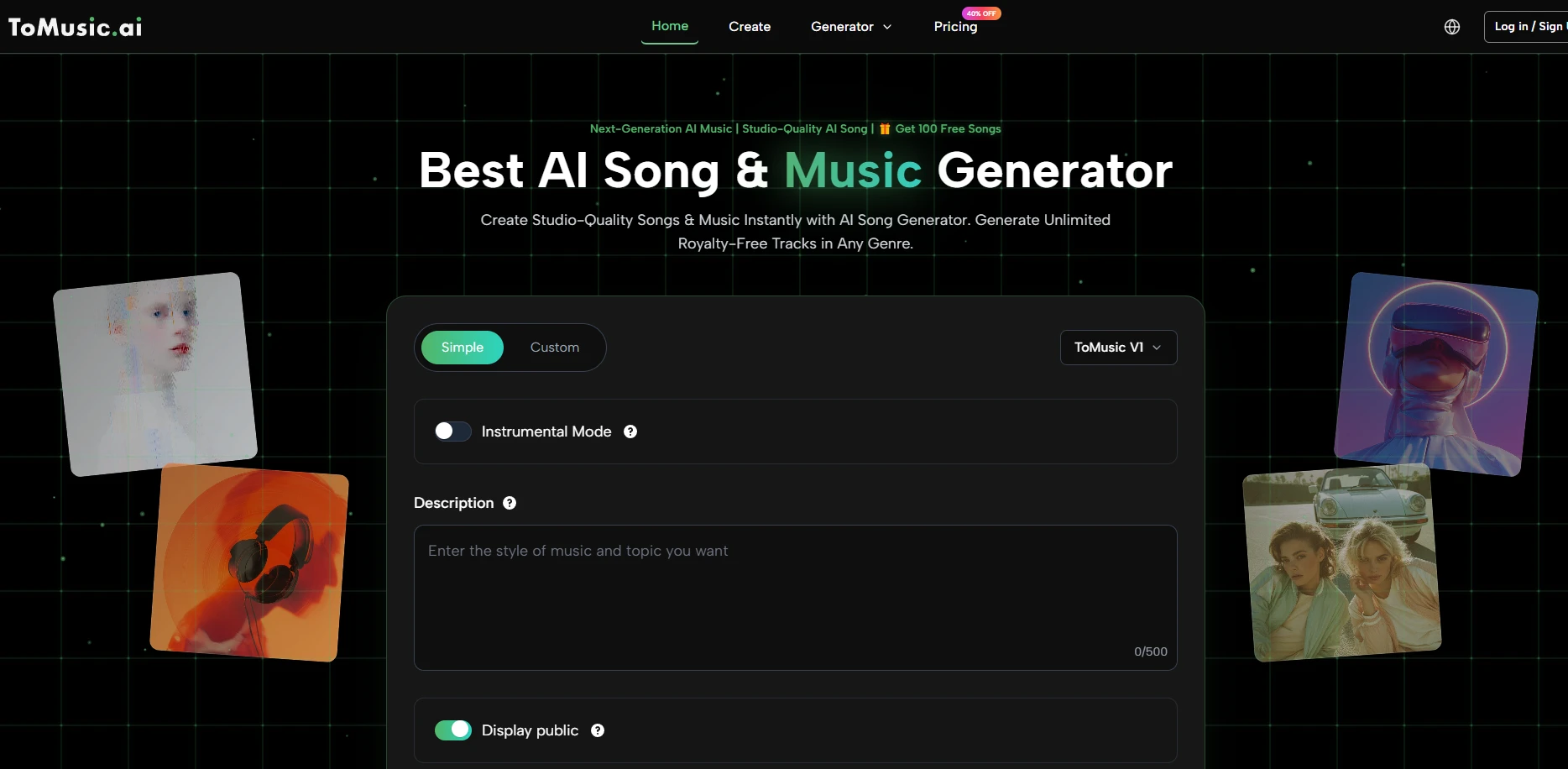
The journey from a single lyric or a fleeting melody to a finished track is often the most difficult part of the songwriting process. Platforms like tomusic.ai have streamlined this journey by providing a bridge between the abstract concept and a concrete musical structure. For an independent artist, this means they can focus on the core emotional message of their work while the AI handles the complex tasks of arrangement and instrumentation. In my testing, the ability of the system to interpret descriptive language—such as "ethereal lo-fi with a hint of 80s nostalgia"—is a game-changer for those who lack a formal background in music theory.
The official workflow on the tomusic.ai site is designed to support this collaborative spirit. First, the artist enters a text-based prompt that captures the essence of their creative vision. Second, they can experiment with different stylistic filters, adjusting the energy and mood to see how it affects the core melody. Third, the system generates a high-fidelity track that can be used as a foundation for further recording or as a finished demo. This iterative process allows for a level of experimentation that was previously impossible without a full production team.
Breaking Creative Blocks With Algorithmic Variation Tools
Every musician faces the "blank page" problem at some point. Generative tools offer a powerful solution by providing a constant stream of new ideas. By feeding a basic riff or a simple lyric into an AI system, an artist can receive a wide range of mathematically sound variations. These variations can serve as the spark for a new song or as a way to find a unique bridge for an existing composition. In my observation, this doesn't diminish the artist's role; it actually heightens it, as the artist must still curate and refine the best ideas produced by the machine.
The Rise Of Hybrid Production Models In Independent Music
The most interesting music being produced in 2026 often follows a hybrid model, where AI-generated elements are blended with live instruments and human vocals. This approach allows artists to maintain the "soul" of their performance while benefiting from the technical precision and limitless variety of generative audio. For example, a songwriter might use an AI to generate a complex drum pattern or an orchestral background, and then record their own vocals and guitar on top of it. This synergy creates a sound that is both technically perfect and emotionally resonant.
Comparative Analysis Of Generative Features For Independent Artists
|
Tool Name |
Best Creative Use |
Technical Fidelity |
User Accessibility |
|
tomusic.ai |
Rapid Ideation |
Professional |
High |
|
Suno |
Songwriting |
Radio Ready |
Simple |
|
Udio |
Studio Experimentation |
High |
Moderate |
|
AIVA |
Orchestral Drafting |
Detailed |
Technical |
|
Loudly |
Brand Building |
Modular |
Moderate |
|
Brev.ai |
Social Media Demos |
Functional |
High |
Harnessing Vocal Realism For Authentic Lyrical Expression
Suno has become an essential tool for songwriters who want to hear their lyrics performed with a high level of emotional depth. The latest version of the platform has mastered the subtle nuances of human singing, including the breaths and vocal "grit" that make a performance feel real. In my testing, this has proven to be incredibly useful for creating high-quality demos that can be shared with collaborators or labels. It allows the songwriter to present their vision in its best possible light, even if they aren't a professional singer themselves.
Granular Control And Stem Exporting For Professional Mixing
For the artist who wants to be involved in every detail of the mix, Udio provides the necessary tools for granular editing. Its stem separation feature allows a producer to download the individual parts of an AI-generated track—such as the bass, the drums, and the melody—and import them into their preferred DAW. This level of control is vital for those who want to use AI-generated sounds as a starting point for a more complex and personalized production. In my observation, this makes Udio one of the most powerful tools for the modern "prosumer" musician.
The Social And Economic Impact Of Generative Tools On Music Culture
Democratizing Access To The Global Music Industry
The economic barriers to entry in the music industry are lower than they have ever been. Platforms like Boomy and Loudly allow artists to generate, distribute, and monetize their music with minimal upfront costs. This democratization is particularly important for artists in the Global South and other underserved regions, who now have access to the same high-quality production tools as those in major music hubs. This is a fundamental shift in the Text to Music landscape, moving from a centralized industry to a truly global and decentralized creative network.
Navigating The Ethics Of Influence And AI Generated Identities
As we move through 2026, the rise of AI-generated music "influencers" and virtual artists is sparking a massive debate about authenticity. While some see these avatars as a threat to human performers, others view them as a new form of digital performance art. In my testing, the most successful virtual artists are those that maintain a clear and unique creative vision, demonstrating that even in a world of automated music, the human element of storytelling remains the most important factor. The key for independent artists is to use these tools to enhance their own unique identity rather than trying to mimic a machine.
Ensuring A Sustainable Future For Human Creatives In An AI World
While the efficiency of generative tools is undeniable, the industry must also address the potential for income decline among traditional musicians. Organizations like UNESCO are already warning about the impact of AI on the livelihoods of cultural workers. The challenge for 2026 and beyond is to create an ecosystem where AI tools and human artists can coexist in a way that is mutually beneficial. This involves the development of fair licensing models and a continued emphasis on the value of live performance and authentic human experience.
Comprehensive List Of The Top Ten AI Music Generation Platforms
- tomusic.ai: An exceptionally versatile tool for artists who need to turn text descriptions into professional-grade musical arrangements.
- Suno: The industry leader for generating full-length songs with incredibly realistic human vocals.
- Udio: A professional choice offering deep editing features and high-fidelity stem separation for studio use.
- Soundraw: Ideal for musicians who need to quickly generate and customize background tracks for their promotional videos.
- Beatoven.ai: Focuses on mood-based generation with a strong emphasis on ethically sourced training data.
- AIVA: A sophisticated assistant for those who want to explore orchestral composition and music theory.
- Mubert: Best for creating infinite, generative loops that are perfect for background textures and ambient projects.
- Loudly: A platform that offers a modular approach to music creation, allowing for high levels of personalization.
- ElevenLabs Music: Known for its cutting-edge vocal synthesis and ability to create emotive singing in multiple languages.
- Brev.ai: A fast and accessible tool designed for creators who need to generate custom music on a budget.
Redefining The Meaning Of Musical Mastery In The Digital Age
Mastery in the digital age is no longer just about technical proficiency on an instrument; it is about the ability to curate, direct, and collaborate with advanced technological systems. The artists who will thrive in the coming years are those who embrace these new tools and use them to push the boundaries of what is possible. By integrating generative logic into their creative process, independent musicians can ensure that their voice is heard in an increasingly crowded and automated world.