Companies have been hiring athletes with disabilities, providing them with the opportunity to pursue their sports while being employed, a practice already common among able-bodied athletes.
Spurred by the Tokyo Paralympic Games, this trend has gained momentum in the business world, and even disabled athletes who are not top contenders have been hired. However, there have been signs of slowing amid the pandemic, and getting this trend to take firm root after the Games has become a challenge.
-- Dreams restored
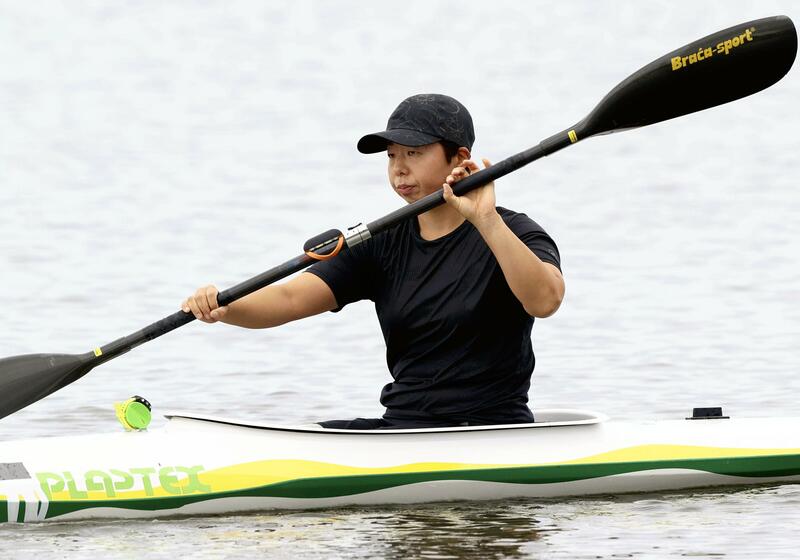
"I couldn't have gotten here without the situation I'm in now," Paralympic athlete Yoshimi Kaji said about her employment by Netz Toyota Naygoya Inc. Kaji, 40, represents Japan in the canoe sprint.
Kaji's legs were amputated as the result of a traffic accident when she was 14. She enrolled in college and dreamed of competing in the wheelchair marathon at the Paralympics, but gave up due to the need to get a job. Kaji ultimately became an elementary school teacher.
Her dreams were revived in 2014, after she had gotten married and given birth. Kaji started canoeing and steadily improved her performance.
To balance her work and child-rearing with canoeing, she turned to Ahnavi, an employment support system run mainly by the Japanese Olympic Committee.
Athnavi was established in 2010 to mediate between athletes and companies that want to hire them. Since 2013, when Tokyo was chosen to host the 2020 Olympics and Paralympics, people who were certified to compete at the Paralympics have also been eligible for Athnavi support.
Kaji registered with Athnavi and found a full-time job at Netz Toyota Nagoya in 2018. Able to concentrate on her sport, she finished sixth in the final world qualifier in May to become a member of Japan's national team. Her husband, Masaya, a 44-year-old junior high school teacher, took over the household chores and child-rearing when she was at training camps and overseas competitions.
"I hope the environment will get better for many para athletes to seize opportunities," Kaji said.
-- Hiring slows
Career support is important in para sports, in which there are few sponsorship deals.
According to the JOC, a total of 47 Paralympians had been hired through Athnavi as of April this year, compared with 282 Olympic athletes. Even so, the number has grown steadily from just two in 2013.
In a survey of participants at the 2018 Pyeongchang and 2020 Tokyo Paralympics, 70% said they were employed. There is a growing trend to hire para athletes who are not top athletes -- in 2019, about 40 para athletes were hired via Tsunahiro World Co., a company that supports employment regardless of the athletic ability of the job-seekers.
However, the pandemic has dampened this trend. Athnavi did not mediate any hiring in fiscal 2020, and managed to mediate just one case of employment this year.
Athnavi refrained from holding face-to-face meetings amid the pandemic.
The number of contracts concluded via Tsunahiro also declined by 30%, with Tsunahiro President Kei Takeuchi saying: "Demand increased ahead of the Tokyo Paralympics because companies wanted to improve corporate image and increase the ratio of the disabled employment. But, the coronavirus has apparently slowed the momentum.
"I think the number of companies willing to hire para athletes will increase after the Games, but how to maintain momentum is an issue."
-- Promoting understanding
Some companies are expecting a ripple effect from hiring para athletes.
Tsu-based Sanko Real Estate Co. hired Ryuji Onda 45, a member of the national wheelchair fencing team, as a contract employee in 2018. Onda, who lives in Mie prefecture, works in the general planning office several times a month.
The company has posted video footage featuring Onda's activities and work on its corporate online bulletin board, and also takes requests for him to give presentations at elementary and junior high schools in the prefecture.
"Working together with him, we became able to see things from disabled people's point of view. Our employees' awareness has changed," a Sanko spokesperson said. "We can contribute to a better understanding of disabled people in the local community."
Nihon Fukushi University Associate Prof. Yu Kodama, who specializes in para sports, said: "Paralympians teach, both inside and outside a company, how to interact with people with disabilities and what an inclusive society is like. They are expected to help improve work environments in that respect. Companies should hire athletes with these considerations in mind."
Read more from The Japan News at https://japannews.yomiuri.co.jp/