
Amid growing cases of dismissal and the termination of employment contracts due to the coronavirus outbreak, there has been increasing use of an employee-sharing system in which employees of one company are temporarily seconded to another.
The system is aimed at transferring manpower from sectors where jobs are being lost due to the pandemic, to others that have conversely become busy. By using the employee-sharing system, businesses are expected to be able to broaden the horizons of their employees without losing the human resources that they have fostered.
--Matched with new jobs
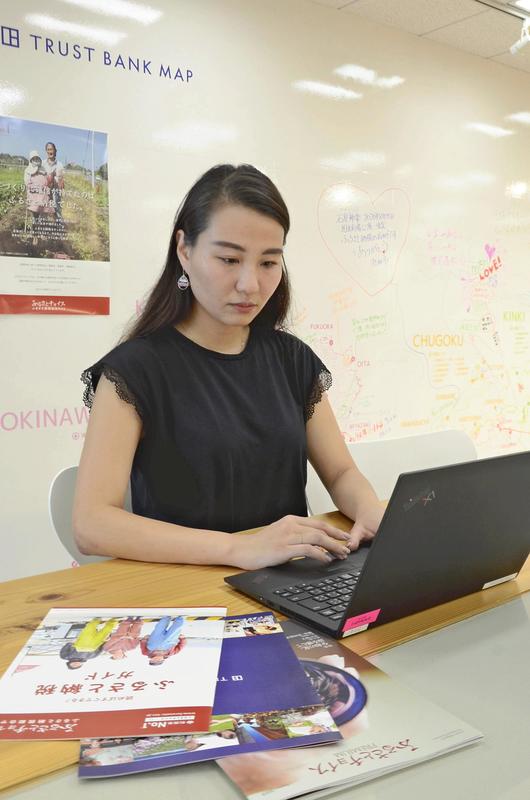
"I'm lucky to have gotten a job related to regional revitalization, which I had been interested in," said Iori Tatesaki, 28, who has been working with Trust Bank, Inc. in Tokyo since April. The company operates "Furusato Choice," a website that handles the provision of donations to municipalities of people's choice under the furusato nozei scheme. Donors are given a tax reduction in return for their contribution.
As an employee of ecbo, Inc. in Tokyo, which provides such services as allowing people to leave their luggage in empty spaces at stores, Tatesaki was in charge of public relations. After the service was suspended temporarily as a preventative measure against the coronavirus, Tatesaki was given the opportunity of being seconded to Trust Bank by the company.
Trust Bank, for its part, has expanded assistance projects to regions and municipalities that have been impacted by the coronavirus. The company decided to accept the ecbo offer enthusiastically.
Trust Bank President Kenichi Kawamura, 47, said, "Recruiting people with work experience in other sectors will serve to stimulate our employees, too."
At Trust Bank, Tatesaki is in charge of a new project, other than the furusato donation scheme, while her salary is paid to ecbo by Trust Bank.
Her temporary transfer from ecbo was mediated by the Platform of Emergency Assistance in the Disaster, a general incorporated association that provides assistance in times of disaster by utilizing information technology. The association liaises via the internet with companies that want to second their employees and those that wish to accept seconded employees.
More than 60 companies have applied so far for the service, which was started in May, and about 20 people have been reassigned in successful matchups. Tomohisa Yamano, a director of the association who devised the service, said: "I wanted to present an option that would make possible the utilization of human resources without dismissals. And to provide companies with an alternative to choosing between maintaining employment on their own and firing employees."
--Broadening horizons
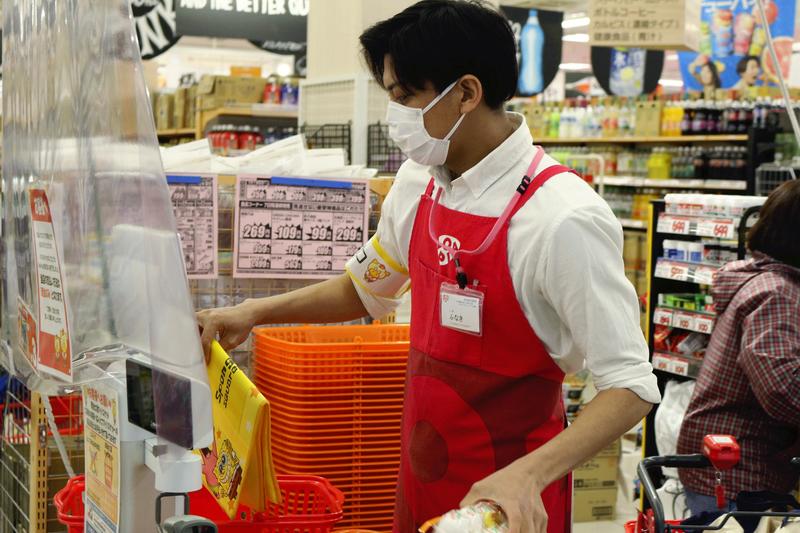
Watami Co., a leading izakaya chain operator that was forced to suspend operations at many of its shops in the aftermath of the government declaring a state of emergency in early April, sounded out supermarket chain Lopia about whether they would accept seconded workers. Lopia readily agreed to the deal, as the number of people going to supermarkets had increased due to prolonged efforts to spend more time at home. As a result, a total of 270 regular employees of Watami have been seconded to Lopia supermarkets.
Yuya Funaki, 27, who served as manager of a Watami shop in Sagamihara, Kanagawa Prefecture, was seconded to Lopia, where he performed such jobs as operating a cash register for about 20 days during the Watami store's business suspension.
--Beyond industry boundaries
In regional areas, there are moves to support farming and fishery industries that have suffered a shortage of manpower because foreign technical trainees could not travel to Japan. In cooperation with the Karuizawa local association of hotels and inns, the JA Sakuasama Cooperative in Nagano Prefecture has sent employees from hotels and inns faced with a drop in the number of tourists to busy farming households since April 10.
The Aomori prefectural government and the Ishinomaki municipal government of Miyagi Prefecture have been helping employees of industries that were forced to suspend their operations or suffered a deterioration in their business to find work in the agricultural and fishery sectors. In Aomori Prefecture, more than 10 employees were able to be seconded in successful matchups. An official in charge of the prefectural government said, "We will seek to discover further needs [for employee sharing] with a view to boosting the number of people who can contribute to companies in other fields while still belonging to their original companies."
Prof. Masahiro Abe of Chuo University, who specializes in labor economics, praised the employee-sharing system, saying that a system to transfer employees temporarily has existed for some time, but "doing that beyond industry and corporate boundaries is unprecedented."
Abe went on to say: "Unlike cases of employees being seconded to affiliated companies, [the new system] also has the possibility of changing labor conditions considerably, including working hours and locations. It is necessary to implement the system while winning the support of workers."
Read more from The Japan News at https://japannews.yomiuri.co.jp/












