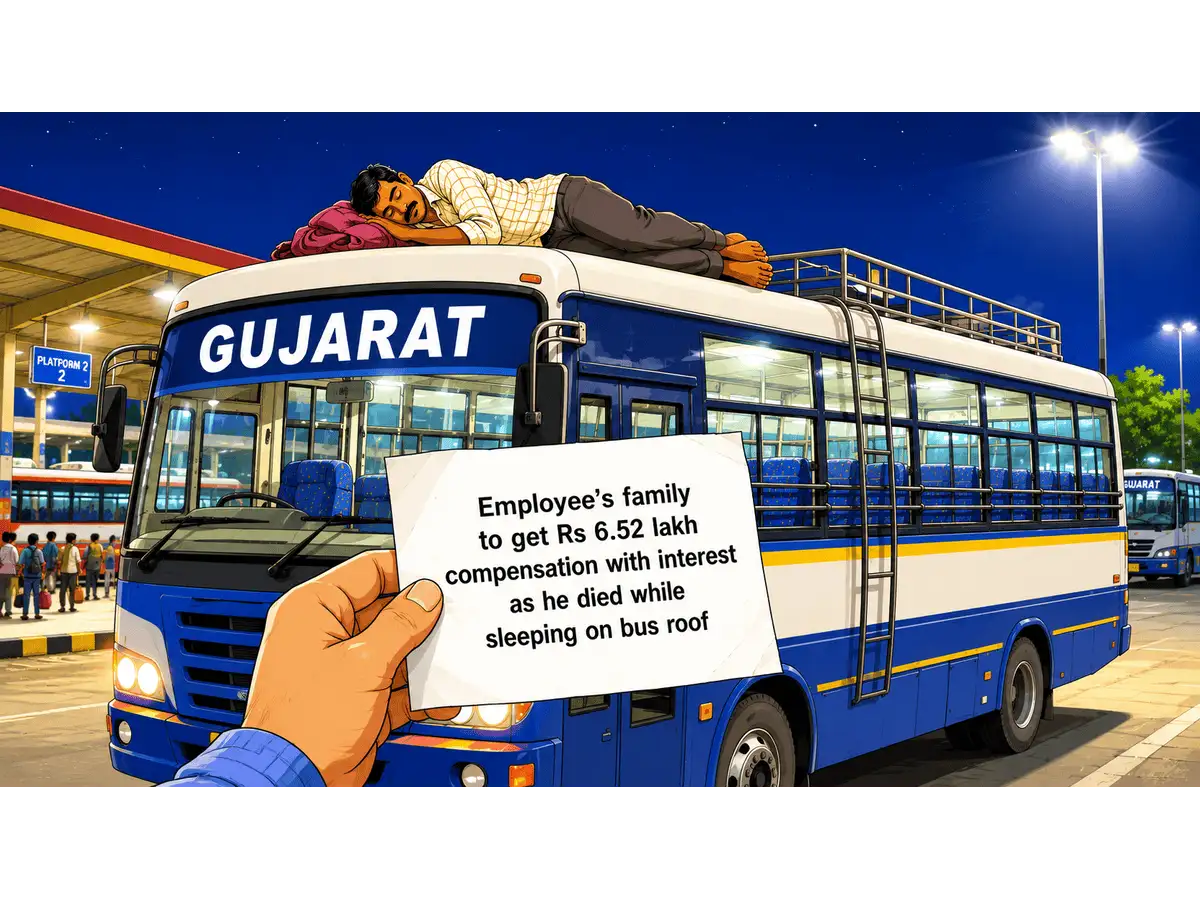
When the late Mr Maganbhai arrived at Ghodasar bus station from Mahudha, Gujarat, he was told to stay overnight and return the next morning to cover the Nadiad-Ghodasar route. He followed these instructions and spent the night there. However, Ghodasar bus station didn’t have a rest room and so he decided to sleep on the roof of the bus for the night.
Unfortunately, while changing his sleeping position, he slipped and fell from the roof onto the ground. He suffered multiple injuries and ultimately passed away. This tragic incident took place on May 31, 2008. Maganbhai left behind a wife and two children and at the time of his death, he earned a monthly salary of Rs 9,128.
In light of this, his wife and children contended that he died while on duty and so they were entitled to compensation. Accordingly, they filed a claim for Rs 7.29 lakh compensation with 50% penalty and 12% statutory interest.
The Gujarat State Transport (S.T.) Corporation argued that Maganbhai was assigned to duty between Nadiad and Ghodasar, and after finishing his last trip, he had stayed at Ghodasar. They pointed out that even though there was no rest room at the Ghodasar Bus Stand, he was expected to remain with the bus. They further claimed that to protect the bus, he should have slept inside the cabin instead of on the roof of the bus. However, Maganbhai chose to climb to the top of the bus from where he accidentally fell and sustained fatal injuries.
The corporation also stated that the incident occurred at night, which was outside his active duty hours, and therefore, they argued that his death could not be considered as occurring in the course of his employment. They maintained that without a connection between the accident and his duty hours, the claim petition should be dismissed.
The Gujarat High Court after hearing the arguments of both the parties passed its order in the wife's favour on April 27, 2026. The Gujarat High Court upheld the order by Workmen's Compensation Commissioner who applied the principle of notional extension of employment and awarded Rs 6.52 lakh compensation to his family along with 12% accrued interest, 40% penalty and costs of Rs 3,000.
The high court also said that the corporation has not submitted any evidence which prohibits drivers from staying with the bus, or prescribing what should be done when rest rooms are not available in remote villages, or how the security of the bus is to be maintained in such places where proper bus stand facilities are not available, reported LiveLaw.
The Gujarat High Court said that on reviewing the judgment of the Trial Court, it appears that the Trial Court had applied the principle of notional extension of employment, relying upon the judgment of the Hon'ble Supreme Court in the case of Leela Bai and Anr. Vs. Seema Chouhan and Anr. reported in 2019-II-LJ-148 and held that when a driver, as part of his duty, stays at a particular village and sleeps on the top of the S.T.Bus due to the absence of a rest room for security of the bus, and accidentally falls on the ground, it amounts to an untoward incident occurring in the course of employment…”
The high court observed: “In an identical fact situation, the Co-ordinate Bench adopted and accepted the principle of “notional extension” of the employment".
The high court also observed that when his wife asked the conductor, he stated that it is the duty of both the driver and conductor to ensure security of the bus assigned to them for the day, and that if they fail to do so, the corporation would take necessary action against them.
The conductor also said that they are paid a night allowance for the security of the bus. On cross-examination by the advocate for the corporation, the conductor said that he was aware of the rules of the corporation permitting them to stay in the bus, reported LiveLaw.
However, the conductor denied any suggestion that it was necessary only in remote areas for the driver and conductor to sleep in the bus.
The high court said that the corporation has neither given any evidence nor produced any rules that prohibit the driver from staying with the bus, or prescribing what should be done when rest rooms are not available in remote villages, or how the security of the bus is to be maintained in such places where proper bus stand facilities are not available.
When confronted with these factual positions, the advocate for the state corporation could not reply to any other aspects.
Ultimately the Gujarat High Court rejected the state corporation’s appeal as well as the enhanced compensation appeal of his wife as she could not prove on what ground the high court could have interfered with the workman compensation’s award. Thus the high court rejected both the appeals.