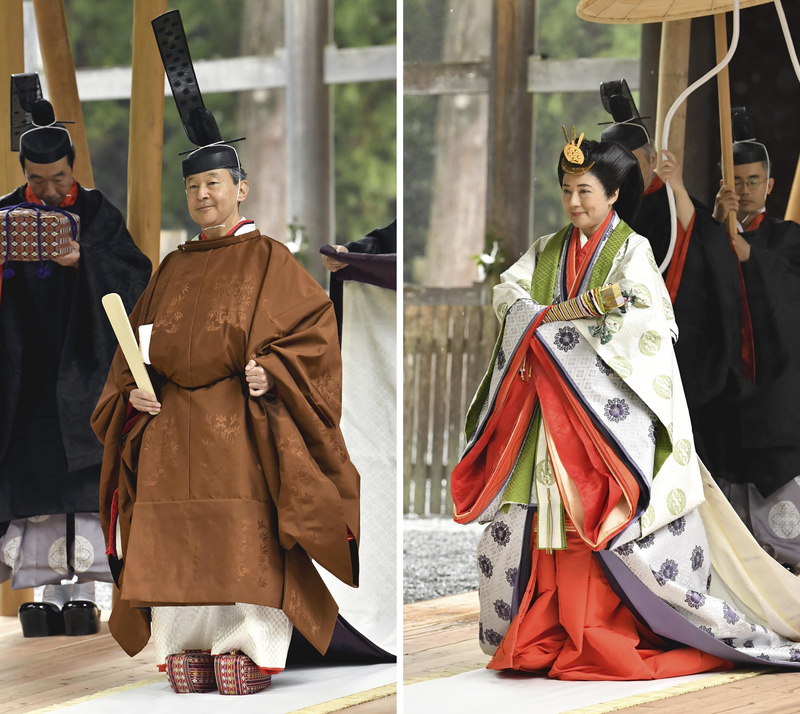
ISE, Mie -- The Emperor and Empress on Friday began the two-day Jingu-ni-Shinetsu-no-Gi ceremony to formally report his enthronement at the Ise Jingu shrines in Ise, Mie Prefecture.
The Emperor on Friday morning visited the Geku shrine to report that the Sokui-no-Rei accession ceremony and the Daijosai thanksgiving ceremony, key rites in the Imperial succession, had been completed.
In the rain, the Emperor, clad in formal court dress traditionally worn by emperors known as korozen-no-goho, got into a ceremonial carriage of the Imperial Household Agency at the Anzaisho building before proceeding toward the south gate of the Itagaki fence of the main sanctuary, in an about six-minute drive to the site 300 meters away.
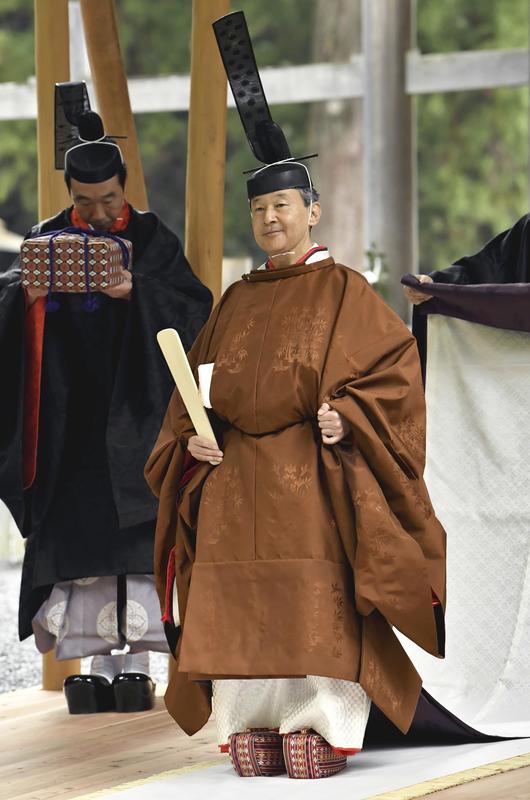
The Emperor, followed by chamberlains carrying the Imperial Regalia -- the sacred sword and jewels -- slowly walked toward the Shoden main hall.
According to the agency, the Emperor presented an offering of a tamagushi tree branch and bowed in front of the Shoden main hall. The tamagushi was offered through Sayako Kuroda, the Emperor's younger sister and chief priest of the Ise Jingu shrines.
The Empress, wearing a junihitoe traditional kimono and an osuberakashi traditional coiffure, bowed after the Emperor. The Empress used a motorized vehicle instead of a horse-drawn carriage due to a horse allergy.
The Geku shrine is dedicated to Toyouke-no-Omikami, a guardian of food.
The Emperor and Empress on Saturday are scheduled to pay a visit to worship at the Naiku shrine, which is dedicated to the Imperial ancestor Amaterasu Omikami.
Read more from The Japan News at https://japannews.yomiuri.co.jp/