State and territory governments have warned that extra commonwealth money for disaster preparation should not come at the expense of emergency response funding.
On Sunday the federal government said an overhaul of disaster funding arrangements could be on the cards, as it considers the findings of a Productivity Commission report on the issue.
“We spend 97% on disaster funding money dealing with the after-effects of things as they occur, and only 3% on mitigating a disaster before it happens,” the justice minister, Michael Keenan, said. “Nobody since I’ve come to this portfolio has told me that they believe that is a sensible or effective arrangement.”
State and territory governments have broadly welcomed possible changes to disaster funding.
“A focus on measures to reduce the risk and adverse consequences of natural disasters is generally supported by the WA government,” a spokesman for the West Australian department of premier and cabinet told Guardian Australia.
A spokesman for the New South Wales emergency services minister, Stuart Ayres, said the state “looks forward to engaging with the commonwealth in this process”, noting that no funding agreements have yet been finalised.
In an earlier submission to the Productivity Commission review into disaster funding, the NSW government said that “the current level of commonwealth investment needs to be maintained”.
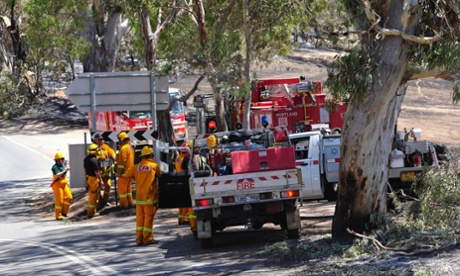
The Queensland government has issued the same warning. The Queensland community recovery and resilience minister, David Crisafulli, acknowledged that fires in South Australia, that had destroyed at least 26 houses, prove “the benefit of increasing spending on mitigation to reduce the devastation of things like fire and flood”.
He said mitigation funding “will reduce the cost of recovery for all levels of government, but is not an excuse for any government to walk away from the funding arrangements that have served our nation for years”.
The federal government is yet to release its response to the Productivity Commission report, which it received in mid-December.
Both Victoria and the Northern Territory were scathing of the existing funding arrangements in their submissions to the report.
“Assistance to communities should be driven by consideration of need and equity, not arbitrary administrative boundaries,” the Victorian submission said.
The NT submission called for the separation of funding pools for disaster mitigation and response, which both currently fall under the national disaster relief and response arrangements (NDRRA).
“The NDRRA has not been an effective tool in driving disaster risk management or mitigation in the Northern Territory as the imperative is to restore a public asset as soon as possible in response to an event, rather than applying for betterment funding that might prevent it from being impacted by a future event,” the territory’s submission said.
The acting federal opposition leader, Tony Burke, said increasing mitigation funding was important, but “you can’t forsake the victims in the immediate crisis in doing so”.