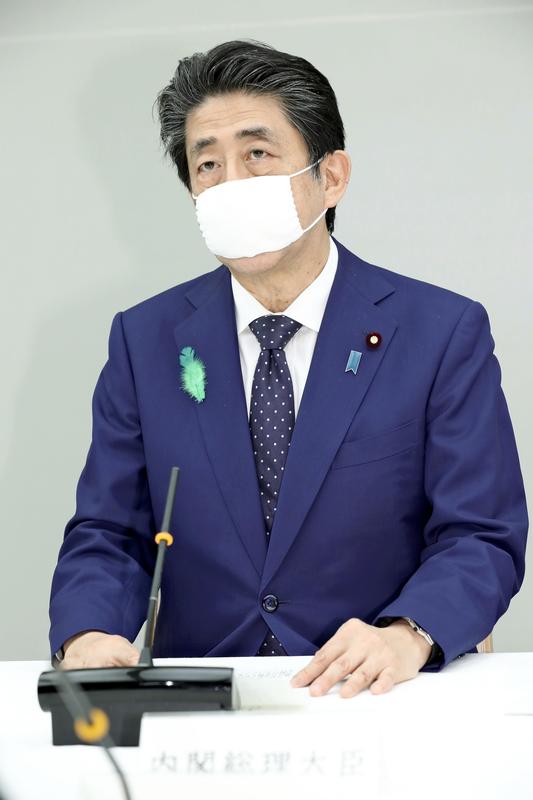
Prime Minister Shinzo Abe expanded the declared state of emergency to all 47 prefectures in Japan on Thursday evening, as the government ramps up efforts to stop the surge of new coronavirus infections.
An initial state of emergency had been declared for seven prefectures, including Tokyo. The latest declaration covers every prefecture, and the state of emergency will remain in effect through May 6. The government hopes keeping the movement of people to a minimum before the long Golden Week holiday break in late April and early May will curb the disease's spread across the country.
Abe made the expanded declaration at a meeting of the government task force on the coronavirus response at the Prime Minister's Office in Tokyo. The declaration is based on the revised law on special measures to deal with new strains of influenza. At the meeting, Abe pressed prefectural governments to urge residents to avoid visiting other prefectures on nonessential trips and to avoid visiting their hometowns ahead of the Golden Week holidays.
Abe will hold a press conference Friday evening to explain to the public more details of the declaration.
Before the declaration was issued, an advisory committee of experts held a meeting to discuss the coronavirus outbreak. Based on questions from the prime minister, the committee decided that the current situation enveloping the whole country met the conditions for declaring a nationwide state of emergency. Based on this, the government revised its basic plan for dealing with the virus.
The new plan listed seven prefectures already covered by the declaration and six further prefectures -- Hokkaido, Ibaraki, Ishikawa, Gifu, Aichi and Kyoto -- as "special alert areas" where steps to prevent the spread of coronavirus must be concentrated. Governors of these prefectures will be asked to request restrictions on the use of facilities and take other steps.
The six newly minted "special alert areas" were designated as such because they met the three conditions of having a total of 100 or more coronavirus infections; the number of infections was doubling more quickly than once in 10 days; and the infection route was unclear for about half of the overall number of cases.
The nation's remaining 34 prefectures include some that have very few cases, although some also have confirmed clusters caused by people who traveled there from urban areas. These prefectures were included in the expanded declaration to "minimize" the movement of people during the Golden Week holidays.
The medical care systems in many regional areas are not as robust as those in major cities. Furthermore, infections spread across Japan when people traveled more during a three-day holiday in March. At the advisory committee meeting, Health, Labor and Welfare Minister Katsunobu Kato said, "There is concern that infections could spread if people move around during the long break, including in regions where the number of cases is increasingly slowly."
Abe said at the task force meeting that reducing people's contacts by at least 70% and even as much as 80% was imperative for enabling the state of emergency to be lifted on May 6. The government plans to prod all prefectures to ask residents to refrain from leaving their homes and cancel large events during this period. It is anticipated that even prefectures that have few infections so far will take bold steps such as closing schools and asking private businesses to shutter their doors, depending on how the situation unfolds.
Ahead of Thursday's declaration, Economic Revitalization Minister Yasutoshi Nishimura, who is in charge of the revised law, gave an advance report on the declaration to the Committee on Rules and Administration in both Diet chambers.
Read more from The Japan News at https://japannews.yomiuri.co.jp/