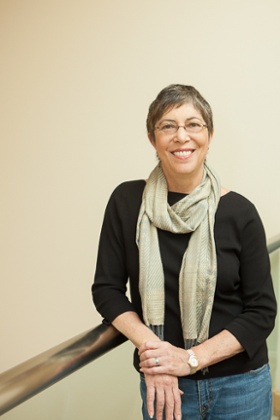
As part of our ongoing brief interview series, we put five questions to Kathrin Winkler, senior vice president and chief sustainability officer at information security firm EMC.
Fast facts about Kathrin
First job: Candy striper, Barnert Hospital, Paterson, New Jersey.
Job history: EMC since 2003 as a product manager, before that at Digital Equipment Corp as a consulting engineer and software product manager.
Lives ... in the woods in exurban Massachusetts, and part-time in downtown San Francisco.
What you’re reading: I just finished Lost Antarctica by James McClintock. It’s about how Antarctica is changing because of climate. Really eye-opening. Also, my husband and I are going to Antarctica in December.
What are you working on these days?
Some things, we’re not ready to talk about yet. But we’ve been working for nearly a year on developing a value for the expected cost of future carbon emissions. The phrase “price on carbon” can mean many things. It can be the current mitigation cost. It can be the social cost. It can be the current market cost. We’ve investigated all of those. But we are looking at the future costs.
Why try to anticipate future carbon costs?
The purpose is evaluating capital investments. if you’re choosing between two facilities, obviously cost, location, proximity to talent, all of those things are factors. But we expect a longer term cost for the one that has higher emissions. But how big do you expect that to be? It could a data center. It could be office space. It could be a way to help make the business case for investing in renewables.
Tell me about your work on e-waste
We consider waste in the design of our products. The people who dispose of waste for us engage in our design process to help us maximize our value capture. We also have material scientists involved to minimize the use of hazardous materials. At end-of-life, EMC takes back our products (mostly large data storage systems). The things we can’t use anymore go to our asset-disposal vendors, who separate the waste into different streams – as much of it that is reusable or recyclable as possible. We require all of those vendors to be certified to one of our US standards and audit them to that standard. As a result, there are now certified vendors in India and Thailand for the first time. These vendors can now do business with any electronics company. So our efforts have a ripple effect.
Before focusing on sustainability, you spent most of your career as a software engineer and business executive. How has that been an advantage and/or disadvantage?
It’s been a tremendous advantage because if you’re trying to influence the culture of a company, you need to understand its businesses, its processes and its metrics for success. You need to speak the language of your constituents. As for developing the sustainability expertise you need, I don’t think that’s so hard. There many ways to do that – conferences, courses, reading. The trick is to augment that with really smart people who have deep knowledge in some area of sustainability.
Away from work, what do you do to live more sustainably?
My job is kind of all-consuming, but we try to build sustainability into our behavior. Everything from composting to turning down the thermostates to not using chemicals on our lawn to driving an electric car. We even take our own chopsticks when we go out to eat. At our local Japanese restaurant, we once left them there and they saved them for us.
Correction: The original version of this piece misspelled Kathrin Winkler’s name. The Guardian regrets the error.
More five minute interviews:
- Five questions for UPS’s Rhonda Clark
- Five questions for Vince Digneo of Adobe
- Five questions for Paulette Frank of Johnson and Johnson
The social-impact hub is funded by Anglo American. All content is editorially independent except for pieces labelled advertisement feature. Find out more here.