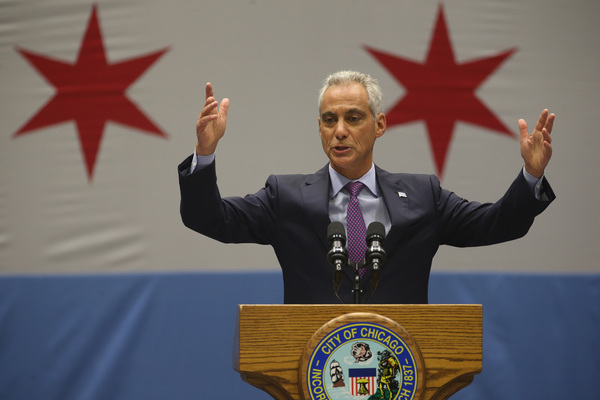
CHICAGO _ Presiding over a city in the national glare for a yearlong failure to control sharp spikes in gang shootings and gun deaths, Mayor Rahm Emanuel delivered a speech Thursday night aimed at convincing Chicagoans he's getting a grip on the problem.
Before 300 invited guests at Malcolm X College on the West Side, Emanuel formally announced what he'd hinted at for weeks _ he'll spend millions of dollars to hire more cops and mentor more at-risk kids.
For Emanuel, the big speech that he'd drawn attention to for most of September represented not just an opportunity to prescribe his treatment to fight the violence that has plagued the city, but a chance to repair his splintered relationship with black Americans, a group of voters key in twice electing him.
Emanuel tried to seize the moment by laying out his vision to strengthen the Chicago Police Department, provide more jobs in economically-challenged areas and prevent crime by offering more hope and opportunity for young men who often turn to gangs in the city's most violent neighborhoods. The mayor started by acknowledging the crisis.
"Gun violence in Chicago is unacceptable ... It is pulling us apart at the very moment when your city needs to come together," Emanuel said at the open of his 40-minute speech. "For all the things that make Chicago great, for all the things that make us proud to call ourselves Chicagoans, the violence that is happening corrodes our core. It is not the Chicago we know and love."
Declaring that "ending this string of tragedies is our top priority as a city," Emanuel reiterated a police hiring plan CPD Superintendent Eddie Johnson detailed Wednesday, with a goal of adding 970 new officers to the department's ranks by the end of 2018.
On employment, Emanuel repeated the adage that "the best anti-crime program is a job" and highlighted his administration's efforts, from holding job fairs and providing summer youth employment to charging developers of downtown high rises fees to help pay for projects in economically depressed neighborhoods.
And to address crime prevention, the mayor announced a three-year $36 million plan to expand mentoring programs. Emanuel noted that research has shown there are 7,200 young men in the 8th, 9th and 10th grades at CPS schools in the city's most violent neighborhoods, and he laid out a goal to provide a mentor for each.
Corporate Chicago and philanthropists already are halfway toward paying for their half of the program, Emanuel said.
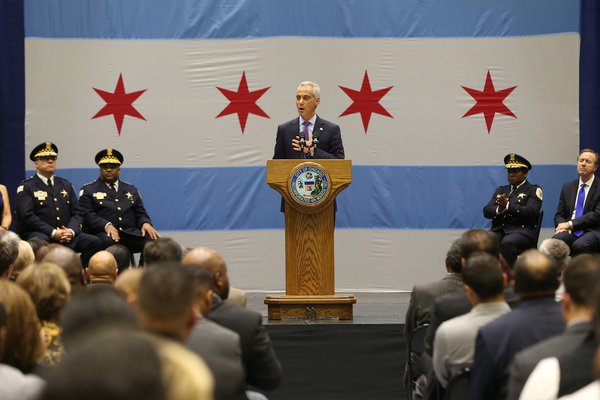
"Police officers and emergency room surgeons are not the only ones whose job it is to save young lives," Emanuel said. "To reverse the rising tide of violence, we need to provide hope instead of desperation and caring adults instead of gang affiliation."
The mayor has struggled to get a handle on Chicago's policing and crime woes since last November, when a judge ordered him to make public police dash-cam video that showed white officer Jason Van Dyke shooting Laquan McDonald in October 2014 as the black teenager walked away holding a folding knife. Prosecutors charged Van Dyke with murder hours before Emanuel released the video.
The sequence of events led to weeks of street protests, many predominantly black American, with some accusing Emanuel of being complicit in a cover-up and calling on him to resign. The mayor rejected both.
During his speech, Emanuel did not shy away from the controversy's effect on the city's current policing challenges.
"Fighting crime requires a partnership between the police and the community, and we all know that this partnership has been tested in Chicago," he said. "It is a problem that has festered in this city for decades. The shooting of Laquan McDonald brought it to the breaking point."
Emanuel sought not only to rebuild confidence in the police, but in his own leadership of the city. He tried to do so by striking a tone as a unifier.
"When we say Chicago is a city that works, that is what we mean. And that is why I am confident we can solve the challenge of violence," Emanuel said. "When we work together, talk together, pray together and act together, as a united city, there is nothing we cannot do. It will not be easy. Real and lasting change never is."
In addressing the crime challenges, Emanuel tried to toe a fine line.
On one hand, he sought to condemn the senseless killings that repeatedly have taken place on the street and denounce past unacceptable actions by police. On the other, he called for more cooperation with the city's cops and sought to boost the department's morale by lauding the difficult job officers face.
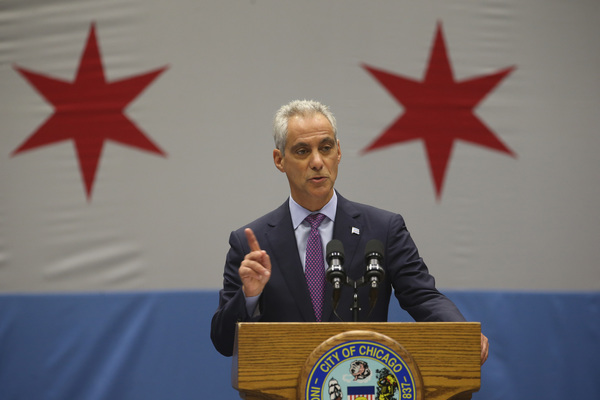
"There can be no permission slip for people taunting police officers trying to solve a crime in their community," Emanuel said. "And there can be no pass for officers belittling a citizen who has turned to them for help."
That last circumstance was a reference to an incident that rapper and songwriter Che "Rhymefest" Smith caught on video last month when he tried to report a robbery at a South Side police station. Smith, who was in attendance, said afterward that Emanuel placed too much blame on gangs and called for more detail on how the mayor will help neighborhoods.
"What about the divestment that led to violence? What about the shutting down of mental health clinics, the shutting of schools? Was this all gangs and guns?" Smith asked.
Emanuel's delivery was at times stilted as he looked down at remarks he frequently veered from. The mayor got choked up with emotion as he peppered his speech with accounts of some of the city's most grim killings.
Among them was Tyshawn Lee, a 9-year-old lured from a Dawes Park play lot and executed by gang members in late November in a retaliation authorities have said was directed at his father. Emanuel also emotionally recalled the killing Nykea Aldridge, the cousin of Chicago Bulls star Dwyane Wade, who was pushing a baby stroller in Parkway Gardens seeking to register her children for school when she was shot and killed.
And Emanuel's voice cracked and he paused to compose himself as he noted how Chicago police Officer Arshell Dennis Jr. returned to work after his 19-year-old son, Arshell Dennis III, was gunned down on a Wrightwood front porch last month, hours before he was due to return to college in New York.
Alderman Roderick Sawyer, 6th, called it "a good speech," but he wants to know how Emanuel plans to pay for it all, including the new cops.
The political undercurrent of the speech was illustrated by City Treasurer Kurt Summers, who was appointed by Emanuel from obscurity in late 2014 and who has flirted with runs for mayor and governor.
"A job program here, a job program there, a summer program here, a mentoring program here and there isn't sufficient and it's not comprehensive," Summers said afterward. "And no matter how many more police officers, how much more training, how many more mentors you have, it's not going to change the economic conditions in underserved neighborhoods in this city, and until that changes we don't solve the root cause of the problem."
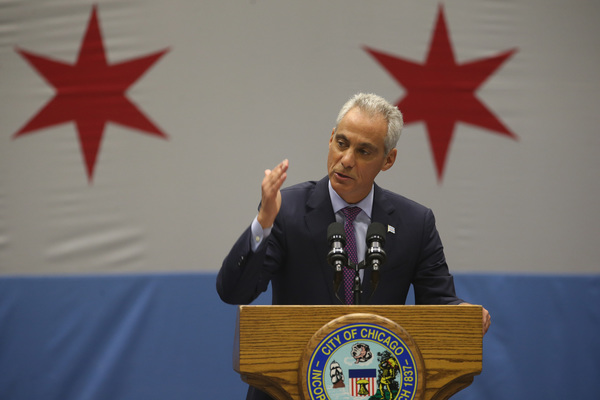
In rolling out his speech, Emanuel likely borrowed from his experiences as a senior White House aide preparing for a State of the Union address.
The mayor's staff strategically trickled out many details leading up to the Thursday speech. Like the presidential address, Emanuel made mention of personal stories of Chicagoans, many of whom were invited to attend. And he gave the speech at 6 p.m., ensuring top billing on evening newscasts.
In that vein, hours before the speech Emanuel's office announced that the overall number of Chicago Public Schools students who were victims of gun violence dropped by 33 percent in the past five school years.
But more detailed CPS statistics requested by The Chicago Tribune showed the number of students who were shot grew between the 2013-14 and 2015-16 school years. That mirrors the city's overall increase in shootings the last two years.
Homicides spiked on Emanuel's watch in 2012 after CPD disbanded strategic "saturation teams" that flooded the city's most violent neighborhoods to prevent gang shootings. By 2014, the city recorded its lowest number of homicides since 1965, according to CPD, only for the killings to spike again in 2015.
This year, the murder rate is on pace to match figures not seen since the crack cocaine wars of the late 1980s and 1990s, with the city already having surpassed 3,000 shooting victims for the year and likely to surpass 600 homicides for the first time in 13 years.
With Johnson, Emanuel aimed to boost police morale by promoting a 28-year-veteran as the department's number of street stops plummeted in the McDonald aftermath. In his speech, Emanuel sought to reinvigorate the department's rank-and-file with praise and the promise to hire more of them.
"While these changes are being implemented, we are simultaneously asking our officers to serve in very perilous situations with a lot of illegal guns and emboldened gangs on the street," Emanuel said. "They need our support. And they know they need to earn the public's trust."
So, too, does the mayor _ especially when it comes to the city's black voters.
And Emanuel set the benchmark for how he'll be judged on the issue moving forward, one likely to play large in his future as mayor.
"At the end of the day, we will be judged by one, simple question," Emanuel said at the closing of his speech. "Can a mother in any neighborhood in Chicago send her children outside to play with peace of mind that they are safe?"