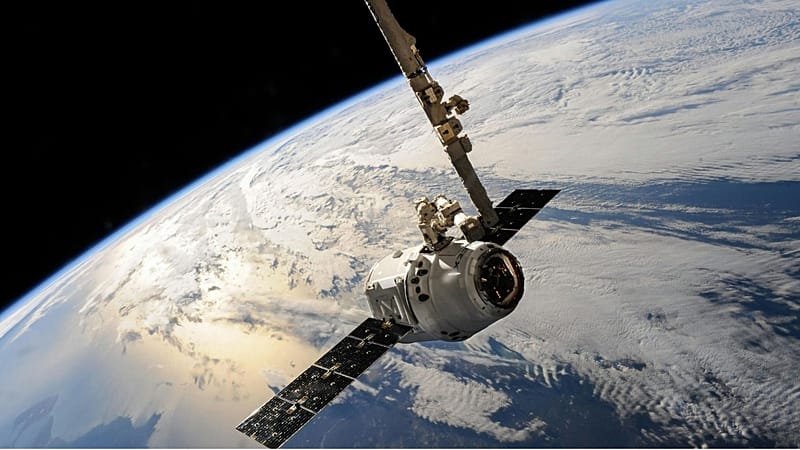
Elon Musk’s company SpaceX said its satellites narrowly avoided a collision with another space satellite.
SpaceX’s so-called Starlink satellites were orbiting just 200 metres away from nine satellites that were launched by Chinese competitor CAS Space last week, according to Musk's company.
The incident came to light after Michael Nicholls, vice president of Starlink engineering at SpaceX, expressed frustration over what he said was a lack of coordination between operators
“When satellite operators do not share ephemeris for their satellites, dangerously close approaches can occur in space,” he wrote on the Musk-owned social media platform X.
“As far as we know, no coordination or deconfliction with existing satellites operating in space was performed,” he added.
Satellites play a vital role in daily life, supporting services such as smartphone GPS, weather forecasting and financial systems.
With Earth's orbit getting crowded, such incidents highlight the need for better satellite management.
In 2023, a record high of around 2,800 satellites were launched, according to the Space Foundation, a US-based nonprofit. SpaceX accounted for a significant share of these launches through its Starlink programme.
The number of satellites in low Earth orbit is expected to increase by 190 per cent within the next decade, according to a World Economic Forum report published in 2024.
CAS Space responded to Nicholls by denying responsibility for the incident while also calling for improved collaboration.
"All CAS Space launches select their launch windows using the ground-based space awareness system to avoid collisions with known satellites/debris. This is a mandatory procedure," CAS Space said via X on Friday night.
"If confirmed, this incident occurred nearly 48 hours after payload separation, by which time the launch mission had long concluded. CAS Space will coordinate with satellite operators to proceed. This calls for re-establishing collaborations between the two New Space ecosystems," the company added in another X post a few hours later.
CAS Space Kinetica 1 launch carried "six Chinese multifunctional satellites, an Earth-observation satellite for the United Arab Emirates, a scientific satellite for Egypt and an educational satellite for Nepal," according to China Daily.
Nicholls’ post did not specify which of these spacecraft passed close to the Starlink satellite.
“We appreciate the responsiveness and look forward to engaging in coordination for future launches,” Mr Nicolls said in reply.
“Establishing data sharing between all satellite operators is critical.”
A collision between spacecraft could create large amounts of debris, scattering hazardous fragments through orbit. This space junk increases the risk of further collisions and threatens both current satellites and future missions.
Experts have also warned about the possibility of “Kessler Syndrome”, a theory proposed by a NASA scientist which suggests that once space debris reaches a critical level, collisions could trigger a chain reaction, creating even more debris and making parts of orbit unusable.