Welcome to the Tuesday, July 28, 2026, Brew.
By: Briana Ryan
Here’s what’s in store for you as you start your day:
- Eleven states have passed laws related to the Education Freedom Tax Credit this year
- Iowa gubernatorial candidates on their visions: "better and truer, not redder or bluer" and "the safest, freest, most family-centered state in America"
- A comprehensive look at 74 years of ballot measures in Hawaii
Eleven states have passed laws related to the Education Freedom Tax Credit this year
Eleven states have passed laws this year related to the Education Freedom Tax Credit (EFTC), which goes into effect in 2027. These bills take various actions that shape how or if a state will participate in the program.
The EFTC is a dollar-for-dollar nonrefundable tax credit, meaning individuals can lower their federal tax liability by $1 for every $1 donated to accredited scholarship-granting organizations (SGO). SGOs distribute the donated scholarship funds to eligible families for a variety of private or public educational expenses, including private school tuition, tutoring services, textbooks, and more. To qualify for scholarships, students must live in households earning no more than 300% of the area's median gross income and be eligible for K-12 enrollment.
The One Big Beautiful Bill Act (OBBBA), which President Donald Trump (R) signed into law in July 2025, created the EFTC. The OBBBA provides two mechanisms of state autonomy in the EFTC: the authority to opt in (or not), and the authority to compile a list of SGOs that will participate in the program.
Under the law, each state’s governor, or other individuals, agencies, or entities designated under state law to make elections on the state's behalf regarding federal tax benefits, can opt in to the program on behalf of the state. Because the OBBBA says state law may determine which entity opts in, some states have responded by enacting laws to create those designations.
The OBBBA includes seven explicit requirements or restrictions for participating SGOs. The only explicit authority the OBBBA gives states over SGOs is the authority to create a list of participating SGOs. The regulations for the program, which the U.S. Treasury will issue, will determine how much control over participating SGOs states may have. In a June 10 preview of the regulations, the Treasury said it likely would not allow states to impose more restrictive requirements on SGOs than those enacted in the OBBBA.
Of the 31 states that have indicated they will participate in the EFTC, legislatures in eight have enacted bills requiring their states to opt in. Other state legislatures have adopted requirements for implementing the program, such as designating a specific state entity to compile a list of official SGOs or setting conditions for state participation.
To help you keep track of the differing state policies addressing the program, Ballotpedia has launched a new resource with up-to-date information on state laws about the EFTC. Here's what the 11 states that have passed laws related to the EFTC have done so far:
- Vermont established requirements for SGOs and restrictions on how scholarships could be used.
- Rhode Island required both the legislature and the governor to agree to opt in to the program before the state could participate. It did not indicate whether the state would participate.
- Oklahoma and Kansas prohibited the state from establishing rules or regulations that exceed the requirements of the applicable federal law.
- Seven of the 11 states established procedural policies for administering the program in their states.
- Eight of the states required the state to opt in, and five explicitly required the state to opt in to the program annually.
- Nine of the states established an SGO certification authority for their states.
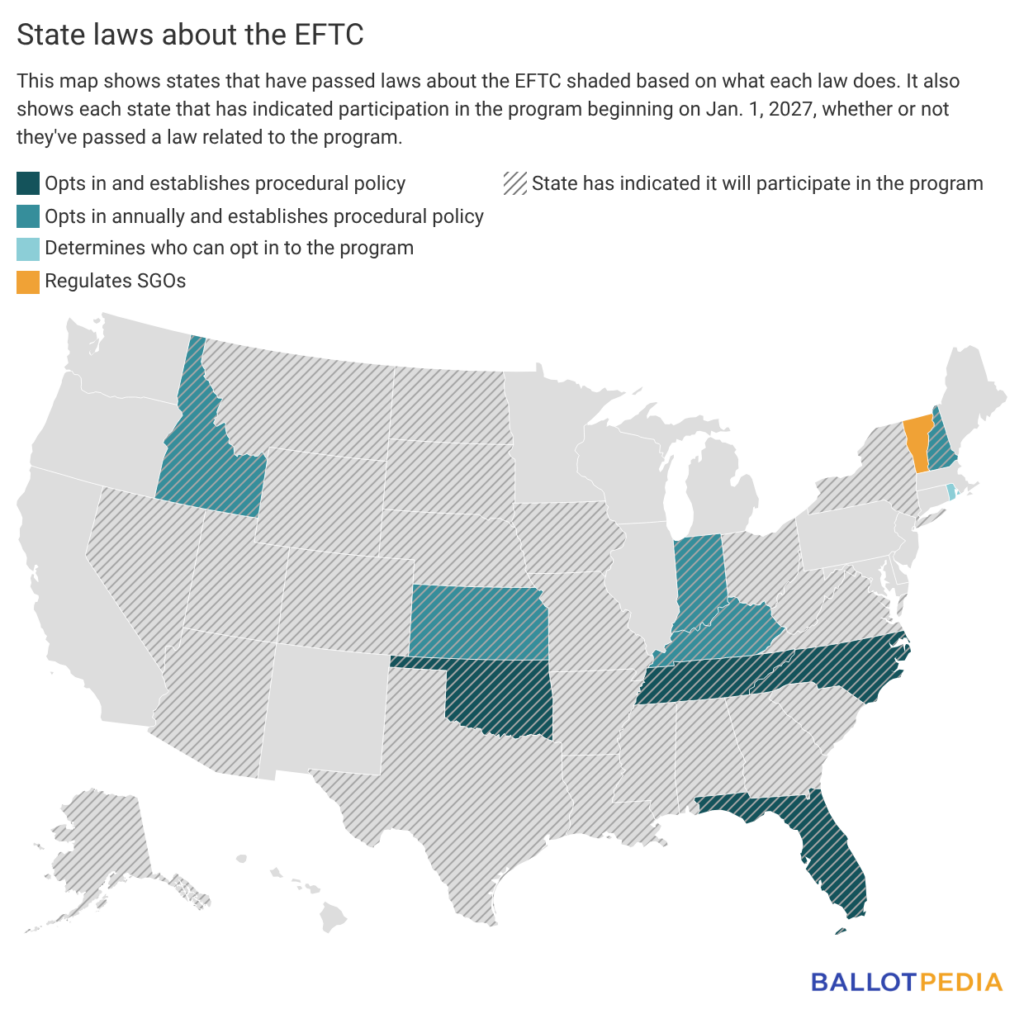
Click here for a full breakdown of state laws regarding the Education Freedom Tax Credit.
Iowa gubernatorial candidates on their visions: "better and truer, not redder or bluer" and "the safest, freest, most family-centered state in America
Rob Sand (D) and Zach Lahn (R) are running in the Nov. 3 general election for Iowa governor. This election is one of 18 open gubernatorial races this year. Incumbent Gov. Kim Reynolds (R), who first took office in 2017, is not running for re-election.
In recent weeks, three major election forecasters — Cook Political Report, Inside Elections, and Sabato's Crystal Ball — have changed their ratings of this election. As of March 31, all three election forecasters rated the race lean Republican. Since June 30, all three forecasters have rated the election as a toss-up. The last Democrat elected governor in Iowa was Chet Culver (D) in 2006.
Both Sand and Lahn completed Ballotpedia's Candidate Connection survey, telling voters who they are, why they are running, and what they hope to achieve in office.
Sand has served as Iowa auditor since 2019. He previously worked as the chief prosecutor for public corruption cases in the Iowa Attorney General’s office.
In his survey response, Sand wrote, "In my first term as Auditor, I uncovered more waste, fraud, and abuse in a single term than any other State Auditor in Iowa history, and have uncovered millions in misspent money since taking office. I work with both parties to get things done for Iowans. In the State Auditor’s Office, I had both an independent and a Republican in senior leadership positions, and promoted – not fired – employees who made campaign contributions to my political opponents. I’m running to make Iowa better and truer, not redder or bluer."
Lahn is a farmer and businessman. He and his wife co-founded the investment firm Homeplace Ventures and the private school Wonder in Wichita, Kansas.
In his survey response, Lahn wrote, "I’m investing in Iowa and I’m my own biggest donor. I don’t answer to donors or corporations — only to God, my family, and the people of this state. I believe Iowa can be a beacon — the safest, freest, most family-centered state in America. That future won’t come from consultants or career politicians. It will come from courage rooted in place, history, and duty. This is Iowa. This is our home. And it’s worth fighting for."
Democrats and Republicans each hold 18 of the 36 gubernatorial offices up for election this year. Nationally, there are 26 Republican governors and 24 Democratic governors.
Click here to learn more about the general election for Iowa governor. Also, if you’re an Iowa voter, check out our Sample Ballot Lookup here to prepare for Election Day.
A comprehensive look at 74 years of ballot measures in Hawaii
Ballotpedia's Historical Ballot Measure Factbook will document nearly 200 years of direct democracy in the United States. This ongoing research effort will provide an unparalleled resource for researchers, reporters, and the public on how ballot measures have evolved, the issues they have covered, and their role in our civic life.
Today, let's look at historical ballot measures in Hawaii. Our comprehensive inventory spans from 1950 to 2024. During that time, Hawaii voters decided on 144 measures, approving 121 and defeating 23 — an 84% approval rate.
Hawaii has the second-highest approval rate of the 25 states for which we have completed Factbooks. Connecticut has the highest, at 91%, and South Dakota has the lowest, at 44%.
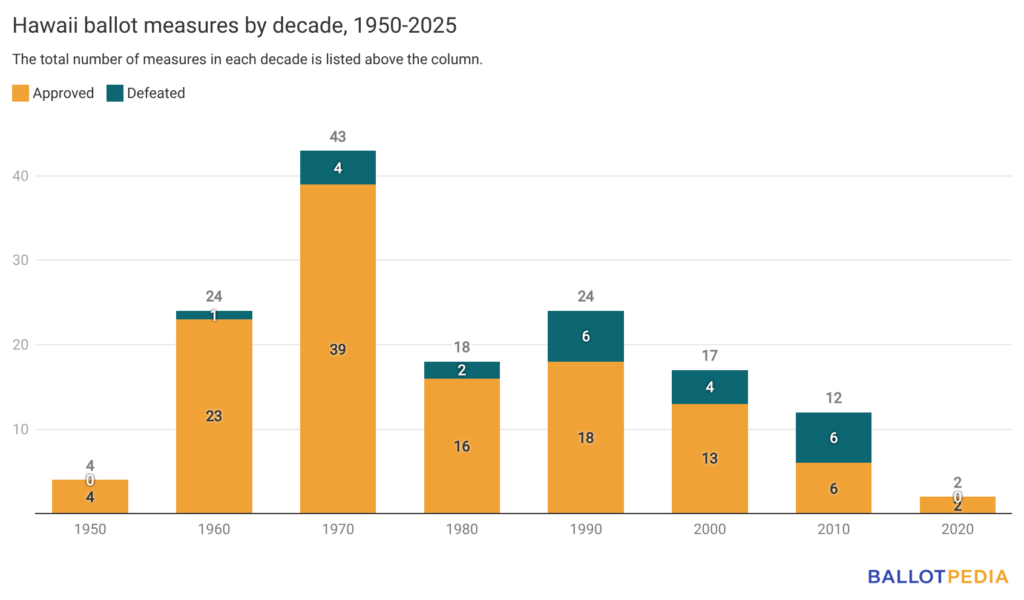
Hawaii measures have addressed 85 unique topics, with some addressing multiple topics in a single measure. The most common topics are related to redistricting policy (13 measures), criminal trials (10 measures), state judicial selection (10 measures), public education governance (9 measures), and bond issues (8 measures).
Here is a selection of notable measures in Hawaii:
In 1950, Hawaii voters approved the Hawaii Constitution Ratification Election 75% to 25%. The measure ratified a constitution drafted in preparation for potential statehood. The U.S. Congress later accepted the constitution through the Hawaii Admission Act of 1959, and it took effect on Aug. 21, 1959, when Hawaii was admitted to the Union as the 50th state.
In 1959, Hawaii voters approved three propositions required under the Hawaii Admission Act before the territory could become a state:
- Voters approved Proposition 1 , 94% to 6%. The measure admitted Hawaii into the United States as a state.
- Voters approved Proposition 2 , 95% to 5%. The measure accepted the boundaries of the new state as defined in the Hawaii Admission Act and relinquished claims to land and sea outside those boundaries.
- Voters approved Proposition 3 , 95% to 5%. The measure accepted additional provisions of the Hawaii Admission Act, including the federal government's reservation of authority over certain lands and property, and the conditions governing property transferred to the state.
Click here to view our full Historical Ballot Measure Factbook for Hawaii.