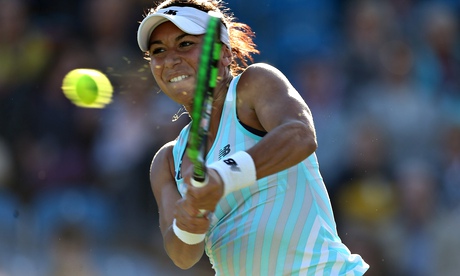
In a sport as mentally demanding as tennis it is fascinating to hear Heather Watson talking about her need to remain intellectually stimulated away from the battle of the court. The British No1 is hungry to learn both about her chosen profession and the world that exists beyond the baseline grind.
“I absolutely loved school,” Watson says, suddenly sounding like she is in a job interview. “I don’t think many people say that but you have all your friends there, you’re learning, you’re having fun. I really enjoyed it.”
Watson has an inquisitive mind. Perhaps that is not surprising. Tennis players are always thinking, even when it looks as if they are acting on instinct alone. Sometimes it must appear that way to them when they are playing. The speed of the exchanges compels them to react in split-second moments which can make it seem as though the thought process is nonexistent, yet their brains are constantly whirring, telling them which shots to hit at different pointsin a rally, and straining to keep negative thoughts at bay when the chips are down.
During Watson’s swift 6-2, 6-3 defeat to Sloane Stephens in the third round of the Aegon Open on Wednesday the importance of positivity was clear. When Watson twice dropped her serve to trail 3-0 after 10 one-sided minutes she must have feared that Stephens would bagel her. It could have happened. Stephens, who beat Watson in the French Open last month, was threatening to devour her.
In her first two matches Watson scrapped to wins over Varvara Lepchenko, the world No38, and Elina Svitolina, the world No17. This time her battling instincts could not save her against an opponent who now has two wins over her this summer but at least Watson could tell herself that she refused to fold. Although it does not look like much to the naked eye, especially with Wimbledon starting on Monday, it could be something to build on.
Watson is interested in psychology. “I’ve always thought about taking up a college course while I’m on the road, just to keep my mind going, but I actually haven’t done it yet,” she says. “Tennis does keep me quite busy. I was very interested in psychology at school. Maybe later on something in finance, even though that sounds quite boring.”
As Watson grows older, she is becoming wiser.
She has learnt from her past mistakes and knows that she returned too soon after she had glandular fever two years ago. Having reached the third round of Wimbledon in 2012, losing to the eventual finalist Agnieszka Radwanska, she lost badly to Madison Keys in the first round.
“I came back too soon,” she says. “I wasn’t fully better yet. I was just desperate to come back. I didn’t want to miss a slam or anything like that. Last year when I had the rib or shoulder injury, I missed one of my favourite tournaments of the year in Estoril because I knew it wasn’t right. You have to be patient, even though it sucks. It took me a while and I lost a bit of confidence because I wasn’t winning matches straight off the bat and I expected myself to. I just had to be patient and really fight my way back.” Despite Watson’s defeat to Stephens this is a promising era for women’s tennis in Britain, with Laura Robson back from the injury that has kept her out for 17 months and Johanna Konta wowing the crowds in Eastbourne.
Watson has slipped to 64th in the world but she is resolute in her belief that she can be a top-20 player one day. Although she has never been past the third round of a grand slam, the 23-year-old is still developing.
“I think I’m kind of a late bloomer,” she says. “I did well in the juniors but later on, towards the end. Even in my career, I’ve had a few hiccups. I haven’t had amazing results and then terrible ones,I’ve just been gradually climbing my way up. I think I definitely have the tennis for it. I need to keep working on my mind and help that bring it out.”
Watson says she remembers all of her matches, even when she was in the juniors, and she recalls going to Wimbledon as a little girl.
“I went there once actually,” she says. “My mum’s friend from Guernsey had two tickets that year and she could have brought anybody but she told my mum: ‘Look, I’ll take Heather.’ She took me there and it was for the semi-finals. It was Venus Williams against … I can’t remember.” That probably annoyed her.“I was about seven or eight and it’s amazing that Venus is still playing and I can say I’ve played on tour against her,” she continues. “Just seeing it, I remember telling her: ‘I’m gonna play here one day,’ and everybody’s like: ‘Yeah, OK, Heather.’ To be playing there now, I’m just so pleased.”
The Wimbledon draw is on Friday and Watson will find out who she is playing in the first round in her own time. Then she will focus. “That’s the tournament I want to do best in,” Watson says. “I always look forward to it. I really, really, really want to do well there this year.”