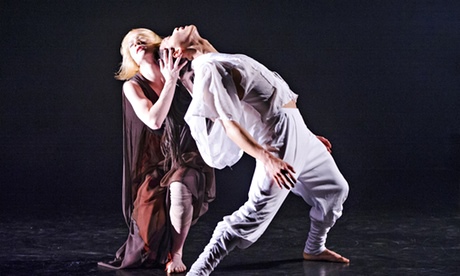
Eleesha Drennan is a Canadian choreographer who has spent the formative years of her career with the National Dance Company Wales. Yet despite the western provenance of her cv, Channel Rose, Drennan’s new work, appears to have striking affinities to kabuki, the Japanese dance drama.
Like kabuki, its peopled with archetypal and vaguely magical characters – in this case, a Gypsy, a witch and a wizard. Elements of their vocabulary – their whirling jumps and incantatory gestures – display a combination of spiritual inwardness and muscular heft that’s distinctively kabuki in style. And while the accompanying music is written by Western composers, it inhabits a spare, evocative soundworld that seems peculiarly Japanese.
In other respects, however, Drennan’s aesthetic is very much her own. Channel Rose is the story of three individuals in search of their own versions of utopia. Some aspects of that search are signposted by props – a pair of rose tinted sunglasses that grant each character a temporary illusion of happiness; a pile of clay that’s moulded into miniature ziggurats and castles to symbolise the gypsy woman’s quest for a home.
Others are choreographed entirely through movement: the wizard’s delicate attempts at flight; the hopeful, lopsided gait of the Gypsy; the fist-shaking fury of the witch as she struggles for dominance. Drennan, at these moments, seems the real deal as a choreographer. Her imagery is strong and original, and elicits excellent performances from the dancers – Viivi Keskinen, Kenny Wing Tao Ho and Drennan herself. Yet, this hour-long work begs for a more compelling structure. The characters may be on a journey to nowhere, but we need to feel what each of them has staked on their success.