The electric car industry has struggled to shake its reputation as a passing fad or an idea too far-fetched to ever become a dominant reality. But with traditional manufacturers now dedicating considerable efforts towards their development, it seems electric vehicles (EVs) are here to stay, and are set to play an important role in the fight to slash our use of fossil fuels.
Early in 2014, fleet management company Alphabet predicted that sales of EVs would double over the following three years, while new figures from the Society of Motor Manufacturers and Traders demonstrated that sales of electric cars and hybrids rose by 58% in 2014. It seems now may be a good time for fleet managers to start taking notice.
It’s easy to see the attraction. Electricity is a cheap resource, meaning that EVs stand to bring businesses substantial savings on fuel costs. Indeed, excellent fuel efficiency means these vehicles are particularly well suited to journeys that require regular stops and starts.
“Based on standard rates, these cars would cost you about £2.80 to do 130 miles,” John Hargreaves, Kia’s head of fleet and remarketing, explains. “That’s clearly massively cheaper than what you’d pay to drive a conventional internal combustion engine the same distance.”
Fuel efficiency isn’t the only area of potential savings. EVs come with substantial tax incentives that are also ideal for fleet managers. In the UK, they are not required to pay vehicle excise duty, while those in London are exempt from the congestion charge, which is currently £11.50 a day per vehicle.
Yet the advantages of electric cars go beyond saving money. “These vehicles generally encourage eco-friendly, safer driving – when you put people in a car that doesn’t go as fast, they tend to drive more sedately,” Hargreaves explains. This brings a host of benefits to fleet managers: less tyre wear, improved driving habits and overall, an enhanced corporate image.
Does this mean that electric cars are soon set to become the go-to option for business fleets? The main issue continues to be flexibility. “Some journeys won’t really be compatible with electric vehicle technology,” Hargreaves explains. Limited charge levels mean they’re not the best option for long journeys – although they are ideal for drivers with a regular daily journey route and time.
An electric car with no power is no use to anyone, meaning the availability of charging points is an important point of consideration. “Businesses need to take account of whether they have the facilities within their office or relevant locations to install charge points,” Hargreaves says. “Clearly, this requires additional space and costs.”
The prosperity of the second-hand EV market also remains untested. “You also need to be mindful of the holding costs of the vehicle,” Hargreaves explains. “It’s a more expensive car, so you’d probably need to modify the holding period. Fleet managers need to ask themselves, what is this car going to be worth when I need to sell it – and how does that compare to the resale price of a normal vehicle?”
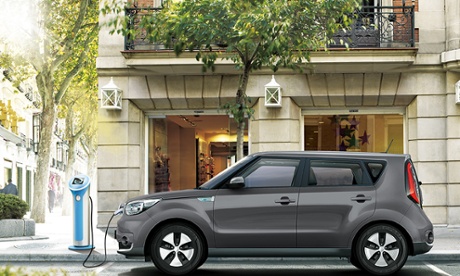
This issue forms the thinking behind the Soul EV, Kia’s first foray into the electric market. “It’s an electric powered car that we’re producing in comparatively low numbers and comes in exactly the same established style as the internal combustion engine version on the road at the moment. We’re hoping this will mean a better resale value – which is a very important part of the fleet proposition.”
Still, Kia is aware that the Soul is not the ultimate solution. “What we’re working on is a variety of ways to enhance environmental credentials,” Hargreaves explains. “The ultimate aim is to give the customer a range of alternative fuel vehicles, rather than saying electric vehicles are it; you’ve got to all fit in this one-sized solution.”
An attractive option is fuel-cell electric hybrid vehicles. They use a small amount of zero-emission fuel such as hydrogen to create electricity which then powers an electric motor. “They’re the best option in terms of range and operation, but are currently very expensive,” Hargreaves admits. “It’ll be slow progress until there’s a proper infrastructure in place.”
So electric vehicles aren’t a cure-all for fleets – not yet, at least. For now, the key is considering them as an important expansion of the range of options available. “We still think they will be an alternative to the internal combustion engine rather than a replacement,” John concludes. “Electric vehicles are only part of the future.”
Content on this page is paid for and provided by Kia Fleet sponsor of the Guardian Small Business Network Accessing Expertise hub.