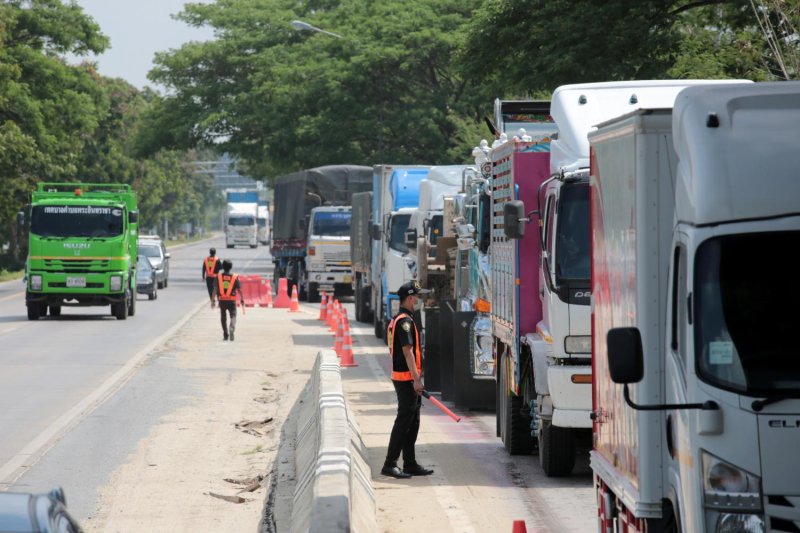
The trucks that keep Thailand moving may soon decide how well the country competes in a low-carbon world -- if the government gets it right.
They haul everything -- food, fuel, exports -- linking every part of the economy. For decades, they have been the quiet backbone of economic growth. Now they sit at the centre of a much bigger shift: the race to cut carbon as global trade rules tighten.
Electric trucks play a major part in keeping Thailand's economy competitive in a low-carbon economy. Unfortunately, the transition has barely begun.
Despite government efforts to promote electric vehicles, electric trucks still make up only a tiny share of the fleet. The slow adoption stems from structural problems that policy has yet to fix.
Hurdles
On paper, electric trucks look efficient. Electricity is cheaper per kilometre than diesel or gas. But operators do not make decisions based on fuel costs alone. They look at the full picture -- what it costs to buy, run, maintain, and eventually replace a vehicle. And that is where the case becomes less convincing.
An electric truck can cost nearly 2 million baht more upfront -- roughly one-and-a-half to twice the price of a conventional vehicle. Over a typical five-year cycle, running about 100,000 kilometres a year, the energy savings are real.
But they are offset by other uncertainties: resale value, the cost of installing charging systems, and the long-term handling of batteries.
In addition, batteries are heavy. The heavier the truck, the less it can carry. Fewer goods per trip means lower revenue per run.
A single trip by an electric tractor-trailer costs around 2,700 to 2,900 baht. For the same distance, diesel comes in at about 1,600 to 1,700 baht. LNG sits near 2,000. Without additional state support or further technological advances, electric trucks are not yet competitive under the present cost structure.
Not ready
Electric trucks cannot use standard EV charging stations since they need much more power, more space, and equipment categorically built for heavy vehicles. Right now, those facilities are few and far between, especially along major routes.
Cost is a big part of the problem, too. Installing a 350-kilowatt charger costs several million baht. Charging multiple trucks at once demands power at the megawatt level. Grid upgrades to support this demand add significantly to the overall cost.
Current weight limits were designed for diesel trucks. Apply those same limits to electric vehicles, and the extra battery weight eats into payload capacity. Due to this built-in disadvantage, operators are left carrying less and earning less while facing higher costs.
Some countries in Europe now allow heavier electric trucks to compensate for the batteries. Thailand has yet to address this issue.
Solutions
So where should the policy change begin? Not everywhere at once.
The most practical starting point lies in fixed routes that are ready. For example, employee shuttle services in industrial estates, container transport within ports, or urban deliveries. These routes have fixed distances and schedules. Charging can be built into each trip, reducing the need to rely on public stations.
Success in these pockets builds confidence. It shows what works before scaling up to longer, more complex routes.
But this is not enough. The transition will stand or fall on how the system is designed to address four main goals: localisation, financial incentives, regulations, and infrastructure.
Localisation
Effective transition begins with a simple question: Will Thailand just import electric trucks or choose to build local industrial strength from this shift to clean energy?
If it chooses the former, electric trucks risk becoming a new cost burden in the logistics industry -- cleaner, but more expensive, with little value created at home.
Thailand's policy on electric trucks should simultaneously move on two fronts: advancing technology to meet real operational needs and building a new industrial base domestically, from manufacturing to supply chains.
Experience from passenger EVs offers a clear lesson. Demand incentives such as subsidies and tax breaks can boost sales. But without linking them to investment, technology transfer, and local production, they do little to build long-term capability.
The electric truck policy should be framed as part of a broader industrial strategy. And the government must implement effective measures to support the localisation of the electric-truck industry.
Thailand already has a working model. Support for passenger EVs under the EV 3.0 and 3.5 schemes offered subsidies, tax cuts, and local production requirements as a package. Sales rose. Investment followed. A manufacturing base began to take shape.
Electric trucks have yet to see that level of commitment.
Affordable financing
Current incentives lean heavily on tax deductions, allowing companies to write off twice the value of locally made vehicles and 1.5 times the value of imports. But tax breaks only help firms that are already making profits. They do little for operators struggling with cash flow.
Learning from the passenger EV model, the initial momentum has to be strong enough to win over operators. If the early stage is too weak, the transition stalls before it begins.
For electric trucks, that means going beyond tax policy. Access to affordable financing will be critical: low-interest loans, credit guarantees, and other financial tools that reduce the risk of stepping into unfamiliar technology. Smaller operators, in particular, will need that support if they are to come along.
But support should come with conditions. Operators must be required to help build a domestic industry and create local supply chains, not only depending on imports. Otherwise, the gains flow outward.
Regulations
Adjusting weight limits for electric trucks could help level the playing field and ease the transition. In Europe and the UK, electric trucks are allowed an additional one to two tonnes. And proposals are underway to extend this to four tonnes to compensate for battery weight and preserve payload capacity.
In the Thai context, however, such changes cannot be rushed. They must be grounded in solid data -- on road safety, engineering limits, and infrastructure impacts -- to avoid turning technological promotion into a hidden cost for the transport system as a whole.
Poorly designed rules can shift costs rather than solve them.
Infrastructure
And then there is the backbone of it all: infrastructure. Charging points for heavy trucks cannot just pop up here and there.
They need a plan -- one that fits into the country's energy and transport systems. Putting them along key industrial routes or around ports would make better use of money and power, where demand is highest.
There is another option: battery swapping. Instead of waiting to charge, drivers can switch batteries and get back on the road quickly. It saves time. But it is not simple.
The upfront costs are high, and the system only works if everyone uses the same standards. That makes it more suitable for specific areas, like ports or industrial zones, rather than across the whole country.
Electric trucks are not just about cleaner air. They test whether Thailand can make this transition work for its economy.
Get it wrong, and the country pays more to move the same goods. Get it right, and electric trucks could drive Thailand's next phase of growth in the low-carbon economy.
Nattaphorn Buayam, PhD, is a research fellow at the Thailand Development and Research Institute (TDRI). Policy analyses from the TDRI appear in the 'Bangkok Post' on alternate Wednesdays.