Democracy in action. Twitter users have posted pictures of long queues outside polling stations up and down the country - a sign of a decent turnout or just bad organisation? Here’s hoping it’s the former.
In Bristol...
25minute queues to vote in #BristolWest - lovely to see so many adding their voices to the mix. #GE2015 pic.twitter.com/AVUEl6zQCB
— Ben Hansen Hicks (@benhansenhicks) May 7, 2015
...in Branksome, Dorset...
Huge queues at Branksome rec to vote great for democracy 😎😎 pic.twitter.com/zpTK5f0syd
— Cllr Philip Eades (@Phil4Poole) May 7, 2015
... in Crowborough, East Sussex...
Queues across #Crowborough at polling stations, go now to avoid a last min rush! - 3 Hours to Go! Vote #Conservative pic.twitter.com/DILD9FETss
— Greg Rose (@TheGregRose) May 7, 2015
... in Hove, East Sussex...
Long #queues 2 #vote this evening #hove - with the ever lovely @robedaa - now 4 a little voting #vodka #Election2015 pic.twitter.com/UEVkSoXSyv
— Miss A (@pongming) May 7, 2015
... and in Brixton.
Queues to get in to vote in Brixton this morning. Democracy ain't dead. Whoever you support - get out and vote pic.twitter.com/aIOj7CrQxZ
— Andy Thornley (@scouser_andy) May 7, 2015
Twitter have composed this sparkling timelapse map of the UK, showing tweets sent using #IVoted.
More than 1.3m tweets about the election have been sent, the social network says, and Labour are the most talked about party so far.
Conversations break down as follows:
Labour 43%
Conservatives 30%
Ukip 12%
SNP 10%
Green 3%
Lib Dem 2%
Ukip supporters accused of intimidating South Thanet voters

My colleagues Rajeev Syal and Ben Quinn have this report on allegations of abuse made against activists claiming to be Ukip supporters.
They write:
As the closely fought battle for the Kent constituency moved into its final hours, supporters aligning themselves to the Ukip leader, Nigel Farage, were accused of pressuring people as they approached polling stations, and swearing at those who said they would not vote for the party.
Farage denied that any of his party’s officials would have been involved in such behaviour but said he could not be held responsible for the actions of unknown people claiming to be from Ukip. Labour supporters, in turn, have been accused by Ukip of destroying posters.
Evening summary
With less than three hours to go before the polls close, here’s a brief wrap-up of polling day so far, before my esteemed colleague Andrew Sparrow launches a fresh blog to take you into the evening and the early hours of Friday morning.
- Parliamentary hopefuls have been posting photos and videos all day on Twitter with last-ditch appeals for votes – or in some cases just to capture the scene at their local polling stations (see 18.48)
- Speaking of polling stations, the keen-eyed folk on the Guardian’s picture desk have been scouring the photographic wires for the weirdest and most wonderful across the country (see 15.32)

- A Guardian/ICM poll taken on the eve of voting shows Labour edging ahead of the Conservatives by one point. It puts Ed Miliband’s party on 35%, just ahead of the Tories on 34%, with Ukip on 11%, the Lib Dems on 9%, the SNP on 5% (in a UK-wide poll) and the Greens on 4%.
- The knife-edge nature of the poll echoed others issued on Thursday, with the final Ipsos-Mori numbers putting the Conservatives down one point to 36%, and Labour up five points to 35%.
- And a snapshot from Lord Ashcroft’s polling had Labour and the Tories in a dead-heat at 33% each.
- Here’s the final round-up of the polls, which puts the two leading parties on an uncomfortably snug 273 seats each:
- Party leaders have cast their votes, with David Cameron in Witney, Ed Miliband in Doncaster North, Nick Clegg in Sheffield Hallam, Natalie Bennett in Holborn and St Pancras and Nigel Farage in South Thanet all, presumably, crossing their ballots as you’d imagine (the law dictates we don’t ask them to tell us).
- Nicola Sturgeon, the SNP leader, did not have the chance to pencil a mark by her own name, as she is not standing for election. She voted in Glasgow East, the constituency of would-be SNP MP Natalie McGarry.

- Darlington council has been forced to reissue ballot papers after it emerged that some were missing the Ukip candidate’s name. The council said 89 ballot papers – 0.1% of the total – had failed to include the name of David Hodgson, but the mistake had been rectified (it’s not clear when) and voting was continuing as normal.
-
Activists claiming to be Ukip supporters in the party’s key target seat of South Thanet have been reported to the police by Labour for intimidation and verbal abuse, police confirmed on Thursday.
-
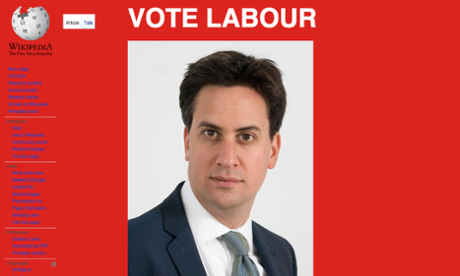
A series of Wikipedia pages relating to UK politics, including that of David Cameron, were briefly defaced with images of Ed Miliband, urging people to vote for the Labour leader in the final hours before polls close.
- And finally... #dogsatpollingstations started trending on Twitter, setting a new bar for hilarious election hashtags
#DogsAtPollingStations pic.twitter.com/ypqwL9Gghi
— Lauren Potts (@_LaurenPotts) May 7, 2015
That’s it from me on this blog. As I said, we will be launching a fresh blog imminently to take you through the remains of polling day and those edge-of-the-seat moments as the results roll in.
Updated
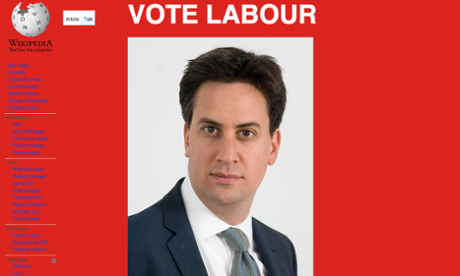
A series of Wikipedia pages relating to UK politics, including that of David Cameron, were briefly defaced with images of Ed Miliband, my colleague Jessica Elgot reports.
She writes:
Entries on the Conservative party, Ukip, George Osborne, Boris Johnson, Ken Clarke and Nigel Farage pages were given a red background, with “vote Labour” printed in white block capitals above a picture of Miliband.
The vandalism left no other information visible for each entry.
Updated
The most memorable moments from the general election campaign have been brought together in this at-times-painful-to-watch Guardian video.
Updated
Parliamentary hopefuls have been posting photos and videos all day on Twitter with last-ditch appeals for votes - or in some cases just to capture the scene at their local polling stations.
With less than four hours until polls close, here’s some social media moments from across the political spectrum.
Labour candidate for Washington and Sunderland West, Sharon Hodgson:
Wonderful school gate at Oxclose Primary. Lots of support & people saying they've already voted Labour #voteLabour pic.twitter.com/aP3pskW5Zv
— SharonHodgson4MP (@SharonHodgson_) May 7, 2015
Conservative candidate for Harlow, Robert Halfon:
#Honk4Halfon. On the A414 campaigning hard for Harlow with the Blue Men and Blue Women. pic.twitter.com/Vb6qPG1z3G
— Robert Halfon (@halfon4harlowMP) May 7, 2015
SNP candidate for Aberdeen, North Kirsty Blackman:
Just bumped into this gentleman who is wearing his voting outfit to #VoteSNP pic.twitter.com/MG0mkg5uzS
— Kirsty Blackman (@AbdnNorthKirsty) May 7, 2015
Plaid Cymru leader, Leanne Wood, and her party’s candidate for Carmarthen East, Jonathan Edwards:
Ail-ethol @JonathanPlaid heddiw / Re-elect the fantastic Jonathan Edwards in Carmarthen East & Dinefwr. #Plaid15 pic.twitter.com/JBpkxOQNi4
— LeanneWood (@LeanneWood) May 7, 2015
Green party hopeful for Bristol West, Darren Hall:
Ah the leafy suburbs of Redland - no jokes about tree huggers please. ;-) pic.twitter.com/qj7wA4MEUO
— Darren Hall (@paleblueCIC) May 7, 2015
Ukip candidate for Clacton, Douglas Carswell:
Getting out the vote in central Clacton! Woo hooooo! pic.twitter.com/zgj8fVxTCq
— Douglas Carswell (@DouglasCarswell) May 7, 2015
Liberal Democrat hopeful in St Austell and Newquay, Stephen Gilbert
"Thank You" to mystery benefactor sent us a box full of boxes of chocolates! @StAN_LibDems @LibDems #TastingHere pic.twitter.com/TAGwsUjYu7
— Stephen Gilbert (@stephen_gilbert) May 7, 2015
Updated
Guardian readers have been helping us document polling day around Britain in pictures and stories – from dogs at polling booths to exercising your right to vote in the pouring rain. Have a browse:
Updated
Students – many of whom are first-time voters – have been sharing pictures of themselves outside polling stations or holding their poll cards, with the hashtag #GenerationVote.
From handing out yellow stickers, to wristbands and wearing “Are you registered to vote?” t-shirts, the National Union of Students (NUS) has been part of a drive to get more students to vote, especially as only 44% of 18- to 24-year-olds voted in 2010.
The umbrella student body also had a more overt political message for who they called: “tuition fee pledge breakers.”
Out and about encouraging students to vote in today's General Election. #generationvote pic.twitter.com/fElweoK42Z
— Alex Brooks (@PresGreenwich) May 7, 2015
Woooo just voted in my first general election #GenerationVote #IVoted pic.twitter.com/MEJ6qVZ9Y1
— Franakin Skywalker (@Franiebear_) May 7, 2015
Updated
Share your polling day photos via #guardianwitness http://t.co/KO7ya8H0kS #ge2015 pic.twitter.com/TQAe4jbvPe
— Election 2015 (@GdnPolitics) May 7, 2015
In Sheffield, political reporter Frances Perraudin says that Liberal Democrat leader Nick Clegg is not leaving anything to fate as he spends polling day knocking on door after door.

After the Liberal Democrat campaign bus completed its mammoth 40-hour road trip from Land’s End to John O’Groats on Wednesday night, Nick Clegg hopped on a small private plane down to Sheffield.
Despite the torrential rain, the Lib Dem leader spent Thursday knocking on doors in his constituency of Sheffield Hallam, trying to get every last voter out to the polling booth to put a cross next to his name.
He said he would not be watching the election unfold on TV tonight, but would instead have a quiet dinner with his wife Miriam at the flat he rents in his constituency, before arriving at the counting hall in the small hours to hear the result.
Sheffield Hallam’s results are expected at about 4am.
Those close to the deputy prime minister say they are confident he will keep his seat – some have said they would bet their houses on it. After a series of polls (which crucially didn’t include the candidates’ names in their questioning) put Clegg fractionally behind his Labour rival, Oliver Coppard, polling from ICM and the Guardian on Monday suggested he was in the lead by seven points.
Whatever the result, Clegg will set off down to London immediately, in preparation for Friday’s VE Day 70th anniversary commemorations and, quite possibly, the start of lengthy coalition negotiations.
Updated

Ukip has vented its anger at a council over an error that led to its candidate being missed off a batch of ballot papers (see 14.05).
Ukip’s parliamentary hopeful for Darlington’s Harrowgate Hill ward, David Hodgson, whose name was left off the list, has issued this statement:
Whilst the error was rectified after a number of people contacted Ukip to complain that my name was not on the ballot paper, there are serious questions to answer at the council.
How can this have happened? Who is going to take responsibility? And what will be done to ensure that nothing like this ever happens again and no candidate ever finds themselves removed from the ballot paper in future.
What is particularly galling is that Darlington council is not prepared to take responsibility nor offer an apology.
Updated
In Scotland, reports relayed by the Scottish Tory leader, Ruth Davidson, of voters being turned away from a polling station in Annan by “burly blokes” (see 13.36) appear to have been put to bed by Dumfries and Galloway council.
@RuthDavidsonMSP No burly blokes outside Annan. Officers and police visiting frequently. No complaints re canvassers. pic.twitter.com/DyDfvAbqzb
— D&G Council (@dgcouncil) May 7, 2015
Updated
Top 10 Google searches in UK all about election
This election campaign may well be remembered for not being very memorable, but polling day itself is proving to be quite the talking point.
The Guardian’s data editor, Alberto Nardelli, says the top 10 most-Googled topics in the UK today are all about the election.
- Who should I vote for?
- Who are my local candidates?
- How do I vote?
- Where do I vote?
- Where is my polling station?
- What is the ‘who do I vote for’ quiz?
- What do I need to vote?
- Can I vote online?
- Who will win the election?
- Who can vote in the UK?
The map below also shows which of the party leaders are the most popular on Google in your constituency. (Source: Google Trends)
Updated
In Norwich North, David Pegg is bearing witness to the last stages of a heavily contested fight between Labour and the Tories.
With just six hours to go until polls close, all parties are mobilising their ground forces for the final stage of the heavily contested campaign for Norwich North. The seat is one of a number of crucial Tory-Labour marginals that will report their results in the early hours of Friday morning, and both sides are now concentrating on knocking on the doors of those voters who have already pledged their support so as to check that they still plan to deliver their vote as promised.
The constituency is currently held by Conservative MP Chloe Smith, former economic secretary to the Treasury. Although she won a comfortable 41% of the vote in 2010, her predecessor was Labour, and pre-election polls have Norwich North on a knife-edge with both Labour and the Tories set to take around a third of the vote.
“They’re fighting strong and we’re fighting stronger,” says Christopher Cushing, who was out door-knocking for the Tories and offering lifts in a car to anyone who wanted help getting to a polling station. “If I had to bet my pension on it I’d say Chloe to hold.”
Labour campaigner Ina Zweiniger, door-knocking with Labour candidate Jessica Asato in Mile Cross, said she anticipated a possible recount if one party claimed victory by only a few hundred votes.
Though fiercely contested, the campaign appears to be friendly, with opposing tellers chatting cheerfully outside a polling station on Magdalen Road.
Elsewhere, there were few posters to be seen around town, though a convoy of three enormous mobile billboards with Nigel Farage’s face on each side was being driven around the city centre in mid-afternoon.
Updated
In Brighton, Peter Walker has been examining the battle between the Greens and Labour for the city’s Pavilion constituency.

If posters in homes were the currency of general elections, then Caroline Lucas would be set for one of the bigger Commons majorities. A long walk through the Seven Dials district of her Brighton Pavilion constituency, which she made the Greens’ first seat in 2010, reveals a sea of her placards. Someone has even made a vast “Vote Caroline” banner to hang from their balcony. No other candidates’ posters are visible.
The reality is, of course, more tricky – Lucas is defending a mere 1,252 majority over Labour, for whom it is, officially, their No 19 target seat. The Greens have poured vast resources into preserving their MP, bringing in hundreds of volunteers from around the country, even abroad, to get the vote out. They even had canvassers at the rail station, targeting returning commuters.
Will they do it? Some local Greens remain privately cautious, putting Lucas’s hopes at 50-50, and worrying about a local “shy Labour” factor (her nearest challenger is Labour’s Purna Sen, a thinktank boffin). But Lucas is nonetheless a reasonable bet to remain in place. She is a popular local MP known as much for her name as her party – and it’s notable that the latter is in tiny writing at the bottom of the ubiquitous window placards.
That said, a couple of voters I talked to at a busy polling station in a church community hall said they had not received even a leaflet from the Greens or Labour during the campaign, only from the Tories, who held the seat until 1997, mainly under veteran MP Julian Amery.
There’s also an argument that Pavilion is the least interesting of the Brighton area’s three seats this time around. The others, Kemptown and Hove, have Conservative majorities of well under 2,000, and Labour has high hopes of recapturing them both.
These are the very sorts of seats Labour must win if Ed Miliband is to start flicking through the Yellow Pages for removal firms. The only downside is that neither is expected to declare until at least 5am.
If that wasn’t enough excitement, today also sees elections for Brighton’s city council, currently run by a Green minority administration. Counting for this, however, does not start till Monday.
Updated
Research from Mencap found 17% of people with learning disabilities were turned away from voting at the 2014 local elections so campaigns are being held across the country to ensure those who need it are supported to vote.
The Guardian Social Care Network has put together this gallery of pictures of people using their vote.
My colleague Ian Cobain has spent his time in Ed Miliband’s constituency down the pub... but it’s doubling up as a polling station today.
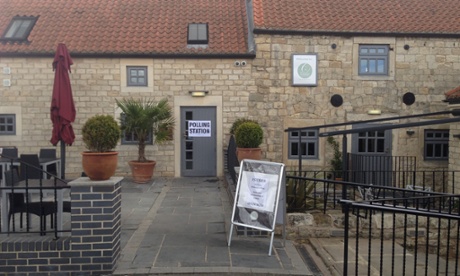
In Doncaster North, where Ed Miliband is defending a 10,909 majority, there was the traditional welcome for voters in the village of Cadeby, where the polling station is located in a back room of the local pub, the Cadeby Inn.
“We’ve had a polling station here for as long as I can remember,” said one barman. “People can vote and then have a drink – or have a few pints before they vote, if they wish.”
Doncaster North may be a safe Labour seat, but it is unclear how many people were backing Miliband in well-heeled Cadeby. “To be honest, I think they mostly vote Tory around here,” said the barman.
In the neighbouring constituency of Don Valley, where Labour’s Caroline Flint is defending a 3,595 majority, a number of people were obliged to vote inside parked cars, after arriving at a polling station in the town of Thorne at 7am, only to find that the key-keeper was late.
An election official told the @DonnyFreePress that “the Presiding Officer used initiative and utilised a car as a temporary polling booth for a short period”. However, one voter told the newspaper: “I was totally aghast.”
In Northern Ireland, my colleague Henry McDonald has this dispatch on the colourful PR tactics of the Alliance Party, as well as projected declaration times for diehard election fans/insomniacs.

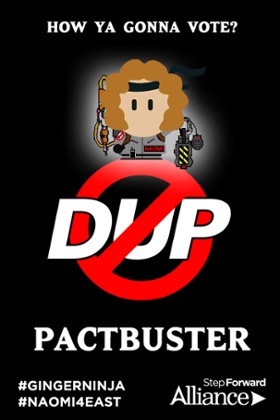
Naomi Long, who last time around was an embattled Alliance Party MP, has a ‘ginger ninja army’ marching behind her on polling day.
Playing on her flaming red hair, the Alliance have recast her as the ‘ginger ninja’ taking on the Democratic Unionist empire in the critical battleground of East Belfast.
Even if she fails to get re-elected her support team deserve an award from some of the most amusing and imaginative PR of the campaign.
Meanwhile, the Electoral Office has provided projected times of declarations for Northern Ireland. The earliest outcome to look out for is at 2.30am when Upper Bann declares. While the outgoing MP the Democratic Unionist Party’s David Simpson is still favourite to retain the seat the last few polls in the constituency suggest his Ulster Unionist rival Jo-Anne Dobson is going to run him very close. Here is the list of projected declaration times:
Foyle 1.45am
Antrim North 2am
Down North 2am
Lagan Valley 2.15am
Belfast West 2.15am
Antrim East 2.30am
Upper Bann 2.30am
Belfast North 2.30am
Belfast East 2.45am
Belfast South 2.45am
Tyrone West 2.45am
Strangford 3am
Antrim South 3am
Londonderry East 3.15am
Down South 3.45am
Newry & Armagh 3.45am
Ulster Mid 4am
Fermanagh & South Tyrone 5.15am
Updated
You may have seen this on Charlie Brooker’s Election Wipe last night: David Cameron’s “looking in the mirror” face. It’s really quite unsettling. Apparently it’s been floating round Twitter for a few days, but I hadn’t seen it. Thank God. A nice counterpoint to Ed’s “bacon butty” face.
David Cameron's mirror face accidentally captured on camera https://t.co/4rkcdhYeM2
— Naomi O'Leary (@NaomiOhReally) May 4, 2015
Boris Johnson casts vote
Boris Johnson, the mayor of London, has cast his vote in Islington, leaving it a good six hours later than the main party leaders, reports Robert Booth.
He voted, with his wife Marina, at the Hanover primary school not far from his home in an affluent area of Islington South and Finsbury, a solid Labour constituency.
Leaving, he said the day had been “terrific” so far. “I am very very hopeful we will be re-elected this afternoon,” he said.
He gave a quick interview in French to a French reporter but declined to answer questions about who he thought the next leader of the Conservative party should be and why the Conservatives did not appear to be on course for a majority.
Johnson arrived to vote at around 3.20pm and left just as the school was emptying out for the day. He was pursued down the street by children in chaotic scenes. He was also buttonholed by the father of Henry Hicks, an 18 year old who was killed in Islington when he came off his moped while being chased by a police car. Johnson agreed to look into his case and Mr Hicks fixed a campaign badge to his lapel.
The Conservative candidate in the constituency is Dr Mark Lim and the incumbent, with a 3,569 majority, is Emily Thornberry who resigned as shadow attorney general after being accused of a “snobbish” tweet showing a house with union jacks and a white van outside it in Rochester Kent.
The seat Johnson is contesting in a bid to return to parliament after he stood down seven years ago is 19 miles away on London’s western fringe, Uxbridge and South Ruislip.
Johnson had spent the morning at City Hall, where he is of course mayor, although he has spent much of the last two weeks campaigning hard in the tightest marginals in London.
Updated
What do chocolate, wine gums, bacon sandwiches, real ale, adrenaline, guarana, a crafty kip and coffee all have in common?
They form the wide range of stimulants favoured by politicians to get them through election results night, according to this report by Buzzfeed’s Emily Ashton.
Caroline Davies is still yomping around in David Cameron’s Witney constituency, where she has found what she believes is the beating Tory heart of affluent Oxfordshire.
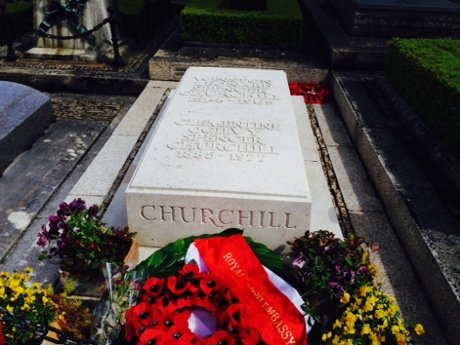
Polling station 90 is a mere 50 paces from the tomb of the Conservative wartime leader Sir Winston Churchill, who was born a stone’s throw away at Blenheim Palace.
There was a steady stream of voters making their way to St Martin’s Church in the tiny village of Bladon. But there seemed to be just as many tourists, eager to see the simple headstone in the modest family plot, on the eve of the 70th anniversary of VE Day tomorrow.
“Strange” said one visitor, who had travelled with his wife from Staffordshire on a day trip. “Churchill was praised for everything he did in the war, but then they got rid of him. He did make a comeback, though”.
Updated
Protest planned for Saturday if Cameron attempts 'constitutional coup'
A post-election protest has already been planned to oust David Cameron from power by a group claiming the Conservatives are planning to “occupy Downing Street” even if they do not win a majority.

The event, organised by anti-austerity group the People’s Assembly, is scheduled to take place on Saturday outside No 10.
A Facebook page for the protest, which has 1,000 people already confirmed to attend, makes the claim that Cameron’s party are “planning to declare that they are the legitimate government and have the right to form an administration”.
Organisers cite a recent Times editorial which urged Cameron to “occupy Downing Street” regardless of whether he has a majority in parliament, stating that this would be a “constitutional coup” against the wishes of the electorate.
You can read the full story here.
Updated
Do you find all this election stuff a bit baffling and wish someone would just sit you down and explain things s l o w l y … ?
The Guardian’s multimedia team have put together this cracking video guide to the election, which takes the hand of our international readers and explains stuff like a hung parliament, the royal prerogative – and why voters have turned off the Liberal Democrats. It’s actually quite amusing too.
Updated
The keen-eyed folk on the Guardian’s picture desk have been scouring the photographic wires for the weirdest and most wonderful polling stations across the country (and believe me, there are plenty). Here’s their selection of the best.
Updated
Here’s a report from my colleague Libby Brooks on a slightly more upbeat vibe in the Scottish Labour camp.

The old saw was that you could stick a red rosette on a monkey in Glasgow and it would get elected, such was the heartland support for the Labour party. No longer. I reported on the reasons why, and Scottish Labour leader Jim Murphy’s battle to win back ‘Glasgow man’, in the wake of Lord Ashcroft’s devastating February polling which suggested that the party would keep just one of its seven seats in the city.
But today, Glasgow Labour insiders I’ve been speaking too are notably more upbeat than they have been in recent months (caveat: these are Changed Times, so ‘upbeat’ means that they’re hopeful of saving a couple of seats rather than preparing for total wipeout).
Word is that former Scottish Labour deputy Anas Sarwar, Ian Davidson, Willie Bain and possibly Tom Harris will survive the night. (No word on Tom Harris’s dog: over the weekend the MP posted a bizarre re-election video in which he claimed to be “bored” of politics and instead offered viewers some canine antics).
Undecideds are a big factor, I’m told: “If you’re undecided now then you’ll go back to the devil you know”. Although tactical voting is little help in most Glasgow constituencies where there weren’t that many Tory or Lib Dem voters to begin with!
There’s also a belief that the “I voted yes but I”m not a nationalist” cohort will have been put off by the SNP’s continual substitution of party for nation in its rhetoric.
Updated
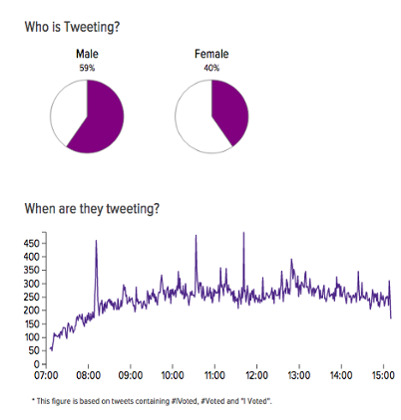
The map below shows tweets in the UK, where geographic data is available, and is based on tweets containing the terms: #IVoted, #Voted and “I Voted”.
Here is where people in the UK have tweeted #IVoted - super image of democratic expression. http://t.co/vFMBNgw41P pic.twitter.com/rp8bjnOecI
— Jamie Bartlett (@JamieJBartlett) May 7, 2015
There are more men than women sharing that they had voted on Twitter, according to Demos the think tank, which contrasts with Facebook where more women are sharing that they had voted.
Updated
With such a tight election, greater focus is being placed on the battles within individual constituencies. My colleague Richard Adams has this report on a Labour-Tory rivalry that is now entering its third consecutive election.
The South Swindon constituency could be a bellwether seat for Labour: the Conservative candidate Robert Buckland won the seat off Labour in 2010 with a 3,500 majority. A 3.8% swing from the Tories would be just enough for Labour to re-capture it, which should be possible if the national polls are right.
But on the ground is a different story from the national one. In 2015 Buckland is opposed by Labour’s Anne Snelgrove, who was the sitting MP in 2010 before she lost to Buckland. But in 2005 Snelgrove defeated Buckland for the same seat by 1,300 votes - meaning that today’s election is the third time the pair have competed against each other.
The score so far is Snelgrove 1, Buckland 1 - and South Swindon is now in extra time for a tie-breaker that could determine the next government.
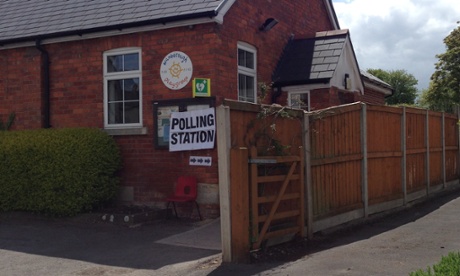
Although Swindon’s image is decidedly urban, South Swindon includes leafy hamlets such as Wanborough, with thatched cottages and a village store. The sole counter, a Conservative drafted in from a neighbouring safe seat, outside the polling station in the village hall says that voting has been quiet over the late morning and lunchtime.
To round out the South Swindon candidates: the Green party is represented by a colourful folk singer named Talis Kimberley-Fairbourn, while the Ukip candidate is the more prosaic John Short. The Lib Dem candidate is another 2010 retread, Damon Hooton.
Updated
It’s a thumbs up from Leanne Wood, the Plaid Cymru leader in Wales, who is pictured with candidate for Rhondda Shelley Rees-Owen after casting her vote.

My colleagues Abby Young-Powell and Natalie Gil have spoken to first-time voters about the issues that matter most to them for their Virgin Voters series.
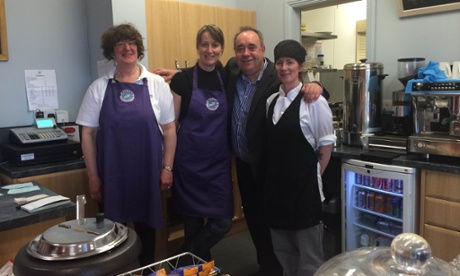
The Guardian’s Karen McVeigh has bumped into the former SNP leader Alex Salmond at a charity cafe in Newmachar, Aberdeenshire, from where she sends this report.
Salmond was taking a last-minute tour of the Axis Centre cafe, which is run by a Scottish employment charity for adults with learning difficulties, and happens to be next door to the polling station in the Gordon constituency in which he is standing.
Ebullient and relaxed, Salmond urged the Guardian to try the carrot cake before, when asked about his mood, embarking on a story about how golfer Gary Player winning the masters in 1974.
“We’re working very hard and we’re going to get everyone out,” Salmond said. “You know Gary Player was asked if he felt lucky winning the masters at the age of 40? He said: ‘You know it’s a strange thing – the harder I work the luckier I get.”
Updated
I’m a voter: sharing on social media
After weeks of party political campaigning by candidates and activists on the doorstep and online, it’s now the voters’ turn to brag about their franchise on social media.
By this morning, more than one million people had used a special button on Facebook to share the news that they have voted in the UK general election.
It’s the first time the social media site has had a “I’m a Voter button” in a UK General Election, so that voters could share the news with their friends.

35 million Facebook users in the UK have access to it, and according to the the site the most discussed election issue is the economy.
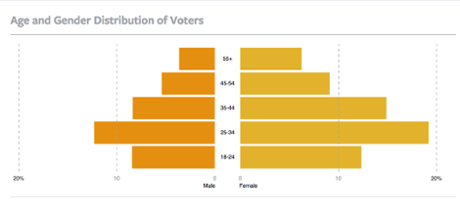
Women in the 25-34 age bracket have shared that they’ve voted the most, according to Facebook data.
The tool, as pictured above, has been used in European elections in the past, as well as the last three US presidential elections.
Facebook says it believes it can have a positive effect on voter turnout, and points to a study carried out in 2012 by science journal Nature that found that 300,000 people went to the polls in the US because they saw news of their friends voting on the social network.
Meanwhile, Twitter has introduced the #IVoted hashflag:
Updated
Forget about #JeSuisEd and #milifandom - the most awesome trending hashtag of the 2015 election has arrived on polling day.
#DogsAtPollingStations
#DogsAtPollingStations pic.twitter.com/ypqwL9Gghi
— Lauren Potts (@_LaurenPotts) May 7, 2015
Who you voting for pup? #DogsAtPollingStations pic.twitter.com/F6r6yv8bku
— Sophie Dare-Edwards (@SophDareE) May 7, 2015
Inca #DogsAtPollingStations #VoteLab pic.twitter.com/nVLUOo3oy4
— nshearing (@medazzanick) May 7, 2015
#DogsAtPollingStations Stanley first in the queue this morning at #Penistone polling station, Yorkshire #GE2015 pic.twitter.com/WPy9c0CDUD
— Wendy Michallat (@wmichallat) May 7, 2015
#ElectionDay #ElectionSelfie #DogsAtPollingStations pic.twitter.com/0ndFzt616X
— Sage Wonderland (@SageWonderland) May 7, 2015
Some moving words and images in tribute to the late Tony Benn have emerged on Twitter.
Someone has left roses by Tony Benn on my office wall. @hilarybennmp pic.twitter.com/ErtBa8pmQ2
— Kerry McCarthy (@KerryMP) May 7, 2015
Thank you to whoever put the lovely flowers there. We miss him. https://t.co/eWnlWGrgI0
— Hilary Benn (@hilarybennmp) May 7, 2015
This is fun - and helpful for any of you planning to hit the pro-plus and pull an all-nighter with Dimbleby or Paxman tonight as the election results roll in.
Democratic Dashboard, based within the London School of Economics, have produced this map of declaration times based on forecast data collated by the Press Association.

In the marginal seat of Nuneaton, Warkwickshire, my colleague Holly Watt says you would not know there was an election going on. She writes:
The Tories’ Marcus Jones is defending a slim majority of about 2,000, but there isn’t so much as a poster to be seen.
Thomas Gunns, 20, said he would not be voting despite reading all the leaflets put through the door.
“I know what all the policies are, but I don’t have strong enough views to decide,” he said.
“I don’t want the Conservatives to win overall though,” he said. “I was unemployed for over a year, and they just want you off the list. They don’t care about what job it is.”
Gunns has now got a job at B&M stores.
His fiancée Marie Green said that she had decided how she would vote and would get to the polling station before they closed in the marginal seat.
“I think it is really important to vote,” she said. “We had Ed Miliband and David Cameron up here, but people just wanted to take selfies with them.”
Voters in the main shopping centre said they had received “hundreds” of leaflets in recent months, but many had only just decided how they would vote.
Nuneaton will be one of the first marginals to declare, with the results coming at 1am.
If Labour’s Victoria Fowler manages to turn the seat, it will point towards a good evening for Ed Miliband.
Lynn Hurley, who works in a local pet shop, said that she planned to vote later, having only made up her mind this morning.
She said she didn’t feel that Nuneaton had seen many improvements in the last five years.
“We’ve lost a lot of shops. It doesn’t feel like it is getting better.”
Updated
Green candidate urges supporters to vote Labour
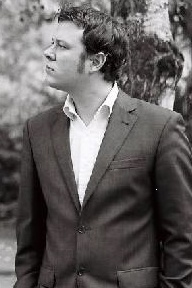
Here’s a rare case of a candidate who doesn’t want any votes – and may not even mark an X next to his own name. James Parker, the Green candidate for the south London marginal of Eltham, has told his supporters they should give their votes to Labour, Jessica Elgot reports.
Parker, whose south London constituency is a Labour seat with a slim marginal of under 1,700 votes, told the Guardian he wanted to see Ed Miliband as prime minister.
“If you are voting Green in Eltham as a protest, do vote for Clive Efford, the Labour candidate,” Parker said. “If you really feel Green in your heart, then vote for me, but it is more important that we don’t have a Conservative government.”
Parker, who said he was genuinely still torn as to whether he would vote for himself, said he was hoping for Green victories in some of the closer seats, like Brighton Pavilion and Bristol West, but said he did not want people to vote Green where candidates, like him, could not win and where Labour was battling Tories.
Parker, a former Labour party member who left after the Iraq war, said. he wanted to see “a Labour government with Green influence.”
“The centre ground is between the Greens and Labour now,” he said. “I think as a party we could have played it better at this tactically, and stood down in areas where Labour were fighting the Conservatives, and Labour could have stood back in seats where we might win from the Lib Dems and the Tories.
“I’d like to see us work together. We on the left should not give in to competitive self-interest.”
Updated
Darlington’s Ukip candidate David Hodgson has told the Northern Echo his omission from a batch of ballot papers has “knocked me sick”.
He told the paper:
It’s shocking - absolutely terrible and inexcusable. I understand the Ukip office has been informed and will be lodging a protest.
I don’t know what happenened but surely some law has been breached. I’ve not got a clue what happens now but I’m guessing the only way to resolve it is for it to be re-run.
Lunchtime summary
With less than eight hours to go before the polls close, here’s what we know midway through voting for the closest-fought general election in years:
- A Guardian/ICM poll taken on the eve of voting shows Labour edging ahead of the Conservatives by one point. It puts Ed Miliband’s party on 35%, just ahead of the Tories on 34%, with Ukip on 11%, the Lib Dems on 9%, the SNP on 5% (in a UK-wide poll) and the Greens on 4%.
- The knife-edge nature of the poll echoed others issued on Thursday, with the final Ipsos-Mori numbers putting the Conservatives down one point to 36%, and Labour up five points to 35%.
- And a snapshot from Lord Ashcroft’s polling had Labour and the Tories in a dead-heat at 33% each.
Here’s the final round-up of the polls, which puts the two leading parties on an uncomfortably snug 273 seats each:
- Party leaders have cast their votes, with David Cameron in Witney, Ed Miliband in Doncaster North, Nick Clegg in Sheffield Hallam, Natalie Bennett in Holborn and St Pancras and Nigel Farage in South Thanet all, presumably, crossing their ballots as you’d imagine (the law dictates we don’t ask them to tell us).
- Nicola Sturgeon, the SNP leader, did not have the chance to pencil a mark by her own name, as she is not standing for election today. She voted in Glasgow East, the constituency of would-be SNP MP Natalie McGarry.

- The FTSE 100 index of top shares had an early wobble, before recovering a little, but is still down 88 points or almost 1.3% at 6845. For analysis on whether this is the ominous-sounding “fallout Friday” come a day early – spoiler alert: not really, no – take a look here.
- Darlington council has been forced to reissue ballot papers after it emerged that some were missing the Ukip candidate’s name. The council said 89 ballot papers – 0.1% of the total – had failed to include the name of David Hodgson, but the mistake had been rectified (it’s not clear when) and voting was continuing as normal.

- There have been – so far unverified – reports of irregularities in other areas, with an IT glitch affecting some voter registrations in Hackney and Dorset and the Scottish Tory leader, Ruth Davidson, tweeting rumours of apparent intimidation of voters at a polling station in Annan. These have so far been confirmed. Guardian reporters are looking into all such claims and will report back via this blog.
- Polling stations will remain open until 10pm tonight, with anyone in the queue at that point having the right to cast their vote. Try not to be too late, though: we’ve all got results night to be getting on with.
I’m signing off for today now, leaving you in the steady hands of Jamie Grierson. Andrew Sparrow will take the reins this evening to gallop you through all the results. And I’ll be back bright and early on Friday morning to try to tell you what on earth it all means.
Thanks for reading, and please keep doing so!
Updated
Ukip candidate missed off ballot papers
Back to Darlington, it has been confirmed that a Ukip candidate was missed off ballot papers sent to a polling station in the constituency.
Ukip’s David Hodgson was not included on the electoral forms, a spokesman for Darlington Borough Council says.
Around 89 ballot papers - 0.1% of the total number of ballot papers printed - had been handed out to voters before the issue was flagged and corrected.
SNP could take three of Edinburgh's five seats
Election candidates in Edinburgh’s five seats are mobilising heavy “get out the vote” campaigns, with Labour and the Lib Dems struggling to hold off the Scottish National party surge.
In a city which heavily voted no to independence, where seats traditionally swap between Labour, the Lib Dems and the Tories, the SNP are poised to win two if not three of its five Westminster constituencies for the first time – a watershed moment for the party and the Scottish capital.
Ian Murray, the defending Labour MP for Edinburgh South and shadow Labour business minister, despatched seven “get out the vote teams” from his offices on Thursday morning with the exhortation: “Let’s get out and win this.”
.@IanMurrayMP sends out "largest #GOTV operation ever" as @scottishlabour battles for one of its 4 #Edinburgh seats pic.twitter.com/VzDgKj9lRI
— Severin Carrell (@severincarrell) May 7, 2015
The SNP are his only challengers now, and they have taken Labour’s voters. In a seat historically split cleanly between the three pro-UK parties, he will have to lean heavily on tactical voting to win.
And he insists Labour’s core vote is stronger than the polls imply. He says Labour and pro-UK votes are quiet, restrained but equally as resolved as the SNP’s showy support.
“If you’re voting SNP, you shout it from the rooftops and putting posters in your windows, but there are those quietly going about their business who still vote, quietly, vote for the party they want to vote for. They’re just not shouting it from the rooftops,” he said.
Updated
My colleague Robert Booth is in Uxbridge and South Ruislip, where Boris Johnson is hoping to be returned to parliament tonight. He writes:
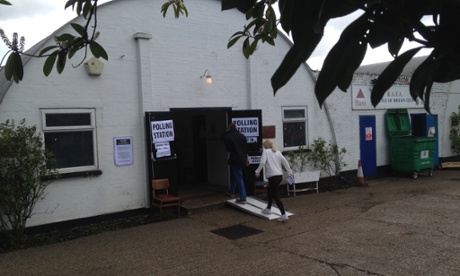
One polling station is located in a World War Two Nissen hut with a fully-stocked bar attached for thirsty voters. This is the Battle of Britain Club, part of the RAF Association, where the walls are adorned with huge paintings of dog fights, Mescherschmitts and Spitfires. It seems appropriate, given the London mayor’s strong identification with Winston Churchill, and tomorrow’s VE day memorial celebrations.
Johnson is up against 12 other candidates in one of the longest ballot papers in the election. Lord Toby Jug of the Eccentric Party of Great Britain and Howling ‘Laud’ Hope of the Monster Raving Looney Party are among them.
A steady stream of voters has been filing in and out and in the neighbouring bar, Simon Butler, 53, a publican, reflected on his eighth general election campaign as a voter: “If you don’t put your cross in the box you don’t have the right to moan”.
“I am most worried about who they are going to share the term with,” he said. “Sturgeon. She could be a disaster if anyone gets into bed with her.”
Angus Bugg-Miller, 20, a first time voter in a general election, said that he had considered not voting, believing strongly in the creed of direct action espoused by Russell Brand, who until last week encouraged followers to not vote.
“I follow Brand quite closely and his endorsement of the Labour party was quite important,” he said. “It was terrible timing [after the voter registration deadline] but he’s come to the conclusion it is an emergency. There are UKIP candidates around.”
The rise of the Scottish independence movement and multi-party politics which unnerve many voters cheers this second year university student.
“People are talking about devolution and that’s exciting,” he said. “That’s what we need. My generation is fundamentally different. There are two routes to change: direct action and the election route which I am trying here today. You have to try once.”
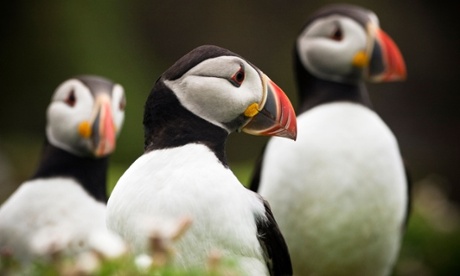
There is, of course, another vote of national importance taking place today - a poll to choose Britain’s national bird.
The ‘election’ will close at midnight and 116,000 people have already cast their vote, Karl Mathiesen writes.
So will the Puffin take it? Or perhaps the Hen Harrier? Or perhaps there will be an unprecedented coalition between the Blue Tit and the red Robin?
Updated
Up in Annan, in Dumfries and Galloway, Scottish Tory leader Ruth Davidson has flagged claims of potentially serious intimidation outside a polling station.
Disturbing reports of people being turned away from an Annan polling station by burly blokes if they say they don't support a certain party.
— Ruth Davidson MSP (@RuthDavidsonMSP) May 7, 2015
Updated
IT glitch causes voting problems in east London and Dorset

My colleague Rajeev Syal reports that voters in parts of east London and Dorset have been told that IT glitches meant they were not registered on the electoral roll, despite many having polling cards.
Also, some Britons who live abroad have complained that postal votes have arrived too late to guarantee they can exercise their democratic rights. Rajeev writes:
In Hackney, where at least 30 people queued to complain outside the town hall, Alix Rowe was one of those left disenfranchised by the problems.
The 23-year-old, who works in fashion PR, registered to vote before the deadline but did not receive a polling card. Knowing that it was not necessary to have a polling card, she went to two local polling stations but was told her name was not registered and they could not help her.
“I feel like a right has been taken away from me,” she said. “One of my colleagues had the same problem but was told they would try and process it today, although there was no guarantee, but that option wasn’t given to me. It seems ridiculous. Everyone’s saying how close the election is, how important it is to vote.”
Meanwhile, some people were unable to cast their vote in the local elections in the Kinson North and Kinson South wards of Bournemouth, Dorset, due to the mix-up.
It was noticed early on that books of ballot papers issued to polling staff in Kinson North had covers marked ‘Kinson South’ and vice versa.
Tony Williams, the chief executive of Bournemouth council, who is acting returning officer in the elections, apologised for the problem which he blamed on a printing error.
An Electoral Commission spokeswoman said: “We are aware of the issues in Hackney, which we understand at this stage relate to specific problems they have identified with their IT system. Any voter that has concerns about whether they are registered, for instance because they have not received a poll card, should contact their electoral services team in Hackney to check this and if needed, to find out where their polling station is.”
“We are aware that some overseas voters have raised concerns that they have not received their postal ballot packs and we will look carefully at the evidence shared with us on this when we consider what issues to raise in our statutory election report, which will be laid in the UK parliament in the summer, she added.
Updated
There are concerns being raised on Twitter over a possible error on ballot papers in Darlington - they’ve reportedly missed one or more parliamentary candidates off the list.
We’re looking into this now but here’s an initial spread of tweets on a potentially serious cock-up.
We've just received word that ballot papers for the Darlington constituency have omitted one or more the parliamentary candidates.
— Britain Elects (@britainelects) May 7, 2015
Darlington Council confirms they will release a statement ASAP in response to social media reports a candidate was left off ballot papers
— Jon Stone (@joncstone) May 7, 2015
How could someone leave a candidate off the election ballot ? Seriously. A Labour marginal seat . What a mess ! #Darlington
— Jane Samuels (@Jane_Samuels) May 7, 2015
London Underground staff may be reminded of rules about political neutrality after a series of cheeky election messages appeared on station information board, reports Matthew Weaver.
The boards, which are supposed to be reserved for service updates, have been used by staff to give their thoughts on the election.
The messages have so far stopped short of overtly endorsing any particular political party, though some have come close. A message at Oval station urged commuters to protect services.
The RMT union, which backs the Trade Unionist and Socialist Coalition, insisted it was not behind the messages, including one that urged voters to put their country before themselves.
The RMT spokesman Geoff Martin said: “We don’t get involved. They just seem to emerge.”
Thursday 7th May "Revised " Thought Of The Day pic.twitter.com/zGkIUtyahx
— Oval Tube Station (@Oval_station) May 7, 2015
A Transport for London spokesman said station staff may receive a reminder of the rules about political neutrality on polling day even if they came close to being breached.
“Most staff do tend to know the rules. If there are any signs that do appear to be close to the mark, stations may be given a reminder of the rules,” he said.
Updated
The Guardian’s Matthew Taylor is in south London, where he finds Labour activists in chipper mood:
In Battersea, south London, there was an impressive turnout of Labour activists this morning, with volunteers queuing outside the party’s offices to help get the vote out. But will it be enough?
The seat is currently held by the Tories with a majority of just under 6,000 and a recent poll from Lord Ashcroft put the Conservatives comfortably in front.
However, a series of London-wide surveys suggest a big swing to Labour in the capital, with the party consistently 12% to 14% ahead of the Tories and poised to claim anywhere between six and 12 seats.
Battersea is at the very outer limit of Labour’s ambitions in the capital, but judging by the levels of activity on the ground this morning, and in recent weeks, the party certainly believes it is going to be close.
The seat declares at 2am and will provide an early indication of how far the Labour tide might reach in London. If Labour is anywhere near, it will be an ominous sign for the Tories, but if the Ashcroft poll proves accurate Labour could be in for a long night.
Good afternoon, Jamie Grierson here. I’m just signing in as Claire writes up a summary of the events so far on this fair polling day.
I’ll kick off with these wise words from Guardian columnist Polly Toynbee - every vote counts – to waste yours would be near-criminal.
What matters is not what your vote says about you, but how you use your vote for the good of the country and for others.
Follow me on Twitter here. And please keep comments coming in below the line.
Always my favourite diversion on polling day – plan your next house move based on which area has the most appealing polling station.
You could do worse than a polling station in a pub, to be honest:

A little rough-and-ready, but a turnstile would keep those queues in line:

This funeral home polling station isn’t really working for me, I’ll be honest:

Police officers have been posted at every polling station in an east London constituency where a recent voting scandal led to the removal of the local mayor Lutfur Rahman after the high court found him guilty of corruption, reports my colleague Jessica Elgot.

Today there are more than 340 police officers on election duties in the borough and voters will have specific walkways into polling stations to ensure they cannot be harassed by groups congregating outside.
A Tower Hamlets spokesperson said the plan had been approved prior to the high court judgment on Rahman, which said voters in the borough had previously been subject to intimidation.
Here’s what Tower Hamlets has in place for polling day:
- A mobile police team on standby to respond to reported incidents.
- A marked area in front of each polling place to keep the area clear to ensure voters have easy access to cast their vote.
- Police tasked with preventing large groups of supporters from congregating around polling stations and obstructing voters.
- Allegations made to the returning officer will be investigated fully and responded to within 24 hours.
Passing through Tower Hamlets polling stations, local voters have been noticing the increased presence.
Just voted. Two police and one security guard at my polling station in Tower Hamlets.
— Dan Sheldon (@sheldonline) May 7, 2015
My polling station has a police presence today (along with all in Tower Hamlets). Democracy is a precious thing. #IVoted
— Andy Willimott (@AndyWillimott) May 7, 2015
Rahman’s Tower Hamlets First party falsified postal votes and put undue pressure on voters at polling stations during the 2014 local and European elections, the high court said. The final result – now voided – was not announced for five days after the election, with the borough criticised by the Electoral Commission which said there was “action needed to restore confidence”.
Local police officers also said they were investigating reports of anti-voting leaflets being distributed in the borough, which apparently call on Muslim residents not to participate in the general election.
Poplar residents woke up to these leaflets on their cars this morning: pic.twitter.com/N4ix6ulR9n
— AlexisFlynn (@AlexisFlynn) May 7, 2015
Updated
Final polls showing move towards Labour, says Lord Ashcroft
The final Guardian/ICM poll of the election campaign is out, and Labour leads by one point. Going through the final batch of figures from all the polling companies reveals one clear trend: if the last minute swing that Lynton Crosby was expecting has happened, it has been towards Labour.
Even Lord Ashcroft, the Tory peer who has ploughed his vast wealth into paying for constituency-level polling, agrees:
All the final polls so far seem to be showing a move towards Labour...
— Lord Ashcroft (@LordAshcroft) May 7, 2015
The last set of phone polls, which up until last week had the Conservatives consistently ahead, are now all pointing to a late swing to Labour.
All the final polls - phone and web - show that Labour and the Tories are virtually tied:
All the final polls are in: 1 2pt Lab lead 1 1pt Lab lead 5 ties 4 1pt Tory leads So a dead heat. They're all right or all wrong.
— Sam Freedman (@Samfr) May 7, 2015
The Guardian’s final projection has the Tories and Labour tied on who will the most seats; it’s too close to call and in large part will depend on the size of Labour’s loss in Scotland.
The Tories are marginally ahead in our average of polls (34% to 33.7%) and will probably win more votes than Labour. Crucially though, if the polls are right, David Cameron is unlikely to have the numbers he needs to stay as prime minister – and for this prediction to be overturned all the polls would need to be wrong.
Updated
Rain on polling day isn’t great news for party activists, who have to chivvy voters that little bit harder to pull their wellies on and get to a polling station.
Nick Clegg, however, has a mac and he isn’t afraid to use it:
Not the best weather on polling day in Sheffield Hallam but enjoyable being on the doorstep all the same. pic.twitter.com/6uWonIUdrh
— Nick Clegg (@nick_clegg) May 7, 2015
My colleague Dominic Smith has sniffed-out a polling station with a story to tell in West Yorkshire. Sniffed-out being an apt description for the Pie Hall in Denby Dale, which has a proud history as the home of Britain’s attempts to claim the world record for baking the biggest pie.
A key battleground in the Tory-Labour marginal constituency of Dewsbury, which both parties realistically need to win if they have any hope of forming a majority government, streams of Denby Dale residents took advantage of a brief blast of lunchtime sunshine to cast their vote in the village Pie Hall.
Hopefully they’d eaten first though, as the hall showcases memorabilia from the village’s ten previous gut-busting communal pie bakes to celebrate momentous events in British history.
The latest effort in 2000 to mark the turn of the Millennium is said to have contained five tons of beef and 200 pints of John Smith’s bitter, and the pie dish from the 1964 effort, the proceeds of which were used to build the community hall, now acts as a giant flower tub at the Pie Hall’s entrance.
Incumbent Dewsbury Tory MP Simon Reevell is defending a 1,526 majority from Labour challenger Paula Sherriff.
Scene of unusual polling station in Dewsbury constituency pic.twitter.com/Jscc6ECm0X
— Dominic Smith (@domsmithy89) May 7, 2015
That's a big pie pic.twitter.com/jbqyNusbVd
— Dominic Smith (@domsmithy89) May 7, 2015
More on that Guardian/ICM poll, the final indication before we move into exit poll territory after 10pm tonight.
Some 2,023 adults aged 18+ were interviewed by telephone between 3 and 6 May.
Here’s how it affects seat numbers: we still see the Tories and Labour tied on 273 seats each, but the anti-Tory bloc outweighs those who whom David Cameron might be expected to work.
Final @guardian #GE2015 prediction - Cameron unlikely to have the numbers to stay as PM http://t.co/0uE4TDYmvd pic.twitter.com/ODnJrKtbp9
— Alberto Nardelli (@AlbertoNardelli) May 7, 2015
Labour has one-point lead over Tories in final Guardian/ICM poll
Labour has moved into a wafer-thin one-point lead in the final pre-election Guardian/ICM poll, leaving the country on a knife-edge with the markets starting to jitter.
Read the full story here; I will pick out key points in a moment.
Back in the City, the FTSE 100 index of top shares has recovered a little, but is still down 88 points or almost 1.3% at 6845.
Financial experts fear there could be mayhem later this month if the next government’s Queen speech was to be rejected.
Peter Cameron, assistant fund manager at Ecclesiastical Investment Management, says:
The key date for investors is probably not until the 27th May, when the new government has to deliver its legislative agenda for the year through the Queen’s Speech.
If a stable coalition is not in place by then and if the speech is voted down, this has the potential to spark panic on the market and trigger a flight out of UK assets.
There could be “pretty extreme market moves” on Friday morning, Cameron (no, not the PM) predicts, if there is a clear result.
The gap in policy between the manifestos of the two main parties is as great as it has been for decades. Perhaps not since Thatcher vs Foot have we seen such a difference in the direction the parties want the country to head. Throw in a larger than ever share of the vote for the smaller parties and this election has the potential to trigger all manner of unpredictable market reactions.
Back to south Wales, where the Guardian’s Steven Morris is touring Aberavon with Labour candidate Stephen Kinnock:
Kinnock has parted for the moment from his wife, the Danish prime minister Helle Thorning-Schmidt, and is being driven around the Aberavon constituency by his friend Jill, getting the Labour vote out.
Has it been fun? “It’s been hard work. There are parts of this constituency that are very hilly and we’ve had some days where there has been rain, hail, storms and you’re wearing out a lot of shoe leather.”
So why here, why now?
“It’s a calling – going into politics is a vocation, something I’ve wanted to do for a long time. I really wanted to get some experience outside the world of politics before going into it. I think it’s good to have been outside the Westminster bubble.
“I’m a proud Welshman: I was born 25, 30 miles up the road. I’m not a Port Talbot boy born and bred, but I’ve always felt an incredible affinity with the challenges of south Wales and the opportunities.”
He says people ask him about his dad – Neil Kinnock – less and less as they get to know him. “There has been less of the questions about dad and my family; more about me and my values, what I can contribute.”
Having accompanied him to the polling station for him to vote, Thorning-Schmidt is taking more of a backseat. She hasn’t campaigned with him – the thought was that David Cameron would not have been impressed.
“She would like to have. There was a worry it might cause a diplomatic incident. She’s here today. She’s giving me moral support. She’ll be in the car driving around a bit – it’s a good chance for her to see the constituency.
“She’ll be at the count but keeping a relatively low profile.”
Stephen Kinnock (son of Neil) helping get out the vote in Port Talbot, South Wales. pic.twitter.com/p1bi8CYjrC
— steven morris (@stevenmorris20) May 7, 2015
An international rescue mission for Ed Miliband – from his brother.
(That’s not cutting election satire, by the way, though of course you’d expect that from this live blog. David Miliband is literally chief executive of the International Rescue Committee in New York.)
If you are British and can get to a polling station, please vote, and please vote #Labour #Ed4PM
— David Miliband (@DMiliband) May 7, 2015
Nick Clegg votes in Sheffield Hallam - video
The Liberal Democrat leader arrives with his wife Miriam to cast his vote in his Sheffield Hallam constituency. Polls are so tight there that you’d expect Clegg to be taking no chances with a magnanimous vote for anyone else.
My colleague Libby Brooks has hopped over to Glasgow North, where she finds Labour campaigners not taking predicted defeat lying down:
At a polling station in Hillhead, Glasgow North, held by Labour’s Ann McKechin on the slimmest majority in the city, the staff tell me that this has thus far been the busiest election they have ever staffed. This is certainly encouraging news for those who hoped that the huge engagement and high turnout in last September’s independence referendum would have a knock-on effect on voting behaviour. And it is likewise good news for the SNP, the party it is generally agreed is favoured by a higher turnout.
The SNP came third behind the Lib Dems here in 2010: now local organiser turned candidate Patrick Grady is in a tight race with McKechin. Out canvassing with Grady last week, I was struck by the number of pensioners – hardly his traditional demographic – who were telling him that they were voting SNP.
By the polling station, Labour activists tell me that their own canvass have been about 50/50. “Our support hasn’t crashed here,” they say, a wee bit defensively.
Nearby, Mary-Anne MacLeod is leafletting for the Scottish Greens: “People are saying they’re voting Green next time but SNP this time,” she explains. Taking in Glasgow University and a chunk of the affluent West End, this constituency has a reasonable Green vote. MacLeod herself joined the party soon after the referendum. “You can spend a long time complaining from your armchair,” she smiles.
Visiting polling station in Glasgow North: "our support hasn't *crashed*" one Labour activist insists #GE2015 pic.twitter.com/lNuDu2iNHi
— Libby Brooks (@libby_brooks) May 7, 2015
What does that dip in the FTSE mean, then, if it means anything at all? Heather Stewart, the Observer’s economics editor, has some quick analysis:
Has “fallout Friday” come early? That was the nickname given by George Osborne to the risk that financial markets would plunge tomorrow morning, if City investors wake up and discover that Ed Miliband – and his new pals from Scotland – are in charge.
Are traders already getting cold feet about the idea of a prolonged period of post-election uncertainty?
The answer is, mostly, no: and it matters, because in 2010 both the Conservatives and the LibDems used the threat of financial market turmoil, and a potential buyers’ strike by bondholders, to justify the decision to enter into an “emergency” coalition, whose raison d’etre was to tackle the deficit.
It’s absolutely true that financial markets hate uncertainty, and this general election has bucketloads of that. But the turmoil has roiled markets from Mumbai to Frankfurt – where the yields, or interest rates, on German government bonds have shot up.
Janet Yellen, the Federal Reserve chairman, mused last night that share prices might be a wee bit too high; global oil prices have jumped, raising doubts about the pace of world economic growth; and Greece is still trying to negotiate its way out of bankruptcy by Monday. That’s plenty for City traders to chew over, even before the ballot boxes are closed.
Ipsos Mori: Tories 36%, Labour 35%
And now we have the final Ipsos Mori poll, which has the Conservatives down one point to 36%, and Labour up five points to 35%.
I think the expression required here is nip-and-tuck.
Latest Ipsos-MORI poll: CON - 36% (+1) LAB - 35% (+5) UKIP - 11% (+1) LDEM - 8% (-) GRN - 5% (-3)
— Britain Elects (@britainelects) May 7, 2015
Ashcroft poll puts Tories and Labour on 33% each
Lord Ashcroft has published his final poll – he’s tweeted it, see below, though it’s a little hard to read.
The key stats are these:
Asked if there were a general election tomorrow, which party would you vote for?
(The interviews were carried out on 5 and 6 May. We will have to assume that if people were asked today how they would vote in another general election tomorrow, the responses might be more blunt.)
- Conservatives 33%
- Labour 33%
- Ukip 11%
- Lib Dems 10%
- Green party 6%
79% of those polled said they would vote that way today.
Today’s 3,000-sample Ashcroft National Poll at a glance. The final snapshot! pic.twitter.com/GAV9pI00dm
— Lord Ashcroft (@LordAshcroft) May 7, 2015
Updated
There are reports that my green light for pet owners to drag their pooches along to the polling booth (see 10.08am) may not be holding up everywhere.
@marksmith174 re Dogs in polling stns, it does depend on whether dogs are allowed in the bldg. Dogs forbidden at my local school/polling stn
— Peter Thompson (@PeterThompson66) May 7, 2015
Though there is nothing in election law that means pets are banned – so long as they do not cause disruption – the definition of “disruption” is very much open to interpretation by the official in charge at a particular polling station (and there’s bound to be some dog-haters among them). And if the building being used has a no-pets policy, then you’d best find a handy railing outside for that lead.
The Guardian’s Ben Quinn is on the trail of the Ukip leader in Kent:
I’ve been catching up with Nigel Farage, who has been strolling through the streets of Ramsgate in the morning sunshine accompanied by his team of advisors and security guards.
The Ukip leader, who voted early this morning, said a potentially “massive difference” to the result here in South Thanet would be made as a result of what the so-called “Shy Kippers” – people who are considering voting for his party but have not admitted to it in polling.
“Over the campaign we have got through to lots and lots of people who have not been interested in politics, first-time voters who have said ‘we are with you and we will vote for you’,” he said.
“My worry is that if they get back from work at 7pm and perhaps had a rotten day, decide to just pour a glass of wine, then we might not get them.”
As usual here, plenty of people are coming forward to shake his hand, and he’s signing copies of his book and Ukip election boards.
But he’s also polarising as usual. A couple of young women at the branch of Caffe Nero where Farage was having coffee said they were disgusted to see him and debated going over to heckle, before deciding against it. They’re Labour supporters but are hoping that the Conservative candidate, Craig MacKinlay, will stop Farage.
Still at it.. Nigel Farage strolling through ramsgate centre this morning, signing banners & books https://t.co/yD6R4PPCod
— Ben Quinn (@BenQuinn75) May 7, 2015
I’m pretty sure this is an election day first, at least for the Guardian (other publications’ mileage may vary).
James Wannerton from Blackpool has a rare condition called lexical-gustatory synaesthesia, which means he can taste words and sounds. For the general election, he has teamed up with artist Sam Cornwell to show how each political leader tastes.
Nick Clegg tastes like pickled onions, elastic bands, a meatless lamb leg and a dribble of yoghurt, we are told. The strong of stomach can see the full, um, delicious range of dishes here.
Meanwhile, in the Rhondda, there’s simpler fare on offer. I’m impressed that the commitment to alliteration led them away from the Ed’s bacon sandwich route.
Election fever yn y #rhondda ! @LeanneWood even on the menu! @Plaid_Cymru @shelleyreesowen pic.twitter.com/xjyGabVFIK
— Cynan Llwyd (@CynanLlwyd) May 7, 2015
Some more background here on that curious Telegraph email to readers, in which editor Chris Evans exhorted them to vote for the Conservatives.
It appears that it was sent to everyone who had “agreed to receive marketing messages by email from Telegraph Media Group”, which apparently included those who’d signed up for its tech or finance bulletins. Instead they were warned of the perils of voting for “the most leftwing Labour leader for a generation”.
Douglas Alexander faces tight race with 20-year-old SNP candidate
My colleague Owen Duffy has this bulletin from the seat of Paisley and Renfrewshire South, where polls say Labour’s campaign chief and presumptive foreign secretary could be one of election night’s biggest beasts to be scalped.
In theory, the seat should be one of Labour’s safest seats in Scotland. A largely working-class community on the western edge of Glasgow, it has long been regarded as a rock solid stronghold for the party.
Incumbent MP Douglas Alexander has been in place for 18 years. A former minister under Tony Blair and Gordon Brown, he is the architect of Labour’s election strategy north of the border. In 2010 he held his seat with a comfortable majority of over 16,000, gaining nearly 60% of votes cast. But in post-referendum Scotland, previously unassailable Labour seats are suddenly up for grabs.

Working to unseat Alexander is SNP candidate Mhairi Black, a 20-year-old politics student at the University of Glasgow. An outspoken and confident campaigner, she would be among the youngest people ever to sit in the House of Commons if elected. (NB: we were incorrect to initially say that she would be the youngest – Christopher Monck, second Duke of Albemarle, was elected aged 13 in 1667.)
Black has drawn criticism over remarks she made at a pro-independence rally, where she told supporters she had wanted to “put the nut in” - or headbutt - Labour councillors.
But if polls are to be believed, she is on course to depose one of Scottish Labour’s most prominent figures - a clear sign of the magnitude of the change Scottish politics has undergone since the nation voted to remain part of the UK last September.
Updated
Guardian reporter Juliette Jowit is in Twickenham, where Lib Dem stalwart Vince Cable has just left the polling station:
Business secretary Vince Cable has voted in his Twickenham constituency.
The Lib Dem MP is defending a majority of 12,000, but Tories are treating the seat as a marginal after an ICM constituency poll last year showed more support for the Conservatives, albeit with one in three voters undecided.
Recent private polling suggested the Lib Dem majority could fall closer to 3,000, and prime minister David Cameron made a visit to his candidate, NHS doctor and local councillor Tania Mathias, on Tuesday.
However Cable’s team will be hoping his undoubtedly popular presence on the doorstep in the last week or so will have swung more votes their way.
One way to get out the vote. Twickenham, SW London pic.twitter.com/xphMwVNPKV
— Juliette Jowit (@JulietteJowit) May 7, 2015
Updated
Shares in London suffer sharp falls
The FTSE 100 has fallen to a one-month low, as UK election jitters add to a global markets sell-off after Federal Reserve chair Janet Yellen warned share valuations could be dangerously high.
The leading FTSE 100 index tumbled by 121 points, or 1.7%, to 6813, as voters headed for the polls in what is expected to be one of the closest elections in years, with the major parties neck and neck in opinion polls.
Andy McLevey at Interactive Investor said: “European equity markets are tracking the US and Asia lower this morning as Fed Chair Janet Yellen cautions that equity valuations are ‘quite high’. As UK voters go to the polls, uncertainty surrounding the outcome of the UK election is also preying on sentiment as cautious investors remain on the sidelines.”
Dafydd Davies at Charles Hanover Investments told Reuters: “Given the [market] rally we’ve had so far this year, you could not say the mood is too alarmist over the election outcome.
“However, the risk of a hung parliament is causing people to sell out a bit to cash in on the rally.”
Investors are also nervous about the situation in Greece, as another deadline approaches without any deal with its creditors.
You can read more on this story here.
Earlier, the Economist posted this snappy image of how the FTSE 100 has reacted in general elections past. The message would seem to be: anything can happen.
#Dailychart: Do British general election results have a big impact on the stockmarket? http://t.co/kmQDwOu9xv pic.twitter.com/dOJ6DFrcqI
— The Economist (@TheEconomist) May 6, 2015
Updated
And so to Wales, where the Guardian’s Steven Morris is rubbing shoulders with the Danish prime minister Helle Thorning-Schmidt. She’s there because her husband, Stephen Kinnock (yes, offspring of Neil and Glenys) is standing in Aberavon.
Steve sends this dispatch:
A pair of super-cool Danish policemen, a Scandinavian prime minister in pristine white jacket and the son of a Labour party grandee. It could only be Stephen Kinnock, out and about with his wife, the Danish prime minister Helle Thorning-Schmidt, in the south Wales constituency he is standing in.
Neil Kinnock’s son walked hand-in-hand with Thorning-Schmidt to cast his vote at the library in the village of Cwmafan, just north of Port Talbot. Kinnock junior is contesting the safe seat of Aberavon, Ramsay MacDonald’s sometime seat and one that has been held by Labour for the best part of a century.
Kinnock said he was taking nothing for granted. “We’ve worked hard for every single vote so I don’t think we describe it as a safe seat at all. It’s a seat where you have to fight for every single vote. We’ve had thousands of conversations, almost up to 10,000, walked hundreds of miles, I’ve had a great team helping.
“I don’t have a crystal ball, I can’t make any predictions, I’m hoping for a good result. I hope the people of Aberavon will send a clear message that we need a change of direction in this country.”
Asked, by a Danish reporter, if it would be odd for her husband to be an MP in the UK while she is prime minister in Denmark, Thorning-Schmidt replied (in Danish): “I’m just very happy on Steve’s behalf. He works so hard. I don’t know anybody who works harder than Steve. I’m very proud of Steve today.”
She sidestepped a question about they would celebrate. “First we are going to see how it goes today, but we are very excited.”
Kinnock – who speaks Danish fluently and is hoping to become as proficient in Welsh – signed of with a crisp “Thank you” and “Tak”.
This wasn’t the time to talk about the intricacies of coalition. But Thorning-Schmidt knows a thing or two about it. In 2011 her Social Democrats finished second in the election but put together a three-party coalition.
She may be better known, however, for taking a “selfie” of herself with Barack Obama and David Cameron at a memorial service for Nelson Mandela. Her smartphone was nowhere to be seen in Cwmafan this morning.
Hello, this is Claire Phipps back on board – thanks to Mark for keeping things shipshape while I sought out a warm blanket.
Forget party leaders voting. The best thing about polling day is the eccentric polling stations. Here are a couple of beauties I spied on Twitter. Let me know if you spot more:
Britain's most badass polling station? At the Royal Artillery Museum in Woolwich pic.twitter.com/USt8cyR6n6 (via @lipsticklori)
— David Wyllie (@journodave) May 7, 2015
@journodave @TomChivers @lipsticklori ...that even beats my station in Tooting pic.twitter.com/gNEFaCTCvT
— Joe Watts (@JoeWatts_) May 7, 2015
This one might be cheating:
Today's marketing strategy. pic.twitter.com/TZO2tQnr54
— Big Green Bookshop (@Biggreenbooks) May 7, 2015

My colleague Caroline Davies watched David Cameron as he cast his vote in his Oxfordshire constituency alongside his wife Samantha – almost certainly the final time he will do so in a general election either as prime minister or party leader – and has filed this report:
At 9am Cameron and his wife Samantha arrived at the small Spelsbury Memorial Hall, in his Witney constituency in Oxfordshire, built to commemorate those who died in the Great War, “Good morning”, he chirruped to waiting media and the local residents who had turned out.
“Did you have a good sleep?” someone shouted. He certainly looked refreshed, despite a whirlwind final 36 hours aimed at key marginals to break the poll deadlock.
They spent less than five minutes in the hall, normally a venue for playgroups, pilates classes and whist drives and which is the hub of village life since the local pub went.
A typical honey-stoned Oxfordshire Cotswolds village, it lies midway between picturesque Charlbury and Chipping Norton, of , well, “Chipping Norton set” fame.
Security was tight. At the last general election, the would-be prime minister was forced to kick his heels at home for two hours while police coaxed from the polling station roof two men, in blazers, boaters and drinking cava, who at 6am had unfurled a 15ft Lord Kitchener-style banner reading: “Britons know your place, Vote Eton, Vote Tory”.
Updated
Sunderland aiming to keep up tradition of being first counts to report

In Sunderland, a vast sports complex three miles from the city centre is the venue for tonight’s election count.
Like every election since 1992, the city’s three constituencies are aiming to be the first to declare and nothing has been left to chance. Using the “marginal gains” theory of cycling supremo Sir Dave Brailsford, Sunderland’s well-drilled election officials have changed to lighter ballot papers to make them easier to count and drafted in bank tellers to speed up the process (while maintaining rigorous standards of accuracy, of course).
In 2010, the results for Houghton and Sunderland South were declared just 52 minutes after the polls closed at 10pm. Washington and Sunderland West was next at 11.26pm and Sunderland Central last at 11.41pm. The first box will be delivered from the nearest polling station in three minutes.
The city council uses 200 counters – some with 25 years of experience – and pairs them with teammates following an induction process. But the slickness of the count relies heavily on the runners: like in recent years, dozens of local sixth formers will be used to sprint the boxes into the sports hall from the delivery vans.
Such is the interest in the Sunderland count that 90 journalists have been accredited to attend – including the Guardian – and all have been warned in no uncertain terms to keep off the floor of the count because “the City Council wants to continue with its record of effective and accurate counts”. Every second counts.
Updated
The BBC’s Evan Davis has a question. I’ve managed to help him out.
@EvanHD So long as it is not disruptive, Evan. For more marvellous election trivia, see here: http://t.co/X6uXb85MDM pic.twitter.com/szBa9dhBwN
— Mark Smith (@marksmith174) May 7, 2015
For more election numbers – including how each polling station should cater for no more than 2,500 people – you can read our excellent guide here.
Updated
Good morning, I’m taking over the blog for a brief interlude while Claire resolves an office heating emergency.
#Milifandom’s spiritual leader, 17-year-old Abby, is feeling pretty chipper this morning. Turns out spearheading a grassroots political love-bombing campaign puts you on the radar of House and About A Boy’s Will Freeman. Surely Alan Partridge will be next to clog up her inbox?
Got a DM off the actual Hugh Laurie and the actual Hugh Grant :-)
— abby #VoteLabour (@twcuddleston) May 7, 2015
What’s that they say about Twitter being an echo chamber?
All the candidates wishing each other good luck on #ElectionDay https://t.co/VZlqvtnUHB #GE2015
— Joanna Geary (@JoannaUK) May 7, 2015
David Cameron votes
The prime minister has cast his vote in Witney, Oxfordshire.
David Cameron arrived hand-in-hand with his wife, Samantha Cameron.
The results in Witney are expected to be declared at around 4.30am on Friday morning.
Updated
First-time voters on what today means to them
This election is the first opportunity for people born during the Labour administration of Tony Blair to vote. Blair was elected on 1 May 1997, which means there’s a week’s worth of 18-year-olds who have reached political maturity just in time to cast their ballot today.
I’ve spoken to two of “Blair’s children” about what voting means to them, and how polling day is panning out so far.
Holden Bigg, 18, Camden
I’ve got a 40-minute window today to vote in: I’ve got to fit it in between the retro games club I run during the school lunchtime and my 2.05 English Literature lesson. The voting station is in a primary school up the road, so I’ll have to rush to make it there and back in time. I’m looking forward to actually going in to the booth and putting my tick in a box. I think that’ll feel really cool.
The election campaign has been a bit boring. We’ve had a lot of leaflets through our door in the last few days but all that’s meant is that there’s more recycling to do. Tonight there’s the school leavers’ ball, which finishes at 11pm. I’ll either go to an election party being held by a friend of mine or go home to watch the results on TV with my dad. If it looks like there’s going to be a Tory majority, I’ll go to bed early - I’ve got school in the morning, after all - but if it looks like Labour might be in with a chance of winning, I’ll stay up.
Orla O’Dwyer, 18, Brent
I just this minute voted - at 8.30am! It felt pretty cool. I was pretty excited this morning - it was a new experience. I had no idea what it would be like: all those little booths, how it felt to walk into one and put my tick in the box.
I haven’t been following the campaign particularly closely in the last few weeks. The polls haven’t shown any change in the parties’ support so the really interesting stuff will come after the votes have come in. That’s when the real government will be formed - when the parties have to start talking to each other. I do feel my vote is important though. I do feel it matters. I won’t be watching the results come in tonight though. I’ve got a lot of deadlines at school and, while the election was interesting, school is what really matters.
Updated
Scotland reporter Libby Brooks sends more from Glasgow East, where SNP activists have been busy since dawn:
Activists are offered bacon rolls as they arrive for early morning get the vote out operations at Natalie McGarry’s SNP campaign hub in Tolcross, Glasgow East. Teams will fan out across the constituency throughout the day, knocking on the doors of those identified as SNP voters after six months of continuous canvassing. Around 100 helpers are expected over the day, including many younger activists who first became involved in campaigning through last year’s referendum.
According to Lord Ashcroft’s latest polling, McGarry is set to topple Labour veteran and shadow Scottish secretary Margaret Curran. The mood amongst activists here is upbeat, despite the fact that the locks on the hub’s shutters were filled with glue for the second time overnight. McGarry arrived to find her team drilling through the locks to open up and the hub was operational by 7.20am. It appears that very little, not even superglue, might stop the SNP surge today.
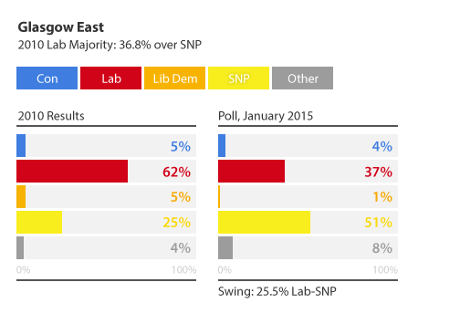
Updated
My colleague Robert Booth is on the trail of Boris Johnson, London mayor and the man who would be MP for Uxbridge and South Ruislip. No sign of him yet at his local polling station, which is in Islington, near his home, rather than in his intended constituency:
Big leaders voted early but no sign of man who would be PM Boris Johnson. He's keeping out of the frame. For now. pic.twitter.com/DaVwWxKXeF
— Robert Booth (@Robert_Booth) May 7, 2015
The best pictures from the long campaign

Our picture editors have compiled this gallery of the best images from the last month of campaigning. There’s some fantastic shots of all the party leaders from up and down the country, showcasing the inventiveness of the modern political campaign (and the willingness of leaders to pose for a photo-op).
My personal fave is this one of Scottish Tory leader Ruth Davidson on a steam train in Aviemore, taken by the Guardian’s incomparable Murdo MacLeod.
Updated
This will give David Cameron and Ed Miliband something to do to while away the hours before results start flowing in: the Guardian’s interactive coalition builder.
Based on the latest predictions – before the polls opened – of how many seats each party will nab, you can drag and drop (gently, please) your chosen leaders to try to cobble together 323 seats: the number likely to survive a confidence vote.
It will also tell you off it you try to put David Cameron and Nicola Sturgeon around the cabinet table together.
The view from Twickenham, seat of Lib Dem business secretary Vince Cable, but targeted by the Conservatives. The Guardian’s Maev Kennedy is there:
There’s a queue of city suits and mothers with expensive buggies waiting to vote in the Turk’s Head pub hall in St Margaret’s, heart of Vince Cable’s hotly contested Twickenham constituency (where David Cameron popped up among the bedding plants in a garden centre on Wednesday).
Polling centre staff say they’ve been ‘very busy’ since the doors opened at 7am.
Guardian reporter Ben Quinn is in Ramsgate, Kent, and saw Ukip leader Nigel Farage cast his vote this morning:
Nigel Farage gave a thumbs-up as he arrived to cast his vote at a polling station near the centre of Ramsgate, where he is bidding to realise a decades-long dream of election to Westminster.
Wearing a red rose in one of his familiar beige coats to plug his party’s policy of a St George’s Day national holiday, the Ukip leader posed briefly in front of a small press group of waiting cameras before leaving the scene outside the Eastcliff community housing office at around 7.30am.
Ukip – whose efforts in the East Kent constituency have been shadowed by protestors following Farage around – had brought forward by two hours the time when he was scheduled to vote, wrongfooting not just protestors but also some members of the press.
There are 11 candidates standing for the constituency, which was held by the Tories in the last parliament. The result is expected to come in very late, possibly on Friday morning after counting in the neighbouring town of Margate.
I can't tell you who I voted for! #VoteUKIP #GE2015 #IVoted pic.twitter.com/8SQgJ1nbPJ
— Nigel Farage (@Nigel_Farage) May 7, 2015
Natalie Bennett votes
Green party leader Natalie Bennett, who is standing in the north London seat of Holborn and St Pancras, has also cast her vote, at Ossulston Tenants’ Hall.

Already there are plenty of reports of busy polling stations – even (modest) queues in some places.
In 2010, turnout was 65.1% and many expect that to be exceeded today.
V busy already in Hornsey and Wood Green Lib/Lab marginal. Station manager of 30yrs experience predicting 80% turnout pic.twitter.com/NAZkj3hoCj
— Robert Booth (@Robert_Booth) May 7, 2015
Former Liberal leader Lord Steel has said the Lib Dems should not enter into a fresh coalition with the Conservatives but instead recharge after their bruising time in government.
If you’re planning to stay up tonight to watch the results roll in, first of all read this guide to results night. Second, get some food in.
Guardian food writer Felicity Cloake has cooked the hell out of some party political metaphors to come up with the Natalie Bennett cocktail and Tory just desserts.
Nicola Sturgeon votes
The Guardian’s Scotland reporter, Libby Brooks, sends this dispatch from Glasgow East:
On a bright but chilly morning in Ballieston, a suburb of Glasgow’s East end, Nicola Sturgeon has just arrived to vote with her husband and SNP chief executive, Peter Murrell.
This constituency of Glasgow East is a key Labour/SNP battleground, with shadow Scottish secretary Margaret Curran facing a strong challenge from the SNP’s Natalie McGarry.
Early-morning voters were bemused at the scrum of photographers surrounding the entrance to the polling station. “I thought that was the queue!” exclaimed one woman.
As she left, Sturgeon said that the decision was up to the people of Scotland, then joked with photographers as they begged for one more shot of her alone. “Yeah, get out my shot!” she told her husband, as he retreated to the side.
Updated
It’s almost as if the party leaders were having trouble sleeping … The next one up is Nicola Sturgeon, with her husband Peter Murrell, in Glasgow East:
Nicola Sturgeon arrives to vote with husband and SNP chief executive Peter Murrell https://t.co/vStTEokbou
— Libby Brooks (@libby_brooks) May 7, 2015
Updated
The Guardian’s political correspondent Rowena Mason watched Ed Miliband arrive at his constituency polling station in Doncaster North:
Miliband looked nervous and excited as he strolled to the polling station at Sutton village hall, moments from his house in Doncaster North. Clasping his wife Justine Thornton’s hand, he said “morning” to other voters, but otherwise it was a silent trip.
An aide said the mood in Camp Miliband was good – in contrast to that in Kirkcaldy and Cowdenbeath on a May morning five years ago.
In 2010, around 1,200 people were left unable to vote at 27 polling stations around the country, despite getting there before the 10pm closing times, according to a subsequent Electoral Commission report.
Such queues of angry people left unable to vote should not happen this time – the law was changed in 2013 to mean anyone who has made it into the queue by 10pm will be allowed to vote, however long it takes.
Ed Miliband votes in Doncaster
And here is Ed Miliband, with his wife Justine Thornton, casting their votes in Doncaster.
Ed Miliband looking a combination of nervous and excited as he votes with Justine in Doncaster pic.twitter.com/RcSYxNTYed
— Rowena Mason (@rowenamason) May 7, 2015
Updated
Nick Clegg has had a lie-in:
Waking up in Sheffield after an epic 1,000 miles from Lands End to John O'Groats #WinningHere pic.twitter.com/PLFJ74TRkS
— Nick Clegg (@nick_clegg) May 7, 2015
Farage votes
Nigel Farage has cast his vote at a polling station in Ramsgate. He’s standing for the seat of South Thanet, the sixth time he has attempted to become an MP.
.@ukip leader goes in to vote in Ramsgate #ge2015 pic.twitter.com/Jc5xZDVwSY
— Robin Brant (@robindbrant) May 7, 2015
Updated
Watch the party leaders vote - live
Reuters have provided us with a live stream that they promise will capture all the party leaders as they vote. Ed Miliband has already voted in his Doncaster constituency.
If none of the leaders are actually at the polling booth at that specific time, the stream seems to default to a live feed from the outside of Islington town hall in north London, which may be interesting to some of you (and you may see some lovely jackets).
You can watch the live stream below. Or click here if you can’t watch embeds.
(Warning - may contain crash zooms at every car that pulls up near the polling stations.)
Updated
David Cameron – or whoever schedules David Cameron’s social media utterances – has won the race to be the first party leader to post their “vote for my team” tweet.
#VoteConservative today - and together, we can secure a brighter future for Britain. https://t.co/t896F6oMoM
— David Cameron (@David_Cameron) May 7, 2015
There have been more polls carried out in this election than ever before, says the Guardian’s data editor, Alberto Nardelli. What have they actually told us? Here are some key pointers:
- David Cameron is unlikely to have the numbers to remain in Downing Street, despite the fact the Conservatives are likely to win the most votes, and may even win more seats than Labour.
- No single party will win an outright majority.
- The Lib Dems have a higher probability of being part of a government than either Labour or the Conservatives do.
Alternatively: the polls could be wrong.
The doors are open, the signs are Blu-Tacked. Here’s a mini round-up of polling stations we’ve spotted so far:


I’m with Robert Peston on this:
@Peston no! It's right to feel that. I can't vote and it's freaking weird...
— martha lane fox (@Marthalanefox) May 7, 2015
Martha Lane Fox is a member of the House of Lords and so not permitted to vote.
POLLS ARE OPEN
It’s 7am and polling stations are throwing open their doors/propping them open with plastic school chairs. They’ll be open until 10pm tonight.
Why not vote, when you have a minute?
If you’ve lost your polling card, or have other questions about how it all works, check out our step-by-step guide here.

My colleague Stuart Heritage was given the daunting task of sifting through the compost heap of campaign gaffes to find the best/worst. You can read his full verdict here. But this is a favourite:
Most hysterical front-page headline
Without a shadow of a doubt, the Mail on Sunday’s “MAY: SNP/LAB PACT ‘WORST CRISIS SINCE ABDICATION’’’. The story here was that Theresa May had predicted constitutional confusion in the event of a second Scottish independence vote. But that’s a lot of subtle information to convey in a reactionary front page, so the word “constitutional” was dropped. And that’s why a Labour/SNP coalition officially became worse than anything that has happened since the abdication, including plane crashes, floods, terrorist attacks, the second world war and, perhaps most damningly, the short-lived BBC1 Saturday teatime gameshow Don’t Scare the Hare.
MAIL ON SUNDAY: May - SNP/Lab pact 'worst crisis since abdication' #tomorrowspaperstoday #BBCPapers pic.twitter.com/n3mMScNm90
— Neil Henderson (@hendopolis) April 25, 2015
Polling day weather forecast
Obviously you’ll want to know what the weather will be like today, because why look out of the window when you can read this on your phone?
Here’s the forecast from Meteogroup:
Today: The far north will remain windy and cool with blustery showers, these wintry over high ground. Elsewhere, it will be largely dry with sunny spells and light winds, although sharp showers may break out in places, such as Northern Ireland, the Midlands, Wales and East Anglia during the afternoon.
Tonight: It looks set to be a dry and mostly clear night once any evening showers die out. There will be the chance of mist or fog patches forming in central areas. It will turn rather cloudy in southern parts of England and Wales as the night progresses. A cold night for May with frost in northern areas.
There’s a fact check here on whether the weather really affects voter turnout. It seems to be something of a myth that rains stops play.

Morning briefing
Wake up! It’s here. Stick with this live blog all day as we bring you everything you need to know as the UK goes to the polls. You may take a short break to cast your ballot. Then I’ll expect you straight back.
I’m Claire Phipps and I’m steering the live blog till around lunchtime, at which point Jamie Grierson leaps in. This evening Andrew Sparrow takes the hot seat as results begin to pile in.
Do come and chat to me on Twitter, @Claire_Phipps, or below the line. But a note of caution: please don’t post to tell us how you voted. I’ll go into the intricacies of the law below – steel yourselves – but in short: it’s illegal for us (or anyone) to publish details of how people voted based on information gleaned from the polling booth, before the polls close. So our indefatigable moderators will have to remove any comments of that nature. Apologies.
The big picture
It looks like another hung parliament is in the offing, with the final Guardian/ICM poll on Wednesday evening putting Labour and the Conservatives on 35% each.
Ukip rounded off the last day of the campaign with 11%, with the Liberal Democrats on 9%.
The SNP – which fields candidates only in Scotland, remember – has a Britain-wide score of 5%. The Greens end up on 3%. Plaid Cymru (for Wales) is on 1%. Other assorted minor parties are also on 1%.
What would this – combined with other latest polling data – mean for seats? It’s 273 each for Labour and the Tories, according to the Guardian’s model:
Could it be any closer? It could not, unless someone removed all but 273 seats from the Commons and they all had to sit on each other’s laps.
Here’s a quick recap of what else to know as you head off to mark your cross:
Jamie Grierson’s summary here has all of the action from the final official day of campaigning.
The Telegraph, rarely shy in its endorsement of the Conservatives, is now verging on haranguing; first with this stern-dad front page (I think “someone” “forgot” the quote marks):
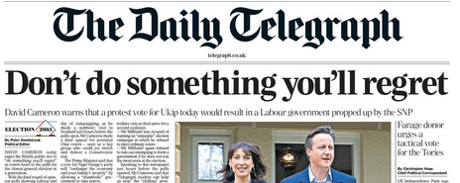
… and next with a letter that Telegraph editor Chris Evans has apparently emailed to readers this morning (truly, 2015 has been the Year of the Telegraph Letter – see here, here, here):
Slightly creepy "unprecedented" email from @Telegraph editor Chris Evans telling me to vote Conservative pic.twitter.com/sM42Czi6jm
— Toby Harnden (@tobyharnden) May 7, 2015
The Daily Mail has a video of Nigel Farage – who has said he will step down as Ukip leader if he doesn’t win in South Thanet – making what he calls a joke during his best man’s speech at his brother’s wedding in 2001. The wedding was a few months after Stuart Lubbock was found dead in a swimming pool at the home of Michael Barrymore.
Farage told guests:
The good news for us who are smokers is that we are far better off here than if we had been at Michael Barrymore’s house. Because there they removed all the ashtrays on the basis that now they chuck all the fags in the pool.
And here is Farage’s response to the Mail story:
It was a best man’s speech, for Christ sake. If you look at the whole video I told a whole series of jokes.
There was absolutely no malice intended in it at all. That particular joke was one doing the rounds quite widely at the time.
Because a homophobic joke is apparently not homophobic if someone else said it first.
Ukip was formerly part of an alliance in the European parliament that included far-right, anti-gay parties from Poland and Italy.
On Wednesday, while campaigning in Kent, Farage argued with a member of the public who accused him of being sexist, racist, homophobic and a banker:
The day in numbers
- 650 parliamentary seats are up for grabs.
- 9,000+ council seats are also being contested in 279 English local authorities today (but not in London).
- 6 mayors will be elected in Bedford, Copeland, Leicester, Mansfield, Middlesbrough and Torbay.
- 50,000+ polling stations are open today across the UK.
- 7am is when polling stations open; they close at 10pm. If you’re in the queue at 10pm, you should still get to vote.
-
5pm is the latest time today to apply for an emergency proxy vote if you truly can’t get to a polling station.
- 65.1% was the turnout for the 2010 general election.
- 15% votes were cast by post in 2010.
- 485,000 people registered to vote on deadline day for the 2015 general election.

The big issue
It’s funny, you might think this morning: after weeks and weeks of brain-taunting coverage of the campaign, polling day is here and the broadcasters are talking about the royal baby and Clydesdale bank and, oh, there’s David Cameron waving outside a polling station, and oh, we’re back to the royal baby again.
Here’s the BBC’s rules on polling day coverage:
Polling day is always rather an odd one for broadcasters. Here are our rules: #GE2015 pic.twitter.com/LtQXBKLR3b
— Nick Sutton (@suttonnick) May 6, 2015
Sky News (in the UK) has the same restrictions, says its deputy political editor:
@stefanstern @suttonnick I've done our lead report for the morning. It's sort of news, but different. I had to be reprogrammed first.
— Joey Jones (@joeyjonessky) May 6, 2015
Rules prohibit TV and radio stations from broadcasting anything that could be construed as campaigning or potentially influencing votes. So, politicians entering polling stations and weather reports: fine. Policies, debates, polls: not fine.
Those rules don’t apply to social media (although journalists for those broadcasters will have to apply a heavy coating of bland), where you can hashflag away until everyone mutes you.
Elsewhere – including here – the principal restriction concerns the publication of information showing which way people have actually voted (as opposed to “intend to vote”, or “might vote if they remember”).
Here’s the relevant bit of legal-ness, from the Representation of the People Act 1983:
66A Prohibition on publication of exit polls
(1) No person shall, in the case of an election to which this section applies, publish before the poll is closed –
(a) any statement relating to the way in which voters have voted at the election where that statement is (or might reasonably be taken to be) based on information given by voters after they have voted, or
(b) any forecast as to the result of the election which is (or might reasonably be taken to be) based on information so given.
(2) This section applies to–
(a) any parliamentary election; and
(b) any local government election in England or Wales.
(3) If a person acts in contravention of subsection (1) above, he shall be liable on summary conviction to a fine not exceeding level 5 on the standard scale or to imprisonment for a term not exceeding six months.
(4) In this section –
“forecast” includes estimate;
“publish” means make available to the public at large, or any section of the public, in whatever form and by whatever means;
and any reference to the result of an election is a reference to the result of the election either as a whole or so far as any particular candidate or candidates at the election is or are concerned.
Which is why, as devoted readers will remember from a few paragraphs back, we ask you not to tell us below the line today how you have voted. After 10pm? We’ll be all ears.
Read these
- Not everyone knows their way around a polling station. The Guardian’s Carmen Fishwick has a step-by-step guide to making sure you put your X – or other “clear expression of preference” – in the box.
- For those still a little uncertain, the BBC offers this advice on what you can’t do in a polling station. On the key issue of taking selfies, it says:
There’s nothing in the law that specifically bans taking photos, but the Electoral Commission very strongly discourages any photography inside a polling station, primarily because of complex laws about maintaining the secrecy of the ballot. For instance, it’s illegal to reveal how someone else has voted, which could happen inadvertently via a sloppy selfie. In addition, taking a photo of a ballot paper’s unique identification number is against the rules.
- And this is handy to know:
Horses and ponies should be tethered up outside.
- You’ll have to forgive this one, but here is me with a full guide to tonight, including timings on when to catch a strategic nap so you don’t miss a high-profile MP pretending to shrug off a catastrophic ousting.
The day in a tweet
Steady on:
UK ON THE BRINK http://t.co/5ku9NtlhqP
— DRUDGE REPORT (@DRUDGE_REPORT) May 7, 2015
If today were a Eurovision classic, it would be…
Bucks Fizz: Making Your Mind Up. Don’t let others change your mind. It could be in contravention of Article 66A of the Representation of the People Act 1983.
The key story you’re missing if you’re election-obsessed
It’s 15 years today since Vladimir Putin first became president in Russia.