Summary: Live from Iowa, it's caucus night!
As Winston Churchill once said, “This is not the end. It is not even the beginning of the end. But it is, perhaps, the end of the beginning.”
With only a few hours before the beginning of the Iowa caucuses, the final day of campaigning in the Hawkeye State has featured a mixture of cautious optimism, presumptuous triumph and forlorn resignation. Although the people voting tonight will only represent a tiny, disproportionately white sliver of the overall American electorate, the momentum out of Iowa could help crown a few potential nominees - and force other would-be presidents to take a deep look in the mirror.
Click here for our all-night live blog.
And scroll down for what happened before the sun went down in corn country.

What kind of day has it been?
- Ted Cruz’s presidential campaign has faced increased criticism in the waning hours of the Iowa campaign after news broke that its aggressive voter-targeting operation is using detailed psychological profiles to sway voters. After having shifted the lion’s share of its ad spending over the weekend to targeting fellow freshman senator Marco Rubio, it may help Cruz beat the upstart Floridian - a Pyrrhic victory if billionaire frontrunner Donald Trump ends up winning the caucuses.
- Speaking of Trump, the real estate tycoon was lauded as “he who will be the next president” by former half-term governor Sarah Palin at his final campaign event of the caucus season. Trump predicted a “tremendous” victory for himself in Iowa, with his wife Melania and daughter Ivanka urging caucus-goers to turn up for Trump.
- Not everyone is so hot on the Donald, however - British singing sensation Adele has come out hard against the candidate’s use of her songs Skyfall and Rolling In the Deep at his campaign rallies. (If we were here, we’d be more upset that they were being played in the same set as Memory from Cats, but that’s just us.) Trump, characteristically intransigent, played Rolling In the Deep at the end of his rally in Iowa today, despite the singer’s protestations.
- Rick Santorum, who won the Iowa caucuses in 2012 and came within a hair’s breadth of winning the Republican nomination that cycle, held a wake for his campaign at a Pizza Ranch restaurant outside Des Moines, thanking his loyal supporters for their backing of “serious candidates”.
- Hillary Clinton may not have won the endorsement of Barack Obama, but she’s sure milking a friendly joint interview they gave 60 Minutes in 2013 for all it’s worth.
- Bernie Sanders has told reporters that his standing in Iowa is couched in turnout - a number set that the campaigns will be following very closely.
Now we’re tossing it over to a wall-to-wall, start-to-finish, wire-to-wire liveblog dedicated exclusively to the Iowa caucuses. To close this update in the same manner that we opened it - with the wise words of a British icon - Adele has a message for beleaguered politicos:
Updated
Ted Cruz completed “the Full Grassley” on Monday afternoon, which means the candidate has now visited all 99 counties in Iowa.

In a community center gym in Jefferson, Iowa, Cruz gave his stump speech to a crowd of caucus-goers and journalists from outlets all over the world. In contrast to some of his bigger campaign events where there is an hour worth of introductory speakers, Cruz was preceded only by his wife Heidi and his Iowa campaign chair who each gave brief remarks.
The Republican hopeful, known for his discipline on the stump, trotted out a couple of new lines. Cruz, who has long likened Barack Obama to Jimmy Carter and himself to Ronald Reagan, derided those Republicans who now insincerely claim to be Reagan acolytes. “We are all Reagan Republicans,” Cruz said of the GOP. “You can’t find a Republican politician who won’t swear on a stack of bibles that Ronald Reagan is tattooed somewhere on his body.”
Cruz also refused to commit to pardoning Dwight and Steven Hammond, two ranchers whose conviction for arson sparked the occupation of Malheur National Wildlife Refuge by a group of anti-government extremists in January. “I don’t want to pre-judge the facts,” Cruz said, while noting “arson is a serious crime.”
Yet for all the hoopla the Cruz campaign made of visiting all 99 counties - a feat also achieved by Rick Santorum and Mike Huckabee this cycle - it felt a relatively normal, campaign event save for the massive presence of media. Caucusgoers tried ask Cruz questions and then gathered to take selfies with him afterwards, as on the second level of the community center gym, a local man worked out on a rowing machine.
It was all typical Iowa retail politics and the culmination of what has been a textbook campaign to win over social conservative voters in the Hawkeye State. The question is whether that textbook still applies to Iowa caucuses in the age of Donald Trump.
The White House has confirmed that Republican billionaire frontrunner Donald Trump has offered to spend $100 million on a new ballroom at the executive mansion - and also confirmed that Trump’s offer was swiftly nixed.
“I’m [not] sure it would be appropriate to have a shiny gold ‘Trump’ sign on any part of the White House,” White House press secretary Josh Earnest said. “That’s what most of the buildings that he offers to build include, so I’m unclear if something like that would have been required with this offer as well.”
“I can tell you that this was not something that was at all seriously considered,” Earnest said. He said he could not provide details because “I was not the one who was consulted.”
Updated
Four years ago at the Pizza Ranch outside Des Moines, when Rick Santorum was on the verge of an upset beyond historic proportions, he drew a massive crowd that packed the local Iowa chain restaurant. Groups of reporters were pinned against the salad bar. You could barely move. The former Pennsylvania senator had to give two different speeches, one with a bullhorn.
Four years later, on Sunday night back at the Pizza Ranch where this indefatigable social conservative had strode to victory over Mitt Romney and won the first-in-the-nation Iowa caucuses, the mood was totally different. This was no campaign rally; it was a wake.
Sure, Santorum filled the party room, but only a handful of reporters were present. The parking lot, at least, was filled with Santorum bumper stickers from all over. These were the loyal supporters: staff members, volunteers, even longtime mega-donor Foster Friess. These were the people who had been with Santorum since he was at 2% in the polls back in 2011 and stood by him throughout the political rollercoaster ride that followed.
They are with him again now, back at 2%.
Rick Santorum's last Iowa town hall at a Pizza Ranch pic.twitter.com/LyerHEtwSW
— Ben Jacobs (@Bencjacobs) February 1, 2016
In both of his campaigns, Santorum has made the retail campaigning mega-tour of visiting each of Iowa’s 99 counties. In 2012, it gave him the grassroots support that he needed to win. In 2016, Santorum’s long haul means nothing as Ted Cruz has usurped his role as mantle-holder of the evangelical right and Donald Trump has swallowed up all the media attention.
Santorum arrived insisting he was going to do a real town hall. After all, he had performed 700 events like this one in the past five years and was going to end on a strong note. He maintained confidence that he could somehow pull off another, even more improbable upset, noting that 36% of his supporters made up their mind on caucus night in 2012 and that even more people could still be persuaded this year.
He insisted that the undercard debates, all of which he participated in, had demeaned the second-tier polling candidates. To Santorum, there was a need for “serious candidates to be taken seriously”. He dismissed polls and instead told Iowans to “vote your convictions”.
By the end of Sunday night’s wake, it became more of a valedictory. Santorum was made an honorary Pizza Ranch employee. His campaign chairman noted that he had been to 120 of the chain’s locations. He was presented with a Pizza Ranch T-shirt – a fleece, too.
Rick Santorum is made an honorary Pizza Ranch employee pic.twitter.com/TeP9tg4xJ9
— Ben Jacobs (@Bencjacobs) February 1, 2016
Santorum told attendees that he liked campaigning in Iowa “beyond measure and I have learned so much from it”. He hoped to come back to a Pizza Ranch next time
“When I come in on Air Force One,” he joked, “there may not be as many of these types of deals.”
When Trump made his lone appearance at a Pizza Ranch earlier in January, the company’s CEO, Adrie Groeneweg, appeared to endorse him. Santorum got the honorary swag from his own campaign staffers.
All the same, Santorum seemed grateful. He was moved by the presentation, and stayed to take selfies with well-wishers and supporters long after he stopped speaking.
One Pizza Ranch miracle had worked before, he figured; there was no reason for him to suppose that it couldn’t happen again.
Updated
Ted Cruz’s presidential campaign has ramped up its aggressive voter-targeting operation, paying out more than $3m to a company that is using detailed psychological profiles to sway voters.

A Guardian analysis of the final campaign disclosures released on the eve of Iowa’s caucuses shows the Cruz campaign, banking on a win in the first-in-the-nation voting state, significantly outspent his main Republican rivals in targeting potential voters online during the final quarter of 2015.
During this period, Cruz surged in the polls and emerged as a frontrunner from the crowded Republican race as attack ads rained down on Donald Trump and Marco Rubio. Over the weekend, the Cruz campaign came under fire separately for mailing accusations of a “voting violation” to individual Iowa residents amid what privacy and transparency experts said had amounted to “a military escalation” of data-driven campaigning.
The federally mandated release of expenditure filings on Sunday shows a crescendo of spending as well-funded campaigns and their allied Super Pacs bolster their digital firepower by pouring record amounts of cash into the so-called “micro-targeting” of voters across social media with increasingly personal ads.
Cruz, who trailed only Trump in the final polls ahead of Monday’s vote, has deepened his ties to the little-known data analytics firm, Cambridge Analytica, directing around 20% of overall spending during the reporting period to the data scientists embedded at Cruz’s campaign headquarters in Houston.
Marco Rubio and Ted Cruz, the two Republican candidates each vying to prove themselves the most viable alternative to Donald Trump, have been locked in a heated battle over immigration in the run-up to the Iowa caucuses on Monday night.

Speaking to the Guardian as voting in the key state was about to begin, Rubio maintained that his record on immigration had been clear whereas Cruz, he said, had misled the American public.
“Ted Cruz presents and portrays himself as this purist who’s never supported anything that even comes close to legalization [for undocumented immigrants] when in fact he did,” the Florida senator said after a town hall in Cedar Rapids on Sunday.
“He helped design George W Bush’s legalization policy as a candidate, he openly and repeatedly talked about reaching a compromise on people that are here illegally … He said he wanted to see immigration reform pass, he wanted to see people come out of the shadows. And now he’s pretending that that never happened and it did.
“It’s not about immigration. It’s about the calculation that he thinks he can say and do anything and people aren’t going to notice,” Rubio said.
Rubio did not enter the final stretch of the Iowa caucus at the top of the polls, but nonetheless his rivals felt sufficiently threatened to spend at least $20m on ads attacking him – largely focused on his record on immigration. At present he stands third in polling behind Cruz and frontrunner Donald Trump in Iowa, andthird in the national Republican race.
Cruz’s closing argument across Iowa drew heavily on Rubio’s support in 2013 for a comprehensive bill to make the case that “a vote for Marco Rubio is a vote for amnesty”.
“I’ve been clear,” Rubio told the Guardian. “I don’t think we can fix this comprehensively, I’ve been very clear about that. That was tried. It failed, for good reason, because Americans don’t trust the federal government and we’re going to have to do this in stages beginning with enforcement.”
So much of Donald Trump’s campaign is built around being a winner, it’s hard to imagine how he’d handle a loss - in Iowa or anywhere else.
Winning is the thing he mentions everywhere he goes. It’s his favorite topic, other than the particulars of his poll numbers and how dishonest the media is. It’s quite possibly the only reason Sarah Palin endorsed him at all. “I’m in it to win it,” as she said.
On the campaign trail in Iowa, Trump has been relentlessly driving home the message that second best is never enough for him. Or as he put it, “If I don’t win all of it … I’ve wasted my time.” Even when it comes to staffers, the message is winning all the way down; his campaign manager said recently that anything short of a first place finish would be a loss.
This reductionist rhetoric is hard to argue with when Trump keeps pulling out poll numbers like a lucky rabbit from a hat. But what happens when the magic stops? Which is to say, when your entire platform consists of winning, if it’s everything you have to offer, what happens when a winner loses?
Research conducted by political scientist Larry Bartels suggests that in the scenario he loses, the long-term political outlook for Trump isn’t good. Bartels observed a “bandwagon effect” whereby political preferences and expectations were self-reinforcing, particularly among low-information voters. If Trump were to lose his winning luster, his voters could turn on him just as quickly.
Of course Trump’s polling ahead in Iowa. And there’s little reason to think this will be his Waterloo, or even the exact moment the tides turn on him. But it could be just about the bend.
Pop queen Adele might not be a fan the Donald, but she can’t stop him blasting her tunes at rallies.
Steve Gordon, an entertainment lawyer and author of The Future of the Music Business, tells the Guardian that usually artists are stuck with whatever nutty candidate wants to play them.
Essentially, to play a recording of a song a political event - such as Adele’s Rolling in the Deep at a Trump rally - the promoter simply gets a license from a licensing agent (either ASCAP, BMI or SESAC).
And because of federal government laws, the licensing agent cannot deny a license to anyone who applies.
There are three things artists regularly try and sue for when their songs appear somewhere they don’t want, says Gordon: trademark infringement, right of publicity and unfair trade practises.
“If I, as a reasonable person, at a Trump or [Mike] Huckabee rally where Adele was played thought that Adele was endorsing the campaign she should have a cause of action,” says Gordon.
But Gordon adds that simply playing a recording of a song doesn’t count as a sufficient endorsement.
Plus, Adele declaring that she “has not given permission for her music to be used for any political campaigning,” means that it’s even clearer to voters that she doesn’t support him.
“If she’s coming out publicly against using her music, then she’s not endorsing him so no one would think she was. If I was his lawyer, he’s got a strong case, and she’s got a BS claim. If they tried to do anything legally… at the end of the day, she’d lose,” said Gordon.
Is there anything artists can do to make sure someone with completely different political views to them stays away from their music?
“Not really,” laughed Gordon.
Updated
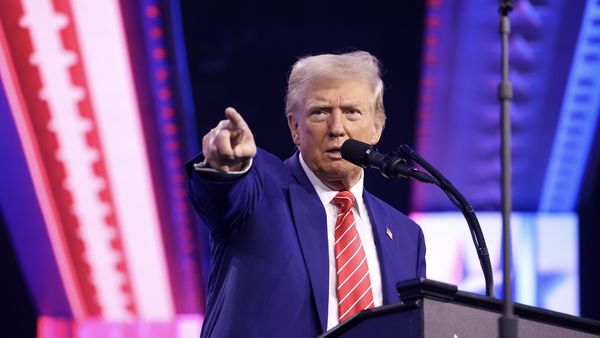
Donald Trump made his final pitch to Iowa caucus-goers at a campaign rally in Cedar Rapids, Iowa - and got in some good jabs at current (and possible future) opponents, to boot.

“Did any phrase hit a human being like ‘low energy’ hit Jeb?” the billionaire frontrunner asked the ebullient crowd. Of his potential Democratic rivals, Trump was even more dismissive. “Man, I’d love to run against the communist in this country,” he said of Vermont senator Bernie Sanders, although he’s “dying” to run against former secretary of state Hillary Clinton.
Trump began the speech by urging his supporters to be on the lookout for any protesters throwing tomatoes. “The security guys, we have wonderful security guess,” Trump said of the Secret Service. “They said, ‘Mr. Trump, there may be somebody with tomatoes in the audience.’”
“So if you see somebody getting ready to throw a tomato, knock the crap out of them, would you? Seriously,” he said. “Okay, just knock the hell. I promise you I will pay for the legal fees. I promise. I promise. They won’t be so much because the courts agree with us, too.”
After lambasting the assembled members of the “totally, totally, totally dishonest” national political press - “The only time they show the crowd is when there’s a protestor, so I love our protestors” - Trump introduced his third wife, Melania, an occasionally seen but seldom heard member of the Trump family, who urged the crowd to caucus for her husband.

“This is very very special night you voting for your next president,” Melania said with a heavy Slovenian accent. “The man who will work for you, who will work with you, and who is that man?”
After a pause, filled by the screams and hoots of the crowd, she pointed to her husband. “I agree - he is the man. Good luck, thank you!”
Trump then introduced his daughter, Ivanka, who pledged that her father “will exceed your expectations” as the Republican nominee.
The billionaire frontrunner returned to the lectern for a long, meandering speech on various policy issues, ranging from the Iran nuclear deal (“terrible”) to foreign policy (“we are not respected anymore”) to Vladimir Putin (“He said ‘Donald Trump is a genius!’”) to Caroline Kennedy (“my daughter Ivanka likes her”) to Isis (“a good promoter”).
Trump positioned himself as a reluctant candidate for the White House. “I had to do it, but it wasn’t something that I wanted to do,” he said of his June announcement at Trump Tower in Manhattan. But once he did, he spurred the rise of “a movement.”
“We have a movement going,” Trump told the crowd. “No matter where we go, we have incredible, incredible crowds and we are truly going to take back this country.”
He then played Adele’s Rolling in the Deep as he left the stage.
Updated
Sarah Palin introduces Donald Trump for 'highest CEO position in the land'
After Donald Trump’s campaign treated those assembled at a rally in Cedar Rapids, Iowa, to Adele’s Skyfall on the billionaire’s pre-rally playlist - in defiance of the British diva’s demands - Trump was introduced by former half-term governor of Alaska Sarah Palin, who trumpeted the Republican frontrunner as the perfect person to fill “the highest CEO position in the land”.

In a speech delivered in Palin’s now-familiar word salad speaking style - “they’re making no sense because it’s led us to - things like, oh gosh, to pay the bills, then, we have had to, uh, print money out of thin air and things” - the former Republican vice presidential nominee said that Trump was the sole candidate who was American enough to be the party’s standard bearer. Republicans and Democrats may hate Trump, Palin said, “but we love he who will be - the next president of the United States”.
“We’re here, we’re clear, get used to it,” she said of his followers.
After a riff on guns, echoing her endorsement speech in deriding liberals who don’t appreciate “guns and our constitution and those who don’t still want to be with us to fight for it, our rights to exercise that”, Palin introduced Trump, who was joined by his wife Melania and daughter Ivanka.
Updated
The Republican billionaire frontrunner picks up his most important endorsement to date:
Ok so, I think I'm ready to admit that I'm going to vote for Donald Trump.
— azealiabanks (@AZEALIABANKS) February 1, 2016
The US military commander in charge of the Iraq-Syria war has tacitly rebuked pledges by leading Republican presidential contenders to “carpet-bomb” the Islamic State.
Though army Lieutenant General Sean MacFarland did not call out Donald Trump and Ted Cruz by name, he rejected what he called “indiscriminate” bombing as illegal, immoral and un-American.
“We are bound by the laws of armed conflict and at the end of the day it doesn’t only matter whether or not you win, it matters how you win,” MacFarland told reporters on Monday.
As Iowans were set to caucus in the first presidential contest of 2016, MacFarland said “indiscriminate bombing, where we don’t care if we’re killing innocents or combatants, is just inconsistent with our values”, despite two major White House contenders adopting it as a central proposal against Isis.
Trump, the Republican frontrunner, told an Iowa crowd he would “bomb the shit out of ’em … there would be nothing left”. His closest rival, the Texas senator Ted Cruz, has repeatedly vowed to pursue the “fundamentally different military strategy” of carpet-bombing Isis without “apology”, most recently in last Thursday’s debate.
“We will carpet-bomb [Isis] into oblivion,” Cruz said in Iowa last month.
Vampire Weekend played a benefit for Bernie Sanders at the weekend, but which other rock stars have declared their intentions? Which candidate has bagged the big names – and is anyone backing Donald Trump?

Bernie Sanders
As the leftwing choice in 2016, Sanders is not short of rock star fans. Vampire Weekend played a benefit in Iowa on Saturday (the band were joined by Sanders and his wife Jane for a rendition of Woody Guthrie’s This Land is Your Land), and others will appear at a Feel the Bern fundraiser in Los Angeles on Friday. Headliners will be the Red Hot Chili Peppers, who – presumably after a long band meeting – collectively declared in favour of the Vermont senator last September. “Bernie Sanders is the only remotely reasonable candidate for president of the United States,” Flea had already tweeted in August. (The Chili Peppers, of course, being longstanding experts on what’s reasonable.)
Indeed, looking down the list of official Sanders backers, despite the presence of progressive rappers such as Killer Mike and Lil B, there seems to be a prevailing 80s and 90s flavour, suggesting he appeals more to the middle-aged indie crowd than to millennials. There’s Lou Barlow of Dinosaur Jr, Jello Biafra of the Dead Kennedys, Belinda Carlisle of the Go-Go’s, Jon Fishman of Phish, Billy Gould of Faith No More, Chris Shiflett of the Foo Fighters, Maureen Herman of Babes in Toyland and Thurston Moore of Sonic Youth. Going further back, the faint sound of barrel-scraping gets louder as David Crosby, Mike Watt of the Stooges and Donovan (Mellow Yellow guy, British not American) are also included.
Strangely, there’s no sign on the list of Roger Waters (also British), who endorsed Sanders last October, or Simon and Garfunkel, who gave permission for their song America to be used on a campaign ad. This did “not imply an endorsement from Simon and Garfunkel”, a spokesperson said at the time, but Art Garfunkel later told CNN that he and Simon were both asked about the song. “It’s the moment when you say, Am I a Bernie guy? Yes, I am.” Billy Bragg supports Sanders, too, but doesn’t make the website either.

Hillary Clinton
If the US were a rockocracy (one small mercy to be thanked, there), then the 2016 election would already be effectively over, with Hillary and Bill back in the White House. That’s because Clinton has all the blue-chip endorsements going, including – deep breath – Kanye West, Beyoncé, Pharrell Williams, Katie Perry, Christina Aguilera, Burt Bacharach, Tony Bennett, Jon Bon Jovi, Mariah Carey, Cher, Kelly Clarkson, Ellie Goulding, Ice-T, Ja Rule, Elton John, Quincy Jones, Lady Gaga, Jennifer Lopez, Ricky Martin, Janelle Monae, Morrissey, Snoop Dogg, 50 Cent, Sting, Barbra Streisand, James Taylor, Usher, will.i.am and Stevie Wonder. Which ought to do it.
The trouble with having such famous fans, however, is that they do tend to be asked their opinions about things, and their opinions are often fairly odd. For instance, 50 Cent spoke surprisingly warmly of Hillary to the Daily Beast, before explaining that he mainly admired her for tolerating Bill’s infidelity. “The lust factor out of convenience,” he said. “Things happen at points, and her seeing past that made her human to me.” Uh-huh.
Donald Trump
Always the mould-breaker, Trump is actually more of a specialist in counter-endorsements. Only this week, Adele has insisted that she did not give permission for him to play Rolling in the Deep or Skyfall at his rallies. Trump also got a letter from Steve Tyler’s lawyers after he used Aerosmith’s Dream On which, the letter complained, “gives a false impression that [Tyler] is connected with or endorses Mr Trump’s presidential bid”. Michael Stipe of REM was even more forthright, if less lawyerly, last autumn, when he refused Trump permission to use his music with the words, “Go fuck yourselves, the lot of you – you sad, attention-grabbing, power-hungry little men. Do not use our music or my voice for your moronic charade of a campaign.”
President Barack Obama hasn’t endorsed any of the Democratic presidential hopefuls this cycle - despite rumors of an imminent White House mic drop being peddled furiously by members of a certain former secretary of state’s campaign.
While Hillary Clinton’s campaign shivers with antici... pation for that endorsement, the ex-member of Obama’s cabinet isn’t holding back any file video of the president piling on the positive descriptors.
Hillary is "one of the finest Secretary of States we've had." —@POTUShttps://t.co/hl6fBFBBRb
— Hillary Clinton (@HillaryClinton) February 1, 2016
In a tweet from Clinton’s official Twitter account, she points to a 60 Minutes interview from 2013 after she stepped down as secretary of state, in which Obama called her “one of the finest secretary of states we’ve had.”
“It has been a great collaboration over the last four years,” Obama continued in that interview. “I’m going to miss her. Wish she was sticking around ... But I want the country to appreciate just what an extraordinary role she’s played during the course of my administration and a lot of the successes we’ve had internationally have been because of her hard work.”
The Iowa caucuses are perhaps the most important yet mysterious contest in American politics. The concept of an election is familiar to everyone – but by its very name, a caucus sounds different and archaic. However, give or take a few wrinkles, the Iowa caucuses are simply another election, held on a cold winter’s night in the Hawkeye State. But those wrinkles do matter quite a bit.

Is it the same process for Democrats and Republicans?
No. Whereas Republicans have a relatively straightforward process, in which they cast secret ballots in their precinct caucuses, it’s far more complex for Democrats.
Republicans
Republicans have a secret ballot. Voters take a piece of paper and mark the name of the candidate whom they support. These votes get counted in each precinct and reported to the state party.
These totals are supposed to be reflected in the final Republican delegation to the national convention. Rules implemented after Ron Paul finished third on caucus night in 2012 but eventually controlled Iowa’s delegation are supposed to enforce this.
The totals reported on caucus night are simply normal vote tallies as in any other election.
That is not the case with Democrats.
Democrats
Democratic caucuses are quite undemocratic. Each precinct is apportioned a number of delegates based on Democratic turnout in the past two elections. It’s like an electoral college at a micro level.
This means turnout doesn’t matter. If a precinct is supposed to have five delegates to the county convention, it doesn’t matter if eight people show up to the Democratic caucus or 800. The precinct is still only getting five delegates. (Precincts elect people to the county convention, which elects people to the district convention, which elects people to the state convention.)
After attendees show up to a Democratic caucus, they are divided into preference groups based on candidates whom they support. Bernie Sanders supporters will stand in one area, Hillary Clinton supporters in another. Once everyone is separated, there is a first count of how many supporters each candidate has.
To be viable in each precinct, a candidate usually needs to receive the support of 15% of those who attend, although in some small rural precincts, the threshold is higher.
If a candidate’s support is under that threshold, his or her supporters need to induce others to join their group in order to reach 15%. If they are unsuccessful in doing so, their candidate is not considered viable and they can either go home or support a candidate who is viable instead. There is then a second count of supporters for each candidate and, from those totals, delegates are assigned.
This means that if Democratic candidates are polling under 15% statewide on caucus night, they could significantly underperform compared to their polling.
Key demographic groups
Despite this socially conservative slant, the key group in Iowa on the Republican side in 2016 will be more moderate “country club” Republicans. With Donald Trump and Ted Cruz appealing to those conservative voters looking for red meat, if moderate Republicans in the eastern part of the state coalesce behind one establishment candidate – Marco Rubio, Jeb Bush or Chris Christie – it could make this a three-person primary, with evangelical, conservative and establishment camps each emerging with a viable contender.
On the Democratic side, students will be the key demographic to watch. This will be the first Iowa caucus in over a decade that has taken place when colleges and universities are in session. If Bernie Sanders can successfully organize and turn out young people across the state, it could give him an edge in several key counties across the state.
Turnout will also be important on the Republican side, as many of the voters most attracted to Trump’s candidacy are new to the political process. The higher the turnout, the better for Trump. In contrast, overall turnout is a mixed indicator for the Democratic primary. While Sanders is also hoping to turn out a number of voters new to the political process, an increase in turnout doesn’t necessarily bode well for him. After all, while Clinton may have lost the state in 2008, she still vastly surpassed her vote goals and likely turned out more people than every other Democratic candidate in the history of the caucuses besides Obama.
A fire started in Adele’s heart by Donald Trump has finally reached fever pitch, with the UK pop star banning the US presidential candidates from using her music.
“Adele has not given permission for her music to be used for any political campaigning,” her spokesperson told the Independent.
For months, Adele’s smash hits Rolling In The Deep (“We could have had it all”) and Skyfall (“Let the sky fall/When it crumbles/We will stand tall/Face it all together”) have blasted out at Trump rallies to warm up crowds.
Mike Huckabee made a recent parody campaign video using her recent hit “Hello”, but it was quickly removed from YouTube.
The six-time Grammy winner had avoided making a statement about the use of her music by any political candidates until now.
Trump attended Adele’s one-off Radio City Music Hall concert last November, but it seems she is not willing to give him the same endorsement.
When Trump likes Adele 😐 #waitingforadele pic.twitter.com/Pz37U7d1Ha
— Daniela Franco (@danielafrancony) November 18, 2015
Other artists have also objected to their songs being played at Trump rallies, with Steve Tyler of Aerosmith sending a cease-and-desist letter to Trump after the billionaire kept playing Dream On.
Trump stopped playing the song, but argued that the incident amounted to a publicity stunt for Tyler. “Steven Tyler got more publicity on his song request than he’s gotten in ten years,” he tweeted in October. “Good for him!”
Even though I have the legal right to use Steven Tyler’s song, he asked me not to. Have better one to take its place!
— Donald J. Trump (@realDonaldTrump) October 14, 2015
But Trump isn’t yet ready to say goodbye to Adele yet - he exited the stage in Iowa earlier today to one of her tracks.
Updated
Miscellany from the field (via Twitter). CNN’s Jeff Zeleny is with Bernie Sanders, who’s stopped by his Des Moines campaign headquarters to rally the team for tonight’s caucuses.
He tells them the message of the polls:
"We will win tonight if voter turnout is high. We will struggle tonight if voter turnout is low. That's a fact," @BernieSanders says today.
— Jeff Zeleny (@jeffzeleny) February 1, 2016
NBC’s Andrea Mitchell is meanwhile with the deflated Rick Santorum, who over four years has gone from king of the Pizza Ranch to honorary employee. Santorum will be damned darned though if he doesn’t try to deflate Ted Cruz.
.@RickSantorum: @tedcruz said everybody in Washington hates him. Not sure how you're going to get anything done if everybody hates you #AMR
— Andrea Mitchell (@mitchellreports) February 1, 2016
And Politico’s Kenneth Vogle crunches some numbers from the weekend’s campaign finance disclosures. Trump spent least, Casich spent most; Clinton and Sanders have the most money in their pockets.
Cash on hand (12/31/15):
— Kenneth P. Vogel (@kenvogel) February 1, 2016
1) Clinton $38M
2) Sanders $28M
3) Cruz $18M
4) Rubio $10M
5) Bush $8M
6) Trump $7M
7) Carson $7M
8) Fiorina $4M
Trump promises 'positive revolution'
Trump concludes his speech with a call to get out and caucus tonight. “It’s we, it’s a movement,” he says. “It’s not me, it’s we.”
He tells them that nothing – not weather, not illness, not a thing – should stop them from going out to vote. “If the doctor says you cannot leave, I don’t care, get outta bed” – the crowd laughs – “you gotta do it.”

And finally he channels a bit of Bernie Sanders, saying that he wants voters to make this election the beginning of a “revolution”: “in a certain way a very positive revolution. I mean, this would be a very, very positive revolution.”
He says he’s going to remember everybody. “And I love you all, special people, thank you all.”
An Adele song serenades him out.
Updated
“You know Obama’s a terrible negotiator,” except when negotiating with Republicans, Trump continues.
“I’m not even angry,” he says.
I’m not angry at the Democrats because we understand where they’re coming from. I’m angry at the Republicans because the Republicans just roll over and allow this stuff to take place.
He segues to gun control, and says that had people had guns during November’s Paris terrorist attacks, 130 people would not have died. Trump has used the massacre to argue in favor of gun rights for months, though not always so explicitly.
He moves on to the Syrian refugee crisis and foreign affairs, saying that he would make the Gulf States deal with the chaos of the Syrian civil war. They would have to create and manage “a big, fat, beautiful safe zone”, he says.
“We protect Germany, we protect Saudi Arabia, we protect Japan,” he says, bemoaning US military bases abroad and the protection treaties between countries.
The billionaire criticizes the Gulf States for not “putting any money toward the migrants.”
By the way I have a big heart, I want to take care of [these people], but they are not coming into this country.
“It’s going to all change, folks. It’s going to all change.”
Updated
Trump offers the crowd a surprisingly anti-materialistic philosophy for a billionaire who has gilded parts of his personal jet.
“I’ve seen people, I’ve seen the most successful people in the world,” he says, some of whom are actually not happy at all.”
“Someone who’s made millions of dollars and does not feel so great about themselves and is always wanting more more more.”
But “the happiest people I’ve seen”, he says, have great families.
“And by the way believing in God is so important, and I’ve seen that so much.” Segue to conservative Christians.
“The evangelicals have been unbelievable to Donald Trump … Boy, do they understand me. They understand me better than anybody.
We’re gonna protect our country. We’re gonna protect christianity. You know, Christianity is under siege, folks.
He segues to Mexico and the wall. Mexico’s definitely gonna pay for it, he says, because they make so much money even before he starts considering “the drug trafficking”.
He’ll build a great wall, though. “What I do best in life is build, you know? I’ve built these buildings that are so great,” he says.
I say it not in a braggadocious way but that’s the kind of thinking we need in this country. … We have people who don’t know what they’re doing. We have $19tn [debt]. This isn’t a word that was in the vocabulary 10 years ago.
NB: “braggadocious” is only sort of a real word in the vocabulary 10 years ago, depending on your dictionary politics.
Updated
Donald Trump is holding a rally in Waterloo, Iowa.
He’s standing with some men who’re holding an oversized check. One is “Tim with Americans for Independent Living,” a veterans organization from the city.
“I like him,” Trump says. “These people are amazing. Some of the people we’re giving this money to, they’re incredible people. It’s such an honor to be in a country with people like this.”
Then he introduces his wife Melania, who’s been “so supportive”. They trade glancing kisses, the smacking sound of which is audible through the mic. He introduces his daughter Ivanka and her husband.

“Jared’s a very successful man from New York he’s done a fantastic job, he’s done a lot of real estate.”
Then he jokes that his daughter is “going to have a baby perhaps in 10 minutes, or a week or two weeks.”
“Nice family is always the best thing, you know that, right?”
Updated
Bernie Sanders has been endorsed by a “servant of the moon” in Fairfield, Iowa, where my colleague Dan Roberts is interviewing the mystical men and Sweden-friendly women who are out to support the senator from Vermont.
“I ride my bike and I blast Frank Zappa music,” one told Dan. As for Sanders: “he’s off the charts, he’s off the grid.”
Every four years the threats of self-imposed exile begin again, though were they likely loudest during George W Bush’s 2004 re-election campaign. Should the Republican win, liberals warned, they’ll up and move to Canada.
Turns out some of them did. Jordan Teicher reports on the men and women who moved to Vancouver to escape living in a country led by Bush.
“It’s been a little over a decade now. We have clear eyes about what we did. We have no intention of going back,” Drucker said.
On election day in 2004, a record-setting 179,000 people visited Canada’s official immigration website, the majority of them Americans. And as anxieties about the outcome of 2016 begin to grow, some Americans are again musing about fleeing to their northern neighbor.

In September, the digital analytics firm Luminoso found about 4% of 4.5 million Donald Trump-related tweets contained threats to leave the country if the billionaire became president.
Of those, 25,000 identified Canada as their intended destination. Since then, comedian and Obama “anger translator” Keegan-Michael Key has joined the chorus. Even former USdefense secretary Robert Gates joked about emigrating if Trump took office.
According to the Canadian government, only about 9,000 Americans have emigrated to Canada every year in the years between 2005 and 2015.
Jim DeLaHunt left an engineering management position with Adobe in California for uncertain prospects in Canada after Bush’s re-election. Leaving behind his country’s penchant for authoritarianism, war and inequality, he says, was the right call.
DeLaHunt, now a tech consultant, misses the scale and ambition of the technology industry in the United States, but says he wouldn’t trade life in Vancouver to go back to it. He and his wife integrated easily into Canadian society, he said, learning how to be “less arrogant and a bit more gentle”, and even picking up local etiquette and speech patterns.

“Canadians say ‘sorry’ a lot more than people in the US do. They thank the bus driver as they get off the bus. In the US, if someone says ‘thank you’ a typical response might be ‘sure’. That seems awfully brusque in Canada. A better response is, ‘No worries.’ There’s little things like that, and if you get those things right you blend in on a day-to-day level,” he said.
For Laura Kaminker, however, that’s completely out of the question. In the 20 years before she and her partner Allan Wood finally moved to Canada from New York City in 2005, she had “lost hope” in the country she saw plagued by “civil liberties crackdowns” and “endless wars”.
Although she still has her American citizenship, she doesn’t vote any more in US elections, and whenever she comes back to Canada after visiting family or friends in the States, she breathes a sigh of relief.
“Every time I say, ‘God, I’m so glad to be out of that crazy country,’” she said.
Updated
Six Republican candidates will sit down to take an interview with one man on Monday: Britain-born radio host Simon Conway, an unlikely icon of Iowa conservatives and “one of the proudest citizens of the United States, ever”.
Conway’s patriotic, country musi opening isn’t unusual for any rightwing talk show host – particularly one who, in Conway’s case, will on Monday interview six Republican candidates on the day of the caucuses.
What is unusual is that when Conway takes the microphone, he speaks in an estuary inflected English accent.
Although Conway takes pains to “point out I am American – born British, naturalized American now”, the accent does make him a somewhat unusual kingmaker. Tea Party radio hosts in early voting states are not often born in London.
After a career in journalism and corporate communications in the UK, Conway moved to Orlando, Florida in 2001. He entered the real estate business, which he found very competitive.
“There are thousands of people selling real estate in Orlando, literally,” he told the Guardian.
So he tried to distinguish himself by buying time on the radio. He got himself a one-hour weekend show and fell in love with the medium.
“From the very first moment I was on the air,” he said, “I did not talk about real estate. It was like an epiphany. I had come home.”
Conway fell into a career as a fill-in talk show host, travelling across the US to what he described as “major, major stations”. In 2011, he took a job at WHO.

Speaking to the Guardian, as he enthused about his Iowa workplace, one the most recognized and honored radio stations in the US and a long-time employer of Ronald Reagan, he said: “If you’re serious about talk radio, this isn’t a job you turn down.”
“I am an equal-opportunity hater. I treat people the same whether I agree with them or [they] don’t agree with me. I will always challenge their positions.
“There are [as many] Republicans who don’t want to face those questions as there are Democrats. The likes of [Ohio governor] John Kasich haven’t been in my studio because he knows it isn’t going to end well.”
Conway worries, meanwhile, that the US is becoming like Great Britain. “People rely on government too much in the UK,” he said. “‘Government is the solution. Government will take care of me.’”
On Monday, just before Iowans head to the caucuses, he will share such warnings again, not just with a listening audience of tens of thousands, but potentially the next president as well.
Texas senator Ted Cruz has had a hard weekend. He’s locked in a close race for Iowa’s most conservative voters with Donald Trump, who has mocked and derided Cruz as a “nasty guy” and “anchor baby in Canada” for weeks.
Cruz’s favorable ratings have dropped … even with his family. Buzzfeed’s Rachel Zarrell has gif’d Sunday’s painful moment.
when even your daughter wouldn't vote for you pic.twitter.com/nxC2lhLNZc
— Rachel Zarrell (@rachelzarrell) February 1, 2016
New Hampshire was supposed to be where Jeb Bush had his comeback. Or where Chris Christie had his breakout moment. Or where Marco Rubio solidified his momentum.
In the last few days Ohio governor John Kasich has had New Hampshire all to himself while the other Republicans blanket Iowa in search of last-minute votes. On Sunday Kasich held his 85th and 86th town hall style events in the state.
“I’m a lot more interested in talking about what I’m for than the people who are in the primary up here in New Hampshire,” Kasich told to the dozens of voters who came out on a sunny winter’s day in Salem. “ I want to raise the bar. I want us to regain hope in this country. We can make this country work again.” The audience broke into applause.
While his opponents tap into voters frustration, preaching doom and gloom, Kasich is wooing moderate Republicans and Independent voters at schools, churches, gymnasiums and community centers across the state with a decidedly sunny vision for the country. And it seems to be working.
A series of recent state polls show Kasich’s steady rise – and complicated path forward – placing him in a tie for second place with three different candidates – Bush, Rubio and Ted Cruz. A RealClearPolitics.com average of state polls confirms his second place standing there behind longtime Republican frontrunner Donald Trump.

In Bow on Sunday night, with a national debt clock ticking behind him, Kasich himself as a conservative, pointing to his record on fiscal issues in Congress and as governor. In a race defined so far by bombast and dire visions of America, Kasich answered voters with careful but decidedly, even confidently, moderate answers.
“If you’re in the cupcake business and somebody comes in and wants cupcakes, sell them cupcakes, that’s my feeling about that.“I won’t have an argument about who you’re selling the cupcake to, I just don’t agree with that,” Kasich said, told a voter who was concerned about the erosion of religious liberties.
When a first-time voter asked him why Republicans shy away from the topic of climate change, Kasich told him: “Do I believe that human beings affect the climate? I do,” Kasich told the young voter on Sunday afternoon. “But we don’t quite know how much. But that doesn’t mean that there aren’t things we need to do.”
Kasich has mostly forsaken the race in Iowa, placing his best hopes in New Hampshire where he has built momentum over the past few months that he hopes will power his campaign through the next few primaries and on to Super Tuesday and beyond.
Tom Rath, a senior adviser to the Kasich campaign, said the governor’s aim is to be “the story” coming out of the New Hampshire primary on 9 February. A strong finish in New Hampshire could make Kasich a clear establishment favorite, Rath said, and help him compete for the blue and purple midwestern states, including Ohio.

But if Kasich does place favorably in New Hampshire, he still faces a long road ahead to the nomination. He’ll have to clear the so-called “establishment” lane, which he currently shares uncomfortably with Rubio, Christie and Bush. It’s also a lane voters seem to be turning away from in droves, borne out by the support anti-establishment, outsider candidacy of Donald Trump.
Stacey Gobron, one of the state’s coveted undecided Independent voters, said her husband, Bob, brought her to the event. She’s been disappointed by the Republican party’s frontrunners and was hoping to hear something different.
“I want low taxes like a Republican but I’m also not so [socially] conservative,” Gobron said.
After hearing Kasich speak in Salem, Gobron said she believes she’s found a candidate to support and she’s optimistic others like her will come around as well.
“He’s so genuine and I feel there’s an honesty about him,” Gobron said of Kasich. “He’s the opposite of Trump. I really believe people are going to get tired of the show. Eventually they will want the genuine.”
A lot of famous family in this election, and with the first vote on the line the candidates are bringing out whomever they can. Senator Rand Paul is trying to win some libertarian love for his dad, former congressman Ron Paul (who put in a strong Iowa showing once upon a time) …
— Dr. Rand Paul (@RandPaul) February 1, 2016
… Hillary Clinton has got her husband, a saxophonist who was big in the 90s, on the trail for her …
.@billclinton took over Hillary’s Snapchat to take you behind the scenes in Iowa. https://t.co/JMkSKnTXeR pic.twitter.com/feLI34lNcJ
— Hillary Clinton (@HillaryClinton) February 1, 2016
But John Ellis Bush is apparently reluctant to trot out his own famous family members, #41 George HW and #43 George W. Instead he’s tweeted this dog in a sweater. Maybe it’s an underdog.
1 more day until the Iowa Caucus and we have all hands — and paws — on deck. pic.twitter.com/aCsSUdcisG
— Jeb Bush (@JebBush) January 31, 2016
Updated
Martin O’Malley, the third Democratic candidate clinging to his campaign like McNulty clung to the bottle, Bubbles to sobriety and Carcetti to the war on drugs, took out a $500,000 loan to keep his campaign afloat, FEC forms show.
For comparison, his opponent Bernie Sanders raised $20m in January alone, the campaign announced yesterday. Contributions averaged $27.
Staffers are reportedly working without pay, but O’Malley’s telling voters to “hold strong”. He’s consistently polled around 3% in Iowa, where the caucus system requires Democrats manage at last 15% or take no delegates at all in respective precincts. Mashable’s Juana Summers is with the former Baltimore mayor and Maryland governor on the trail.
O'Malley in Des Moines pic.twitter.com/EGajSJHHxW
— Juana Summers (@jmsummers) February 1, 2016
NB: O’Malley was an inspiration for The Wire, is what’s going on with the links and allusions.
Updated
Well ya know what they say up in my parts, reality TV loves company even though the liberal media’s heads are spinning with the rock’n’rollers for Donald Trump, who’s gonna get that capitulator-in-chief out of the White House, and – yes, Sarah Palin is back on TV. (Nobody has ever said this though.)
Palin appeared on NBC’s Today Show on Monday to share her thoughts about the primary election, even though the former governor of Alaska has never campaigned in the Iowa caucuses. John McCain chose her as his running-mate months after the 2008 caucuses, in which he placed fourth, behind Mike Huckabee, Mitt Romney and the actor Fred Thompson.
But Palin has endorsed Trump for the Republican nomination, and was happy to talk about it. She said that Trump’s less-than-devout religiosity – on Sunday he pulled out cash during communion, mistaking it for an offering – should not turn her evangelical fans away from the billionaire.

“I hope voters aren’t trying to find the most Christian-y, godliest candidate out there,” she said, “because, you know, who are we to judge one another’s level of faith our Christian quotient, if you will.”
“Hopefully people are looking for he who has that record of success that proves he’s going to be able to get that job done for us.”
Nor should Trump’s history of supporting Democrats scare away voters, she said. “You compare him to someone like Ronald Reagan, who too at one point was at registered Democrat. And then he saw the light.”
She said she was glad Trump understands that “free markets and capitalism and restoration of our freedom is the way for America to be restored. We should celebrate that he has come over on the right side.”
“I believe that he will win win Iowa,” she said. “Iowa voters too are ready for restoration of constitutional government again, and Donald Trump is the one who can do this.
That said, she added that she’s a fan of Ted Cruz too. “Yeah, tonight, whatever the outcome, I think the Republican party again is in a fortunate problem of having good candidates at the top.”
Updated
On the eve of the Iowa caucuses, eight years after the crushing disappointment of her defeat by Barack Obama, Hillary Clinton made her final pitch to a gymnasium packed with roughly 2,600 people.
“I’m a better candidate,” she said. “And, thanks to you, I’ll be a better president.”
The crowd was not just one of the largest of her campaign. It also rivaled in its enthusiasm scenes that have become synonymous with rallies held by her opponent, Bernie Sanders.
Accompanied by her husband Bill and daughter Chelsea, the former secretary of state fashioned herself as a pragmatic progressive with a history of accomplishment to match her soaring rhetoric.

The same night in Des Moines, around 1,700 people attended Sanders’ Sunday night rally. A crowd as large as 5,000 saw him joined by indie band Vampire Weekend at the University of Iowa on Saturday.
“She’s a world-class change-maker,” her husband said, adding that a president must be find common ground with rivals, and without sacrificing principles. “Of all of the people I have ever worked with in my public life, Hillary is the best at that.”
Much of Clinton’s closing argument in Iowa and New Hampshire has centered around the idea that the policies put forward by Sanders, a self-identified democratic socialist, might sound appealing but are ultimately impractical.
“Senator Sanders wants to start over – to plunge us into a contentious national debate,” Clinton said. “Stick with the Affordable Care Act, stick with making it better,.”
Clinton also took a veiled shot at Sanders by vowing not to raise taxes on the middle class, following an acknowledgement by the senator’s campaign that his healthcare plan would require a tax hike on most Americans – in return, they say, for larger savings on insurance costs.
“I will not raise middle class taxes – absolutely off the table. I will follow the money to the top,” Clinton said.
DC bureau chief Dan Roberts, reporting from Iowa with colleagues, the campaigns and maybe every political journalist in the continental US.
Iowa, where 200,000 people get to sink or launch the career of the most powerful elected official on earth. pic.twitter.com/0JZb9kESCj
— Dan Roberts (@RobertsDan) February 1, 2016
When you can't move in your local coffee shop for breakfast TV political shows. Welcome to Des Moines on caucus day. pic.twitter.com/LJu2oUBKCx
— Dan Roberts (@RobertsDan) February 1, 2016
“When you can’t move in your local coffee shop because they are filming breakfast TV political shows. Des Moines on caucus day.”
Updated
Four years ago a one-term senator so drew the crowds of Iowa that he had to deliver two speeches at one restaurant, one using a bullhorn.
But although Rick Santorum won Iowa on the strength of his evangelical credentials, he failed to make a mark on the rest of the 2012 primary, which Mitt Romney survived to win the nomination. Which raises a question: is Iowa any good at predicting a winner?
As usual, it depends. In modern elections, the conventional wisdom is that candidate’s need a top-three finish to have a chance – though in 2008, for instance, John McCain placed fourth. Iowa Democrats have had more success picking the eventual nominee than their Republican counterparts. But it is just the first state of many that will eventually decide who runs in the general election.
And if you’d like to know more about the sad travails of Rick Santorum, my colleague Ben Jacobs was with the former senator at a Pizza Ranch yesterday – that same site of Santorum’s glory four years ago. Santorum was declared an “honorary employee”.
Updated
What are caucuses?
Better to ask and learn than live in ignorance. The Iowa caucuses are the first decision of the presidential election, and a means for the rural state to influence a national election that is often dominated by the dense populations of big states like California and Florida. And sometimes there are cookies.
They caucuses start at 7pm local time, though campaigns recommend Iowans get there early – once you’re late you’re out.
How do they work?
- Republicans hold a pretty normal election. They meet up in precinct caucuses, eg schools, churches, town halls, and cast secret ballots for whomever like best. Officials count, and each candidate receives a proportional number of delegates.
- Democrats play a sort of musical chairs. They vote publicly in a two-stage election: candidates need at least 15% or their supporters have to either choose another candidate or go home. There’s talking, debate, persuasion, acrimony, all the good stuff of democracy on a very local scale – but whether 10 or 1,000 people show up, each precinct only has its pre-assigned number of delegates. After the field is winnowed down, there’s a second vote, a count, and delegates are doled out.
Video editor Valerie Lapinski explains.
Some other notes:
- Attendees can register for or switch parties on caucus night, and anyone 18 or older can participate. In states with closed primaries, by contrast, voters can only vote for someone in the party of their registered affiliation.
- Caucuses are run by the parties, not the state, so volunteers will count votes across Iowa’s 99 counties. Republicans count ballots on location and that report to the party; Democrats figure out the delegates on location. Mistakes happen.
- And while history suggests it’s important to place in the top three in Iowa if you want a real chance at the nomination, recent elections have produced odd winners … mostly for Republicans. Rick Santorum won in 2012, and Mike Huckabee in 2008; neither won the nomination, and neither are showing strength in polls.
- Need more about the weird machinery of American politics? My colleague Ben Jacobs explains in depth through the link below.
Updated
One last one last poll, this one from Quinnipiac University and with an emphasis on the giant question that looms over even the very large head and hair of Donald Trump: who will actually come out to caucus?
For first-time likely caucus goers, Trump has a steady lead over Texas senator Ted Cruz, 31% to 24%. Florida senator Marco Rubio has gained, with 17%, and Ben Carson is hovering only a little above rest of the pack at 8%. No one else has more than 4%.
But for Republicans who’ve caucused before, the race is far closer. Among these caucusers, Cruz leads Trump 26% to 25%. Rubio’s got 20%.
Twenty-eight percent of the people who named a candidate said they might still change their mind, and 3% said they were undecided.
The Democratic race has a similar dynamic. Bernie Sanders leads Clinton 62% to 35% with would be first-time caucusers. Clinton has the edge 52-41% with Iowans who’ve shown up to caucuses before. There’s less room to maneuver, though: only 2% say they’re undecided, and only 14% of those who named a candidate say they might change their mind. Martin O’Malley’s supporters amount to 3% of the people surveyed, in line with other polls.
All of this means high turnout should be good for Trump and Sanders, low turnout good for Cruz and Clinton – and that we shouldn’t be surprised to see campaigns doing everything they can to get people voting or staying home, as it suits their candidates’ interests.
Updated
Iowa caucus day begins
Hello and welcome to our coverage of the Iowa caucuses – the long awaited first decision day of the 2016 primary elections.
Astounding his party, pundits, pollsters and plenty of Americans, billionaire Donald Trump has sailed into caucus day with a lead for the Republican nomination in one of Iowa’s most trusted polls. Trump lead Texas senator Ted Cruz by five points in the Des Moines register poll, with Florida senator Marco Rubio a little further back. Trump and Cruz have exasperated Republican leaders and moderates, but like populists and a few presidents past they look poised to thrive in the Hawkeye state.
Democratic leader Hillary Clinton faces the possibility of déja vù: Vermont senator Bernie Sanders trailed her by only three points in the final Iowa poll, within the margin of error and with the enthusiasm of thousands at his back. Sanders is hoping for an upset to jump start his political revolution, and Clinton is hoping to secure her place as the party’s pragmatist-in-chief.
But if the 2016 election has proven anything before its first decision, it’s that Americans have a huge appetite for chaos in their democracy. Republicans Jeb Bush, Rand Paul, Chris Christie, John Kasich, Ben Carson and Carly Fiorina are all still hoping – maybe a little desperately – for surprise strength in Iowa, as are former Iowa winners Mike Huckabee and Rick Santorum.
Former Maryland governor Martin O’Malley, or at least his support, remains a key factor that could turn the close Democratic race.
Caucuses begin in Iowa at 7pm local time (8pm Eastern, 1am GMT) and we can expect results around 11pm local (midnight ET, 5am GMT).
You may notice some people are feeling excited.
It all begins today - WE WILL FINALLY TAKE OUR COUNTRY BACK AND MAKE AMERICA GREAT AGAIN!
— Donald J. Trump (@realDonaldTrump) February 1, 2016
In Iowa for the Guardian US are head of news David Taylor, DC bureau chief Dan Roberts, west coast bureau chief Paul Lewis, political reporters Ben Jacobs and Sabrina Siddiqui and editor-at-large Gary Younge. National reporter Lauren Gambino and columnist Richard Wolffe are in New Hampshire, the next primary state – and a battleground where Sanders leads Clinton by 20 points and Rubio is gaining strength against Trump.
So we’ll bring you all the news and throw in some glories of American democracy too. There’s a patriotic tractor with a hologram eagle. Pheasant hunting with Trump sons. Bernie Sanders ice cream. Republican sea ice sophistry. Derelict campaign bus protest art projects. Five thousand people singing folk songs. Three generations of Clinton.
Election 2016 starts today.
Updated