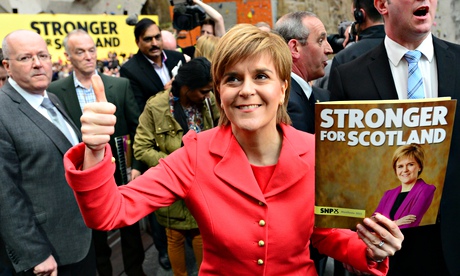
Something remarkable. There has been a dramatic shift in Scots’ political preferences since they voted on whether to remain part of the UK last autumn. The SNP is currently on 49%, up 29 points on 2010, with Labour and the Liberal Democrats both down by 15-16 points. This 22-point swing is sufficient to more or less wipe out the Scottish Labour party – which has dominated Scotland’s Westminster contingent for a generation – and nearly all of Scotland’s Lib Dems, too. Current projections suggest the SNP will win between 50 and 55 of the country’s 59 seats.
Why is this happening?
The referendum campaign last year boosted the share of Scots who support independence, which is the SNP’s defining cause. Stable at around 30% for many years prior to devolution, it is now typically in the 45-50% range. Second, the SNP has managed to convince many Scots that it, not Labour, is the party of social justice and redistribution. Third, the referendum energised Scottish voters in a manner seldom seen in British politics. Nearly 85% of voters turned out, higher than in any modern general election.
Why is the SNP winning when the yes campaign lost?
The SNP lost the vote last September, but won the campaign, boosting support for independence and recruiting huge numbers of activists - more than enough to dominate a fragmented Westminster election. The yes vote is united behind the SNP, while the no vote splits between Labour, the Conservatives, the Lib Dems and others. The SNP could win more than 90% of Scotland’s seats with 45% of the vote, exploiting the same “winner takes all” electoral system that enabled Labour to dominate Scotland for decades.
Are there any rays of hope for Labour and the Lib Dems?
A few. Elections are won and lost locally as well as nationally, and many incumbent MPs, particularly those such as Jim Murphy or Charles Kennedy with high profiles, will hope that personal loyalties can help them hold back the tide – pollsters do not name MPs but election ballots do. Politically inexperienced SNP candidates and organisers may hold the party back in seats such as Paisley and Renfrewshire South, where the 20-year-old SNP candidate Mhairi Black is dividing her time between revision for university finals and fighting Labour’s national election campaign director, Douglas Alexander. The SNP could be hurt by a lower- than-expected turnout; in the independence referendum turnout was below that suggested in polling and lowest in the strongest yes areas. The size of some Labour incumbents’ majorities is also a factor, – even a small, late shift away from the SNP would be enough to save them.
What effect will this have on politics after the election?
The SNP’s surge will hurt both of the bigger parties – Labour will lose dozens of MPs, while the loss of Lib Dems seats to the SNP leaves the Conservatives with fewer potential allies in the Commons. The UK’s unbalanced constitutional arrangements are likely to come under further pressure. The Conservatives, joined by Ukip, are likely to continue criticising the asymmetric devolution system, particularly if Labour relies on SNP votes to pass policy for England. The electoral system will also come under renewed pressure if the SNP holds the balance of power, while Ukip and the Greens are marginalised despite winning more votes. Ironically, the SNP surge may have a bigger short-term impact on England’s constitutional settlement than Scotland’s.
Robert Ford is senior lecturer in politics at the University of Manchester