Jamie Grierson's evening summary
Echoing scenes from Challenge Anneka, Britain’s political leaders scrambled themselves across the length and breadth of the country in planes, trains and automobiles as they entered the last 48 hours of the election campaign. The prime minister is currently on a non-stop 36-hour tour of the UK, which will see him talking to nightshift workers as he campaigns through the small hours, while Lib Dem leader Nick Clegg is embarking on a 1,000-mile two-day battlebus odyssey from Land’s End to John O’Groats. Ed Miliband was in Bedfordshire and North Warwickshire, while Ukip’s Nigel Farage was in Ramsgate and the Green’s Natalie Bennett was in Cambridge.
The big picture

While we could easily have predicted to see plenty of babies kissed, sleeves rolled up, thumbs flicked to the sky and hard hats donned, we could be forgiven for presuming in the last 48 hours that none of the country’s politicians would “commit news”. But rather than stick to the safety of photo ops in the final throes of the election campaign, the parliamentary hopefuls did quite the opposite. Nick Clegg issued a warning over the prospect of a second election before Christmas, a Ukip candidate was suspended for a foul-mouthed rant and Ed Miliband revealed a so-called red line over scrapping the non-dom rule and in doing so acknowledged for the first time he might not seal a majority. Who knows what tomorrow might bring?
What happened today
- A list of “very, highly or extremely controversial” potential cuts to benefits have been drawn up by civil servants in response to warnings that the next government would struggle to keep welfare spending below a legal cap of about £120bn a year.
- Nick Clegg raised questions on Tuesday about the stability of any post-election deal with the Conservatives, saying he would never be a party to a government that recommended withdrawal from the EU. The Lib Dem leader said: “I would never, of course, accept being part of a government that advocated withdrawal from the European Union”.
- A second election before Christmas is inevitable unless the Liberal Democrats become part of a government in the event of a hung parliament after 7 May, Nick Clegg has said.
- Nicola Sturgeon has warned that the next British government could be illegitimate if it fails to include “Scottish voices” as she stepped up demands for a post-election deal with Labour. The Scottish National party leader told a rally in Dumfries on Monday that it would be wrong for it to be made up solely of English MPs, hinting that she expects David Cameron’s Tories to win the most seats in Thursday’s election.
- A Ukip parliamentary candidate has been suspended after saying he would shoot his Tory rival if he ever became prime minister, the party has said. In an expletive-laden rant, Robert Blay said the Conservative party’s candidate Ranil Jayawardena was “not British enough to be in our parliament” and accused him of timing the birth of his child to coincide with the general election.
- The Conservatives have raised 10 times more in donations than Labour in the final week of the general election campaign, official figures showed on Tuesday. David Cameron’s party received £1.36m, while Ed Miliband’s campaign gained £131,242, according to the final list of contributions released by the Electoral Commission.
- The Evening Standard has urged Londoners to vote Conservative in Thursday’s general election. The newspaper is following in the footsteps of its stablemate the Independent, which on Tuesday morning stunned many by announcing its support of a continuation of the Conservative-Liberal Democrat coalition.
Laugh of the day
My hasn’t he grown? ITV Meridian scored an absolute winner when they discovered a 24-year-old clip of a lean and youthful Ed Miliband - or Ted Miliband as he was known back then - leading a rent strike on behalf of Oxford students in the spring of 1991.
EXCLUSIVE: Watch @Ed_Miliband 's first ever TV appearance from 1991. Copyright @itvmeridian http://t.co/NLj1e2UOuu pic.twitter.com/yxnutjsvlt
— Adam Clark (@adamclarkitv) May 5, 2015
Quote of the day

I feel like the British public will go through as many Milibands as they can til they get to on that they like. So, I dunno how many more of the brothers there are but I’m sure if the British public continues to meet more and more Milibands they’ll find one that they deem appropriate.
US comedian Jon Stewart gave a brief but typically sardonic take on the UK election for Channel 4 News, in which he predicted England will “secede itself” and praised Cameron and Miliband for “lowering expectations”, further underlining how much he will be missed when he leaves the Daily Show in August.
Jon Stewart speaks to @jonsnowC4 on #Cameron vs #Miliband and #Bush vs #Clinton - watch his take on #GE2015 https://t.co/cRAcVX9Bbr
— Channel 4 News (@Channel4News) May 5, 2015
Hero of the day
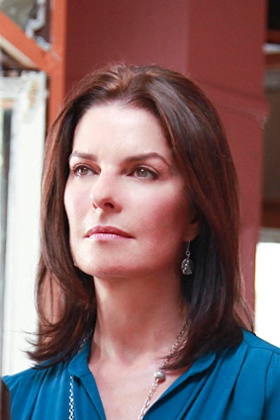
Roland Emmerich’s upcoming sequel to Independence Day will be getting a female president in the shape of Sela Ward. Ward, best known for big-screen roles in The Fugitive and Gone Girl, will be playing the character of President Lanford. I accept Lanford is a fictional political character, but presuming the film will end with the world being saved, most likely by her, then her selection seems fair.
Villain of the day
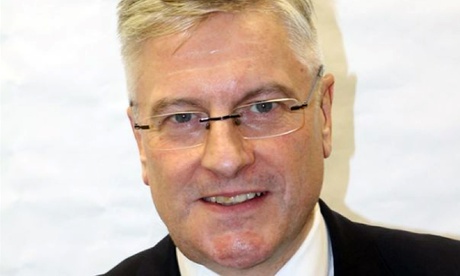
Ukip parliamentary candidate Robert Blay was suspended after saying he would shoot his Tory rival if he ever became prime minister. In an expletive-laden rant, Blay says the Tory party’s candidate Ranil Jayawardena was “not British enough to be in our parliament”.
Tomorrow’s agenda
I can’t quite believe I’m about to write this - but tomorrow is of course the final day of the election campaign. So what can we expect? 24 hours of pleas and promises, insults and putdowns, banners and balloons and predictions and projections.
That’s it for me for today. It has been a pleasure. Join the Guardian’s election team tomorrow morning, as we bring you the latest news, reaction, analysis, pictures, video, and jokes from the campaign trail.
Alan Travis, the Guardian home affairs editor, has written a guide to what happens if no single party wins a majority and there is a hung parliament again.
He writes:
Britain has no written constitution but the nearest things we have to official handbooks in this situation are the cabinet manual drawn up in 2011 and the Fixed-term Parliaments Act 2011.
The rules, however, make clear that Cameron is entitled, and indeed required, to stay on as a caretaker prime minister in a hung parliament. “The incumbent government remains in office unless and until the prime minister tenders his or her resignation and the government’s resignation to the sovereign,” says the manual.
This means that while Cameron does have first go at forming a new government, it does not stop any other party leader from trying to do the same thing.
UK election will come down to the SNP - Jon Stewart

Outgoing Daily Show presenter Jon Stewart has told Channel 4 News the Scottish National Party will hold the deciding vote on 7 May.
The comedian joked England would “secede itself” after the election and said David Cameron and Ed Miliband had been smart to “lower the public’s expectations”.
In an interview with Jon Snow, he said the UK had better institutions than the US - but still arrived at “stupid decisions” such as going to war in Iraq.
You guys do it right. You get to the same terrible results we get to but you do it so much more efficiently. To do in six weeks what it takes us four years to accomplish it’s quite exciting.
Asked by Snow what he believed the outcome would be, Stewart said both Cameron and Miliband have been smart as to “not portray themselves as too Churchillian or too charismatic”.
I think it’s really smart to lower the public’s expectations of what either one of those could accomplish. It’s going to come down to SNP, they’re going to be the deciding vote and England is going to secede from itself.
Snow suggested that satirical comics like Stewart had contributed to a breakdown in trust in politicians, which Stewart flatly rejected.
That’s not the problem of the jokes. People have lost faith in the system, not because people have pointed it out, but because the system has shown itself to be so fraudulent. We here in the states look very admiringly about the fact you don’t spend that much money on elections, you do them very quickly, your news media is sober, concise and clear minded, it has no partisan rumblings, it has no bias, you have institutions in place that we imagine we wish we had and yet here we are you guys make the same stupid decisions we do even with the proper institutions. With not spending too much on elections, with having a better news broadcasting system, with questioning your politicians in Question Time directly and yet you still went to war in Iraq so I’m not sure what the answer is anymore.
Here is a video clip of Stewart’s interview.

Nick Clegg has just been speaking to journalists on the Liberal Democrat battle bus as it makes its way to his constituency of Sheffield Hallam for a quick stop off before trundling on to the Lake District.
He said that the two biggest parties didn’t want a coalition and were under “huge pressure” from within their own ranks to try their best to run a minority government and avoid coalition.
If you pick up the phone to any Tory MP on the right of the Tory party and ask them if they want to re-enter a coalition with the Liberal Democrats – once their expletives have died down after five minutes – for them its an article of faith that somehow the right wing vocation of the Conservative party was denied its moment in the sun by the presence of the Liberal Democrats.
Clegg said he thought “the Labour party perhaps haven’t been through the pain barrier of realising that they’re not going to run things on their own again”.
I think the Labour Party would have a hell of a job on its hands explaining to its activists why they might want to enter into a centrist coalition with a party they have been vilifying in hysterical terms for half a decade.
The Lib Dem leader said that, while he was grateful for endorsements from a series of national newspaper editorials, including the Financial Times and the Independent, he wished the warm words had come sooner.
The deputy prime minister said he’s getting about four hours sleep a night and is trying to get in some early morning kickboxing sessions to keep his energy levels up. He’s been taking cat naps at the back of the bus, apparently, unbeknownst to the journalists, who sit at the front.
My colleague Henry McDonald has filed this sobering piece from Northern Ireland.
Armed checkpoints will be mounted across Northern Ireland over the next 48 hours in the run up to polling day.
The Police Service of Northern Ireland said the extra security along main arterial routes over the region is in response to a rising dissident republican threat.
Republican organisations opposed to the peace process have tried to intensify their violent campaigns ahead of the general election.
PSNI assistant chief constable Stephen Martin said: “In light of the four attacks carried out in Belfast and Londonderry over the last two weeks, the PSNI will have an enhanced profile in local communities to provide safety and reassurance to everyone.”
Last week the PSNI discovered a large bomb during a security operation in North Belfast at the edge of the republican Ardoyne district.
The Conservatives have raised 10 times more in donations than Labour in the final week of the general election campaign, official figures showed on Tuesday.
David Cameron’s party received £1.36m, while Ed Miliband’s campaign gained £131,242, according to the final list of contributions released by the Electoral Commission.
Over the four full weeks of campaigning, Labour secured the most financial backing, receiving £4,658,499 – most of which came from unions – while the Conservatives were given £3,456,017.
In the final week, the Liberal Democrats raised £89,000, Ukip £7,896 and the Green Party £10,000, the watchdog said.
Over the entire “short” campaign, Ukip took in £1,614,312 and the Liberal Democrats £234,000.
We’re doing our last Guardian / British Thinks focus group in Thanet at the moment. The participants have been asked to bring symbolic objects to sum up how they have viewed the election campaign
This man, a Labour supporter, brought a DIY “Ukip survival kit” which contains nails for “the coffin” of South Thanet because he says he is resigned to the fact that Nigel Farage will win here.
Last @guardian @britainthinks focus group in Thanet have brought symbolic objects. This is a "ukip recovery kit" pic.twitter.com/2FOzrLgJhW
— Ben Quinn (@BenQuinn75) May 5, 2015
Among other items brought along by members of the panel were a CD (“things just keep on spinning around but there’s no difference”), a blindfold, and a set of keys (“because the election it’s a bit like a car key party”).
Ukip has suspended a general election candidate for “abhorrent” abuse about a rival - including racial slurs and a threat to shoot him should be ever become prime minister.
The Mirror published a video of Robert Blay speaking to its investigators about Tory opponent Ranil Jayawardena at a public meeting on Saturday in Ramsgate addressed by party leader Nigel Farage.
The Press Association reports:
Ex-Conservative Mr Blay - who is standing for election in North East Hampshire - noted that Mr Jayawardena had been tipped as Britain’s first Asian prime minister.
The Mirror reported that he went on: “If he is I will personally put a bullet between his eyes. If this lad turns up to be our prime minister I will personally put a bullet in him. That’s how strong I feel about it.
“I won’t have this f***** as our prime minister. I absolutely loathe him.”
MIRROR EXCLUSIVE: UKIP suspends candidate after he threatens to SHOOT Tory rival http://t.co/qsNExQhMrz pic.twitter.com/QB13PEIvQ7
— Daily Mirror (@DailyMirror) May 5, 2015
Reporter Andre Rhoden-Paul has just sent this from Sheffield:
Two protestors campaigning for victims of child abuse have scaled the roof of Nick Clegg’s constituency office in Sheffield.
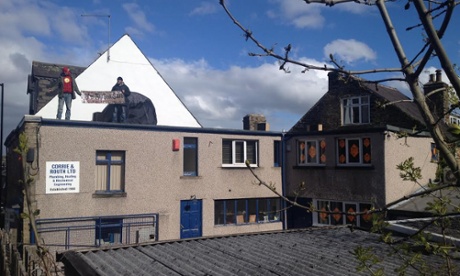
The protesters from Come Clean on Child Abuse accuse the deputy prime minster of not doing enough to address historic allegations of sex abuse at his former school.
Martin Matthews, 44, and Robert Carwadine, 50, scaled Clegg’s office in Fulwood, Sheffield late last night.
The men holding a banner saying “time to come clean” on the roof of the premises, shared with a plumbing company, plan to protest until polling stations close at 10pm on Thursday.
Martin Matthews of Great Bookham, Surrey dressed as superhero Flash said:
We want politicians that are going to get hold of these historical allegations of child abuse, clear it up and say it’s never going to happen again.
A spokesman for Clegg said:
The actions of abusers were horrific. They have ruined people’s lives, and it is right that all must be done to get to the truth. There are police investigations underway, as well as the Independent Panel Inquiry into Child Sexual Abuse under Justice Lowell Goddard. These must be allowed to do their job, and have our full support.
Police cars are monitoring the protestors and declined to comment.
Updated
From the Ukip campaign trail
In fresh polling today the Tory peer Lord Ashcroft put UKIP on 12% – a one point rise – cheering the party somewhat after a recent apparent squeeze in support.
Still under pressure to deliver a key Ukip breakthrough by winning a seat in the east Kent constituency of South Thanet, Nigel Farage appeared however to be reducing his exposure to the media today in order to focus on chasing local votes.

The press were invited to join the UKIP leader on a walkabout in the town of Sandwich – a Tory stronghold in the south of the constituency – but an appearance at a bingo hall in port town of Ramsgate in the evening was cancelled as Farage continued to canvass on the streets.
Separate Ashcroft polling which was release six days ago put Farage two points behind his Conservative opponent Craig Mackinlay in South Thanet.
Douglas Carswell, who is seeking re-election in the Essex constituency of Clacton, joined Farage on the trail in Thanet and later tweeted pictures of the two on the streets of Cliftonville, a strongly Labour district of Margate where there have been particular tensions over the issue of immigration.
Out and about with Nigel in Thanet ..... Good response from local folk pic.twitter.com/T7M1YXpy0u
— Douglas Carswell (@DouglasCarswell) May 5, 2015
Nationally, there was some cheer for Ukip in the form of polling today by the Tory peer Lord Ashcroft which had the party rising one percentage point to 12 percent. Ashcroft polling which was released six days ago put Farage two points behind his Conservative opponent Craig Mackinlay in South Thanet.
Voters who Farage encountered in the earlier part of the day in Sandwich included a man who expressed concerns about the threat to the UK from “arabs” and extremists.
Farage later reportedly said that he could not believe that the security threat from ISIS infiltrating the UK via migrants crossing the mediterranean was not a “massive issue” in the election campaign.
.@UKIP leader later says he's can't believe security threat from IS & med migrants isn't a 'massive issue' in #ge2015
— Robin Brant (@robindbrant) May 5, 2015
Mirror/Survation poll puts Labour one point ahead
The latest poll from the Mirror/Survation puts Labour one point head of the Tories.
Here’s the Mirror’s deputy political editor Jack Blanchard with the rundown of results:
Today's Mirror/Survation poll: LAB 34 (n/c) CON 33 (n/c) UKIP 16 (n/c) LD 9 (n/c) SNP 4 (+1) GREEN 4 (+1) OTHER 1 (-1)
— Jack Blanchard (@Jack_Blanchard_) May 5, 2015
My colleague Rowena Mason has more on Ed Miliband’s hint of his first red line in any coalition negotiations with the Liberal Democrats by saying he would only lead a government that abolishes non-dom status.
She writes:
There has been speculation over the past 24 hours that Labour could seek to partner with the Lib Dems even if both parties together fall short of a majority to ensure they together form a larger bloc than the Conservatives. This could help address the question of legitimacy, which the Tories argue would be a problem for Miliband if he were to try to become prime minister without having won the largest number of seats.
Revealed: coalition proposals to cut welfare for sick, poor, young and disabled
My colleagues Shiv Malik and Patrick Butler have this exclusive on a list of “very, highly or extremely controversial” potential cuts to benefits drawn up by civil servants in response to warnings that the next government would struggle to keep welfare spending below a legal cap of about £120bn a year.
They write:
The cuts proposed by officials at the Department for Work and pensions include abolishing statutory maternity pay and barring under-25s from claiming incapacity benefit or housing benefit. Money could also be raised, civil servants suggested, by increasing the bedroom tax in certain cases.
In one of the DWP documents seen by the Guardian, two Whitehall officials say colleagues who were consulted in 2014 about the potential cuts described them as “very/highly/extremely controversial” which highlighted that when it came to welfare spending that there was “not much low-hanging fruit left”.
The Conservatives have proposed cutting £12bn in welfare after the election, without specifying how the budget would be cut. The DWP proposals were canvassed the year before, amid warnings that the failure of the coalition to get to grips with accelerating spending on key benefits would leave the next administration “vulnerable to a breach” of the welfare spending cap.

Just returning to Nick Clegg’s interview on Radio 4’s PM, my colleague Patrick Wintour has flagged a key quote on the Liberal Democrat leader’s position on working with parties that want to withdraw from the European Union.
Asked by Eddie Mair if he would be happy to work with the Tories even though David Cameron is ready to hold an in-out referendum on the European Union in the next two years, Clegg replied:
I would never accept, of course, being part of a Government that advocated withdrawal from the European Union.
Cameron has said he would fight to persuade voters to back staying within the EU in the event of a referendum - so who is Clegg targeting here?
Meet Ted Miliband

ITV Meridian has dug into the archives and found the first ever TV appearance of Ed Miliband – or Ted as he was then known – when he was just a fresh-faced, grey wooly jumper-wearing student in spring 1991.
Miliband told the interviewer he was “delighted” to see the 10 second clip of him leading a rent strike on behalf of Oxford students, and asked how it was found so many years later.
Updated
Patrick Wintour, the Guardian’s political editor, has tweeted this key line from Nick Clegg’s Radio 4 PM interview:
Clegg "I will never be party to a government that advocated withdrawal from the European Union". A storyette.
— Patrick Wintour (@patrickwintour) May 5, 2015
Updated
Scrapping non-dom rule is a red line - Miliband

Ed Miliband will tomorrow vow that the non-dom rule will be scrapped by any government he leads after the election campaign.
The Labour leader last month announced that if he wins the election he will abolish the non-domicile rule that allows many of Britain’s richest permanent residents to avoid paying tax in the UK on their worldwide income.
In a rare nod to the prospect that his party will not win an overall majority, Miliband will say “any government” he leads will do the same.
He will say:
Let me be clear: any government I lead after this election will abolish the non-dom rule.
The next Labour government will do what no government has done for 200 years. We will replace the non-dom rule with a clear principle: anyone permanently resident in the UK will pay tax in the same way.
And only Labour will do this. We have come to expect David Cameron and Nigel Farage defending the richest and most powerful. But it is extraordinary that Nick Clegg is defending the non-dom rule too.
Nick Clegg came under pressure from Eddie Mair on Radio 4’s PM over a tweet sent by Lord Scriven about a private conversation the deputy prime minister had with David Cameron.
Q: Can I have a private conversation with you without you blabbing to someone else? What did you tell Lord Scriven about David Cameron?
Scriven is an old friend of mine, Clegg says. I’m not going into private conversations I had. I refuse to provide a running commentary on private conversations.
Here’s the original tweet that caused such a stir.
So Cameron has taken to lying on Tory Maj. @nick_clegg told me that Cameron privately admitted to him that the Tories won't win a majority
— Paul Scriven (@Paulscriven) May 4, 2015
Natalie Bennett, the Green party leader, is making her third trip in a fortnight to Bristol West – a seat the party thinks it can win.

She will be joined by party grandees Baroness Jenny Jones and Jean Lambert MEP, as well as Jack Monroe the writer and food campaigner who left the Labour party in favour of the Greens.
Bennett’s message is that the Greens will help deliver a “fairer” economy, and are determined to: “keep the Tories out of government and keep Labour in line.”
Party members and supporters are invited this evening to bring along an undecided friend to meet Bennett et al., to try and persuade them to vote Green.
On Wednesday morning, Bennett, Monroe and the Bristol West candidate, Darren Hall, are visiting Fareshare, a charity which takes food destined to go to waste and distributes it to the most needy.
The Greens are buoyed by an Ashcroft poll that puts them ahead of the Lib Dems, who hold the seat in Bristol West, but behind Labour. Still, they insist they have the momentum.
In the Guardian Monroe last month explained why she is supporting the Greens:
Like greeting old friends, I embraced the importance placed on a national health service, on public transport, on sustainable energy, on fair pay for fair work.

An interview with Nick Clegg is now being aired on Radio 4’s PM. I will listen in and flag the most interesting snippets.
Ed Miliband, the labour leader, has spent the day touring marginal seats and dodged five questions about how he will act in the very likely event of a hung parliament.
He was asked three times at an event in Bedford if he would seek to be prime minister even if he leads the second largest party. But he repeatedly refused to say, arguing it would be a distraction from the last 48 hours of campaigning.

David Cameron, the Prime Minister, then upped his warnings about Miliband trying to govern even if he has fewer seats, saying it would create a “massive credibility problem”.
Confronted with these accusations later in North Warwickshire and asked to reassure swing voters, the Labour leader said:
All I have to say to voters making up their minds is to focus on the big choice the country faces. I’ll let others speculate on the election outcome.
He would not even use the example of other European countries, where the leader of the second biggest party is commonly prime minister, to make a case for legitimacy.
“Rather than politicians talking about themselves we should be talking about the British people and the choice laid before them,” he said.
Updated

It was a brief interview on Radio 4’s PM with Plaid Cymru’s Leanne Wood. Most interesting moment was when Eddie Mair asked Wood about her 2007 arrest for blockading Faslane naval base in Scotland during a protest against the Trident nuclear programme.
Q: Are you proud of that moment?
I’m proud of the campaign work I’ve done in relation to Trident, Wood said. I’m proud my party has made Trident replacement a key issue during this campaign.
Updated
Faisal Islam of Sky News has spotted election related graffiti on a poster at an underground station. Awkward.
Graffiti spotted on Russell Brands film poster at Sloane Square station.:. On so many levels: #GE2015 pic.twitter.com/zasIAe3sJz
— Faisal Islam (@faisalislam) May 5, 2015
Plaid Cymru leader Leanne Wood is being interviewed on Radio 4’s PM now. I’ll have a listen and flag up the key moments.
Updated
My colleague Marina Hyde has been on the campaign trail with Boris Johnson and David Cameron.
She writes:
An audience of captive workers was laughing, and David Cameron was laughing with a slightly clenched jaw. Whether the PM and Johnson ever really liked each other, even in the Bullingdon days, has always seemed doubtful. Either way, they now embody the least convincing relationship of mutual reverence since that between Alex Ferguson and Jose Mourinho.
Read the article in full here.
With just 48 hours to go before the UK decides, politicians are making their final push on the campaign trail, from Land’s End to West Lothian. Here are the election photo highlights of the day:

The Scottish Tory leader, Ruth Davidson, and the first openly-gay leader with a major political party in the UK, has appeared together with her partner Jen Wilson for the first time on the campaign.
Wilson joined her at the Strathspey steam railway at Aviemore where Davidson, never knowingly shy of a photo opportunity during this campaign, smeared coal dust on her face before she posed with a coal-filled spade by the loco’s boiler.
Updated

The SNP has suspended two party members today after their involvement in angry protests at a Scottish Labour rally in Glasgow yesterday.
Piers Doughty-Brown and James Scott have been placed under “administrative suspension” pending investigation of their role in yesterday’s incident in the city centre, which saw Labour activists - including leader Jim Murphy and supporter Eddie Izzard - jostled and abuse hurled at them by self-described “anti-austerity campaigners”.
Amid scuffles, involving a handful of protesters and party members, Murphy and Izzard were forced to abandon an open-air rally and interviews with the media when protesters, carrying a banner reading ‘Red tories Out’, began playing music from a sound system and heckling with a loud-hailer.
Murphy later condemned “the ugly face of aggressive nationalism”, while SNP leader Nicola Sturgeon described the fracas as “disgraceful” and “absolutely nothing to do with the SNP”.
She said: “All parties have the right to make their case and they should be listened to respectfully.”
However, today it emerged that two of the leaders of the protest were SNP members. They were also identified by Labour activists as among those who protested outside last Friday’s Labour rally, attended by Ed Miliband, also in Glasgow.
Updated
Good afternoon, Jamie Grierson here. I’m taking over the blog for the rest of the day. Follow me on Twitter here and please keep your comments coming in below the line.
To kick off my evening session here’s a film from the Guardian’s video team of mayor of London and parliamentary hopeful Boris Johnson as he joined David Cameron on the Conservative campaign trail.
Ashcroft poll gives Tories 2-pt lead
Lord Ashcroft has released his latest poll findings.
The Conservatives lead by two points in this week’s Ashcroft National Poll, conducted over the past weekend. The Tory lead is down by four since last week, with Labour unchanged on 30 per cent. The Liberal Democrats are up two points at 11 per cent, Ukip up one at 12 per cent, the Greens unchanged at seven per cent and the SNP up one at five per cent.
Ashcroft has also written up the findings from focus groups he conducted in three marginal seats. Given the argument about whether a Labour minority government would be legitimate if Labour did not have the most seats, the conclusions on this issue is particularly interesting. Here they are.
One possible outcome is that Labour could form a government with the help of other parties, even if it comes second to the Conservatives in terms of both votes and seats. Most did not realise such an outcome was even possible, and many – including many who planned to vote Labour – were indignant at the idea: “They would have cheated their way in”; “It would be underhand. Not what the public wanted, not what the public said”; “It’s dealmongering, moving away from democracy”; “If that happened, at the next election, I’d think, what’s the point of voting?” Not everyone was exercised about it – but so many felt so strongly that it suggested such a government would have a job persuading the public of its political legitimacy, however constitutionally permissible it might be.
That’s all from me for today.
My colleague Jamie Grierson is taking over now for the rest of the day.
Updated
Ed Miliband has given an interview to Louise Pentland, a fashion vlogger. No, I’ve never heard of her either, but she has 1.26m followers on Twitter (a few more than me) and her YouTube channel has more than 2.1m subscribers.
She is another Russell Brand non-voter. She voted when she turned 18, she says in the interview, but hasn’t voted since. Miliband tells her that the country is “run by those who turn up”.
Daily Politics welfare debate - verdict
With less than 48 hours until the polls open, it was surprising to see the pace of this series of debates slow a little. Welfare is a divisive and emotionally-charged issue so it was almost bizarre to see the candidates sit back and allow their rivals to finish lengthy answers without interruption.
Ukip’s Suzanne Evans and Liberal Democrat Steve Webb brought very little to the lectern, while the Greens’ Jonathan Bartley was fairly mute too. It came down to a classic clash between the blues and reds, but Labour’s Rachel Reeves failed to place the work and pensions secretary Iain Duncan Smith under any considerable pressure - and vice versa.
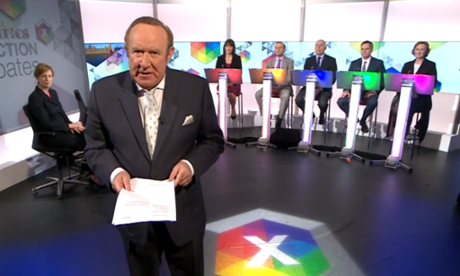
However, there were stand-out moments thanks to the voracious interrogation conducted by presenter Andrew Neil, whose thoroughly researched briefings and bulldoggish style has illuminated these debates throughout the campaign. Here are some key moments:
-
IDS admits Tories have not worked on where £12bn cuts will come from
The Conservatives have previously revealed plans to make £12bn of “savings” to welfare in the first two years of the next parliamentary term. The prime minister and his party has faced frequent calls to reveal exactly where the axe will fall. Neil pushed Iain Duncan Smith to explain where the cuts will come from, asking the work and pensions secretary why he thinks it is not relevant for the public to know. Duncan Smith explained his party hasn’t done the work on exactly how the savings will be made.

We would have to have done the work on it. That’s why. We would have had to reach agreement as to exactly where those are... as soon as we’ve done the work and had it modelled we’ll let everybody know what that is.
Neil then asks the question on many a lip: shouldn’t you have done this work before you ask people to re-elect you?
The work we do on this will be done in the spending review and we will announce that in time.
-
The rise in food bank use is the fault of the recession, says IDS
The work and pensions secretary was urged to explain the rise in use of food banks, which according to the latest figures from the Trussell Trust were used to feed almost 1.1 million people for three days in 2014-15. Duncan Smith said it was the fault of the recession, which Neil pointed out was over long before the spike in use of food banks.
The real principle rise and the reason for the rise in the use of food banks and support through the community was the terrible recession we had. It’s difficult to overstate this we had the biggest recession we have had in living memory.
-
Don’t mess with Iain Duncan Smith

The Greens’ Jonathan Bartley infuriated the work and pensions secretary with a suggestion that, according to press reports, 60 suicides can be linked to the Government’s welfare reforms. In perhaps his most impassioned moment of the debate, IDS flatly denied the claim and swiftly put Bartley in his place. The Green didn’t apologise but certainly appeared to realise the enormity of his allegation and soon quietened down. Here is IDS’s moment of fury in full:
That’s just scurrilous. You make an allegation and you can not stand that up and I simply say to you be very careful. You say you’re a Christian, be very careful what you say about people’s motivations. I have to tell you now, the department has looked at this and I’m not prepared to accept the welfare changes that have improved the quality of lives for all sorts of people... and what I’m telling you now is what we absolutely know is you can not make allegations about individual cases, in tragic cases where obviously things go badly wrong and suddenly say this is directly as a result of Government policy. I totally reject that. What a scurrilous point to make. I think what you said is cheap.
Updated
A Tory candidate’s tweet comparing Labour to Jimmy Savile, as we reported earlier (see 9.58am), has generated more anger.
Craig Whittaker, standing for re-election in Calder Valley, linked to the Daily Mail article headlined “Trust Labour? I’d rather trust Jimmy Savile to babysit” earlier this morning.
Since then, care charities have tweeted their displeasure at Whittaker’s tweet:
We are not happy with @Whittaker4mp comments RE:Jimmy Savile on his Twitter.We would like comment from him, @UKParliament, @WhoCaresTrust
— Care Leavers' Assoc (@CareLeavers) May 5, 2015
We’re extremely disappointed with @MailOnline for the headline & @Whittaker4mp for subsequent RT. We are taking this matter very seriously.
— The Who Cares? Trust (@WhoCaresTrust) May 5, 2015
Incidentally, The Who Cares? Trust acts as the secretariat for All-Party Parliamentary Group on children in care, which is the parliamentary group which Whittaker chairs.
Hat tip to Political Scrapbook for pointing that out.
We’re always sympathetic to typos at the Grauniad. James Duddridge, a Conservative candidate, has had an unfortunate experience at the printers. Either that, or else he has come up with a cunning ruse to publicise his election leaflet.
Always have someone to proof read your leaflet. This one had no imprint and mentions Erection Day. Keep it up! pic.twitter.com/09d5l163Hc
— James Duddridge (@JamesDuddridge) May 4, 2015
Updated
Tories would have gained an extra 30 seats from AV, research suggests
In his Today programme interview Nick Clegg complained that both Labour and the Tories opposed constitutional reform. That may have been a little unfair. Ed Miliband half-heartedly backed the alternative vote, whereas the Conservatives aggressively campaigned against it (and won).
So it is hard not to smile at the news that, if AV had been introduced, the principal beneficiaries would have been - the Conservatives.
Chris Hanretty has been looking at the figures, using British Election Study research, and he has posted his findings on the Newsnight blog. According to his analysis, the Conservatives would get 30 more seats than currently forecast, mainly because they would benefit from a huge number of Ukip second preferences. Labour would get fewer seats than currently forecast. And, according to Hanretty, the Lib Dems, who it was assumed would be the principle beneficiaries of AV, would neither gain nor loss. AV would have no effect on them at all.
On the basis of Hanretty’s figures, Cameron would comfortably be on course to remain prime minister.
Updated
Ed Miliband has conducted a video interview with the Guardian. It covers quite a range of topics, from relations with his brother to Manic Miner.
Updated
Our BritainThinks focus group’s verdict on the campaign
What do the real voters think? We have 60 in five key seats giving their view throughout the campaign as part of our polling project with BritainThinks. They each have an app and are telling us what they think of stories as they crop up.
Below are some of their thoughts – from newspaper editorials to coalition deals:
In a speech in Cambridge Natalie Bennett, the Green party leader, said all three main parties were failing to address the problem of climate change.
All three parties want us to pursue the fantasy of fracking as an energy source, ignoring the need to decarbonise our electricity supply by 2020.
Conservatives and Labour want to build new roads and expand airports, ignoring the environmental and social impacts on communities.
None of the establishment parties have the bold plans to improve energy efficiency on the scale that we need to both tackle fuel poverty in Britain and to cut our carbon emissions.
None have plans to break up the oligopoly of the Big Six energy firms, to democratise our energy supply and put it in the hands of communities and small local companies.
None have acknowledged that nuclear power is another failed 20th century dinosaur. Blow after blow hits the nuclear power sector. The two European plants under construction are wildly over schedule and over budget, and may not generate a single watt. But the nuclear lobbyists still find government doors swept open before them, while policies fail to deliver for our renewable future.
Only the Green party is setting out the policies that could make Britain a leader in the technology we need to build a low carbon future, which is the only future we can have. It would be a future of tremendous possibility, of good, stable jobs and warm, comfortable, affordable-to-heat homes. A future with a stable climate.
According to the Daily Record, one of the protesters who disrupted Jim Murphy’s rally in Glasgow yesterday, Piers Doughty-Brown, is an SNP member who has now been suspended from the party.
Margaret Curran, the shadow Scottish secretary, said this showed Nicola Sturgeon was wrong yesterday to say this had nothing to do with the SNP.
Yesterday Nicola Sturgeon said the appalling scenes on the streets of Glasgow were nothing to do with the SNP, yet today she has suspended the SNP member who led the disruption.
What happened yesterday was the ugly face of nationalism, but we will never let it stop us making a positive case for Scotland’s future - and it will never stop me standing up for the people of the East End of Glasgow.
As someone who has been followed on the streets of Glasgow by Mr Doughty-Brown and who has raised concerns about his behaviour for months, I am happy to assist Nicola Sturgeon with her investigation.

My colleague Peter Walker has been listening to Lucy Powell’s interview (see 1.08pm) in more detail. He says it is clear that she was just making the point that carving something in stone does not in itself guarantee that it will happen. At another point in the interview Powell said:
[Ed Miliband is] highlighting a point he’s been saying throughout this campaign – it was just another way of highlighting that.
Powell has also made this point on Twitter.
Honestly Tories and others desperately mis-quoting what I said. Anyone who heard the whole interview knows I said the opposite.
— Lucy Powell (@LucyMPowell) May 5, 2015
Updated
Clegg's 'second election' claim - analysis

Nick Clegg’s warning about a second election being inevitable unless the Lib Dems are included in a coalition in a hung parliament (see 1.32am) is striking (and probably rather alarming to everyone who feels that one election a year is more than enough). But is it actually true?
Under the Fixed-term Parliaments Act, there will not be another general election until 2020 unless one of two things happens: two-thirds of the Commons votes for an election, or the government loses a vote of confidence and 14 days pass without an alternative government winning a vote of confidence.
What Clegg is doing is effectively issuing the same sort of “vote for stability” message that David Cameron is issuing. Cameron is arguing that to ensure stability we need to avoid a coalition/hung parliament, while Clegg is arguing that to ensure stability we do need coalition, but in other respects they are making the same point. They are both alarming voters with the prospect of chaos.
But would having the Conservatives or Labour trying to govern as a minority party, without the Lib Dems, really generate such chaos as to make a second election inevitable?
For there to be a two-thirds vote in favour of an election, the Tories and Labour would both have to support the idea. That is not totally inconceivable, but it is very hard to imagine, mainly because circumstances that might favour one of them electorally would make the other party want to postpone. Besides, Labour can’t afford a second election.
It is slightly easier to imagine circumstances where a government loses a confidence vote and no alternative government wins one. But, given that the SNP have said they would do everything to keep the Tories out of power, it is hard to see them voting down a Labour government.
Another point is that, as long as someone else is available to try to form a government (Boris Johnson? Andy Burnham? Even Clegg himself?), then it is possible they could have a go. As Catherine Haddon explains in a helpful Institute for Government blog on this, “there is nothing in the act that restricts the number of times we go through the merry-go-round of a government falling and a further government being formed.”
Clegg is assuming this crisis would arise because a minority government without the Lib Dems involved would be unable to govern. It is at this point that his logic really falls down. The Lib Dems have produced various examples of how minority Tory/Labour governments would not be able to pass bills (see 2.40pm), but they all ignore the fact that, on some measures, those governments would be able to rely on opposition support.
For example, the Lib Dems says a minority Labour government would have to offer full fiscal autonomy to the SNP. But they wouldn’t, because Scottish devolution legislation could go through with the support of the Lib Dems and the Tories, who both support the Smith commission proposals.
Minority government would involve ministers having to compromise with the opposition, but – as Clegg should know better than anyone else, because the Lib Dems have championed pluralistic politics for years – this is perfectly doable. Anthony King, a professor of government at Essex University, makes exactly this argument in an article in today’s Telegraph.
And here’s the conclusion from a recent Institute for Government report, Westminster in an age of minorities (pdf), a paper that specifically addresses how minority government could work.
The biggest challenge for a minority government undoubtedly lies in the parliamentary arena, where bills and spending plans may be defeated, amended or talked out (if timetable motions are defeated). Yet minority governments are often far from impotent in the legislature. Instead, successful minority governments put together temporary coalitions with different parties on different issues, conceding enough to get their business through, and relying on the fact that the interests and preferences of opposition parties are rarely aligned.
Minority administrations hold an extensive set of powerful levers simply by virtue of being in government. At Westminster, the executive tightly controls the budget process, has the ability to block non-government legislation fairly easily, retains the sole right to introduce secondary legislation (which is rarely challenged in parliament) and, despite recent reforms, can still determine the business of parliament most of the time. It makes hundreds of important public appointments, can reorganise the structure of government departments and agencies largely at will, and retains important prerogative powers over defence, foreign policy and much more.
All of this illustrates that a government without a majority can still be a powerful and effective force, although its survival rests on the continued acquiescence of opposition parties.
Updated
Hi Jamie Grierson here. I’ll be listening to the Daily Politics election debate on BBC Two, starting now. Today it’s on welfare. Conservative work and pensions secretary Iain Duncan Smith, Labour’s shadow work and pensions secretary Rachel Reeves, Liberal Democrat Steve Webb, Ukip’s Suzanne Evans and the Green party’s Jonathan Bartley are all appearing. I won’t post a minute-by-minute account, rather flag the most interesting moments.
Updated
Here is more from the Lib Dem news releases justifying Nick Clegg’s claim that there will be a second election before Christmas unless the Lib Dems are included in coalition.
New analysis reveals it would be virtually impossible for a minority Conservative or Labour government to pass key legislation without major financial concessions to buy off smaller parties like the SNP, Ukip and DUP ...
Party analysis reveals:
- A minority Labour government would not be able to pass a Queen’s speech without conceding full fiscal autonomy to the SNP.
- A minority Labour government would not be able to pass a spending review if reliant upon SNP “ending austerity” votes, without conceding on their plans to make savings in the first year from departmental budgets and welfare cuts.
- A minority Conservative government would have to find an additional £1bn for Northern Ireland to buy DUP votes to support a spending review.
- A minority Conservative government would have to slash funding for international aid to buy off Ukip and rightwing Tories.
- A minority Conservative government would not be able to pass a Queen’s speech without conceding to Ukip’s demands to hold an EU referendum this year, undermining Cameron’s claims that he wants to stay in Europe after negotiating a new settlement.
- A minority Labour government would not be able to pass key budgetary votes as the SNP have stated they will vote against estimates if they include the cost of Trident.
Updated
Clegg says there will be second election before Christmas if the Lib Dems aren't included in a coalition

Nick Clegg made his comment in a news release the party has just sent out.
Here is the Nick Clegg quote in full.
Everybody knows that no one will win this election – even if David Cameron and Ed Miliband won’t admit it publicly.
That means that politicians will have to work together to put the country first.
The Liberal Democrats have shown that coalitions can be strong and stable. But instead of creating stability, Labour and the Conservatives will create a shambles.
If they try to stagger through with a messy and unstable minority government instead of putting the country first then they will risk all the hard work and sacrifices people have made over the last five years.
The last thing Britain needs is a second election before Christmas. But that is exactly what will happen if Ed Miliband and David Cameron put their own political interest ahead of the national interest.
The only party that will ensure stability is the Liberal Democrats.
I will post a snap analysis shortly.
Updated
This is intriguing.
Clegg warns there'd be 2nd election before Christmas if Lib Dems aren't part of coalition
— Laura Kuenssberg (@bbclaurak) May 5, 2015
I’ll post more when I get a full quote.
The Tories are getting excited about this quote from Lucy Powell, vice chair of Labour’s election campaign. “Labour know Ed Miliband has no intention of keeping the promises he makes during the election campaign,” says Grant Shapps, the Conservative chairman.
Here is the quote:
I don’t think anyone is suggesting that the fact that [Ed Miliband has] carved them [his promises] into stone means, you know, means that he will absolutely, you know, not going to break them or anything like that.
To my ears, Powell was just making the (fairly obvious) point that the fact that Labour’s election pledges have been carved in stone will not, by itself, guarantee that they won’t be broken. But the BBC are running this as one of their lead items in the World at One news bulletin.
You can listen to the audio on the Guido Fawkes website and judge it for yourself.
This is pretty extreme.
Perhaps it was the moment when David Cameron endorsed Matthew Offord, not Boris Johnson, as the next Tory leader. (See 10.53am.)

Leanne Wood, the Plaid Cymru leader, has issued a statement saying voters should use the election to end Wales’s position as a forgotten nation.
The old way is on its way and people in Wales now have the chance to keep Wales at the heart of the political agenda beyond election day.
I ask people in every corner of our country to think about it: which local candidate will best represent your community at Westminster? Which party do you trust to make sure Wales’ voice is heard loud and clear?
I have been encouraged by the warm reception Plaid Cymru teams have received across Wales during this campaign. If you like what Plaid Cymru has had to say during this election campaign, vote for us.
Gordon Brown's speech – extracts

There have not been many (any?) memorable speeches this campaign. But, according to my colleague Libby Brooks, who was there (see 12.27pm), Gordon Brown’s was “thunderous”.
Here are two extracts from the text sent out in advance (which, knowing Brown’s speaking style, may have borne little relationship to what he actually said).
-
Brown defended Labour’s decision to rule out a deal with the SNP.
While for the SNP the pursuit of nationalism is their goal, we believe in partnership, and that real progress is not some progressing at the expense of others but all of us progressing together. So it could never have been Scottish nationalism but only Scottish Labour that led the way to a minimum wage across the whole of the UK, to stop the good region undercutting the bad and the bad nation undercutting the worst in a cut-throat race to the bottom – and it is a minimum wage that we will convert into a £8 an hour minimum wage
And that is why there can be no deal, no tie-in, no arrangement and no compromise with an SNP for whom nationalism is the imperative they serve.
Not because we are taking the low road of electoral calculation.
But because we have taken the high road of supporting the very principles of cooperation that the SNP want to break; the principles of partnership that the SNP would smash; the principles of sharing that the SNP would bring to an end; and the principles of solidarity that the SNP would throw into the dust.
And that’s the difference.
The nationalists wake up in the morning thinking of how to advance the cause of a separate state.
We wake up in the morning thinking of how to advance the cause of social justice.
Their aim is a second referendum. Our aim is a fair economy.
-
He said Labour would take people to the “mountaintop of social justice”.
Join us and let us all play our part in Labour and Scotland’s fight for social justice.
And I say to those who feel the pain of others and who believe in something bigger than ourselves: we know that when the strong help the weak it makes us all stronger.
I say there are millions like you who cannot be truly happy when others are sad, who cannot be at ease when millions are ill at ease, who cannot feel fully secure with so many insecure, and who cannot be comfortable when so many are without comfort.
And so I give you my view.
The independence people really want is independence from poverty.
The liberation people really want is liberation from deprivation and unemployment.
And the freedom people really want is freedom from all forms of injustice and inequality.
Yes it’s an uphill battle, but the battle is for the mountaintop of social justice.
Join us and let us all play our part in reaching that mountaintop.
Updated
Jim Murphy and Gordon Brown speak in Glasgow
In a characteristically upbeat speech, in the face of unanimously devastating polls, Jim Murphy has told voters in Scotland to ask themselves one question as they step into the polling booth on Thursday: what would David Cameron do?
Putting the squeeze tightly on voters wavering between Labour and the SNP, he said: “A Conservative prime minister who has reduced his great office to the status of the SNP’s cheerleader in chief, who has built his whole campaign on talking up the SNP. Does he want you to elect that one Labour MP who could be the vote that kicks him out of Number 10 or does he want you to elect an SNP MP who in the parliamentary arithmetic could be the only thing to save his skin?”
While Murphy was characteristically upbeat and measured in the face of devastating polls, Gordon Brown delivered a thunderous address, calling on Scottish voters – including those who voted yes in the referendum – to “ascend to the mountaintop of social justice together” by voting for Scottish Labour.
“In our DNA is the idea and determination that we will share our resources across these island, from each according to his capacity, to each according to his need … The sharing that a nationalist could never understand because it is not in their DNA to put social justice above the needs of nationalism.”
Thunderous words from Gordon Brown in Glasgow #GE2015 https://t.co/8ehUH9XmL9
— Libby Brooks (@libby_brooks) May 5, 2015
Updated
Three-minute election video: who will decide who forms the government?
Speaking of legitimacy, Guardian columnists Jonathan Freedland and Polly Toynbee turn their attention to Friday morning and the question of legitimacy in a hung parliament. Who decides who forms a government? Who gets to have a go at it first? Will it be down to Nick Clegg? And what do the front pages of the rightwing press tell us about the Tories’ plans?

Updated
PM suggests minority Labour government would have 'massive credibility problem'
In his Q&A this morning Ed Miliband studiously refused to talk about what might happen in the event of a hung parliament. (See 11.13am.) But David Cameron has not been so reticent. In an interview with the Daily Mail this morning, he suggested that Labour would not have the “legitimacy” to govern if it were not the largest party.
Asked whether a government led by a party that had failed to win the most seats in the Commons and votes in the country could have legitimacy, [Cameron] said: ‘I think people would have serious questions and problems with it – and they would have every right to.’
In an interview with the LBC this morning, Cameron went slightly further. Nick Ferrari asked him about stories in the paper suggesting Miliband wanted to form a government even if he did not have the most seats. Cameron replied:
I just think that there’s a massive credibility problem, with this idea that you can have a Labour government, backed by the SNP, only fighting for part of the country. I mean, the concerns of voters that I’m hearing about that, are very, very strong.
-
Cameron suggests a Miliband government would have “a massive credibility problem” if Labour did not have the most seats.
Is Cameron right? Analysis

Technically, no.
In so far as there is a guide to the British constitution, it is the Cabinet manual (pdf). And there is nothing in it saying that the government has to be led by the party with the most seats. A party with a majority gets to form a government but, if no party has a majority, the government is formed by whoever is “is best able to command the confidence of the House of Commons” (with the proviso that the incumbent prime minister gets to try first).
All constitutional experts are agreed that the government does not need to be led by the largest party, and there is precedent for the second largest party being in power, although you have to go back to the Labour government of 1924.
But Miliband could have a problem on Friday because many people will think that there would be something amiss with the “loser” of the election forming the government. Many voters will not have had time to brush up on their 1920s history, and they may well remember Jim Murphy making the argument in Scotland earlier in the campaign (in words that he probably regrets now) that the largest party forms the government.
Opinion polling evidence also shows that people would back Cameron on this point. When YouGov asked people recently who had “better claim” to be prime minister in a hung parliament situation, 48% said the leader of the party with the most MPs, and only 26% said the leader of the group of parties that could command a majority (the “correct” answer).
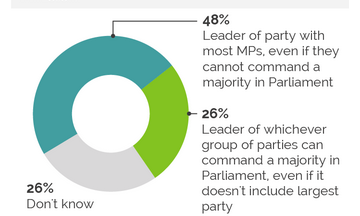
Earlier this morning on the BBC Norman Smith said there could be a conflict come Friday between the “parliamentary arithmetic” and “perceived legitimacy”.
In fact, a purist would say that legitimacy should rest with the leader of the party best placed to command the parliamentary arithmetic. But that is not where we are, and instead this weekend may see an intense public debate about two alternative concepts of legitimacy.
Updated
Ukip have got a two-page advert in the Daily Telegraph.
Unfortunately for Ukip, the Telegraph hasn’t shown them the same courtesy that other advertisers, like HSBC, sometimes get from the paper. As the Press Association reports, the two-page ad follows a front-page splash headlined: “A vote for Ukip is a suicide note for Britain”.
Updated

Miliband is now taking questions from the press.
Q: Why are you not travelling as much as your rivals in the last 48 hours?
Miliband says he will fight flat out to win the election.
Q: The shortfall in NHS hospital trusts would use up most of the extra money you have set aside for the NHS.
Miliband says he is highlighting those figures because they show the crisis facing the NHS. Only Labour would address this, he says.
Q: What is your view on who has the right to form a government?
Miliband says there are 48 hours left. He is fighting for votes, and focusing on the issues.
Q: If you are not the largest party, will you try to form a government?
Miliband says he is focusing on getting the right outcome for the election.
Updated
In his Q&A, Ed Miliband says when he hears David Cameron “banging on” about how good life is for working people, he realises that he just does not “get it”.
The Conservatives have unveiled a defector from Ukip. Elliot Nichols was a Ukip district councillor in Surrey until yesterday. He was also Ukip’s parliamentary candidate for South West Surrey until he stood down before Christmas, citing personal reasons. In a statement released by CCHQ, Nichols said:
Two years ago I left the Conservative party and joined Ukip. I switched with high hopes. Since then events – especially in recent months – have convinced me that this was a grave error of judgment.
I made a mistake – a big one – and today I am proud to rectify it.
We need an EU referendum, a sustainable NHS, better schools, a tax-free minimum wage, and above all a strong economy. To these challenges, each critical in its own way, Ukip offers no solutions, only soundbites, and nasty ones at that.
So, Nichols is a double defector. He ratted, and re-ratted, as Churchill put it.
Updated
Cameron wins 40% of the children's vote, according to kids' newspaper

If the children of Britain were the only voters on Thursday, David Cameron would emerge with 40% of the vote, according to a survey by the weekly children’s newspaper First News.
More than 5,000 First News readers took part in the junior general election, which would make the Green party the third largest Commons bloc (on 18%), behind Labour on 22%.
(NB: It is perhaps stating the obvious to point out that the kind of parents who buy their child a subscription to a weekly newspaper are likely to be at either end of the political spectrum – traditional conservative or campaigning left – which may be reflected in their child’s choice.)
The final count was:
David Cameron, Conservative: 40%
Ed Miliband, Labour: 22%
Natalie Bennett, Green: 18%
Nick Clegg, Lib Dem: 9%
Nigel Farage, UKIP: 6%
Nicola Sturgeon, SNP: 4%
Leanne Wood, Plaid Cymru: 1%
Updated
David Cameron has been holding an event at the same time as Ed Miliband. I did not see the live footage, but, from Twitter, it sounds as if it has been quite lively.
Boris at rally with PM raises "nightmare prospect" of "Alex Salmond holding out his glass for more pink champagne on the British taxpayer"
— James Chapman (Mail) (@jameschappers) May 5, 2015
Cameron at rally in Hendon: "It's all about jobs, it's all about the economy, it's all about livelihoods" #GE2015
— James Chapman (Mail) (@jameschappers) May 5, 2015
No hermetic control for PM's last push: voter challenges him and Boris over Eton education and "banking friends"
— James Chapman (Mail) (@jameschappers) May 5, 2015
Asked if he'll hand over to "man on your left" if he falls short, Cameron reaches round Boris and puts arm round Hendon MP @MatthewOfford
— James Chapman (Mail) (@jameschappers) May 5, 2015
Cameron now taking questions from genuine ordinary people, many of them hostile. Interesting. #ge2015 pic.twitter.com/ruw4ts3RRF
— Tom Newton Dunn (@tnewtondunn) May 5, 2015
After Clegg #r4today confirmation he cd back Lab with most seats, Cameron pounces: if u vote LibDem "you don't know what u're going to get"
— Paul Waugh (@paulwaugh) May 5, 2015
Updated
Our multimedia team have launched this impassioned plea from Guardian columnist Owen Jones for people to vote on Thursday. He urges the electorate to blame the people with power, not those without it. Change rarely comes from the generosity of the powerful but is fought for from below, he says. Now is the time to take action, he concludes.
Updated
Q: Would you re-introduce the educational maintenance allowance?
Miliband says he cannot promise to restore EMA.
But he would give the vote to 16- and 17-year-olds, he said. The government would not have been so keen to get rid of the EMA if young people had had the vote.
Q: What is your view on the trade deficit?
Miliband says that in the scale of unwritten stories, the current account deficit is very important. Productivity is further behind other countries than it has been. That is why skills training is so important.
Q: What would you do in a hung parliament?
Miliband says he will leave the commentary to others. He is fighting for every vote.
Q: Would you introduced electoral reform? At the moment every vote does not count equally.
Miliband says he is sympathetic to that point. But he is not in favour of proportional representation. We had a referendum on the alternative vote, he says.
Q: Can you imagine Labour getting rid of private schools?
Miliband says his priority is improving state schools.
Updated
Miliband confirms he is committed to implementing Leveson proposals
Q: What are you plans on housing. I love my children, but don’t want them living at home?
Miliband says Labour would build 1m homes during the course of the next parliament.
Also, he would reform the private rental market.
Q: The campaign has been marred by racism and nationalism. How would you address this?
Miliband says he sympathises with this point. There is more that unites us than divides us, he says.
Q: Will you implement in full the Leveson proposals?
Miliband says he will “do right by the promises we made to the victims of press intrusion”. That is in the manifesto, he says.
Alert readers will know, of course, that there is a connection between this point and the Ivor Gaber post at 9.51am.
Q: Can we nail this point about the Liam Byrne note. It was the Tories who started this, with the note Reggie Maudling left for Labour in 1964?
@steve_mccabe @NatJPeters E.g. Tory Reggie Maudling to new Chancellor Jim Callaghan in 1964: "Sorry to leave it in such a mess, old cock!"
— Blair McDougall (@blairmcdougall) April 6, 2015
Miliband, perhaps sense that there is not much to be gained from attacking the Tories over the state of the economy in the 1960s, instead chooses to attack David Cameron’s economic plans.
Updated

Ed Miliband is speaking now.
It is largely his standard stump speech, about the need for an economy that works for working people, not those at the top, but he includes a passage highlighting the new figures about two-thirds of hospital trusts having to make deep cuts that we highlighted in today’s Guardian splash.
Miliband says that when the NHS is underfunded it is working people who will lose out the most.
There is a live feed of the event on the BBC website, or you can watch the embedded live stream below:
Updated
Bedford is a classic marginal. The Tories won in 2010, but, according to a poll from Lord Ashcroft last summer, Labour was then ahead.

On this list of target seats produced last year, it was 24th on Labour’s list.
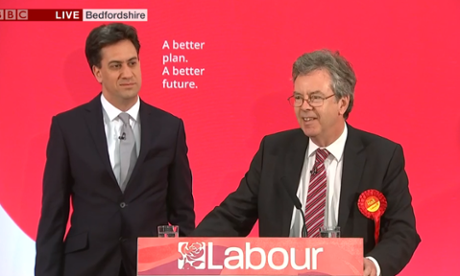
Ed Miliband's People's Question Time in Bedford
Ed Miliband is about to start a People’s Question Time event in Bedford.
He is being introduced by Patrick Hall, the Labour candidate. Hall says that, as the campaign goes on, the attacks on Miliband from the Tories have got more extreme. He says he is very pleased that Miliband has chosen not to retaliate in kind. That is a testament to his decency, he says.
Tory candidate under fire for tweet comparing Labour to Jimmy Savile
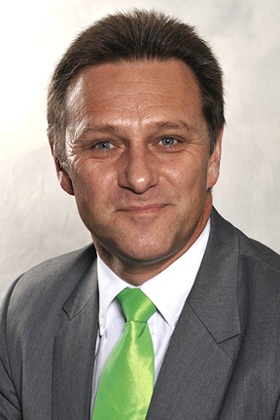
A Tory parliamentary candidate has been heavily criticised for retweeting a Richard Littlejohn headline that compares Labour being in charge of the country with giving Jimmy Savile the chance to babysit.
Craig Whittaker, who is standing for re-election in Calder Valley, linked to the Daily Mail article – headlined ‘Trust Labour? I’d rather trust Jimmy Savile to babysit’ – early this morning.
Trust Labour? I'd rather trust Jimmy Savile to babysit http://t.co/UCmlUEE0Pe via @MailOnline
— Craig Whittaker (@Whittaker4mp) May 5, 2015
To make matters worse, Whittaker chairs the all-party parliamentary committee for looked after children and care leavers.
Emma Burnell, writing on LabourList, says the Mail headline is “the sickest propaganda yet” and that the victims of Jimmy Savile deserve better than to be dragged into political attacks:
Politics can be a rough game, but there should be boundaries. Acceptable levels of decency in dialogue. There are criticisms of Labour from the right – that many may not agree with – but a clash of ideologies will always lead to strong and impassioned arguments.
But there are limits. Just as some on the right were justly shocked over the vitriol over the death of an old woman (no matter what political damage she did to the country) Labour have a right to expect not to be unjustly compared to Jimmy Savile. More importantly the victims of Jimmy Savile deserve not to have their abuse abused for political purposes.
Updated

Nicola Sturgeon has told Scottish voters that they have 48 hours to end austerity, driving home her message that this is an election like no other in terms of Scotland’s opportunity to make its voice heard in Westminster (which of course is another example of using “Scotland” and “SNP” interchangeably – last time I looked, the country had exactly the same number of MPs as it had last time round).
At a campaign visit to a nursery in Livingston – her second big media event with the impressive local candidate Hannah Bardell, who is challenging a 10,000 Labour majority – Sturgeon said: “Not once in my life has Scotland voted Tory and yet for more than half my life we have had a Tory government. With more anti-Tory MPs than Tory MPs elected in May we can lock David Cameron out of Downing Street.”
She reiterated her challenge made in Dumfries last night to Ed Miliband to join the SNP in an anti-Tory bloc on Friday morning: “We’ve been absolutely clear that SNP MPs will vote to stop a Tory government even getting off the ground – Ed Miliband now needs to give the same commitment.”
Updated
Ivor Gaber, a journalism professor, has written a good article about media coverage of the election that we have just launched on our site. He concludes that the “Tory press” is back with a vengeance.
Here’s an extract.
I guess we shouldn’t have been surprised by [the resurrection of the “Tory press”], but even seasoned press observers – well, this one at least – could have been taken aback by the sheer ferocity of the 21st-century incarnation of the beast – had it all not seemed so ludicrously, even comically, dated.
The Daily Mail has been frothing at the mouth about “Red Ed” for the past two years or more. One has to hand it to the paper for its sheer determination in trying to plant the concept into the mind of the general public at every opportunity – Lynton Crosby eat your heart out. But the failure of the campaign to find any sort of resonance among the man or woman in the pub or coffee bar has been one of the more edifying aspects of the campaign.
The Sun has been equally ridiculous and made itself a laughing stock, which will be remembered long after the polls have closed with its classic twin-headed monster splash – “SNP will eat your babies” for its English readers and “Nicola for Sainthood” north of the border, both on the same day! Much mirth for all we media watchers.
Updated
Jim Murphy tells the Daily Record this morning that he would be “heartbroken” if votes for the SNP usher in another five years of Tory government across Britain. The Scottish Labour leader, who is facing heavy losses on Thursday, said he feared a return to the dark days of Thatcher when his family were forced to emigrate to South Africa after his father lost his job.
It’s interesting to note how Tory warnings of SNP “coalition chaos” are reported here: the Herald this morning describes David Cameron as “ruthlessly playing the Scottish Nationalist card” in a last-ditch attempt to appeal to voters in the south.
And the Herald also has an interesting story about Kirsten Oswald, the SNP candidate hoping to claim Jim Murphy’s seat, appealing to Tory voters in her election literature. Curious, when pro-union tactical voting seems to be the overwhelming trend in Scotland.
Updated

Andy Burnham, the shadow health secretary, was asked by Victoria Derbyshire on the BBC just now if Labour would accept that it had no right to form a government if it was not the largest party after Thursday.
Burnham replied:
The party with the largest number of seats normally gets the chance to try and form a government. But we have to see how the country votes, don’t we.
But, when pressed on whether Labour would refuse to try to form a government in those circumstances, he refused to engage. “We will have to see who the country votes,” he replied. It was not right to speculate on this now, he claimed.
Updated
Jim Murphy, the Scottish Labour leader, is to make a final plea to wavering and lost Labour voters to back his party by insisting that failing to vote for Labour on Thursday will result in “a decade of Tory rule”.
Murphy is due to appear with Gordon Brown in Glasgow later this morning. Polls unanimously predict Scottish Labour faces a wipeout at the hands of the SNP, and Murphy is being challenged heavily in his East Renfrewshire seat by the SNP candidate Kirsten Oswald – who has been appealing to Conservative voters in the once Tory stronghold to back the SNP.
Her letter to Tory constituents praised the “values of hard work, responsibility and public service which the Conservative party has traditionally stood for”.
Murphy is due to say that only Labour is capable of unifying the UK:
We’re less than 48 hours away from being able to change our country and set out on the road to a fair economy. We get it by rejecting the divisions of the past and embracing a fairer plan for Scotland’s future.
We cannot gamble on ending Tory rule with a vote for the SNP. They plan to vote against Labour budgets and a Labour Queen’s speech, and are planning the road to a second referendum. It’s the last thing working class people in Scotland need.
The Tories plan is classic divide and rule. A divided Scotland means five more years of Tory rule. The only way to be sure of getting rid of the Tories is to vote Labour, if David Cameron has even one more MP than Labour then he will hold talks with the Lib Dems.
Updated
Caroline Lucas says don't vote tactically, vote for the party you believe in
Caroline Lucas, the only Green MP in the last parliament and the candidate in Brighton Pavilion, was also on the Today programme this morning. She effectively urged Green supporters not to vote tactically - ie, not to wear one of Polly Toynbee’s nose-pegs - and to instead back the party they believed in.
Up and down the country the sense that I’m getting [is] that people are fed up of tactical voting, that there is far more of a sense of people wanting to vote for what they believe in – and in particular, what the Green party is offering, the politics of hope instead of all of this politics of fear.
Every other party right now is trying to terrify you out of voting for the opposition because of something to do with migration or something to do with the SNP. None of them are putting forward a positive vision and the number of people now coming to the Green party saying that they are desperate to vote for something positive – whether that be our policies for much more ambitious action on climate change, whether that’s our policies on challenging austerity, whether it’s to do with standing up for a truly public NHS – that is what people want.
They’re fed up of voting with a nose peg over their noses and when they take that nose peg off, there’s a pretty nasty smell around and that’s because they haven’t voted for what they believe in.
Here’s another exhibit from the “You’d never know he was a Lib Dem” school of campaign strategy.
After Wiltshire MP Duncan Hames’ leaflet, which had more blue, red, and Ukip purple than yellow, come these billboards from John Leech, who is campaigning for re-election in the studenty marginal of Manchester Withington.
Have you spotted our billboards around the constituency? #Chorlton #Didsbury #Manchester Give us a wave! #Makeit15 pic.twitter.com/goP1OLM58g
— #Makeit15 (@makeit_15) May 5, 2015
Could the size of the student vote be the reason why Leech isn’t shouting from the rooftops that’s he a proud Lib Dem?
Nick Clegg's Today interview - Summary and analysis
At the end of an election campaign, after countless interviews, it is hard to get a party leader to say anything new and I don’t think John Humphrys landed any great scoops. My colleague Tom Clark thinks Nick Clegg firmed up his line that the Lib Dems would talk to the largest party first in a hung parliament situation, but I’m not even sure about that. If there was anything new, it was not so much that the Lib Dems would talk to the largest party first, but that they would give them “the space and the time” to form a government.
Here are the key points.
-
Clegg said that the Lib Dems would give the party that won most seats and votes “the space and the time” to try to form a government.
The party that gets most votes and the most seats, in other words the party that gets the biggest mandate from the British people, even if it does not have a slam-dunk majority, it seems to me right to give that party the space and the time to try and set up a government.
The Lib Dems would talk to that party, he said. But any possible deal would depend on that party being willing to engage with the Lib Dems too, he insisted.
“Time and space” could be Clegg’s way of saying that we should not expect a decision about potential coalitions etc anytime soon after Thursday night.
Given that many seat projections, like ours, are tending to point towards the Tories having most seats and votes, this is probably good news for Tories.
However, as Chris Terry, a researcher for the Electoral Reform Society points out, Clegg’s views could be irrelevant.
Clegg's views on coalition may well be irrelevant given he needs two thirds of members to back any coalition...
— Chris Terry (@CJTerry) May 5, 2015
Terry is referring to the Lib Dem rules that say that any coalition proposal will only be adopted if it has overwhelming support within the party. The precise “triple lock” rules are complicated, but you can read them here.
- Clegg said that seats and votes would both be taken into account when deciding which party had the best mandate from the electorate. This interpretation probably benefits the Tories, since it is quite possible that Labour could have more seats, but fewer votes, than the Tories, but very unlikely that this could happen the other way round.
-
He said providing stable government would be a priority.
First we should obey the democratic will of the British people, secondly we should guarantee stability above and beyond everything else, we need a stable, decent and united government after Thursday. I worry terribly about the fracturing of politics as Labour rush off to the left and the Conservatives rush off to the right.
That suggests Clegg would prefer a coalition to supporting a minority government on a confidence and supply basis.
- He said the Lib Dems would only accept ministerial posts in a coalition if they could implement some of their policies. They were not interested in power just for power’s sake, or “bums on seats in Whitehall”.
- He said neither Labour nor the Tories could be trusted to deliver constitutional reform.
- He confirmed that an EU referendum was not a “red line” issue for the Lib Dems, and that the party would consider backing Tory plans for one in return for the Tories agreeing to support some key Lib Dem demands.
-
He insisted that the Lib Dems would do better than commentators expected. At one stage, when John Humphrys said the Lib Dems were bound to lose some seats, he said he would not even accept that, but that was more light-hearted bravado than a serious prediction.
.@nick_clegg, on 2-day UK tour, says he has not made EU referendum a red line because there are bigger priorities. pic.twitter.com/3xuRK0uBrN
— BBC Radio 4 Today (@BBCr4today) May 5, 2015
Updated
Q: Andrew George, a Lib Dem candidate, says he has always voted against Trident. So you have a national policy and a local policy. Which is the Lib Dem policy?
Clegg says all parties have MPs who are opposed to Trident. There are Labour MPs opposed. Some Tories have reservations about the cost, he says.
The Lib Dem policy is clear. It would maintain Trident, but do so “on a less all-singing, all-dancing basis”.
Q: Some would say that’s a typical Lib Dem compromise.
Some would says that is moving with the times, says Clegg.
And that’s it.
I will post a summary soon, although that shouldn’t take long, because it was not a revealing interview.
Q: You wanted a fairer voting system. But, in fact, we have a less fairer voting system because you blocked boundary reform. So what is the point of another Lib/Con coalition?
Clegg says his reforms have been frustrated. It was not just the Tories; Labour united with the Tories to block Lords reform. They also obstructed reform to party funding.
If you want constitutional reform, you cannot trust Labour and the Tories “one jot”, he says.
Q: You say you have been a moderating influence on the Tories. But the Tories have claimed credit for some of your ideas. So it looks as if you have not achieved much at all.
Clegg says that even by the provocative standard of Today questions, that is a bit much.
The Lib Dems had 8% of the vote. But they ensured that 27 million people got a tax cut, and that apprenticeships were extended, and pensions were reformed, and equal marriage was introduced.
And they produced the stability that allowed the economic recovery to happen.
Updated
Q: Why is opposition to an EU referendum not one of your red lines?
Clegg says he is not in principle opposed to a referendum.
But the Lib Dems agreed that, in the event of more power being transferred to Brussels, there should be another referendum.
Q: Cameron has gone further than that. So why is the referendum not a red line for you?
Clegg says he has other red lines.
Many listeners will think investing in the NHS, and in schools and nurseries, and raising the income tax threshold are more important.
Q: Did David Cameron tell you the Tories would not win a majority?
Clegg refuses to answer. He does not control what Lib Dem people tweet.
Updated
Clegg says, again, his “hunch” is that the Lib Dems will do much better than people think.
Where people hear the Lib Dem story, they like it.
They like the stability and decency and unity it stands for.
Q: If you only get half the seats you have now ...
Clegg says he does not think that will happen.
He is not joining in the “hysterical” punditry. The Lib Dems will do better than people expect.
Q: If you lose seats ...
Clegg says he does not accept that. He wants more.
Q: Vince Cable says you should have as many ministers as last time. Would it be legitimate for you at all to be in government?
Clegg says he would not accept power for power’s sake. He is not just interested in “bums on seats in Whitehall”. It would be about whether the Lib Dems could implement their policies.
Q: If the Conservatives get more seats than Labour, will you offer yourself to them? And the same with Labour if they get the most seats?
Clegg says the party that gets the most votes and seats should have the space and time to try to form a government.
But he does not know whether the party in that position would reach out to the Lib Dems.
Of course the Lib Dems would listen to what that party said.
The key thing is to provide stability.
The Lib Dems would follow the democratic instructions handed to them by the electorate.
Q: If the Tories or Labour get the most seats, would you offer them your support?
Clegg says he would talk to the party with the most seats.
Q: Would you look at votes as well as seats?
Clegg says it is seats and votes that both count.
Nick Clegg interviewed on the Today programme
John Humphrys is interviewing Nick Clegg now.
Q: Would you do a deal with Labour?
Clegg says who does a deal with whom will be entirely determined by the votes of voters.
Q: But you who want to do a deal with will affect those votes?
Clegg says David Cameron and Ed Miliband are “preposterously” pretending they will win a majority. He is not.
The Lib Dems would add a heart to a Tory government, or a brain to a Labour one.
They would not do a deal with Ukip or the SNP. So they are “the guarantors of stability”.
Good morning. I’m taking over from Claire.
John Humphrys will be interviewing Nick Clegg on the Today programme shortly.
As Claire said earlier (see 7.01am), Clegg has had some strong support in the papers today, with the Times and the Independent praising his record.
But she missed one other surprise Lib Dem partial-endorsement.
World First - Sun says vote for Nick Clegg (and 13 other Labour facing Libs) to keep SNP out, reports @KateEMcCann http://t.co/qJOv6HS1LA
— Tom Newton Dunn (@tnewtondunn) May 5, 2015
Nigel Farage isn’t happy about the claims today by Iain Duncan Smith that a vote for Ukip is “like a suicide note”:
For IDS to accuse UKIP voters of writing “suicide notes” for a country they believe in is another Tory slur that'll drive more people to us
— Nigel Farage (@Nigel_Farage) May 5, 2015
Scotland today
Here’s some more info from the Guardian’s Scotland correspondent, Severin Carrell, on the day ahead north of the border:
- At 9am, Nicola Sturgeon gives a speech at a children’s nursery in Livingston on how SNP MPs will work at Westminster.
- At 10.45am, Scottish Lib Dem leader Willie Rennie joins former Gordon MP Sir Malcolm Bruce and candidate Christine Jardine for a “final push” in their campaign against SNP candidate Alex Salmond.
- At 11am, Jim Murphy, the Scottish Labour leader, gives a speech with former party leader and prime minister Gordon Brown in Glasgow.
- Then at 11.45am, Scottish Tory leader Ruth Davidson campaigns on the Strathspey steam railway in Danny Alexander’s seat of Inverness, Nairn, Badenoch and Strathspey.

John Swinney, the SNP deputy first minister of Scotland, has just been on the Today programme. He was pressed on claims made by his boss, Nicola Sturgeon, that a Westminster government without Scottish MPs would lack legitimacy.
Swinney said the comments had to be understood in the context of the Tories holding only one seat in Scotland, which he said it could lose on Thursday:
We’ve had a number of Conservative governments that were roundly rejected in Scotland by the electorate … There is a need for a government of the United Kingdom to be representative of the whole of the United Kingdom.
We’ve set out a position that we will do everything we possibly can do to lock the Conservatives out of power … The important parliamentary point is that the government that is formed has to command a majority in the House of Commons … It’s important when that government is comprised that it is supported throughout the United Kingdom and has political legitimacy throughout the United Kingdom.
Last year’s independence referendum does cast a shadow over this election, Swinney said:
There is nothing that can happen from this election that can lead to another referendum.
[But last year] the UK party leaders came to Scotland and said to Scotland, don’t leave the United Kingdom.
We can use that voice to create influence to deliver the policies that people in Scotland want to see delivered.
Nick Clegg has had an early (and hair-raising) start, braving the Cornish winds for an interview with ITV’s Good Morning Britain:
It's looking windy at lands end. There is a @metoffice warning for gusts 50-60mph for S & SW coasts! @gmb #windy pic.twitter.com/IMnPneBaSh
— Laura Tobin (@Lauratobin1) May 5, 2015
My lucky colleague Frances Perraudin is aboard the Lib Dem battle bus and sends this agenda for the next 48 hours:
The Liberal Democrat battle bus starts its 1,000-mile dash from Land’s End to John O’Groats today, stopping at marginal constituencies to make one last attempt to convince undecided voters before polling day.
Today the bus will transport party leader Nick Clegg through a long line of Lib Dem seats, starting in St Ives, via stop-offs in Somerset, Cardiff and Solihull.
The battle bus will then continue heading north on Wednesday, visiting Cumbria, Glasgow, Inverness and John O’Groats before finishing back in the deputy prime minister’s constituency of Sheffield Hallam on Thursday, so he can place his vote.
Today’s Guardian long read profiles David Cameron.
Matthew D’Ancona writes:
To understand Cameron is to look beyond the straightforward countenance – the psychic inertia in which the English upper middle class seems to specialise – and to observe the struggle between a radical social reformer who wanted to transform both the character of conservatism and the nature of the 21st-century state, and the supreme pragmatist who accepted that politicians must adapt dreams to circumstances.
He never forgot that, in politics, he had chosen what Bismarck called ‘the art of the possible’; or, that in politics, as in any performance art, timing is all.

The Telegraph has also announced its view on who ought to be PM after polling day.
I’d insert a drumroll here but savvy readers will be ahead of me: it’s Vote Cameron!
On the question of bringing both economic and political stability, the choice is clearer every day. In 2015, the national interest and private necessity do indeed coalesce. A vote for Mr Miliband looks to be one for chaos and recession. Mr Cameron is offering stability and opportunity.
Morning briefing
Good morning and welcome to the Guardian’s election live blog, as we dive into the final 48 hours of campaigning.
I’m Claire Phipps, kicking off the blog today, before handing over to Andrew Sparrow to steer you through Tuesday’s twists and turns. We’ll have live coverage every day from 7am till late until polling day on Thursday. After the polls close, we’ll just keep on going until we fall over/readers fall over/there’s a government that doesn’t fall over.
I’m on Twitter @Claire_Phipps, so do come and chat there or in the comments below.
The big picture

It’s not often I write this, but Nick Clegg might well be starting the day with a smile on his face. First, there was the Guardian/ICM poll that found him on course – despite earlier polling predictions – to save his own seat.
OK, it’s no Cleggmania Part Two: his seven-point lead in Sheffield Hallam is because almost half the people (48%) who say their nationwide preference is for the Conservatives are planning to support the Lib Dem leader (leaving the Tories’ own candidate in the constituency on a measly 12%). And a party leader retaining his own seat is hardly the stuff of electoral dreams.
(Those with long memories might also recall that a last-minute Sheffield rally doesn’t always bode well.)
But the Lib Dem leader has had a further boost from the Independent, which has backed him in an editorial that called for the continuation of the Conservative-Lib Dem coalition. You can read the story about that here and the editorial itself is here:
Nick Clegg may not personally recover from the tuition fees debacle, despite being right (eventually). But history will record him as the man who turned a party of protest into one of government. As a principled, effective politician who could hold another coalition together, we hope he keeps his seat.
Clegg should insist on being education secretary in the next government, the Independent says, before adding:
Any partnership between Labour and the SNP will harm Britain’s fragile democracy. For all its faults, another Lib-Con coalition would both prolong recovery and give our kingdom a better chance of continued existence.
The Times, too, has taken a sympathetic look at Clegg’s five years in government and decided he deserves another shot:
The deputy prime minister has been more maligned than any politician in Britain these past five years. Most of that criticism has been unfair, though he did block much needed electoral boundary reform.
He has nonetheless taken the opprobrium with good grace and conducted himself with civility. It would be a shame if that were rewarded with expulsion.
Most of the criticism of Nick Clegg has been unfair http://t.co/jp9stoSr6j pic.twitter.com/hEGazl3zbQ
— The Times of London (@thetimes) May 5, 2015
The newspaper endorsement is a funny beast, and readers are not always happy with the editorial stance taken (as the Guardian well knows). But if nothing else, Clegg’s boost will be well discussed on social media today – and that’s not an arena he has dominated so far in this campaign.

There will be – and has already been – discussion too of the possible role of father-and-son owners of the Independent, Alexander and Evgeny Lebedev. Certainly the latter seemed rather won over by David Cameron in an interview he conducted himself – with lots of pictures of them together – for the Evening Standard (which the Lebedevs also own, and which is expected to unveil its own endorsement of the Conservatives).
In February, Lebedev Sr told the Guardian it would be up to his editors to decide which political parties to back. Certainly the Independent on Sunday took a different stance, insisting it would stay “true to our name … while our rivals have reverted to their ideological bunkers” and not advise its readers which way to vote.
(Cross Independent readers – and the comments under the editorial suggest there are a few – might prefer Steve Richards’ take, in the same organ.)
You should also know:
-
Ed Miliband has warned that the NHS faces a financial bombshell, with two-thirds of hospital trusts face having to make “swingeing cuts”, after a leaked internal document showed that the health service is projected to run a deficit of nearly £2bn this year.
Guardian front page, Tuesday 5 May 2015: Miliband’s warning – NHS faces financial bombshell pic.twitter.com/WzCBjprPBg
— Guardian news (@guardiannews) May 5, 2015
- A payment of £50,000 gives business people direct access to Cameron and senior Conservatives at dinners, drinks receptions and other events.
- Nicola Sturgeon has said it would be wrong for the Westminster government to be made up solely of English MPs, hinting that she expects the Tories to win the most seats.
- Labour is to give security guards at the party’s northern head office backdated earnings after the Sun reported (paywall) they were being paid less than the living wage.
- Iain Duncan Smith says a vote for Ukip would be akin to writing Britain’s “suicide note”.
- In a remarkably chummy interview in the Daily Mail, Cameron describes finding his “oomph” for the final days of the campaign (removal of asterisks is all my doing):
There was no bollocking. There was just a sense that … um. I just thought, I’ve got to turn the dial up.
Read Nadia Khomami’s summary of all Monday’s key moves here.
And with just two days to go, here’s how the polls shape up:
Diary
Today, expect to hear more from the two main parties on their key pushes: Labour on the NHS and the Conservatives on the economy.


- Nick Clegg is on the Today programme at 8.10am before jumping on the Lib Dem battle bus to begin a two-day sprint from Lands End to John O’Groats, today via Newquay, Cardiff and Solihull.
-
Ed Miliband will be in Bedfordshire and North Warwickshire.
- David Cameron goes west from Twickenham and Hendon, to St Ives and Torbay.
- Nicola Sturgeon campaigns in Livingston.
- Nigel Farage heads to Ramsgate.
- Gordon Brown and Jim Murphy are out in Glasgow.
- Green leader Natalie Bennett is campaigning in Cambridge. Her colleague Caroline Lucas is on the Today programme at 8.40am.
- John Swinney, the SNP deputy first minister, is on the Today programme at 7.15am.
The big issue
Two days before the polling stations open and we are in a strange zone in which politicians are mocked for publicly stating that they can win a majority, but regarded with suspicion at the mere hint that they might be considering how they might govern post Thursday.
So the Telegraph today leads on “Ed Miliband[’s] plot to become prime minister even if he does not win election”, suggesting Labour could attempt to woo the Liberal Democrats to lessen the reliance of a minority government on the SNP.
The BBC reports that in the event that the Tories have the most seats but are short of an outright majority – the scenario towards which many polls now lean – a Lib-Lab deal could enable them to outvote the Conservatives:
There would be many hurdles to be overcome before any Labour-Lib Dem minority government could be formed. It would be accused by opponents of being a ‘coalition of the losers’.
Many Lib Dems would be opposed to minority coalition: not only would the party have to compromise yet again on its policies in return for power, but it would also have even less chance of getting its own policies implemented.

Alternatively, as my colleagues Patrick Wintour and Rowena Mason report, Cameron could try to “cling on to power” with the support of the Lib Dems and Democratic Unionists. They offer a helpful guide to the (albeit not very helpful) rules:
It is argued that the Cabinet Manual – the civil service book setting out the rules on the transfer of power – states a prime minister can stay only until the point at which it is clear they cannot command the confidence of the Commons; not when any other party demonstrates they can form a majority or requires a vote in the House.
The relevant section of the manual states: “Where an election does not result in an overall majority for a single party, the incumbent government remains in office unless and until the prime minister tenders his or her resignation and the government’s resignation to the sovereign. An incumbent government is entitled to wait until the new parliament has met to see if it can command the confidence of the House of Commons, but is expected to resign if it becomes clear that it is unlikely to be able to command that confidence and there is a clear alternative.”
The argument will then turn on whether convention expects the prime minister to resign as soon as it is clear that they no longer command a majority. Some argue precedent, with expert opinion saying the leader of the largest opposition party will be appointed prime minister.
The Guardian’s data editor, Alberto Nardelli, says the permutations make tactical voting this Thursday “an even more important issue than in other elections”. Here’s his guide to how to do it.
Read these
The view from abroad today, as the world wonders who it’ll be dealing with come Friday:
- For US polling guru Nate Silver’s Five Thirty Eight, Mona Chalabi takes a trip to Clacton to try to explain Ukip:
Voters over the age of 40 are twice as likely to vote Ukip as those under 40. That may be because older voters have different priorities. While the economy, unemployment and education all rank high as concerns for the overall British electorate, they’re lower on the list of worries among those who are going into, or are already in, retirement.
That works to the disadvantage of other parties claiming that Britain’s economic stability would be jeopardised by exiting the European Union. And that works to the advantage of Ukip, which is not well-versed in policy areas like the economy, having focused almost exclusively on the EU and immigration.
- Steven Erlanger, in the New York Times, profiles the two contenders for PM:
David Cameron, 48, the red-cheeked toff who went to Eton and belonged to snooty clubs; and Ed Miliband, 45, the gawky, adenoidal, agnostic son of a Marxist Jewish refugee and historian …
Both Mr Cameron and Mr Miliband, though part of a younger generation of leaders, have pulled their parties back to the past, toward older ideologies.
- And the Guardian has rounded up writers from Le Monde, El País and Süddeutsche Zeitung for a European take on the UK result:
Face it, my beloved Britons: you’ve got a weird electoral system. You might think it’s normal that the Greens could get 10% of the vote and just one seat, while the SNP might end up with 4% and 50 seats. But it’s not. Even if it does stop Ukip.
Even the name is funny: first past the post. It sounds like a board game in which a team of journalists and a team of politicians jump from one marginal seat to another, with a rich lord called Ashcroft tossing the dice.
- Closer to home, do check out John Harris and John Domokos’ diary of 11 weeks on the campaign trail up and down Britain; here they’re in Bristol:
If the Greens are going to increase their support further, they’re going to have to appeal to parts of the city where politics – of whatever hue – cuts very little ice. A good example is Redcliffe, where we spend two hours following a Green team around some threadbare low-rise flats.
One twentysomething mother-to-be doesn’t know there’s an election on; neither do a group of young men crowded around a stairwell, though their spirits are lifted by news that the Greens support the decriminalisation of weed.
The day in a tweet
Chalking up half a point for the Lib Dems for their “women are just like regular human beings” video. Now how about some more female Lib Dem MPs?
Watch the #libdems Women's Manifesto – it's easy to understand and filled with lots of pink! https://t.co/4j25hVSKou
— Liberal Democrats (@LibDems) May 4, 2015
If today were a TV drama, it would be…

Poldark. Compare and contrast: the Cornish cliffs.
The grey, grey sea.
The manly stare.
The devoted onlooker(s).
Nick Clegg at Land's End at the start of his journey. pic.twitter.com/Gql9aSWEJw
— David Hughes (@DavidHughesPA) May 5, 2015
The key story you’re missing when you’re election-obsessed
Fox News in the US has apologised after wrongly reporting that a man had been shot “multiple times by police” in Baltimore, a city already riven with tension after six police officers were charged in connection with the death of Freddie Gray. Fox News host Shepard Smith told viewers: “What happened is, we screwed up.”
Updated