Iain Duncan Smith has sought to persuade Ukip voters that the only way they can get a referendum on EU membership is by voting Tory.
If Ukip supporters go ahead and vote for Nigel Farage’s party, he argued, it would be akin to writing a “suicide note” for their hopes of a vote on Europe because doing so could aid a Labour victory over the Conservatives.
It would be a “risk that is no longer a protest”, he claimed. Iain Duncan Smith has told the Daily Telegraph:
The last thing I always say to Ukip people on the doorstep is that, for 24 years, I have campaigned for a referendum on the European Union.
And the British people have wanted one. And they should stop and think because if they do not vote for the Conservatives, then basically they will have taken away that referendum from the British people for which they will not be forgiven.
And I certainly won’t forgive them.
Updated
Evening summary
There’s less than three days to go until the general election, and we’re still no closer to having a clearer picture of what the results will be. Parties are slinging accusations at each other left, right, and centre. There’s speculation about back-room talks and admissions, there’s fear-mongering, cosying up and even a bit of crying (maybe... probably). Here’s everything that happened today.
The big picture
In a huge U-turn on his stance on voting, Russell Brand released a video on his YouTube series the Trews today urging viewers to back Labour. The comedian said his change of heart was down to his opposition to Conservative policies, as well as to his interview with Ed Miliband last week. Brand played a clip from the Miliband interview which had not been shown before, in which the Labour leader said he would welcome and respond to pressure from grassroots activists. Brand responded:

One thing I agree very sincerely with Ed on is that politics does not rain down on us. It comes from below. Movements putting pressure on governments. We don’t know that the limitations of the Labour administration are going to be. But we have just heard the leader of the Labour party saying that he welcomes and wants pressure from below. For me, what the interview meant is that Ed Miliband understands that people are pissed off, people have had enough of their needs being neglected because of the requirements of big business.
I know I have been Mr Don’t Vote. But, actually, what I mean is politics isn’t something that we can just be involved in every five years. Democracy is by every day, not just for elections. Democracy has to be something you are constantly involved in, whether you are students occupying your university, whether you are communities coming together to reclaim your housing, whether you are people running worker-led cooperatives. We have to confront big business. We have to confront people who are tearing apart London and socially cleansing.
What I heard Ed Miliband say is, if we speak, he will listen. so, on that basis, I think we’ve got no choice but to take decisive action to end the danger of the Conservative party.
It’s a shame Brand’s departure came after the voter registration deadline. There must be hoards of young people out there who want to take the comedian up on his advice, but can’t. Still, one thing’s for sure - his interview with Miliband was big news for young and old today.
What happened today
- Ed Miliband ruled out having an “arrangement” with the SNP about passing Labour legislation and even suggested he would refuse to have conversations with them during an appearance on the Today programme. He also refused to say whether a government led by a party that was not the largest in the Commons would be legitimate.
- Sajid Javid, the Conservative culture secretary, was confronted by a woman who escaped genocide in Bosnia at a Citizens UK event after he refused to commit to ending indefinite detention of asylum seekers. David Cameron was due to appear at the event, but pulled out.
- Lib Dem peer Paul Scriven said Nick Clegg had told him in private David Cameron admitted the Conservatives would not win a majority. Cameron responded that Clegg was getting “increasingly desperate”.
- Scottish Labour leader Jim Murphy and Eddie Izzard have been forced to abandon a rally on the streets of central Glasgow after they were shouted down by nationalists chanting “Red Tories out!”. Nicola Sturgeon said the protesters had “nothing to do with the SNP”.
- Sturgeon said the prospect of a hung parliament is an opportunity for people in Scotland to unite to elect a big team of SNP MPs to end the austerity cuts and achieve new investment in the NHS UK-wide. She also questioned the legitimacy of a UK government without Scottish MPs.
Quote of the day
“We will not scaremonger, we will not divide communities. We will always fight for those decent, centre-ground British values of compassion, of tolerance, of being generous-hearted, open-minded, open to the outside world” - Nick Clegg, explaining Liberal Democrat values.
Laugh of the day
Just had my first marriage proposal of the election campaign. He had to settle for a poster for now.
— Nancy Platts (@Nancy_Platts) May 4, 2015
You can’t fault a man for trying.
Hero of the day
Zrinka Bralo, the Bosnian journalist who confronted Sajid Javid at the Citizens UK event.
Villain of the day
The nationalist protesters who prevented Jim Murphy and Eddie Izzard from speaking at a rally in Glasgow.
Tomorrow’s agenda
Tomorrow, Nick Clegg is due to appear on the Today programme before campaigning in Cardiff. Miliband will be in Bedford, Cameron will be in London, Sturgeon will be in Livingstone, and Farage will be in Ramsgate.
That’s it from me for today. Join the Guardian’s election team again tomorrow morning, as we bring you the latest news, reaction, analysis, pictures, video, and jokes from the campaign trail.
May The Fourth Be With You
It’s coming to the end of May 4, and Google has tweeted some Star Wars search-related trivia for you:
#MayThe4thBeWithYou: the most-searched #StarWarsDay characters on Google pic.twitter.com/Nl7iMsOmRX
— GoogleTrends (@GoogleTrends) May 4, 2015
In case you missed it, our data journalist George Arnett has written about how the British public are most likely to think Ed Miliband wants to be young padawan Luke Skywalker, while David Cameron wants to be masked-villain Darth Vader, according to a new YouGov poll.
The Independent has published its election editorial. It falls short of backing any party, but concludes:
For all its faults, another Lib-Con Coalition would both prolong recovery and give our kingdom a better chance of continued existence.
This title casts no vote. But we prize strong, effective government, consider nationalism guilty until proven innocent, and say that if the present Coalition is to get another chance, we hope it is much less conservative, and much more liberal.
What’s striking is that fear of SNP control over a Labour government has swayed the Indy’s stance.
For all his talk of no deals with the SNP, Miliband is bound to rely on that party to get his legislative programme through. This would be a disaster for the country, unleashing justified fury in England at the decisive influence of MPs who – unlike this title – do not wish the Union to exist. If that were to be the case while Labour were the second biggest party either in terms of vote share, or seats – or both – how could Labour govern with authority? They could not. Any partnership between Labour and the SNP will harm Britain’s fragile democracy.
I’ll let you make your own minds up about that one. But to me, it’s always seemed the case that a Tory-led government would put the union at greater risk due to the possibility of a Brexit - the only thing Nicola Sturgeon’s party say would give immediate cause for a second Scottish independence referendum.
Earlier today, it was revealed that Kirsten Oswald, the SNP candidate standing against Jim Murphy in East Renfrewshire, has sent out a letter to Tory voters asking them to lend their support to the SNP instead – because the SNP “understands” Conservative party values, concerns and priorities.
Scottish Labour deputy leader Kezia Dugdale has now hit back, accusing the SNP of “rank hypocrisy”. She said:
After weeks of telling Scots that they’ll do everything to keep the Tories out of power, they’ll tell Tory voters that they now “respect their beliefs” when it helps them try to seat Jim Murphy.
This is rank hypocrisy from the SNP, whose empty rhetoric on standing up to the Tories is now plain for all to see; they’ll say whatever they need to to get a second referendum.
The irony is that David Cameron is rubbing his hands with glee at the thought of Scotland sending more nationalists to Westminster, because every SNP MP makes it more likely he’ll sneak into Downing St by the back door.
The SNP have said again they'd block Labour policies. Now SNP candidate backs Tory values. Want #Labour? Vote #Labour pic.twitter.com/7P7mQY7I1K
— Margaret Curran (@Margaret_Curran) May 4, 2015
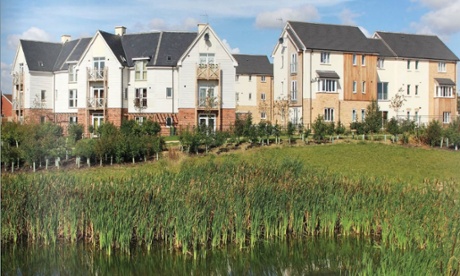
Gallagher Estates, which is owned by the property developer Tony Gallagher, who is also a member of the Tory party’s Leader’s Group for major donors, is in dispute with local councillors over a development being supported by £30m of public money.
Updated
The Conservatives have responded to reports that Labour are considering the option of forming a minority coalition with the Liberal Democrats. A party spokesman just sent me this:
This confirms that if you vote Liberal Democrat, you’ll get an SNP-led Ed Miliband government. This ‘minority coalition’ would be propped up by the SNP.
You can only keep David Cameron as prime minister and get the strong, stable majority government our economy and our country needs by voting Conservative on Thursday.
Sturgeon questions legitimacy of UK government without Scottish MPs
My colleagues Severin Carrell and Libby Brooks have filed their report from the SNP rally in Dumfries. Here are some of the key points from their article:
Provoking a fresh confrontation with the Conservatives, she [Nicola Sturgeon] said: “Surely a test of legitimacy that should be applied to whatever Westminster government is formed after this election cannot simply be that it is the largest party in England.
“The test that must be applied is whether a government can build a majority and win support that reflects the whole of the UK. English MPs will always be the largest part of any Westminster majority, but to ignore Scottish voices would be wrong.”
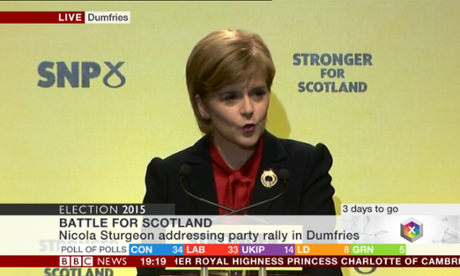
With the SNP now expecting to take a majority of Scotland’s 59 seats and become the third largest party in the Commons, Sturgeon warned she plans to place theLabour leader, Ed Miliband, under intense pressure to agree to an anti-Tory alliance with the SNP hours after the election result.
Nigel Farage has welcomed the Bow Group’s backing of Ukip in marginal constituencies.
Today’s news goes to the heart of what is going on in British politics and reveals the truth that to keep Mr Miliband out of Number 10, people must vote Ukip.

He added:
In fact, it was the Conservative voters in Heywood and Middleton’s by-election last year that kept Mr Miliband in as Labour leader when they should have backed Ukip.
What this endorsement recognises is that Ukip MPs are critical to ensuring issues like an EU referendum, defence spending and stopping the SNP bully are high up the agenda in the next parliament, and I welcome the Bow Group’s recognition of these facts.
Updated
Nicola Sturgeon’s Dumfries (see 18:48) speech is currently being aired on BBC news.
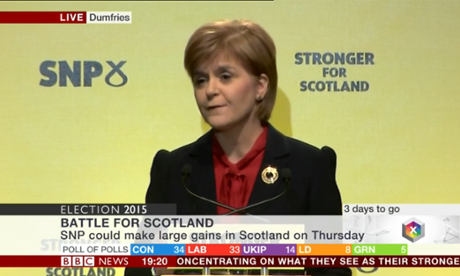
My colleague Libby Brooks is there.
Nicola Sturgeon at Dumfries rally: I have a cast iron guarantee for voters regarding what the SNP will do on May 8th....#GE2015
— Libby Brooks (@libby_brooks) May 4, 2015
Sturgeon: we will never support the Tories into gov't. If we can get Tories out on Friday, we should get Tories out on Friday #GE2015
— Libby Brooks (@libby_brooks) May 4, 2015
Updated

Your editorial (2 May) recommending a Labour vote at the general election acknowledges that “it would be good to hear Green voices in Westminster to press further on climate change and sustainability”. I agree - which is why I’d urge your readers to vote Green. The Greens are the only nationwide party to commit to urgent and ambitious action on climate change, and we have been almost alone in championing the very fossil fuel divestment movement the Guardian has acknowledged is so critically important.
Updated
The Bow Group, the oldest Conservative think-tank, has urged Tory supporters to back Nigel Farage and other Ukip candidates in seats where they’re best-placed to defeat Labour. The group accused the Tory leadership of “sleepwalking” to a Labour win by failing to acknowledge an overall majority was out of sight, and bemoaned the lack of a formal “accommodation” with Ukip. In a statement, it said:
In northern seats, as well as in key Ukip targets such as Rochester and Strood, the Bow Group, which was Margaret Thatcher’s think tank of choice, has reflected on the situation across the country and has come to the conclusion that given Ukip’s strong positions on defence, taxation, an EU referendum and uncontrolled immigration, that they are best-placed to counter the Labour threat in areas such as Heywood and Middleton, Great Grimsby, Boston and Skegness, Barrow in Furness and all across the north of England.
Chairman Benjamin Harris-Quinney told the Telegraph:
Of course our preference at this election is a Conservative majority, but few in the Conservative Party will acknowledge the reality that this is now very unlikely to happen, and without that acknowledgement we are sleep-walking into a Labour government.
We recognise the need to keep Ed Miliband out of Number 10 and the best way to do this is for Conservative voters to lend their votes to Ukip, who are best-placed to beat Labour in many areas.
It is also imperative that leading conservative voices like Nigel Farage in South Thanet, and incumbents Douglas Carswell and Mark Reckless, are returned to Parliament in order to balance the far left-wing rhetoric of minor parties like the SNP, Plaid Cymru, the Green Party and the Liberal Democrats in the House of Commons chamber.
It is a strategic failing that no accommodation could be made with Ukip prior to the election, but in acknowledging there won’t be a Conservative majority we have to now be realistic that the best chances of forming a Conservative government lie in alliances between parties of similar values like the Conservatives, Ukip and the DUP.
Updated
Since it was built in the 16th century, Syon House in west London has hosted the nation’s kingmakers and kings.
A recent Conservative party dinner was no exception, bringing together politicians and political donors in the exquisite house, which is owned by the Duke of Northumberland and surrounded by Capability Brown landscaping.
The black-tie event in March was held by one of the most exclusive dining clubs, the Leader’s Group, which requires a minimum donation of £50,000 a year to the Conservatives. The group attracts some of the most successful business people in the world to regular dinners and parties with senior cabinet ministers, including the prime minister.
Nicola Sturgeon says hung parliament is chance to end austerity cuts
At an SNP rally in Dumfries this evening, Nicola Sturgeon will say that the prospect of a hung, or balanced, parliament at Westminster is a major opportunity for people in Scotland to unite to elect a big team of SNP MPs to end the austerity cuts and achieve new investment in the NHS UK-wide. In her speech, Sturgeon will say:

The fact is that at this Westminster election your vote really counts - it counts whether you live in Dumfries, Dundee or Durham.
That is the power of the people in this election.
Let us be clear what this election is about.
It is about ensuring a strong voice for Scotland - a strong voice that can undo the damage of the last five years of Tory government.
It is about making sure that the next government puts people first.
It is about ending Tory cuts and austerity
It is about protecting our NHS.
It is about making work pay with a higher minimum wage.
It is about investing in childcare and education, not in new nuclear weapons.
It is - above all - about giving Scotland the power and the voice at Westminster that we need to deliver progressive policies for the benefit of Scotland and for the whole UK.
If people in Scotland come together on Thursday to deliver a strong voice at Westminster, we can put those priorities and those values at the heart of the next Westminster parliament.
And we will do that not just for Scotland – but for the UK as a whole.
The fact is that ending austerity is just as important in England, Wales and Northern Ireland as it is in Scotland.
Sturgeon will also say that SNP MPs will never vote to put a Tory government into office, even if they are the biggest party.
We know that Tory government is bad for Scotland and bad for the rest of the UK.
We have heard strong voices over the course of this campaign, from all parts of the UK, who share our aim of ending austerity and backing the NHS.
So we will not do anything that would put the Tories into office.
Indeed, if there is an anti Tory majority on Friday morning, we will call on Labour - even if they are not the largest party - to vote with us to keep the Tories out.
And, surely, any Labour leader who turned his back on that and allowed the Tories to get back into office, rather than work with the SNP to keep them out - as Ed Miliband suggested last week that he would - would simply never be forgiven in Scotland, or indeed in many other parts of the UK.
If we can get the Tories out, we should get the Tories out.
Sturgeon will add that this does not mean Labour have a free pass.
A strong group of SNP MPs will not let Labour simply be a paler version of the Tories – we will challenge them to become a better version of the Labour Party.
We will use our influence - whatever influence Scotland gives us - to make sure that the Tories are replaced with a government that is better, bolder and more progressive.
There has been much discussion in recent days of how SNP influence in the Commons will work.
And let me be clear - the influence of a big team of SNP MPs in a minority House of Commons, governed by the Fixed Term Parliaments Act, would be significant.
We would use that influence responsibly and constructively at all times - but always with a view to winning better and more progressive policies.
The policies the SNP would push for are as follows:
- If Labour propose a minimum wage of only £8.00 an hour – the SNP will push for it to be £8.70.
- If Labour fail to offer the NHS the full financial support it needs – the SNP will put forward proposals that would support the NHS “and build support for that, in parliament and across the country”.
- If Labour remain committed to Tory cuts, the SNP will give their MPs a choice – “vote with the Tories for cuts or vote with the SNP for an end to austerity”.
- And if Labour push for parliament to spend £100bn on new nuclear weapons, the SNP will vote against it and we will challenge others to vote with them to stop the renewal of Trident.
Updated
My colleague Alberto Nardelli has written a guide to tactical voting.
To get a Labour-led government …

- In most constituencies, simply vote Labour.
- In some Scottish seats where the Lib Dems and the Tories are better placed than Labour, don’t vote Labour as it risks splitting the vote on the left. Vote SNP to keep the Tories and Lib Dems out and maximise Miliband’s chances of running a government supported by the Scottish nationalists. These include all Lib Dem-held seats - such as Inverness, Nairn, Badenoch and Strathspey, Gordon, Berwickshire, Roxburgh and Selkirk, and Fife North East – and Conservative-held Dumfriesshire, Clydesdale and Tweeddale.
- In Dumfries and Galloway, Labour and the Conservatives are virtually tied behind the SNP, so you have a choice: vote Labour and risk the Tories winning, or vote SNP if you think that’s better than a Tory win.
- In English seats where the Lib Dems are defending from the Tories and Labour is a distant third, Labour voters might choose to vote for the Lib Dems to keep the Tories out. Although this won’t make a difference to the overall coalition arithmetic (assuming Tory-Lib Dem is the frontrunner), it could affect whether Labour or the Conservatives emerge as the largest party, which could help their claim to be the most legitimate option to govern. Such constituencies include Cornwall North, Cheadle, St Ives, Taunton Deane and North Dorset.
- Labour voters who really want to minimise the Tories’ share of seats could consider voting Ukip in Boston and Skegness, Rochester and Strood, South Basildon and East Thurrock and in Castle Point.
- Don’t vote for the Greens except in Brighton Pavilion, which they already hold. Due to the first-past-the-post voting system, a vote for the Greens anywhere else helps the Conservatives.
To get a Conservative-led government...

- In most constituencies, simply vote Conservative.
- In seats that the Lib Dems are defending from Labour, vote Lib Dem. These include Sheffield Hallam, Bermondsey and Old Southwark, Birmingham Yardley, Cardiff Central, Bristol West and Cambridge.
- In Great Grimsby and Rotherham, where Ukip are challenging Labour and polling better than the Tories, vote Ukip to help the Tories form a government.
- And in Scotland, Conservative supporters should vote for the Lib Dems in seats that Nick Clegg’s party is defending from the SNP – with the exceptions of Berwickshire, Roxburgh and Selkirk, which the Scottish Conservatives could gain, and of course Dumfriesshire, Clydesdale and Tweeddale, which the Tories currently hold.
Updated
Senior Labour figures are considering the option of forming a minority coalition with the Liberal Democrats, the BBC is reporting. They say such a coalition would have collectively more seats than the Conservatives and would therefore have greater legitimacy in the eyes of voters. But a Lib Dem spokesman is still recorded as maintaining that the party would seek to do a deal with whoever receives the most votes and seats. As it stands, that’s David Cameron’s party. So it suggests Labour figures are being optimistic.
Let us assume, as every pollster does, that the Tories are not going to win 323 or more seats. If Nick Clegg holds on to Sheffield Hallam, the constituency he has represented since 2005, Cameron will still have a Lib Dem partner with whom he can do business.
It will not be Clegg’s formal seniority that concerns his former Tory partners. Their (justified) anxiety will concern the identity of his successor, which depends in turn upon the number of leadership contenders who survive the night. It is a measure of the extent to which Cameron needs Clegg to survive that his next best hope is Ed Davey, the Lib Dem energy secretary, who has said that he finds it “incredibly difficult” to envisage another pact between his own party and the Tories. When you are pinning your hopes on the gap between “incredibly difficult” and “totally bloody impossible”, you know your strategy is perilous.
At the Conservative rally earlier in Bath (which is where David Cameron was instead of at the Citizens UK event), the PM said Labour had no right to portray itself as the champion of the low-paid after it wrecked people’s lives in the crash. Cameron told Miliband never to “dare lecture” the Conservatives about helping the poor after the Labour government had lavished knighthoods on disgraced bankers.
Do you know what drives me so mad in this election? It is when they [Labour] say our party is for the few not the many.
Ed Miliband, I remember who got hurt in the crash. It wasn’t the bankers, they got away with the bonuses and the pensions and the knighthoods you gave them. I tell you who got hurt – it was the low-paid, the people who lost their jobs, the families that couldn’t make it through. Don’t you ever dare lecture us about how to help the many not the few.
We had no growth, we’ve now got the fastest growth of any major economy in the western world. We had mass unemployment, we’ve got 2 million people back to work. We had the biggest budget deficit almost anywhere in the world. We cut it in half. That’s our record.
Now let us remember their [Labour’s] record. Do you remember what happened in the great crash? Do you remember what they did? They spent all the money, they put up the taxes, they whacked up the borrowing, they wrecked our economy – all the time saying they’d abolish boom and bust. That is what they said.

Updated
Speaking en route to Cornwall, a Lib Dem spokesman has responded to this evening’s polling: “The only poll that matters is on Thursday. Nick has always maintained that he was confident but not complacent about the contest.
“But this poll underlines what we have long said: that when faced with the actual choice on the ballot paper, between Nick Clegg and Ed Miliband’s Labour candidate, the people of Sheffield Hallam back Nick Clegg’s record of delivering for south-west Sheffield, an area neglected for decades by Labour.
“But that doesn’t mean we will slacken off on the doorstep over the next 72 hours. Elections should be contests not coronations and Nick Clegg and the Sheffield Hallam Lib Dems will be out come rain or shine fighting for every vote.”
Guardian/ICM poll puts Nick Clegg 7 pts ahead in Sheffield Hallam
The poll puts Clegg on 42%, seven points clear of his young Labour rival, Oliver Coppard, who is on 35%. Ian Walker, the candidate for the Conservatives, is on 12%.
But Clegg achieves his seven-point lead only because almost half the people (48%) who say their nationwide preference is for the Conservatives are planning to support the Lib Dem.
When ICM asked voters which party they would prefer if they put the local context and candidates out of mind, Labour is out ahead, on 34%, with the Lib Dems on 32% and the Conservatives on 21%.
Updated
Nicola Sturgeon says nationalists at Labour rally "nothing to do with SNP"
Nicola Sturgeon has commented on the incident earlier today in which Scottish Labour leader Jim Murphy and comedian Eddie Izzard were shouted down by nationalists at a Glasgow rally. As the Guardian’s Scotland reporter Libby Brooks writes:

Arriving in Largs to crowds of hundreds thronging the high street in the sunshine, SNP leader Nicola sturgeon described the earlier fracas at a Labour event in Glasgow as “disgraceful” and “absolutely nothing to do with the SNP”.
She said: “All parties have the right to make their case and they should be listened to respectfully”.
Updated
My colleague Aisha Gani has spoken to the community leaders who questioned Clegg onstage.
Esmat Jeraj, 25, who works at the Hyderi Islamic centre in south London, said:
It was very heartening to see the support being offered by Mr Clegg and the Lib Dems and the willingness to build on our existing relationship to continue working together building a fairer society.

She added:
The Lib Dems have already championed their commitment in 2010 by ending indefinite detention and are now willing to introduce a time limit alongside resettling 1500 Syrian refugees and ending the use of pain as a form of restraint.
John Clifton, 28, from the Salvation Army in Ilford, added:
It’s been a day of real politics where we’ve seen the power that organised people can yield. Really excited about the pledge about making all government departments pay a living wage and his (Clegg’s) willingness to work with the working party to explore the community finance foundation.
Updated
The Press Association has some copy about Nick Clegg’s speech:
Mr Clegg used his speech to attack the planned Tory welfare cuts and to warn about the threat to British values from “populist” politics.
The Lib Dem leader said: “My commitment to you is this. The Liberal Democrats, we will not pander to that politics of fear. We will not pander to that politics of populism.
“We will not scaremonger, we will not divide communities. We will always fight for those decent, centre-ground British values of compassion, of tolerance, of being generous-hearted, open-minded, open to the outside world.”
Setting out his key principles of stability, decency and unity, he said: “You cannot afford to lurch this way or that.”

In an attack on George Osborne’s 12 billion welfare cut plan, he said the Chancellor should look vulnerable people in the eye and “come clean with them about his plans to make their lives harder, rather than easier”.
“There is nothing remotely decent about what they are doing,” he said.
“Nor, by the way, is it remotely decent to shrug our shoulders as Ed Balls has said, and Ed Miliband has said, and get our kids and our grandkids to pick up the price for the mistakes of the bankers.
“They shouldn’t have to pay the price for this generation’s debts, we must wipe the slate clean.
“There is nothing decent about Nigel Farage blaming foreigners and immigrants for every problem in this country.”
Turning to “unity”, he said: “You don’t create unity by dividing society like the Conservatives wish. You don’t create unity by dividing communities like Ukip want to.
“And you don’t create unity if you want to pull our country apart like the Scottish nationalists do. We must remain a whole, united United Kingdom.”
Updated
My colleague Aisha Gani filmed the moment Ed Miliband said he would end zero-hour contracts.
Huge applause when Miliband says he will end zero hours contracts. Audience member: that's the way Ed #cukmay4 https://t.co/QOxEr1DIc0
— Aisha S Gani (@aishagani) May 4, 2015
My colleague Rowena Mason has just filed a full report on the heckling of Tory minister Sajid Javid at the Citizens UK event. She writes:
A Tory cabinet minister was dramatically confronted by a woman who escaped genocide in Bosnia at an election rally after he refused to commit to ending indefinite detention of asylum seekers.
Sajid Javid, the culture secretary, was heckled at the pre-election Citizens UK assembly on Monday, as took the prime minister’s place at the podium in front of thousands of community activists.
David Cameron had been due to appear at the rally, having promised to return at the last one five years ago. However, he pulled out of this campaign’s event, and sent one of his most junior cabinet ministers in his place.
Responding to the request for a time limit on detention, Javid said a cap was “arbitrary” and could lead detainees to further delay or exploit the system.
His answer was immediately challenged by one of the questioners on stage, Zrinka Bralo, a former journalist and director of The Forum, a migrant and refugee communities group.
Revealing her background as a refugee from Bosnia, she said too many people were suffering, adding: “We have to put an end to this.”
Speaking later to the Guardian, the 48-year-old said: “I don’t want to shout from the margin, want pragmatic and positive change.... Even though Mr Sajid said he didn’t commit to time limit, we are seeking to gain a relationship.
“I wasn’t planning telling my story from Bosnia but his story about his father moved me. I’ve had three years of therapy after the genocidal war. Coping with that isn’t easy. I came in 93, but if I came now I could have been in detention. We’re disputing why are you locking 30,000 people up?”
Miliband concludes by saying he knows change doesn’t simply come from politicians. “Politics is not something done by the elite,” he says, his view is change comes because people demand it.
Here’s more from his speech:
Next up: Miliband. Gordon Browns's strong @CitizensUK speech in 2010 part of Labour folklore (some even claim helped party hang on to seats)
— Jeremy Cliffe (@JeremyCliffe) May 4, 2015
Citizens UK crowd going wild for Ed M. He's in full Preacher Miliband mode - lyrical and loud #CUKMay4
— Jeremy Cliffe (@JeremyCliffe) May 4, 2015
Strong performance by Miliband, but unlike Gordon Brown in 2010 he hasn't mentioned Demosthenes once. #CUKMay4
— Jeremy Cliffe (@JeremyCliffe) May 4, 2015
Ed M tells Citizens UK about his 'faith'. 'Not a religious faith' but faith in politics and people to change society. Obvs goes down well.
— John McDermott (@johnpmcdermott) May 4, 2015
Not quite a Gordon Brown level of performance here by Ed M. But then GB seemed to summon that from the grave of John Knox himself.
— John McDermott (@johnpmcdermott) May 4, 2015
Been to two Ed M events today. One about the NHS with Lab activists. Another at Citizens UK. At both he was confident and full of vim. [1/2]
— John McDermott (@johnpmcdermott) May 4, 2015
Nick Clegg appeared to charm Citizens UK rally but Ed Miliband has just got a standing ovation and whoops before even started speaking...
— Rowena Mason (@rowenamason) May 4, 2015
Miliband speaking to "all the low paid workers in this audience" - saying "your cause is my cause" #cukelection
— Rowena Mason (@rowenamason) May 4, 2015
Miliband getting the biggest cheers as he says to young people: "Your cause is my cause." #citizensuk
— Emily Ashton (@elashton) May 4, 2015
Huge applause as Miliband vows to end indefinite detention of people in asylum, plus detention for pregnant women & trafficking victims.
— Emily Ashton (@elashton) May 4, 2015
Karen on stage says: "Imagine at your desk as prime minister Mr Miliband" - gets huge cheers #CUKMay4
— Aisha S Gani (@aishagani) May 4, 2015
One of key moments of 2010 elex was Gordon Brown's memorable speech to #cukelection. Labour then thought it saved them 10 seats.
— Allegra Stratton (@BBCAllegra) May 4, 2015
Updated
Miliband says he doesn’t want to come to just two meetings in five years, “I don’t think that’s very good.”
He says he would commit to broadening of health education to include care. “We definitely want greater training for care workers.”
Miliband says in principle living wage for care workers is the right aim, as its one of the most important jobs we have, but adds: “you know it’s got quite a big cost, the easy thing to do is make promises and hope if I become prime minister you don’t catch up with me.” He says he will work with care sector to raise wages.
Miliband says he will end scandal of 15-minute care visits. “We do want a single named point of contact for each person who is being looked after, we do want to have higher levels of training in care sector, and we also want to ensure finding a way of promoting the living wage. I’m not going to make all the promises you want today, but I do want to work with you on this issue.”
He says his parents were given refuge in this country, and his government will end indefinite detention of people in asylum and immigration system. “We will also end detention entirely for pregnant women and victims of trafficking.”

He says he’s proud to be a supporter of living wage and one of the first things Labour will do in government is make sure all Whitehall departments pay living wage. And he will use power of procurement to seek to extend that to central government departments. Labour will also offer tax relief to employers who pay minimum wage.
He adds he wants to cap payday lenders and have a levy on them to set up a community finance fund.
Updated
Here’s more on Clegg’s speech and reception:
Clegg praised over payday loan action & ending child detention. "I'm slightly overwhelmed, I'm usually being told what I haven't delivered."
— Emily Ashton (@elashton) May 4, 2015
Nick Clegg's speech went down a treat in this hall, especially when he knocked Osborne for welfare cuts. #citizensuk
— Emily Ashton (@elashton) May 4, 2015
Strong, passionate speech from Clegg. Brings the house down by attacking UKIP over immigration #CUK4May
— Jeremy Cliffe (@JeremyCliffe) May 4, 2015
Clegg also raises some laughs with a dig at Cameron for not turning up #CUKMay4
— Jeremy Cliffe (@JeremyCliffe) May 4, 2015
Clegg at his radical centrist best there. Railing against left and right. Slamming UKIP. A reminder of what made him so popular in 2010.
— John McDermott (@johnpmcdermott) May 4, 2015
Updated
Ed Miliband speaks at Citizens UK

Miliband receives the biggest round of applause when he’s introduced.
“I believe in a faith I learned from my parents, who fled the nazis,” he says. “They taught me when you see an injustice, you shouldn’t just get angry, you should do something about it.” Miliband’s faith isn’t religious, but tells him good people can overcome injustice. It’s a change brought about not by politicians but by people who come together. “We can find wisdom and strength from the people all around us,” he says.
“To all the young people, I say your cause is my cause. I’m fighting for all those people on zero-hour contracts. Your cause is my cause. I’m fighting for all the low-paid workers doing two/three jobs because they can’t pay the bills.” Miliband says he will fight for a living wage in the country. For those who are getting ripped off by landlords. For staff and patients who fear privatisation of NHS. “Your fight is my fight, your struggle is my struggle, your vision is my vision.”
Updated
On the living wage, Clegg says “of course we must commit to pay living wage in central government and we have plan to do so by April next year, but I can’t commit to doing this across public sector as a a whole. We can commit to greater transparency around payment of living wage.”
He adds that the Lib Dems have actively supported the growth of credit unions. “On your proposal that we should use libel funds from banking, it’s a great idea but I announced today the funds raised by Deutsche bank should be spent on improving NHS trusts.”
Clegg says the red lines he’s set are very specific, he won’t accept any more pay cuts in public sector. He adds he’d like to meet Citizens UK more than once a year if he could, because “every time I meet you you bring me flowers.”
It’s now Ed Miliband’s turn.
On social care, Clegg says the Lib Dems can commit to developing a national accreditation scheme, but he’s not able to commit to paying the living wage because further savings will be required in local government budgets.
On sanctuary, he says the Lib Dems can make the commitment to ending indefinite detention of immigrants. “That must come to an end,” he says to huge cheers.
He also adds that the number of Syrian refugees Britain takes should be increased to 1,500.
Clegg says the Lib Dems will not pander to the politics of fear and populism. They will fight for the centre ground. He warns of lurching to the right, which would mean more cuts, and to the left, which would mean more borrowing. “Stability is essential, just look at the countries elsewhere in Europe who haven’t been able to govern in a stable way.”
Clegg receives a huge cheer when he takes on Osborne and Farage. He says there’s nothing decent about Osborne’s plans to make life harder for ordinary people, and there’s nothing decent about Farage blaming immigrants for all of the country’s problems. “You don’t create unity by dividing societies and communities.”
Sajid Javid challenged on time limit of detention of migrants

My colleague Aisha Gani has spoken to the woman who confronted Sajid Javid at the Citizens UK event, Zrinka Bralo, a former journalist who now runs a migrant and community group, The Forum.
Bralo was particularly unhappy with the justice secretary’s refusal to put a time limit on the detention of migrants, which he said would be “arbitrary”.
“I don’t want to shout from the margin,” says Bralo, “I want pragmatic and positive change.
“Even though Mr Sajid said he didn’t commit to time limit, we are seeking to gain a relationship. I wasn’t planning telling my story from Bosnia but his story about his father moved me.
“I’ve had three years of therapy after the genocidal war. Coping with that isn’t easy. I came in 1993, but if I came now I could have been in detention. We are disputing why [this government is] locking 30,000 people up.”
Updated
Nick Clegg speaks at Citizens UK

Nick Clegg says he’s overwhelmed at being thanked for what he has delivered, for a change. He asks the audience to applaud Sarah Teather for ending detainment of 7000 immigrant children. He now has four minutes to make his case for why the Lib Dems should form next government.
Updated
Hello, I’m taking over from Andrew now. I’m on Twitter @nadiakhomami and I’ll be reading your comments below the line as well, so please do continue to share all your political wisdoms.
It’s now Clegg’s turn to speak at the Citizens UK event.
Updated
In his speech in Bath earlier David Cameron said that the election arguments were “going [his] way”.
Whether it is the choice on plan, the choice on teams, the choice on leaders, the choice on deficit, the choice on taxes, all the arguments are going our way.
That’s all from me, Andrew Sparrow, for today. My colleague Nadia Khomami is taking over now for the rest of the day.
Douglas Alexander, the shadow foreign secretary, now battling to save his Paisley and Renfrewshire South seat from 20-year-old politics student Mhairi Black, has been likened to Barack Obama in an effusive op ed piece by David Axelrod, Labour’s US election consultant, in Monday’s Daily Record.
Axelrod suggests Alexander is in the Obama mould because both men share a deep concern for their roots: Obama’s “understanding of the problems and pain of ordinary people in the southside of Chicago meant he could better represent them.”
And “the best politicians take the local and make it national. They make the concerns and the values of their neighbourhoods the concerns and values of the nation. That’s why I admire Douglas Alexander.
Axelrod goes on:
I’ve come to know him as we’ve worked together to get a Labour government elected on May 7. From our conversations I know he is rooted in the community he represents. He grew up in Renfrewshire, where his mother – a hospital doctor – tended to sick bodies while his father – a minister – tended to their souls.
He’s explained to me how, as a young man, he saw the pain when local industries closed. He saw what it did to families. How unemployment isn’t just about leaving you without a wage but also leaving you without dignity.
And that changed him. It made him want to represent the people he saw in pain and try to improve their lives. It made him want to tell the nation what was happening in his neighbourhood and that the values he shares with his neighbours should be national not just local.
And Paisley and Renfewshire South will be one of the most closely-watched seats in Friday morning, precisely because – according to the polls, the shadow Foreign secretary faces unemployment.
At the Citizens UK event Sajid Javid got a harder time when he faced questions. At one point he managed to defuse the criticism with some humour, but he could not escape the fact he was disappointing the audience with his answers.
Sajid Javid heckled as he says time limit on detention would be arbitrary and could lead detainees to delay or frustrate system
— Rowena Mason (@rowenamason) May 4, 2015
First heckle for Javid over refusal to consider time limit on immigration detention. He says it wd be "arbitrary" & should be case-by-case.
— Emily Ashton (@elashton) May 4, 2015
Sajid Javid being tackled by a survivor of genocide in Bosnia who says "we need to sort this out". But he says no time limit on detention
— Rowena Mason (@rowenamason) May 4, 2015
Bloody hell, @CitizensUK don't mess about. "Will govt depts pay living wage within year?" No, says Javid. "5 years?" shoots back questioner.
— Jeremy Cliffe (@JeremyCliffe) May 4, 2015
Citizens UK demanding an answer from Javid about whether Cameron will meet with them. Javid havering. CUK won't back down. Impressive.
— John McDermott (@johnpmcdermott) May 4, 2015
Loving the #citizensuk format of demanding yes or no answers from political leaders. Sajid Javid, however, is not
— Jason Groves (@JasonGroves1) May 4, 2015
Farage says women won't stand for Ukip because they are ‘less selfish’ than men about money

Nigel Farage has claimed women are less likely to enter politics because men are more “selfish” about spending their money on becoming MPs.
The Ukip leader came up with the claim as he sought to explain why only around 12% to 16% of his party’s parliamentary candidates are women.
He acknowledged that it was a “low” proportion of the overall number of candidates but said Ukip is doing better than some of the other parties on attracting ethnic minority representatives.
Asked about how many female general election candidates Ukip has, Farage said: “What we do have is more female MEPs than the other the political parties. Seven females were elected for Ukip. That happened without us using any positive discrimination at all.”
Pressed on the general election candidates, he said: “We’ve got about 10% of our candidates are black and ethnic minorities, and about 16% are women, which is low. The reason is I think that if you stand for Ukip it costs you quite a lot of money and I think a lot more men are prepared to take selfish decisions about spending money on politics than women. I can’t think of any other reasons.”
Sajid Javid's speech - Verdict

At American political conventions it is very common for speakers to tell a personal story about triumph in the face of adversity, about how they prevailed through hard work, and with the support and love of family. We don’t really go in for that in the UK (luckily for David Cameron and Ed Miliband - “how I made it from Oxford to my first job as a political adviser” doesn’t really count) but, if we did, Sajid Javid would be destined to become prime minister. Since Alan Johnson, there has been no one in frontline politics with such a remarkable “rags to riches” story.
Javid’s speech (see 3.49am) was interesting a) because he is seen as a potential future Tory leader and b) because the factor that is thought to hold him back the most is the fact that he is seen as a rather wooden, dull and unsympathetic character. For Javid, this was an opportunity for him to dispel that.
And how did he do? Well, his delivery was rather stilted. But that did not matter much, because his story was inspiring, and what he had to say about community (which was a bit Russell Brand, at times) sounded sincere, and cleverly adapted to appeal to the audience. If Javid ever does run for the Conservative leadership, this speech will be seen as a starting point for his political ascent.
Here are some other comments.
From the Economist’s Jeremy Cliffe
Decent Javid speech - his family's story as tale of community action. Glimpse of a winning Tory pitch for young, ethnically diverse votes.
— Jeremy Cliffe (@JeremyCliffe) May 4, 2015
From the FT’s John McDermott
Watching Sajid Javid at Citizens UK. Speech clunky but you can see how politically powerful his life story could be.
— John McDermott (@johnpmcdermott) May 4, 2015
Updated
Sajid Javid now has four minutes to make his case.
He says he is sorry David Cameron cannot be here.
He says the power of community is something he understands, because, when his father arrived in the UK from Pakistan, he relied on support from community.
His father was told Manchester would not take him on as a bus driver because he was not white. He teamed up with others and challenged that, and was taken on.
His father then wanted to start his own business. He says he remembers his father being turned down by every bank. But he got a loan from the community, started his own stall, and paid his money back. And then he offered similar help to others.
His mother was fantastic at sowing. She approached a workers’ cooperative and asked her for work. They did not have any extra work, but the cooperative took her on anyway, because they knew she had children to feed.
Javid said he left his career (in banking, but he does not mention that) because, he says, he thinks it is not enough to take; it is important to give back to the community too.
He urges the audience to support the Conservatives. But, even if they don’t, they should vote. Because that is how you all bring about change.
Key points: improved social care; dignity for families seeking sanctuary; increased implementation of living wage; to meet again #CUKMay4
— Aisha S Gani (@aishagani) May 4, 2015
Updated

The Scottish National party could push for a second independence referendum if the next UK government implements tough spending and welfare cuts, the party’s deputy leader has suggested.
Stewart Hosie, a close ally of SNP leader Nicola Sturgeon, said pressure from Scottish voters for a new vote on independence would be hard to resist if Westminster failed to implement the SNP’s spending plans.
Stoking up a simmering battle with Labour over its future dealings with the SNP, Hosie said there would be “a very strong case” for the SNP to “trim, change and adjust” Labour’s first Queen’s speech if Scottish voters return a large group of SNP MPs on Thursday.
Hosie said the SNP was waiting to see how the next minority government responded to its policy demands before deciding its policy on a second referendum – an event described last year by Sturgeon as “once in a generation” event.
Hosie told BBC Radio Scotland:
I think the point we have to wait to see the outcome of this election [before deciding on a referendum] is absolutely correct … If we are in a really strong position at Westminster, to end austerity, to demand legitimately more powers for Scotland, north of what the Smith Commission have proposed, we need to see how Westminster responds to that.
If Westminster responds positively to legitimate demands for example, for more powers or to end austerity or to fully fund the health service, that’s a good thing. If on the other hand, they ignore the SNP, frankly I don’t care about that, but if they ignore the wishes of the Scottish people, then I suspect that you, I and all the politicians would have to respond to what the people were saying at that point.
Sajid Javid speaks at Citizens UK
Sajid Javid, the Conservative culture secretary, is speaking at the Citizens UK event. He is representing David Cameron.

He is being held to account. A Citizens UK speaker says that, first, in 2010 Cameron told his event he would cap the cost of usury. The Tories have delivered on that.
Second, the Tories have delivered on ending the detention of child migrants.
Third, Cameron said he would champion the living wage. There has been progress, but much more needs to be down, the speaker says.
Finally, Cameron committed to meet Citizens UK every year and to attend two assemblies. Cameron has had two round-table meetings with the prime minister. But he has not fully met this pledge, she says.
Sajid Javid, instead of David Cameron, is on stage #CUKMay4 pic.twitter.com/QHPG0yi8h2
— Aisha S Gani (@aishagani) May 4, 2015
Updated
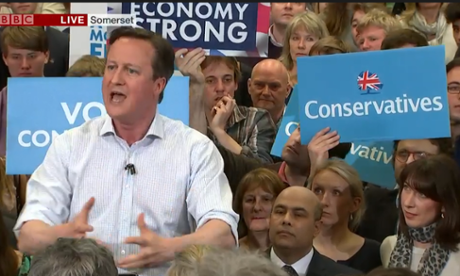
David Cameron is speaking in Somerset one.
He says the Tories have one big argument; it is about the economy. Who do you want to run it?
David Coburn, the Scottish Ukip MEP, said today there was “massive support” for Ukip in Falkirk and that his party could win there. (Falkirk was a Labour seat until its MP, Eric Joyce, resigned from Labour after being convicted of assault.) Coburn said:
[People in Falkirk are not interested in the Scottish nationalists because the Scottish nationalists are not good for the business of Falkirk. They are not interested in fracking, which is essential to keep Grangemouth open. They are not interested in coal technology or improving it. They really just want to send us back to a William Wallace pre-industrialised age ... but I think the vast majority of people would like to have their central heating thank you very much.
We have got massive support here and it looks like we are going to win in Falkirk, fingers crossed, or at least do extremely well.
David Cameron has firmed up his reaction to the claim from Paul Scriven that he privately told Nick Clegg he did not expect to win a majority. (See 8.31am.) Cameron told Sky News.
That’s complete nonsense and I think it’s rather desperate that the Liberals are saying things like this. The truth is, I think that they know that it comes down to a straight choice - do you want me to continue as prime minister or do you want Ed Miliband and the SNP in office?
Harry Lambert at the New Statesman’s May2015 site has produced some of the most thorough and thoughtful forecasting of the election.
He has got a new post up today. In it, he says Ed Miliband is most likely to be prime minister after the election, but that there are four routes that could lead to David Cameron staying in power.
Ipsos MORI has released some striking poll findings showing the people are far more likely to think that young people will have a lower quality of life in the future than they were 12 years ago, or even four years ago.
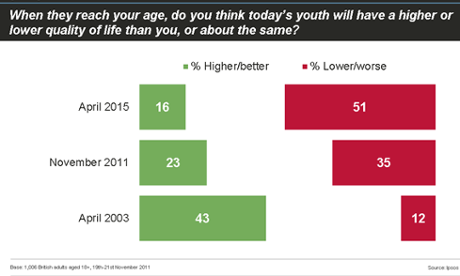
According to Ipsos MORI, this view is shared across all age groups, although Ukip supporters are noticeably more pessimistic than Tories.
This pessimism is very consistent across age groups: just 17% of 18-34 year olds think the future for young people will be better, 15% of 35-54 year olds think the same, as do 17% of those aged 55+. There is also little difference between social classes, men/women, or across regions.
However, there is a large difference in views between Conservative and Ukip voters: Ukip voters are particularly pessimistic with 73% thinking the future will be worse compared with 41% of Conservative voters. Labour (56% saying worse) and Lib Dem (61% saying worse) voters are both somewhere in between.
That is interesting: on this measures, the two extremes in British politics are Ukip (most pessimistic about the future) and Conservative (most optimistic).
Nigel Farage says he would back increasing disaster relief for Nepal
On the Radio 4’s Election Call Nigel Farage, the Ukip leader, also said that he would double or treble aid spending to Nepal. Although Ukip wanted to cut aid spending, it was in favour of disaster relief, he said.
When you think that our foreign aid budget is roughly a billion a month. We’ve offered just a few million pounds to Nepal. I have no objections to doubling or trebling that. I have no objections to helping with disaster relief but I have a problem with foreign aid that frankly isn’t working, is going to the wrong places, and does not command public support.
A flurry or volunteers in red t-shirts emblazoned with the Citizens UK logo led delegates to their seats for the organisations Accountability Assembly. Over 2000 faith leaders, community representatives and voters from key marginal constituencies have gathered today to celebrate civil society through songs and drama, be a part of political theatre, and hear how the leaders attending will respond to the key issues on their people’s manifesto, including: tackling pay day lending; improved social care; dignity for families seeking sanctuary; and increased implementation of the living wage.
Ed Miliband and Nick Clegg will be speaking to the assembly later. David Cameron pulled out on Friday evening, and Sajid Javid will be attending in his place. Organisers said they were disappointed that the prime minister would not be attending.
Neil Jameson, executive director, Citizens UK, said in a statement:
Our assembly puts the power in people’s hands. Those facing hardship will have a rare and special opportunity to address politicians face to face.
Today the three main political parties will listen to our testimonies and requests and outline their response.
The #cukmay4 assembly begins with school orchestra https://t.co/tshvz7OU2u
— Aisha S Gani (@aishagani) May 4, 2015
Constitutional scholar dismisses claims government without largest party would be illegitimate
Despite both Ed Miliband and David Cameron’s insistence that they are still fighting hard for a Commons majority, the most enlightening political analysis is now focusing on what happens if they don’t.
The constitutional and legal scholar Adam Tomkins, professor of public law at the University of Glasgow, has analysed two key documents, the Cabinet Manual (which the civil service uses to understand the conventions of government) and the Fixed-term Parliaments Act 2011.
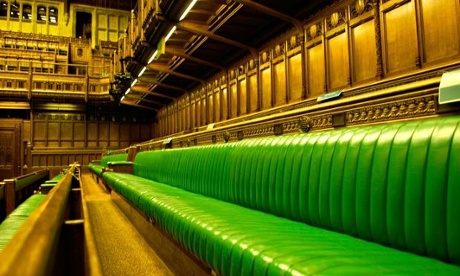
Using a close study of the texts, Tomkins refutes the suggestions coming from Conservatives that the SNP will be able to hold a minority Labour administration to ransom. And also the theory that the party with the most seats has the right to attempt to form an administration first, something claimed by Scottish Labour earlier in the election campaign.
Tomkins tables a (not unlikely) House of Commons picture of: Conservatives 290 seats; Labour 270; SNP 45; Lib Dem 25; Others 20. In this scenario a Labour-led government could well command the confidence of the House, despite Labour being a smaller party than the Tories.
(Labour 270 + LD 25 + SNP 45 = 340)
Would such a government be illegitimate, as some English voices on the centre-right have claimed in recent days? From a constitutional perspective the clear answer is no, it would not …
Suppose that a Labour-led minority government is struggling to pass its budget in the face of SNP resistance. There is nothing to stop Mr Miliband going to the House to say that, if his budget is not passed, he will resign on behalf of the government and advise the Queen that the Leader of the Opposition should be invited to form a government. If the PM does this the SNP would have to support Labour’s budget or usher in a new Tory government. That new Tory government may well not last long: if it could not gain the confidence of the House it could suffer defeat on a motion of confidence and we would be into the 14-day period provided for by the Fixed-term Parliaments Act.
His conclusion?
For sure, the parliamentary arithmetic at the end of the week could allow the SNP to cause chaos and wreak havoc, but the Fixed-term Parliaments Act is not a legislative licence for the tail to wag the dog.
The full blogpost is well worth reading for other insights into some uncharted constitutional territory, as well as Tomkins’ conclusion that the three main party leaders in 2010 (including “squatter” Gordon Brown) acted entirely properly. Reading between the lines, I sense that Tomkins does not expect the same this time around.
Updated
Natalie Bennett accuses Labour of showing 'lack of backbone' over immigration
Natalie Bennett, the Green party leader, delivered a speech on immigration this morning. She said that the anti-immigration rhetoric from the other parties had been “the most depressing” aspect of the campaign and she was particularly critical of Labour.
The so-called immigration debate, which has so often descended into a vicious rhetorical race to the bottom, has, for me, been the most depressing part of this campaign.
Elections should be about discussion and disagreement - but for months now we’ve seen the entire political establishment trying to sound ‘tough’ in an attempt to win back votes from UKIP.
As a migrant, and someone who loves this country for the tolerance it has shown those arriving on its shores, I’ve watched in horror as politicians line up to blame those not born here for failures of government policy ...
As Ukip rose to prominence over the last five years it was no surprise to see the Tories attempt to sure-up their right flank by clamping down on migrants. They promised caps, they set targets, and they failed even on their own terms.
But it was Labour’s lack of backbone that proved just how far our politics has been infiltrated by anti-immigrant rhetoric. Rather than standing up to Nigel Farage and his chums, Labour wilted. Rather than showing real opposition, they have adopted a harsh rhetoric - proudly pledging their plans on banners and merchandise to ‘control immigration’.
Rather than challenging myths around so-called health tourism, and rather than championing the rights of migrants, they have abandoned them, leaving them to take the blame for everything from a lack of affordable housing to pressures on our NHS.
She said the Greens would never blame immigrants for the failure of government policy. They were also committed to taking more refugees from Syria, to ending the indefinite detention of migrants and to ending the rule that requires people to earn £18,600 before they can bring a non-EU spouse to the UK, she said.

The Citizens UK election rally is getting underway now.
There is a live feed here.
I will be flagging up the highlights, obviously.
On Election Call Nigel Farage, the Ukip leader, was asked about the Russell Brand endorsement of Labour. Farage replied:
I’m very pleased Russell Brand has not endorsed me ... I do not think it will make any difference to the campaign at all.
He said that, ever since Ukip’s experience with Robert Kilroy-Silk (who helped the party raise its profile when he was elected as an MEP, but who subsequently fell out with Farage and left) the party had been rather cautious about celebrity endorsements.
On a visit to the Lib Dem held constituency of Carshalton, in Surrey, Nick Clegg was asked by 14-year-old Harvey Cuffe whether he could get controversial columnist Katie Hopkins arrested. Clegg said it was the best question he’d been asked in the whole campaign. “I don’t think I can,” he said.
Cuffe then asked the Lib Dem leader if he could get Hopkins killed. “No, no, no,” said Clegg. “Maybe you should just ignore her,” he added.
The Independent’s political reporter Matt Dathan caught the exchange on video.
Watch Nick Clegg respond to a 14-year-old boy asking him: "Can you get Katy Hopkins killed?" #GE2015 pic.twitter.com/Di4cEgymZs
— Matt Dathan (@matt_dathan) May 4, 2015
Updated
Martin McGuinness’ home in Derry was paint bombed over night prompting the Sinn Fein deputy first minister of Northern Ireland said the attack on his family will not prevent him from “building the peace.”
Sinn Fein’s chief negotiator during the peace process said his grandchildren were in the house when it was attacked on Sunday night.
McGuinness said:
This was an attack not just on me but on my family too, including my grandchildren who were in the house at the time.
I would like to thank my neighbours for all their help and assistance in the aftermath of the attack.
This attack on my family follows an arson attack on the car of a Sinn Féin member in Derry last week and on Sinn Féin election billboards and posters in the city.
The people behind these attacks have nothing to offer the community and they are intent on dragging society back to the past.

What Miliband said to win over Russell Brand
In his video Russell Brand said he was persuaded to back Labour by what Ed Miliband said about his support for grassroots activism. (See 1.13pm.) Today Brand played a clip from what Miliband said in their interview last week that was not included in the edited version of the interview Brand released on Wednesday. (See 12.49am.) Here is the key quote in it from Miliband, in which Miliband explains his belief in the importance of politicians listening to what activists say.
One of the things that strikes me, and this is how we are trying to change the Labour party - and I think we’ve been actually quite successful at this - is that you’ve got to have a politics rooted in communities. The Tories are a virtual party these days. They exist with advertising and money, but they don’t have people ... Let me give you an example, the living wage. The living wage campaign did not come out of policy wonks. It came out of people in the 1970s in America in workplaces saying a living wage is the idea that if you go out to work, you should be able to live on that wage.
Here is some Twitter comment on Russell Brand’s endorsement of Labour.
From LabourList Mark Ferguson
Russell Brand not only endorses Labour, but the kind of community led politics that Britain needs. Fair play http://t.co/vEcVxmqivV
— Mark Ferguson (@Markfergusonuk) May 4, 2015
From the Telegraph’s Michael Deacon
Now all that Russell Brand's fans have to do is build a time machine so that they can meet the deadline for voter registration
— Michael Deacon (@MichaelPDeacon) May 4, 2015
From the RSA’s Anthony Painter
Great that Russell Brand has endorsed @Ed_Miliband. Pity some people may not have registered to vote as a result of his previous comments.
— Anthony Painter (@anthonypainter) May 4, 2015
From Guido Fawkes’s Alex Wickham
Am enjoying Labour types trying to work out whether Russell Brand endorsing a Labour-SNP-Green government is a good or bad thing.
— Alex Wickham (@WikiGuido) May 4, 2015
From the Labour blogger Hopi Sen
Odd thing about Brand is if a politician did screeching reverse on issue as big as voting, they'd be killed for hypocrisy and stupidity...
— Hopi Sen (@hopisen) May 4, 2015
From the Labour blogger Sunny Hundal
Maybe next time Russell Brand could try interviewing politicians *before* telling people not to vote for them
— Sunny Hundal (@sunny_hundal) May 4, 2015
David Cameron’s line about Russell Brand being a “joke” seems to have infuriated him. This is what Brand said in response on his video.
David Cameron might think I’m a joke, but I don’t think there is anything funny about what the Conservative Party have been doing to this country and we have to stop them.
And this is what Russell Brand said about his advice to the Scots.
If you are Scottish, you don’t need an English person telling you what to do. You know what you are going to be doing.
That seems to be a tacit SNP endorsement, but it is hard to be sure.
Brand says he was won over by Miliband's support for grassroots activism

Here are some more quotes from Russell Brand’s video.
-
Brand said he had been won over by Ed Miliband saying that, as prime minister, he would welcome and respond to pressure from grassroots activists.
One thing I agree very sincerely with Ed on is that politics does not rain down on us. It comes from below. Movements putting pressure on governments. We don’t know that the limitations of the Labour administration are going to be. But we have just heard the leader of the Labour party saying that he welcomes and wants pressure from below. For me, what the interview meant is that Ed Miliband understands that people are pissed off, people have had enough of their needs being neglected because of the requirements of big business.
-
He said that, although he was known for not voting, he did believe people should be politically engaged day in, day, out, not just at elections. That is what democracy should be about, he said.
I know I have been Mr Don’t Vote. But, actually, what I mean is politics isn’t something that we can just be involved in every five years. Democracy is by every day, not just for elections. Democracy has to be something you are constantly involved in, whether you are students occupying your university, whether you are communities coming together to reclaim your housing, whether you are people running worker-led cooperatives. We have to confront big business. We have to confront people who are tearing apart London and socially cleansing.
-
He said he was urging people to back Ed Miliband because “he will listen”.
What I heard Ed Miliband say is, if we speak, he will listen. so, on that basis, I think we’ve got no choice but to take decisive action to end the danger of the Conservative party.
Updated
Brand says vote Labour for 'more democracy'
Here are some of the key quotes from Russell Brand’s interview.
-
Brand urges voters outside Scotland to back Labour.
There’s loads of things I could complain about with Ed Miliband. What’s important is this bloke will be in parliament and I think this bloke will listen to us. So on 7 May vote Labour, on 8 May – more democracy, more power to more communities, for all of us.
He says he would not tell the Scots what do do.
- He urges voters in Brighton Pavilion to support Caroline Lucas.
If you’re in Brighton I think it’d be a travesty if we lost the voice of Caroline Lucas in Westminster. But anywhere else you’ve got to vote Labour, you’ve got to get the Conservative party out of government in this country so that we can begin community-led activism, so that we can be heard continually.
Updated
Brand says he has learnt we are in a dangerous position.
The Tories are going to take down our public assets.
He says he knows he has been “Mr Don’t vote”. But he thinks democracy is something people should be involved in every day.
What I heard Ed Miliband say was, if we speak, he will listen.
We have to stop the Conservative party, he says.
He says he would not tell the Scottish what to do.
In Brighton, you should vote for Caroline Lucas.
But anywhere else, you’ve got to vote Labour.

Brand turns to Ed Miliband.
He plays a clip from the interview with Miliband he conducted last week but which has not been shown before.
Miliband says his politics is rooted in community.
The living wage campaign did not come from policy wonks, Miliband says. It was an idea championed by people, in the US originally in the 1970s.
Similarly, says Miliband, the pressure for action on climate change has come from people.
Brand, in the interview, tells Miliband he agrees. What we need is “galvanised people” campaigning for change.
Brand tells Miliband in the clip that he would see Miliband’s election as the start of something that would see people being involved.
Brand says Miliband’s father was bang into socialism. Something like that, says Miliband.
Brand says he is accused of not voting. But Murdoch does not vote either, yet he runs the country.
I hope not, says Miliband.
And that’s the end of the interview clip.
Brand is now talking again post-interview.
He says he is glad Miliband “welcomes and wants” pressure from below.
Updated
Brand turns to the Conservative party.
He says the Tory broadcast was a propaganda exercise.
David Cameron said that Russell Brand was a “joke”. But what is a real joke is 900,000 people using food banks in a society like ours.

Brand turns to the Greens.
He said last week, after the revolution, the Greens were the kind of people you would want running things.
Natalie Bennett is “clearly decent”. And Caroline Lucas is a “lovely person”, and exactly the kind of person you would want running things, he says.
But the Greens are obstructed by the first-past-the-post electoral system.
Updated
Brand says he looked at Ukip next.
Ukip are opposed to immigration. But immigration is worth £20bn to the economy. And many Britons go to live and work abroad.
They are very “one note”, he says.
According to Nigel Farage, all the problems are caused by unskilled migrant labour.
You can’t take them seriously - it’s bloody daft.
Russell Brand's Labour endorsement - live (almost)
Here is what Russell Brand is saying in his interview.
He says it is hard to ignore an election.
You can’t just “bah, humbug” you way through that.
Brand says he looked at the Lib Dems first.
But the Lib Dems backed Tory policies, especially the tax cut for millionaires.
Updated

Leftist commentators are hailing Russell Brand’s support as a coup for Ed Miliband, especially given the comedian and activist’s long-entrenched stance that voting for any mainstream party is a vote for the corporate-elitist status quo.
Bloody hell. I did not expect Russell Brand to endorse Ed Miliband. That was an impressive bit of convincing https://t.co/IwsYQG9Ad3
— Sunny Hundal (@sunny_hundal) May 4, 2015
Mr Don't Vote @rustyrockets advocates a Labour vote in most seats. Cameron won't find that a joke https://t.co/ZKdwX75BGz
— Kevin Maguire (@Kevin_Maguire) May 4, 2015
Breaking: Russell Brand backs Labour and Ed Miliband
Russell Brand has just released a video on his YouTube series the Trews in which he urges viewers to vote Labour, in a huge departure from his previous stance that voting is a waste of time.
He explains his change of heart because “the Conservative party plans to dismantle our community assets, to tear apart the very fabric of our society”.
He says his interview with Ed Miliband last week made him change his stance on the value of voting:
What I heard Ed Miliband say was that if we speak, he will listen. So on that basis we have no choice but to take decisive action to end the danger of the Conservative party. David Cameron might think I’m a joke but I don’t think there’s anything funny about what the Conservative party has been doing to this country and we have to stop them …
He then moves on to say that if you’re Scottish, you’ll probably be voting SNP; if you live in Brighton Pavilion, you should vote for Caroline Lucas; but if you’re anywhere else, you should vote Labour.
Updated
Cable says Lib Dems would expect same number of ministers as now in second coalition with Tories
Vince Cable, the Lib Dem business secretary, has told the Financial Times (subscription) that, in a second coalition with the Tories, the Lib Dems would expect the same number of ministerial posts as they have now.
There is no way we would accept a weaker role than the one that we have had in terms of policy or the number of ministerial jobs.
That is quite a demand, because the number of ministerial posts the Lib Dems got in 2010 was related to the number of MPs they had. Most forecasts suggest they will lose around half their seats, meaning, as the FT puts it, that “if Cable’s demands were met most Lib Dem MPs could be working at a ministerial level”.
The FT story includes a quote from a party spokesman making it clear that Cable was not speaking for the party on this point.
Miliband is wrapping up.
He says the Tory party is a “virtual party”. They don’t have activists on the ground. He urges the Labour activists in the room to keep campaigning.
This election will be decided by our energy, our hunger for change, our willingness to go the extra mile ... Please fight with every fibre of your being.
Q: Why cap profits on private NHS providers? Why not just stop private provision?
Miliband says you cannot have an integrated service with a fragmented service.
The private sector can play a role “at the margins”. But it should be limited, he says.
Q: If the Tories get more seats than Labour, do they get first right to put forward a Queen’s Speech?
Miliband says other leaders, like Cameron, have conceded the election. He hasn’t. He will lead the commentary on the election to others.
Q: Is the NHS what the campaign boils down to?
Miliband says the NHS is part of that. And the NHS is at real risk, for three reason. First, because of the planned cuts. Second, because of further privatisation. And, third, because of the likely reorganisation contained in the suppressed report from Lord Rose.
Miliband's Q&A
Miliband is now taking questions.
Q: You told John Humphrys this morning you were not planning conversations with the SNP. (Labour supporters jeer. Miliband tells them to be quiet, because we pride ourselves on a free press.) Does that mean you will do vote by vote deals?
No, says Miliband. He will put a Labour budget before the Commons. It will be written by Labour people.
He could not have been clearer. He has said no deals, no arrangements.
Cameron wants to turn this into a clash between two nations. He says he wants it to be a clash between two ideas.
Q: What is your favourite Delia recipe?
I like all of them, he says.
My colleague Nicholas Watt says the Paul Scriven tweet (see 8.31am) may not have been wholly accurate.
Not sure @paulscriven account @nick_clegg @David_Cameron chat 100% correct. Snr @LibDems source: PM told NC he 'probably' wouldn't win maj
— Nicholas Watt (@nicholaswatt) May 4, 2015
Miliband says Labour would put forward a bill to repeal the Health Act within its first 100 days in office.
Miliband mentions today’s letter in the Guardian from American health professionals warning about what could happen to the NHS. Here’s an extract.
As American health care professionals who often use the example of the NHS to advocate for a fairer and better system in the US, we have recognised recent developments in England that are deserving of concern. In particular, we express concern over movements toward transferring more and more services to for-profit corporations in your healthcare system and measures that encourage the development of a self-pay market for care. Access to treatment should not depend on whether someone can spare the money. While some may say the changes in England have so far only been at the margins, it is the risk of a slippery slope that should cause concern.
He says that 40% of contracts in the NHS have been issued to private providers. And he says private patient income has risen by 58% under this government.
Miliband says the NHS is “fighting for its life” because of the choices the government has made. There are queues at A&E units, and we have even seen a tent erected at a hospital.
David Cameron’s record on this is “a disgrace”.
The British people will hold him to account for his broken promises, Miliband says.
There is a live feed on the BBC website, but the signal is very poor.
Ed Miliband's speech
Ed Miliband is speaking in Brighton on the NHS.
He has just been introduced by Delia Smith.
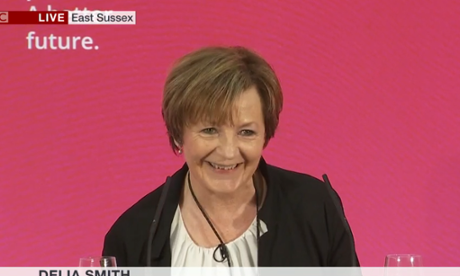
Miliband starts by thinking Smith, saying we’ve got one great British national treasure fighting to save another (the NHS).
Nigel Farage has given his clearest explanation yet of what he wants out of the election on LBC Radio - but does it stack up?
Essentially, the Ukip leader says his party could still be crucial in helping to keep David Cameron as prime minister because of the very “tight arithmetic” the Conservatives need to form a majority.
“Even if Ukip has a relatively small number of MPs, given the tight arithmetic, that could be crucial, that could make a difference. If Cameron had a majority on his own, I think it would be a stitch-up,” he says.
“What I’ve said is that Mr Miliband has turned his back on the British people and won’t offer a referendum, which I believe to be absolutely key ... Even in those seats where we can’t win, every vote for Ukip is not just a vote for a change of policy but actually for a change to our electoral system.”
At the point of doing a deal with Cameron, the Ukip leader’s red lines are an EU referendum in 2015 and “serious” deficit reduction plans.
However, Farage’s offer only works if the Conservatives have c. 310 seats (unlikely) and choose to partner with the DUP/Ukip over the Liberal Democrats. Clegg has ruled out being part of any bloc that includes Ukip - and would not stomach those EU and deficit reduction red lines.
All in all, it seems the idea that Farage will hold sway is implausible.
Eddie Izzard and Jim Murphy abandon Glasgow rally due to anti-Labour protests
Scottish Labour leader Jim Murphy and Eddie Izzard have been forced to abandon a rally on the streets of central Glasgow, as they were shouted down by nationalists chanting “Red Tories out!”.
Murphy at first gamely tried to turn the chant to “Get the Tories out!”, but judging by this footage from Channel 4 News’s Alex Thompson, Murphy and his celebrity endorser cut their losses and escaped in a waiting car.
Minor scuffles - interviews abandoned as JM/EI make it to car and leave pic.twitter.com/HwSzxH5Yui
— alex thomson (@alextomo) May 4, 2015
Tom Gordon, the political editor at the Sunday Herald, thinks this isn’t such a disaster for Murphy, as it shows the opposition looking “demented on TV”.
And that's the end of the Murphy/Izzard event. Jim'll be gutted there was no eggs, but he made the opposition look demented on TV. Result
— Tom Gordon (@HTScotPol) May 4, 2015
Updated
Here is more from what Nick Clegg is saying about the Paul Scriven tweet, and the Tories knowing they won’t win the election. (See 10.40am.)
“I wish I could reveal some of these private conversations because the difference between what the Conservatives say privately and what they say publicly is now quite a gulf,” Clegg said.
He said the Tory claim that they need 23 seats to gain a majority was a “big fat fib”.
Nobody thinks they’re going to get a majority. They need 323 seats and there’s absolutely no way they’re going to get that.
He was asked directly whether Cameron had ever told him that he didn’t think the Conservatives would get a majority.
“Look I don’t think it’s for me to reveal private conversations,” Clegg repeated.
The Lib Dem leader was asked if he had given permission to his friend to send the tweet.
Paul is an old friend of mine from Sheffield. I really don’t control even my closest friends tweets. And I’m not going to start intervening in a spat between his tweets and what over-excitable Conservative spin doctor says.
Stewart Hosie says SNP would not offer Labour 'a blank cheque' and would want to see policies 'trimmed'
Stewart Hosie, the SNP’s deputy leader, has again raised the stakes with Labour by insisting his party expects to influence a minority Labour government’s policy programme and again raised the threat of voting against Ed Miliband’s Queens speech or first budget.
Implying that serious rows over further cuts could fuel demands for a new referendum on independence, Hosie said “there was a very strong case [to see Labour’s policies] trimmed, changed, adjusted to reflect the kind of wishes that we have.”
Interviewed on BBC Radio Scotland, Hosie – a close ally to party leader Nicola Sturgeon - said the SNP wanted to support a Labour minority government “but there’s no blank cheque ... Ed Miliband can’t take the SNP votes for granted.”
After Sturgeon confirmed on Sunday night that the SNP could oppose a Labour Queen’s speech, Hosie was pressed on what would provoke his party to do so. He said the price for SNP support would be a deal with Labour on the detail of any spending cuts plans or changes to the benefits system.
He told presenter Gary Robertson:
Well, we’ve been very clear and upfront, transparent with the public because, I’ve said this on the programme a number of times, we want to see an end to austerity, a modest increase in public expenditure which still sees the debt and deficit fall but which lifts the squeeze from ordinary people, we can’t afford another £30bn of cuts, another 5 years of misery for many, many people.
So we will make a very strong case to say that should there be a minority Labour administration that we can help, we would like to see their approach trimmed, changed, adjusted in order to reflect the kind of wishes that we have.
Hosie tried to adopt a far more conciliatory tone compared to previous interviews, where he’s taken a far more combative stance on the SNP’s terms for backing Labour, by insisting the SNP wanted to be collaborative not confrontational.
But he cited warnings from Labour backbencher John McDonnell that up to 40 Labour MPs could also resist deep cuts in an Ed Balls budget, and implied that if a Labour or Tory administration pushed through spending cuts or NHS reforms the SNP did not like, it could provoke a fresh referendum.
Pressed on claims by SNP candidates that a decision on staging a second referendum depended on the consequences of the election, Hosie said they were right.
I think the point, we have to wait to see the outcome of this election is absolutely correct, you know if we are in a really strong position at Westminster, to end austerity, to demand legitimately more powers for Scotland, north of what the Smith Commission have proposed, we need to see how Westminster responds to that…
If Westminster responds positively to legitimate demands for example, for more powers or to end austerity or to fully fund the health service, that’s a good thing. If on the other hand, they don’t ignore the SNP, frankly I don’t care about that, but if they ignore the wishes of the Scottish people, then I suspect that you, I and all the politicians would have to respond to what the people were saying at that point.
Earlier I quoted tweets from Andrew Neil and Fraser Nelson says the national debt was higher in 2007 than in 1997. (See 9.10am.)
It was higher in cash terms, but lower as a percentage of GDP. Here are the figures in percentage terms.
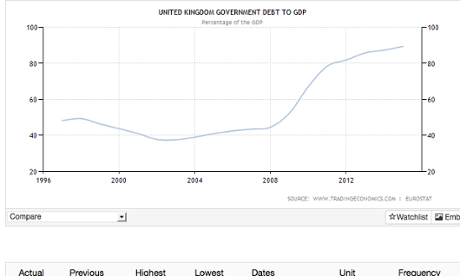
And this is what David Cameron said when asked about Scriven’s claim.
I think Nick Clegg is increasingly desperate because he knows the truth, which is there is an inescapable choice. On Thursday people have to choose - would they like me to continue as prime minister or do they want Ed Miliband and the SNP, the only other available option?
My message is if you vote Lib Dem you are in danger of ending up with Ed Miliband, if you vote Ukip you are in danger of ending up with Ed Miliband.
It’s only by voting Conservative you can guarantee that I’ll continue as prime minister, George Osborne will be back at his desk working on that long-term economic plan.
And we will continue with the growth and the jobs and the investment like here in Hastings.
Paul Scriven told BBC News that he was inspired to post his tweet about David Cameron telling Nick Clegg that he would not get a majority by today’s Telegraph story saying the Tories were targeting Lib Dem seats in the hope of winning an absolute majority. Scriven said:
If David Cameron is going to lie when he knows in his heart of hearts his private polls are showing that the British people are likely to give no party an overall majority, then so be it. I don’t take back anything I said in the tweet. People are not stupid. The opinion polls show what’s happening, the private opinion polls show what is happening.
When I read what’s on the front page of the Daily Telegraph, that David Cameron is not telling the truth to try to scare people to vote, then I think that his private feelings do need to be made clear.
David Cameron has been asked on Sky about the comment to Nick Clegg mentioned in Paul Scriven’s tweet. (See 8.31am.) He said that Clegg was getting “increasingly desperate”, but he refused to say whether he had told Clegg privately that he did not expect to get a majority.
Scriven has defended his tweet.
Paul scriven on 5 live now: said Clegg told him a number of weeks that Cameron had said he wouldn't get a majority: "I stick by my tweet"
— Faisal Islam (@faisalislam) May 4, 2015
And my colleague Patrick Wintour has some extra information about this.
Understand that v disputed conversation between Clegg & Cameron in which PM said he did expect majority occurred just before short campaign
— Patrick Wintour (@patrickwintour) May 4, 2015
In his Today interview Ed Miliband sidestepped questions about whether it would be legitimate to form a government if Labour were not the largest party.
The Times (paywall) has splashed on a story saying that some Labour figures think the answer is no.
THE TIMES: Win right to govern, Miliband is warned #tomorrowspaperstoday #BBCPapers pic.twitter.com/mZasec09Ys
— Neil Henderson (@hendopolis) May 3, 2015
Allies of Mr Miliband insist that he would have the right to enter No 10 if he mustered the support of more than half the 650 MPs in the Commons, even if this meant relying on the Nationalists ...
Others, including some members of the shadow cabinet, are privately worried about this outcome. One Labour frontbencher said: “If we come second and try and cling on, [everyone else] will kill us. Mr Cameron would say — not unreasonably — that he’s won and he’d be right. I don’t think that the country will forgive us if we have effectively lost the election but say we’re going into government. If the mandate for governing relies almost exclusively on the SNP, we should quit trying because we will have failed to convince the electorate, and seek a new leader.”
Another senior frontbencher said: “If we are not within 10 to 12 seats of the Tories, it will be very difficult to govern for five years . . . We would have questionable legitimacy to make changes on the scale wanted.”
It would be better for the party to stay in opposition for a few months and campaign against the minority Tory government, he said, while hoping for another election quickly. “It would not be a good idea to be in government in these circumstances, even if it was mathematically possible.”
Actually, the answer to John Humphrys’ question is quite straightforward. In legal and constitutional terms, it would be perfectly legitimate for the second largest party to form a government. It has happened before, when Labour formed a government in 1924.
But whether the public would think such a government was legitimate is, of course, a different matter.
Clegg says senior Tories acknowledge privately that they are not going to win
Nick Clegg has been asked on Sky if Paul Scriven was right to say that David Cameron had told him he accepted he would not get a majority. (See 8.31am.) Clegg said he would not reveal private conversations. But then he went on:
All I’m saying is that the Conservatives know, in their heart of hearts, that they are not going to win. I have never met a senior Conservative who claims privately anything other than acknowledging that they are not going to win.
Updated
Going back to the argument about budget deficit, which took up so much of Ed Milband’s Today interview, this chart puts things in perspective.
Here's the Tories' record of running budget surpluses. Sorry, but you'll have to squint pic.twitter.com/LwprCeR3dL
— Jolyon Maugham (@JolyonMaugham) May 4, 2015
A senior Liberal Democrat spokesperson has commented on the tweet from the Lib Dem peer and 2010 candidate for Sheffield Central, Paul Scriven, about David Cameron not expecting a majority. (See 8.31am.)
Paul is one of Nick’s closest confidant in politics and I don’t think he would make this stuff up. I don’t know any senior Conservative to says in private they’ll get a majority.
Here is some Tory reaction to the Ed Miliband interview.
Miliband won't admit Labour spent too much.He's learnt nothing. Don't let him do it again. #VoteConservative #r4today pic.twitter.com/3UooM6tr9S
— CCHQ Press Office (@CCHQPress) May 4, 2015
.@Ed_Miliband still in denial. Independent OBR clear Labour left UK worst exposed to crash - dont let him do it again pic.twitter.com/f40ADc3nL1
— CCHQ Press Office (@CCHQPress) May 4, 2015
Miliband says net debt will fall under the Labour plan. It won't - it will carry on rising by more than £30bn a year
— Tory Treasury (@ToryTreasury) May 4, 2015
Ed Miliband's Today interview - Summary and analysis
In his book about the Labour party under Ed Miliband, Five Year Mission, Tim Bale writes about the impact of the rightwing press on the broadcast media and includes this quote from someone in Miliband’s office.
Ed’s been interviewed by John Humphrys three times and two of the three times Humphrys had the Daily Mail open next to him.
I don’t know if that was the case today, but Humphrys questions were, to a large extent, the ones that the Daily Mail would have asked. They were critical, but Miliband held up pretty well.
There were various news lines (see below) but perhaps what was most interesting was what Miliband said about the SNP. In one sense he was just saying something he has said many times before, but he was also hardening up his line. He is now ruling out “arrangements” (which, arguably, are looser than “deals”) and he is even suggesting he won’t even talk to Alex Salmond or Nicola Sturgeon about Labour’s programme. This is daft; ministers talk to opposition parties about their plans all the time, because it is party of how sensible government works. But Miliband is being pushed into a position where, if he does form a minority government and makes even a miniscule concession to the SNP, he will be accused of gross betrayal.
Here are the key points.
-
Miliband ruled out having an “arrangement” with the SNP about passing Labour legislation and even suggested he would refuse to have conversations with them. This goes even further than the language was he was using last week. Early in the campaign Miliband ruled out a coalition with the SNP. Last week he clearly ruled out any “deal” with them, implying there would be no confidence and supply arrangements. Today he went further.
We are not going to have an arrangement with them.
He said he would put forward a Labour Queen’s Speech. What the SNP did about that would be a matter for them. John Humphrys then asked him if he would have any “conversations” with the SNP.
Q: Neither your nor any of your colleagues will have any conversations with anybody from the SNP at any point after the election?
Miliband replied:
We’re not going to negotiate about the Queen’s Speech, no. We are not going to negotiate with the SNP.
Humphrys said Miliband was redefining the question. He tried again.
Q: I’m asking if you’re going to have any conversations with them.
Miliband replied:
I’m not planning that, no. We’re not going to negotiate about the Queen’s speech. I’m going to put a Labour Queen’s speech before the House of Commons.
-
Miliband strongly defended his decision to commission a stone monument engraved with Labour’s election pledges, saying it was vital to show people they could trust him. Asked if he regretted it, he replied:
Not at all, because I think trust is a huge issue in this election. The difference with our pledges is that they are not going to expire on May 8 ....
Nick Clegg went into the last election saying he would cut tuition fees. He trebled them. David Cameron went into the last election saying no iffs, no buts, net migration down to the tens of thousands. It’s 298,000. We are setting out promises; they don’t expire on May 8.
Asked about the negative reaction, he said: “It got people talking”. And he brushed aside a critical article about it in the Guardian. “They don’t always get everything right,” he said.
- He implied that he might not try to have have the stone installed in the Downing Street garden. At the weekend Labour said this was the intention, but it has been said he would not get planning permission. Asked where the stone might go, Miliband said he would leave the landscape gardening to others.
-
He said that David Cameron was “desperate” and that he was trying to stir up divisions between England and Scotland because he was losing the key election arguments.
David Cameron is a pretty desperate man, I just want to make this point. He’s a desperate man because what he’s reduced to is trying to set this election up as a clash of two nations. He’s lost all the arguments.
He’s lost the argument about the economy, he’s lost the argument about leadership, he’s lost the argument about his broken promises on the NHS. This is all he’s got left.
He also accused the Tories of “spraying promises around like there is no tomorrow” without knowing how they would be funded.
-
He refused to say whether a government led by a party that was not the largest in the Commons would be legitimate. He said he did not want to speculate about the election outcome, and that it was up to constitutionalists to talk about the constitution.

Our focus group's opinion on talks of post-election deal-making

What do the real voters think? We have 60 in five key seats giving their view throughout the campaign as part of our polling project with BritainThinks. They each have an app and are telling us what they think of stories as they crop up.
Below are a selection of comments from voters after days of relentless media coverage of how post-election deals could pan out, and how it makes them feel.
So Ed is prepared to let the Tories in because he doesn’t want to work with the SNP? I don’t believe him.
Dennis, 52, Glasgow East
And here’s the verdict from Alastair Campbell, Tony Blair’s former spin doctor.
Don't often listen to @BBCr4today cos of constant hectoring and smugness of certain presenters. @Ed_Miliband dealt with said presenter well
— Alastair Campbell (@campbellclaret) May 4, 2015
I’ll post a summary of what Ed Miliband said shortly.
Ed Miliband's interview - Verdict from the Twitter commentariat
Here is some reaction to Ed Miliband’s interview from political journalists and commentators on Twitter.
From the Spectator’s Isabel Hardman
Miliband interview over: he should be pleased with that as he’s managed to dodge and obfuscate in the way he presumably planned before.
— Isabel Hardman (@IsabelHardman) May 4, 2015
From the Herald’s Iain Macwhirter
Stormin' interview by Ed Miliband on BBC today. Refused to give an inch to Humprhys Daily Mailism. He's pumped. #GE2015
— Iain Macwhirter (@iainmacwhirter) May 4, 2015
From the Telegraph’s Liam Halligan
John Humphreys savaging Miliband on @BBCr4today "Fighting for Labour majority" stuff & "no deal" hung parliament denial will exasperate many
— Liam Halligan (@LiamHalligan) May 4, 2015
Here is some comment on what Miliband was saying.
From the BBC’s Andrew Neil
Listening to Ed Miliband @BBCr4today it's clear he thinks he can put together a Queen's Speech which SNP will back, without talking to SNP
— Andrew Neil (@afneil) May 4, 2015
From the BBC’s Mark Mardell
Listening to Miliband on Today I wonder if conservatives are playing a POST t 8th game - wanting him to rule out all contact with SNP
— Mark Mardell (@BBCMarkMardell) May 4, 2015
(I don’t think you need to wonder about that, Mark. It’s as plain as a pikestaff, isn’t it?)
From the Spectator’s Fraser Nelson
Listening to Miliband on R4, it's clear: Labour would govern vote-by-vote with the SNP, giving Salmond a veto on every Bill it wants passed.
— Fraser Nelson (@FraserNelson) May 4, 2015
And here is some fact-checking.
@BBCr4today Miliband claims national debt was lower before crash 2007 than it was 1997. Not true: it was about £200bn higher
— Andrew Neil (@afneil) May 4, 2015
Miliband tells R4 that debt, before the crash, was lower "than what we inherited". Flatly untrue. Here's the truth... pic.twitter.com/XvDsbHFWlx
— Fraser Nelson (@FraserNelson) May 4, 2015
Q: Will you have the leader of the SNP tugging at you?
No, says Miliband. He says he has said that will not happen.
He says Cameron is a desperate man. He has lost the argument about the economy, about the NHS and about leadership. That is why is he resorting to these tactics.
And that’s it.
I’ll post a summary and reaction soon.
Q: You forget the deficit in your last conference speech. Is this stone to remind you of it?
Miliband says it is to remind people of his promises.
This is a once in a generation election about who Britain is run for, he says.
Q: Is it a gimmick?
It has got people talking, says Miliband.
Q: The Guardian criticised it.
They don’t always get everything right, says Miliband.
He says Nick Clegg broke his promise on tuition fees. He wants to ensure that people trust him.
Q: You won’t be allowed to put it in the Number 10 garden.
I’ll leave the landscape gardening to others, says Miliband.
He wants to be the first prime minister to under-promise and over-deliver.
Miliband: (The stone’s) to remind the British people; Humphrys: they won’t be seeing it – it’s in your garden!
— Ross Hawkins (@rosschawkins) May 4, 2015
Updated
Q: What do you say to people in the Question Time audience who say you just don’t get it.
Miliband says it was a failure of bank regulation. George Osborne’s permanent secretary has said that.
Q: You were borrowing too much?
Miliband says he has dealt with that. They should be talking about the future, he says.
The Tories are “spraying promises around like there is no tomorrow.” They don’t know how they will be funded.
All Labour’s plans, by comparison, are funded.
Miliband says his promises are carved in stone - literally.
Q: When will you get rid of the deficit?
As soon as possible, Miliband.
He says he must be the first Labour leader Humphrys has interviewed - and he has interviewed a few - going into an election promising cuts.
Miliband says the timing of deficit reduction will depend on tax rises, cuts, and how much economic growth is generated.
Labour has a “balanced, sensible plan to get the debt falling”.
Miliband says the election is a clash of idea. Are we going to ensure people have enough to pay their bills.
Q: And that is why judgments matters. The OECD said Britain entered the crisis with one of the biggest structural deficits in the developed world, and that that limited its room for manoeuvre.
Miliband says he is proud of the fact that Labour borrowed to invest in schools and hospitals.
Q: You borrowed too much.
Miliband tells him he is getting excited. He is worried about him.
Q: You continued with that borrowing, even after Northern Rock collapsed.
Miliband says Osborne adopted Labour spending plans three weeks before Northern Rock.
Q: The other reason people did not trust you in the Question Time debate was because you said the last Labour government did not borrow too much. You must be the only person in the country who thinks that.
He says he will put tax rates up.
Q: But what will happen if you don’t get the votes you need?
Miliband says Humphrys asked him directly if he would have an arrangement with the SNP. He said no.
Q: So you won’t have any conversations with the SNP?
I’m not planning that, no, says Miliband.
He says he is going to put a Labour budget before the Commons.
Q: What is a legitimate government?
You’ll have to explain that, says Miliband.
Q: Some of your MPs are saying that if you don’t have more seats than the Tories, your government won’t be legitimate.
Miliband says he is not going to speculate on that.
Q: It’s an important constitutional point.
Then get constitutional experts on, says Miliband.
Ed Miliband's Today interview

Ed Miliband is on the Today programme now. John Humphrys is interviewing him.
Q: Let’s talk about trust. On Question Time you dismayed a lot of people by saying that you would do no deals with the SNP. But you will have to do deals, won’t you?
Miliband says he is fighting for the big issues at stake. There is a huge difference between having a country run for working people, and one run for those at the top. I will focus on that.
Q: People are capable of focusing on two things, that choice, plus what might happen next. And you have a duty to tell people.
Miliband says the Tories have been putting out a “falsehood” that there would be a coalition with the SNP. He would not, because they are “a separatist party who wants to break up the country”.
Q: But what happens if you don’t have enough seats to form a government. Will you let David Cameron form a government.
Miliband says he wants to put forward a Labour Queen’s Speech.
Q: But people are entitled to know what you would do. Would you have an arrangement with the SNP?
No, says Miliband. What the SNP do is a matter for them.
Updated
There is an addition to today’s agenda. (See 7am.)
#UKIP Leader @Nigel_Farage will be our guest on #ElectionCall today. Do send us you questions or phone in later. pic.twitter.com/na6L678Ihu
— The World at One (@BBCWorldatOne) May 4, 2015
David Cameron has repeatedly said he is fighting for a majority.
According to the Lib Dem peer Paul Scriven, in private he admits this will not happen.
So Cameron has taken to lying on Tory Maj. @nick_clegg told me that Cameron privately admitted to him that the Tories won't win a majority
— Paul Scriven (@Paulscriven) May 4, 2015
Updated
That FT splash has already cost the Lib Dems one vote. This is from the novelist Linda Grant.
Tories and LibDems are already in coalition talks. Which is why I won't be voting LD in Hornsey&Wood Green pic.twitter.com/FHuj5jaimK
— Linda Grant (@lindasgrant) May 4, 2015
YouGov poll gives Tories 1-pt lead
Here are today’s YouGov GB polling figures.
Update: Con lead at 1 - Latest YouGov / The Sun results 3rd May - Con 34%, Lab 33%, LD 9%, UKIP 12%, GRN 5%; APP -13 http://t.co/LxVXgYoAGb
— YouGov (@YouGov) May 4, 2015
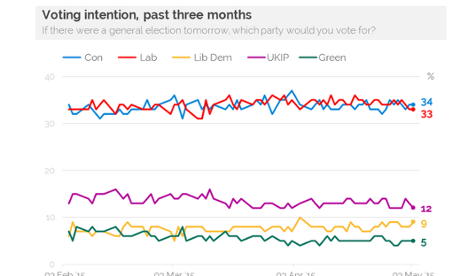
Good morning. I’m taking over from Claire.
Before Ed Miliband’s Today interview, here is one more story worth flagging up. The Financial Times (subscription) says David Cameron and Nick Clegg are planning a new coalition.
FT UK: Cameron and Clegg prepared to move quickly to form coalition #tomorrowspaperstoday #BBCPapers pic.twitter.com/yv2xqIMwhW
— Neil Henderson (@hendopolis) May 3, 2015
Here’s an extract.
David Cameron and Nick Clegg are preparing for talks on a new Conservative/Liberal Democrat coalition within hours of Thursday’s general election, if the Tories win the most seats in a hung parliament ...
Mr Cameron’s allies say they expect him to “move quickly” on Friday to try to seize the initiative if the Tories emerged as the biggest party on May 8, while Mr Clegg said on Sunday he would initially talk exclusively to the party leader with the biggest mandate.
With neither Labour nor Tories expected to win an outright majority, Mr Cameron’s allies say the prime minister would claim victory and assert his right to govern.
In 2010, Mr Cameron offered a coalition deal to the Lib Dems within 24 hours of the election and senior figures in both parties expect similar talks to begin quickly this time, if the two parties believe they could form a stable government.
Sturgeon: 'SNP isn't intending to be disruptive'
Nicola Sturgeon has just been on ITV’s Good Morning Britain programme. The Guardian’s Scotland correspondent, Severin Carrell, was watching:
Nicola Sturgeon, the SNP leader, has denied that her party could cause “chaos” at Westminster if it voted against a Labour budget, insisting on ITV’s Good Morning Britain that voting down a minority government’s budget would simply force ministers to renegotiate and retable it.
Sturgeon was pressed on her comment in a BBC Scottish leaders’ debate that the SNP would vote against unacceptable cuts in a Labour budget, and said: “I’ve been a member of a minority government. The SNP was the minority government between 2007 and 2011 – in one of those years we failed to get our budget through parliament.
“The government didn’t fall. What we had to do was go away, talk to other parties, make compromises, bring that budget back – which we did a week later, I think, when it passed through parliament.
“The SNP isn’t going into Westminster with the intention of being disruptive or bringing governments down or blocking budgets for the sake of it. We’re going into it with the intention of getting better policies and better politics at Westminster.
“And if there’s a minority Labour government and we’ve said we would want to lock the Tories out of government if the numbers allow it, but if there’s a minority Labour government we can use our influence to make that a better government delivering better policies for the interests of ordinary people in every part of the UK.”
Sturgeon agreed that it was “a fairly legitimate question” to ask how the SNP could have the interests of other parts of the UK at heart, since it wanted to leave the UK. She said fighting further welfare cuts and defending NHS funding were causes supported across the UK, not just in Scotland.

Updated
After #EdStone, Cameron’s “tax lock law” and Clegg’s “red lines”, is this the end for politicians simply saying what they would do if elected?
The Guardian’s political editor, Patrick Wintour, says the three Westminster leaders are finding “ever more contorted symbolic devices to say exactly the same thing to voters – please trust me”:
Miliband is genuinely fascinated by how politicians achieve change and do not find themselves forced into breaking their promises. Much of his often bizarre discussion with the comedian Russell Brand was at root a debate about how politicians in parliament need the pressure from below to achieve change. It is the kind of debate he might often have had with his Marxist father Ralph Miliband, the author of Parliamentary Socialism: A Study in the Politics of Labour …
So Miliband’s statue may be a Photoshopper’s paradise and an aesthetic disaster, but it has its well-meaning origins.
Leanne Wood: 'Miliband has been arrogant'
The Plaid Cymru leader, Leanne Wood, has just been on the Today programme, interviewed by James Naughtie.
On the role of Plaid Cymru in the event of a hung parliament, Wood said:
What I find quite staggering is the attitude from Lab politicians, assuming Plaid Cymru, the SNP and Greens are in their pocket.
We would be prepard to vote down a Labour budget that was putting more on the backs of the poor … They need to take on board some of the things we are saying.
People are saying neither of the two main parties have done enough to win trust and a mandate to govern. That’s democracy .
On whether she is prepared – as Sturgeon said last night the SNP would be – to vote down a Labour budget that imposed more austerity:
We can’t have been clearer in our opposition to the Tories … neither would we prop up a Labour govt intent on pursuing Tory policies.
We’ve offered our hand to Ed Miliband to set up that alternative government and he’s arrogantly pushed that hand away.
My suspicion is [on Friday morning] he’ll have to speak to someone else because there won’t be the numbers there to form a government.

Her party has had a good campaign, Wood said:
Plaid Cymru has had a lot of positive feedback over the last month. Exposure in the televised debates has helped – people are more aware of what we stand for.
Our message has been that we want to rebalance power and wealth across these islands. We want an end to austerity … we want parity with Scotland.
On why she and Plaid Cymru have not had the campaign impact of Sturgeon and the SNP:
The SNP made their breakthrough back in 2007, when they formed a minority government … We’ve got assembly elections next year and I hope we’ll see a Plaid Cymru breakthrough then.
In devolution, they’re streets ahead of us … We need to do the same in Wales. We’ve got a third-rate devolution system.
Updated
Morning briefing
Good morning and welcome to the final Monday of this 2015 election campaign. I would say “the” 2015 election campaign, but talk of a second vote should Thursday not produce a government strong enough to withstand a Queen’s speech wobble has made me cautious.
I’m Claire Phipps and I’m starting the live blog today, before handing over to Andrew Sparrow and more of the Guardian’s crack politics team. We’re here every day from 7am till late every day till polling day, at which point we just keep on going till someone decides to be the prime minister. Send snacks, please.
I’m on Twitter @Claire_Phipps, so do come and chat there or in the comments below.
The big picture
David Cameron declared himself Team Nigella, but Labour now has Delia Smith on side. The TV cook, author and joint majority shareholder of Norwich City FC has pulled on a Labour team shirt (don’t worry, my stock of footballing metaphors is nearly exhausted).
Writing in the Mirror, Smith says:
When I was about seven, 67 years ago, I recall we had a poster … in our front window saying “Vote Labour for a National Health Service” in the year they were campaigning for it. Now what they pioneered and worked so hard for – which became the envy of the world – is in grave danger of being compromised or, at worst, ceasing to exist as we know it …
Labour has more vigour and younger candidates. Our future lies with them – their ideas and vision need to be heard.
Smith follows on the heels of actor Steve Coogan, who yesterday urged voters to give Labour their X, and both – coincidentally enough – cite the apparent threat to the NHS posed by another Tory government.
Health is Ed Miliband’s big theme today, and he’s expected to make much of a report commissioned by the government but as yet unpublished that is thought to be critical of the massive health reforms implemented under then health secretary Andrew Lansley. The report, by the former Marks & Spencer chief executive Stuart Rose, was passed to ministers in December 2014.
Andy Burnham, Labour’s shadow health secretary, will say today:
They won’t tell us what’s in it. They won’t tell us what they plan to do with it. They won’t tell us what they plan to do with the NHS. But we do know one thing. We know who wrote it: the Conservative peer, Lord Rose.
Lord Rose may be good at running supermarkets. But I say to David Cameron: you can’t run the NHS like a supermarket, we don’t want a supermarket health service, so publish this report and show us what is in your secret plan.
Today the Guardian publishes three letters – one from a group of US medics, one from public health professionals, and one from nurses – warning of the growing creep of private influence within the health system.
And the Mirror reports that Crosby Textor, the lobbying firm run by Lynton Crosby, Cameron’s election strategy chief, advised private health firms how to “take advantage” of NHS contracts now open to private bidders.
Austerity and welfare cuts were key themes at Sunday night’s Scottish leaders’ debate in Edinburgh, with SNP leader Nicola Sturgeon warning her Labour counterpart Jim Murphy that her party’s MPs would not support further cuts to disability benefits:
If Labour puts forward a budget that imposes more cuts on vulnerable people – as clearly they intend to do – the SNP will vote against it and we will seek to use our clout in the House of Commons to get a fairer deal.
Scottish Conservative leader Ruth Davidson said that what she called “the rough wooing between Nicola and Jim” was precisely “the kind of deal-by-deal vote you would see in the next parliament if it was a Labour party that was reliant on the SNP … exactly the sort of politics that most people hate”.

You should also know:

- Victims of domestic violence will be given easier access to legal aid to help them escape abusive relationships, Labour will pledge today.
- The permanent secretary to the Treasury, Sir Nicholas Macpherson, has argued that the 2008 financial crisis was “a banking crisis pure and simple”, contradicting Conservative claims that it was caused by Labour overspending.
- The Lib Dems say they’ll use the £227m fine levied on Deutsche-Bank for the Libor scandal to fund air ambulances and buy new hospital equipment (last week Cameron promised the same money to apprenticeships).
-
Read Andrew Sparrow’s round-up of Sunday’s key developments here. It’s not all about #EdStone. But it’s mostly about #EdStone.
And with three – three! – days to go, here is the latest poll of polls:
Diary
If you don’t trip over a politician this week, you’re really not trying hard enough. Expect non-stop campaigning for the next three days (as long as you’re not in a safe seat that no party can even be bothered leafleting. Democracy, eh?). Here are today’s highlights:


- Leanne Wood, leader of Plaid Cymru, is interviewed on the Today programme at 7.10am.
- At 8.35am, Ed Miliband is on the Today programme, where he will be trying to focus minds on the NHS.
- David Cameron is at a bank holiday rally where he will pledge tax cuts for 30 million people. (I’m not sure simple pledges cut it any more. How about a tattoo or a Scout Promise?)
- The Liberal Democrat battlebus chugs on, today in Twickenham, Kingston, Carshalton and Newquay.
- At 10.45am, former Labour Scottish first minister Jack McConnell campaigns in Aberdeen. Eddie Izzard is also in Scotland for Labour, campaigning with Jim Murphy in Glasgow.
- At 11am, Green party leader Natalie Bennett makes a speech on immigration.
- At the same time, Ukip is launching its manifesto for Scotland.
-
Nicola Sturgeon takes the SNP campaign to Fife, Helensburgh in Argyll & Bute, Greenock, Largs and Dumfries.
- Scottish Lib Dem leader Willie Rennie will kick off a “polling week blitz” of 11 Lib Dem seats in Stonehaven, near Aberdeen.
- This afternoon, Miliband, Nick Clegg and culture secretary Sajid Javid will take questions at the Citizens UK assembly in London.
The big issue
Could there be a second general election this year? This won’t, of course, be bad news for devoted readers of the election campaign live blog, but others – voters and politicians alike – will not be relishing the prospect of a re-run.
Tory grandee Ken Clarke, in a Guardian interview this morning, says a second bout would fix nothing:
You can get out of a hung parliament by having a second election but, not surprisingly, the public tends to return a parliament which looks rather like the first one.
So where has the idea come from? Labour’s out-and-out snubbing of a coalition deal with the SNP – by all accounts set to be the third largest party come Friday – leave a potential Prime Minister Miliband in a vulnerable position. A Labour official reportedly described a second election as a “very likely scenario” this weekend: either a minority Labour government falls over without SNP support; or a minority Conservative one (even with Lib Dem backing) is toppled when Labour and the SNP vote down its Queen’s speech.
Clarke was a Tory government whip in the run-up to the first election of 1974. Of that year’s second election, in October, he told the Guardian:
Harold [Wilson, the Labour leader] made a minuscule increase in his majority and by the last two years of the parliament had a minority government ...
You won’t necessarily find that if you hold it within a few months you will get a different result from the first one so people need to make their mind up this time.
The Telegraph reports that the Tories have identified 23 seats to bombard this week in a last-ditch attempt to secure a majority. Most are held by the Lib Dems, including Eastbourne, Bath, Chippenham, Cheadle, Twickenham, and Kingston and Surbiton.
And the Times (paywall) has “senior Labour figures” warning Miliband against trying to form a minority government if he doesn’t beat Cameron to the most MPs.
Andrew Rawnsley’s guide to what happens next once the votes are counted is definitely worth a read before Thursday.
Read these
- Nicholas Watt in this here Guardian notes that the Tory right has been ominously quiet during the campaign:
If the Tories have lost a significant number of seats – about 30, to take their numbers down to 276 – then Cameron’s position may become complicated at the 1922 meeting on Monday. Cameron may try to hold on.
But one idea doing the rounds is that some on the right might try to install Boris Johnson as Tory leader before a second election in October. In the meantime, Cameron would remain as a caretaker prime minister.
- Writing in the Times, Tim Montgomerie says the system is unfair to Ukip and the Greens:
The old left-right divides are increasingly obsolete. The new questions involve localism versus centralism; intergenerational fairness; openness to the world or isolationism; and debates as to whether the individual matters most in public policy or that family and community do. These questions often divide rather than unite existing parties.
Personally, I’d vote for a eurosceptic, Christian Democratic-style party. Under a PR system I might have that option.
- Lesley Riddoch in the Scotsman says the result in Scotland is pretty much a foregone conclusion:
With three days to go, it’s the mood south of the Border that’s now more interesting. While English political leaders, commentators and money experts are predicting Britain will go to hell in a handcart if the SNP plays any policy-making role in government, English voters themselves seem far less perturbed.
Indeed some – clearly feeling cheated they cannot vote for the SNP and the UK’s most popular party leader – have begun asking pointed questions about the shortcomings of English democracy instead.
The day in a tweet
Scottish Labour leader Jim Murphy reveals what gets politicians, reporters and live bloggers through the last week of the election campaign (mine’s a Diet Coke):
A few midnight 'health' snacks to keep me going whilst I campaign for @scottishlabour overnight tonight. pic.twitter.com/knwxqMhUn8
— Jim Murphy (@JimForScotland) May 3, 2015
If today were a song, it would be…
Monday Monday by The Mamas & The Papas: “Oh, Monday morning, you gave me no warning of what was to be.”
The key story you’re missing when you’re election-obsessed
Today could be the day we find out the name of the new baby … ha, sorry, just kidding. It’s May the Fourth, which means Star Wars news, which is that the eighth instalment of the series is to be filmed in the UK, at Pinewood.
Updated