Jamie Grierson's evening summary
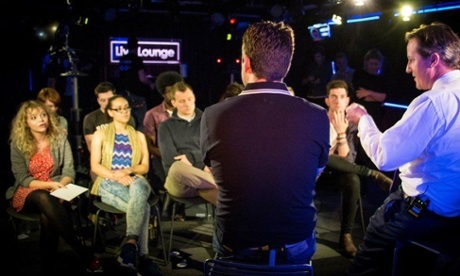
As the Guardian’s Jonathan Freedland recently wrote, many of the usually reliable features of a British general election campaign have failed to materialise. No random act of violence involving a politician, no John Prescott punch. No open mic gaffe, no candidate falling over. But maybe, just maybe, in a small studio at BBC Television centre earlier today, something close to those oft-replayed moments unfolded before our dry eyes. An unsuspecting prime minister was torn apart by crowd of young voters. It’ll be a doddle, Cameron might have thought. But the tenacity of the youthful audience bowled him over. Gay rights abuses, exhausted doctors, the neglected homeless and scraping by on the minimum wage all formed the arsenal of searching questions thrown at the blustered Tory leader. As many pointed out on Twitter, this was the sort of interrogation that has been lacking from of the country’s most well-established journalists. Who said youth was wasted on the young?
The big picture
Shortly after Cameron’s grilling was over, it was the turn of Ukip leader Nigel Farage, this time at the hands of the BBC’s Evan Davis. But Davis didn’t need to push Farage particularly hard to provoke a rather tetchy reaction. He was irked by questions about his private school education, didn’t accept Davis’s analysis of his party’s economic proposals and accused the presenter of being a member of the “liberal metropolitan elite” when he asked about controversial comments made by Ukip members. But this didn’t prevent Farage from providing typically blunt and revealing comments, covering immigration and Sharia law to questions over his health.
What happened today
- David Cameron was unable to specify what the living wage is when he was questioned by young people as part of a Radio 1 interview. The prime minister was asked by an audience member if he could live off the minimum wage – £6.50 an hour – as part of a discussion about low pay, but stumbled when asked to specify the living wage, saying: “It’s different in different parts of the country ... I don’t have the figures in my head.”
- Nigel Farage has said he would prefer immigrants from India and Australia to eastern Europeans, despite previously claiming his party would not want to discriminate against new arrivals by nationality. The Ukip leader indicated he would prefer immigration from countries he said had the most similar cultures to the UK as he was grilled about his approach to immigration during the latest BBC Leader interview broadcast on Wednesday evening.
-
Labour could replace GCSEs within a decade with a single baccalaureate that would end the historic divide between academic and technical education, the shadow education secretary, Tristram Hunt, has told the Guardian. It would end the long tail of underachievement in English schools, their single biggest issue, Hunt said.
- David Cameron has intensified his warnings of an SNP-Labour alliance after the election, tweeting footage of the former Scottish National party leader Alex Salmond joking that he will be writing the next Labour budget. Salmond responded by telling the prime minister to get a sense of humour, since he had simply been making a light-hearted point that Scottish Labour leader Jim Murphy would not be playing a role in writing the document.
- An online campaign expressing fandom for the Labour leader, Ed Miliband, has attracted widespread attention, but its 17-year-old founder does not want her Tory-voting parents to know. The Labour leader has become an unlikely subject of teenage adoration on Twitter under the hashtag #milifandom, which became a trending topic on the network on Tuesday.
- The Liberal Democrats would end public sector pay cuts if they were returned to government, guaranteeing that salaries rise by at least inflation, Nick Clegg has announced. Public sector workers deserve to see the “light at the end of the tunnel” after five years of pay restraints, the deputy prime minister said, adding that they should feel the benefits of the economic recovery.
- Nick Clegg has mocked Grant Shapps after Wikipedia blocked a user account over suspicions that it is being used by the Conservative party chairman “or someone acting on his behalf” to edit his own page and those of rivals. The deputy prime minister said he believed Shapps’s denials but then suggested the contested account going by the name of “Contribsx” could have been run by Michael Green – the alter ego used by Shapps to write a series of get-rich-quick guides.
- Miliband has said that Labour would invest £150m in new cancer diagnostic equipment for GPs surgeries. (See 9am.)
- Cameron accused Labour of presiding over a “poverty state”. He made the claim in a speech setting out details of the Conservative proposals to extend free childcare. (See 11.35am.)
- Cameron was out campaigning with Boris Johnson. (See1.07pm.)
Quote of the day
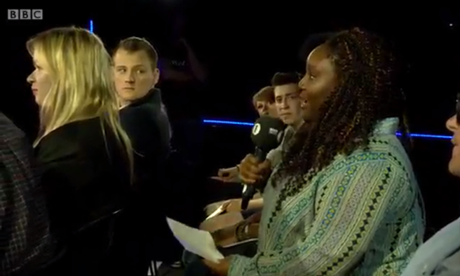
“Could you live off a £6.50 an hour?”
I’ve only been able to identify her as “April from London” - but she put in a tenacious performance as she grilled the prime minister on BBC Newsbeat over the living wage.
Laugh of the day
The Sun has launched a “How Nigel Farage are you?” quiz. I’m not going to reveal my percentage but I’m pleased to say it was low.
Big fan of tweed? Can’t stand wind farms? Find out how @Nigel_Farage you are here: http://t.co/VdaaRQWEtL #SunNation pic.twitter.com/GdTv85Rl5d
— #SunNation (@SunNation) April 22, 2015
Tomorrow’s agenda
It’s looking like a quiet day on the campaign trail tomorrow but look out for economic arguments from the Lib Dems in the morning.
David Cameron is leaving the election behind for a day as he travels to Brussels for crisis talks over the migrant disaster in the Med.
That’s it for me for today. It has been a pleasure. Join the Guardian’s election team tomorrow morning, as we bring you the latest news, reaction, analysis, pictures, video, and jokes from the campaign trail.
A cameraman went flying as he was handled by a Labour party press officer when Ed Miliband arrived in Ipswich for a campaign visit.
Richard Perry ended up sprawled on the floor in the scrum during the Labour leader’s campaign stop.
PA captured the moment on video:
Health and immigration have dominated the opening hour of the ITV Wales Election Debate.
The first question would have been music to the ears of Labour – 71-year-old Peter said he had just had a heart operation. The treatment had been “excellent” and why was the health service in Wales – run by the Labour-controlled assembly government – being used as a “political football”.
Owen Smith, the shadow Welsh secretary, said one of the most “shameful episodes” of recent political history was David Cameron claiming the historic boundary of Offa’s Dyke was a line between line and death.
Welsh secretary Stephen Crabb rehearsed familiar claims about the number of people on the waiting list. Interesting line from the Green’s flamboyant leader in Wales, Pippa Bartolotti: “Everybody’s right..... in their way”. Not a common political sentiment.
On immigration, Ukip’s leader in Wales, Nathan Gill said his party was pro immigration, at least the right sort – and said his wife was an immigrant (she is American).
Plaid Cymru leader Leanne Wood, whose performance in UK debates have won rave reviews, was again being feted on Twitter.
In his opening speech, Owen Smith took a swipe at Plaid’s “pipe dream” of an independent Wales, perhaps a sign that Labour still feels the nationalists could be a thorn in its side.
David Cameron’s unnerving at the hands of young voters on BBC Newsbeat has already triggered allegations of a “left wing” bias at the BBC in the right-wing press.
The Telegraph claims the broadcaster has been “accused” of a left-wing ambush against the prime minister - although this appears only to be backed up by an unnamed “Conservative source” quoted in the article and two tweets.
My colleague Rebecca Ratcliffe has filed a report on David Cameron’s question and answer session on BBC Newsbeat, in which he was torn apart by an audience of young voters. She writes:
David Cameron was unable to specify what the living wage is when he was questioned by young people as part of a Radio 1 interview.
The prime minister was asked by an audience member if he could live off the minimum wage – £6.50 an hour – as part of a discussion about low pay, but stumbled when asked to specify the living wage, saying: “It’s different in different parts of the country ... I don’t have the figures in my head.”
The awkward exchange was part of a Radio 1 Live Lounge interview in which Cameron was frequently interrupted by audience members, who challenged him on issues including homelessness and the voting age.
Nigel Farage's interview with Evan Davis - verdict

Farage lost his cool with the “liberal metropolitan elite” tactics of presenter Evan Davis during this tetchy appearance on the BBC’s Leader Interviews. He was irked by questions about his private school education, he didn’t accept Davis’s analysis of his economic proposals, he didn’t want to account for his party members controversial comments and he really didn’t like Davis using the word “hate” when describing Farage’s position on multiculturalism. As the leaders’ debates have shown, Farage can remain calm and collected when under pressure, enough to win public support - his outburst over the BBC’s audience bias excluded. So it was surprising to see him so aggravated in an interview he must have known was coming for weeks.
Here’s three things we learned in the interview:
1) Farage would rather Indian and Australian migrants move to the UK than eastern European countries. “I have to confess I do have a slight preference,” the Ukip leader said. Indians and Australians are more likely to speak English, he said. People that come from countries that “haven’t fully recovered from being behind the Iron Curtain” would not connect with the country, he added.
2) Farage was not fighting fit at the start of the election campaign but has bounced back. In February, Farage publicly denied rumours he was suffering serious ill health, insisting he was as “fit as a flea”. But he conceded to Davis that at the start of the campaign he was not “feeling quite as sharp and as fit as I should have been”. However, this has changed and the last two or three days he’s back to feeling like “Tigger”.
3) The Ukip leader still believes there are parts of the UK where police have withdrawn and Sharia law has come in. A clip of Farage on Fox News was played to the Ukip leader, in which he makes this claim. Davis says this can’t be right. “Well, you could argue there are parts of the country where it’s happened,” he replies.
4) Fifty per cent of the boys at Farage’s private school came from working-class backgrounds... but he wasn’t one of them.
Updated
Davis finishes by asking Farage how he’s feeling. The Ukip leader is asked if he’s operating at 100% at the moment given his prominent role in the party.
But Farage insists he has bounced back.
I think to be honest with you in the earlier part of the campaign I wasn’t and I wasn’t feeling quite as sharp and as fit as I should have been and I think that’s because of, frankly, in my enthusiasm for Ukip to succeed in this election I got my diary planning wrong and I was doing way, way too much. I’ve readjusted that and I have to say the last two or three days I’m feeling pretty bouncy, back to being a bit more like Tigger, I’m enjoying it and looking forward to the next fortnight.
That’s the end of the interview. I’ll have a short summary soon.
Updated
The Ukip leader repeats his assertion that he will stand down as leader if he misses his South Thanet target seat.
Q: You have said you will resign as leader of Ukip if you don’t win Thanet South. Do you regret saying that because the polls by no means make it that right ...
A: I don’t regret it at all, no. The truth is –
Q: You are maybe in the last couple of weeks now of your leadership of the party.
A: Well you know, David Cameron could be in the last two weeks of his leadership. Miliband could be in the last two weeks. Clegg could be. I mean look, we can all be gone.
Updated
Farage and Ukip have pledged smaller class sizes. Davis argues this is not costed in the manifesto.
If you have controlled immigration you will have smaller class sizes particularly at primary.
Farage is defending the economic policies in his manifesto, which promise £18 billion of tax cuts to be funded by, among other proposals, cuts to international aid and leaving the EU.
Q: Is that the basis of your economics, that you’re going to cut taxes and hope more money comes in?
A: By cutting taxes by £18 billion I think there’s a very strong argument that says that will lead to dynamic growth within the economy. And we certainly saw examples of this. You know going back in time we have seen examples of this.
Updated
Farage says the last Ukip manifesto was “nonsense”.
Farage says he was given a 12-page document to sign off, which then appeared as a 486-page document online.
The 12 pages was, all right, but the 486 wasn’t and it was incoherent and it was actually - it was actually the kind of mistake that happens with a small political party with almost no budget at all.
Updated
Athlete Mo Farah has now been drawn into the debate.
Davis says a local government Ukip questioned on Facebook how Mo Farah, African from Somalia can win medals for Britain.
Now, Farage really doesn’t like this.
Let me now attack the liberal metropolitan elite in the shape of you talking to me, all right? When you interviewed David Cameron, when you interviewed Miliband and Clegg did you go through a list of their – not just council candidates?
Updated
Farage takes issue with Davis’s claim that he “hates” multiculturalism.
You’ve just used a very strong word and I’m picking up on it, Farage says. I don’t hate anything.
Q: You don’t have multiculturalism?
A: Don’t HATE multiculturalism.
Updated
Davis quotes the Ukip manifesto back to Farage, which says ”the liberal metropolitan elite often tells us patriotism is wrong”.
Q: Who is this liberal metropolitan elite who says patriotism is wrong?
A: There is too much snobbery and actually that’s what it’s about. It is London-based snobbery about the way ordinary folk feel and you know out there in the country a lot of people are unashamedly patriotic and that’s considered to be awful in London.
Updated
Farage is asked if he and his party are happier with some migrants than other migrants and says he “does have a slight preference - Indians and Australians over people from former communist countries”.
I have to confess I do have a slight preference. I do think, naturally that people from India and Australia are in some ways more likely to speak English, understand common law and have a connection with this country that some people that come perhaps from countries that haven’t fully recovered from being behind the iron curtain.
Updated
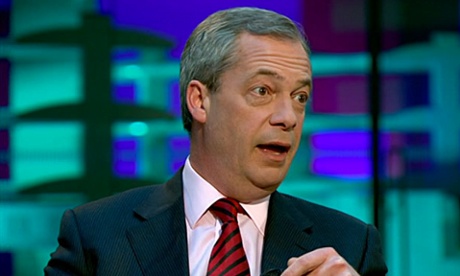
Davis challenges Farage over earlier comments made about Islam and a “fifth column”.
Farage says:
I’ve talked about – I’ve talked about a mercifully small percentage of the Muslim population. So if you’re going to quote me, let’s get it right, okay. A mercifully small percentage of the Muslim religion.
Updated
Farage comes under pressure from Davis for ramping up rhetoric on crime, Romanian gangs, foreigners with HIV among other inflammatory issues.
Q: Does it worry you that if you sound off on foreign criminals and foreigners with HIV, you talk about our borders open to hundreds of millions of people …
A: Which they are.
Q: All of these things may be true, there are people with HIV, there are foreign criminals, all of this may be true, but if you make such a big – if you ramp up the rhetoric on these issues many British people will say, ‘Look, this party is just not where I want it to be’. With modern British values of tolerance, worldliness and being a good …
A: To wake people up – to wake people up to the truth of what’s going on you sometimes have to say things in a way to get noticed, of that there’s no question.
Updated
A clip of Farage on Fox News is played to the Ukip leader, in which he says:
Wherever you look, wherever you look you see this blind eye being turned and you see the growth of ghettos where the police and all the normal agents of the law have withdrawn, and is where Sharia law has come in.
Davis asks: are there areas … where the police and normal agents of the law have withdrawn and where Sharia has come in?
Farage replies:
Well, you could argue there are parts of the country where it’s happened. In France it’s a much bigger problem than it is here.
Updated
Davis says in polls that 85% won’t vote Ukip despite a high level of public support for some of the things that Ukip stands for like control of immigration and its stance on the EU:
Q: Is this because there are a lot of people who think Ukip just has a faint tinge of meanness about it, or is a divisive party?
A: I mean, there has been – and I think this is because we’re taking on the establishment, and I think this happens not just in politics, it happens in science, it happens in business – if you take on the consensus they make life very hard for you. There has been a very consistent attempt to try and paint Ukip out to be something that it isn’t.
Updated
Davis turns to policies.
Farage denies he wants to cut the top rates of tax.
What we’re now arguing is that there is a squeezed middle. There are people out there who are experienced nurses or police officers who are paying 40p tax, a level that was designed to be for those earning a very great deal of money.
And frankly, you know, if you’re living in an expensive part of the country, 40p is too much tax for those people. So we’re looking at lifting the bands significantly.
Davis says that, by about 1990, Farage had been to a public school, was working in the City and had been a longstanding member of the Conservative party.
Farage says:
Ah, but what the others are saying is ‘I’m alright Jack, let’s pull up the ladder and not give people who didn’t have the same opportunities as us the chance to get them’.
William Dartmouth, Ukip foreign affairs spokesman, is he a kind of anti-establishment character, Davis says. He’s the 10th Earl of Dartmouth and went to Eton, Davis says.
Farage replies:
Yes, the deputy leader of Ukip is called Paul Nuttall, he comes from Bootle. You are missing the point about Ukip completely. Yes, you can quote the posh people in Ukip, and we’ve got them, of course we have. But you look at the number of genuinely working class people in Ukip, in senior positions in Ukip, and it’s way ahead of the other parties.
Updated
Nigel Farage's interview with Evan Davis
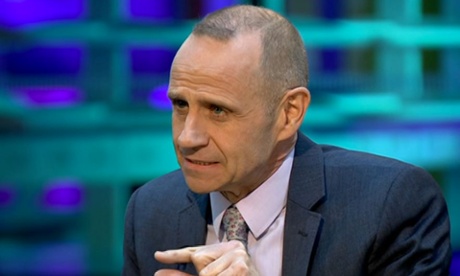
Evan Davis is interviewing Nigel Farage now.
Davis starts by asking about his time at school as he seeks to address Farage’s criticism of other parties for being “establishment”.
I was very lucky. I went to school at Dulwich College in south London, which has been there for nearly 400 years … 50% of the boys in my year came from working class backgrounds.
Updated
Here’s some reaction from the commentariat on Twitter to Cameron’s Newsbeat interview.
The Telegraph’s deputy political editor, Steven Swinford
The most insane interview that David Cameron will face during this election campaign #livelounge https://t.co/Y1mYGx0Glt
— Steven Swinford (@Steven_Swinford) April 22, 2015
The Telegraph’s chief political correspondent, Christopher Hope
BBC accused of left-wing ambush on David Cameron over hostile Radio 1 interview. By @emilygosden: http://t.co/nV73uU9fGt
— Christopher Hope (@christopherhope) April 22, 2015
Journalist Pete Paphides
Blimey. Possibly the most thorough grilling David Cameron has received during the entire election campaign. And it’s on Radio 1 now.
— Pete Paphides (@petepaphides) April 22, 2015
Journalist Ellen Coyne
The young woman on Newsbeat is doing a great job pressing Cameron on homelessness. Strong but really measured.
— Ellen Coyne (@ellenmcoyne) April 22, 2015
Updated

Shadow business secretary Chuka Umunna has reacted to the prime minister’s struggle to specify the living wage.
David Cameron has shown again that he’s completely out of touch. It’s no wonder the Tories have nothing to offer working people.
And unlike the Tories who have done nothing to promote it, Labour will help employers pay a living wage with new incentives through Make Work Pay contracts.
The prime minister is asked if he could live off £6.50 an hour in a discussion about the minimum and living wage measures. There is then an awkward discussion over whether he knows what the living wage rate is.
Q: Do you know what the living wage is?
A: It’s different in different parts of the country.
Q: What about outside London?
A: I don’t have the figures in my head
That’s it over.
Updated
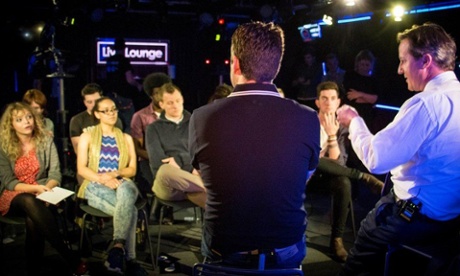
David Cameron is asked on BBC Newsbeat if he would welcome Northern Ireland’s Democratic Unionist party into a new government given their record on gay rights.
I have a strong track record of standing up for the rights of gay and lesbian people in our country. Nothing I would do in politics would go against that very clear set of principles and values I have.
Cameron is asked if he is a feminist and if it is morally right to charge tax on tampons.
I wish we could get rid of this. There’s a problem with getting rid of VAT on certain individual issues because of the way this tax is regulated in Europe. It’s nothing to do with HMRC’s classification of tampons as a luxury good. If it was I would change it like that.
Updated
The prime minister has been confronted with a hard-hitting question about the tragic events in the Mediterranean.
Q: Government policy is to let migrants drown.
A: I don’t accept that.
Q: How can you defend such a policy?
A: People are being trafficked by evil traffickers. Far too many have drowned. Numbers were going up rather than down. So policy was changed to have a coastguard approach to stop people leaving. I’m going to Brussels to make sure there’s more search and rescue.
Updated
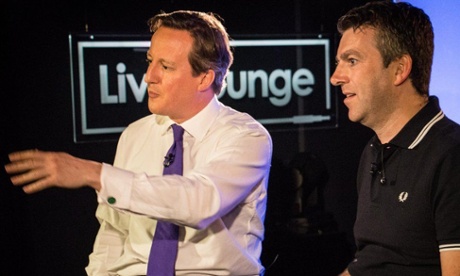
Cameron was asked on BBC Newsbeat about overworked GPs by an aspiring doctor.
Q: A third of GPs want to retire due to stress. Is this sustainable?
A: Patients want to be able to access NHS seven days a week. Future for general practice is opening seven days a week.
Q: Third of GPs want to retire. That’s quite scary. Extra GPs pledged isn’t going to cover gap.
A: GPs excited about being open for seven days. They can do more to keep patients away from hospitals.
Updated
Cameron faces tough questions from young voters
David Cameron has been given a hefty grilling by young voters on BBC Newsbeat.
Homelessness, overworked GPs, the migrant crisis in the Med, gay rights in Northern Ireland and tax on tampons all came up.
I’ll file some highlights.
Q: Thousands of young people live on streets, turned away from local authorities. How is this ethical?
A: We have to house the homeless. Local authorities do have a duty.
Q: It’s not happening.
A: It is happening in most cases.
More from our data editor Alberto Nardelli.
The Labour leader, Ed Miliband, was the most searched for politician on Google today.
And the top three searches on Google relating to the Labour leader were:
1. Ed Miliband careless whisper
2. Cool Ed Miliband
3. Milifandom
The last search increased eight-fold in the last 12 hours.
Here’s the day’s breakdown:
David Cameron - 23.79%
Ed Miliband - 36.57%
Nick Clegg - 5.83%
Nigel Farage - 20.63%
Natalie Bennett - 2.56%
Nicola Sturgeon - 10.63%
Updated
ComRes have just published a poll of 10 Conservative-held seats that are Ukip targets. My colleague Alberto Nardelli has taken a look.
The figures aren’t good for Farage’s party. Although the party is considerably up (+15.4 points) on its 2010 vote share, it still lags behind both the Tories and Labour.
ComRes/ITV (UKIP battleground, change vs 2010) CON 39 (-7) LAB 28 (+2) LIB 5 (-10) UKIP 21 (+15) GRN 4 (+4) Writeup http://t.co/nN5pOiGIei
— NumbrCrunchrPolitics (@NCPoliticsUK) April 22, 2015
In part this is explained by the collapse in Lib Dem support (-10.2 points), which has gone mostly to Labour and the Tories but overall the numbers are further evidence that the party’s support is edging downwards.
However, looking at the constituencies surveyed (South Thanet, Boston and Skegness, Thurrock, Forest of Dean, Great Yarmouth, North Thanet, East Worthing and Shoreham, Sittingbourne and Sheppey, South Basildon and East Thurrock, and Castle Point), it is difficult to properly assess Ukip’s chances in these seats (or indeed how the party is polling in each) - as the range goes from top-target South Thanet, where Farage is standing, to Sittingbourne and Sheppey, and East Worthing & Shoreham where the Tories won 50% of the vote five years ago, and aren’t realistically “Ukip targets”.
The poll isn’t great news for the Conservatives either. It provides a hint of how Ukip eats into the Tory vote share. Cameron’s party is down 7.3 points across the 10 seats compared with 2010.

Farage reiterates his pledge to step down as Ukip leader if he fails to win the seat in South Thanet.
Q: You have said you will resign as leader of Ukip if you don’t win Thanet South. Do you regret saying that because the polls by no means make it that right ...
I don’t regret it at all, no.
Updated

In a particularly heated exchange in tonight’s leader interviews appearance, Farage accuses Evan Davis of being a member of the “metropolitan elite”.
Davis recalls a Ukip candidate who tweeted suggesting that Mo Farah was an African from Somalia and asks Farage if it is patriotic to support the athlete when he won his gold medals in the London 2012 Olympics.
The discussion escalates and Farage hits out at Davis:
It’s very interesting that you do what everybody in the liberal metropolitan elite does. You pick up a comment from somebody in Ukip made on Facebook, probably late at night. What you never do is challenge the other leaders about why their elected councillors and officials.
Updated
I prefer Indians and Australians to eastern Europeans - Farage

Nigel Farage has said he would prefer migrants from India and Australia to come to Britain over eastern Europeans.
In a combative interview with Evan Davis to be broadcast in full at 7.30pm on BBC One, the Ukip leader said he would prefer Indians and Australians to move to the UK because they are more likely to speak English.
I have to confess I do have a slight preference. I do think, naturally that people from India and Australia are in some ways more likely to speak English, understand common law and have a connection with this country than some people that come perhaps from countries that haven’t fully recovered from being behind the iron curtain.
Farage admits he struggled at the start of the election campaign but now feels “more like Tigger”. The Ukip leader earlier this year dismissed claims he was ill.
I think to be honest with you in the earlier part of the campaign I wasn’t … feeling quite as sharp and as fit as I should have been and I think that’s because of, frankly, in my enthusiasm for Ukip to succeed in this election I got my diary planning wrong and I was doing way, way too much. I’ve readjusted that and I have to say the last two or three days I’m feeling pretty bouncy, back to being a bit more like Tigger, I’m enjoying it and looking forward to the next fortnight.
Updated
Salmond's Labour budget claim "fantasy and nonsense" - Miliband

Ed Miliband has dismissed claims - disputably made in jest - by Alex Salmond that he is writing the Labour budget as “fantasy and nonsense”.
Speaking to the BBC’s John Pienaar on Five Live, the Labour leader was played a clip of the former SNP leader joking at an event earlier this month. Miliband said:
It’s fantasy and nonsense. We’re going to be writing the Labour budget.
The Labour leader also appeared to rule out an imminent return to British politics by his brother, David Miliband. He said David is happy doing the job he is doing in America but has been cheering him on from the other side of the Atlantic.
He’s been sending me encouraging words. He thinks it’s going well.
Updated
Hello, Jamie Grierson here to guide you through the political swamp that is the election campaign. Key event this evening is Ukip leader Nigel Farage’s interview with Evan Davis on BBC One, which according to Guido Fawkes is quite lively (see 16.25).
David Cameron's Spectator interview - Key points
James Forsyth and Fraser Nelson have interviewed David Cameron for the Spectator. The interview does not contain “a story”, but that doesn’t matter because it is interesting, which is even better. It provides some reasonably illuminating insights into how Cameron sees himself.
Here are the key points.
-
Cameron accepts that some people see him as too laid back.
Why do so many people, including members of his own government, think that Cameron must do more to show he really wants to win? ‘I don’t know,’ he replies. ‘There is something about me — I always manage to portray a calm smoothness or something.’
This clearly bothers Cameron. He makes a point of telling Forsyth and Nelson how busy he is - his record is 26 constituency visits in one week - and he compares his campaign workload with that of the other main party leaders. He is working harder than they are, he thinks.
-
Cameron explains his attachment to “boring” Conservatism - the belief that being practical is more important than being visionary.
‘Conservatives are practical, sensible, clear-headed people. We want to know not just what the passion is, we want to know what the plan is. This is who we are.’ Then he adds, ‘This is who I am.’
‘The trouble is we all sound like the people who lift up the car bonnet and fix the engine underneath. We have got to tell people where the car is going, and how great it is going to be when we get there. But as Conservatives, we always go back to the car. To me, that is part of what being a Conservative is — we are not utopians and dreamers, we are deeply practical people. But don’t underestimate the passion and the love for our country in what we’re doing.’
He even manages to convert this into a formula for “boring” Conservatism.
Now I accept plan versus dream makes you sometimes the boring one but I think the vast majority of the British people know that plan plus carrying out a plan equals dream. Dream plus rhetoric equals chaos.
Here it is again. It’s very Stanley Baldwin, or John Major.
Plan + carrying out plan = dream
Dream + rhetoric = chaos
I’m not sure Martin Luther King would agree, but it would make a great essay question.
-
Cameron says he does not like the selfie phenomenon, because it makes it hard for him to find out what people think when he campaigns.
‘It is an extraordinary phenomenon,’ he says, ‘and it sometimes makes part of the process of politics quite difficult. Everyone wants a selfie rather than to have a conversation, and sometimes that’s a bit frustrating, particularly with your party activists. I want to know what they are finding on the doorsteps, but actually you are too busy having your picture taken.’
-
He says the government has “undersold” its achievements in some ways.
He accepts that the revolutionary character of his government is not widely appreciated. ‘I think it is very undersold in many ways,’ he says. He doesn’t say by whom. He later refers to the government’s ‘quiet revolution: pro-work, pro-saving, pro-enterprise’.
-
He jokes about smoking and Europhilia both being unsavoury vices. This came in response to a question about Jeremy Clarkson.
We ask if there might be a place for his friend Jeremy Clarkson, who is now at a loose end. The answer is no: Clarkson is unsound on foreign policy. ‘Clarkson has some very strange views about Europe, he’d like smoking to be compulsory, smoking and Europhilia to be compulsory. I used to take part in one but I’ve never been involved in the other as it were. I think I’ve probably said enough about him over the last few weeks.’
That’s all from me for today. Jamie Grierson, who covered the economics debate, is now taking the controls for the rest of the night. He will also be covering Nigel Farage’s interview with Evan Davies.

Updated
In an interview with Channel 4 News being broadcast this evening, Nigel Farage, the Ukip leader, says at one stage earlier in the campaign he made the mistake of trying to do too much.
I started the campaign and think I make some mistakes. My desperation for Ukip to do well meant that I really packed the diary and the day in a way that frankly wasn’t very bright. I have now trimmed it back a bit. I’m being a bit more selective.
When Jon Snow says he looked “a bit wonky” at one stage, he replies:
I was. No, no. Hands up I was. I had completely overdone it. I wasn’t getting it right. I feel a bit of the old vim and vigour back and I’m looking forward to the next fortnight.
On the blog we’ve been publishing comments about the campaign from swing voters taking part in our Battleground Britain project.
You may find it easier to read some of the full focus groups reports. They are all available here, on the Britain Thinks website.
They do help to explain, for example, why the Conservatives are pushing their anti-SNP message so aggressively. Here is an excerpt from the campaign diary for Monday (pdf).
Support for Sturgeon was as strong as ever in Scotland, with some panelists suggesting that Labour and the Conservatives had been unduly negative about the SNP ...
On the other side of the border, however, opinion amongst our English panelists was more mixed. There was a strong sense of distrust about the SNP, with several commenting on how Scotland’s interests would be better represented than England’s if the party were to play a role in government:
“I feel SNP could be a risky vote and whilst they have some excellent policies, will they implement them in the best interests of everyone or just Scotland?” (Uwais, Dewsbury)
“Nicola Sturgeon’s been at it today telling anyone who would listen that she really has the interests of all of Britain at heart!! Yeah right!!” (Phil, Ealing Central and Acton)
“Saw that the SNP have released their manifesto. All I can see is Scotland will control what happens in England...” (Bryan, Dewsbury)
Evans Davis has been interviewing Nigel Farage this afternoon. It will be on BBC1 at 7.30pm.
According to Guido Fawkes, it got a bit lively.
Hear Farage goes tonto and calls @EvanHD a member of the metropoltan liberal elite in the BBC interview later.
— Guido Fawkes (@GuidoFawkes) April 22, 2015
Loughborough University’s Communication Research Centre is publishing regular reports on media coverage of the campaign. The latest one went up at the end of last week. Here is a summary of its findings.
A ‘quotation gap’ has opened up in TV coverage, with the Conservative party receiving 6.6% more speaking time than Labour.
However, there is no ‘appearance gap’ between the two main parties in TV coverage. Conservative and Labour representatives featured in similar amounts.
In national press coverage there are both ‘quotation gaps’ and ‘appearance gaps’ that favour the Conservative party.
The challenger parties have retained their presence, to some degree, with some making ground (Greens) and others losing it (Plaid Cymru and SNP).
Daily Politics economy debate - verdict
It was a tough debate for the candidates. Andrew Neil and Robert Peston would not stand for any obfuscation as each politician was put to the test over their party’s economic proposals. SNP’s Stewart Hosie probably stood out as having the strongest resolve, clear and unflinching with his party’s message to end austerity. But like the other members of the panel even he became flustered on occasion - particular over the value of oil to the Scottish economy and the reality of achieving fiscal autonomy.
Here’s a rundown of when each candidate collapsed under the pressure of Neil and Peston’s questioning.
Chris Leslie - Labour’s shadow chief secretary to the treasury kept ignoring Neil’s question about whether it was wise to borrow when the debt stands at £1.5 trillion. Capital is important, Leslie said. But is it sensible to borrow? “It is not limit of ambitions to have current budget solely into balance, I hope we will move to surplus.”
David Gauke - The Tory financial secretary pushed Andrew Neil to declere “it’s like groundhog day” when he ignored calls to reveal how his party would fund spending pledges for next parliament. “Look at what we’ve done over the last parliament,” Gauke kept saying. We know what happened in last five years, said Neil, where will you find it in next five years. “We’ve got to find money for the NHS, Conservatives have been clear.”
Stewart Hosie - It was put to the SNP’s deputy leader that his party’s Yes campaign was based on oil being $113 a barrel and it’s now half that. Just as well you lost, Andrew Neil says, or you’d be in fiscal crisis. Hosie said nobody expected the price to soften when it did. But Neil says you can’t base the finances of a nation on something you can’t control. Hosie says no one predicated Scottish constitutional change on oil, perhaps on control of the resource.
Patrick O’Flynn - The former political editor of the Daily Express turned Ukip candidate for Cambridge was asked if his party broadly back Tory cuts and broadly back an in-out EU referendum, why not just vote Conservative? O’Flynn rolled out an unconvincing claim that it wasn’t Ukip backing Tories, it was the Tories copying Ukip. I don’t think David Cameron is the real thing, he said. He’s trying to impersonate Ukip positions now after abandoning almost every position that brought him to prominence.
Dick Newby - The Liberal Democrat peer came under pressure for increasing VAT, tuition fees and rolling out austerity after pledging not to. Newby said We went into Government to turn the economy round and put the economy on sound footing and that’s what happened, Newby said, without addressing any of those specific promises head on.
Clegg rejects claim Lib Dems favoured regional pay in public sector
The Conservatives have accused the Lib Dems of being in favour of regional pay variations in the public sector. As the Western Morning News reports, George Eustice, the farming minister, has cited as proof of this a leaked letter that Danny Alexander, the chief secretary to the Treasury, wrote to the Welsh government in 2012 saying he was “keen to see local, market-facing pay introduced across the UK”.
Nick Clegg has rejected the claim. Speaking in Bristol, he said:
This is desperate stuff from the Conservatives. What Danny Alexander was doing is what happens in government - you look at the evidence for a change and he actually announced, within weeks of that letter, that the evidence was not there and we stopped the Conservatives from going ahead with the plan.
It’s ridiculous the Conservatives are trying to pretend this letter is anything other than what Danny was doing, which was looking at the evidence. We looked at it, thought it was a really bad idea and stopped it.
Many Conservatives now still hanker after the imposition of regional pay which will mean that nurses and teachers and doctors in Wales and the South West will be paid hundreds of pounds less than their counterparts in other parts of the country. We think it’s unfair, we looked at it before, we stopped it then and we would stop it again.
Miliband's latest comment ruling out an 'agreement' with the SNP - and what it means
Ed Miliband went marginally further than he has before on Radio 2’s Jeremy Vine show in terms of ruling out an arrangement with the SNP.
Asked if Labour would do a deal with the SNP in the event of a hung parliament, Miliband replied: “There isn’t going to be a coalition.”
Then, when pressed on whether there would be “an agreement” with the SNP, he replied: “There isn’t going to be that.”
In practice, though, this does not take us very much further forward. A party like the SNP could support a minority Labour government through a coalition, or through a formal “confidence and supply” arrangement. Nicola Sturgeon has said both options would require a deal on Trident, but Miliband says that is non-negotiable, and so those options seem to be off the table.
That leaves the SNP supporting Labour on a vote by vote basis, with the key votes at the start of the parliament being on the Queen’s Speech and/or a confidence motion. The SNP has said it would not keep the Tories in power, which considerably weakens its negotiating position with Labour. But the party has signalled that it would expect to be consulted before a minority Labour government’s Queen’s Speech. Whether that would constitute an “agreement” would be a matter for debate.
On Sky News just now Boris Johnson confirmed that one day, perhaps, he would not mind standing for the Conservative leadership.
In the dim, distant future obviously it would be a wonderful thing to be thought to be in a position to be considered for such an honour, but I think it highly unlikely. As I’ve said many, many times before that it’s more likely that I will be reincarnated as an olive or blinded by a champagne cork or locked in a disused fridge.
In other news, our religion correspondent will have an update soon from the Vatican ...
BBC Daily Politics has posted highlight quotes from its economy debate on Twitter.
From Labour’s Chris Leslie
From the #bbcdp debate on the economy hosted by @afneil and @Peston ... here's @ChrisLeslieMP pic.twitter.com/4eYDRqQYZE
— DailySunday Politics (@daily_politics) April 22, 2015
Conservative David Gauke
From the #bbcdp debate on the economy hosted by @afneil and @Peston ... here's @DavidGauke pic.twitter.com/Iv1VWM0ef3
— DailySunday Politics (@daily_politics) April 22, 2015
Ukip’s Patrick O’Flynn
From the #bbcdp debate on the economy hosted by @afneil and @Peston ... here's @oflynnmep pic.twitter.com/AG8HlLDwld
— DailySunday Politics (@daily_politics) April 22, 2015
Liberal Democrat’s Dick Newby
From the #bbcdp debate on the economy hosted by @afneil and @Peston ... here's @RichardNewby3 pic.twitter.com/dceVQQpjEs
— DailySunday Politics (@daily_politics) April 22, 2015
And SNP’s Stewart Hosie.
From the #bbcdp debate on the economy hosted by @afneil and @Peston ... here's @StewartHosieSNP pic.twitter.com/t7xytMsdUG
— DailySunday Politics (@daily_politics) April 22, 2015
Viewers tuning in on 7 May will see “Darren”, the man responsible for keeping E4 on air, manning the control room in place of its regular programming.
The first time in the UK a channel has closed down to encourage people to vote, a pre-election marketing campaign will tell viewers: “How many times have you missed life-changing events because you wanted to watch your favourite show?
“May 7 is election day and Darren is going to turn E4 off so you might as well go and vote. You won’t forget will you Darren?”
Updated
The Scotsman’s Kenny Farquharson has this take on the Alex Salmond budget joke.
What shocks me about that footage is that Alex Salmond is campaigning for Ian Blackford. https://t.co/tB7v5qlAx3
— Kenny Farquharson (@KennyFarq) April 22, 2015
Blackford, a former SNP treasurer, fell out very badly with Salmond some years ago.
Salmond says it is the Tories who have been picking Scottish pockets
Alex Salmond has issued a riposte to David Cameron’s quip on ITV this morning about him being a pickpocket. (See 11.57am.)
The Tories have been picking Scotland’s pocket for years, and have been well and truly rumbled - which is why David Cameron and the rest of the Westminster gang are sinking like a stone in Scotland.
Of course, it’s typical of David Cameron’s style to make an off-microphone gibe but he didn’t have the bottle to debate in the referendum, or with Nicola Sturgeon in this election campaign - if he had he’d be looking even more hot and bothered.
At a hustings organised by Oil and Gas UK in Aberdeen earlier today, Salmond - who is hoping to win the Aberdeenshire seat of Gordon from the Liberal Democrats, said everyone in the SNP was pleased because the party had set the election campaign alight.
Everybody in the SNP has a broad smile at the moment because our very positive message for the future of Scotland, having real influence for the first time since the 1970s in the Westminster Parliament, is catching this campaign alight.
Lib Dem treasury minister Danny Alexander, who is currently in a tight race with the SNP in his seat of nearby Nairn, Badenoch and Strathspey, joined the gloomy chorus warning that the prospect of a Labour-SNP post-election agreement was a frightening prospect.
People are in many cases frightened of what the SNP will do to the country, they are frightened of the instability that might emerge from the SNP holding the cable to the life support machine on a Labour government, or indeed what you might see if the Tories and Ukip work together.
Andrew Neil puts it to David Gauke that a pledge by David Cameron to create two million jobs has been plucked out if thin air.
Gauke dodges the question. Businesses and employers create jobs. Governments can put in place conditions to create jobs. Tax policies, bring regulations down.
Neil presses him on where the two million number came from.
From businesses. Small businesses. Small to medium sized businesses, Gauke says.
A Ukip candidate has been threatened with beheading, the Press Association reports.
A Ukip candidate has said he fears for his safety after being threatened with beheading in a phone call from someone claiming to be a potential constituent.
Northumbria Police have confirmed they are investigating allegations made by David Robinson-Young, who said he received the call from a man calling himself Mr Khan yesterday.
The caller said he lived in the South Gosforth area of Newcastle upon Tyne East in which Robinson-Young is campaigning ahead of the General Election.
Mr Robinson-Young said he had been left “shaken” by the call, and said: “He said the Muslim community is really annoyed with the British government supporting bombing Muslim countries and that the community here just wants to get on with their family lives.”
Nick Clegg has been visiting an Airbus factory near the Liberal Democrat seat of Bristol West, currently held by communities minister Stephen Williams.
“I think my own constituents would prefer a progressive coalition,” said Williams. “Probably in their hearts they would like to see a Liberal Democrat-Labour coalition.”
The day after the Lib Dem candidate in St Ives, Andrew George, stood by his remarks from last week that there would not be another Lib Dem/Conservative coalition, Williams was asked if his party had more of an appetite for coalition with Labour than the Conservatives.
“I certainly think most Lib Dem voters would regard themselves as progressive and want to see a progressive government,” he said, “but that doesn’t necessarily follow that you would get a progressive government just by Labour.”
Bristol West is a key target seat for the Green party, who are throwing a lot of their comparatively meagre resources at the seat, something Williams admitted to being slightly worried about.
“They will take some votes off us, but up to a point, if I’m going to lose votes, I might as well lose them to the party that is going to come fourth,” said Williams.
“The Labour candidate is probably more irritated by [the Greens] than I am.”

Salmond tells Cameron to get a sense of humour
Alex Salmond has responded to David Cameron. He says Cameron should get a sense of humour.
Instead of a few carefully stage managed appearances, David Cameron should try holding a few public meetings and meeting real people - and develop a sense of humour. The point made in a light hearted way was that Scottish Labour leader Jim Murphy had been slapped. down by his party bosses at Westminster and told that he would have no role in Labour budget. David Cameron is clearly a prime minister with both a people by-pass and a sense of humour by-pass.

Labour’s Chris Leslie is asked on Daily Politics if it is sensible to borrow more while debt is running at £1.5 trillion.
Leslie says there is a distinction between day to day spending and productive public investment. Capital is important, he says. Labour still hopes to move to budget surplus with debt falling as percentage of GDP.
Andrew Neil is joined by economics editor Robert Peston. He says productivity is lamentable. Economists argue public sector investment is vital.
Conservatives’ David Gauke says his party have set out infrastructure plan investing in railways, road building plan. Labour has abandoned two road building programmes.
Andrew Neil despairs at David Gauke for dodging a question on where the Tories will fund spending pledges such as £8bn for the NHS. “It’s like groundhog day,” Neil says.
NHS is a priority for us, Gauke says. We’re committed to £8bn. He keeps repeating that the coalition found £7.3bn in last term but won’t explain how £8bn will be found in next term.
Labour’s Chris Leslie presses him. You have to come clean how you will fund spending. Where are you getting the magic money?
Candidates on Daily Politics are asked about a comment made by former leader Alex Salmond. The former SNP leader is quoted as saying the Scottish labour leader will not be writing the Labour budget because “I’m writing the labour budget.”
SNP’s Stewart Hosie says he was having a bit of fun. Our plan sees the deficit fall every year in this parliament. Debt falls as share of GDP in each year. It’s a deal to be struck which seems fair.
Labour’s Chris Leslie says SNP will have no influence on budget. We will not budge on that, he says.
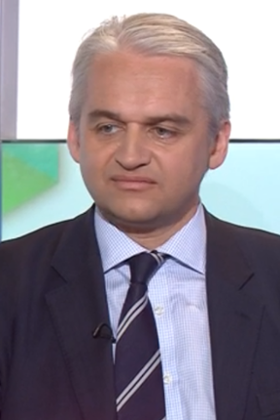
Daily Politics presenter Andrew Neil asks Ukip’s Patrick O’Flynn if it can be presumed Ukip will not tax late-night adult TV channels after Daily Express owner Richard Desmond, who also owns Television X, Red Hot TV, donated £1m to the party.
I don’t have any proposals for that today, former Daily Express political editor O’Flynn says.
Updated
Lunchtime summary
-
David Cameron has launched a fresh attempt to highlight the threat posed by a minority government being reliant on the SNP. Posting a video of Alex Salmond, the former SNP leader, joking about writing Labour’s budget, Cameron said the footage would “shock” voters. (See 1.35pm.) Earlier he told his own joke about Salmond being a pickpocket. (See 1.22pm.) Speaking on Radio 2’s Jeremy Vine show, Ed Miliband said Cameron was trying to “stir up English hatred of the Scots”.
Ed Miliband says David Cameron is trying to "stir up English hatred of the Scots". @theJeremyVine
— PoliticsHome (@politicshome) April 22, 2015
- Miliband has said that Labour would invest £150m in new cancer diagnostic equipment for GPs surgeries. (See 9am.)
- Cameron has accused Labour of presiding over a “poverty state”. He made the claim in a speech setting out details of the Conservative proposals to extend free childcare. (See 11.35am.)
- Cameron has been campaigning with Boris Johnson. (See 1.07pm.)
- Miliband has laughed off the revelation that he has apparently become a sex symbol for some admirers.
Ed Miliband told Justine re #milifandom: "She thought it must be a case of mistaken identity.."
— PoliticsHome (@politicshome) April 22, 2015
Updated
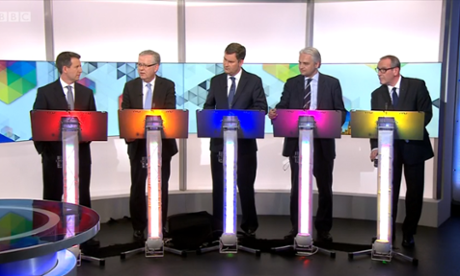
Hi Jamie Grierson here. I’ll be keeping an eye and ear on the Daily Politics election debate, this time its on the economy. Tory David Gauke, Labour’s Chris Leslie, Liberal Democrat Dick Newby, Ukip’s Patrick O’Flynn and Scottish National Party’s Stewart Hosie are all appearing. I won’t post a minute by minute account, rather flag up the most interesting bits.
Updated
SNP candidates most likely to be on Twitter, survey finds
According to the Press Association analysis, SNP candidates are most likely to be on Twitter, and Ukip candidates least likely.
Of the seven main parties, the SNP has managed to get all of its parliamentary candidates on Twitter - while Ukip has only managed to do so with 52% of its prospective MPs.
The Scottish nationalists and Ukip top-and-tailed a Press Association table on Twitter participation. Labour were in second place with 92% of candidates on the micro-blogging site, while you can expect to see tweets from 84% of the Tories’ hopefuls.
Plaid Cymru had 83% of its candidates on Twitter, compared to 77% of the Greens’ and 69% of the Lib Dems’.
If you want to learn more about the Twitter activity of the candidates in your constituency, this site, election.awedience.com, is ideal. You insert a postcode and Twitter use data comes up for every candidate in the constituency with a Twitter account. The data itself is not particularly interesting, but if you open up the candidate analysis, and click on the blue tabs, you can find individual tweets, categorised in various ways, such as by keyword. For one candidate I tried at random, the top keyword was “great”. As in “Great to meet XXX ...”
Cameron says Salmond's budget joke will 'shock' voters
David Cameron has tweeted a video of Alex Salmond joking about writing the next Labour government’s budget.
Unsurprisingly, Cameron doesn’t find it funny.
This footage will shock you: Alex Salmond laughs & boasts he’ll write Labour’s budget. Vote Conservative to stop it. https://t.co/A6DGJtM8OM
— David Cameron (@David_Cameron) April 22, 2015
Salmond was speaking at an event earlier this month.
Updated
The pink bus was sadly absent today as Yvette Cooper came north of the border to help launch the Scottish Labour women’s manifesto with deputy leader Kezia Dugdale MSP, co-founder of the Women 50/50 representation campaign, and shadow Scottish secretary Margaret Curran, who is fighting for her political life in the key SNP /Labour battleground of Glasgow East.
After the requisite photocall with toddlers at a nursery in Ballieston, Cooper warned voters not to “swallow” the SNP’s prospectus.
“We’ve seen the Tory campaign become increasingly desperate. The SNP have been trying to divide us; now the Tories are trying to divide us. For women whether it’s in Leeds or Lanarkshire they are still facing the same pressures and we want the solidarity of women being about to stand together in order to get rid of the Tories.”
Talking about the campaign more generally, she added: “It is important for people not to just take a gamble on having a Labour government and swallowing a lot of the things that the SNP are saying that will put a Labour government at risk.”
Focussing on tax credits, she added her voice to Scottish Labour’s relentless hammering of the SNP’s flagship policy for full fiscal autonomy, which was again undermined by the IFS projections yesterday.
Cooper said: “Scottish Labour has led the way for women’s equality, but right now what does [the election campaign] mean for women? The analysis that we’ve done of the impact of the Tory/Lib-Dem government on women is that women have been hit six times harder than men by all of the changes. A lot of that is because tax credits have been particularly heavily cut. Labour is the only party that can guarantee tax credits.”
Margaret Curran insisted that women voters were still weighing up the impact of their choice. “People are beginning to say ‘what does it actually mean for me?’ This is just me voicing a political aspiration or perspective. It is about what does it mean for me and my family. Particularly when you talk to women, who I think do focus on the practicalities more effectively, you get down to the real issues that are at stake in this election.”

Here’s the YouTube video of David Cameron’s Alex Salmond joke. (See 11.57am.)
David Cameron and Boris Johnson stage joint campaign visit
David Cameron and Boris Johnson are doing a campaign visit together in Surbiton. They have been visiting a nursery.
Here are some of the highlights from Twitter.
Boris and Cameron arrive at a campaign visit. The media are kept behind a rope. Boris and Cameron say nothing pic.twitter.com/QbbMfW4PEi
— Michael Deacon (@MichaelPDeacon) April 22, 2015
PM and Boris help 3yr olds with a jigsaw. PM:"I have a cunning plan". Boris: "He has a long-term cunning plan". pic.twitter.com/p6myNuqU1X
— James Mates (@jamesmatesitv) April 22, 2015
Boris, finally completing child's puzzle: "It's a bit like the campaign." PM: "It comes together in the end" pic.twitter.com/0RiyuTdvIv
— James Chapman (Mail) (@jameschappers) April 22, 2015
Boris Johnson and Cameron enjoyed their finger painting in Tory blue with nursery children. "It's the woad to recovery" puns Boris #GE2015
— Steven Swinford (@Steven_Swinford) April 22, 2015
DC conceded that Boris has bigger hands. We all know what they say about men with big hands. Though perhaps a fact check for another time.
— Niall Paterson (@skynewsniall) April 22, 2015
Five minutes after Cameron and Boris enter nursery a child is brought out screaming. Correlated? Causal?
— Marina Hyde (@MarinaHyde) April 22, 2015
Julian Huppert, the incumbent Lib Dem candidate for Cambridge, is distributing election leaflets that describe him as an “independent”, rather than making explicit his party affiliation. The leaflet does not include the Lib Dem logo and has only one mention of the party when it boasts that “Julian and the Lib Dems” will give an extra £8bn to the NHS.
The leaflet claims that Huppert “has always and will always put Cambridge before party”.
This is by no means the first time that a Liberal Democrat candidates’ election literature has come under scrutiny for appearing to obscure party affiliation.
No mention he's a Lib Dem, no mention of Clegg. This is one of Duncan Hames's campaign leaflets. pic.twitter.com/ntrbVSaqoU
— Frances Perraudin (@fperraudin) April 8, 2015
A leaflet circulated by Duncan Hames, the incumbent in Chippenham, features no mention of the party and uses a completely unrelated colour scheme.
“I think it’s quite right that he should use a leaflet like this to advertise his personal pride in the personal things he’s delivered for this local area,” said Clegg earlier this month when he was asked about the leaflet.
“A lot of people don’t actually vote always for an MP just because of the political label they’ve got hung round their neck … I wouldn’t be here if Duncan did not want to campaign as a Liberal Democrat.”

Nicola Sturgeon, the SNP leader, has been campaigning in Edinburgh this morning.
In London she may be depicted as the most dangerous woman in the world. But, according to the Press Association’s Lynsey Bews, in Scotland at least one activist has compared her to Princess Diana.
Overheard an SNP activist saying @NicolaSturgeon is to the Scottish people what Princess Di was to the English.
— Lynsey Bews (@lynseybews) April 22, 2015
Updated
Tim Collins, the former Tory MP who was a party press officer during the 1992 election campaign, said this morning that David Cameron should learn from John Major’s decision to take to his soap box during that campaign.
An awful lot of money had been invested in advance planning in 1992 of what we called ‘Ask John Major’ events. But in the end, John Major thought he wasn’t going to get through to the actual public, decided he wanted to have a soap box, actually braved howling mobs, got eggs and worse thrown at him, had suits destroyed, blood was drawn and all the rest of it.
But people thought here’s a guy who is actually prepared to fight for my vote and I think that is what’s lacking now.

In his LBC phone-in, while I was listening to David Cameron, Boris Johnson suggested that British special forces should be sent to Libya to stop people traffickers sending migrants across the Mediterranean. Nick Ferrari, the presenter, pushed him into saying this. The Press Association has the details.
Asked again about the use of military personnel, Johnson said: “I think you need to choke off the problem at source - you need to stop these people being put into boats.”
Told the only way to do this was by putting troops into Libya, Johnson said: “Isn’t the tradition you don’t discuss the use of special forces but you need to do something?”
Ferrari asked: “Special forces into Libya?”
Johnson replied: “You need to do something about it.”
Ferrari countered: “You’re saying special forces into Libya.”
Johnson replied: “I’m a long way away from the discussions about this but there are clearly some very highly organised and ruthless people who are sending people to their deaths in the Mediterranean. It seems to me that is something that should be the subject of concerted European response led by Britain.”
Ferrari interjected: “We’ve got it - the SAS and SBS into Libya.”
Johnson said: “I don’t see why not, I don’t see why not.”

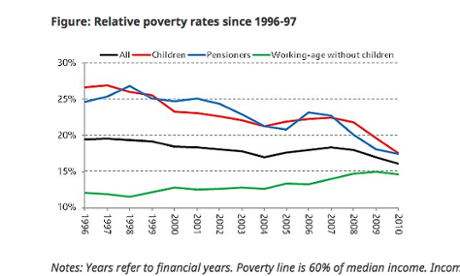
In his speech earlier David Cameron said poverty increased under Labour. (See 11.35am.)
That is true of poverty for working-age adults without children, but not true of the population at large. The Institute for Fiscal Studies set out the details in a briefing note in 2013. Here’s an extract.
If our summary of Labour’s distributional objectives is accurate, then outcomes reflected those objectives quite closely. Turning first to poverty, both absolute and relative measures of income poverty fell markedly among children and pensioners - although the scale of the changes did not always match the considerable ambition, as set out explicitly in the case of the government’s child poverty targets.
By contrast, the incomes of poorer working-age adults without dependent children - the major demographic group not emphasised by Labour as a priority - changed very little over the period. As a result they fell behind the rest of the population and relative poverty levels rose. Since childless working-age people started the period with low levels of poverty compared with other demographic groups, one consequence of these trends was that the risks of poverty across the major demographic groups converged under Labour. This is illustrated in the Figure below.
With falls in income poverty, one might expect to have seen a fall in income inequality. Indeed inequality did fall across much of the distribution. Those on relatively low incomes did a little better than those with incomes just above the average. However, those right at the top saw their incomes increase very substantially with the result that, on most measures, overall inequality nudged up slightly.
Updated
Brian Hoskins, the director of the Grantham institute for climate change at Imperial College London, has said that given the importance of the Paris climate summit this year, the attention given to climate change in the general election campaign was “pathetic” and “extremely disappointing”.
“The contrast between the importance of this year and our election is just stark,” he said. “It seems we go towards the lowest common denominator in such a discussion of this, instead of stepping back and saying what do we want, what is our vision for the country, what is our vision for the world, we’re saying, are we going to get a pack of butter for 20p rather than 30p? It’s a shopping list rather than a vision.”
Here’s David Cameron’s Alex Salmond joke. (See 11.57am.)
Anyone else hear the PMs little joke at Alex Salmond?... #ThisMorning #DavidCameron pic.twitter.com/BfpJxwa97I
— greengoestweet (@greengoestweet) April 22, 2015
Here’s today’s Guardian three-minute election video, with Jonathan Freedland and Gaby Hinsliff discussing whether the Tory campaign is wobbling.
For an alternative view, try this post at Labour Uncut, where Atul Hatwal argues that it is the Labour campaign that is in difficulty. Here’s an extract.
The Tories campaign has been lacking in many ways. The ludicrous uncosted spending commitments, the absence of hope or humanity and the shackled, bloodless performance of David Cameron have all been risible.
But on the challenges that will define this contest – the SNP scare, the ground game gamble and the retail offer – Labour’s campaign bosses have repeatedly made the wrong call.
Natalie Bennett says punitive welfare sanctions are 'morally indefensible'
Natalie Bennett, the Green party leader, has been speaking to Sheffield Students’ Union this morning. She said today’s Trussell Trust figures showing 1m people used food banks in the last year illustrated why the Greens were demanding sweeping changes to the welfare system, including an end to punitive sanctions.
Here’s an extract from her speech.
Unlike the other parties, who are chained to their slogans about hard working families, we are standing up for a very important principle.
That is: that our benefits system should be there for anyone who needs it, and provide enough for people to get by on without fear of hunger.
That we don’t think that punitive sanctions will lift people out of poverty – in fact they are morally indefensible and deeply damaging - and that it is the duty of government to ensure that our economy provides decently paid jobs for all those looking for work.
That principle: that those at the bottom of society shouldn’t be made to pay for the mistakes and fraud of the bankers, runs through everything we are doing as a party.
We believe that poverty is a result of political decisions - and that only a new kind of politics can overturn the race to the bottom on wages and benefits that we’ve seen for too long in this country.
Bennett said the Greens wanted the minimum wage to be increased to the level of the living wage, and for the minimum wage to reach £10 an hour by 2020. She also said the Greens wanted the value of benefits to go up.

Updated
It seems the best bit of the ITV This Morning interview came right at the end. The BBC’s Sean Clare is quoting what Phillip Schofield was saying, introducing the next item, and David Cameron’s response.
"Coming up on @itvthismorning, a man who can steal your watch without you noticing". @David_Cameron: "Who's that, Alec Salmond?"
— Sean Clare (@Sean__Clare) April 22, 2015
Farage defends his decision to describe Ukip spokesman as 'half-black'
Nigel Farage, the Ukip leader, was interviewed on Sky News just now. He was asked if he regretted referring to Ukip’s immigration spokesman Steven Woolfe as “half-black”. Farage replied:
Well, he refers to himself as that, so you will really have to ask him that question ... I don’t regret repeating how a candidate describes himself.

There’s a wee stooshie in Aberdeen about Alex Salmond’s appearance at today’s Oil and Gas UK hustings. Initially it was reported that he has pulled out of the event, with the Lib Dem’s Danny Alexander, but overnight changed his mind. Salmond’s rivals for the Aberdeenshire seat of Gordon have accused him of spending more time on his book tour than on the campaign trail.
#salmond now changed mind and IS appearing at Aberdeen oil and gas hustings after Daily Mail's @AlanRoden revealed that he had pulled out.
— Lindsay McIntosh (@lmkmcintosh) April 22, 2015
And there was an interesting discussion on Radio Scotland’s Good Morning Scotland earlier between political editor Brian Taylor and king of polls, professor John Curtice. Both agreed that all the “huffing and puffing” from various Tory grandees about the SNP would have a minimal impact on Scottish voters, as would current entreaties from the likes of Clegg and Tebbit to vote tactically. “You might knock off a few hear and there,” concluded Curtis, “but fundamentally the vote in Scotland is not going to shift”.
Updated
Cameron's childcare speech

Here are some extracts from David Cameron’s childcare speech this morning.
-
Cameron said the Conservatives, not Labour, were “the party of working people” and accused Labour of presiding over a “poverty state”.
That is the choice at this election.
On one side, the so-called Labour party.
The party that increased welfare spending by a half – but under whom poverty actually increased.
The party which just doesn’t get that doling out more and more welfare to people doesn’t help them – the incentives it creates can actually hurt them.
The party that’s behind one of the biggest injustices of our age – punishing hardworking people on low incomes by letting welfare balloon, unemployment rocket and education seem pointless.
The Labour Party? Really? The name’s an offence under the Trade Descriptions Act.
-
He said the Conservatives’ offer on childcare was better than Labour’s.
We introduced 15 hours of free childcare a week for 3 and 4 year olds and disadvantaged 2 year olds.
In the next parliament we will double that for 3 and 4 year olds.
That’s right – 30 hours of free childcare a week – worth £5000 to working families.
That means over 600,000 extra free childcare places available for families every year ...
So if you’re a working parent with a one year old, you can rest assured that by the time they’re 3, they’ll be able to go to nursery for 30 hours a week – completely free.
And we have legislated for tax-free childcare for anything outside that. If you spend £10,000 on childcare, you will get £2,000 back – for each child ...
Look at Labour’s offer: 25 hours a week; 190 fewer hours a year.
That means a Labour government would cost working families £830 in childcare alone.
And because they’re not increasing the rate they give providers, they may not be able to even deliver that.
UPDATE AT 12.34PM: Cameron’s line about poverty going up under Labour is misleading. See 12.34pm for details.
Updated
Here is a Guardian video of David Cameron responding to the Grant Shapps story.
Q: People think the Conservatives are heartless. Do you guys lack heart?
Cameron says he does not accept that. He has taken the poorest people out of income tax. He has created 2m new jobs. It makes him mad to hear Labour talk about this.
(This ITV interview is rubbish, I’m afraid. I can’t face any more. I will give up on the minute by minute, but keep listening in case Cameron says anything interesting.)
Q: Why do 1m people need food banks?
Cameron says he is trying to address this. The key thing is to improve the economy, so more people get jobs.
Q: How will you stop foreigner exploiting the NHS?
Cameron says the government will put a charge on visas for people outside the EU, so that they are effectively charged in advance for using the NHS. And it will take more steps to recover money from other EU countries.
Q: You have been accused of privatising it through the back door.
That is nonsense, says Cameron. The NHS has been there for him and his family. He is committed to it. He will make sure the NHS gets the £8bn Simon Stevens says it needs.

Following on from Andrew’s post about the Ukip vote being squeezed (see 10.39am), our data editor Alberto Nardelli has written this detailed analysis of how the Tories are clawing back supporters from Ukip.
The Tories’ is a 36.5% strategy. It isn’t aimed at winning over new friends, but at winning back old ones. This tactic relies on targeting Ukip voters without scaring those already convinced to back the party …
Also, contrary to the popular assumption, the bulk of Ukip’s support comes from professional and managerial middle classes, not the working classes, according to the latest data from the British Election Study (BES).
Using BES data from 2005 to 2014, research shows that Ukip voters are overwhelmingly those who voted Conservative in 2010.
BES co-director Professor Geoffrey Evans said:
The idea that many Ukip voters are working class and that they therefore pose a threat to Labour’s support in the election has gained considerable currency in recent years. But we find this is wrong; the working class basis of Ukip has been strongly overstated.
The party’s strongest supporters are often the self-employed and business owners. Even within the working class, Ukippers tend to be low level supervisors, and not the disadvantaged semi and unskilled workers often thought to provide the core of the party’s support.”
- You can read the BES report – ‘Working class votes and Conservative losses: solving the Ukip puzzle’ – in full here
Updated
David Cameron’s interview on ITV’s This Morning
David Cameron is being interviewed on ITV’s This Morning.
Cameron says it is his wife’s birthday this weekend.
Q: On Thursday you are going to the EU summit about migrants coming to the EU. What are you going to do?
We need action to save lives, says Cameron. We have to do more to stabilise the countries these migrants come from.
Q: Why did the EU scrap the Mare Nostrum rescue policy?
Cameron says it was felt this was encouraging migrants. It was replaced by a coastguard rescue system. But that has not worked either.
Q: Labour has accused you of leaving people to die in the Mediterranean.
Cameron says the EU needs to do better. But there are no easy answers.

Updated
Here are some more lines from Nick Clegg’s news conference this morning.
- Clegg said many parents would not benefit from the Conservative pledge to guarantee 30 hours of free childcare to working parents of three and four-year-olds.
The Conservatives aren’t doing anything to help the parents of two-year-old toddlers with the childcare costs for two-year-olds.
They are doing nothing to help the mum and the dad, the parents who go back to work after nine months or a year and have to wait - under the Conservative scheme - for two whole years before they get any help from a future Conservative government on childcare costs.
What is the point of giving help only to families when a child turns three, but nothing in those crucial early years for many, many working families when the childcare pressures are the greatest.
That is why our priority is to move, over time, as money allows to a 20-hour entitlement for all three and four-year-olds, all two-year-olds and also for childcare costs of children between the point at which parents go back to work and the point when that two-year-old entitlement kicks in.
-
He said the prospect of the Tories governing in alliance with Ukip or the DUP was “spine chilling”.
I’ve been in government with George Osborne and David Cameron for five years and I’ve seen at every single turn that when the Conservative backbenchers start cutting up rough they buckle,” he said.
John Major is a very decent man, but he knows from his own time in Downing Street what it’s like to be basically held hostage by the right wing of your own party. It’s a very very real prospect and people simply aren’t focusing enough on it.
Ballot Monkeys, a new election satire, went out for the first time last night. Stuart Heritage was impressed. His Guardian review is here.
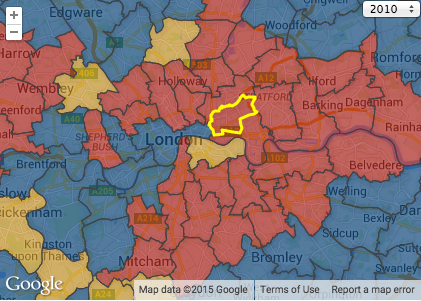
This is an excellent website. Set up by a team from Democratic Audit at the London School of Economics, the Democratic Dashboard allows you to find a wide range of information about your constituency, just by inserting your postcode.
It includes candidate information, previous election results and demographic data. I was particularly interested in the voter power index. I live in a safe Labour seat (Vauxhall) and, according to Democratic Dashboard, that means my vote is worth 0.3 of an average vote, putting Vauxhall voters 437th in the constituency power rank.
Updated
The polls suggest the Ukip vote is being squeezed. But, on BBC Breakfast this morning, Nigel Farage, the Ukip leader, said the party would do better than people expected.
Our vote is firming over the course of the last couple of weeks. In our target seats we are doing well.
The thing about Ukip is that all the so-called experts have underplayed us over the last few years. They have underestimated our potential, they are doing so again, and I think we are going to surprise people.
Here’s Jeremy Hunt, the Conservative health secretary, responding to the Labour cancer announcement. (See 9am.)
When Labour left office, they left us with the lowest cancer survival rates in Western Europe. We’re treating 700,000 more people a year in this parliament than the last, and now survival rates are at record highs. That’s only possible because we have built a strong economy that has allowed us to invest an additional £750m in cancer services.
Here’s the Guardian video of Nick Clegg mocking Grant Shapps.
Cancer Research UK has welcomed Ed Miliband’s pledge of £150m for cancer diagnostic equipment (see 9am), as well as other pledges made on cancer by other political parties.
NHS cancer services are already under strain, and the UK’s ageing population means there will be a growing number of people being diagnosed with cancer for the foreseeable future.
“We want all political parties to commit to supporting earlier diagnosis and access to the best treatments ahead of the election. So it’s positive to see commitments on cancer in several manifestos”, said Emma Greenwood, Cancer Research UK’s head of policy.
Updated
Our focus group verdict on recent campaigning
What do the real voters think? We have 60 in five key seats giving their view throughout the campaign as part of our polling project with BritainThinks. They each have an app and are telling us what they think of stories as they crop up.
Here, five offer their thoughts on media portrayals of the SNP, tactical voting, and which parties are winning the ‘campaign game’.

At his news conference this morning Nick Clegg mocked Grant Shapps over the Wikipedia allegations, Frances Perraudin reports.
Asked for his views, Clegg said: “Well, Grant Shapps has fervently denied that he had anything to do with it. He himself does not have the time apparently to edit his own Wikipedia entry. I’m prepared to believe him. It could have been someone else. Michael Green for instance.”
Updated
Boris Johnson says Shapps has dismissed Wikipedia allegations as 'nonsense'
And this is what Boris Johnson said about Grant Shapps on the LBC.
Nick Ferrari ask if, if it was true that Grant Shapps had been editing huge swathes of his Wikipedia page, was he in some form of emotional trouble? Johnson replied:
Grant has said that the whole thing is a load of nonsense.
Q: Was that nonsense in the say way it was nonsense that he had a second job while sitting as an MP. (Shapps had to admit that he had wrongly denied carrying on with a second job after being elected to parliament.)
This is completely trivial by comparison with the kind of stuff that we have been talking about throughout this programme.
Q: So having a problem with the truth with regard to a second job, that’s trivial?
I said it was trivial by comparison ...
Q: That he has a problem with the truth.
... with more free childcare, cuts in inheritance tax. Grant has said it is untrue.
Q: I heard that. But his second job, that he said he denied “overfirmly”. Then he had to admit it was right. Just suppose he’s denied it over-firmly again. What does that say about Grant Shapps?
Grant has knocked this thing on the head. He has said it is completely untrue and defamatory or whatever. Frankly, at this stage, I’m much more inclined to focus on the big issues at this election, the direction of the UK economy, and whether we can use that economic success to help people with their childcare.
Q: Ever seen your Wikipedia entry?
I’m sure my Wikipedia entry has been edited by all sorts of people.
Ferrari then reads out excerpts, about being made to read letters in the Times as a child, about being spotty and nerdy as a child, and about being brutally competitive with his sister.
Johnson says it is true that he is very competitive with his sister. He goes on:
Wikipedia, from what you have just said, is a farrago, a Nigel Farrago, of stuff that is cobbled together by hidden hands. You know not where or who they are. Many of them know absolutely nothing about what they are talking about plainly. The golden rule is don’t trust stuff you read on the internet, that’s my view.
Updated
Other journalists share my assessment of David Cameron’s comments on Grant Shapps.
From the Daily Mail’s John Stevens
Asked if he has full confidence in Grant Shapps, David Cameron does NOT say yes, but says that he's doing a great job
— John Stevens (@johnestevens) April 22, 2015
From the Telegraph’s Christopher Hope
Oh - not a full vote of confidence in Grant Shapps then from his boss David Cameron: https://t.co/RKOSgAruHz
— Christopher Hope (@christopherhope) April 22, 2015
Last night the Lib Dems issued a formal party press released about the Grant Shapps story. In case you missed it, here it is in full.
Grant Shapps is a fine man and has never done anything dodgy – Paddy Ashdown
Grant Shapps is a wonderful human being, a literary great and has in no way ever brought his party or politics into disrepute, the Chairman of the Liberal Democrat General Election Campaign said.
Paddy Ashdown called the Conservative Party Chairman a credit to his craft and applauded him for his contribution to writing, including for his Booker Prize-winning novel ‘Stinking Rich Three’.
The former Liberal Democrat leader also urged journalists to stop calling Mr Shapps ‘Michael Green’ – because it is definitely not funny and was entirely normal for politicians to use alter-egos.
Liberal Democrat General Election Campaign Chairman Paddy Ashdown said:
“Grant is a wonderful guy - he is a credit to the Conservative Party, a fine sportsman and reads a book a day. We could all learn a lot from him.
“He has led the Tories with exemplary skill and if, like me, you have been lucky enough to meet him – you know you have been touched by greatness.
“Quite simply, a colossus.”
ENDS
Notes to Editors
- This Press Release has been edited by Wikipedia user Contribsx.
Updated
Cameron defends Shapps over Wikipedia allegations, saying he 'does a great job'
Q: Turning to hardworking people you have been talking about, an industrious Wikipedia user has had his account closed. It is alleged that this is the work of your party chairman. Do you have full confidence in Grant Shapps?
Here is David Cameron’s reply in full.
Grant does a great job. He’s made a very clear statement about this. And I’ve got nothing to add to that.
That’s an endorsement, but a relatively half-hearted one. It is about the least Cameron could say without provoking headlines about Cameron not backing Shapps. He did not specifically say that he had full confidence in Shapps (although he implied that he did), and, although he defended Shapps, he did not do so with any great enthusiasm or conviction.
-
Cameron defends Shapps over Wikipedia allegations, saying Shapps “does a great job”.
Updated
Q: You say Labour cannot lecture you on poverty. But today’s food bank figures are embarrassing. You don’t have a good record on this, do you?
Cameron says he does not accept this. Poverty is down, and pensioner poverty is down too.
Cameron says he has put extra money into the NHS every year.
In 2010 Labour said spending extra money on the NHS would be irresponsible. Cameron says his government ignored that.
The only way to safeguard the NHS would be to continue with a strong economy. The Tories are backing the Simon Stevens plan. Labour are not backing it, he says.
Cameron's Q&A
David Cameron is taking questions now.
He says he will give priority to the regional media. He is in Bedford.
Q: How important is the east of England to your campaign?
It is crucial, says Cameron.
(What a useless question.)
Q: What is your view on the impact of immigration?
Johnson says immigration has been very beneficial.
Q: Have they stolen jobs from Brits?
No, says Johnson. He does not believe in the lump of labour fallacy.
Q: What do you think of the DPP’s decision not to prosecute Lord Janner?
Johnson says this was regrettable, but that the DPP took that decision because Janner has Alzheimer’s.
But there may be a way forward. The facts could be tested.
Q: You want a trial of facts?
Yes, says Johnson. And he says he would like another medical opinion to confirm that Janner really is unfit to stand trial.
Nick Ferrari says David Cameron was stumped by a question from a 10-year-old girl who asked him if he could pick another politician he would like to win. Cameron could not name anyone. He wanted to win himself.
Ferrari says the same girl is on the line. She asks Johnson what one decision he took he would most regret.
Johnson says the Thames Gateway bridge was a bad idea. But, instead of scrapping the plan, he should be built alternative bridges.
David Cameron is giving his speech on childcare now. I will post more from the speech when I’ve seen the text, but I will do the Q&A in full.
David Cameron visiting a factory in Bedford where he once bought a shed (apparently not a joke) pic.twitter.com/ljDaJFxGki
— John Stevens (@johnestevens) April 22, 2015
Updated

Boris gets about a month ahead of himself on LBC. Asked about Tory housing policy: "I am absolutely clear MY policy is...."
— Rowena Mason (@rowenamason) April 22, 2015
Updated
Q: Couldn’t the anti-SNP talk backfire, and lead to the break-up of the union?
Johnson says the SNP are entitled to their views.
But Labour could only form a government with the SNP. The risk, therefore, is that Labour would be held to ransom by the SNP. You would have a lot of “crackers” policies, for example on defence.
The SNP want higher taxes. A super-tax might be imposed. There is a “chop-smacking relish” with which the SNP and Labour in Scotland anticipate taxing “the Sassenachs”, especially in London and the south east.
Q: Why are you only getting involved in the campaign now?
That’s not true, says Johnson. He says he has been doing plenty of campaigning.
Q: What’s the worst moment you’ve had?
Johnson says it has all been good-natured.
People have not been focusing on the election, he says. It is only starting to crystallise now.
Boris Johnson's LBC phone-in
Boris Johnson is doing his LBC phone-in now.

Q: You are rattled, aren’t you?
No, says Johnson. We were about one point behind in the polls. Now we are about one point ahead. That understates the position.
The Tory manifesto is terrific.
It “chills my blood” to think of Ed Miliband and Ed Balls taking over again. They wrecked the economy, he says.
Updated
Labour says it would invest £150m in cancer diagnostic equipment for GPs

Labour released details of their cancer treatment announcement overnight. Here are the key points. The quotes are from the Labour news release
-
Ed Miliband says Labour would invest £150m in new cancer diagnostic equipment for GPs surgeries.
Labour’s new investment of £150 million each year from 2016/17 in new diagnostic infrastructure will make it possible to do more tests directly in GP surgeries by ensuring key equipment is available in every town.
He will also say that Labour’s new Cancer Treatments Fund, which will be put in place after the Cancer Drugs Fund expires in 2016, will help kick start the urgent replacement of outdated radiotherapy machines. In spite of official NHS guidance saying that machines should be replaced every 10 years, NHS radiotherapy centres have not always been able to do so, with a recent Labour Freedom of Information request revealing that 1 in 5 are older than that.
-
Miliband says the government is missing its cancer treatment targets.
The NHS England’s Business Plan 2015-2016 was released at 9.24pm on March 27th – Parliament’s last working day before the General Election. It reveals that the NHS does not now expect to meet the cancer target for people to begin treatment within two months of urgent referral this year, with officials saying that the point they expect the NHS will be meeting the target will now be March 2016.
The key cancer target has already become a potent symbol of the Government’s NHS failure after being missed for the first time at the start of 2014. On current trends another 23,000 patients could be waiting longer than two months to start their treatment, impacting on health and chances of survival, as well as causing patients great anxiety.
Official data shows that numbers waiting over six weeks for key cancer tests have increased four-fold since May 2010, while a recent survey from the Royal College of Radiologists has indicated that hundreds of thousands of patients are now waiting over a month for their test results.
And here is a quote from Ed Miliband.
The NHS needs a real plan with real money right now – not an IOU.
Yesterday I set out our NHS Rescue Plan for our first 100 days, our first Budget and our first year in office. Now I want to set out the next stage of our fully-funded plan, an investment of £150 million a year, every year in the key equipment patients need to get quick access to cancer tests and improve early diagnosis.
I’ve got news for David Cameron: the game’s up, you broke your promises on the NHS before and no one will believe you again in the future.
Updated
Meanwhile, Nigel Farage has been talking about the deaths of migrants attempting to cross Mediterranean to get to Europe. He has made similar points over the last few days but his language today will have some resonance, saying they should be “taken back to where they come from”.

This was Farage on BBC Breakfast:
I am suggesting they should be making sure that those coming in vessels that are not seaworthy are put on vessels that are seaworthy and taken back to where they come from.
There may be some cases where people genuinely need refugee status and if Britain has to give a helping hand and if we have to give, for example, some Christians refugee status, given that with Iraq, Libya there’s almost nowhere for them to go, then fine.
Updated
The LBC Boris Johnson phone-in has been put back again, until 9am.
Today's Guardian seat projection - Labour 271, Conservatives 270
And here is today’s Guardian seat projection.
YouGov poll gives Tories a 1-pt lead
Here are today’s YouGov GB polling figures.
Update: Cons lead at 1 - Latest YouGov/The Sun results 21st Apr - Con 35%, Lab 34%, LD 7%, UKIP 13%, GRN 5%; APP -11 http://t.co/EPVhHUzdYT
— YouGov (@YouGov) April 22, 2015
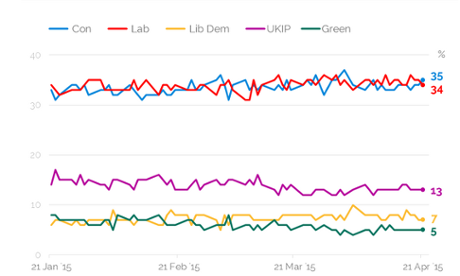
Boris Johnson may be running late. His phone-in was due to start at 8.30am, but now it is scheduled for 8.45am.
Boris Johnson's LBC phone-in
Boris Johnson, the Conservative mayor of London, is about to do a phone-in with LBC.
If you haven’t already, do read Robert Booth’s Guardian article about Johnson on the campaign trail. Here’s an excerpt.
The Conservative candidate for Uxbridge and South Ruislip was in the seat Churchill occupied in August 1940 as air force chiefs masterminded the Battle of Britain against Adolf Hitler’s Luftwaffe. The photo opportunity at RAF Uxbridge was part of the Conservative strategy of rolling out Johnson to energise a campaign that otherwise loyal observers such as Margaret Thatcher’s former communications guru Lord Bell have decried as “dreadful, risk averse and boring”.
Johnson’s perceived likeability, deft touch with ordinary people and impression of capability in a crisis have led to voters making him clear favourite to succeed Cameron as party leader and potential prime minister – ahead of Theresa May and George Osborne, according to a YouGov poll last month.
His backers in the party, including Nadine Dorries, are explicit about how voters should read Johnson’s forthcoming appearances: vote Conservative, get Boris.
Good morning. I’m taking over from Mark now.
The Socialist Labour party is launching its manifesto today. Led by Arthur Scargill, the former NUM leader, it standing candidates in some seats in Wales. At a rally last night in Aberavon, where Stephen Kinnock, son of the former Labour leader Neil Kinnock, is Labour’s candidate, Scargill said his party would abolish public schools.
We should abolish all private schools such as Eton, Harrow and Westminster, because they are an elite which gives a better education because of the more money that is pumped into them. We believe all faith schools should be abolished as well because they are a breeding ground for prejudice and intolerance. If Muslims, Buddhist, Catholics or Protestants can go to university together then they can go to school together.
The party would also nationalise pension schemes. Ken Capstick, the party’s treasurer, defended this proposal in an interview on the Today programme this morning.
This government and the Labour government before it and the Tory government before that have been taking money from people’s pension funds for years. The mine workers’ pension fund has half of its surplus taken by this government every time there is an actuarial valuation ... the government takes half. If they can do it to us, then what’s the difference in us doing the same thing.

Nick Clegg announces pay deal for public sector workers
My colleague Frances Perraudin is with the Lib Dems in London, where Nick Clegg is ruling out any further pay cuts for public sector workers if the party is part of the next government.
"You have done your bit to get the country back on track [with pay cuts]," Clegg tells public sector workers. pic.twitter.com/iogIsCEp9j
— Frances Perraudin (@fperraudin) April 22, 2015
"We've only got two weeks left to stop a right wing coalition gov," says Clegg.
— Frances Perraudin (@fperraudin) April 22, 2015
Asked where the axe would fall now public sector pay cuts have been ruled out, Clegg says he is confident they can find savings elsewhere.
— Frances Perraudin (@fperraudin) April 22, 2015
"Grant Shapps says he doesn't have the time to edit his Wikipedia entry," says Clegg. "It could have been somebody else like Michael Green."
— Frances Perraudin (@fperraudin) April 22, 2015
Updated
#milifandom gives Labour leader Twitter boost
In case you missed this story overnight, it seems that Ed Miliband has developed an unlikely fanbase of smitten teenage girls, after a 17-year-old student declared her admiration for the Labour leader on Twitter and prompted a flood of replies from other young women.
My colleague Rebecca Ratcliffe reports:
A student, known only as Abby, caused a Twitter storm after declaring herself leader of the #milifandom – a group of enthusiastic Ed Miliband admirers. Fandoms are usually reserved for the likes of Justin Bieber and One Direction, but the #milifandom hashtag has been trending, with scores of young females sharing their affection for the leader.
Abby says the Milifandom, which started last week, is “a movement against the distorted media portrayal of Ed”.
And of course, this being an election campaign, any organic grassroots social media movement has to immediately be countered with another, opposite, organic grassroots social media movement. Cue the @Cameronettes …
@Cameronettes David we know it's you this isn't going to work mate
— abby (@twcuddleston) April 22, 2015
Updated
Grant Shapps says Wikipedia editing allegations are 'nonsense'
The Tory party chairman Grant Shapps was just on BBC Radio 4’s Today programme, where he responded to the report that Wikipedia has blocked a user account on suspicions that it is being used by Shapps, “or someone acting on his behalf” to edit his own page along with the entries of Tory rivals and political opponents.
Shapps said he didn’t edit Wikipedia and he can prove he didn’t because his diary says he was elsewhere at the times the edits were made.
The BBC’s technology correspondent Rory Cellan-Jones said the truth was very difficult to be able to get to the bottom of. “The key thing is that anyone can edit a Wikipedia entry”.
Shapps was also on last night’s Newsnight, where he made much the same point.
Updated
As Vintagebeauty has commented below the line, the well-connected Andrew Neil tweeted last night that a major Tory donor told him the party’s campaign was “useless”, believing that David Cameron’s “heart is not in it”.
That prompted this reply from the Times columnist Tim Montgomerie.
@afneil DC has wanted out for a while. He has just wanted to go out on some sort of high and hasn't been able to find that high.
— Tim Montgomerie ن (@montie) April 21, 2015
Tesco posts £6.38bn loss, biggest in UK retail history
Not strictly politics, but given the sum involved a huge blow for the coalition’s much-trumpeted economic recovery.
Get full coverage and reaction over on the business live blog, helmed by “the nicest man in journalism” Graeme Wearden.
Morning briefing
Hello, and welcome to the Guardian’s election live blog. We are bringing you live coverage every day until 7 May – and in all likelihood well beyond – from 7am till late. As always we kick off with our all-you-need-to-know morning briefing, designed for election fans who don’t spend all night watching TV news or all morning scanning the papers and radio.
I’m Mark Smith, starting this morning’s blog, before Andrew Sparrow takes over later on. We’re on Twitter @marksmith174 and@AndrewSparrow, and reading comments below the line, too, should you want to say hello, ask a question or point out anything we should be covering.
The big picture
A scan of the morning front pages demonstrates a whiff of election torpor, with few titles splashing on campaign announcements, and wider politics relegated to downpage stories. But after three days of variants on the theme of ‘Red Ed and Redder Nicola bad for economy’, it’s no surprise that even the rightwing press have some attack fatigue.
TIMES: Law chief faces new onslaught over Janner #tomorrowspaperstoday #BBCPapers pic.twitter.com/bGc4fY8qPy
— Neil Henderson (@hendopolis) April 21, 2015
Given the slight lull in hostilities, the key issue of the day will be whether Labour manages to shift the debate away from questions about grubby politicking and back to policy. Conservative HQ will be delighted at the media coverage of recent days. As the Guardian’s political editor Patrick Wintour points out in his excellent analysis of the Tory strategy:
They have managed to combine their warnings of economic chaos after 8 May – the threat of excessive borrowing, leftwing influence and instability – with the threat posed by Scottish nationalism. By uniting Nicola Sturgeon and Ed Miliband in the nation’s mind, the Tories have injected a badly needed new ingredient into their warnings about Miliband. Previously, those warnings were not gaining sufficient traction because Miliband had been outperforming expectations.
Ed Miliband will be talking about how to improve cancer services in the NHS, as Labour’s campaign strategists seek to cut through the media morass and get back to campaigning on the front foot, talking about the party’s strengths.
Here are the stories you will be hearing and reading about today:
Labour
- Ed Miliband is to promise extra help for NHS cancer patients by pledging an extra £150m for better diagnostic systems. This will include testing by family doctors with the aim to getting results within one week after government figures revealed 23,000 patients waited longer than their target time.
- The party would also appoint former Countryfile presenter Miriam O’Reilly as an “independent commissioner for older people”.
Conservatives
- David Cameron will answer critics who say that the focus on the SNP is overly negative by outlining plans to deliver 600,000 extra free childcare places.
- Wikipedia has blocked a user account on suspicions that it is being used by the Conservative party chairman, Grant Shapps, “or someone acting on his behalf” to edit his own page along with the entries of Tory rivals and political opponents.
- Conservative party supporters should consider voting tactically for Labour in most areas of Scotland as the best way of supporting the UK, the former Tory chairman Lord Tebbit has said.
- The mayor of London Boris Johnson is primed to take bigger role in the Conservative campaign after getting starstruck response while canvassing in the capital
Liberal Democrats
-
Nick Clegg will say the party would end public sector pay cuts if they are returned to government, guaranteeing that salaries rise by at least inflation. Nick Clegg will say people working in the public sector deserve to see the “light at the end of the tunnel” after five years of pay restraints.
Other news
- The Scottish National party’s flagship financial policy of full fiscal autonomy could lead to a shortfall of nearly £9bn in Scotland’s finances by 2020, according to the latest projections from the Institute of Fiscal Studies.
- Nigel Farage has said that critics of the lack of ethnic diversity in the Ukip manifesto have got it wrong, because along with “one fully black person” it also features a “half-black” party spokesman.
- The DUP has ruled out taking part in any coalition, but said it would be prepared to support a party whose proposals would be in the best interests of Northern Ireland and the UK
Today’s diary
- 7.30am: Nick Clegg to announce public sector pay policy at National Liberal Club, London
- 8.30am: Mayor of London takes part in LBC’s regular Call Boris phone-in show
- 9am: David Cameron making speech on childcare in Bedfordshire
- 9.30am: Nicola Sturgeon campaigns in Edinburgh South
- 10am: Scottish Labour launch women’s manifesto in Baillieston
- 12noon: Cameron and Boris Johnson campaign together
- 7.30pm: Nigel Farage is the latest party leader to be interviewed by the BBC’s Evan Davis
Reading list

In the Guardian, Rafael Behr says Nick Clegg has a point when he says only the Liberal Democrats can restrain the reactionary ‘Blukip’ tendency:
As with the SNP surge, a significant cause of Lib Dem decline is deep-rooted cultural aversion to the Tories. Not only is the Tory brand toxic for many voters; it turns out to contaminate parties that get too close, as Labour did in the no camp during the Scottish independence referendum. So the Lib Dems can expect little gratitude for serving as a parliamentary prosthesis where there might once have been a liberal, moderate, pro-European limb on the Conservative party. Nor is there any excitement about their potential role as lobbyists for more liberalism in a Labour administration. But that doesn’t mean their humiliation is good for British politics. The space they occupy would otherwise be vacant.
The Telegraph’s Philip Johnston ponders what could happen if nobody can form a government. The answer? We’d be a bit like Belgium:
If neither Mr Cameron nor Mr Miliband were able to put together a viable government, a second election would normally follow; but the Fixed-Term Parliaments Act 2011 complicates matters. It provides for a dissolution of Parliament only when there is a specific vote of no confidence in the government or if two thirds of all MPs vote for an election. This makes the prospect of another early general election less likely. In any case, the parties may have little appetite for one given the expense and the prospect of losing support in a fresh contest.
Without a dissolution we would have a legislature but no government, a bit like Belgium, where the prime minister resigned in April 2010 and no new parliamentary majority could be established for almost two years.
Michael Goldfarb, writing for Politico.eu, says David Cameron is promising the UK a referendum on the EU without having a plan, asking what the prime minister really thinks:
Given the volatile state of British feelings about the nation’s relationship with the EU, it really is extraordinary how little the issue has figured in this election campaign. If the issue is so important, why aren’t Conservatives jumping all over Labour for refusing to offer a referendum? Clearly, their strategists have decided the EU referendum is not the critical issue that will turn this tight election campaign to the Tories. They have to know that the most recent polling shows that more voters want to stay in the EU then leave.
If today were a song …
… it would be Melanie Fiona - Change The Record ft. B.o.B.
Non-election story of the day

Ever wonder why it’s always the pretty girl or guy in front of you in the Pret queue that gets a free coffee? It’s simple - staff are allowed to give away free stuff to people they fancy. And their biggest-selling product is the simple banana.
Updated