Here is the front page of tomorrow’s Guardian:
Saturday's Guardian front page: "Tories pledge extra £8bn a year for NHS" #tomorrowspaperstoday #bbcpapers #GE2015 pic.twitter.com/kSCcaUzJ5F
— Nick Sutton (@suttonnick) April 10, 2015
As many as 25 million voters are being ignored as a result of the UK’s first past the post system, according to the Electoral Reform Society (ERS), which maintained it can confidently predict the winner in 364 “safe” seats. Katie Ghose, the society’s chief executive, said:
The fact that we can firmly predict the outcome of over half of the seats being contested this May is a sorry indictment of our outdated voting system. The average constituency hasn’t changed hands since the 1960s, and some have been under the same party’s control since the reign of Queen Victoria.
This is a huge disincentive for people to get out there and vote, and for other parties to challenge incumbents.
The ERS said it could predict the result in 186 of 303 Tory-held seats, 150 of 257 Labour and seven of 56 Liberal Democrat. The areas with the most “safe” seats were North East England (79.3%), Northern Ireland (77.8%), East of England (70%), South East England (69%) and London (68.5%).
I’ve taken the quotes from PA.
“Why do they always wobble on a Thursday?” is the question posed by the Guardian’s Jonathan Freedland in his column, as he discusses the impact of yesterday’s polls on the Conservative campaign. He compares it to a Thursday during the 1987 Tory campaign, when Margaret Thatcher thought she might actually lose the election.
Freedland writes:
The memoirs of the future may describe 9 April 2015 the same way. Thursday was the worst day so far in what has been a shaky start to the Conservative general election campaign.
He explains how the attack on Miliband from Michael Fallon over Trident received a reaction akin to the head-desk moment from the little girl during a storytime photo-op with David Cameron.

It was also hard to see how the Tory press uncovering the secrets of Red Ed’s “tangled love life” might hurt Miliband with voters, Freedland said.
He concludes:
The failure of these attacks to penetrate is leading to desperation, especially in those parts of the press that, thanks to Miliband’s stance on media regulation, are determined to keep him out of No 10.
Adding:
Both the Trident and ex-girlfriends stories smack of Tory operatives frantically stabbing at the old buttons and pulling at the familiar levers, only to find they no longer work.
Labour's election war room revealed
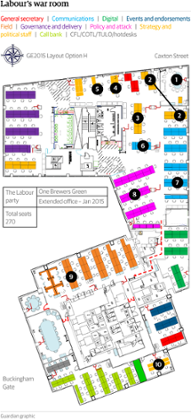
The Guardian has obtained a floorplan of the heart of the Labour Party’s election HQ in Victoria, London. It includes key members of Labour’s 250-strong operation, including Ed Miliband, shadow cabinet members and senior insiders.
Updated
There are 27 days to go until the general election, and the political parties ramped up their campaigns this week. If you missed out on the key details, we’ve published a list of everything you need to know about this week’s events, from non-doms to Trident.
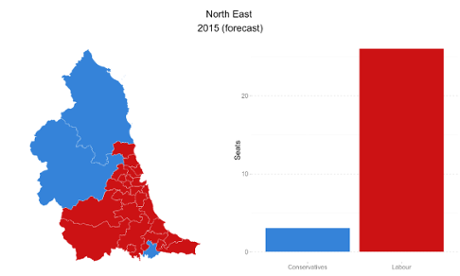
The Election Forecast team are predicting that that Labour will win 26 seats in the North East and the Conservatives will win 3. This implies that the only seats likely to change hands at the upcoming election are those held by the Lib Dems. They write:
The collapse of the Liberal Democrats is likely to be a feature across electoral regions in the UK, but the North East is unlikely to witness significant challenges from the ‘insurgent’ parties that are likely elsewhere.
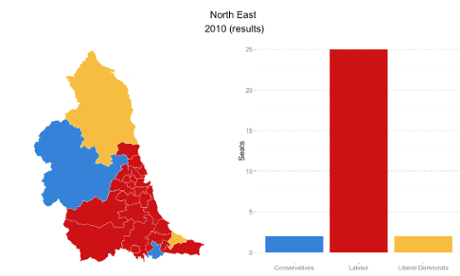
A graph showing the North East results in 2010:
Compared with the forecast for 2015:
Updated
Not much to report from that LBC discussion, except that David Davis said Michael Fallon’s attack on Miliband was a result of the Conservatives trying to draw attention away from the non-dom issue and their defence of the undeserving rich.
The Guardian view on the election in Scotland: Scottish nationalism is oozing confidence, Scottish progressive politics is on a roll too, and Labour needs to regain a hearing in Scotland if it is to win in May.
With nearly four weeks still to go, all conclusions are necessarily provisional. There is also a risk of overinterpreting marginal changes in poll numbers. With these provisos, four large things can be tentatively said about the 2015 election campaign so far.
The first is that the Conservative party is making a terrible job of broadening its appeal, due to the negativity of its campaign and lack of sympathy for its leaders. The second is that Labour is putting together some modest but steady momentum based on traditional progressive politics. The third is that the so-called insurgent parties are slipping back in England and Wales. And the fourth is that the continuing strength of the Scottish nationalists overhangs all calculations.
Following on from my post about the chief economist of the Toscafund Dr Savvas Savouri predicting that political uncertainty will depress the value of the pound against the dollar (16:13), YouGov’s Joe Twyman has just posted this:
Sterling hits five year low against dollar due to uncertainty over election. What happens if there is run on pound during coalition talks?
— Joe Twyman (@JoeTwyman) April 10, 2015
Meanwhile, in Devon...
Political pig racing in Devon - but not sure the bookies have seen the latest polls #c4news pic.twitter.com/M8JoJaGuub
— Tim Bouverie (@TimPBouverie) April 10, 2015
Labour parliamentary candidate in Ceredigion Huw Thomas, who called for his Plaid Cymru rival Mike Parker to resign due to an article he wrote in 2001 comparing English-born residents of rural Wales to Nazis, has himself had to apologise after it emerged he once advocated damaging cars displaying England flags. As the Press Association reports, in a blog post written during the 2006 football World Cup, Thomas described the “sickening” number of St George’s Cross flags seen around Wales. He wrote:
It really shows the level our society has been infiltrated by immigrants who aren’t ready to integrate.
I got the opportunity when I was offered an English flag for half price in WHSmiths Oxford to answer with the sentence ‘since I am neither a simpleton nor a casual racist I must decline your offer’.
At the end of the post on Welsh language website Maes E, Thomas suggested throwing Tippex over cars sporting the flag as it would look like bird poo and require hours of cleaning, adding: “Perfect - a call to action.” In a statement today, Thomas apologised “wholeheartedly” for the comments which he said he made while he was a “young student”. He added:
These are not my views now and I deeply regret writing this post online. Every candidate at this election will have gone through a political journey. Most will have said or thought things when they were young and at university, college or school that they now regret. This is certainly the case for me.
David Axelrod has actually broken his silence today to defend Ed Miliband from “low rent and laughable attacks” by the Conservatives. Axelrod has previously been criticised for his low visibility during the election campaign.
@UKLabour Low rent &laughable personal attacks on @Ed_Miliband reflect panic within the Tory camp, as working people focus on real choice.
— David Axelrod (@davidaxelrod) April 10, 2015
Former Labour Foreign Secretary Margaret Beckett, UKIP Deputy Chairman Neil Hamilton, Former Conservative Shadow Home Secretary David Davis and former Lib Dem leader Sir Menzies Campbell will be appearing on LBC now to review the week’s events. I’ll post any interesting updates from it at the end.
Updated
We have a new interview with Plaid Cymru’s Leanne Wood, who reflects on her putdown of Nigel Farage over his HIV health tourism remarks during last week’s leaders debate.
Like many people, you hear things that he and others with those kind of politics come out with, and normally you just have to shout at the television or the radio. So to be in the position to be able to directly challenge that kind of debate, I felt like it was an opportunity I couldn’t miss really, and I’m very glad that I took it and that there was somebody there to call him out on such a prejudicial position.
Updated
The Conservative party chairman, Grant Shapps, is facing an electoral challenge from a candidate called Michael Green, the name Shapps used as an alter ego to promote get-rich-quick products. As our political correspondent Rowena Mason reports, the man is thought to have changed his name by deed poll to pull off the stunt in the Welwyn Hatfield constituency. He submitted nomination papers at the last minute and is using Laurence Durnan, the editor of the website Political Scrapbook, as his election agent.
The campaign website says: “I‘ll get straight to the point: Tory chairman Grant Shapps has been pretending to be ‘Michael Green’. Well my name really is Michael Green. And I’m pretty pissed off.
“So I’ve decided to embarrass him by standing against him in his own constituency. That’s right: his secret pseudonym will be joining him on the ballot paper.”
Homelessness charity Shelter have done some polling with YouGov to find out what the most important factors are for voters when deciding to vote Labour or Tory. Around 20% of the public are potential “swing voters” who may switch party between now and May (7% say it’s “likely” they will, 13% say it is “possible”).
An analysis of Shelter’s polling results shows that the factors which will most influence who they vote for are whether the party is seen as being: “on the side of people like me” and whether it is “trustworhty” – more so than other regularly cited factors such as: the state of the economy, their ability to make tough decisions and the personalities of the leaders.

When asked what parties could do to show they’re “on the side of people like me”, voters said: pledges on the NHS, immigration and welfare are the most important.
But what’s striking is “the pledge to build more affordable homes” came fourth, above increasing economic growth, cutting taxes, holding a referendum on EU membership and lowering university costs. See a more detailed breakdown of the results on the Shelter blog.
I’ve just noticed that there is an interview with David Axelrod - Miliband’s American election guru - in the new issue of BA High Life magazine. Axelrod, who helped Obama win two US presidential campaigns, reveals some of his strategy:
If you want one rule: find out what the conventional wisdom is and bet against it; I’ve done pretty well doing that. The conventional wisdom is almost always wrong. During the course of a presidential campaign you’ll hear at least a dozen times that this or that occurrence is a ‘decisive’ or ‘defining’ event, but they almost always aren’t.
This election is being run as a pseudo-event, my colleague Marina Hyde writes. I’ve included the beginning of her article below.
Back in the 1960s, the writer Daniel Boorstin defined a pseudo-event as one that would not happen if the cameras were not there. It’s almost as if he could foresee the day when journalists would travel to Somerset to watch George Osborne smile at a vacuum cleaner.
So far, this has been an election staged in out-of-town business parks, cleared factory floors, deserted building sites, and town halls filled with pre-screened party supporters. The list of venues to which the party leaders are bussed or flown satirises itself: a heavily-guarded empty barn, a facility that makes virtual reality suites, a rural hedgehog farm. On Wednesday, the Lib Dems retreated to a woodland adventure centre, prompting a return to that old thought experiment: if Nick Clegg says something political in a forest, does he make a sound?
Channel 4 News’ Michael Crick has interviewed David Cameron, during which the PM claims “saying Ed Miliband stabbed his brother in the back is hardly adding to the political lexicon of Britain, it’s a point that’s been made by almost everybody else, including many people in the Labour party.”
My intv with David Cameron - on whether he'd costed his volunteer work scheme, and justifying attacks on Ed Miliband. http://t.co/b9FiFDcSMl
— Michael Crick (@MichaelLCrick) April 10, 2015
Lord Ashcroft has published some word clouds revealing what the biggest concerns about each party are. It would appear voters are worried that Ukip’s policies are too unclear, the Greens lack clarity, the Lib Dems are beholden to the Conservatives, Labour won’t fulfil their promises and the Tories favour the rich.
Biggest concerns about voting UKIP? pic.twitter.com/2lCbKW2Tqf
— Lord Ashcroft (@LordAshcroft) April 10, 2015
And biggest concerns about voting Green? pic.twitter.com/vqHbETnpHM
— Lord Ashcroft (@LordAshcroft) April 10, 2015
Biggest concerns about voting Lib Dem? pic.twitter.com/SSfdGC0SGo
— Lord Ashcroft (@LordAshcroft) April 10, 2015
Biggest concerns about voting Labour? pic.twitter.com/j48oXerAaO
— Lord Ashcroft (@LordAshcroft) April 10, 2015
From my 8k-sample national poll - what are the biggest concerns about voting Conservative? pic.twitter.com/SIomY0xwzd
— Lord Ashcroft (@LordAshcroft) April 10, 2015
Here’s the debate between Patrick McLoughin and Yvette Cooper on the World at One today, when the Conservative transport secretary could not explain how the public sector would be able to afford to let workers take three days of paid leave for volunteering if everyone wanted to take this up.
These tweets from PA’s Joe Churcher are handy.
Provisional @pressassoc figures suggest Ukip is the only one of the main parties fielding fewer female candidates than in 2010 - 77 v 83.
— Joe Churcher (@JoeChurcher) April 10, 2015
Total number of candidates is 3,963 (down from 4,150 in 2010) but a fifth more are women - 1,020 compared to 854, provisional figures show
— Joe Churcher (@JoeChurcher) April 10, 2015
Ukip contesting 624 seats - 66 more than 2010 and Greens (including Scottish party) 571 - up more than 70% from 335.
— Joe Churcher (@JoeChurcher) April 10, 2015
BNP has only eight candidates. In 2010 it fielded 338.
— Joe Churcher (@JoeChurcher) April 10, 2015
The fact that Ukip are fielding fewer female candidates is interesting, considering the party’s Diane James said on LBC yesterday that they don’t believe in all-women lists and quotas because they’ve never needed it.
Meanwhile, BNP spokesman Simon Darby denied the dramatic decline in numbers of candidates reflected a collapse in BNP support and membership, maintaining that the party took a deliberate decision not to waste deposits in an election which it expects to be swiftly followed by a second poll. “If it was up to me I won’t have stood anybody,” he said. “We are taking a very pragmatic view at this election. We deliberately pulled the number of candidates because it is happening in totally unfavourable circumstances for us. If we had put 400 candidates up and spent half a million quid, we still wouldn’t be allowed to have our say, we wouldn’t have been invited to hustings and debates and our candidates would have been vilified in the press. For a number of reasons, it is actually advantageous for us not to be involved this time.”
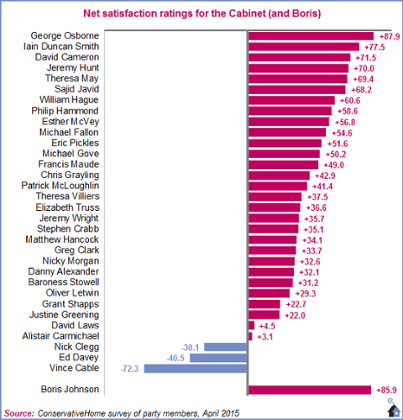
George Osborne has topped the last Cabinet league table of this Parliament, according to a Conservative Home survey of party members. Osborne’s rating of 87.9 - a rise of 13 points since last month - is his best ever. Cameron has also scored his highest rating of this parliament, with 71.5 points. But what’s interesting is that Boris Johnson trails closely in second place with 85.9 points, even though he’s not an MP.
Channel 4 News has released the results of an extra YouGov question about tactical voting in Scotland. Last night’s Times/YouGov poll gave the SNP a 24% lead over Labour. But when Channel 4 News asked an additional question about whether pro-union voters would switch their votes to the party with the best chance of defeating the SNP, it found that the lead falls to 15%. Analysis suggests that this could save up to nine Labour and two Lib Dem seats.
As Channel 4 News political editor Gary Gibbon writes:
The seats Labour would save if tactical voting worked along the lines suggested by our poll would often be ones with relatively marginal Labour leads in 2010. Bizarrely, the way the Labour vote has collapsed in its heartlands, seats with mind-bogglingly large majorities are more vulnerable than marginal ones where middle class supporters of the Tories (and the Lib Dems where they still exist) could save a Labour MP’s bacon.
Under this projection, near wipe-out could become an horrendous rout … I did say it was a qualification, not exactly great news.
Nicola Sturgeon’s campaign video from Stirling earlier today:
Press Association chief political photographer Stefan Rousseau’s photo of the day is of David Cameron facing a mirror image of himself in a train window as he arrives at Dawlish, Devon.
ELECTION Photo du Jour: David Cameron arrives in Dawlish to see new sea defences. By Stefan Rousseau/PA pic.twitter.com/ai7BFq3T1I
— Stefan Rousseau (@StefanRousseau) April 10, 2015
The Liberal Democrat care minister, Norman Lamb, has accused mental health campaigners in his North Norfolk constituency of trolling him on Twitter. As my colleague Frances Perraudin reports, Lamb, who promotes himself as a champion for mental health awareness, was responding to tweets from the Campaign to Save Mental Health Services in Norfolk & Suffolk which called him duplicitous and said it had encountered many people who were adversely affected by cuts to mental health services under the Liberal-Conservative coalition.
@Alex_Boothe @Alex_Boothe I am pursued by vicious, sometimes defamatory and totally cynical trolling by Norfolk/Suffolk Crisis campaigners!
— Norman Lamb (@normanlamb) March 31, 2015
Here’s a video of Sky News’ political editor Faisal Islam flicking through the Conservative Party’s notes for speakers (sent to 600 candidates), in which there are 99 mentions of Miliband and only 10 of Cameron.
Michael Fabricant, the Conservative MP for Lichfield, Staffordshire, has just revealed that he has been diagnosed with skin cancer.
I was diagnosed with skin cancer this morning (melanoma & basal cell carcinoma) at Queen's Hospital Burton. Probably caught in time. #NHS
— Michael Fabricant (@Mike_Fabricant) April 10, 2015
.Had various bits removed so walking very oddly! The staff at Queen's are excellent and thoroughly professional. Well done #NHS!
— Michael Fabricant (@Mike_Fabricant) April 10, 2015
More from Cameron’s trip to Devon - the PM made time to visit a cafe in Barnstaple, where he slipped up by confusing the Devonian and Cornish methods for eating a cream tea. Devon tradition is to put cream on the scone before the jam, but the Cornish do it the other way around. You can watch a video of Cameron setting himself up for the fall and quickly realising his mistake after clocking the reaction from the staff here, but I’ve included the quotes below.
When you are in Devon you do the jam and the cream in a different order to Cornwall, is that right?
I’m going to get this wrong, aren’t I?... In Devon it’s... jam first and cream on top?
Wrong way round. I knew I’d get it wrong...
It all tastes the same, doesn’t it?
David Cameron has defended the Conservatives’ campaigning tactics after Ed Miliband branded the party’s personal attacks as desperate. Speaking to reporters during a visit to Devon, Cameron said:
I am talking about this every day, which is there is a choice of leaders and there is a choice of teams to run this country. I will be talking about that the day before polling day as I am today.
Asked if he liked Miliband personally, Cameron said:
I don’t really know him, to be honest ... but we have a profound disagreement about how to run the country. In the end, whether you call it personal or not, elections are about choosing the team to take the country forward.
Cameron also denied the Tories had a difficult week of campaigning:
I wouldn’t say that is what has happened at all. I would say you have seen a very strong argument coming from the Conservative Party ... I think that argument is only getting stronger.
I’ve taken the quotes from PA.
Updated
No matter how many times you read it, nothing tells a story better than a good graphic. This is what Scotland could look like after the election, if current polling is anything to go by.
What the political map of Scotland could look like after #GE2015 pic.twitter.com/dBCFjoIAHA
— Press Association (@pressassoc) April 10, 2015
The Greens’ spoof boy band party election broadcast seems to have gone viral. The video, entitled “Change the Tune”, is now the most-watched broadcast of the election campaign so far, with more than 870,000 total views. According to Mark Cridge, an elected member of the Green Party Executive (who are responsible for the day-to-day running of the party), the video has exceeded the party’s expectations.
We’ve put a lot of emphasis on social media and digital campaigning to extend our message to people who haven’t engaged with politics previously and satire and comedy is a fantastic way of doing that. Regardless of what people think of the Green party, everybody likes the film.
Membership has increased four-fold since January 2014 and is approaching 60,000 members in England and Wales, making the Green Party the third biggest party in England and Wales.
Here’s the video again, just because...
Channel 4 have launched a new campaign called ‘X’, which aims to encourage more under 25s to register and vote. As part of their launch, they’ve released this video. Most of it made me cringe but some of it made me chuckle too. My favourite part is “FOMO, it sounds like some sort of kinky party.”
The Guardian’s Steven Morris has been in Bristol, where the Green Party have been campaigning today. Here are some segments from his report:
A hand-written note on a table at the Green Party’s new high street shop in Bristol tells the story: “We have run out of badges & posters! More coming next week!”
The green surge may be on in Bristol West – spiritual home of the street artist Banksy, real home of eco-warriors, activists and dreamers. “I think this is the sort of place where people want an alternative,” said Jesse Meadows, a 27-year-old actor who was staffing the badge-less table.
Bristol West is the Green Party’s number two target seat, after Brighton Pavilion, where Caroline Lucas won in 2010. Lucas was on Gloucester Road in Bristol on Friday at the opening of the party’s new HQ in the constituency.
“This green surge in Bristol West mirrors what is happening nationally,” she said. “People are coming to the Green Party because they want an alternative to stale politics as usual. They want a visionary alternative that is practical as well.”
Lucas said it was “extraordinary” that the environment, in particular climate change, was not being discussed during the campaign.

“Climate change is the greatest threat we face. Where is that as an issue in this campaign? We are the only party putting that on the agenda. Not in a scare-mongering way but to say, look, you can tackle the climate change crisis and you can create jobs. We have a positive vision of a million green jobs that can take us out of that crisis.”
Addressing the party faithful in the packed shop, however, the biggest round of applause came for her attack on any attempts to privatise the NHS. “Ed Miliband is talking about restrictions on the private sector. We are saying we do not want public money in our NHS services going to private companies. End of.”
The Green candidate in Bristol West is Darren Hall, a former RAF engineering officer who worked as project manager in the successful bid for Bristol to become European green capital 2015. He will be taking on the Lib Dems’ Stephen Williams, who is defending a majority of 11,000.
Caroline Lucas on why she feels the Greens could win a parliamentary seat in Bristol. http://t.co/BJFZ2iZ2jG
— steven morris (@stevenmorris20) April 10, 2015
Updated
A new government will take at least a month to be formed following the general election – and we could have a second election as early as July, according to a new report by Professor Richard Rose of the School of Government and Public Policy at the University of Strathclyde, for the asset management group Toscafund.
Large losses incurred by the Liberal Democrats will reduce their MPs to a point where they cannot assure enough votes to give a Conservative-Lib Dem coalition a plurality in the Commons. Ulster Unionists will also have insufficient MPs to give the Conservatives a secure hold on government. A combination of Labour and SNP MPs would also lack an absolute majority.
Rose, who based his report on fresh survey data and constituency competition, said that even if two parties join forces to give David Cameron or Ed Miliband a vote of confidence as prime minister, this would not create stability. The prime minister would still lack the support of an absolute majority of 50% of MPs, something would require a combination of three or four parties. He added:
If there is a Labour-SNP agreement, a ‘hung parliament’ would have a Sword of Damocles hanging over whoever governs. This is because the SNP will retain the power to vote the government out of office when it thinks it appropriate.
The SNP will also have an incentive to withdraw support from a Labour government before May 2016, when it competes with Labour at the election of a new Scottish Parliament.
Meanwhile, Dr Savvas Savouri, the chief economist of the Toscafund, predicted that this political uncertainty will depress the value of the pound against the dollar.
This is a good time for anyone planning on a summer holiday in Florida or Dubai to buy dollars, because political uncertainty will drive down the pound’s value. It is also a good time for people with attractive London houses to look for American buyers.
Two elections in three months. I don’t know if the country could handle it. Here’s our latest poll of polls, which shows you which parties need to work together to form a majority.
The SNP would get more votes than the Lib Dems if they fielded candidates across Britain. As my colleague Alberto Nardelli reports, voters were asked by pollsters at Survation to imagine that the SNP and Plaid Cymru were standing in all constituencies in Great Britain including their own. The results gave the SNP 9% of the vote, which would put them one point above the Lib Dems.
Labour would be on 32%, the Conservatives on 30%, Ukip on 15% and the Greens on 4%, according to the poll provided by Survation to the Guardian today (in Survation’s most recent regular poll, published earlier this week, Labour were on 35%, the Tories on 31%, Ukip on 15% and the Lib Dems on 9%).
The SNP figures echo a similar survey carried out in recent days by YouGov. It puts Nicola Sturgeon’s party running in all constituencies in Britain on 11% of the vote, ahead of the Lib Dems and just behind Ukip’s 13%.
In YouGov’s figures the Lib Dems would drop to 7%, with the other 15% of Clegg’s 2010 share of votes opting for Sturgeon’s party instead. Support for Labour would fall to below 30%, with one in 10 of the party’s 2010 voters preferring the SNP (slightly more than the hypothetical 7% of Labour to SNP switchers in the Survation figures).
To put all this into context: in the 2010 election, the SNP won less than half a million votes compared with the Lib Dems’ 6.8m.
Although this is obviously a theoretical exercise, it further highlights the growing appeal of the SNP south of the border following the televised debate, which attracted more than 7m viewers across the UK.
One of the most searched questions on Google during that debate was “can I vote for the SNP if I live in England?”
Polling on the night saw Sturgeon top a Great Britain-wide poll that had asked who won the debate, and on average she was virtually tied with David Cameron, Ed Miliband and Nigel Farage across all the evening’s polls.
Survation polls since the debate have seen Sturgeon claim the highest approval rating among all of Britain’s party leaders.
Updated
There are reports that Scottish Labour MPs were surprised by last night’s YouGov poll which gave the SNP a 24% lead over Labour. It might be worth noting that the poll was taken after the STV debate and before the BBC leaders debate, which is when most people thought Jim Murphy emerged triumphant. Then again, Nicola Sturgeon hardly came out on top after the STV debate, with audience members jeering at her claims about a second independence referendum. So the timing might not have made a difference.
Scottish Labour MPs flabbergasted by the YouGov / Times Scotland poll. They thought things had been going their way in the last two weeks.
— Sam Coates Times (@SamCoatesTimes) April 10, 2015
The Telegraph is reporting that Scottish Labour MPs are now calling for Gordon Brown to become the face of their campaign. Senior figures apparently said the former prime minister is “without doubt the best orator of his generation” and can win over Scottish voters where Ed Miliband is failing to have “cut through”. I don’t doubt that we’ll be seeing more of Brown in the next few weeks.
It’s intriguing how suddenly the “Big Society” theme has made a comeback after disappearing from the debate for more than three years. As the BBC’s Ian Katz points out, here’s Michael Gove on Newsnight only on Tuesday saying you won’t be hearing the phrase in this campaign (10 minutes onwards). I can’t help but feel the resurgence was spontaneous.
Gove on #newsnight Tuesday: you won't hear "Big Society" in this campaign. PM today: "This is Big Society in action" https://t.co/MYBDPhEfTu
— Ian Katz (@iankatz1000) April 10, 2015
Updated
Hello, I’m taking over from Andrew now. I’m on Twitter @nadiakhomami and I’ll be keeping an eye on your comments below the line, so get in touch if you’ve seen something I haven’t.
Nick Clegg has criticised the Conservatives’ volunteering plans, calling it an attempt to revive the Big Society agenda which had been left “dead and buried”. As the Press Association reports, Clegg said:
I’m all for volunteering, who isn’t? The question is how is it going to work, the Conservatives have provided no details of how it is going to be paid for. We have got lots of over-stretched public services in hospitals and the NHS and so on, how are they going to be able to give people three days off?
It seems to me, it’s got less to do with the actual details of the policy, it’s more about the Conservatives swinging back to the Big Society which I thought had been dead and buried by the Conservatives.

The Lib Dems have also sent me this statement from the party’s campaign spokesperson Lord Scriven:
It is fast becoming clear that the Conservatives’ so-called economic credibility is going out the window with their second uncosted announcement of the day.
If they can’t pay for their headline-seeking giveaways, no one will believe they can properly fund vital public services like the NHS or education.
The fact is the Tories can only pay for these policies by further slashing the welfare budget and public spending.
Only the Liberal Democrats can ensure the recovery by building both a stronger economy and fairer society, and will invest £8bn in the health service.
Updated
McLoughlin says Tory volunteering pledge 'will be afforded'

On the World at One Patrick McLoughlin, the Conservative transport secretary, could not explain how the public sector would be able to afford to let workers take three days of paid leave for volunteering if everyone wanted to take this up. He resorted to the unusual claim: “The money can be afforded and it will be afforded”.
And he added:
If it’s in the public sector then it is something which we believe can be accepted and adapted and it will be up to individuals whether they want to take it forward or not.
“It will be afforded” is a new one on me. What it seems to mean is: “We’d like to pay for it, but we don’t know how.”
Yvette Cooper, the shadow home secretary, was scathing.
It’s a great thing for people to volunteer in their communities but if half the nurses in the NHS took this up the NHS would need 2,000 more nurses to cover the rotas, the police would need 800 more police to cover the rotas - who’s going to pay for them? Where’s the money going to come from? How much is it going to cost? There’s some estimates saying it’s going to cost £1bn in the public sector, there’s different estimates.
Patrick McLoughlin has just wriggled and writhed, he’s unable to tell us how much would it cost, where’s the NHS going to get the funds to pay for this? I think that’s irresponsible. They should be telling us where the money’s going to come from.
That’s all from me for today.
My colleague Nadia Khomami is taking over now for the rest of the day.

Updated
Damian McBride, Gordon Brown’s former communications chief and a former Treasury official, has been in touch on Twitter to point out that the Tory claims about fuel duty etc going up under Labour (see 9.06am and 10.25am) are particularly disingenuous.
Not only is @ToryTreasury refusing to rule out increasing those taxes, @AndrewSparrow, the Red Book assumes they will rise each year.
— Damian McBride (@DPMcBride) April 10, 2015
In fact, @AndrewSparrow, the Red Book assumes an extra £4.3bn being raised from fuel, alcohol, tobacco and APD by 2020, due to tax hikes.
— Damian McBride (@DPMcBride) April 10, 2015
Updated
Lunchtime summary
-
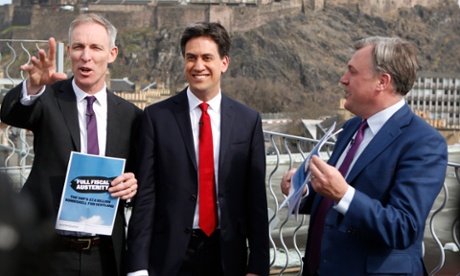
Ed Miliband has warned that Scotland faces “devastating consequences” if Scottish spending had to be cut by £7.6bn in a year under Nicola Sturgeon’s plans for full fiscal independence. In a press conference in Edinburgh, Miliband, Ed Balls, the shadow chancellor, and Jim Murphy, the Scottish Labour leader, sought to capitalise on Nicola Sturgeon’s admission on Wednesday that SNP MPs wanted to vote for full fiscal autonomy for Scotland as soon as possible. Miliband said this was “one of the most significant events of the campaign so far in Scotland” and that it would have a devastating the Scottish government’s finances. Scottish pensioners could lose £940 a year, Balls said. Miliband said:
Full fiscal autonomy will mean a £7.6bn hole in Scotland’s finances. Today I challenge Nicola Sturgeon and the SNP to say how they will fill this £7.6bn gap. Which services will be cut? Which taxes will be raised? And what cuts will it mean for pensioners in Scotland when they are taken out of the UK pensions system? The SNP claim in this campaign to be proposing no reductions in spending, but in fact they are planning dramatic reductions in spending. They must now come clean.
Sturgeon dismissed this, saying the SNP would increase spending in Scotland and that Labour was acting out of desperation. (See 11.37am.)
- Business organisations have given a mixed reaction to Conservative plans to let people take three days a year paid leave for volunteering. The Institute of Directors said the scheme would increase business costs and had not been thought through. (See 10.37am and 11.02am.)
- Miliband has accused the Conservatives of making unfunded promises because they are panicking. In his Edinburgh speech he said:
This week we have seen them defending tax avoiders and descending to personal abuse.
Today in further signs of panic, they are announcing billions of pounds of unfunded and unbelievable promises.
They can’t explain where the money comes from. They can’t tell us how they will make these promises happen. They simply won’t be believed.
On the World at One just now Patrick McLoughlin, the Conservative transport secretary, was unable to explain how the government would fund the volunteering pledge in the public sector. Eric Pickles, the communities secretary, had a similar problem on the Today programme. Yvette Cooper, the shadow home secretary, said the plan could cost the public sector up to £1bn.
-
Senior Conservative and Labour activists in some of the most hotly contested marginal seats have voiced concerns that the “air war” being conducted by David Cameron and Ed Miliband through photo opportunities, planned policy announcements and television appearances is not cutting through with voters. As Robert Booth and Josh Halliday report, party bosses in several of the tightest contests have revealed that some would rather senior party top brass stayed away from their doorstep campaigns. One Tory candidate told the Guardian that George Osborne would not be welcome at his campaign launch. Another Conservative local chairman said Ukip’s Nigel Farage and the SNP’s Nicola Sturgeon were communicating better than his leadership and a senior Labour activist complained that visits from the party’s senior hierarchy were a “pain in the arse” that hindered, rather than helped, the local campaign.
Updated
Jill Seymour, Ukip’s transport spokeswoman, has dismissed the Conservative promise to freeze regulated rail fares in real terms for five years.
It’s a bit late in the day for the Conservatives to decide it’s time to get a grip on rip-off rail fares, and trying to pose as a friend of the daily commuter. Since the coalition came into power in 2010, the average rail ticket has risen in price by around 20 per cent – way ahead of inflation. At the same time, there has been little evidence of this money being spent on much-needed improvements to the rail infrastructure, or on helping to solve reliability problems.

Nigel Farage has also has defended one of his parliamentary candidates after claims he tried to bribe voters by providing sausage rolls at an event attended by snooker star Jimmy White, my colleague Rowena Mason reports.
Last night Diane James, a Ukip MEP, spoke of her admiration for Vladimir Putin. She told LBC:
I admire him from the point of view that he’s standing up for his country. He’s very nationalist. I do admire him. He is a very strong leader.
He is putting Russia first and he has issues with how the EU encouraged a change of government in the Ukraine, which he felt put at risk and put in danger a Russian population in that country.
Today, at an event in Manston in Kent, Nigel Farage, the Ukip leader, defended James’s comments.
What she said was that he stands up for his country. He undeniably stands up for his country. But I think we’ve got to a point where he maybe poses us potentially a bit of a threat.
Which takes us back to the defence argument. Why will no one else commit to spending just 2% of our national income on defence? It seems to me that it’s vital that we do so.

Updated
Natalie Bennett says England should boycott 2022 World Cup because of Qatar's stance on gay rights
Natalie Bennett, the Green party leader, has said England should boycott the 2022 World Cup in Qatar because of its record on gay and workers’ rights. Asked by Gay Times if England should go to Qatar, Bennett replied
Personally no, that’s my personal opinion. I think there are so many issues around Qatar – gay rights issues, workers’ rights issues.

Updated
Twitter has unveiled “hashflags” for the parties during the campaign. This means party logos appear if certain hashtags are used.
Today we are launching #GE2015 hashflags! #conservative #labour #libdems #ukip #greens #snp #plaid15 #dup #sdlp #respectparty
— Twitter UK (@TwitterUK) April 10, 2015
There are two Cleggs on the ballot paper in Sheffield Hallam. Nick Clegg, the Lib Dem leader, is facing a challenge from Steven Clegg, who is standing for the English Democrats in the same seat, appearing just below the deputy prime minister on the statement of nominations.

Updated
Michael Fallon, the Conservative defence secretary, who seems to be being lined up as CCHQ’s Ed Miliband expert, has put out a statement about the Miliband press conference in Edinburgh.
Ed Miliband’s visit to Scotland shows that the SNP are already pulling Labour’s strings.
Nicola Sturgeon makes a statement, and the Labour leader rushes to Edinburgh to respond. If it’s like this now, imagine what it would be like with the SNP propping up Ed Miliband in Downing Street. Borrowing, taxes, our defence policy – all of it would have to be signed off by the SNP.
That is one of the most peculiar election claims I’ve seen so far. It is even odder than what Fallon was saying about Miliband yesterday.
Updated
The Green party in England and Wales now has more than 59,000 members, Natalie Bennett, the Green party leader, has said.
The Tories have confirmed that their plans to let people have three days paid leave for volunteering will not allow them to engage in union activities. (See 11.18am.) Trade union activity does not count as charitable activity, they says.
In response, Frances O’Grady, the TUC general secretary, issued this statement.
One wonders whether they will go on to ban help at food banks, outlaw giving advice to workers on zero-hours contracts and stop people volunteering for community wind power projects.
If the Conservatives insist people can only help registered charities that means you couldn’t lend a hand at your local school, unless it is a private school with charitable status.
Here’s today’s Guardian election three-minute video.
Jonathan Freedland and Alberto Nardell are discussing whether Labour’s poll surge will last.
Murphy is summing up now.
He says his plans would ensure Scotland benefited from the mansion tax. This would not happen under the SNP, he says. And in the Scottish parliament the SNP recently voted against Labour’s plan to raise the top rate of tax to 50p, he says. The SNP talk like radicals, but act like conservatives, he says.
Q: You said the independence question is settled. Won’t that undermine former Labour supporters who voted yes in the referendum?
Miliband says he is just saying what the SNP themselves said last year. Nicola Sturgeon did not get a great response when she floated the idea of another referendum. That tells you something about the mood of the Scottish people, he says.
Q: If you are prime minister, would Britain recognise the Palestinian state?
Miliband says Labour voted for this in the Commons. But Labour said it was a vote for the principle of recognition. A decision about when recognition would actually take place would be made at the time, when it would most help negotiations.
Q: [From the Scottish Sun] You have made a devastating case against the SNP. But, by making the case, won’t you ensure it does not happen?
Miliband says the SNP are not abandoning their plan. They are doubling down in it.
Murphy says what is significant is that Nicola Sturgeon said on Wednesday that the SNP would vote for this in the Commons.
Balls says the Tories would be happy for the SNP to extend austerity. The Tories would not stop deeper cuts in Scotland. That is exactly what they want, he says.
Updated
Q: [From my colleague Severin Carrell] Has Labour done any work on the implications of its plans for Scotland and the Barnett formula?
Balls says Labour plans such as the mansion tax, the bankers’ bonus tax and the bank levy would all benefit Scotland. Labour would get the deficit down, and is aiming for a current budget surplus, not an overall one like the Tories. It is doing a zero-based review.
If Labour is elected, there will be extra spending in Scotland this year for the NHS in Scotland, he says.
Updated
Q: Are the SNP and Ukip equally dangerous to the UK?
Murphy says they are quite different. This election is not about the future of the UK, he says. Scotland voted on that last year.
Q: [From Gary Gibbon, the Channel 4 News political editor] We have done a poll showing half of Tory and Lib Dem supporters in Scotland are thinking of voting tactically for Labour to keep out the SNP. Would you encourage that?
Miliband says he would encourage everyone to vote Labour.
Q: How big is the gap between you and the SNP?
Miliband says the gulf is “very wide”. The SNP is not a party of social justice. Until recently, it was proposing a 3p cut in corporation tax. We are not having a coalition with them, he says.
Q: Can we assume from the fact that you are talking up the SNP that you are scared of Nicola Sturgeon?
Miliband says he is putting forward Labour plans. And he is examing SNP plans. That is legitimate, he says.
Murphy says the SNP have taken a slogan, full fiscal autonomy, and turned it into a policy and said they would vote for it. But that collides with some facts, like the fact there would be a £7.6bn black hole in Scottish finances.
He says David Cameron has a Scottish-sounding surname. But he is entirely out of touch with the nation of his ancestors.
Cameron cannot beat Labour in Scotland. So he is using the SNP do try to do it for him. The SNP are the Tories’ “little helpers”.
Q: Aren’t you facing wipeout in Scotland?
Let’s wait and see, says Miliband. He says he has an old-fashioned view; let’s wait until the election.
The SNP have a strange argument. They want to see the end of a Tory government. But they think you can achieve this by not voting Labour, here, or in Wales, or in England. That is very strange.
Q: Why aren’t we seeing you campaigning in Scotland?
Miliband says he will be meeting voters. He will be doing in later today.
Labour's Q&A
Q: [To Miliband] Are you more of a hindrance than a help during the campaign?
Miliband says he does not feel that way.
Balls says Scottish pensioners could lose £940 a year under SNP plans
Ed Balls says pension spending in Scotland would be cut by £1bn under the SNP’s plans for full fiscal autonomy.
That would affect 1m pensioners in Scotland, he says. They would lose £18 a week, or £940 a year.
It would not be full fiscal autonomy. It would be full fiscal austerity, he says.
The biggest lie in the campaign is the claim that the SNP would end Tory austerity, he says.
Ed Balls says the growth rate in Scotland would have to be 5.3% to make up for the shortfall in its revenue created by its plans for full fiscal autonomy. That would be twice the current growth rate, he says.
Here’s a quote from Ed Miliband’s opening statement.
Desperation is becoming the hallmark of David Cameron and this Tory campaign.
This week we have seen them defending the non-doms and descending to personal abuse. Today, in further signs of panic, they are announcing billions of pounds of unfunded and unbelievable promises.
They can’t explain where the money is coming from. They can’t tell us how they will make these promises happen. They simply won’t be believed. And the result if they were returned to government would be even greater spending cuts, putting the NHS at risk, with inevitable rises in VAT.
Ed Balls is speaking now.
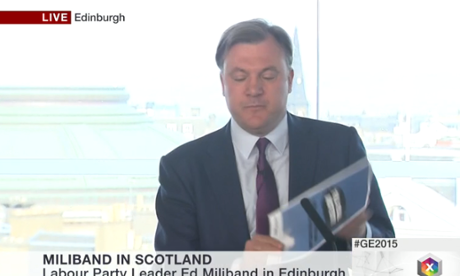
He produces a copy of a document that Labour has produced setting out the implications of the SNP’s plans for full fiscal autonomy.
Updated
Ed Miliband's speech
Ed Miliband is speaking now.
He says time is up for failed Tory austerity.
Desperation is the hallmark of the Conservative campaign, he says.
And today the Tories are announcing billions of pounds of unfunded promises. As a result, their cuts would have to be even more severe than expected.
Miliband turns to the SNP. Their plans are “unravelling”, he says. He says Sturgeon’s comments about full fiscal autonomy on Wednesday were one of the most significant developments in the election campaign in Scotland.
He says he would never sell Scotland short by adopting the SNP’s plans. And he defends the need for the UK to pool resources. You cannot reform the banks, or “call time on rogue employers”, unless you do it in all parts of the UK, he says.
Miliband, Balls and Murphy in Edinburgh
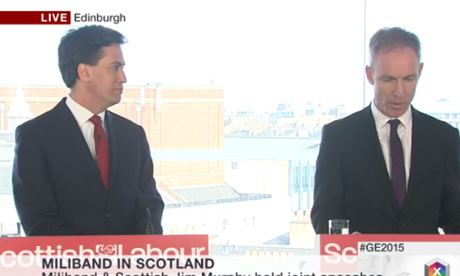
Ed Miliband, Ed Balls and Jim Murphy are now holding their press conference in Edinburgh.
Jim Murphy to Ed Miliband 'after the week you've had at least this time you've got the sun on your back!' #GE2015 pic.twitter.com/qLt4OVeOiZ
— Carl Dinnen (@carldinnen) April 10, 2015
Murphy goes first. He says he has been trying to get the SNP to talk about its own policy of full fiscal autonomy for some time. It was only on Wednesday, at the BBC leaders’ debate, that Nicola Sturgeon confirmed that this is what she wanted to vote for soon.
He says the Institute for Fiscal Studies has said this would cost Scotland £7.6bn.
The SNP has been wrong on its estimate of Scotland’s revenue from oil by a factor of 10. Yet it still won’t admit it was wrong, he says.
He says full fiscal autonomy would stop Scotland being able to guarantee paying the full UK state pension.
Updated
Sturgeon accuses Labour of scaremongering over SNP plans
Ed Miliband will shortly be giving a speech in Edinburgh attacking the SNP’s plans for Scotland to have full fiscal autonomy. As Severin Carrell reports in his preview story, Miliband will argue this would cost Scotland £7.6bn.
In a pre-emptive strike this morning, Nicola Sturgeon, the SNP leader, accused Labour of “desperation”.
This is desperation on the part of the Labour party. Instead of putting forward a positive case of their own, they are resorting to the same fears and smears that they resorted to during the referendum. The truth is the only cuts on the horizon for Scotland are the ones that the Tories are proposing and Labour are backing.
She said the SNP was proposing “a modest increase in public spending” that would allow Scotland’s health budget to rise by £2bn by 2020.
Let us lift austerity and have spending increases in the next parliament that are fiscally responsible but allow us to spend more money on our vital public services like the health service.
I am proposing an increase in spending in the health service across the UK that would see by the end of this decade an additional £2bn being spent on the NHS in Scotland. That’s the choice we have at this election – continued austerity being proposed by the Tories and Labour, or an alternative to austerity, which is what the SNP is proposing, and we need a strong Scottish voice in Westminster that can force that alternative to austerity.

Updated
On Radio 5 Live Jeremy Hunt also said he would vote to leave the EU if the Conservatives did not secure significant reforms. He said:
If we don’t get the deal that we need, yes I would [vote to leave]. But I think we can get the deal we need, because I have confidence in David Cameron. He has stood up to European leaders before.

On Radio 5 Live Jeremy Hunt, the Conservative health secretary, said the NHS should not be used as a political football.
I stand with the vast majority of doctors and nurses who don’t think the NHS should be used as a political football. I know there are lots of doctors and nurses who are sick and tired of the NHS being used.
When asked about a Conservative attempt to get doctors to sign a joint letter making this point, he claimed he had not been involved in that.
Roy Lilley, a health commentator, tweeted a copy of an email soliciting support for the proposed letter yesterday.
Tories canvassing for a 'support the NHS' letter from doctors - the games continue! pic.twitter.com/Qk7stSJ41T
— Roy Lilley (@RoyLilley) April 9, 2015
Frances O’Grady, the TUC general secretary, claims the Tory volunteering plan will allow union members three days paid leave to get involved in union activities. She has put out this statement.
The TUC has long called for a Community Day bank holiday to encourage volunteering and community engagement. We therefore welcome any move that makes employers recognise the benefits of volunteering and social action.
Trade unions are the UK’s biggest voluntary groups. This new right will give every union member a guaranteed three days for time off to get involved with union activities.
Somehow, I don’t think this is what Eric Pickles intended.
Updated
Populus poll gives Labour 2-pt lead
Populus has got a new poll out this morning.
Latest Populus VI: Lab 33 (-), Con 31 (-), LD 8 (-2), UKIP 16 (+1), Greens 6 (+2), Others 7 (-) Tables here: http://t.co/XaGgAxgjKA
— Populus (@PopulusPolls) April 10, 2015
CBI says Tory volunteering plan must allow some flexibility
Earlier I quoted a line from the CBI on the Tory volunteering plan that described volunteering as a “win-win”. (See 10.14am.) Those two sentences were all that was running from the CBI on the Press Association. I took them as an endorsement.
I’ve now seen the full statement from John Cridland, the CBI’s director general, and it is a bit more equivocal. Here it is.
Businesses encourage their employees to volunteer in the community and should do even more to increase this. Volunteering is a win-win for everyone concerned.
We look forward to seeing detail on how the Conservative party’s proposals will be implemented. The key to success will be providing sufficient flexibility for firms so as to avoid it becoming an administrative or financial burden.
Updated
IoD says Tory volunteering plan will increase business costs and 'hasn't been thought through'
The Institute of Directors has strongly criticised the Conservative plan to let people take three days paid leave for volunteering. (See 7.29am, 10.14am and 10.19am.) This is from its director general, Simon Walker.
Many, many businesses are already highly engaged in their local community and with charitable causes, and the IoD thoroughly supports them. However, the policy announced today does not appear to be have been thought through at all. Passing a law to compel firms to pay their staff to volunteer for charity is hardly in keeping with the spirit of philanthropy.
Businesses should support their staff if they want to volunteer, but the architects of this idea cannot pretend that forcing firms to give an additional three days of paid leave will do anything other than add costs. Time off for charity work and volunteering is a matter for managers and employees to discuss between themselves, not a target for heavy-handed government intervention.
This announcement not only undermines the Tory record on reducing business regulation, it also puts additional pressure on public sector employers, and ultimately the taxpayer. Frankly, the essence of volunteering is that it is voluntary. The IoD would welcome proposals to incentivise and make it easier for companies to facilitate volunteering, but it has to be a choice.
I’ve asked the Tories if they will rule out putting up fuel duty, air passenger duty, alcohol duty or tobacco duty. (See 9.06am.) The answer seems to be no, although they do point out they got rid of the fuel duty escalator.
@AndrewSparrow we're challenging Labour on fuel duty. We abolished Labour's fuel duty escalator. Harman indicating they'll bring it back.
— Tory Treasury (@ToryTreasury) April 10, 2015
I posted a follow-up question, but have yet to have a reply.
@ToryTreasury Are you ruling out an increase in that, or any of the others?
— AndrewSparrow (@AndrewSparrow) April 10, 2015
Updated
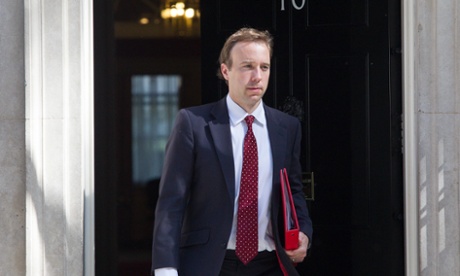
Matthew Hancock, the Conservative energy and climate change minister, has taken £18,000 from a key backer of the UK’s leading climate sceptic lobby group, my colleague Rowena Mason has revealed. Here’s the start of her story.
According to official records, Hancock has accepted five donations over the years from City currency manager Neil Record, who has given money to the Global Warming Policy Foundation, and is on the board of its campaigning arm.
The most recent donation to the MP was £4,000 given in November last year – after Hancock became a minister with responsibility for energy.
Record has separately given more than £300,000 to the Conservative party but Hancock is the only individual MP that he has backed, according to the Electoral Commission.
The Global Warming Policy Foundation, chaired by former Conservative chancellor Lord Nigel Lawson, is well known for casting doubt on established climate change science.
Updated
Labour claims Tory volunteering plans could undermine public services
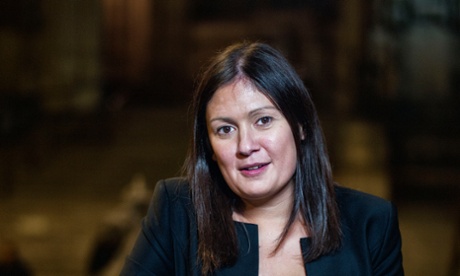
But Labour has criticised the Conservative volunteering plan. This is from Lisa Nandy, the shadow Cabinet Office minister.
This is a re-announcement from David Cameron that has unravelled before it’s even been made. Giving every public servant three extra days off could cost millions of pounds but there’s no sense of how it will be paid for. If just half of public sector workers took this up it would be the time equivalent of around 2,000 nurses, 800 police and almost 3,000 teachers.
I suppose Labour could argue that the policy could cause “chaos”.
Updated
The Conservative plan to give employees the right to three days’ paid leave a year for volunteering has been welcomed in principle by the CBI. This is from John Cridland, the CBI director general.
Businesses encourage their employees to volunteer in the community and should do even more to increase this. It is a win-win for everyone concerned.
Under the plans, the working time regulations will be amended to make clear people are entitled to 28 days’ paid holiday and three days’ paid volunteering or serving as a school governor. They would be able to take the time in a block or flexibly.
On the Today programme this morning Eric Pickles, the communities secretary, was unclear whether companies would be granted exemptions if they could not afford to grant the time off work. Asked about this, he replied:
We expect a bit of give and take on this in the same way we expect people to have a bit of give and take with regard to annual leave.
As Esther reported earlier (see 7.29am), Pickles also confirmed that there would not no extra money to help public sector employers pay for extra staff to cover people absent through volunteering. When Justin Webb suggested this could be a big problem for an employer such as the NHS, Pickles did not seem to accept the point.
John Prescott, the Labour former deputy prime minister, wasn’t impressed.
If yesterday's Michael Fallon interview was a car crash, Eric Pickles just caused a motorway pile-up #r4today
— John Prescott (@johnprescott) April 10, 2015
UPDATE AT 11.02AM: The full statement from the CBI is a bit more equivocal than the two sentences quoted above, which I got from the Press Association. See 11.02am for more details. I’ve amended the post above to reflect this.
Updated
We’ve updated the Guardian’s seat projection based on the latest polling.
Labour and the Conservatives remain deadlocked – both parties are projected to win 271 seats.
The SNP has edged further up, and is now projected to win 53 seats. The Lib Dems are – albeit slowly – gaining ground and are on 29 seats (still some distance from the 57 won in 2010).
The bigger picture remains unchanged: with less than a month to go, a Labour-SNP alliance remains the largest potential two-party bloc – and time may be running out for David Cameron.
Updated
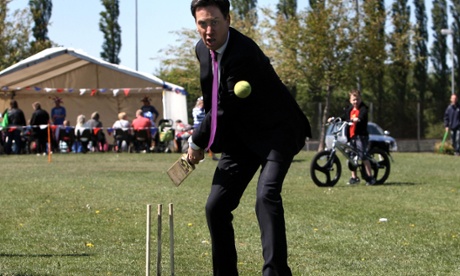
It turns out I’ve done Ed Miliband a disservice. (See 8.28am.) He is a proper cricket fan. I apologise. He talked about this in his recent interview on Absolute Radio, where he took a question from Geoffrey Boycott. Miliband said:
I could go on for hours about Geoffrey Boycott. I saw his 100th 100 in 1977. It was my first cricket match I had been to, and it was England v Australia. And ever since then I was Geoff’s greatest fan.
Boycott asked him about showing England matches on terrestrial TV. Miliband said he would love to see more England matches on terrestrial TV.
I think there’s a danger for cricket it ends up only being on Sky, and that fewer people watch it, and the game dwindles a bit.
Updated
Yesterday Ed Miliband was attacked for standing against his brother in a leadership election. Today he’s under attack in the Daily Mail for – well, essentially having girlfriends before he got married.
DAILY MAIL: Cataract Ops: jump NHS queue by paying #tomorrowspaperstoday #BBCPapers pic.twitter.com/n7vlayTaoS
— Neil Henderson (@hendopolis) April 9, 2015
As my colleague Nicholas Watt reports, Miliband hit back in an interview last night, criticising the Mail and the Daily Telegraph for running pictures of his former partners on their front pages.
Miliband said that he accepts that reports on his private life “come with the territory” but said it was unfair to drag in his former partners.
Miliband spoke out on ITV’s The Agenda on Thursday night after he was asked about the front pages of the Daily Mail and Daily Telegraph which feature pictures of his former partners. The newspapers focused on his love life after an interview with his wife, Justine Thornton, who said she was “furious” to learn Miliband was in a secret relationship with a woman who had invited them to dinner where they met for the first time.
Asked by the ITN political editor, Tom Bradby, about the front pages, Miliband said: “Let them do it. The thing I would feel is the women I went out with – it’s not great for them that they get dragged into this. For me it comes with the territory – let the Mail or the Telegraph or whoever do what they like.”
Updated
It turns out Ed Miliband did spend some of his youth listening to the cricket after all. (See 8.28am.)
Richie Benaud was one of the great voices of my childhood. A superb all-rounder, captain and commentator.
— Ed Miliband (@Ed_Miliband) April 10, 2015

In the LBC female leaders’ debate last night Harriet Harman, the Labour deputy leader, confirmed the party would not increase national insurance, income tax or VAT. But she specifically refused to make similar assurances about fuel duty, air passenger duty, alcohol duty or tobacco duty. She said:
We’ve said so far in our manifesto on tax: we rule out increasing VAT, the basic or the higher rate of tax, we will put up the top rate of tax, we will not put up the national insurance rates, and for all the other taxes that there are – you know, airport taxes, I can’t remember what they are called, airport passenger duties, or alcohol duties or tobacco or petrol – we will lay that out in the budget.
This morning the Conservatives are trying to turn that into a likely tax increase. George Osborne, the chancellor, has put out this statement.
Now we know. Ed Miliband will put up taxes on hard-working people.
It’s clear he is planning to bring back the last Labour government’s “fuel duty escalator” – the petrol tax that ratcheted up the cost of filling up your tank, all to pay for ever higher spending on welfare and waste.
One by one, we are finding out the £3,028 of tax rises for working families Ed Miliband is planning. He must now come clean and set out what the others are.
The only problem with this is that, to the best of my knowledge, the Tories have not ruled out increasing fuel duty, APD, alcohol duty or tobacco duty either.
I’ve asked for some clarification on this. I’ll let you know what they tell me.

Updated
Ed Miliband will campaign for Labour in Edinburgh today, confronted by a challenging opinion poll from YouGov for the Times that shows the Scottish National party extending its already significant lead.
Original plans to campaign in the Falkirk area have been dropped; Labour is facing a substantial and unexpected SNP challenge in seats such as Edinburgh South, where the SNP was a distant fourth in 2010.
YouGov today puts the SNP up three points on 49%, with Labour a striking 24 points behind at 25%. It confounds reports from within Scottish Labour ranks of more positive feedback from canvass returns in battleground seats and recent polls suggesting Labour was making slow gains.
The YouGov poll implies the SNP could win 50 seats from the six won in 2010, slashing Labour’s holding from 41 seats in 2010 to just a handful. Strikingly, its findings are in direct contrast with the latest UK-wide polls showing Labour taking a lead over the Tories.
Miliband will join Scottish party leader, Jim Murphy, to redouble Labour’s attacks on Nicola Sturgeon’s plans for tax, fiscal and political autonomy within the UK short of full independence.

Updated
Lib Dems propose offfering loans for under-30s to pay deposits on rented property
On the Today programme this morning the BBC’s Norman Smith called today “freebie Friday”. That’s because, as well as having the Tories promising to freeze regulated rail fares in real terms and to give workers up to three days paid leave for volunteering (see 7.02am), the Lib Dems are proposing offering loans to help young people renting pay their deposit. They call it “Help to Rent”.
Under the plan, people in work aged 18 to 30 could get a government loan of up to £1,500, or £2,000 in London, to allow them to pay the deposit needed when renting a property.
Announcing this, Nick Clegg, the Lib Dem leader, said:
You’ve got this generation that is sometimes called “the clipped wing generation”, or “the boomerang generation”, of an increasingly large numbers of youngsters – I think the estimates are now about two million people in their 20s and 30s – who simply can’t find the money needed for a deposit to rent a flat or home of their own.
It also has a big knock-on effect on what happens to the property market as far as families are concerned. It means that couples whose children have grown up are not downsizing as readily as they might because they have to keep large properties to maintain space for their kids. So we have a very simple idea which is in effect to extend a system of government loans.
It’s simply unfair that thousands of hard-working young people still have to live in the same bedroom they lived in when children. When you get your own job, you want to stand on your own two feet, have your own space, and not have to rely on the bank of mum and dad.

Updated
The Conservative plan’s to freeze regulated rail fares in real terms for the next five years has been grudgingly welcomed by Manuel Cortes, head of the TSSA rail union. In a statement Cortes said:
The Tories belated conversion to inflation-only fares increases is welcome. Everyone recognises the sinner that repents, even at one minute to midnight.
But we must remember it was their crazy decision to privatise our railways 20 years ago which has seen fares more than treble on the most popular routes since then – a staggering 246% in peak fares between London and Manchester is but one example.
Now after starting the inferno on fares, they want to claim credit for stopping it just ahead of the general election. I think the jury will still find them guilty for rip off rail fares on 7 May.
But Mick Cash, leader of the RMT union, has dismissed the move as a stunt:
This latest stunt would still mean annual fare increases that would institutionalise the harsh reality that the British passenger pays the highest fares in Europe to travel on rammed out and unreliable trains.
The only solution is to end the rip off of rail privatisation which would allow us to free up the hundreds of millions of pounds drained off in profits to invest in services and cut fares.
Updated
Good morning. I’m taking over from Esther.
And I see that David Cameron has paid tribute to Richie Benaud.
I grew up listening to Richie Benaud’s wonderful cricket commentary. Like all fans of the sport, I will miss him very much.
Will Ed Miliband feel obliged to chip in too? Probably not. I don’t think Miliband spent much of his teenage years listening to cricket.
Updated
Meanwhile, Labour has hit back with this on the Conservative “volunteer leave” announcement:
Tory volunteering proposal isn't only unfunded it's not even new - DC promised it in 2008. Another broken promise pic.twitter.com/iWggpnkDGV
— Labour Press Team (@labourpress) April 10, 2015
Those happy to confess to a certain level of election geekery may be interested in this detailed piece on the Conservative Home website looking at the “ground war” in battleground Labour-Tory marginals.
Mark Wallace notes that Lord Ashcroft’s latest batch of polling suggests Conservative activists are being outperformed on the doorsteps by Labour campaigners, which he says makes for “sobering reading”.
The Conservative party faces some challenges on the ground. While the decline in membership has at last been reversed, we are still fewer in number and more advanced in years than Labour.
In some parts of the country, long-serving activists have also decamped to Ukip, further weakening the machine. Many associations have struggled to replace long-serving stalwarts as they age, die or leave to follow Nigel Farage.
Updated
The Telegraph is reporting this morning that the Conservative manifesto, which will be published next week, will not include a commitment to meeting Nato’s target of spending 2% of national income on defence.
The paper says the decision has angered military chiefs, and quotes General Sir Richard Shirreff, who until last year was Nato’s deputy commander in Europe, saying:
We will lack credibility in the eyes of our fellow members [of Nato] having trumpeted the importance of 2% in last year’s Wales summit.
If we have puffed ourselves up about how clever we are for spending 2%, then not doing that undermines our credibility.
Updated
The communities secretary, Eric Pickles, has just appeared on the Today programme talking about the party’s plan to allow 15 million people to take up to three days “volunteering leave” a year.
He described it as a “very sensible, modest proposal … it seems to me we’re having to scrape the barrel to find objections”.
Justin Webb asked him how a large public sector employer such as a hospital would pay for covering the additional absence. Pickles said:
Of course nurses do go on holiday, they are entitled to annual leave.
In any large organisation, you are going to want to train and enhance staff. This is going to enhance productivity, enhance the process.
Q: Where will the extra money come from?
We’re talking about three days and it would be worked out to ensure it didn’t cause inconvenience to the health service.
No extra money, in other words. Later, when asked about private companies, he said “Nobody is forcing companies to do this if it causes problems to the company.”
Q: So there will be provision to opt out if it puts too great a burden on an employer?
We expect there to be give and take on this in the same way as we expect there to be give and take on annual leave.
Pickles was asked by Webb, finally, if this announcement was part of a Conservative strategy to adopt a more positive campaign. The announcement had been planned “for some considerable time”, he said, but reporters tend to “look for the negative” in any announcement.
Updated
Morning briefing
Good morning and welcome to the Guardian’s live election blog, with 27 days to go until polling day.
Just like every day during the campaign, we’ll be following each announcement, debate, photo-op and baby-kissing of the day, with plenty of analysis and reaction.
I’m Esther Addley and I’ll be launching the blog this morning, handing over to Andrew Sparrow a little later. Do feel free to contact us on Twitter @estheraddley and @AndrewSparrow or leave a comment below.
The big picture
It’s been a lively few days on the campaign trail, with Labour’s big non-dom announcement on Tuesday – which seems to have successfully wrong-footed the Conservatives – and yesterday’s row over Trident and defence secretary Michael Fallon’s suggestion that if Ed Miliband “stabbed his own brother in the back”, he would somehow do the same for the country.
Opinion remains sharply divided over that tactic by the Tories. Was it a strategic mistake to make such a startlingly personal attack?
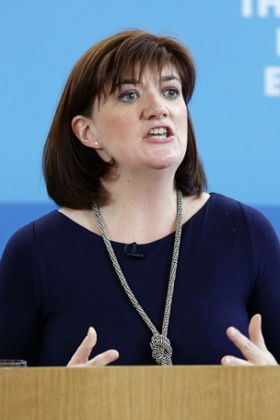
That was the view of many political commentators, although it was notable that David Cameron and most other senior Conservatives were happy to endorse the comments throughout the day, including the education secretary, Nicky Morgan, in last night’s LBC debate and Treasury minister, David Gauke, on Newsnight.
Others consider that the party knew exactly what it was doing a day after it found itself on the back foot over non-doms, citing the “dead-cat rule” attributed to the party’s campaign strategist Lynton Crosby – namely, if you find yourself in a hole, create such an enormous stink elsewhere so that everyone’s attention is diverted. More on that from the Spectator’s Isabel Hardman here, while in the Telegraph, Dan Hodges suggested that the Tories needed to “go nuclear” on Miliband just to put him at the centre of the campaign.
Their strategy – and it is a clear part of their strategy, despite Labour attempts to claim this is the move of a ‘rattled’ campaign – is simple. Tory focus groups show them Miliband is effectively unelectable.
In any event, Labour will certainly have been buoyed by three polls on Thursday evening that showed it pulling ahead of the Tories – in one case opening up a six-point lead – and even gave Miliband a personal rating higher than that of Cameron for the first time.
But as the Guardian’s political editor, Patrick Wintour, says, the signs remain tentative, and we are still a very long way from polling day. Last night a YouGov/Sun poll and another by ComRes for the Mail had the Tories in the lead, albeit by a tiny margin of 1%.
In Scotland, meanwhile, the SNP has extended its lead over Labour, according to one poll.
SNP extends its lead in latest Scotland in YouGov/Times poll: SNP 49 +3 Lab 25 -4 Con 18 +2 LD 4 +1 On uniform swing SNP = 50+ seats
— Andrew Neil (@afneil) April 9, 2015
Others had this to say:
Refusing to get excited about Labour's 3 poll leads. Painful memories of April 1st 1992 when we were sure we were on our way to victory.
— John O'Farrell (@mrjohnofarrell) April 9, 2015
It's that time of the evening where everyone gets excited about the poll that backs up the thing they want to say and ignores the rest
— Jess Brammar (@jessbrammar) April 9, 2015
Certainly neither party is going to be taking anything for granted at this point, and both will be keen to set the agenda with their respective policy announcements this morning.
Meanwhile, here’s the Guardian’s poll of polls – which is the up-to-date aggregate of all published constituency-level polls, UK-wide polls and polling conducted in the nations, and projects the result in each of the 650 Westminster constituencies using an adjusted average.
Diary
- The communities secretary, Eric Pickles, will be on the Today programme at 7.20am talking about Tory plans to to give 15 million people up to three days’ leave a year to volunteer.
- At 8.50am, the Lib Dem minister for justice, Simon Hughes. will be talking to the programme about the party’s plan to give grown-up children stuck living with their parents a £2,000 loan to move out and rent a property.
- At 9.30am, Labour’s shadow home secretary, Yvette Cooper, and shadow justice secretary, Sadiq Khan, will launch the party’s crime and justice manifesto in London, vowing to scrap next year’s police commissioner elections and introduce the first ever victims’ law.
- Ed Miliband is in Falkirk this morning, where he will insist that he will “never sell Scotland short” by backing SNP plans for full fiscal autonomy. Falkirk, you will recall, has been the scene of some lively Labour politics in the past few years. That’s at 11am.
- David Cameron will announce today that the Conservatives want to freeze regulated rail fares for five years in line with inflation, which the party says will save passengers an average of £400 each. We’ll have more detail on the announcement as the morning unfolds.
- At 7.30pm, Boris Johnson attends hustings in his target constituency of Uxbridge and South Ruislip.
- And at the same time, Cameron will be at hustings in his home seat of Witney in Oxfordshire.
The big issue
After all the drama of yesterday, we may be looking at a crunchier day dominated by policy. Labour will want to talk about crime, with the launch of their crime and policing manifesto in London this morning. The Guardian’s Alan Travis has this preview of the announcement.
As well as scrapping the unloved police and crime commissioners, the manifesto will include a pledge to guarantee local policing in every area and to introduce the first ever victims’ law.
Labour also proposes to overhaul the Prevent anti-radicalisation programme, toughen controls on terror suspects and strengthen the law on tackling hate crime.
It can expect to be pressed, however, on the “efficiency savings” that will fund part of the programme, and on the “leaner local government alternative” that it says will replace commissioners.
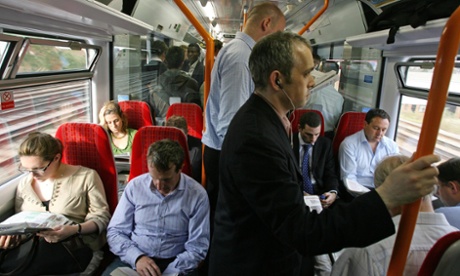
The Conservatives, meanwhile, will be hoping their pledge to freeze rail fares in real terms over the next five years will prove popular enough to bring the focus back to – you’ve guessed it – “hard-working families”, and wrestle the polls back in their favour.
According to the Times (paywall) this morning,
The prime minister will say today that it should no longer be “taken for granted that people who get up early and come home late, spend a large amount of the money they earn travelling to and from work”. He will seek to draw a line between the Tories and Labour, saying that the previous administration levied above-inflation fare rises “year after year”...
Mr Cameron said: “The cost of commuting is one of the biggest household bills that hardworking families face and it is something we are determined to bear down on.”
The Tories also want to talk today about volunteering, and their plan to give three extra days of paid leave to do volunteering affecting up to 15 million people.
It’s worth keeping an eye out, however, for ongoing muttering about the Conservative campaign strategy, not least because the party was confident that by this stage in the campaign it would be beginning to put clear water between itself and Labour.
Here are a few perspectives:
Tories determined to make campaign about Ed M. Big mistake. Makes them look defensive, negative and angry.
— Jeremy Cliffe (@JeremyCliffe) April 9, 2015
Genuine question: What would you do to rejig the Tory campaign? I'm preparing a (short term political) plan.
— Tim Montgomerie ن (@montie) April 9, 2015
Read these
- Here’s a handy primer from the Mirror on seven things we learned from the LBC women’s debate last night featuring Tory Nicky Morgan, Labour’s Harriet Harman, Lynne Featherstone for the Lib Dems and Ukip’s Diane James, one of which, they note, is “nobody mentioned tampons”:
No, seriously. Tampons are a political issue. Specifically the fact that VAT is levied on them. We’ve calculated that women spend around £114 on tampons each year, and there would be a big saving if they weren’t taxed.
- The Economist has an interview with Nicola Sturgeon, in which she says she plans to “pave the way” for Ed Miliband, “perhaps forcing” Labour to avoid spending cuts, oppose Trident renewal and block opening the NHS to private sector providers. On independence, she says:
I can’t tell you when there will be another independence referendum. I think there will be one and I think there will be a “yes” vote.
- “Let’s bury this ‘back-stabbing Miliband’ myth,” writes Joan Smith in the Guardian:
I’m not sure how I managed to miss the fact that leadership of the Labour party is a hereditary position. Apparently, Labour hasn’t even got round to abolishing the rule of primogeniture.
- If the economy is improving, why isn’t that paying off for the Conservatives in this campaign, asks Jeremy Warren in the Telegraph:
Nine times out of 10, it is perceived economic competence that determines the outcome of British elections; the party that leads the polls on economic management ends up winning. Yet this time, the rule doesn’t seem to be holding.
The two main parties are neck and neck in the polls, a position which has not shifted significantly for a long time now. Britain’s economic recovery, with its accompanying jobs “miracle”, has had virtually no effect.
The day in a tweet
We're 28 days out from #GE2015. At this point in #GE2010, the post-debate LibDem surge/Cleggmania was still more than a week away.
— Chris Hanretty (@chrishanretty) April 9, 2015
If today were a …
… song, I’m opting for Keep on Running, by the Spencer Davis Group.
Anyone else feel like we have a long, long way to go yet?
The key story you’re missing while you’re election-obsessed
The Guardian is reporting that Hillary Clinton will at last declare her intention to run for president at noon on Sunday, and that she’ll do so – of course – on Twitter.
Meanwhile, my colleague Paul Lewis will be interviewing declared Republican candidate Rand Paul on Periscope later in the day, in part based on readers’ questions. More here.
Updated