Jamie Grierson's evening summary
Nearly 12 hours have passed since that Westminster-shattering exit poll flashed on our TV screens like a bad joke. Perhaps Jeremy Vine has cocked up his CGI? Nope, it’s on Sky too ... well, perhaps the poll will be wrong. Of course, it was wrong. The Tories did even better than the bombshell poll predicted, and Labour fared worse.
Now, for many, Britain looks and feels like a different place, as if emerging from a night in hospital after being treated for concussion. The 11.3 million who voted Conservative may well be snuggling into the security blanket of a majority government tonight. But those voters who didn’t back the Tories are likely left feeling exposed, chilled by the uncertainty about what might unfold. Ripping up the Human Rights Act, bringing in the snoopers’ charter, risking an exit from the European Union.
What will these fundamental changes mean to the future of the country? And what fresh designs will be drawn up for Britain in the corridors of power, as the Conservatives embark on five years of near-unfettered reign?
The big picture

What happened today?
-
British prime minister David Cameron has confounded pollsters and pundits by winning a sensational second five-year term in office for his Conservative party.
- Some of the biggest names in British politics failed to win seats in Thursday’s general election. They include Ed Balls, Nigel Farage, Lib Dem’s Danny Alexander and Labour’s Douglas Alexander.
- A devastated Ed Miliband has resigned as leader of the Labour party, saying he is truly sorry for the scale of the party’s crushing defeat. In an emotional speech, Miliband said it was time for someone else to take over as leader, but called on the party to keep fighting, rather than give in to despair.
- Nick Clegg resigned as leader of the Liberal Democrats after taking the blame for an election defeat that he described as “immeasurably more crushing and unkind” than he had feared.
- It must have seemed too good to be true for the Tories as a defeated Nigel Farage confirmed he would stick to his promise to resign as Ukip leader, having failed in his seventh attempt to enter parliament.
- Nicola Sturgeon is to demand that David Cameron’s government delivers substantial new powers for Scotland over taxation, the minimum wage and national insurance after the Scottish National party’s dramatic electoral victory in Scotland.
- David Cameron has anointed George Osborne as his natural successor by reappointing his closest cabinet ally as chancellor and promoting him to the position of first secretary of state.
Big winners of the day
Mhairi Black, SNP
Boris Johnson, Conservative
Stephen Kinnock, Labour
David Cameron, Conservative
Alex Salmond, SNP
Big losers of the day
Ed Balls, Labour
Jim Murphy, Labour
Vince Cable, Liberal Democrat
Simon Hughes, Liberal Democrat
Douglas Alexander, Labour
Nigel Farage, Ukip
George Galloway, Respect party
Esther McVey, Conservative
Laugh of the day
Former Lib Dem leader Paddy Ashdown vowed to eat his hat live on air if the exit poll proved to be true. Before you could say “total utter wipeout” someone set up a Twitter account for Paddy Ashdown’s Hat, which has more than 12,000 followers.
5000 followers? Seriously? In 45 minutes? THIS IS WHY WE CAN’T HAVE NICE THINGS, BRITAIN
— Paddy Ashdown's Hat (@paddys_hat) May 7, 2015
Quote of the day

Liberalism here and across Europe is not faring well against the politics of fear.
Nick Clegg gave a sober warning over Britain’s political future in his resignation and farewell speech.
Tomorrow’s agenda
The fallout from the shock Tory triumph will continue and the race for the Labour leadership will gather pace.
And here are tomorrow’s front pages:
The Guardian features that awkward line-up at the Cenotaph ...
Tomorrow's Guardian front page pic.twitter.com/KiHjxhO7Im
— Paul johnson (@paul__johnson) May 8, 2015
The Times quotes Cameron with “the sweetest victory”...
THE TIMES: The 'sweetest victory' #tomorrowspaperstoday #BBCPapers pic.twitter.com/zlJTbOEpTF
— Neil Henderson (@hendopolis) May 8, 2015
The Sun also looks at the VE Day meet up ...
THE SUN: Awkward! #tomorrowspaperstoday #BBCPapers pic.twitter.com/erCaMcVLKy
— Neil Henderson (@hendopolis) May 8, 2015
The Independent laments the death of liberal BritainTh
INDEPENDENT: The strange death of liberal Britain #tomorrowspaperstoday #BBCPapers pic.twitter.com/lHJvNXHlVW
— Neil Henderson (@hendopolis) May 8, 2015
The Mirror shows its disappointment by only giving up half its front to the election result ...
MIRROR: And then there was one/I'll give birth to my dead daughter's baby #tomorrowspaperstoday #BBCPapers pic.twitter.com/j8SNiP3Spy
— Neil Henderson (@hendopolis) May 8, 2015
The Mail says the nation has been saved from “Red Ed” ...
DAILY MAIL: This was your victory #tomorrowspaperstoday #BBCPapers pic.twitter.com/G8oTh49ypw
— Neil Henderson (@hendopolis) May 8, 2015
The Ukip-backing Express features defeated Farage ...
EXPRESS: The sweetest victory of all #tomorrowspaperstoday #BBCPapers pic.twitter.com/Iw7srV1Zsd
— Neil Henderson (@hendopolis) May 8, 2015
The FT focuses on Cameron’s victory message at No 10 ...
FINANCIAL TIMES: Cameron's one nation mission #tomorrowspaperstoday #BBCPapers pic.twitter.com/KFM8uz6lb9
— Neil Henderson (@hendopolis) May 8, 2015
That’s it for me for today. It has been a pleasure. Join the Guardian’s election team tomorrow morning, as we bring you the latest news, reaction, analysis, pictures, video, and jokes.
Updated
Tonight’s Question Time covered Scottish independence, the possiblity of Brexit and proportional representation, although Scotland dominated the discussion throughout.
Labour’s former spin doctor Alastair Campbell, Tory cabinet minister Francis Maude, former Lib Dem leader Paddy Ashdown, Scotland’s deputy first minister John Swinney and columnist Julia Hartley-Brewer all featured.
Here’s a selection of highlights posted by the programme’s Twitter account.
Maude: Is independence inevitable? Absolutely not, but there's a real job for all of the parties to do #bbcqt
— BBC Question Time (@bbcquestiontime) May 8, 2015
.@campbellclaret The lesson from Scotland is if you take the electorate for granted, eventually that's going to come back to bite you #bbcqt
— BBC Question Time (@bbcquestiontime) May 8, 2015
.@paddyashdown Post #indyref speech by Mr Cameron was one of most dangerous & egregious speeches made by a Prime Minister of the UK #bbcqt
— BBC Question Time (@bbcquestiontime) May 8, 2015
.@paddyashdown There are echoes in some parts of SNP of a destructive nationalism... which I fear is now beginning to rise in England #bbcqt
— BBC Question Time (@bbcquestiontime) May 8, 2015
Maude: Is there any perfect fairness? No. But I think when parties moan about system when they fail to win seats, my sympathy limited #bbcqt
— BBC Question Time (@bbcquestiontime) May 8, 2015
.@campbellclaret We're having the referendum on Europe because of Cameron's fear of UKIP, and of his backbenchers #bbcqt
— BBC Question Time (@bbcquestiontime) May 8, 2015
Our reporters and columnists take stock as the election result sinks in and they can finally get some sleep (some of them, anyway) ...
Still not slept, but on the BBC news channel at 9.30pm on why supporters of social justice need to dust themselves off. C’mon!
— Owen Jones (@OwenJones84) May 8, 2015
Finally leaving Westminster. Looking ahead, there aren't going to be enough margaritas in London for me tonight.
— Marina Hyde (@MarinaHyde) May 8, 2015
I am feeling thoroughly ashamed to be English.
— Giles Fraser (@giles_fraser) May 8, 2015
One consolation. Sam Cam's Diary can continue. @mrscamerondiary
— John Crace (@JohnJCrace) May 8, 2015
I've been awake so long that I've completely lost track of what day/time it is but early evening #bbcqt is completely confusing me
— Gaby Hinsliff (@gabyhinsliff) May 8, 2015
Lovely #ThankYouEd trending. can't ever imagine a #thankyoudave hashtag
— Simon Hattenstone (@shattenstone) May 8, 2015
A Tory majority. Wow.
— Frances Perraudin (@fperraudin) May 8, 2015
I know you're all upset today, but here's why things aren't really that bad http://t.co/L1kC3rL8P0
— Stuart Heritage (@stuheritage) May 8, 2015
Updated

I don’t know how he does it but after pulling an all-nighter, David Dimbleby is already up and about again, presenting a special post-result Question Time on BBC One.
There are no big-hitters on the line-up - Labour’s former spin doctor Alastair Campbell, Tory cabinet minister Francis Maude, former Lib Dem leader Paddy Ashdown, Scotland’s deputy first minister John Swinney and columnist Julia Hartley-Brewer all feature - so I’ll just keep an eye on the programme and flag any noteworthy moments.

Labour MP and former home secretary Alan Johnson has dissected his party’s election failure in this brutally honest piece for the Guardian.
Johnson contends that Miliband’s chances of picking up the keys to No 10 started to nosedive after last week’s Question Time debate in Leeds.
The West Hull MP says after Miliband refused to accept Labour had overspent during its years in power, the public “became convinced that Labour had indeed driven the car into the ditch and declined to return the keys”.
He says the biggest damage was done on the economy.
We seemed to have no effective riposte to Cameron’s successful distortion of our economic record in government.... As a result it was open season on Labour’s record in office with the economy front and centre.
Johnson says the Labour party seemed determined to disguise its sound economic policy.
And he makes it clear that had the result matched the outcome predicted in so many polls, Labour today would most likely have been sitting down to talks with the SNP.
He says the proposition of a Labour-SNP tie up was “difficult to handle without insulting the intelligence of the electorate” adding “of course left-of-centre parties would at least talk to one another in the event of a hung parliament”.
Updated
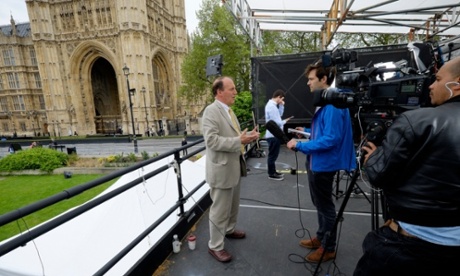
Guardian columnist Marina Hyde paints a vivid end-of-days portrait of Westminster on the morning after the night before... zombies, chinooks and protesting dogs all star in a surreal political panto.
There, among the mobile studios and microphones, politicians and producers come together in an orgy of feeding. Bits of this tented corner of Westminster resemble a field hospital, which, in a sense, they are.
Updated
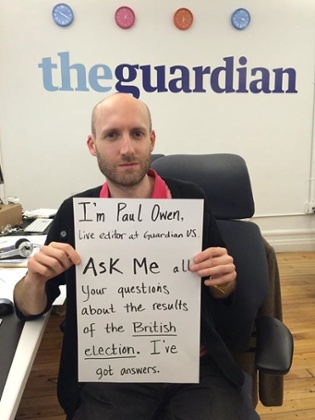
From the Guardian US Q&A on Facebook, Paul Owen answers a question on how the British election compares to past US ones:
The closest American equivalent I can think of is George Bush winning the 2004 presidential election. American liberals during 2000-04 seemed to feel that Bush was appalling, beyond the pale, and felt sure their fellow voters would agree and would turf him out. But they didn’t agree and he stayed put. British leftwingers have felt very similar about David Cameron’s government over the last five years and are shocked he has been returned to power - and with a majority this time, instead of being in coalition with the centrist Liberal Democrats as happened last time.
Ask your questions here.
Here’s a final dispatch from Shane Hickey at the Guardian live election special.
The Labour party should take six months with an interim head, such as Harriet Harman, before electing the next leader of the party, said Guardian commentator Polly Toynbee.
Speaking on what the left does next following the Conservative victory on Thursday, Hugh Muir said he believed that Ed Miliband should have stayed on for some time longer so that the party could look at what they are now for and who they want to appeal to.
By rushing into an election, he said they were robbing themselves of that.
And here’s Hugh Muir on who should be the next Labour leader:
Updated
Guardian front page, Saturday 9 May
Tomorrow's Guardian front page pic.twitter.com/KiHjxhO7Im
— Paul johnson (@paul__johnson) May 8, 2015
Updated
Here’s a couple of video clips from the Guardian live election special.
Hugh Muir and Polly Toynbee on the next steps for the Labour party...
And Rafael Behr on Labour’s mistakes over the national deficit.
Here’s more from the Guardian live event on the election from my colleague Shane Hickey.
Discussing what went wrong in polls before the election, the Guardian’s Alberto Nardelli told a discussion that they got the Labour vote share wrong (but not the Green, Lib Dem and UKIP shares) and judged the turnout incorrectly while constituency polls put Labour in a stronger position than the party was in.
Examining areas where the Conservatives came out successful where Labour was expected to win, Nardelli said one theory was that suburban middle class families who were interested in the economy trusted the Tories more.
Guardian US Facebook Q&A
We’re sure our US readers have a lot of questions after last night’s shocking victory by David Cameron’s Conservative party, so Guardian US is holding a Q&A to answer them.
Post your questions on Facebook now. Guardian US live news editor (and British expat) Paul Owen will be online until about 3:30 ET to respond.
Updated
More from the Guardian live event election results special. Here’s data editor Alberto Nardelli on how the polls got it so wrong.
Updated
Returning to the Guardian live election results special, my colleague Shane Hickey has this update.
Guardian columnist Matthew d’Ancona described the Conservative victory as a validation of the election strategy adopted by the prime minister, David Cameron, which Labour should now learn from.
Speaking at an event where Guardian journalists discussed the election results in Kings Place in London, he said the only member of the Tory party he spoke to prior to the election who believed the party would achieve over 290 seats was the prime minister, whose strategy focused around the economy and leadership.
“And it worked spectacularly,” said d’Ancona.
Owen Jones, also speaking on the panel, said that he anticipated £12bn of cuts would fall on “the backs of the working poor”.
And here are Owen Jones and Aisha Gani discussing the politics of fear:
Updated
Ed Balls, Ed Davey, George Galloway, Vince Cable, Douglas Alexander, Simon Hughes, Danny Alexander, Lynne Featherstone, Nigel Farage. There was a long list of shock election losses overnight.
For those schadenfreude junkies out there, the Guardian has assembled a collection of video clips of the biggest names in British politics realising they would not be heading to parliament.
Updated
Here’s a clip of Owen Jones at the Guardian live event (watch above and see 17.22 for details of the event) giving his take on what happened last night.
Updated

Theresa May says “there is more to do and I’m keen to get on and do it” after returning to the Home Office.
May, who has been reappointed as home secretary, has overseen some of the most high-profile and controversial reforms of the last five years, including the counter-terrorism and security act and immigration act.
Michael Fallon, who has held on to his role as defence secretary, said:
Defending the realm is the first responsibility of government and I will continue working to help keep this country safe and ensure that the UK’s military capabilities remain recognised as world beating.
Fallon added he was proud of what he achieved in the last administration, including streamlining the Ministry of Defence.
David Miliband – "heart goes out" to my brother
David Miliband, who is already subject to some speculation over a return to UK politics, has sent his commiserations to his brother Ed and the Labour party on Twitter.
Heart goes out to great colleagues who lost seats, Labour teams who worked so hard and of course to Ed. (1/2)
— David Miliband (@DMiliband) May 8, 2015
But he quickly turned to the future of his party in a subsequent post, which will no doubt require some reading between the tweets.
Deep and honest thinking required to rebuild progressive politics. (2/2)
— David Miliband (@DMiliband) May 8, 2015
Is he the man to rebuild?
Updated
It was the reshuffle that never was.
Here’s some reaction from the commentariat on Twitter to David Cameron’s decision to reappoint the top four ministers in his cabinet.
He may, however, put a bit more shuffle in the reshuffle in the next round, expected from tomorrow onwards.
David Cameron meant it when he said about the need to stick to the plan. Theresa May, Philip Hammond & George Osborne all stay put #GE2015
— Sophy Ridge (@SophyRidgeSky) May 8, 2015
So when does the actual shuffling part start #reshuffle?
— Rosemary Bennett (@RosieDBennett) May 8, 2015
This reshuffle: can't see David Cameron being very good at card games
— Lisa Markwell (@lisamarkwell) May 8, 2015
Remember that time when we'd been awake for 36 hours and they kept us up for a reshuffle where they didn't shuffle anyone.
— Alex Wickham (@WikiGuido) May 8, 2015
Reshuffle not very shuffly.
— India Knight (@indiaknight) May 8, 2015
Julian Borger, the Guardian’s diplomatic editor, reports on the US reaction:
The Obama administration sent its congratulations to Cameron but, in reference to a future UK referendum on the EU, restated its preference for the UK remaining a strong EU member.
“The UK’s relationship with the EU is first and foremost a question for the British people and the British government, not for us,” the deputy secretary of state, Antony Blinken, told The Guardian during a telephone briefing.
But he added: “From our perspective – and we’ve said this on a number of occasions – we value a strong UK voice in the EU. The EU for us is a critical partner on global issues as well on European issues and transatlantic issues and we very much welcome an outward-looking EU with the UK in it. We benefit when the EU is unified, speaking with a single voice, focused on our shared interests around the world and in Europe.
“Regardless of that, the UK is obviously a very significant player in the world and a longstanding and important friend to the United States and we will have always enjoy a special relationship.”
Some of the most thoughtful comments on Labour’s defeat have come from Tristram Hunt, the shadow education secretary, who spoke to the BBC earlier. Here are the key points he made.
-
Hunt said Labour had not offered a “compelling vision” to many voters.
What happened was that we failed to offer a compelling vision of the future which married a social democratic future to the personal aspirations of voters in Britain. And when we now begin to think about the future of the party, we have to think about the new landscape in Britain, the self-employed, the small business owner, the owner/occupier, and how our messages to them will make them think that their families’ future, their material aspirations, their personal aspirations, will find a home in the Labour party.
-
He said Labour needed to address the issue of English nationalism.
The Labour party needs to speak to a growing national identity in Scotland and also, crucially, a national identity in England. The loss of Rowenna Davis, for example, our candidate in Southampton, or Lucy Rigby in Lincoln, or our candidate Lee Sherriff in Carlisle, these are areas where a sense of Englishness and pride in English identity somehow did not find an expression through the Labour party. And it did find an expression, certainly in Stoke on Trent as elsewhere, through Ukip. And that is part of the framing we have to think about.
- He said Labour should not rush the leadership election. The party needed time to think about the future, he said. And it needed to conducted a “quite brutal” and very detailed postmortem. By contrast, Jack Straw, the former Labour foreign secretary, argued earlier this afternoon that the party should get the leadership election over quickly, on the grounds that leaving it too long would allow the Tories to attack the party’s record unchallenged, as they did in 2010.
- Hunt said the election campaign had not covered key issues, like the impact of technology on labour markets, the ageing society and its implication for welfare, and competitiveness. Labour should discuss these issues in the leadership contest, he said.
-
He sidestepped questions about whether he was interested in standing for leader. That was an issue for another day, he said.
The Times columnist Jenni Russell was impressed.
Have never seen @TristramHuntMP so dynamic, engaged; discussing Lab's need for change on every channel. Amazing. Leadership bid? #GE2015
— Jenni Russell (@jennirsl) May 8, 2015
That’s all from me for today. My colleague Jamie Grierson is going to keep the blog going for the rest of the evening.
Updated
Guardian discussion event live from 6pm
The Guardian is hosting an event tonight to discuss the fallout from the election. When it was organised, we thought that we would be in the midst of a full-blown constitutional crisis. How different it all seems now.
A tumultuous election has decapitated three party leaders and David Cameron is leading a majority government. Still plenty to talk about though – not least the future for a stunned Labour party.
We’ll have updates from the event, hosted by Jonathan Freedland with a rotating panel featuring Polly Toynbee, Hugh Muir, Owen Jones, Matthew d’Ancona, Deborah Orr, Rafael Behr, Gaby Hinsliff, Aisha Gani and Guardian polling expert Alberto Nardelli.
The event starts at 6pm and there will be a live stream at the top of this blog.
Updated
Michael Fallon remains as defence secretary
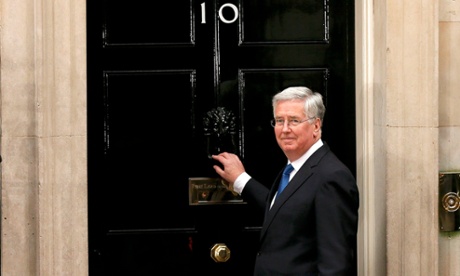
We’ve got David Cameron’s final appointment of the night.
My final appointment tonight is Michael Fallon as Defence Secretary.
— David Cameron (@David_Cameron) May 8, 2015
Updated
Jean-Claude Juncker, the European commission president, has congratulated David Cameron on his victory.
Congratulations, @David_Cameron for a resounding victory.I am ready to work with you to strike a fair deal for the UK http://t.co/a20jD9nBh7
— Jean-Claude Juncker (@JunckerEU) May 8, 2015
In his statement Juncker said:
I stand ready to work with you to strike a fair deal for the United Kingdom in the EU and look forward to your ideas and proposals in this regard.
Updated
Philip Hammond to remain as foreign secretary
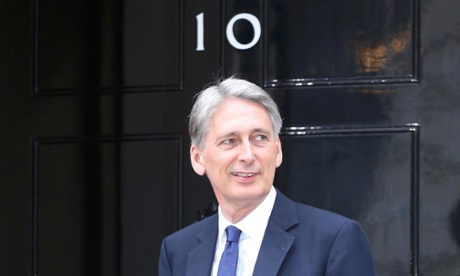
David Cameron is going for a continuity approach to his reshuffle.
Philip Hammond will remain as Foreign Secretary.
— David Cameron (@David_Cameron) May 8, 2015
I suppose a Kremlinologist would wonder why David Cameron said he was “glad” about Theresa May remaining as home secretary, but did not say that about Hammond staying in post. Perhaps because he feels more need to flatter May. Or perhaps he is just keeping his tweets short because his energy is flagging.
Updated
Theresa May to remain as home secretary
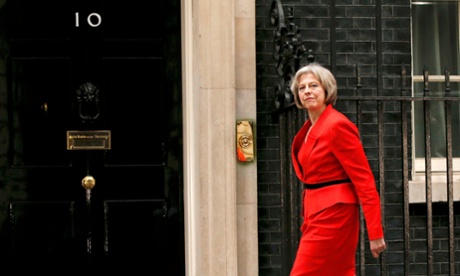
We’ve had the second appointment from David Cameron.
I am glad to announce that Theresa May will remain as Home Secretary.
— David Cameron (@David_Cameron) May 8, 2015
May is already the longest-serving home secretary since Rab Butler in the 1950s.
Updated
Cameron reappoints Osborne as chancellor
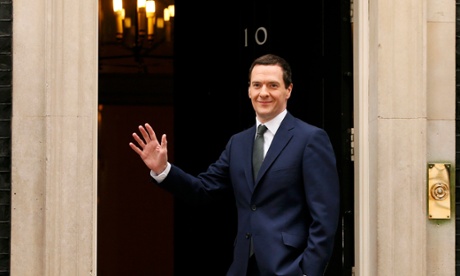
David Cameron has made his first appointment: George Osborne is made chancellor and first secretary of state.
Retaining Osborne as chancellor is no surprise. Cameron revealed this would happen during the campaign.
I have re-appointed George Osborne as Chancellor of the Exchequer. He will also be First Secretary of State - the ranking Cabinet Minister.
— David Cameron (@David_Cameron) May 8, 2015
But he has also given him the title that William Hague used to have, first secretary of state. It is a title given from time to time to very senior cabinet ministers, like Lord Mandelson under Gordon Brown. Effectively this makes Osborne his deputy in all but name.
Updated
Cabinet post announcements are looking imminent.
The prime minister has just posted this on Twitter:
I'll be announcing some Cabinet posts over the next couple of hours. To find out, keep an eye on this account.
— David Cameron (@David_Cameron) May 8, 2015
Andrew George, the Liberal Democrat who lost the last seat to be declared, in St Ives, Cornwall, has delivered his verdict on what went wrong for his decimated party.
He told the BBC:
As a country we’re not used to coalition politics and I as I think many knew were complained about us jumping in too deeply into coalition and the risk of us becoming toxified by the Conservative brand and that appears to be what has happened.
Co-operation between parties rather than tediously re-rehearsing the arguments between them is something which actually the public like to see politicians doing.
But unfortunately when they call for such things when it comes to actually doing it they respond by voting the smaller party out of office more or less.
If you are looking for a chart with all the election results set out on one page, including results from all the very minor parties, this page on the BBC website is particularly useful.
US president Barack Obama congratulates Cameron

Barack Obama has congratulated David Cameron on his “impressive electoral victory” and once again hailed “the special and essential relationship”.
In a statement issued by the White House, Obama said:
The special and essential relationship between the United States and the United Kingdom is rooted in deep and abiding shared interests and values. I have enjoyed working closely with prime minister Cameron on a range of shared interests these last several years, and I look forward to continuing to strengthen the bonds between our countries, as we work together on behalf of global peace, security and prosperity.
Updated
On the BBC’s election programme, Andrew Marr is making the point that, just as the Labour tradition in Scotland seems to have been wiped out, the Liberal tradition in the south west of England seems to have been obliterated too.
Updated
Stephen Fisher, one of the psephologists working on the BBC/Sky/ITV exit poll, has written an analysis of why the election result turned out as it did on his Elections Etc blog. The whole thing is worth reading, but here is a summary of his key points.
- The Conservatives benefited disproportionately from the collapse of the Lib Dems. Effectively, all their gains came from the Lib Dems.
-
The Conservatives benefited from an incumbency factor in many seats.
It is a well-known phenomenon that new incumbents build up a personal vote and so buck the national trend. In the US this is known as the sophomore surge. On average new Conservative incumbents went up by 4 points more than other Tory candidates, helping them hold on to some key marginals against the E&W [England and Wales] swing.
-
Ukip hurt Labour more than the Conservatives.
It seems that the UKIP rise hurt Labour more than the Tories. Where Ukip were up by less than 7 points the Conservatives were up by 1.5 points on average; Labour up 6.9. Conversely, where Ukip was up by more than 14 points the Conservatives down 0.9 points and Labour were up only 1.6. So the Labour were up 5.3 less where UKIP did well but the corresponding difference for the Conservatives was just 0.6.
Ros Altmann, the pensions expert and former adviser to Tony Blair, has cheered the election result.
You may recall, earlier in the campaign, David Cameron said he would make Altmann a Conservative peer if he won the election with a view of giving her the job of minister for consumer protection.
Part of her new role for the Conservatives is expected to involve carrying out a review of financial fairness for consumers, including the idea of capping fees on pension products.
So pleased with Election result & really lk fwd to being able to help many more ppl achieve a better later life
— Ros Altmann (@rosaltmann) May 8, 2015
Updated
JK Rowling has tweeted her support for Jim Murphy, the Scottish Labour leader, who lost his seat.
For showing unbelievable guts in the face of impossible odds, @JimForScotland, get in Gryffindor. #NotMuchBloodyComfort
— J.K. Rowling (@jk_rowling) May 8, 2015
Updated
Just hours after an unexpected and humiliating defeat at the hands of the Tories, Ed Miliband has had to stand beside the prime minister for a VE Day memorial service at the Cenotaph in Whitehall.
Along with resigned Lib Dem leader Nick Clegg and triumphant SNP leader Nicola Sturgeon, the politicians put politics aside - but there was no escaping the awkward tension between the rivals.
Here’s a selection of images coming into the Guardian picture desk.


Updated
On the World at One Damian McBride, Gordon Brown’s former communications chief, said Labour figures from the Blair/Brown generation were always going to be damaged by their association with issues like the Iraq war and the financial crash. The solution was to pick someone from the 2010 generation, he said.
Fortunately for Labour, that is a fantastically talented generation. You could name 15 names that are incredibly sound.
McBride did not name 15 potential candidates, but he said a “very decent list” of potential leaders would include: Chuka Umunna, Dan Jarvis, Owen Smith, Gloria De Piero, Rachel Reeves and Liz Kendall.
Final result announced
Appropriately enough, the final result of this election is another Lib Dem loss. Andrew George has lost St Ives, which has been won by the Conservatives.
This leaves the Conservatives with 331 seats, and a majority of 12. Labour are on 232.
650/650 seats declared. Cons gain St Ives from Lib Dems. Latest: http://t.co/Q570TKq4bs pic.twitter.com/NkKGvZd5Bb
— Election 2015 (@GdnPolitics) May 8, 2015
Updated
In the next parliament there will be a modest increase in the number of female MPs. The Fawcett Society has been looking at the numbers, and it has released this chart.
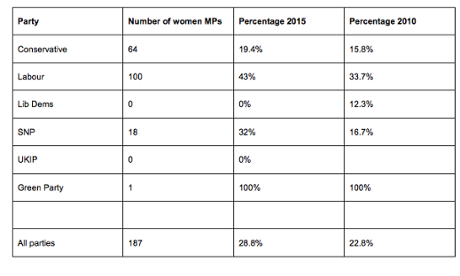
Commenting on the figures, Belinda Phipps, the Fawcett chair said:
We are really pleased that there has been an increase, albeit a small increase, in women MPs in the House of Commons. We know that when women are part of the legislative and decision making process better decisions are made.
We particularly welcome the fact that the parties are turning to women to lead the way, with two new party leaders in Harriet Harman for Labour and Suzanne Evans for Ukip. Together with Nicola Sturgeon and Natalie Bennett that makes women a formidable force in the new political world.
Harman is acting Labour leader until Ed Miliband’s successor is elected. And Nigel Farage has proposed Evans as acting Ukip leader until a contest takes place.
Updated
Cameron and outgoing party leaders mark VE Day
The shock of the election result is yet to subside and just hours after Ed Miliband and Nick Clegg resigned as leaders of their respective parties they are stood shoulder to shoulder, along with the prime minister, at the Cenotaph to mark VE Day - in what must be one of the most awkward line-ups in political history.
David Cameron, Nick Clegg, ed Miliband, Nicola Sturgeon at Cenotaph ceremony #VEDay70 #GE2015 pic.twitter.com/KgIXYFqaK7
— jon henley (@jonhenley) May 8, 2015
Updated
Inquiry into election poll accuracy to be launched
An independent inquiry is to be carried out into the accuracy of election polls, the British Polling Council has said.
Months of pre-election polling showed the Tories and Labour neck and neck - a prediction we now know to be way off the mark.
In a statement, the council said:
The final opinion polls before the election were clearly not as accurate as we would like, and the fact that all the pollsters underestimated the Conservative lead over Labour suggests that the methods that were used should be subject to careful, independent investigation.
The British Polling Council, supported by the Market Research Society, is therefore setting up an independent enquiry to look into the possible causes of this apparent bias, and to make recommendations for future polling.
Professor Patrick Sturgis, who is professor of research methodology and director of the ESRC National Centre for Research Methods, will chair the inquiry.
The Labour MP Jamie Reed has written a blog addressing why Labour lost. One problem is that Labour is losing touch with its working class, provincial voters, he suggests.
Party unity was not a hard won achievement; it was the symptom of a parliamentary party incapable of rebooting itself to meet the changed environment in which we found ourselves.
For me, nowhere was this more visible than in the emerging relationship between the party and traditionally Labour non-metropolitan areas. In our rugby league towns and lower league football cities, in the places most people have heard of, but never been to. These areas need Labour (ever more so as the state retreats) but a cultural divide has been allowed to open up between the party and for too many of those people for whom it exists to serve. The same happened with the Democrats in the US. Once the party of the working class in the southern states, millions of working class Americans in these states now vote overwhelmingly against their own economic best interests by voting Republican in every US election. Why? Because they connect ‘culturally’ with the Republicans in a way in which they no longer do with the Democrats. It’s a toxic development but an avoidable one.
A brief but interesting fact has been raised by my colleague Jessica Elgot on the staggering collapse of the BNP.
The BNP's share of the vote has dropped by 99.7%, and it got 1,667 votes in total. Beaten by the 'Cannabis is Safer than Alcohol Party'.
— Jessica Elgot (@jessicaelgot) May 8, 2015
The Labour MP John Mann told the World at One that, when Labour chose its next leader, it needed to avoided someone who, like Ed Miliband, was a career politician and a former special adviser
It’s about time we didn’t have a political insider. So, my first criteria: let’s not have anyone who’s been a speical adviser. That is almost the message that is coming from the general public.
Asked about potential candidates, he said one obvious person who stood out was Dan Jarvis, the former army officer and Barnsley Central MP.
We need somebody who is not a political insider who has always been locked in Westminster.
(Mann overlooked the fact that the Tories did quite well in the election despite being led by a former special adviser.)
Updated
Sticking with cabinet announcements, Guardian home affairs editor Alan Travis has flagged this interesting snippet in the Epsom Guardian that suggests Chris Grayling - who ushered in some of the most controversial reforms of the last five years, including a major shake-up of legal aid - is keen to hold on to his post as justice secretary.
Chris Grayling told his Epsom count that he wants to remain justice secretary http://t.co/6DIxAO8eFu
— Alan Travis (@alantravis40) May 8, 2015
Cameron to announce top four cabinet posts this afternoon
Top 4 cabinet posts to be announced later this afternoon - chancellor, Home Secretary, foreign secretary, defence secretary. Rest on Monday
— Nicholas Watt (@nicholaswatt) May 8, 2015
And here’s Jim Messina’s take on why the Conservatives won.
Campaigns are about future & Cameron was viewed as having the more optimistic vision for future by 10+ pts https://t.co/0JZXV1JGWy
— Jim Messina (@Messina2012) May 8, 2015
David Axelrod, the American strategist and Obama adviser who helped Labour with its campaign, has been tweeting about the result.
Disappointed by Thursday's result, but I'll always be proud of @Ed_Miliband & his heartfelt battle to make Britain work for all her people.
— David Axelrod (@davidaxelrod) May 8, 2015
And he has congratulated Jim Messina, his fellow American and Obama adviser who worked on the the Conservative campaign.
Congratulations to my friend @Messina2012 on his role in the resounding Conservative victory in Britain.
— David Axelrod (@davidaxelrod) May 8, 2015
Video clips of all the election drama
Our video desk has launched clips of some of the key moments of election night and morning, which must rank among the most dramatic – and brutal – 12 hours of British politics.
Ed Miliband resigns as leader of the Labour party - video
Nick Clegg resigns as leader of the Liberal Democrats - video
Nigel Farage resigns as leader of Ukip after losing Westminster bid - video
David Cameron: we can make Britain greater still - video
Labour’s Ed Balls loses seat in Morley and Outwood - video
Nicola Sturgeon: SNP victory in Scotland was vote against austerity - video
Updated
Tom Watson says he would consider standing for Labour deputy leadership
Tom Watson, the Labour MP and former general election coordinator, told the BBC that he would consider standing for the deputy Labour leadership following the announcement that Harriet Harman will be standing down. (See 1.09am.) He said:
I would consider it. I’ve always thought that the deputy leader role is a campaigning role. It is one that requires party focus and organisation.
Labour gives details of how new leader will be elected
Hi, I’m back, and I’m joining Jamie and Mark writing the blog this afternoon.
Labour has confirmed that the next leader will be selected using the new election system introduced by Ed Miliband. This is full OMOV, you’ll recall (one member, one vote), not John Smith OMOV, which was just one member, one vote for parliamentary selections, but which preserved the electoral college for leadership elections.
That means that the electoral college that selected Ed Miliband, with party members getting a third of the votes, union members getting another third, and parliamentarians getting another third, will no longer apply.
Instead, all party members, union members affiliated to Labour, and parliamentarians will get an equal vote, as well as people who have paid a small fee to become “registered supporters”.
Labour’s national executive committee will meet next week to agree the timetable for the contest. Labour says it wants a new leader in place before the September conference.
To stand, a candidate will need the support of 15% of MPs (ie, 35 of them.)
Members vote using preferential voting. If no candidate gets 50% on the first count, the candidate with the fewest votes is eliminated and his or her second preference votes will be redistributed.
Russell Brand stages climbdown on Miliband support
Comedian Russell Brand has performed a swift climbdown on his support for defeated Labour leader Ed Miliband, claiming he was “caught up in some mad The Thick of It” moment.
One of the most divisive highlights of the election campaign was Brand’s interview with a fired-up Miliband at the comic-turned-political activist’s north London home.
Miliband framed the interview as a bid to break through to Brand’s 9.5 million Twitter followers and 100,000 plus YouTube subscribers, many of whom were presumed to have share the comedian’s anger towards the political establishment.
At great potential cost to his integrity, Brand surprised his fans and commentators by backing Miliband and urging the electorate to vote for Labour, in all seats but Brighton Pavilion, where the Green’s Caroline Lucas was battling for re-election.
But just four days after he endorsed the now-resigned Labour leader, Brand has moved to distance himself from his public support. He said:
I think for a moment I got caught up in some mad The Thick of It, oh wow, Ed Miliband’s in my house... People were telling me, journalists, people who know loads about politics, look if Labour don’t get in it’s going to really be bad because independent living fund will get cut, public services are going get cut more than ever, its going to get worse for very poor people, the climate of the country is going to get mean and nasty. And now actually the Conservatives have won.
The Guardian’s Steven Morris has heard some interesting thoughts about the Lib Dem bloodbath in the south-west of from Gavin Grant, chair of the party’s western counties region.

It turns out the Lib Dems’ private canvassing picked up what he called a “subtle but terrible” shift to the Tories in the last few days in Cheltenham, where Martin Horwood lost his seat.
“People were saying they wanted clarity, a government not beholden to the SNP. That message chimed with people right at the end of the campaign,” said Grant. “We did some re-canvassing in Cheltenham. The trend among switch voters – those deciding between ourselves and the Conservatives – was away from us. There was a desire for certainty.”
Actually, they didn’t pick up that trend elsewhere and poured resources into Cheltenham to try to save it. “We thought maybe this was something peculiar to Cheltenham,” he said.
It turned out it wasn’t. A huge shock for the Lib Dems to lose Yeovil, Paddy Ashdown’s old seat, perhaps an even bigger one that Steve Webb lost in Thornbury and Yate.
Grant insisted the Lib Dems would be back – he expected results in the local elections to be better, leaving the party with a continuing presence in the west. And an EU referendum would provide a rallying point for the party, especially here. “Some of us sadly have been here before,” said Grant.
Updated
David Cameron's number 10 victory speech - verdict

David Cameron has moved to tackle fears of a broken union head on in his first address as prime minister of a majority Tory government.
As a nationalist storm surges south from Scotland to Westminster, Cameron painted himself as a sort of father of nations, promising to bring “together the different nations of our united kingdom”.
Stood on the steps of Number 10 Downing Street, the prime minister packed his speech full of the language of reassurance, repeatedly referring to “our united kingdom”, “these islands”, “governing with respect” and cautiously name-checking each nation individually, including England.
The union is safe with me
Cameron has heard Salmond’s Scottish lion roar and wants to tame the beast. He started by reminding the country of his record so far:
I have always believed in governing with respect that’s why in the last parliament, we devolved power to Scotland and Wales and gave the people of Scotland a referendum on whether to stay within the UK.
And then turned to what he will do next:
In this parliament I will stay true to my word and implement as fast as I can the devolution that all parties agreed for Wales, Scotland and Northern Ireland.
He gave made a particularly inflated promise for Scotland - not quite full fiscal autonomy but increased power over taxes was in there:
In Scotland, our plans are to create the strongest devolved Government anywhere in the world with important powers over taxation.
But was clear not to forget England:
And no constitutional settlement would be complete if it did not offer also fairness to England.
An in-out referendum on the EU is on
Cameron reeled off a list of pledges for the next five years and emphatically underlined the commitment that will likely dominate political debate for the next two years:
And yes we will deliver that in-out referendum on our future in Europe.
And with a majority he’s likely to stick to the original promise and hold the vote in 2017, no sooner.
Will Cameron miss Nick Clegg?
In a brief moment that echoed the faux sentimentality of those heady bromance days at the start of the coalition government, the prime minister paid tribute to his deputy of the last five years.
I’ve been proud to lead the first coalition government in 70 years and I want to thank all those who work so hard to make it a success and in particular on this day Nick Clegg. Elections can be bruising clashes of ideas and arguments and a lot of people who believe profoundly in public service have seen that service cut short.
Updated
Tory election strategist Jim Messina says victory 'stunned the world'
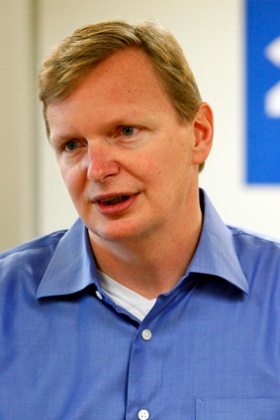
This election wasn’t just about David Cameron and Ed Miliband’s battle for No 10, there was a secondary head-to-head between the big-name American campaign consultants charged with greasing their paths to Downing Street.
In this backseat battle, President Barack Obama’s 2012 campaign manager Jim Messina, who was advising Cameron, prevailed over the efforts of his fellow former top Obama aide and friend David Axelrod, who was paid handsomely by the Labour party.
Messina has been crowing already, saying the scale of the Conservative election victory “stunned the world”.
In an interview on US television on Friday:
All elections are always about the future, especially an economic future. We won that choice by over 20 points last night, and that’s why we stunned the world, and it looks like [Cameron’s] going to have an absolute majority which I don’t think many people thought we’d have.
Messina later tweeted an allusion to the pollsters’ failure to get anywhere near an accurate prediction of the final result:
Things US&UK have in common: completely broken public polling & re-electing their strong leaders.
— Jim Messina (@Messina2012) May 8, 2015
14.25 update: A gracious Axelrod tweeted his congratulations:
Congratulations to my friend @Messina2012 on his role in the resounding Conservative victory in Britain.
— David Axelrod (@davidaxelrod) May 8, 2015
Updated
The Guardian has launched its editorial line in the aftermath of the Conservatives’ election victory. Obviously, the paper backed Ed Miliband last week.
The leader pre-empted Cameron’s speech just now, in which he referred to the EU referendum and promised to give Scotland “the strongest devolved government in the world”.
The leader says the Tory government now faces three immense tests of its statesmanship.
- Europe
- The future of the UK
- Bringing the economy together
Each of them will challenge to the full Mr Cameron’s professed wish to unify rather than divide. Each will also test the prime minister’s ability to take the one-nation path of which he spoke overnight without being blown off course by the rightwing backbenchers who will certainly try to do to him what their predecessors did to John Major after the equally unexpected Tory win in 1992. Mr Cameron needs to address each of these three issues as a prime minister not as a party manager. If that means asking for help from other parties, it should not be automatically rejected. The issues are too important for party politics.

David Cameron finishes by promising to make “Great Britain greater still” before returning to number 10 in the company of his wife Samantha Cameron.
I’ll post a full summary of his doorstep victory speech shortly.
Cameron moves to address fears over the future of the union.
He says governing with respect means recognising different nations of UK have their own governments as well as the UK government. The governments of these nations will become more powerful, he says.
“In Scotland, our plan is to create strongest devolved government in the world,” he says.
“I truly believe we’re on the brink of something special in our country”, David Cameron says.
As a majority government we will be able to deliver all of our manifesto, he adds.
He lists the party’s pledges on 3m apprenticeships, more help with childcare, cutting taxes, building homes, crating millions of more jobs,
“We will deliver that in-out referendum on Europe,” he promises.
Updated
David Cameron gives victory speech outside Number 10
The prime minister is giving a speech on the doorstep of Number 10 Downing Street after his party was awarded a majority of MPs.
He starts by saying he will now form a majority Tory government and was proud of leading a coalition.
He praises Nick Clegg and says Ed Miliband called him to congratulate him.
Updated
The wait for the last few election results may be excruciating for the candidates involved, but there is at least one person in the country who wishes the pace of the ballot-counting would come down a notch.
Avid cross-stitcher – and tweeter – Tom Katsumi is “live-stitching” the election – and he’s nearly finished.
He’ll probably have more red wool leftover than he expected too.
Almost caught up! #UK2015GeneralElectionResultsLiveStitch pic.twitter.com/ZYjdDbpoZl
— Tom Katsumi (@tomkatsumi) May 8, 2015
One for my mum, who could craft us all under the table... after having first built the table. pic.twitter.com/Xq7NXaPqq1
— Tom Katsumi (@tomkatsumi) May 8, 2015
Harriet Harman steps down as deputy Labour leader

Harriet Harman has confirmed she is now the acting leader of the Labour party following Ed Miliband’s resignation - but will step down as deputy leader once a successor is chosen.
In a statement, she says:
On the resignation of Ed Miliband as Leader of the Labour Party I, as his deputy, am stepping forward to be acting leader until a new leader is elected by the party.
It is not my intention to stay on as Deputy Leader of the Labour Party when the new leader is elected.
Therefore, I am announcing that I am stepping down as deputy leader - with my resignation taking effect when the new leader and deputy leader are elected.
Updated
Miliband's resignation speech in full
While we’re waiting for David Cameron to re-emerge from Downing Street, we now have the full text of Ed Miliband’s resignation speech.
Thank you for your kindness, friends. Friends, this is not the speech I wanted to give today because I believed that Britain needed a Labour government. I still do, but the public voted otherwise last night.
Earlier today I rang David Cameron to congratulate him. I take absolute and total responsibility for the result and our defeat at this election. I am so sorry for all of those colleagues who lost their seats - Ed Balls, Jim Murphy, Margaret Curran, Douglas Alexander and all the MPs and indeed candidates who were defeated. They’re friends, colleagues and standard bearers for our party, they always have been and they always will be.
I also want to congratulate all of our candidates who were elected yesterday, and who will help take our party forward as well. I want to thank those people who ran our campaign - it was the most united, cohesive and enjoyable campaign I have ever been involved in.
I want to thank Douglas Alexander, Lucy Powell, Spencer Livermore, and most of all, all of you, the incredible team at the Labour party. And I also today want to thank the incredible team of Labour Party members, activists and all those people who pounded the streets over the past few months.
Friends, Britain needs a strong Labour party. Britain needs a Labour party that can rebuild after this defeat so we can have a government that stands up for working people again.
And now it’s time for someone else to take forward the leadership of this party. So I am tendering my resignation, taking effect after this afternoon’s commemoration of VE Day at the Cenotaph.
I want to do so straight away because the party needs to have an open and honest debate about the right way forward without constraint.
Let me say that Harriet Harman is the best deputy leader anyone could hope for. I worked for her more than 20 years ago, I’m proud to have had her as my deputy for my term of leadership.
She will take over until a new leader is elected. For me, I’m looking forward to reacquainting myself with Justine, Daniel and Sam. But before I do I want to say a few things.
First of all, thank you to the British people. Thank you to the people who have met me on train stations, in colleges, in workplaces, in schools. Thank you for sharing your stories with me, I have learned so much from you. It has been an enormous privilege. Thank you for the selfies, thank you for the support, and thank you for the most unlikely cult of the 21st century - Milifandom.
Second, I want to address those who voted Labour yesterday. Today you will feel disappointed, even bleak. But while we may have lost the election, the argument of our campaign will not go away. The issue of our unequal country will not go away. This is the challenge of our time, the fight goes on and, whoever is our new leader, I know Labour will keep making the case for a country that works for working people once again.
Third, I believe in our United Kingdom. Not just because it is our country, but because it is the best way of serving the working people of our country. You know, I believe there is more that unites us than divides us across the whole United Kingdom. And all of us, in the months and years ahead, must rise to the challenge of keeping our country together.
Finally, I want to say something to my party: thank you to you. Thank you for the privilege. I joined this party aged 17, I never dreamed I would lead it. It has been an incredible force for progress, from workers’ rights to the NHS to the minimum wage. No other party in British politics can boast these achievements, and, yes, it will be a force for progress and change once again.
And to all the Labour Party members, you are the most loyal supporters, amazing people. I thank all of you today. I am truly sorry I did not succeed. I have done my best for nearly five years.
Now you need to show your responsibility. Your responsibility, not simply to mourn our defeat but to pick yourself up and continue the fight. We have come back before and this party will come back again.
And if I may, I say to everyone in our party: conduct this leadership election with the same decency, civility and comradeship that we believe is the way that the country should be run. I believe I have brought a culture to this party of an ability to have disagreement without being disagreeable. I urge everyone to keep this in mind in the months ahead.
Finally I want to say this: The course of progress and social justice is never simple or straightforward. Change happens because people don’t give up, they don’t take no for an answer, they keep demanding change. This is my faith. Where we see injustice we must tackle it.
In a couple of hours I will no longer be leading this party. But, you see, for me, that has never been the only way to achieve change. Because I believe it is not simply leaders who achieve change, it is people that make change happen.
I will never give up on that idea, I will never give up on that cause, I will never give up on fighting for the Britain I believe in. That faith will always be my faith, that fight will always be my fight, that cause will always be my cause. And I will always be there in that cause with all of you. Thank you very much.
Attention has focused on the polling companies, with commentators demanding to know how the election result seems so out of line with the opinion polling during the campaign, which had the two main parties largely neck and neck.
Damien Lyons Lowe, the chief executive of Survation, one of the main opinion polling firms, has revealed that his company conducted a telephone poll the day before the election, carefully balanced demographically, and using mobile as well as landline numbers to maximise the reach.
It put the Conservatives on 37% (the actual result was 37%) , Labour on 31% (30.5%), Ukip on 11% (13%), the Lib Dems on 10% (8%)and the Greens on 5% (4%).
So why didn’t Survation publish it? The answer is that it didn’t “seem right”. In a post appropriately titled Snatching Defeat from the Jaws of Victory, Lyons Lowe writes:
The results seemed so “out of line” with all the polling conducted by ourselves and our peers – what poll commentators would term an “outlier” – that I “chickened out” of publishing the figures – something I’m sure I’ll always regret.
The fact is, there is a herd mentality in the polling business - they’d all rather be wrong together.
Updated
I was not expecting the prime minister to go in first - perhaps he needs the toilet or needs to feed the cat. It’s been a long night.
Hi Jamie Grierson here. I know this must have been said many times today but I did not expect to be signing in to the blog under these circumstances. Cameron has just left Buckingham Palace for Downing Street, we’ll be covering his Number 10 doorstep speech.
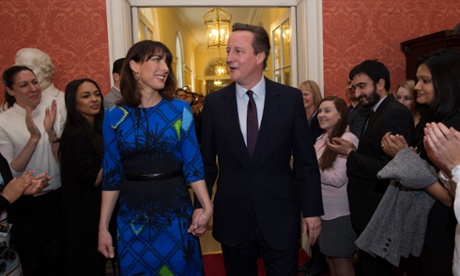
The BBC have got pictures of the Camerons arriving at the King’s Door entrance of Buckingham Palace. Samantha Cameron’s dress is already an office talking point.
David Cameron meeting Queen at Buckingham Palace after #GE2015 success http://t.co/jpy6wse1Rp pic.twitter.com/6CoT0NwX6l
— BBC Breaking News (@BBCBreaking) May 8, 2015
Europe reaction
The rest of Europe rubbed its eyes in astonishment at the stunning election outcome and braced itself for two years of gruelling negotiations over Britain’s future in the European Union.
Following 18 months of shadow-boxing and what senior diplomats in Brussels call the “phony war” over David Cameron’s EU referendum gamble, the prime minister’s second term mandate clears the air. He will now have to come clean on what concessions he hopes to win from the rest of the EU in order to keep Britain in the union.
“The ball is very much in the court of the UK now,” said a senior EU official. “It’s up to the British to define what they want.”
Cameron will have his first opportunity to sound out his fellow EU leaders in two weeks when a special EU summit takes place in Latvia. But the expectation in EU capitals is that the prime minister will unfold his shopping list at a Brussels summit on 21 June 21.
Chancellor Angela Merkel of Germany, who fervently wants to keep the UK in the EU but is unwilling to make major concessions to facilitate that, will be central to the negotiations.

I’ll post the full text of Miliband’s resignation speech shortly. But first, here’s some snap reaction from the Twitter commentariat. Most pundits are in agreement that Miliband’s swansong was dignified and classy, in the face of such a devastating rejection by the country.
From the Sunday Times’ Tim Shipman:
As ever, nothing so much becomes leaders as the manner of their going. Classy speeches from Miliband and Clegg. Same was true of Al Gore
— Tim Shipman (@ShippersUnbound) May 8, 2015
From Politics Home’s Paul Waugh:
Lots of tears and hugs among Labour staffers after that dignified resignation speech from Ed Miliband
— Paul Waugh (@paulwaugh) May 8, 2015
From the leftwing blogger Sunny Hundal:
There was a glint of Ed Miliband looking relieved that he will never again face the harsh glare of the media as Labour leader
— Sunny Hundal (@sunny_hundal) May 8, 2015
Cameron arrives at Buckingham Palace to see Queen

Meanwhile, David Cameron has arrived at Buckingham Palace for an audience with the Queen to confirm his second term as prime minister following his party’s General Election victory. This report is from the Press Association:
The PM and his wife Samantha arrived in a chauffeur-driven limousine at the Queen’s official London residence just before 12.30pm. The car stopped outside the entrance known as the King’s Door and Cameron was met on its steps by a senior palace aide.
The monarch has seen 12 prime ministers head her government over the decades, from her first, Sir Winston Churchill, to Cameron.
The Queen had arrived at the palace from Windsor Castle about 50 minutes before the meeting. They will meet in the same room in which weekly audiences are held between the Queen and the PM when parliament is sitting.
Updated
He says Labour has been “an incredible force for progress” ever since he joined aged 15, and will be once again.
Miliband says he is truly sorry, and that he did his best as the leader of the Labour party for nearly five years. Don’t mourn the defeat, he says, but keep fighting for Britain.
This party has come back before and will come back again
And that’s it. Ed Miliband’s Labour reign is over.
Updated
Miliband says Harriet Harman, the deputy leader, will take over until a new leader can take over. She will represent the Labour party after this afternoon’s VE Day commemorations at the Cenotaph in London.
He thanks everyone for the selfies – and says #Milifandom was the most unlikely cult of the 21st century.
- Harriet Harman to become caretaker leader of Labour party
Ed Miliband thanks supporters "for the selfies... support & the most unlikely cult of the 21st century - Milifandom" pic.twitter.com/qsy8lX1Aze
— BBC Breaking News (@BBCBreaking) May 8, 2015
Updated
Ed Miliband resigns as leader of the Labour party
Miliband thanks his staff, including Lucy Powell, and “all those people who pounded the streets” on behalf of their local candidates.
Britain needs a strong Labour party, Miliband says. And it’s time for someone else to take over the leadership of the party.
- Ed Miliband resigns as leader of the Labour party
Updated
This is Mark Smith taking over the blog
Ed Miliband is speaking now. He says this is not the speech he wanted to be making.
Miliband says he has spoken to Cameron to congratulate him on the election result.
Updated
Cameron’s victory speech at Conservative HQ - video
David Cameron tells Conservatives celebrating their election victory at the party’s headquarters on Friday: “We are on the brink of something so exciting.”
The PM says his party can now “offer real hope to people in our country”, and says he did not expect the Conservatives to win so many seats in the election.
Source: @SebastianEPayne/Spectator
Updated
It looks as though the Lib Dem leadership is not the only job Nick Clegg has lost today – this sounds as if his services for LBC radio’s Call Clegg programme are no longer required:
So farewell Nick Clegg. Two-and-a-half years of Call Clegg @LBC You were brave enough to be the first. And superb.#GE2015 @nick_clegg
— Nick Ferrari (@NickFerrariLBC) May 8, 2015
Nick Clegg's resignation speech: reaction

A staunch defence of liberalism from the retiring Nick Clegg, who reportedly left the room in tears after delivering his resignation statement.
The Spectator’s Isabel Hardman says it would have been good to see some of that during the campaign:
Could Clegg have articulated the Liberalism he is praising now better during the campaign? To give voters a reason to back his party?
— Isabel Hardman (@IsabelHardman) May 8, 2015
The Mirror’s Kevin Maguire thought Clegg gracious in defeat:
Nothing became him in leadership than the leaving of it. Gracious, well-judged Clegg resignation with a hint of defiance
— Kevin Maguire (@Kevin_Maguire) May 8, 2015
Lord Steel says it is time for the Lib Dems to reassess, reports Newsnight’s Laura Kuenssberg:
Lord Steel says Liberalism has been 'set back for several decades' and party has to move back to be 'left of centre'
— Laura Kuenssberg (@bbclaurak) May 8, 2015
From the Press Association’s David Hughes, a reminder how far Clegg has fallen from the heady days of the 2010 campaign:
I was with the Lib Dems at the birth of Cleggmania and was there for last rites today. It's been an incredible and historic story.
— David Hughes (@DavidHughesPA) May 8, 2015
The Guardian’s Frances Perraudin slogged her way through the campaign on the Lib Dem battle bus:
Thinking back to the night before polling day on the LibDem bus. They seemed in such good spirits. I think none of them expected this at all
— Frances Perraudin (@fperraudin) May 8, 2015
Updated
Clegg: Fear and grievance have won. Liberalism has lost. But it is more precious than ever and we must keep fighting for it.
It is easy to imagine there is no road back. There is.
This is a very dark hour for our party but we cannot and will not allow decent liberal values to be extinguished overnight.
Updated
Clegg says it is too early to give a “considered account” of the “catastrophic” losses.
But he says liberalism across Europe “is not faring well against the politics of fear”.
Nationalism and “us v them” is on the rise.
He says this has brought Britain to a perilous point.
“In the absence of strong and statesmanlike leadership … the existence of our United Kingdom itself is in grave jeopardy.”
Clegg says the Lib Dems will never know how many lives they made better through their decision to “step up” in coalition.
He says they have made the country fairer and more liberal than it was five years ago.
He thinks history will judge his party kindly.
Clegg says it is “simply heartbreaking” to see so many colleagues and friends lose their seats.
He says responsibility for the Lib Dem collapse is his, not theirs. He says it is the price paid for making the decision to go into government.
Nick Clegg resigns as leader of the Lib Dems
I always expected this election to be exceptionally difficult, he says.
Clearly the results have been immeasurably more crushing and cruel, so he will resign.
Updated
Nick Clegg is going to make a statement very shortly.
Are we going to see three party leaders step down within hours of the results?
It might be a night that many people will want to forget, but here’s your chance to relive it, very, very quickly:
How it went down. #GE2015 | http://t.co/B8hRHxoQmA pic.twitter.com/VGm1JEQYAo
— Troy Griggs (@TroyEricG) May 8, 2015
The final female Lib Dem MP has lost her seat to the Conservatives.
Tessa Munt has failed to hold on to Wells. The eight Lib Dem MPs to have won so far are all men.
Curiously, Nigel Farage says he will take the summer off and decide whether to stand for the leadership again after that.
So, a way to keep his promise AND the leadership?
It's a Vicky Pollard resignation!
— Laura Kuenssberg (@bbclaurak) May 8, 2015
Updated
Nigel Farage resigns as leader of Ukip
He says he is a man of his word, having promised to step down should he fail to secure South Thanet.
He recommends that Suzanne Evans should be acting leader.
Nigel Farage is expected to announce he is stepping down as Ukip leader in a speech that is starting now. The Guardian’s Ben Quinn is there.
Farage is about to speak pic.twitter.com/l0gYa0A48G
— Ben Quinn (@BenQuinn75) May 8, 2015
Updated
You can read more here from Patrick Wintour and Rowena Mason on Ed Miliband’s expected resignation and what happens next:
A devastated Ed Miliband is expected to resign on Friday after talking to staff at the party’s headquarters, admitting the scale of the crushing defeat had taken him and his staff by surprise.
There had been some discussion that he would stay on as a caretaker leader – just as Michael Howard did following the Conservative defeat in 2005 – but it appears he has decided it is better to have an immediate break.
His close staff are said to be deeply upset, struggling with the disappointment made the deeper by the opinion polls that had led them to believe they had blocked David Cameron from getting clear path back to Downing Street.
It was not yet clear whether Harriet Harman, the deputy leader, will stand down at the same time or remain to oversee the election. Both the Labour leader and deputy leader posts are elected by an electoral college.
Jim Murphy will not step down as Scottish Labour leader
Jim Murphy is not resigning: determined to offer period of stability and be leader of fightback #GE2015
— Libby Brooks (@libby_brooks) May 8, 2015
Jim Murphy, Labour’s leader in Scotland, who lost his own seat to the SNP last night, has been making a statement.
It was a terrible night for Scottish Labour, and a terrible morning for working people across the UK, he says.
While we’ve lost seats, he says, the thing that hurts most is the loss of hope that will be faced in another five yrs of Tory government.
“We have been overwhelmed by history.”
He says it will take time for the divisions of the referendum to fade back into distinctions between left and right.
Jim Murphy: forced into an artificial contest btwn Scottish & English nationalism many Scots chose the SNP #GE2015
— Libby Brooks (@libby_brooks) May 8, 2015
He says he and deputy Kezia Dugdale, elected last year, had not had enough time to steer Labour back to where it needs to be.
He will not resign as leader of Scottish Labour and says he will stand for Holyrood in 2016.
Updated
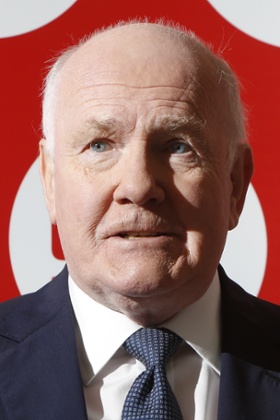
John Reid, the Labour former defence secretary, said Labour needed to be careful about thinking just changing the captain on the bridge was enough, when in fact the whole ship may be going in the wrong direction.
The veteran Labour politician said the public had thought the party was “on the wrong side of all the major arguments” including economic competence, immigration, and reform of public services.
“We have to get back to where Labour attracts votes across classes, across regions, across social stratas,” he told the BBC.
Alastair Campbell, Tony Blair’s former spin doctor, acknowledged the party had never really got “into the guts of why we’ve been losing support in Scotland”.
Updated
Tories reach 323 seats for Commons majority
Tories have reached 323 - the magic no for controlling the House of Commons once you take out the speaker and Sinn Fein
— Rowena Mason (@rowenamason) May 8, 2015
Updated
Ed Miliband: ‘responsibility for defeat is mine alone’
Ed Miliband has tweeted about Labour’s defeat, for which he claims full responsibility – surely a preamble to a resignation:
I’ve just thanked Labour’s staff. They are a credit to our party, and, driven by a passion to serve, they are a credit to our country.
— Ed Miliband (@Ed_Miliband) May 8, 2015
I am grateful to the people who worked on our campaign and for the campaign they ran. The responsibility for the result is mine alone.
— Ed Miliband (@Ed_Miliband) May 8, 2015
Defeats are hard, but we’re a party that will never stop fighting for the working people of this country.
— Ed Miliband (@Ed_Miliband) May 8, 2015
Nigel Farage: 'I've never felt happier'
The Ukip leader (for now) has made his speech as a losing candidate in South Thanet.
He says many people may think he’s having a bad day but five years ago he was in intensive care after a crash, so this isn’t as bad as that.
There was an earthquake in this election and it happened north of the border.
He says people in England were so scared of the SNP they shifted from voting Ukip to the Conservatives.
He says Ukip is no longer the party of retired colonels – “suddenly Ukip is the party for people under 30, particularly young, working women”.
He says Britain needs to examine its voting system:
What’s interesting is what’s happening with our democracy in Britain.
How can a party – the SNP – get 50% of votes but nearly 100% of the seats in Scotland? How can Ukip get something like three million votes but only one seat?
I think the time has come for real, genuine radical reform and Ukip will be the party that leads it.
And he ends on a surprising note, saying he feels that:
An enormous weight has been lifted from my shoulder … I have never felt happier.
The comedian Chris Addison has already suggested an alternative job for Farage.
Oh shit. Farage is now free to present Top Gear.
— Chris Addison (@mrchrisaddison) May 8, 2015
Updated
Farage previously said he would resign “in 10 minutes” if he didn’t win South Thanet.
We will see if he gives anything away in his speech, to come shortly.
There was talk overnight that other senior Ukip members would want him to stay on.
Farage had said that his successor ought to be a serving MP: the only contender now being Douglas Carswell, Ukip’s sole Westminster representative.
Updated
Nigel Farage loses in South Thanet

The Ukip leader has failed in his latest – and, he has said, last – attempt to become an MP. You can read Ben Quinn’s full story here.
Farage loses... Tories win Thanet #ge2015 shouts of "bye nigel" from floor
— Ben Quinn (@BenQuinn75) May 8, 2015
Nigel Farage loses to Craig Mackinlay in South Thanet. Farage 16,026 and Mackinlay comes in at 18k. He looks teary. #GE2015
— Beth Rigby (@BethRigby) May 8, 2015
Updated

Andy Burnham is favourite to become Labour leader if Ed Miliband goes, reports my colleague Kevin Rawlinson, who has sized up the contenders and assessed their chances in any upcoming leadership battle.
Burnham didn’t get much support the last time he stood for the leadership, when he made it to the second of four rounds of voting without ever really challenging. That he is the only one of the five candidates from that election seriously in the running this time, however, says a great deal about his performance ever since.
Perhaps predictably, he claimed to have no interest in the job as the exit polls were released on Thursday evening. “The only job I want tomorrow is to be health secretary in Ed Miliband’s government,” he said.
Updated
The German and Belgian leaders of the Greens in the European parliament, Rebecca Harms and Philippe Lamberts, described the prospect of the UK quitting the EU as “hara-kiri”.
“The UK is sleepwalking its way out of the EU,” they said. “This would have dramatic and negative consequences for the UK and its component nations, as well as for the rest of Europe. We can only hope David Cameron finally wakes up to this risk.”
Today has seen a record number of women elected as MPs: 182 so far. In 2010, it was 148. There are still seats left to declare, but the current number would make up 28% of the total 650 MPs at Westminster.
Updated
With the imminent resignation of Ed Miliband as Labour leader, Guardian columnist Rafael Behr asks: what happens next?
The great danger for Labour now is that, along with the failure of Miliband’s theoretical compromise position will die the brittle harmony he managed to negotiate in the party. Even before a leadership contest is called, a battle is getting under way to apportion blame for the defeat.
The left will want to pin responsibility on the residual habits of ‘Blairism’, while New Labour loyalists will cite an ill-judged lapse into a business-bashing left ‘comfort zone’.
Twin failures in Scotland and England teach different – perhaps contradictory – lessons:
The SNP positioned themselves as a more authentic ‘progressive’ proposition than ‘red Tory’ Labour. When Mhairi Black, the 20-year-old student who unseated Douglas Alexander, made her victory speech, she denounced austerity, the bedroom tax and Trident. There are many on the Labour left who will hear that kind of language as proof that Miliband vacated orthodox socialist positions and paid a price for it in an epic Caledonian collapse.
Yet in vital marginal seats in England, Labour’s swing barely registered. In many constituencies that were high on the party’s target list, Conservative majorities increased – Swindon, North Warwickshire, Hastings. For that to have happened, voters must have had profound reservations about Miliband’s capability to run the economy: doubts that will have long pre-dated the short campaign.

Updated
Finally, after much delay, the contenders are gathering at the count in South Thanet. Might we be about to find out if Nigel Farage is going to Westminster – or stepping down as Ukip leader?
Alastair Campbell: we should take our time to decide Labour's future
Alastair Campbell has blogged about Labour’s dark night. In a post headed “We got it wrong”, he writes:
Perhaps one of the reasons we are in this position is because we took so long to elect a new leader after Gordon Brown lost in 2010 that we allowed the Tories to frame the politics surrounding the economy for the entire parliament, and we did not rebut their attacks on our overall record with sufficient clarity or vigour …
But whereas I thought we took too long to elect a leader last time, perhaps the debate about the party’s future this time should be even longer. Because perhaps one of our problems is that we did not in reality have the debate that we should have had, with ourselves and with the public, from the moment Tony Blair made way for Gordon Brown.
After a result as awful as this, there has to be real deep soul-searching, and honest analysis about how and we have gone from being a party identified as the dominant force across UK politics over a decade and more, to where we are today.
These are not questions that can, or should, be answered in a hurry.
The former – and possibly future – French president Nicolas Sarkozy has tweeted his congratulations to David Cameron.
Heartfelt congratulations to you @David_Cameron on your impressive victory -NS
— Nicolas Sarkozy (@NicolasSarkozy) May 8, 2015
Updated
European press wary of Conservatives' election win
A reminder that Europe is watching. The German news magazine Der Spiegel has called David Cameron’s win “bad news for Europe”, reports Louise Osborne in Berlin.
The news magazine also says that the Tories’ expected very slim Commons majority will weaken the prime minister.
[The result] means that Cameron, the weak, will be even more susceptible to blackmail from within his own party than he has been in the last five years.
His Eurosceptic squallers in the backbenches, who for years have set the tone in the EU debate, will be even more powerful.
Der Spiegel goes on to say that the drama of two unions will continue – that of the British and the European unions – something that could either be the “never-ending story”, or a great opportunity to “at last sort out the constitutional chaos within the UK”.
Meanwhile, the French newspaper Le Monde has the UK election on its front page, under the headline “Worry in Europe”.
Le Monde's front page this afternoon - 'Cameron's triumph: worry in Europe' https://t.co/T9jB53rzN1
— Angelique Chrisafis (@achrisafis) May 8, 2015
Updated
David Cameron is expected to visit Buckingham Palace at around 12.30 today to see the Queen, at which point she will presumably invite him to form a new government.
Here is the moment Ed Balls lost his seat in Morley and Outwood to his Tory rival, Andrea Jenkyns, by just 422 votes:
There are now only 15 seats still to declare, including South Thanet, where we will learn the fate of Nigel Farage.
The Conservatives need six more seats to win a majority.
George Osborne has been tweeting. He says the country has given the Tories a mandate “to complete the job we started five years ago”.
Honoured to represent people of Tatton for the next 5 years. Will always seek to represent whole community, regardless of how people voted
— George Osborne (@George_Osborne) May 8, 2015
British people have asked us to complete the job we started 5 yrs ago of turning Britain around. Will get straight back to work on that task
— George Osborne (@George_Osborne) May 8, 2015
David Cameron has told Conservative party staff that “this was the sweetest victory of all”.
He says the party has hung on in Scotland and “displaced those Lib Dems in the south west”.
“We are on the brink of something so exciting.”
Ed Miliband has just arrived at Labour party headquarters in London, with his wife Justine Thornton.
Unsurprisingly, he declined to answer yelled questions from reporters over whether he will resign.
The Guardian’s understanding is that he will, with a statement expected later this morning.

Leanne Wood, leader of Plaid Cymru, has defended her party’s performance:
We were predicted to lose two out of our three seats at the beginning of this campaign, and we’ve increased our majority in those two.
What is concerning is that we now have a Conservative government to rule over Wales without a mandate.
Labour is the biggest party in Wales
All 40 seats in Wales have been declared, and Plaid Cymru, despite the exposure afforded by Leanne Wood’s participation in the TV debates, has stalled on three MPs:
- Labour 25
- Tories 11
- Plaid Cymru 3
- Lib Dems 1
Updated
The bookies are quick off the mark:
Next Labour Leader: Andy Burnham 7/4 fav, from Yvette Cooper (9/4), Chuka Umunna (3/1), Dan Jarvis (6/1) and Tristram Hunt at 11/1. #GE2015
— Paddy Power Politics (@pppolitics) May 8, 2015
More from Patrick Wintour:
Miliband quitting. Howard caretaker option dropped.
— Patrick Wintour (@patrickwintour) May 8, 2015
The Howard caretaker option refers to Michael Howard, who resigned but stayed as on leader for a few months until a successor – one David Cameron – was elected.
Ed Miliband to resign, the Guardian understands

The Guardian’s political editor, Patrick Wintour, confirms that the Labour leader is expected to stand down shortly.
We’ll have all the latest here as it unfolds.
Updated
Ed Miliband is expected to address Labour party staff shortly.
Can we expect him to stand down as leader? The BBC says it understands he will do – which would not be a surprise – but Labour insiders, for now, say this is speculation.
We will see.
The Guardian’s Larry Elliott has written his first thoughts on Ed Balls’ rejection by the voters of Morely and Outwood. The full article will be launched shortly, but here’s a summary of Larry’s take.
The Conservatives have waited almost 20 years for their own Portillo moment. With Ed Balls’s defeat in his Morley and Outwood seat, they got it.
Plenty of Westminster big beasts lost their seats in the 2015 election: Vince Cable, David Laws, the two Alexanders - Douglas and Danny. But the scalp of the man who was Gordon Brown’s closest adviser and who would have been chancellor in an Ed Miliband government was the biggest of the lot.
In some ways, the loss of Balls should not have come as that much of a shock. He was defending a small majority of 1,101 in his Yorkshire seat. He is a divisive character. And he has been the champion of a Labour economic strategy that has not convinced the voters. But the loss of the shadow chancellor is a profound blow to Labour …
At 48, Balls is still a relatively young man and now has to decide what to do with the rest of his career. One option would be to take a job in academia, perhaps in America, where he has plenty of contacts. Another would be to run a think tank, seeking to influence Labour policy from the sidelines. Another would be to make a swift return to Westminster in a by-election in a safe Labour seat.
One thing is certain: if Balls decides to retire from frontline politics, he will be missed.
Tory peer and pollster Lord Ashcroft – who earlier defended his polling predictions – says the new Conservative government needs to crack on with constitutional reform:
Ok let's now get on immediately with constituency boundary changes and reducing MPs from 650 to 600.
— Lord Ashcroft (@LordAshcroft) May 8, 2015
...and let's get rid of the 5 year fixed Parliament nonsense which was a pander to the LibDems...
— Lord Ashcroft (@LordAshcroft) May 8, 2015
...and furthermore let's set up a Royal Commission or similar to review the voting system. First Past the Post has had its day...
— Lord Ashcroft (@LordAshcroft) May 8, 2015
On the last point, he might well have support from Ukip, which has lamented that its third-largest share of the national vote has translated to a mere one MP (so far).
The Green party, too, has ended up with just a single MP:
with 20 results to come The #Greens got 1,115,162 votes
— General Election (@UKGE2020) May 8, 2015
More here from my colleague Rowena Mason on Ukip’s difficult night:
Ukip has suffered a frustrating night after gaining 12% of the vote but still only one MP so far – Douglas Carswell in Clacton.
Nigel Farage’s target seat of South Thanet is yet to declare but sources say it is “very, very, very tight” in a battle with the Conservatives.
The party failed to take Thurrock, Castle Point, or Great Grimsby, which were thought to be its next most likely targets. It also lost Rochester, which Mark Reckless had won in a byelection after defecting from the Conservatives.
The party is now likely to campaign hard for voting reform after picking up about 2.5m votes across the country.
Balls says Tory government could put union, NHS and EU membership at risk

Here is the key quote from Ed Balls’ concession speech.
-
Balls suggested five years of Tory government would put the union, the NHS and Britain’s membership of the EU at risk.
Any personal disappointment I have at this result is as nothing compared to the sense of sorrow I have at the result that Labour has achieved across the United Kingdom tonight in Scotland, but also in England and Wales, and the sense of concern I have about the future.
We will now face five years where questions will arise about the future of our union, about whether or not we can stay as a member of the European Union, and fight for jobs and investment, whether we can make sure we secure our National Health Service at a time of public spending cuts. Those are real concerns to me and to many people across the United Kingdom.
I’m heading off for a break now. Claire will be running the blog for the next few hours.
Updated
The BBC’s deputy political editor, James Landale, says many Labour politicians have been gracious in defeat:
I am struck by the graciousness of so many Labour candidates in defeat. Not sure it is being matched by all Conservative victors.
— James Landale (@BBCJLandale) May 8, 2015
What could he mean?
Iain Duncan Smith on Rochester result "I was once a colleague of Mark Reckless, I am pleased he is no longer the MP for that seat" #GE2015
— BBC Radio 5 live (@bbc5live) May 8, 2015
Sturgeon: 'The failure here is Labour's'

Nicola Sturgeon triumphantly joins Huw Edwards on the BBC for an interview:
We were hoping to do well, I think we were quietly confident … never in my wildest dreams did I imagine we would win 56 seats.
There is an appetite for change in Scotland, for Scotland’s voice to be heard much more loudly in Westminster than it has before.
The failure here is of Labour to beat the Conservatives … Labour has barely increased the share of the vote.
I was very clear during the campaign that if we had managed to get an anti-Tory majority we would have asked to work with Ed Miliband to keep the Tories out.
Even a majority Conservative government cannot ignore what happened in Scotland yesterday.
Sturgeon said she would push to end austerity, making it the number one item on the agenda for SNP MPs. The question of independence would not feature, she insisted:
It’s not about winning another mandate for a referendum … I’m not going to go back on that.
It wasn’t just people who voted yes last yr [who voted SNP yesterday] – signifcant numbers of those who voted no also did so.
If there’s ever going to be another referendum, people will have to vote for that in the Scottish parliament.
Updated
Today's national newspaper front pages - gallery
How the UK’s national newspapers reported the shock news that David Cameron appeared to be on course to remain as prime minister, with a Commons majority for the Conservatives.
Some commentators are comparing the Tories’ surprise win to 1992 when John Major confounded the pundits and won the last Conservative majority.
There are however other more potentially difficult echoes of ‘92 for the Conservatives, especially a new government with a wafer-thin majority.
After his victory, Major found himself tormented by his Tory eurosceptic right and thus relied on the Ulster Unionist party’s then nine seats to prop up his majority in the Commons.
If, as projected, David Cameron is just over the line by two to three seats, there will come a time sooner rather than later in this parliament when he may have to go to the eight Democratic Unionist MPs and the two new Ulster Unionist MPs for support to keep his government in power.
Nigel Farage is still waiting to hear if he has won in South Thanet.
He’d previously said he would step down as leader if he failed to secure the seat. Will he do that, he’s asked by reporters:
Are you calling me a liar?
He said the election had showed up the odd nature of the first past the post system, in which Ukip, “a party that wins clearly the third [largest] popular share of the vote”, would have barely any representation in parliament: just one seat so far, for Douglas Carswell in Clacton.
Quizzed on the new Conservative government, Farage said:
I just think nothing will change … I would like to see the Conservative prime minister break one promise, which is the maintenance of the Barnett formula.
David Cameron is the first PM since Lord Salisbury in 1900 to increase vote share at next election after being PM for more than 18 months
— Andrew Cooper (@AndrewCooper__) May 8, 2015
Re-election of Sir Gerald Kaufman in Manchester Gorton means that he will be Father of the House in the new House of Commons
— Labour History Group (@LabourHistory) May 8, 2015
In the City of London, shares are surging as traders welcome the election results. The FTSE 100 index of blue-chip shares soared 150 points at the open of trading, a gain of 2%.
Companies who would have faced tougher regulations under a Labour government are leading the way; energy firm Centrica is up 6.5%, and several housebuilders have jumped 5%.
Engineering firm Babcock, which holds a contract to build Trident submarines, has seen its shares rise almost 7%.
And the pound is on track for its best day against the euro since 2009, up almost three cents at €1.381.
Ed Balls left the Leeds Arena as soon as he had delivered his concession speech, refusing to answer questions from reporters.

Speaking after the result, Jenkyns said the result was testament to two years of hard work.
“I’ve worked my heart out in the last ten years. I couldn’t have given any more. I gave up my job, sold my house, moved back in with mum after 20 years to do this full time,” she said.
She said the noticed “more and more Labour voters coming over” to her in recent weeks. “People who had only ever voted Labour before were putting their trust in me.”
She said she had campaigned as if she already were the MP, organising a jobs fair, listening to residents’ planning concerns and gripes about potholes.
Jenykns said “there was a lot of humility” in Ed Balls’ reaction to defeat. “He told me I would make a very good MP,” she added.
Updated
Here’s David Cameron’s speech to CCHQ this morning.
Exclusive: David Cameron's victory speech to CCHQ staffers this morning #ge2015 #conservative https://t.co/nKtdhBVxr7
— Sebastian Payne (@SebastianEPayne) May 8, 2015
The eight Lib Dem MPs
Who are the eight Lib Dems who have survived this bloodthirsty night?
- Nick Clegg, Sheffield Hallam: the party leader, though having gone from being deputy PM to marshalling a group of MPs small enough to fit in a minibus, he might not hang around for long.
- Tim Farron, Westmorland and Lonsdale: already being talked about as a potential successor to Clegg.
- Alistair Carmichael, Orkney and Shetland: Scottish secretary under the coalition, he’s now the only Lib Dem MP in the whole of Scotland.
- Norman Lamb, Norfolk North: one of the few better-known names – he’s a junior health minister – to hang on.
- Tom Brake, Carshalton and Wallington: the party’s London spokesperson held off the Tories.
- John Pugh, Southport
- Mark Williams, Ceredigion
- Greg Mulholland, Leeds North West
And that’s it so far, with three constituencies with resident Lib Dem MPs still to declare:
- Tessa Munt, Wells: now the party’s last hope of a female MP.
- Berwick upon Tweed: declaration expected around midday. Julie Pörksen hopes to succeed retiring Alan Beith here.
-
Andrew George, St Ives
Updated
Here is some snap Twitter comment from political journalists on Ed Balls losing his seat.
From BuzzFeed’s Jim Waterson
Labour lost Ed Balls' seat because Labour voters went to UKIP. Labour's northern base is now in places where UKIP in 2nd. Not a good look.
— Jim Waterson (@jimwaterson) May 8, 2015
From the Independent’s Steve Richards
Ed Balls is one of the big post 1945 political figures. A huge loss to country and Labour.
— steve richards (@steverichards14) May 8, 2015
From the New Statesman’s Jason Cowley
Now Ed Balls has gone. A massive figure cut down. The absolute end of the Balls-Miliband era. Ukip eating up Lab votes in the north. #GE15
— Jason Cowley (@JasonCowleyNS) May 8, 2015
From the Guardian’s Matthew D’Ancona
I shall miss @edballsmp - a bruiser, an intellectual, a great conversationalist and un homme serieux. He'll be back.
— Matthew d'Ancona (@MatthewdAncona) May 8, 2015
From the Independent on Sunday’s John Renoul
Don't agree with what Ed Balls did to Tony Blair, but he was the biggest intellect in Labour's shadow cabinet.
— John Rentoul (@JohnRentoul) May 8, 2015
From the Evening Standard’s Pippa Crerar
Ed Balls loses by 422 votes. If he'd spent just a wee bit more time in his constituency...
— Pippa Crerar (@PippaCrerar) May 8, 2015
From the New Statesman’s George Eaton
Ed Balls a big loss to the Commons - even some Tories concede that he was the top economist in the House.
— George Eaton (@georgeeaton) May 8, 2015
From the Sunday Times’s David Smith
Tragic for Ed Balls, whatever your opinion of him. He was almost chancellor under Gordon Brown. I suspect he'll never be chancellor now.
— David Smith (@dsmitheconomics) May 8, 2015
From the Sunday Times’s Tim Shipman
I know he divides opinion but Ed Balls is one of the grown ups and a man who cares about politics. This is a loss for the Commons.
— Tim Shipman (@ShippersUnbound) May 8, 2015
Updated
Andrea Jenkyns -who has just kicked out Ed Balls - hugs her delighted mum. Says Labour voters came over to her. pic.twitter.com/2NQ8OzlpWX
— Helen Pidd (@helenpidd) May 8, 2015
Ed Balls’ concession speech
Ed Balls is making his concession speech.
He congratulates his political opponents, and he congratulates the new MP.
He thanks his campaign team.
It has been a great honour to be an MP in Morely and Outwood, he sys.
Any personal disappointment I have at this result is nothing compared to the sense of sorrow I have about what has happened to Labour, he says.
He says there are now real concerns about the future of the UK, and about the future of the UK in the EU.
Labour believes in the union because pooling risk underlines fairness.
He concludes saying he is confident Labour will be back.
Andrea Jenkyns says "there was a lot of humility" in the way Ed Balls responded to defeat.
— Helen Pidd (@helenpidd) May 8, 2015
Updated
Labour shadow chancellor Ed Balls loses seat

The shadow chancellor, Ed Balls, has lost his Morley and Outwood seat by 422 votes, becoming the highest profile Labour casualty of a terrible election night for the party.
Balls, who has been an MP since 2005, failed to defend his 1,101 majority in the face of a stealth ground campaign from the Conservative party.
The Tory candidate Andrea Jenkyns was declared the winner after parties “mutually agreed” a recount at around 7am. Rumours had swirled since polls closed that the Tories were feeling confident about their chances. Balls disappeared before midnight and surfaced grim-faced at 7am to receive the news that he was behind on around 260 after the first count.
Forty-year-old Jenkyns, a music teacher and amateur opera singer, has essentially been campaigning full time since her selection in April 2013. She even quit her job in a secondary school and sold her house in Boston, Lincolnshire, moving back home with her mother Valerie in order to dedicate herself to defenestrating Balls.
Selling herself as “non-politician” from humble beginnings, Jenkyns didn’t go to university and she worked her way up from being a Saturday shop girl to a senior retail manager.
In her late 30s she decided to retrain and has recently achieved an Open University degree in international relations and politics. On her website she describes herself as “an upfront, direct, and strong Yorkshire lass who passionately stands up for what she believes in.”
Her father was a lorry driver who built up his own haulage business. He died a few years ago after contracting the superbug MRSA in hospital in 2011 - it was this tragedy which spurred her on to run for parliament.
Updated
Here is the latest BBC seat projection.
Our forecast now 329 Con 233 Lab
— Laura Kuenssberg (@bbclaurak) May 8, 2015

David and Samantha Cameron arrived at Conservative HQ in Westminster at 7.20am, waved to staff from the top of the front steps of the HQ and moments after they went in a huge cheer rang out from behind the windows where venetian blinds were pulled shut.
Around 20 minutes later, the couple left, Cameron smiling broadly as he opened the door of his government Jaguar for his wife, and they left for Downing Street.
Among those celebrating were Grant Shapps, the Conservative chairman, and Greg Hands, the deputy chief whip, who even in the moment of triumph was maintaining discipline. Asked by the Guardian what the atmosphere was like, he said: “What happens in there, stays in there.”
Lord Dubbs, a Tory peer, was more open: “It was absolutely euphoric,” he said. “What is most important is it gives us the chance to serve for another five years.”
Lord Feldman, chairman of the board of the party and its fundraiser in chief, said he was “tired but very happy”.
He said of the result, “It was what we were planning and what we expected”. Asked by the Guardian about Labour’s supposed supremacy in the ground war campaign, he said: “They talked a lot and we just got on with it. Our campaign was different. More targeted.”
Here are the average swing figures on the basis of the results that are currently in.
Con to Lab - 0.44%
LD to Con - 7.84%
LD to Lab - 8.27%
Ukip says it is now UK's 3rd largest party in terms of votes
Ukip says that it is now the third largest party in the Uk in terms of nationwide vote. And it has come second in at least 90 seats, it says. In a statement it says:
In many constituencies we are the opposition, on behalf of working class voters who have been neglected and taken for granted for decades. This is true of both Northern England where we are the opposition to Labour and in Southern England where we are the opposition to the Conservatives.
We’ve provided hope and truth for the electorate and driven the political agenda.
Here is David Cameron, along with his wife Samantha Cameron, heading back into No 10.
He looks pretty pleased, let’s just say.

Q: Your first 18 months are going to be dominated by the EU referendum. That is going to damaging.
Osborne says David Cameron does not believe in running away from problems. With a manadate from the electorate, he will be able to get a better deal for Britain.
Back to George Osborne on Today:
Q: How is David Cameron going to bring the nation together?
That is one of the very big challenges all MPs face, says George Osborne.
There is no simple and easy answer, he says.
He says people should respect the Scottish election result, and make the Scottish feel party of a strong UK.
There are plans for further devolution to Scotland. It would be a mistake to throw that away, he says.
Updated
Caroline Lucas has not just held her Brighton Pavilion seat but done so with style, increasing a 2010 majority of just 1,252 over Labour to almost 8,000 – an amazing achievement.
The Greens did throw everything at this seat, and it’s paid off. The party’s supporters in the count room cheered ecstatically as the result came in.
Lucas gave a near Oscar-length list of thanks, and also praised her constituency for being “creative, compassionate and brave”.
Politics, she said, is about “giving people hope, not filling them with fear”, and she said she believes people are receptive to an anti-austerity message if properly presented.
The Greens are left on one seat – the exit polls had predicted two – but they will be not just relieved, but heartened that Lucas now seems entrenched in parliament.

George Osborne, the Conservative chancellor, is being interviewed on Today now.
Q: Are you going to be dragged to the right?
No, says Osborne. We are a party for the working people.
Scotland's new political landscape this morning. #GE2015 http://t.co/AoNsGRHsOz pic.twitter.com/VSq2ap9t7n
— Scotsman (@TheScotsman) May 8, 2015
David Cameron has arrived back at Downing Street.
David Cameron arrives back at Number 10 Downing Street with his wife Samantha: https://t.co/CDqZyVC983 via @NeilLancefield
— Press Association (@pressassoc) May 8, 2015
Updated
My colleague Tom Clark makes a good point about the significance of the Conservatives having a majority.
Super-slim Con maj signif b/c of Salisbury convention then mks it harder for Lords to block repeal HR Act & other manifesto horrors
— Tom Clark (@guardian_clark) May 8, 2015
Scotland: final results
All the results are in in Scotland and it’s an astonishing victory for the SNP:
- SNP 56 (+50)
- Conservatives 1 (-) David Mundell in Dumfriesshire, Clydesdale and Tweeddale
- Labour 1 (-40) Ian Murray in Edinburgh South
- Liberal Democrats - 1 (-10) Alistair Carmichael, Orkney and Shetland.
Our video department have put together this highlights package from the Scottish counts, which is very much a lowlights package for non-SNP supporters.
Updated

On the Today programme Paddy Ashdown, the former Lib Dem leader and head of the party’s election campaign, is being interviewed now. He says he is proud of the campaign his party ran, and the decency it embodied.
He says the country is now more divided than it was. David Cameron used fear of the Scots to win the election, he says. He says he hopes that Cameron will reflect on this, ad heal the divisions he created.
Q: Should Nick Clegg resign?
Ashdown says Clegg should be allowed to make his decision in his own time.
Updated
Labour take Dewsbury from Conservatives

Dominic Smith has filed this from the count in Dewsbury, which has proved a ray of sunshine for Labour on a dark, dark morning.
It’s a rare Labour gain from the Conservatives in Dewsbury, with Paula Sherriff ousting incumbent Conservative MP Simon Reevell by a majority of 1,451 votes.
Ahead of the poll, it was assumed a victory here in this key Tory-Labour marginal in West Yorkshire would be a strong indication Ed Miliband was about to be swept into Downing Street. Instead, it offers just consolatory cheer after Labour spectacularly failed to take a long list of other targets including North Warwickshire and Thurrock.
The declaration finally came just after 7.15am after hours of tension for candidates and their supporters with gossip about the likely victor changing by the hour.
Sherriff, a healthcare worker, overturned a narrow majority of 1,526 with Reevell himself only taking the seat from Labour in 2010.
Speaking at the count at Cathedral House in Huddersfield, Sherriff said: “It’s been a very long evening and morning for everybody. I wish Simon all the best in his future career.
“Dewsbury has been suffering for five years and people have been hurting. People deserve a hard-working full-time MP and that’s exactly what I’ll bring to the constituency.”
Updated
Danny Alexander, the former Lib Dem chief secretary to the Treasury, said the Conservative campaign had been “hugely divisive” for the UK.
I think that the way David Cameron has conducted this election campaign has been hugely divisive for the UK. He has tried to stoke up the fear of the SNP in England and has helped the SNP to stoke up the fear here in Scotland and it’s been a campaign where the two parties have fed off one another and I think that has been very divisive within the UK. I hope that Mr Cameron, if he does continue as prime minister, will reflect much more carefully on what’s needed to heal the United Kingdom rather than simply pandering to his own party advantage.
He also said he expected a second independence referendum in Scotland.
In this constituency I got more or less a very similar number of votes to that which I received in 2010, but the SNP did very well and they’ve had a wave of success across Scotland, the Labour Party has almost disappeared and those votes have gone to the SNP. I suspect they will try and use this to push for another referendum on independence which I think would be the wrong thing for our country.
Caroline Lucas wins in Brighton Pavilion
The Green party has held on to its sole seat in the Commons.
Huge cheers from the room as Lucas was returned, increasing her share of the vote by 11% on 2010.
Lucas says politics about "giving people hope, not filling them with fear." Party has had best election ever. But political system "broken"
— Peter Walker (@peterwalker99) May 8, 2015
Updated
I now make it 8 seats that Lab have taken off Cons. But Cons have lost 6 to Lab. A net gain so far of two.
— Philip Cowley (@philipjcowley) May 8, 2015
David and Samantha Cameron have arrived at Conservative HQ in central London. Huge cheers ringing out from inside the building. Grant Shapps went in too.
Now. pic.twitter.com/enZ4rk4qXK
— Mark Textor @ AGF (@AGFchairman) May 8, 2015
Updated
Emily Thornberry, sacked from the Labour frontbench after her unfortunate “white van” tweet, has been returned in Islington South and Finsbury with an increased majority.
Her colleague Stella Creasy also saw a bumper win in Walthamstow, increasing her votes by 17% to snare a 68.9% share of the total vote.
A 23,000 majority is overwhelming - Walthamstow will have some sleep now and then am back on it later today to repay your faith! #thankyou
— stellacreasy (@stellacreasy) May 8, 2015
A reminder that the world is watching the UK right now, from Guardian Australia’s political correspondent Daniel Hurst.
As the numbers in Westminster shifted, British citizens living in Australia closely followed the developments at an event at Westminster House in the nation’s capital, Canberra.
The aptly named residence of the British high commissioner, Menna Rawlings, hosted dozens of citizens along with business, media and other diplomatic representatives watching the election results on television screens.
A photo of each of the party leaders was placed atop the grand piano, while visitors were able to choose from red or blue-tinged drink options depending on their political preferences. While waiting to see if the exit polls turned out to be correct, people posed for photos wearing bobby hats in front of a fake Number 10 door.
When David Cameron emerged on the television screens to claim his seat - and make broader observations about the result - Australians could relate to his assertion that the only opinion poll that mattered was the one conducted on election day. The line is a familiar and regular feature of Australian political discourse.
Leaving the party, one of the attendees referred to the surge in support in Scotland for the SNP and quipped: “I’m going to go and watch Braveheart tonight.”
Even amid the gloom there’s some glimmers of joy for Labour. Their candidate for Hove in East Sussex, Peter Kyle, just took the seat back from the Conservatives, a result that had not been expected this morning.
Hove had been in Labour’s top 30 targets from the Tories but they failed in the first Brighton area seat to be declared, Brighton Kemptown, and the omens looked poor.
In Hove, Labour were arguably helped by some unfortunate circumstances – the sitting Tory MP, Mike Weatherley, stood down due to cancer. Kyle was also seen as an energetic and well-assisted candidate.
Last of the three seats at this count is Brighton Pavilion, currently held by the sole Green MP of the last parliament, Caroline Lucas. She’s still tipped to win, but the longer the count takes the more nervy some Greens look.
With 559 results in, the current turnout figure is 65.8%.
Another scalp for the SNP, and it’s another Lib Dem losing his seat: Michael Moore, the former Scottish secretary, is out of Berwickshire, Roxburgh and Selkirk. The swing to the SNP was 27%.
The SNP now has 56 of Scotland’s 59 seats.
Updated
This is probably a sound prediction, from the Spectator’s James Forsyth.
One consequence of tonight is that in any future hung parliament, no small party will enter into a full, formal coalitionn
— James Forsyth (@JGForsyth) May 8, 2015
The Guardian’s James Ball puts some of the night’s big numbers in context.
This is six minutes' worth of what will be cut from the welfare budget (photo HT @flashboy, who feels okay rn) pic.twitter.com/i4Oamu2SOv
— James Ball (@jamesrbuk) May 8, 2015
Northern Ireland: final results
The final breakdown of Northern Ireland’s 18 seats shows gains for unionism.
- The DUP will return with eight, as before.
- Sinn Fein now has four, having lost Fermanagh/South Tyrone.
- The SDLP go back with the same three seats as the last parliament.
- The Ulster Unionists have gone from zero seats in 2010 to two.
- Independent Unionist Lady Sylvia Hermon goes back to the Commons to represent the North Down constituency.
David Cameron has just arrived at Conservative party headquarters. It’s not yet clear whether he will make a speech from there at some point soon, or wait till he can reclaim that Downing Street lectern.
Here's to a brighter future for everyone. pic.twitter.com/EeN0YFAvBm
— David Cameron (@David_Cameron) May 8, 2015
Updated
The Liberal Democrats have lost St Austell and Newquay to the Conservatives.
The BBC latest forecast now predicts just eight seats for the Lib Dems once all the totting-up is done. This would, at least, narrow the field for any potential leadership contest.
David Cameron presents himself as a one nation prime minister - Analysis
David Cameron has been tweeting this morning, underlining a message his set out in his acceptance speech about two hours ago. Here’s the tweet.
One nation, one United Kingdom - that is how I hope to govern if I am fortunate enough to continue as Prime Minister.
— David Cameron (@David_Cameron) May 8, 2015
And this is what he said in his speech:
I want my party, and I hope the government I would like to lead, to reclaim a mantle that we should never have lost, the mantle of one nation, one United Kingdom. That is how I will govern if I’m fortunate enough to form a government in the coming days.
At one level this is a relatively commonplace Conservative platitude, although Cameron seems to be half-acknowledging that it was a mistake for the Tories to allow Ed Miliband to grab the one nation label for Labour.
But, in the light of the way that Cameron has been campaigning over the last few weeks, it is also an astonishing about-face. Cameron spent much of the election campaign warning about threat posed by Scottish MPs. If a minority government were dependent on the votes of the SNP, then the interests of the English would suffer, he argued, because the SNP would force the government to prioritise the Scots.
The Conservatives admitted that this message proved effective on the doorstep, but at times they laid it on so thick that it sounded as if they were saying the SNP had no right to pass UK laws. For example, Cameron told the Andrew Marr show.
Frankly this is a group of people that would not care what happened in the rest of the country. The rest of the United Kingdom – Wales, Northern Ireland and England – would not get a look-in, and that is the prospect we face ... The SNP do not want to come to Westminster to contribute to a government. They want to come to Westminster to break up our country.
Now, having fought a two nations election campaign, Cameron is presenting himself as a one nation prime minister. It is quite a U-turn.
But there is a precedent. During the Scottish independence referendum, Cameron urged the Scots to vote to no on the grounds that they were respected partners in the union. Less than 12 hours after the polls closed, he made a statement in Downing Street disclosing plans to restrict the voting rights of Scottish MPs.
Updated
I’m not entirely sure what Rupert Murdoch’s gripe against the BBC is (though he has a point on the polls):
So all UK polls nonsense. Also bloody nose for BBC.
— Rupert Murdoch (@rupertmurdoch) May 8, 2015
Mind you, Murdoch had this to say only a couple of days ago:
UK Polls predict closest ever result, followed by months of instability without unlikely last minute big swing to Cameron.
— Rupert Murdoch (@rupertmurdoch) May 5, 2015
The Conservative onslaught against its former Lib Dem coalition buddies continues: they have taken Taunton Deane, the seat formerly held by Jeremy Browne, who announced last year that he would not seek re-election.
Over in the City, traders are pleased that the Conservatives have had such a good night.
The FTSE 100 is expected to jump by over 100 points when the stock market opens at 8am, a gain of around 2%.
We are now calling #FTSE100 to open +120 points and trade above 7000 level at 8am market open
— Joshua Raymond (@Josh_CityIndex) May 8, 2015
The pound has already hit its highest level against the US dollar since late February, at $1.55.
The markets had been braced for weeks of coalition negotiations, so there’s relief that the result is so decisive. Some investors, though, are already pondering the implications of the surge in support for the SNP, and the prospect of an EU referendum.
Our business liveblog will be tracking all the details through the day.
And in not-at-all-surprising news, George Osborne has been returned as MP for Tatton.
Better news for the Lib Dems in Norfolk North, where Norman Lamb has kept his seat.
It looks as though the result in Ed Balls’ constituency is going right to the wire:
A recount has been ordered in Ed Balls' Morley and Outwood seat.
— Helen Pidd (@helenpidd) May 8, 2015
Hearing there are 260 votes in it - don't know who was the loser on the first count. Ed not answering qs pic.twitter.com/TxyY1ZE6GY
— Helen Pidd (@helenpidd) May 8, 2015
Updated
The Electoral Reform Society says that 153 female MPs have been elected so far, with 150 results still to come.
In the last parliament, there were 148 female MPs.
Lib Dem minister Stephen Williams has been booted out in Bristol West by Labour’s Thangam Debbonaire.
In fact, he came third, behind a Green surge from candidate Darren Hall, who was tipped to do well here:
BRISTOL WEST - FULL RESULT pic.twitter.com/v6vUgi8Psk
— BBC Points West (@bbcpointswest) May 8, 2015
John Curtice, the psephologist who was in charge of the BBC/Sky/ITV exit poll, is on the Today programme now. He says the idea that the Lib Dems would not be punished for going into coalition was always questionable. Now it has been shown to be false.
Q: Were you surprised by your own poll findings?
Yes, says Curtice. But he says that he has learnt to expect the unexpected. Five years ago, when the exit poll suggested the Lib Dems would lose seats, people did not believe that. But it turned out to be correct.
He says he looks forward to seeing Paddy Ashdown eat his hat, as he promised to do if the exit poll turned out to be correct.
Updated
The biggest names to lose

So far…
Labour
- Jim Murphy, the Scottish Labour leader, lost to the SNP. 81% turnout
- Douglas Alexander, Labour’s campaign chief and shadow foreign secretary, also fell to the SNP in Paisley and Renfrewshire South. His successor is 20-year-old Mhairi Black, the youngest MP elected since 1667.
Liberal Democrats

What to say? Three Lib Dem cabinet ministers lost their seats, as did several ministers and a former party leader:
- Vince Cable was pushed out in Twickenham by the Conservatives.
- Danny Alexander lost in Inverness, Nairn, Badenoch & Strathspey to the SNP.
- Ed Davey was ousted in Kingston and Surbiton by the Tories.
- Lynne Featherstone lost in Hornsey and Wood Green to Labour.
- Jo Swinson lost in East Dunbartonshire to the SNP.
- David Laws saw Yeovil go to the Conservatives.
- Charles Kennedy lost in Ross, Skye and Lochaber to the SNP. He’d been MP there since 1983.
- Another long-serving MP, Simon Hughes lost in Bermondsey to Labour.
- Labour also took Cambridge from Julian Huppert.
Conservatives
- The biggest scalp so far is Esther McVey, who lost to Labour in Wirral West.

Ukip
- Mark Reckless saw his seat in Rochester and Strood go back to the Tories.
Respect
- George Galloway lost Bradford West to Labour’s Naz Shah.
Updated
Ian Murray, who now faces the next five years as the only Labour MP in Scotland, after holding his seat with a greatly increased majority, told the Guardian he felt “a bit numb really,” after watching his party eviscerated at the general election
“No celebrations tonight, although I’m absolutely delighted to be reelected. It has been a devastating night for the Labour party in Scotland. We need to reflect, we need to listen, we need to move on.”
Asked why Labour had been so heavily defeated, losing all the 40 other seats it won at the 2010 election, he said: “I don’t think we have been heard properly. People wanted a strong policy on poverty pay, they wanted strong policies for the next generation, they wanted strong policies on the environment.
“We responded on all of those but in my view, we didn’t cut this message through because people were too interested in who was doing deals with who and that vacuous [SNP] phrase ‘standing up for Scotland’.
“What has just been delivered this evening is five more years of Tory government.”
Jeremy Hunt, the Conservative health secretary, has kept his seat in south west Surrey.
The Conservatives have also held on to Brighton Kemptown, which Labour was hoping to take.
If you’re joining us from the overnight election live blog, you’ll have spotted that Mark Reckless – who defected from the Tories to Ukip and won a by-election in Rochester and Strood – has just lost his seat. The Conservatives have snatched it back.
Douglas Carswell in Clacton is so far the only Ukip MP. We are yet to hear of Nigel Farage’s fortunes in South Thanet.
Updated
Here is the Guardian’s 6am front page:
Guardian front page 6am edition pic.twitter.com/rWeJVGff0l
— Paul johnson (@paul__johnson) May 8, 2015
Morning briefing
Good morning. For those who stayed up all night, and for those who are just rising and wondering what on earth is going on – here’s what the night has brought us.
What we know
The polls were wrong. The suggestion, right up to the wire on polling day, that the Tories and Labour were neck and neck has not been borne out.
It is clear that the Conservatives will be the largest party by some margin. They might even sneak a small majority.
Labour has been ripped apart in Scotland, where it has had just one seat returned: Edinburgh South. It has failed to see the breakthrough it needed in England and is predicted to emerge from the counting with 232 seats, well down on predictions.
The Liberal Democrats have been obliterated nationwide. Though Nick Clegg retained his seat in Sheffield Hallam, and the Scottish secretary, Alistair Carmichael, held on, all the other Lib Dem cabinet ministers – Danny Alexander, Vince Cable and Ed Davey – lost their seats. So did ministers Jo Swinson, David Laws and Lynne Featherstone.
The SNP has stormed across Scotland, scooping up all seven seats in Glasgow and toppling Labour big beasts Jim Murphy and Douglas Alexander. Exit polls predicted it could take 58 out of Scotland’s 59 seats. Alex Salmond will be heading back to Westminster after winning in Gordon.
Ukip has had a quiet night, scoring a number of second-place finishes but so far securing just one MP, Douglas Carswell, who returns in Clacton.
George Galloway, for Respect, has lost his seat in Bradford West to Labour’s Naz Shah.
Boris Johnson is on his way back to the Commons, having won in Uxbridge and South Ruislip.
Here are the revised BBC/Sky/ITV exit poll projections at 6am on Friday:.
- Conservatives: 325
- Labour: 232
- SNP: 56
- Lib Dems: 12
- DUP: 8
- Plaid Cymru: 3
- Ukip: 2
- Greens: 1

What we still don’t know
- Whether David Cameron will have enough seats to form a majority without needing to rely on the Lib Dems – who, with a potentially new leader, might in any case not want to rush back into Tory arms – or the DUP.
- Whether Nick Clegg and Ed Miliband will resign.
- Whether Nigel Farage will win in South Thanet, where the result has not yet been declared.
- Whether Caroline Lucas will retain a seat for the Greens in Brighton Pavilion.
- If Ed Balls has retained his seat in Morley and Outwood, amid rumours he has lost his seat.
Stay with the live blog throughout Friday, where we will bring you all the latest as results continue to pile in.
Updated