We’re closing this blog now, and we will carry on covering the remaining election results, and the reaction – including the likely resignation of Nick Clegg later today – on a new blog which we’ve just launched.
Thanks for the comments.
The Conservative Claire Perry is happy to see Mark Reckless go.
Hallelujah. Mark Reckless out. Don't let the door hit your fat arse as you leave.
— Claire Perry (@claire4devizes) May 8, 2015
This result will give David Cameron particular pleasure, the Tories have defeated Mark Reckless in Rochester and Strood
— James Forsyth (@JGForsyth) May 8, 2015
According to the BBC, there are the current share of the vote figures, based on the seats that have been counted so far (not full GB projections).
Conservatives: 34%
Labour: 34%
Ukip: 12%
Lib Dems: 8
SNP: 7
And Ed Miliband has been tweeting too.
He says David Cameron has a duty to unite the country.
This has clearly been a very disappointing and difficult night for the Labour party. To every member and supporter, I want to say thank you.
— Ed Miliband (@Ed_Miliband) May 8, 2015
The next government has a huge responsibility to bring our country together. What unites us is much, much more than what divides us.
— Ed Miliband (@Ed_Miliband) May 8, 2015
David Cameron has been tweeting the core message from his acceptance speech.
One nation, one United Kingdom - that is how I hope to govern if I am fortunate enough to continue as Prime Minister.
— David Cameron (@David_Cameron) May 8, 2015
Sinn Féin has lost its first Westminster seat since 1992.
The Ulster Unionist candidate Tom Elliott has triumphed in Fermanagh/South Tyrone - the most marginal constituency in the UK. In 2010 Sinn Féin won the seat by just four votes against another united unionist candidate.
But Elliott has recaptured the seat for unionism once more. He polled 23,608 votes against Michelle Gildernew of Sinn Fein who took 23,078 votes.
The loss is significant for Sinn Féin as the last time it surrendered a Westminster seat was 23 years ago when Gerry Adams lost his West Belfast stronghold to the SDLP’s Dr Joe Hendron.
The result is also major boost for the unionist community west of the river Bann where until now Sinn Féin has been the dominant political force.
The Tories have won back Corby from Labour.
Revised exit poll figures say Tories on course for 325 seats, Labour 232
Here are the revised BBC/Sky/ITV exit poll projections.
Conservatives: 325
Labour: 232
SNP: 56
Lib Dems: 12
DUP: 8
Plaid Cymru: 3
Ukip: 2
Greens: 1
This is from Jon Mellon, a member of the BBC/Sky/ITV exit poll team.
Our forecast (updated after the exit poll using the declared results) has the Conservatives right on the edge of a majority #GE2015
— Jon Mellon (@jon_mellon) May 8, 2015
Caroline Flint has held Don Valley for Labour.
Here’s our latest front page.
Guardian front page 6am edition pic.twitter.com/rWeJVGff0l
— Paul johnson (@paul__johnson) May 8, 2015
Labour sources admit Ed Balls seat will be "close" but too early to say #GE2015
— Sophy Ridge (@SophyRidgeSky) May 8, 2015
Rosie Winterton has held Doncaster Central for Labour.
Boris Johnson, tired but visibly delighted at the incoming results, has cheekily, and somewhat worryingly, joked it was the Guardian wot won it.
Referring to a direct video appeal he made to Guardian readers to vote Tory 24 hours before the polls opened, he joked: “It was devastating. I met people who had seen it.”
He made a more serious analysis of the election dynamic saying Ed Miliband had “goofed” by “vacating the centre-ground that Tony Blair had squatted on so authoritatively”.
On a dismal night for the Lib Dems, he added that he did “feel very guilty” about calling Nick Clegg a “lapdog-cum-prophylactic” and praised his brave decision to enter the coalition, saying he “did the right thing”.
Turning to thoughts of breakfast, he said: “I am full of beans. I might go and fill myself with more beans.”
Updated
Cameron says he wants to reclaim the mantle of one nation
David Cameron starts by thanking staff at the count and his supporters and Conservative campaigners across the country.
It is a huge honour to be MP here, he says.
Today is the 70th anniversary of the victory in Europe in 1945. We should start by remembering those who gave their lives.
He has often said there is only one poll that counts, the one on election night, and that has never been truer.
This has been a very strong result for the Conservatives. Their positive plan has been rewarded.
He believes that those who can, should work. And those who can’t, should be helped.
It is to early to know what the final result will be.
But he wants to build on that strong foundation.
If you want a home and a job, we are with you, he says.
He says you must not duck difficult issues in politics.
He wants to carry on governing for everybody, he says.
He says he will implement as quickly as possible devolution for Scotland and Wales.
He wants his government to reclaim the mantle of one nation.
Updated
David Cameron has just been re-elected MP for Witney.

Updated
Ed Miliband learned at 5.30am that he had held his safe Labour seat of Doncaster North, just as the scale of his party’s losses were becoming apparent to all around him.
He took to the stage at Doncaster Racecourse after watching one Labour MP after another lose their seats in Scotland to the SNP, and as results from across England and Wales made clear that he had no hope of pulling neck and neck with the Tories.
“This has clearly been a very disappointing and difficult night for the Labour Party,” he said. We haven’t made the gains we wanted in England, and in Scotland we have seen a surge of nationalism overwhelm our party.”
Miliband made no hint about his own future, and ended his brief speech by adding: “The next government has a huge responsibility in facing the very difficult task of keeping our country together.”
In an apologetic note, Miliband added that he was “deeply sorry” that so many Labour MPs had lost their seats north of the border, hailing them as “dedicated and decent colleagues”.
Miliband won 20,708 votes, giving him a majority of 11,780. In 2010 his majority was 10,909. The Ukip candidate, Kim Parkinson, won 8,928 votes. The Tory candidate, Mark Fletcher, came third with 7,235 and the Lib Dems polled 1,005 votes.
Updated
The BBC have updated their forecast. They now have the Tories on 325 seats, which is – just – enough for a majority (taking into account the fact that Sinn Fein do not take their seats).
And Labour is heading for just 232 seats, the BBC says.
BBC FORECAST UPDATE CON 325 LAB 232 SNP 56 LIB 12 UKIP 1 GRN 1
— NumbrCrunchrPolitics (@NCPoliticsUK) May 8, 2015
Tories gain Portsmouth South
— Penny Marshall (@pennymitv) May 8, 2015
Former Labour MP Gerry Sutcliffe says Miliband should consider his position
Gerry Sutcliffe, the former Labour MP, has said that Ed Miliband needs to consider his position.
Former Lab MP,Gerry Sutcliffe,tells @carolynquinncq Ed Miliband"will have to consider his position. It's time for somebody else to take over
— Peter Hunt (@BBCPeterHunt) May 8, 2015
Peter Kellner on the BBC says that, so far, Labour has made just five gains from the Tories, but that it has lost five seats to the Tories too.
My colleague Alice Ross has sent this on the fate of the employment minister, Esther McVey.
McVey became one of the only high-profile Tory casualties of the night, narrowly losing her Wirral West seat to Labour’s Margaret Greenwood.

The vote went to a recount that saw Greenwood, a former teacher and NHS campaigner, win by just 417 votes, with 18,898 votes to McVey’s 18,481.
In her acceptance speech, Greenwood said the result showed people “care about the NHS, they care about public services, they want a fairer economy”.
The result followed what Tory sources said was a brutal campaign in England’s smallest constituency. Although Wirral West is a relatively affluent north-western seat, it has a high proportion of public sector workers, and Labour sources said McVey’s defeat was partly due to high turnout on the Woodchurch estate, where her support for the bedroom tax and austerity measures provoked strong opposition.
On a night when Labour hopes were shattered in many parts of the country, the Wirral peninsula retained three MPs and gained a fourth, claiming one of the Tory party’s only senior women in the process.
Updated
Miliband says it has been a 'very disappointing night' for Labour
Ed Miliband has been re-elected in Doncaster.
In his acceptance speech he thanks Labour members for their work.
The results are still coming through, but this has clearly been a very disappointing night for the Labour party.
There has been a surge of nationalism in Scotland.
The next government faces a huge responsibility in keeping the UK together.
We should stand up for people in every part of the UK.
He says he is going to London, to await the full results.
-
Miliband says it has been a ‘very disappointing night’ for Labour.
Updated
Lib Dem stalwart Vince Cable was unseated in Twickenham by the Conservative candidate, Tania Mathias, who overturned a 12,000 majority to take the seat Cable, 72 on Saturday, had held for nearly two decades.
Mathias, an NHS doctor and local councillor, admitted she was “very surprised”, though polling a few weeks ago put the Tory ahead - prompting David Cameron to visit the constituency earlier this week. Liberal Democrats had hoped that in the final weeks of the campaign the presence of Cable, a popular MP locally, would sway undecided voters to back him.
Mathias, who has previously been a refugee worker and doctor in the Gaza Strip, Africa, India and China, said that she would focus on opposing expansion of Heathrow airport, a major local issue and one on which she can work with neighbouring Tory MP Zac Goldsmith.
“It depends if we have a majority because I don’t want any new taxes on family homes,” she added. “[Also] there were quite a few people [on the doorstep] who had good ideas: I said if I get in please contact me in the first week, and I’m hoping those people will do that.”
Charles Kennedy, the former Lib Dem leader, has lost his seat.
Charles Kennedy is gone - the one Lib MP not to vote for the coalition loses his seat in a post coalition demolition
— Ross Hawkins (@rosschawkins) May 8, 2015
Conservatives HOLD Cannock Chase #GE2015
— CCHQ Press Office (@CCHQPress) May 8, 2015
Last month an Ashcroft poll suggested Labour had a six-point lead here.
BREAK: Ulster Unionists gain, Sinn Fein lose Fermanagh and South Tyrone, the most marginal constituency in the UK. #GE2015 @SkyDavidBlevins
— Darren McCaffrey (@DMcCaffreySKY) May 8, 2015
Prof Curtice says now with more than half the results, Tories look 7pts ahead in popular vote, and still possible to get an overall majority
— Laura Kuenssberg (@bbclaurak) May 8, 2015
Rob Booth has some more on Boris Johnson’s victory speech.
The new MP for Uxbridge and South Ruislip said he wanted to see “further devolution to the component parts” of Britain and called for a debate on a federal solution.
I don’t think that the people who voted SNP last night are going to want to split up the UK. I think they are going to want to keep us together. We are going to need to work on that, we are going to need to be sensitive, to take time and come up with a solution. It is there to be done.
Johnson said he would stand down next year as mayor and said he wanted to serve “in some capacity” in a Conservative government. In a statement of loyalty, he praised David Cameron and said he “has achieved something sensational. He has confounded his critics and amazed the world. It is the most astonishing turnaround. The pollsters need to go around polling themselves.”
Updated
And the average turnout so far is 65.3%, the Press Association reports.
This is what Labour’s Keir Starmer – the former director of public prosecutions – is promising voters of Holborn and St Pancras where he beat the Tories’ Will Blair and the Greens’ Natalie Bennett.
Time for an inclusive future based on values of equality, fairness and dignity for all #VoteLabour @CamdenLabour
— Keir Starmer (@Keir_Starmer) May 7, 2015
According to the Press Association, after the first 340 results, here are the average swings:
C to Lab 0.08%
LD to C 7.05%
LD to Lab 7.13%
With more than half the results in, the Greens have sent out a note about some of their successes. They say they have retained 47 deposits, which is more than they have ever done before, and they have beaten the Lib Dems in 60 seats.
And here is their list of their best results so far.
Hackney North: 14.6% (7,281 votes)
Isle of Wight: 13.8% (9,404 votes)
Liverpool Riverside: 12.1% (5,372 votes)
Bath: 11.9% (5,634 votes)
Hackney South & Shoreditch: 11.8% (5,519 votes)
Updated
Paddy Ashdown, the former Lib Dem leader and head of the party’s election campaign, has written an email to Lib Dem members. Here’s an extract.
Last night was a bitter night for Liberal Democrats. Perhaps most bitter of all, the results do not do justice to your hard work, dedication or passion.
You have fought the campaign of your lives, and I am incredibly proud of you.
Let us remember what we fought for - liberal values, offering a vibrant, positive, and hopeful alternative for our country.
The forces of decency, moderation, unity, respect for others and progressive politics are weaker this morning. But they are not lost, and they must not be lost.
However painful this defeat, our fight for all this party stands for must continue.
He did not say anything in it about Nick Clegg’s future.
The Conservatives’ Anna Soubry holds her Broxtowe seat.
Esther McVey loses seat to Labour’s Margaret Greenwood.
Updated
Clegg hints that he will announce his resignation as leader later today
In his acceptance speech Nick Clegg thanks his “outstanding” campaign team.
For 10 years he has been involved in the “sometimes brutal” world of British politics, he says.
Many people did not support him this time. His message to them is that he will work for all people in the constituency.
He says this has been “a cruel and punishing” night for the Lib Dems.
He says he will be making further remarks about the implications for his party, and his leadership, when he addresses colleagues later today.
- Clegg hints that he will announce his resignation as leader later today.
Updated
Nick Clegg has held his seat in Sheffield.
It is even worse for the Lib Dems in Eastleigh than expected. The Tories have taken the Hampshire constituency with a majority just shy of 10,000.
The Lib Dem’s Mike Thornton said it was going to be “very difficult” for Nick Clegg. He said: “We’re getting punished by people who used to vote for us for taking a responsible decision five years ago, which was country before party.”
He added: “I’ll be looking for a job. If you know anyone who wants to take on an ex-MP with a knowledge of Westminster and a way with words, I’d be very happy to know about it.”
He stepped down as borough councillor to become an MP. His only political office now is as parish councillor.
Echoing what he told the Evening Standard yesterday, Boris Johnson, the Conservative mayor of London and new MP for Uxbridge and South Ruislip, has told the BBC that we should move towards a federal structure.
Boris Johnson has been re-elected to parliament with a landslide victory in the safe Conservative seat of Uxbridge and South Ruislip.
The London mayor received 22,511 votes, beating his nearest challenger, Labour’s Chris Summers, on 11,816.
Johnson’s return to the House of Commons after seven years was met by a cheer at around 4.30am inside the athletics centre.
“The people of Britain, after a long and exhausting campaign, have finally spoken,” he said in his victory speech. “I think they have decisively rejected any attempt to take the country back to the 1970s. The people of this country want us to go forward with sensible moderate policies.”
The losing Labour candidate said the voters had “elected a show pony to replace a work horse”, in a reference to his predecessor. “People are falling constantly for the Boris Johnson myth,” he said. “I sound like a bad loser, but I know the people who voted for me know that it is true.”
Johnson’s victory paves the way for return to ministerial office, which he held in a junior capacity when he was first in parliament from 2001 to 2008 as MP for Henley. David Cameron has talked up Johnson’s prospects of one day leading the party during the election campaign.
Incredible - Labour HOLD a seat in Scotland. Ian Murray in Edinburgh South. #GE2015 pic.twitter.com/vbN5Gpg8Qk
— BuzzFeed UK Politics (@BuzzFeedUKPol) May 8, 2015
All seven Glasgow results have now officially declared, and Nicola Sturgeon is taking a photo call with the successful candidates.
The city – were it was once said that you could put a red rosette on a monkey and people would vote for it – saw some extraordinary swings from Labour to the SNP, including 30.6% in Glasgow East.
The new SNP MP for Glasgow East, Natalie McGarry, speaking to the Guardian, said that she was feeling excited and a little overwhelmed by her victory. “I don’t think anyone was expecting to see such an incredible swing towards the SNP right across Scotland.”
In her acceptance speech, Carol Monaghan, for Glasgow North West, told supporters: “The referendum rekindled Scotland’s self-confidence and this general election has given us our voice.”
Alison Thewliss, who won a 7,000-plus majority over the former Scottish Labour deputy leader, Anas Sarwar, said that the SNP’s success was indicative of “a loss of faith in a Labour party that has drifted so far from the principles that it once held dear”.
In one extraordinary result, indicative of the scale of the rout that Labour has experienced in Scotland, the BBC swingometer crashed when attempting to represent the 39.3% swing to the SNP in Glasgow North East.
New SNP MP Anne McLaughlin laughed as she explained to the Guardian: “I’d been worrying about a 26% swing because that was what I knew we needed to win.
“I’ve been campaigning for the SNP for 27 years and there have been so many election where we’ve been predicted gains that never came to anything like that. I’m stunned.”
Updated
From Wirral West, Alice Ross reports that Tory employment minister Esther McVey’s re-election chances are on a knife-edge as the returning officer declares a recount in her seat.
For Labour, it’s a sliver of hope that they may claim at least one high-profile scalp on an otherwise dismal night. Arriving at the count earlier accompanied by her father, McVey said: “Of course I’m nervous – it’s a human emotion.”

More from Vince Cable: “Unfortunately it’s been a terrible night for our party all
over, though I’m absolutely sure we’re going to bounce back, both
nationally and locally.”
The Lib Dems hoped they might win in Watford, where the Lib Dem mayor, Dorothy Thornhill, was the candidate. It was described as a three-way marginal. But Thornhill came third, more than 14,000 votes behind the Conservative Richard Harrington, who was reelected.
Nick Hurd, son of Margaret Thatcher’s foreign secretary Douglas Hurd, has romped home for the Conservatives in Ruislip, Northwood and Pinner with 30,521 votes – an increased majority of 20,224 over Labour.
The Eton and Oxford-educated former minister for civil society beat Labour’s Michael Borio who recorded 10,297 votes, a slight increase for his party, and Joshua Dixon for the Liberal Democrats whose vote collapsed from 8,345 in 2010 to 2,537.
Hurd said a Tory win in the national election was “not a national vote for hitting the most vulnerable people in society”. Instead he said it was “a vote for continuing the recovery out of chaos”.
John Denham warned Labour it was suffering from "southern discomfort". Labour has just lost his Southampton seat.
— Kiran Stacey (@kiranstacey) May 8, 2015
Jack Straw's son Will fails to win Rossendale and Darwen from the Tories
— Helen Pidd (@helenpidd) May 8, 2015
Vince Cable loses seat
Vince Cable, the Lib Dem business secretary, has lost his seat in Twickenham.
Updated
In a big win for Labour on an otherwise bleak night, Neil Coyle beat Simon Hughes, the Liberal Democrat who has held the south London seat of Bermondsey and Old Southwark for over three decades.
Hughes, the justice minister, survived two previous close races; one in 1997 when he resisted the Labour landslide that swept Tony Blair to No 10. But this time he succumbed to a resurgent Labour party determined to claw back the seat it lost to Hughes in 1983.
Hughes had trounced Peter Tatchell, the gay activist, in a famously dirty election. This time, Hughes was up against Coyle, an energetic Bermondsey Labour councillor and former director of policy at the Disability Alliance, backed by a big grassroots campaign.
“Labour was contending where we haven’t for 20 years,” Coyle told the Guardian, adding that the predicted tactical voting by Tories in favour of Hughes to keep Labour out did not materialise.
Hughes said he was privileged to serve a “most diverse and talented” community and said liberalism would go on despite today’s setbacks.
Housing was the biggest issue for voters in Bermondsey, a constituency that takes in Tate Modern, the Shard, the Globe theatre and Borough market. But further south, much of the ethnically diverse constituency remains poor with over 40% of residents living in social housing.
Coyle cited two specific factors that would swing the contest in Labour’s way: the bedroom tax which had badly affected many residents and the rise in tuition fees. Coyle said Hughes was in denial as to how much he was in trouble locally. He turned out to be right, putting an end to a long parliamentary career.
Boris Johnson has just been elected in Uxbridge. In his acceptance speech, he thanks his wife Marina for her help with his campaign and he tells her that he has not forgotten that today is their wedding anniversary.
He says people have voted for a programme of economic common sense to take the country forward.
Updated
It has been a bad night for pollsters. But Lord Ashcroft has argued that his constituency polls have turned out be to fairly reliable.
Not a great night for any of the pollsters or forecasters. Post-mortem needed. But keeping track of my marginal polls against the results...
— Lord Ashcroft (@LordAshcroft) May 8, 2015
…and the right winner in 31 of 37 (84%) snapshots so far in all polls over the last year. Average error on all parties’ vote shares of 3.4%.
— Lord Ashcroft (@LordAshcroft) May 8, 2015
Conservative Bob Blackman has held on to Harrow East, a critical bellwether constituency that has gone with the winning party in every election for the past 36 years.
This was another seat where polling was proved wrong; a poll by Lord Ashcroft put the Labour candidate, Uma Kumaran, ahead by four points less than a month ago.
Blackman, who won this seat in 2010 from Labour, increased his majority to 4,757. He said he was grateful for the Ashcroft poll, because it had had a galvanising effect on voters. “I thank Michael Ashcroft because what it said to the voters of Harrow East is that this election is key, and you have to get out there and vote,” he said.
“It is truly a privilege to represent Harrow East, the most multicultural, the most multifaith constituency in the country.”
In his acceptance speech Douglas Carswell, who has been re-elected as Ukip’s MP for Clacton, said around 5m people had either voted for Ukip or the Green party. Those 5m people will be lucky to get “tiny handful” of MPs, he said.
That failure to translate those 5m votes into seats is less a translation of how my party or the Green party campaigned. Rather, it tells us how dysfunctional our political system has now become. Approximately four times more people voted either for the Greens or for Ukip than the SNP, yet the SNP is expected to get many more times the representation.
(This backs up the point Andrew Marr was making earlier. See 3.59am.)
Looks like the first we will hear from Cameron will be between 4.30am and 5am, which is the best estimate for when Witney will declare.
One interesting question for Labour activists here will be how the Liberal Democrats fare. The Lib Dems were second last time with 11,233 or a 19.4% share. Turnout in Witney is 73.57%, exactly the same as five years ago. Cameron has not been drawn on the results so far.
“Early days,” is all he said when asked how it was going. He is now closeted in a room somewhere within the Windrush leisure centre, as the count continues, and it is understood his wife Samantha has joined him.
The Conservatives have held Thurrock. It was one of Ukip’s best hopes.
Nick Clegg has arrived at his Sheffied count.
#LibDems leader @nick_clegg arrives at #Sheffield Hallam count #GE2015 http://t.co/yLF4ga9Scc pic.twitter.com/eS4KUrHWw1
— ITV News Calendar (@itvcalendar) May 8, 2015
According to the Press Association, Clegg ignored a question about whether he would resign as he arrived at the count. The PA describes him as “grim-faced”.
With his future hanging in the balance, Ed Miliband has arrived at the count for his Doncaster North constituency with his wife Justine. He was greeted by cheering party members, but said nothing to waiting reporters.

Updated
There were europhic scenes inside the Kings Hall in Belfast as Nigel Dodds, the Democratic Unionist leader at Westminster, won back his North Belfast seat.
Dodds polled 19,006 votes against his closest rival Gerry Kelly, of Sinn Féin, on 13,770.
The DUP MP was later joined inside the count centre by the first minister of Northern Ireland and party leader, Peter Robinson, and several newly relected MPs.

Updated
Alex Salmond, the former SNP leader, has just been elected in Gordon. And here is his victory speech:
Updated
The Conservatives have held Cardiff North.
CARDIFF NORTH: Conservative hold
— ERS Cymru (@ERS_Cymru) May 8, 2015
That was fourth in the list of Labour target seats. The majority in 2010 was just 194.
The Lib Dem leader, Nick Clegg, arrives in Sheffield as his party sustains heavy losses.
Labour have taken Ilford North from the Conservatives.
I'm the new MP for Ilford North and I owe this man - @mattgoddin my agent, organised and friend - everything pic.twitter.com/AMT3mZBspk
— Wes Streeting (@wesstreeting) May 8, 2015
Labour people have been telling me how good Wes Streeting is for weeks. Winner against the swing. Tipped as a future leader already
— Tim Shipman (@ShippersUnbound) May 8, 2015
And Simon Hughes, the Lib Dem justice minister, has lost his Bermondsey seat, after 32 years as an MP.
Updated
We’ve had more than 200 results in now.
As Ed Miliband becomes more embattled, Jonathan Freedland has put together some reasons for why he should stay as Labour leader.
Lynne Featherstone, the Lib Dem Home Office minister, has lost her Hornsey and Wood Green seat.
Updated
Labour’s John McDonnell has retained Hayes and Harlington, the west London constituency which includes Heathrow airport, with an increased majority of 15,700.
McDonnell secured his fifth term beating Pearl Lewis for the Conservatives who polled 11,144, down for the party from 12,553 in 2010.
“We wanted change, unfortunately it does not look as though we we’ll see that change in the national government,” McDonnell said.
He said the prospect of Tory government supported by the DUP made him “fear for the community” in terms of cuts to benefits and the NHS. He said the most vulnerable in society were put at risk by the result of the election tonight.
Updated
No official results in Gordon, Aberdeenshire, yet, but Alex Salmond’s election agent said he reckons his share of vote is 47-48% based on what he’s seen so far.
Salmond, when asked if he had won his Westminster seat, said: “The winds are blowing across Scotland and they are blowing particularly strongly in the North East of Scotland.”
Salmond's election agent says his vote looks like 47/48 per cent. Christine Jardine disappointed but says her vote - 36 5 in 2010 - held up
— Karen McVeigh (@karenmcveigh1) May 8, 2015
Christine Jardine, the Lid Dem candidate for the Gordon seat – where the incumbent of 32 years, Sir Malcolm Bruce – is retiring, says she is disappointed by the result but adds their vote has held up. It was 36% in 2010, to the SNP’s 22%.
Jardine said: “In general we have to regard it as a victory to the SNP because they won all those seats. What’s lost tonight is a voice in Scottish politics and opposition and variety.”
The former BBC journalist, however, expressed concern at the lack of variety of competing voices in Scottish politics.
Jardine said: “We have to be very careful that we don’t allow ourselves to get into a rut over this and become victims. Democracy depends on a variety of voices.”

Updated
Alistair Carmichael, the Lib Dem Scottish secretary, has held his seat, Orkney and Shetland.
But it’s not really Scottish, Andrew Marr jokes on the BBC; it’s Danish.
Some of the sharpest commentary on the BBC election programme is coming from Andrew Marr, who is effectively back in his old political editor role. He has just made the point that electoral reform has traditionally been a leftwing cause. Now, in the light of what has happened to Ukip, it is set to become a rightwing cause, he says.
Ukip has been racking up the votes quite successfully in England. Just look at some of the big swings - see 3.44pm. But it might only gain one seat.
UKIP will only win one seat, party official predicts
— Rohit Kachroo (@RohitKachrooITV) May 8, 2015
Ed Miliband has left his home in his Doncaster North constituency and
is now making his way to the count at Doncaster Racecourse.
Two years ago the Lib Dems were cock-a-hoop at hanging on to Eastleigh in a fiercely contested byelection brought about by the Chris Huhne speeding ticket disgrace.
Despair tonight as the man who replaced him, Mike Thornton concedes he has lost his seat to the Tories. This is Lib Dem heartland. The party dominates the council (40 out of 44 seats) and has a long history of brilliant, grassroots campaigning.
We’ll find out how bad it’s been for Thornton in a few minutes ... but here he talks to me about why it’s been such a tough night for his party.
Updated
Labours’ Willie Bain had a majority of almost 16,000 at the last election, but he has been beaten by the SNP.
It just gets worse for Labour - safest Scottish seat lost to SNP - Willie Bain gone.
— George Eaton (@georgeeaton) May 8, 2015
Meanwhile in South Thanet a result seems hours away, writes Ben Quinn:
A result could potentially be as late as 8am in the seat where Nigel Farage is now expected to fail in his bid to win, but already there appears to be a growing clamour in his party for him to stay on as leader.
Aaron Banks, the multi millionaire Ukip donor who gave £1m to the party last year after being wooed by Farage, has been making it clear that he believes the party should stick with its present leader.
I caught up with him as he was leaving the South Thanet count and asked him why Farage should stay. The answer: “Well, because he’s done a bloody good job.” As a mark of success, Banks pointed to the 4 million votes which UKIP appeared to have won.
Banks told me that he would continue to support and fund Ukip no matter if there was s change of leadership.
A possible get-out clause which would could create the window dressing to allow Farage to stay on might also be taking shape. Sources in the party told the Times’s Laura Pitel that Farage could tender his resignation and that it may be refused.
.@sundersays Ukippers are suggesting he could tender his resignation and the party could refuse to accept it.
— Laura Pitel (@laurapitel) May 8, 2015
Updated
This is from Newsnight’s Laura Kuenssberg.
Labour source 'every Labour person still awake is texting about the leadership contest, which starts tmrw'
— Laura Kuenssberg (@bbclaurak) May 8, 2015
Yvette Cooper, Chuka Umunna, Andy Burnham, and Dan Jarvis might all be in the frame
— Laura Kuenssberg (@bbclaurak) May 8, 2015
Another Labour source - 'they want Ed M gone by Monday and a blood letting leadership battle asap'
— Laura Kuenssberg (@bbclaurak) May 8, 2015
And this is from Newsnight’s Allegra Stratton.
I would say Liz Kendall will get support for Labour leadership bid, perhaps with Tom Watson alongside.
— Allegra Stratton (@BBCAllegra) May 8, 2015
Talk that Tristram Hunt, Rachel Reeves + Chuka Umunna a team. Gloria de Piero v strong but not sure she wants it. Think it skips generation.
— Allegra Stratton (@BBCAllegra) May 8, 2015
Labour folk want to end Blair-Brown rift so wary of backing Burnham or Cooper. Liz Kendall or Umunna instead. Tories fear Dan Jarvis.
— Allegra Stratton (@BBCAllegra) May 8, 2015
A video recap of the moment Scottish Labour leader Jim Murphy lost his seat to the SNP.
Largest swings
The Press Association has just sent out this list of the 30 largest swings in the first 124 constituencies to declare.
Glenrothes 34.90% swing Lab to SNP
Kirkcaldy & Cowdenbeath 34.55% swing Lab to SNP
Dunbartonshire West 34.45% swing Lab to SNP
Motherwell & Wishaw 33.81% swing Lab to SNP
Cumbernauld, Kilsyth & Kirkintilloch East 31.65% swing Lab to SNP
Inverclyde 31.63% swing Lab to SNP
Rutherglen & Hamilton West 31.01% swing Lab to SNP
Glasgow East 30.65% swing Lab to SNP
Dundee West 28.91% swing Lab to SNP
Glasgow North 28.88% swing Lab to SNP
East Kilbride, Strathaven & Lesmahagow 27.88% swing Lab to SNP
Airdrie & Shotts 27.22% swing Lab to SNP
Paisley & Renfrewshire South 26.92% swing Lab to SNP
Paisley & Renfrewshire North 26.47% swing Lab to SNP
Kilmarnock & Loudoun 25.95% swing Lab to SNP
Renfrewshire East 24.23% swing Lab to SNP
Falkirk 24.05% swing Lab to SNP
Lanark & Hamilton East 23.61% swing Lab to SNP
Midlothian 23.39% swing Lab to SNP
Ayrshire North & Arran 23.33% swing Lab to SNP
Linlithgow & Falkirk East 22.70% swing Lab to SNP
Stirling 22.30% swing Lab to SNP
Redcar 18.91% swing LD to Lab
Dundee East 17.64% swing Lab to SNP
Dunbartonshire East 16.05% swing LD to SNP
Harrogate & Knaresborough 14.36% swing LD to C
Hartlepool 13.93% swing Lab to UKIP
Ochil & Perthshire South 13.92% swing Lab to SNP
Isle of Wight 11.87% swing C to UKIP
Brecon & Radnorshire 11.19% swing LD to C
A senior advisor to Farage has said that UKIP might only get one seat - Clacton. #ge2015
— Chris Mason (@ChrisMasonBBC) May 8, 2015
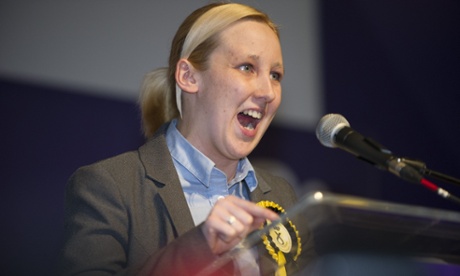
The odds were heavily stacked against the SNP’s Mhairi Black winning the Paisley and Renfrewshire South seat to become Westminster’s youngest MP since 1667.
She was up against one of the best-known Labour MPs left in Scotland, Douglas Alexander, who was defending a majority of more than 16,000. He was not only shadow foreign secretary but had election experience in abundance, enough to secure him the job of Labour’s UK campaign co-ordinator.
Some of her obstacles were self-inflicted, resurrected comments on social media such her expression of hatred for Celtic football club, normally the kiss of death for candidates in the west of Scotland, potentially alienating a large slice of the electorate from the outset.
None of it mattered. The 20-year-old University of Glasgow student won anyway, riding the SNP surge that has engulfed Scotland, comfortably overturning Alexander’s majority.
“The fact is that people have woken up to the fact that Westminster has not been serving them and the Labour party has not been serving them,” she said.
Her rise to prominence began when she was 19. She asked a question at a Yes campaign rally and was asked to do something for YouTube, which went viral.
The former SNP - and Labour _ MP Jim Sillars took her under his wing, inviting Black to join him touring Scotland. During the campaign Labour dismissed her as immature, partly on the basis of her social media comments. But none of it stuck.
Within minutes of her victory in Paisley, one of the stunning results of the general election, she was becoming acquainted with fame, moving from one television interview to another, already on the way to becoming an SNP star.
Updated
Ed Davey, the Lib Dem energy secretary, has lost his seat.
Energy Sec Ed Davey loses seat but Tim Farron holds on #GE2015
— Emily Morgan (@emilymorganitv) May 8, 2015
Guardian front page 3.30am pic.twitter.com/tzh0xgqlKq
— Paul johnson (@paul__johnson) May 8, 2015
Lib Dem source says Simon Hughes has lost, reports @rosschawkins
— Chris Mason (@ChrisMasonBBC) May 8, 2015
Boris Johnson has just rolled back into the count at Uxbridge with his wife Marina and is talking to activists ahead of an expected victory announcement in his seat of Uxbridge and South Ruislip in the coming half an hour or so.
He’s predictably “very bouyant”, according to an aide (he’s not talking to reporters yet), and spent the evening after polls closed having dinner at the Uxbridge Conservative Club where Cameron curry and Boris burger were on the menu. Like the loyalist he has been telling us he is, Johnson had the Cameron curry, although his wife had the burger, I learn.

Jack Staw tells Sky News its a "pretty depressing" situation & "it's up to Mr Miliband to decide his own future" #GE2015
— Sophy Ridge (@SophyRidgeSky) May 8, 2015
The results keep rolling in for the SNP. Jo Swinson, the first UK minister to lose her seat, was trounced by the SNP’s first-time candidate, former broadcaster John Nicholson.
In Kirkcaldy, where former Labour leader Gordon Brown grew up as son of the manse, there was an extraordinary 35% swing to the SNP.
The argument that support for the SNP was solely coming from the yes-voting 45% is surely blown out of the water now.
Updated
Within the Lib Dems, a public debate about what has gone wrong has also started. Gareth Epps, a member of the federal policy executive, has written a blog saying “if the leadership does not smell the coffee immediately, the Liberal Democrats will die.”
The identity of the party has been at best blurred; the leadership’s addiction to a toxic and fundamentally Tory austerity regime flawed; and the complete failure to articulate a positive constitutional future for the UK hit home not by the AV referendum farce but by Cameron’s ignorant reaction to last September’s election result. The campaign without a strategy or direction has resulted in the old truism that if you stay in the middle of the road, you get run over by a truck.
Margaret Curran, the shadow Scottish secretary, has lost her Glasgow East seat to the SNP.
John Harris reflects on what could possibly be the worst election result for the English left since 1983.
Labour have a bit of good news. The party has taken Ealing Central and Acton, 46 on the its target list, from the Tories. It required a swing of just under 4% to turn over a majority of around 3,500. But it was close with new MP Rupa Huq winning by less than 300 votes.
Ruth Davidson, the Scottish Conservative leader, has paid a generous tribute to Jim Murphy.
We've had more than our share of differences, but I have to say, that was a wonderfully dignified speech from @JimForScotland ...
— Ruth Davidson MSP (@RuthDavidsonMSP) May 8, 2015
A warning from Boris ...
Updated
Jim Murphy, the Scottish Labour leader, has lost his East Renfrewshire seat to the SNP.
In his concession speech, he congratulates the SNP, but says that with victory comes responsibility. Patriotism does not just belong to one party, he says.
He says he will continue to lead the Scottish Labour party. The party that fights for the underdog has now become the underdog. But it has been around for 100 years, and it will be around for another 100 years, he says. “The fightback starts tomorrow.”
On the south coast, an update from Brighton.
It looks increasingly as if the new parliament will still have at least one Green MP. People from both Labour - when pressed – and Greens in Brighton predict - in the former case - that Caroline Lucas is likely to be re-elected in Brighton Pavilion, very possibly with an increased majority.
As for the other two Brighton seats, Kemptown and Hove, both of which
were on Labour’s top 30 list of targets to take from the Tories, Labour says the battle is “very tough” and predicts at least one recount. I get the sense this might be optimistic, and both could be Conservative holds.
Don’t expect the results till about 5.30am, very possibly later.
The Labour anti-Miliband backlash is starting to go public. John Mann has taken to Twitter to say, effectively, “I told you so”.
Can't say that Labour leadership weren't warned repeatedly-those who even bothered to meet that is. Never hurts to listen.
— John Mann (@JohnMannMP) May 8, 2015
In1983 immediately after election I wrote' the left that listens is the left that wins' it remains true today.
— John Mann (@JohnMannMP) May 8, 2015
The leftwing People Before Profit party has done considerably well in West Belfast, the stronghold of Sinn Fein.
Sinn Fein’s Paul Maskey, as expected, won the seat with 19,163 votes, an increase of 3,000 votes in the last byelection in the constituency. “This is a vote against austerity,” Maskey told the audience.
But Gerry O’Carroll of People Before Profit stunned the King’s Hall in Belfast with 6,798 votes. O’Carroll said it was a “groundbreaking result” for his party, which in real terms means a seat in the Northern Ireland Assembly this time next year.
Overall so far the party scores are two seats tp Sinn Fein, six to the DUP and one for the Ulster Unionists. The DUP should end up with eight seats as before and could still potentially play a key role if David Cameron needs them.
Here’s Nicola Sturgeon talking more about what the SNP ‘tsunami’ will mean.
Turnout in Sheffield Hallam is 76.85%. In 2010 turnout was 74.51%. Declaration running slightly behind- now expected 0430.
— Chris Mason (@ChrisMasonBBC) May 8, 2015
Every Labour figure being interviewed is being asked if Ed Miliband should stay as leader. They have all either sidestepped the question, or said yes, but in private Labour figures are saying something different.
Labour MPs and party sources are telling me they can't see how Ed Miliband can stay on as leader... #GE2015
— Sophy Ridge (@SophyRidgeSky) May 8, 2015
Before the election it was assumed that Ed Miliband would be forced out if he did not become prime minister. Over the last few weeks there may have been a rethink, because he was judged to have fought an effective personal campaign. But, ultimately, it is the result that counts, and if the exit poll does turn out to be accurate, the pressure to go will be very strong.
Next up is our own Alberto Nardelli talking about how the Conservatives may exceed poll predictions and why the polls were so wrong.
Mike O’Brien, the former Labour minister, has failed to take North Warwickshire back from the Conservatives. The Tories’ majority in 2010 was just 54, and this was Labour’s top target.
Sour faces among the Ukip faithful here in East Kent at the news that its candidate Jamie Huntman had failed to win in Castle Point. It’s a result that bodes ill for Nigel Farage, given that both it and South Thanet were south eastern Ukip target seats.
Castle Point was significant for a number of reasons. Huntman had been tipped by some in the party as a potential future leader, but not now being an MP potentially makes it impossible for him to lead the party should Farage step down as promised in the even of failing to enter parliament.
I spent some time with Huntman two weeks ago and while he was benefiting from the efforts of a large team of local Ukip activists and enthusiastic youngsters from elsewhere, it seemed at that point that the wind was starting to come back in to the sails of the Rebecca Harris, the sitting Tory MP.
After putting both parties at almost neck and neck in Castle Point last February, an Ashcroft poll on last month had put Ukip and the Tories on 36% and 41%, respectively.
Updated
The SNP have taken Kirkcaldy, Gordon Brown’s old seat.
Labour sources are now admitting that the results in Scotland are “very difficult” and they are blaming the SNP for David Cameron’s likely return to Number 10.
If the exit poll is right, the seats the SNP are taking off Labour will turn out to be crucial if David Cameron ends up back in No 10. The next government will have huge task uniting country.
It sounds like Labour is coming close to admitting defeat.
Updated
The Democratic Unionist Party has recaptured East Belfast. Gavin Robinson won the seat with 19,575 votes, with the former MP, Naomi Long of the Alliance party, polling 16,974 votes. The DUP will now definitely go back to the Commons with eight seats.
David Cameron has arrived at the Witney count. He came on to the floor shortly after 2.30am and has spent his time here chatting to counters. As far as the media goes, though, it seems he has nothing to say, at present anyway. He walked past the waiting cameras making no comment as broadcasters shouted: “How is it going?”
Cameron did one lap of the floor before departing, less than 10 minutes after arriving.
Updated
George Galloway expects to lose in his Bradford West constituency, sources in the Galloway camp are conceding.
Updated
Alex Salmond, the former SNP leader, tells the BBC that the SNP will still try to form a progressive alliance in the Commons. Asked what he would do if David Cameron were to offer the SNP full fiscal autonomy, he sidesteps the question.
He recalls that the SNP were able to cause disruption in the Commons in the 1980s when they only had a small number of MPs, and Margaret Thatcher had a huge majority. In the next parliament it will be much easier for the SNP to cause trouble, he says.
John Harris has sent this video from Nicola Sturgeon’s highly anticipated arrival in Glasgow.
Neil Coyle looked pretty confident as he arrived at Southwark council headquarters. No wonder. Moments later the BBC’s Jeremy Vine predicted that Simon Hughes, the Liberal Democrat deputy leader until last year, would lose.
That would be a big win for a resurgent Labour party in the area. Hughes won here back in 1983, when he beat Peter Tatchell, the gay rights campaigner in a famously dirty campaign. The Liberal campaign at the time said it was a “straight choice” between the two candidates.
Coyle – describing himself as buoyant – said a Labour victory in Bermondsey and Southwark would boil down to two things. By entering coalition, the Lib Dems had made themselves unpopular. “Being in coalition led to his downfall,” said Coyle.
Secondly, Labour had put in a serious effort in Bermondsey, deploying more than 1,000 volunteers to get out the vote on the day people cast their ballots.
“Labour was contending where we haven’t been for 20 years,” he said. Turnout in Bermondsey, which covers landmarks such as the Shard, the South Bank and Borough market, but also poorer neighbourhoods further south, was high. It means the result will not be known until 4am instead of 3am as originally scheduled. But right now, it is Labour who are looking upbeat.
Updated
Nicola Sturgeon has arrived at the Emirates stadium in Glasgow to a reception line of jubilant SNP candidates, before the first Glasgow result has even been officially announced.
Sturgeon told waiting press that the results were “historic”, and that she was “immensely proud” of the SNP candidates and campaign regardless of the results.
I think the results we may be about to see unfold in Scotland tonight show that the anti-austerity message that the SNP put at the heart of this campaign has resonated across Scotland.”
We’ll wait and see the extent of the SNP victories tonight. Regardless of the results tonight, I’m immensely proud of our candidates and campaign team.
Obviously it’s at a very early stage of the night in terms of results across the UK, as indeed it is in Scotland. But if the parliamentary arithmetic allows us to lock out the Tories then as I have said throughout this campaign that’s what we should do and my message to Ed Miliband is that we should work together to do exactly that.
Updated

The defeat of Douglas Alexander, Labour’s UK campaign coordinator and shadow foreign secretary, was the SNP’s biggest scalp of the night in Scotland.
Adding to Labour’s ignominy, the vastly experienced Alexander was beaten by a 20-year-old student, Mhairi Black, who becomes the youngest MP for centuries.
Alexander, who had been defending a majority of more than 16,000, was consumed by the anti-Westminster rage that has engulfed Scotland. He took only 17,864 of the votes in Paisley and Renfrewshire South to Black’s more than 23,000.

Alexander congratulated Black on fighting a formidable campaign. Black won the biggest cheer of the night when she pledged the SNP would stop what she said would be the billions wasted on a renewal of Trident.
In spite of demands on him from his role as UK campaign coordinator, Alexander had been devoting lots of his time, energy and resources since January to surviving the SNP surge. But previously solid Labour areas deserted him.
He is the highest-profile figure in Scotland to lose his seat. Labour is on course to suffer a double-blow, with its Scottish party leader Jim Murphy expected to lose Renfrewshire East.
Updated
Kevin Maguire, the Daily Mirror columnist, thinks Ed Miliband and Nick Clegg will both have to resign.
Taxis for Miliband and Clegg
— Kevin Maguire (@Kevin_Maguire) May 8, 2015
Lib Dem source says Salmond has taken Gordon #GE2015
— Lynsey Bews (@lynseybews) May 8, 2015
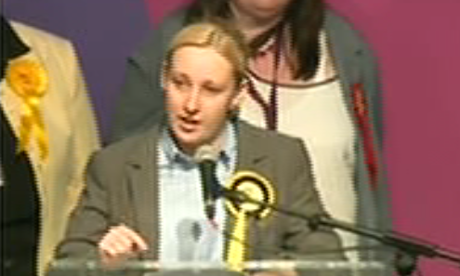
Mhairi Black, a third-year politics student at Glasgow University, has prepared for her finals next month in the most extraordinary way – by defeating the man who planned the party’s entire election campaign, Douglas Alexander.
In doing so Black, who is 20, has become the youngest MP since 1667. When she was born in 1994, Alexander was already working for Gordon Brown, as a speechwriter. Her youngest political memory is of being taken to the anti-Iraq rally as a child and given a large lollipop.
Her campaign was not without controversy - she told a rally she had fantasised about “putting the nut” into Labour councillors, and she described “no” voters in the independence referendum as “selfish”. It made no difference to her prospects - she has turned his 16,000+ majority into a 5,684 lead of her own.
Here are the results in full.
Mhairi Black (SNP) 23,548 (50.94%, +32.87%)
Douglas Alexander (Lab) 17,864 (38.64%, -20.96%)
Fraser Galloway (C) 3,526 (7.63%, -2.32%)
Eileen McCartin (LD) 1,010 (2.18%, -7.35%)
Sandra Webster (SSP) 278 (0.60%, -0.34%)
SNP maj 5,684 (12.30%)
26.92% swing Lab to SNP
Electorate 61,281; Turnout 46,226 (75.43%, +10.07%)
Updated
Earlier this evening Labour figures were arguing on TV that David Cameron had lost his majority, and even that Ed Miliband could end up as prime minister.
But that line now seems to have been dropped, and, if George Eaton is right, the mood is turning against Miliband.
Labour HQ source: "Ed has to resign tomorrow. Everyone here accepts that."
— George Eaton (@georgeeaton) May 8, 2015
Here is an analysis from Rafael Behr on the possible fallout for Labour.
Updated
Alex Salmond gives his take on the SNP’s election night, saying: ‘This looks like an electorial tsunami.’
Results for South Thanet are expected to be held up, says my colleague Ben Quinn in Margate.
We’re being told now that there will be a delay due to the late arrival of boxes of postal votes. It mean the expected declaration time will be more like 7am than the scheduled time of 6am.
The SNP are on course for a landslide in Scotland. As these journalists, and no doubt others, are pointing out, that will make repairing the union a key priority for the next prime minister.
This is from the Independent’s Steve Richards
Union more vulnerable tonight than it appeared to be in days leading up to referendum. England opts for Thatcherism and SNP rules Scotland
— steve richards (@steverichards14) May 8, 2015
This is from the Spectator’s James Forsyth.
This can't be said enough, David Cameron has to now embrace federalism ASAP as without that the Union is in dire trouble
— James Forsyth (@JGForsyth) May 8, 2015
This is from the Sunday Times’ Tim Shipman.
Cameron will need to make another of his big bold offers. This time to the Scots and his backbenchers. Graham Brady for leader of commons?
— Tim Shipman (@ShippersUnbound) May 8, 2015
Interestingly, Boris Johnson, the Conservative mayor and soon-to-become MP, has started talking about the need for a federal UK.
Updated
There has been a huge upset in South Antrim with Ulster Unionist Danny Kinahan winning the seat off the DUP’s Rev William McCrea by just under 1,000 votes. This is highly significant because even if the DUP wins back East Belfast, it will return with eight seats at most to the Commons, although the DUP could still play the role of kingmaker.
Not surprisingly Ian Paisley Junior has romped home with 18,107 votes in the constituency of North Antrim dominated for four decades.
Jubilation is gripping Glasgow, with Nicola Sturgeon arriving at the count to huge cheers and enthusiastic hugs.
Nicola Sturgeon arrives at a euphoric Glasgow count. #GE15 pic.twitter.com/GDlGRZUSsz
— Michael Gray (@GrayInGlasgow) May 8, 2015
Updated
Why were the opinion polls so wrong?
When the exit poll dropped at 10pm the numbers seemed unbelievable.
Three hours later and - and based on the first results - if anything the exit poll may well have underestimated the number of seats the Tories will win and overestimated Labour’s share. It’s not even out of the question that Cameron may get an overall majority.
Although we still haven’t received projections of a vote share yet, it is already quite clear that the the polls were wrong - and by a significant margin.
The polls were roughly anticipating a tie. On these early figures, the Conservatives will end up with a five-seven point lead over Labour.
At this stage it’s impossible to know why the polls were wrong. It could be as simple as “many people lied” to an underlying systematic error across all the polls.
In Scotland the polls seem to have had a better night. The SNP’s 50%-plus share of the vote - and with it nearly all of Scotland’s 59 seats - has materialised.
"There's going to be a Scottish lion roaring tonight, which no Westminster government can ignore," Alex Salmond tells BBC Scotland.
— BuzzFeed UK Politics (@BuzzFeedUKPol) May 8, 2015
The Ulster Unionist Party are back in the House of Commons. Danny Kinahan takes South Antrim from DUP's William McCrea.
— Chris Page (@ChrisPageTV) May 8, 2015
Senior Tories now suggesting that an overall Tory majority might be on the cards
— James Forsyth (@JGForsyth) May 8, 2015
Two tweets about the biggest losers tonight.
From Newsnight’s Ian Katz
Not sure if Labour and Lib Dems or the polling industry are biggest losers tonight. #GE2015
— Ian Katz (@iankatz1000) May 8, 2015
From Will Jennings, a politics professor
Wrong so far #GE2015: forecasters, polls, influence of social media and you vote, claims of decline of newspaper industry, what else?
— Will Jennings (@drjennings) May 8, 2015
Lord Kinnock, the former Labour leader, told the BBC that the Tories could do well tonight because “there are enough people who are willing to accept that myth and then think they are voting for their own security by voting for Conservative candidates”. He went on:
The awful thing is, it’s not simply those people who, relatively innocently, are working against their own interests. The real price will be paid by those who truly are innocent.
Here is some more intelligence from the Press Association from seats that have not declared yet.
Lib Dem losses
Lib Dem MP Martin Horwood says it is likely that he has lost his Cheltenham seat to the Conservatives.
Potential Conservative gain
Conservative sources say the result in Hampstead and Kilburn, Britain’s most marginal seat, is too close to call. Labour is defending a majority of 42.
Conservative gains
Conservative sources say the party is set to gain Walsall South from Labour.
Conservative sources say they are “quietly confident” they will gain Devon North from the Liberal Democrats.
Conservatives sources say they are on course to beat the Liberal Democrat’s environment minister Dan Rogerson in North Cornwall.
DUP gain
The DUP’s Gavin Robinson is set to recapture Belfast East from the Alliance, according to sources from both parties.
Labour gains
Labour sources say they expect to take Thurrock from the Conservatives by as many as 2,000 votes. The Tories had a majority of 92 over Labour in 2010.
Labour sources are predicting “an easy win” at Brent Central, where the Liberal Democrats had a majority of 1,345 in 2010.
Labour sources in Hornsey and Wood Green, where Home Office minister Lynne Featherstone is defending the seat for the Liberal Democrats, say they believe “it’s not a question of victory, but how large the majority is”.
SNP gains
Tory candidate Finlay Carson is predicting a runaway win for the SNP in Dumfries and Galloway. He is hoping to beat Labour into second place.
Both Conservative and Labour sources are claiming they could win the key marginal seat of Lincoln. Labour says there is “not more than 600 votes in it”.
Michael Connarty, defending Linlithgow and Falkirk East for Labour, says: “I do not think I will be the MP in the morning.”
Updated
In Margate, the Ukip leader, Nigel Farage, has made some more comments to the press before disappearing into a hotel.
Responding to the exit poll, he said: “The most likely outcome is a lot of Ukip votes and a lot of angry Ukip voters. They are going to feel unrepresented.”
Labour set for Glasgow wipeout
As we await SNP leader Nicola Sturgeon’s imminent arrival, the mood in the Emirates arena here in Glasgow has changed from stunned silence to barely suppressed jubilation, as candidates and their entourages hugged and let out muffled squeals of excitement.
One longtime SNP activist had tears in his eyes as he said: “I never thought I’d see the day.” It is now clear that the unthinkable has happened: Labour has lost all seven seats in Scotland’s largest city, previously a rock-solid party stronghold.
Meanwhile, the red rosettes that were bravely in force at the beginning of the count have faded into the night, as Labour MPs privately concede that the SNP surge was an unstoppable force and the vain hope of late-breaking undecideds swinging to Labour was just that.
Admiring defeat before the official results announcement, Tom Harris, MP for Glasgow South, told the Guardian: “When I was first elected in 2001 I would never have believed in a million years this could have happened.”
Describing himself as “bewildered”, he said “it hurts, of course it does”.
Harris believes that there was nothing that Labour could have done to avoid the rout. “The Scottish public who wanted independence and didn’t realise how badly they wanted it have now taken revenge on the Labour party as the main roadblock to independence.”

Updated
The nationalist SDLP has retaken Foyle, one of its remaining strongholds in Northern Ireland. Mark Durkan increased his majority by more than 1,002 votes with an overall 17,725. It is now almost certain that the SDLP will return its three MPs to Westminster but will have no influence on a new government given its historic allegiance to Labour.
Updated
Conservatives could end up with an overall majority, BBC says
Here are the Nuneaton results in full.
Marcus Jones (C) 20,827 (45.52%, +4.01%)
Vicky Fowler (Lab) 15,945 (34.85%, -2.03%)
Alwyn Waine (UKIP) 6,582 (14.39%)
Keith Kondakor (Green) 1,281 (2.80%)
Christina Jebb (LD) 816 (1.78%, -13.55%)
Paul Reilly (TUSC) 194 (0.42%)
Stephen Paxton (Eng Dem) 104 (0.23%)
C maj 4,882 (10.67%)
3.02% swing Lab to C
According to the BBC, the exit poll pointed to a Conservative to Labour swing in Nuneaton. But the swing actually went the other way.
John Dimbleby says that, on the basis of this, John Curtice is saying it is possible that the Conservatives could win an overall majority.
Douglas Alexander 'to lose his seat'
Douglas Alexander, the shadow foreign secretary, has lost his seat, my colleague Ewan MacAskill reports.
SNP sources in Paisley say SNP student Mhairi Black has defeated Labour's incumbent, Douglas Alexander, who is the party campaign chief.
— Ewen MacAskill (@ewenmacaskill) May 8, 2015
Douglas Carswell, who is set to be re-elected as Ukip MP for Clacton, has always said he did not want to lead Ukip. But that might be changing.
Carswell doesn't rule out making leadership bid if Farage loses
— Ross Hawkins (@rosschawkins) May 8, 2015
Nigel Farage has said he will resign if he does not get elected in South Thanet, and he said this week he would expect the party leader to be an MP.
Updated
.@jrfearnley, Lib Dem in Croydon Central, says 'questions will be asked' of Nick Clegg's position if exit poll accurate #croydondecides
— Gareth Davies (@Gareth_Davies09) May 8, 2015
Sinn Féin’s Pat Doherty returned comfortably in West Tyrone. Doherty polled 16,805 votes and retained his more than 10,000 majority from the previous election.
Senior Tory sources now saying the exit poll is "very solid" and even think they might do slightly better.
— Tim Shipman (@ShippersUnbound) May 8, 2015
Police are investigating allegations of electoral fraud in Glasgow East after a report of a person voting under a false identity. My colleague Kevin Rawlinson has the details.
A senior Ukip source says the party has certainly not given up on Nigel Farage winning his South Thanet target seat and points out the predictions so far are based on the results of Tory-leaning Broadstairs wards not the more Ukip-friendly Ramsgate.
“We’re still hopeful. But it is very, very, very tight. Tighter than we would like,” the source says. Farage is said to be holding his nerve and having a few drinks before the final result is called at around 6.30am.
Some estimates circulating at the East Renfrewshire count suggest Jim Murphy has lost to SNP candidate Kirsten Oswald by about 5,000 votes.
— joncraigSKY (@joncraig) May 8, 2015
The Green party said it had received 4.4% of vote in the first six constituencies to declare, up from 1% in 2010, the Press Association reports. The party saved its deposit in a North-East seat for the first time ever in Newcastle Upon Tyne East, where candidate Andrew Gray’s tally of 8.7% was a 7.1% improvement on the last election.
This is from the BBC’s James Cook.
Everyone at the Emirates saying Labour have lost all seven Glasgow seats to the SNP. #ge2015
— James Cook (@BBCJamesCook) May 8, 2015
We're in glasgow. V serious talk of snp winning all city seats, inc. outlier glasgow North East.
— John Harris (@johnharris1969) May 8, 2015
Labour’s Sadiq Khan has been re-elected in Tooting with 25,263 votes ahead of the Conservatives’ Dan Watkins on 22,421. Watch his acceptance speech after the result was declared.
Updated
In Tooting, where Sadiq Khan was re-elected for Labour, there was a tiny 0.16% swing from the Conservatives to Labour.
But it was better for Labour in Newcastle upon Tyne Central. Chi Onwurah held it for Labour, with a 4.76% swing from Conservative to Labour.
Jane Ellison held Battersea for the Conservatives. There was a 1.65% swing from Labour to the Conservatives.
Updated
Jeffrey Donaldson is the first MP elected in Northern Ireland. The Democratic Unionist party candidate was reelected to Westminster with a majority of 13,000 votes - an increase of 2,500 from 2010.
There’s still no sign of Ukip leader Nigel Farage here at the Thanet count, where he is now expected to arrive at around 4am.
However, there is growing expectation here that he will fail to win in this East Kent seat despite the party throwing a king’s ransom at the effort to capture it.
Some rumours even have Labour’s young candidate Will Scobie pipping Farage to second place, with the Conservative’s Craig Mackinlay (a former senior member of Ukip) holding the seat for the Conservatives.
Hacks hungry for interviews with political big beasts have at least been graced by the presence of Al Murray - the self-styled “pub landlord”. He made his entrance a short time ago, telling waiting photographers and others that Farage would still be welcome to drown his sorrows in his pub.
I asked him what success would look like, a second-place finish perhaps? He replied that second place would be a miracle, first place would be deserved. Murray also had a gentle pop at Russell Brand. While not mentioning him by name he said that democracy was a serious business and noted that some people had been changing their mind recently about the value of voting.
Al Murray now at the Thanet count. Had a gentle pop at Russell Brand +Willing to let Farage drown sorrows in his pub pic.twitter.com/rDUCkxae7m
— Ben Quinn (@BenQuinn75) May 7, 2015
If the exit poll turns out to be correct, Ed Miliband’s future as Labour leader will be in the balance, my colleague Rowena Mason reports.
Updated
In Twickenham, where Vince Cable is seeking re-election, a recount seems likely.
Officials & politicians talking of possible recount here in Twickenham, where outgoing Business Sec Vince Cable defends 12,000 maj #GE2015
— Nick Powell (@NICKSKY) May 8, 2015
At this stage it it normally clear to party officials at a count who is going to be win. Here are some of the snaps from the Press Association with claims about who is likely to win in some key seats.
Expected SNP gains
SNP sources say the party is set to gain Dunbartonshire West from Labour shadow defence spokeswoman Gemma Doyle.
SNP sources claim the party is set to gain Motherwell and Wishaw, where Labour had an 16,806 majority over the nationalists in 2010.
SNP sources say the party is set to gain Dunbartonshire West from Labour shadow defence spokeswoman Gemma Doyle.
SNP sources claim the party is set to gain Kilmarnock and Loudoun, a Labour seat for the past 18 years. The seat was held by shadow economic secretary Cathy Jamieson, who is defending a majority of 12,378.
Tom Harris, Labour’s candidate for Glasgow South, said he had heard from party workers at the count that he is likely to lose the seat he has held since 2001.
Tory holds
Conservative sources say that the count at Stroud, where the Tories had a majority of 5,164 at the 2010 election, is too close to call.
Labour party sources say they do not expect to win the Milton Keynes South seat from the Tories, who had a majority of 5,201 at the 2010 election.
Tory gain
Conservative sources say they are “quietly confident” of winning Somerton and Frome from the Liberal Democrats. They need a 1.5% swing to secure the seat.
Labour gain
Labour sources say they expect to gain Morecambe and Lunesdale from the Conservatives.
Labour sources say they expect to gain the Tory marginal of Lancaster and Fleetwood.
Lib Dem hold
Liberal Democrat sources claim they will retain Eastbourne by a narrow margin.
Could be bad news for the #LibDems Commons' football team...
— Peter Franklin (@peterfranklin_) May 7, 2015
Labour’s Scottish leader, Jim Murphy, looks like he will be a victim of the Scottish National party surge. He is involved in an extremely tight contest in Renfrewshire East. And the Conservative tactical voting he hoped for, which might have seen support for him to keep the SNP at bay, has failed to emerge.
Murphy attracted a lot of publicity, taking his campaign out into the streets, regularly attracting hecklers during the referendum and in the general election campaign.
If Murphy loses, the Labour leadership in Scotland would fall on the relatively inexperienced deputy Kezia Dugdale, who is a member of the Scottish parliament.
Labour’s other high-profile figure in Scotland, Douglas Alexander, is – in spite of defending a 16,000 majority – also fighting for survival. The hoped for tactical voting by Tories in his Paisley constituency has also failed to materialise and the support in some previously solid Labour areas has fallen short of expectations.
The received wisdom in Scotland among political strategists and commentators is that the SNP benefits from high turnout, and it is higher than expected in Alexander’s seat, up by about 10% to 75%, suggesting the nationalist momentum from the referendum is still going.
The third of the three candidates in the area, Jim Sheridan, looks to be on course to losing his seat to the SNP.
Updated
And here is my colleague Jonathan Freedland giving us an idea of the political future should the exit poll prove accurate.
Updated
SNP sources claim the party is set to gain Motherwell and Wishaw, where Labour had an 16,806 majority over the nationalists in 2010, the Press Association reports.
This is what the Lord Mandelson told the BBC earlier.
What seems to have happened is that all the three main parties have lost this election. Some have lost it more than others - the Lib Dems in particular - but we seem to be heading to an outcome in which no party has achieved a majority ...
The Labour Party has been squeezed by two nationalisms. Obviously in Scotland with the SNP, very severely indeed, but also in England by the nationalist frenzy whipped up by David Cameron and the Conservative party. The Labour Party has found itself very uncomfortably between those two.
Labour sources claim the count is “neck and neck” in Harrow East where the Conservatives are defending a majority of 3,403, the Press Association reports.
Back on TV watch, and on Channel 4’s Alternative Election, I’m still not warming to scripted comedy Paxman – his Charlie Brooker-style ranting is quite hard going. That said, I’m guessing that Dimbleby isn’t currently yelling at guests to stop taking the piss, so the true spirit of Jeremy is still with us.
Most meta moment of the evening: sofa-bound TV viewers watching Paxman introducing the next instalment of election Gogglebox, where sofa-bound TV viewers watch Paxman interviewing David Cameron. My head hurts.
Meanwhile Twitter informs me that Dave Rowntree is a political activist of some standing, rather than merely the drummer from Blur. I did not know this, so apologies, Dave. Alex James is still an insufferable cheese bore, however.
We know it's late, but do try to remain focused - we're on until 6am! #AltElection pic.twitter.com/muu515iE4c
— Channel 4 (@Channel4) May 7, 2015
Al Murray, the TV comedian standing in South Thanet – the seat Nigel Farage is contesting – says coming second would be a miracle.
Updated
My colleague Holly Watt is at Nuneaton. It was billed as the first key result of the night - it was 38th on Labour’s list of target seats - but the Tories are set to hold it, it seems.
Just walked round the room in Nuneaton. Don't think I can see a single table where the red pile is bigger than blue pic.twitter.com/h5Z4JWx1WA
— holly watt (@holly_watt) May 7, 2015
Updated
There was shock on the faces of Labour supporters at the North Swindon count – even though the Tories were expected to hold the seat, the huge swing of 4.3% to Conservative from Labour compared with 2010 was outside predictions.
For the first Conservative victory of the night it was a stunning result – and even the Tories themselves didn’t quite seem to believe it.
It bodes very badly for Labour in the south-west and elsewhere, especially in the marginal of South Swindon to be announced later, where Labour had real hopes. It doesn’t now.
What appears to have happened is that the Lib Dem vote collapsed – from 8,600 in 2010 to 1,700 this time – and migrated to the Conservatives. The Lib Dems also suffered the humiliation of being knocked into last place behind the Greens, albeit by 16 votes.
Ukip also prospered and vaulted into third place despite the Conservative gains, helped perhaps by the 1,500 voters who backed the BNP last time.
This is from the Sunday Times’s Tim Shipman.
Lib Dem sources telling me Simon Hughes has probably lost and even David Laws in fight for survival. Which makes exit poll look accurate
— Tim Shipman (@ShippersUnbound) May 8, 2015
Putney has declared. Justine Greening, the Conservative international development secretary, has been re-elected, with her share of the vote marginally up. The swing was a tiny 0.44% from the Conservatives to Labour.
Updated
Our results table does not feature swings. So, here are the swings from the first three seats to declare. All three were Labour holds.
Houghton and Sunderland South
7.01% swing Lab to Ukip
Sunderland Central
5.47% swing C to Lab
Washington and Sunderland West
6.92% swing Lab to Ukip
If you include Swindon North (see 12.49am) that means three of the first four seats to declare saw swings away from Labour.
Updated
My colleague Holly Watt has sent this update from Nuneaton:
Definite smiles are starting to appear on Conservatives’ faces, as the blue votes pile up on the tables in the middle of the room.
The declaration is now expected at 1.30am. The turnout has gone up slightly from 65.8 to 67.35%. Vicky Fowler has arrived at the count and the Labour agent is still trying to block the press from talking to her – see John Harris’s video this week. Who knows what they are hiding?
Alwyn Waine, Ukip’s candidate, said it looked like her party had done well. “This seat has been the focus of fierce competition between Labour and the Tories and that squeezes us, but I think we have got a decent number of votes.”
Updated
There is a recount in Bradford West, George Galloway’s constituency, the BBC reports.
Philip Cowley, the psephologist, says the Swindon North seat suggests the Tories are doing better than the exit poll suggested.
According to the exit poll, there should have been a 1% swing to Labour in Swindon N. There was a 4.3% swing to the Conservatives.
— Philip Cowley (@philipjcowley) May 7, 2015
Boris Johnson, the London mayor and Conservative candidate for Uxbridge and Ruislip South, leaves the counting centre in Uxbridge, west London – the seat he is hoping to win.

Updated
The Tories have held Swindon North. That was 102nd on Labour’s target list, according to the Progress briefing from last year (pdf).
Here are the figures in detail:
*Justin Tomlinson (C) 26,295 (50.33%, +5.78%)
Mark Dempsey (Lab) 14,509 (27.77%, -2.74%)
James Faulkner (Ukip) 8,011 (15.33%, +11.67%)
Poppy Hebden-Leeder (Green) 1,723 (3.30%, +2.33%)
Janet Ellard (LD) 1,704 (3.26%, -13.97%)
C maj 11,786 (22.56%)
4.26% swing Lab to C
These figures help to explain why the exit poll could be right. The swing is not Conservative to Labour, but Labour to Conservative – by more than four percentage points. That may be because Ukip are taking votes from Labour.
Updated
Barry Norton, Cameron’s election agent for 20 years until last December, has fought enough elections with him to know the Tory leader’s mindset at such times, Caroline Davies writes.
He said the prime minister would be cautious about the exit polls. Norton, Tory leader of West Oxfordshire district council, said he had spoken to Cameron three times today.
“The first thing he said was: ‘Are you worried about any of your district seats?’ That was what he was like,” said Norton, “Thinking about that even at this time.” He said Cameron would be “first and foremost trying to see how accurate that exit poll is”.
What’s important is not just what we get, but what others get. I’m sure he is thinking of everything. He’s just that type of person. His mind capacity is tremendous, his memory is brilliant.
Will he be stressed? “I think he handles it all very well,” he said.
Updated
Douglas Alexander, the shadow foreign secretary, is in trouble in his Paisley and Renfrewshire South seat, it is being reported.
Senior @scottishlabour source: looking bad for shadow foreign secretary Douglas Alexander #GE2015
— Paul Hutcheon (@paulhutcheon) May 7, 2015
turnout in Douglas Alexander's seat over 75% apparently. @kdugdalemsp said earlier turnout of more than73% could be problematical for Labour
— Gillian Bowditch (@GillianBowditch) May 7, 2015
Very good source tells me Farage *has* lost South Thanet. I’d be surprised if they were wrong. But we’ll see. http://t.co/ko0nFZL9Bh
— Isabel Hardman (@IsabelHardman) May 7, 2015
The Greens privately don't think Norwich South possible this time - Bristol West only seat they *could* gain @georgeeaton
— Tim Wigmore (@timwig) May 7, 2015
Lord Mandelson tells the BBC that all three parties have lost in the election.
In South Swindon, the exit poll news quickly took the wind out of Labour’s sails, and confident predictions of a close result requiring a recount have been replaced with glum pessimism that – in the words of one Labour organiser – “maybe the Tories have run away with it”.
Labour had hopes of retaking a seat it had lost in 2010 with a swing of 3.8% but the Conservatives appear to have run a targeted ground operation in a south-west barometer seat.
The election officers are finishing the counting for the relatively safe Conservative seat of North Swindon first, and there may be a result soon, with South Swindon to follow at 3am. The turnout in North Swindon was slightly up compared with 2010, at 64.7% – but South Swindon’s is expected to be higher and closer to 70%.
One @LibDems source: we will do better than 10 but not looking good. We can repaint @HarrietHarman minibus yellow + fit in our MPs
— Nicholas Watt (@nicholaswatt) May 7, 2015
A colleague who has been on the pink minibus says it seats about 16, including the driver.
Updated
Labour are saying that the BBC suggestion that the Greens will win Norwich South (see 12.24am) is “well wide of the mark”.
Updated
If you can drag yourself away from the horrors currently unfolding in front of you, I’d suggest flicking over to Sky Arts. They’re running a live fixed-camera show set behind the scenes of the Sky newsroom. It’s hard to explain – half of it is a fascinating insight into the operations of a vast newsgathering operation, and the other half is essentially the sort of dry, trumpet-blowing guff that only Sky investors could get excited about. I’d keep watching it until someone said “synergy”, if this didn’t seem like the sort of thing where someone says “synergy” every 15 seconds.
On the BBC, Jeremy Vine is running through some individual seat projections, based on the exit polls.
He says there are several seats very high up on the Labour list of target seats that the Conservatives are set to hold, including Sherwood (5th on Labour’s list of target seats), Broxtowe (8th), Amber Valley (11th), Carlisle (15th), Stroud (16th), Weaver Vale (17th) and Lincoln (18th).
Further down the Labour target list, the Tories are also expected, on the basis of the exit poll, to hold Ipswich (34th), Halesown and Rowley Regis (37th) and Nuneaton (38th).
Updated
The BBC says the seat it expects the Greens to gain in Norwich South.
Updated
The difference in heights of the piles of ballot papers tell their own tale – with Labour sources in at least three Glasgow seats already privately admitting defeat and others lowering expectations to “very bleak”, is it possible that the unthinkable might happen – Labour could lose every seat in Glasgow?
Of course one must exercise caution, but the early sampling for the SNP, in particular in Glasgow East and Glasgow South-West, has been, I’m told, spectacular.
After a day of relative positivity, with Glasgow Labour sources suggesting that at least three seats could be saved in a city that once represented the party’s more solid of heartlands in Scotland, the wind was quickly taken out of sails as the exit poll suggested an SNP landslide.

“If that’s true then we might as well pack up and go home now,” one senior adviser observed, shocked as much as distressed. In the first hours after the polls closed, there were far more SNP than Labour candidates around the counting tables which spanned the length of the Emirates sports arena. One female SNP observer wore a floor-length canary yellow dress for the occasion.
But Labour’s mood was one of stunned acceptance as it became increasingly evident from early sampling that things were looking bleak in every Glasgow seat. One election agent admitted early on that he believed his candidate had lost his previously rock-solid seat. Referring to Jim Murphy’s recent insistence that undecided voters could swing for Labour at the last minute, he admitted: “The undecideds just didn’t want to tell us that they weren’t voting for us.”
Updated
Yvette Cooper, the shadow home secretary, says she is “very puzzled” by the exit poll. It does not fit her experience, she says.
Nigel Farage, the Ukip leader, does not seem to be a happy man tonight.
V v odd interview with Nigel Farage on ITV at election night party in Margate - walks off camera after saying Sun + Mail wrong about Ukip
— Rowena Mason (@rowenamason) May 7, 2015
@BethRigby Farage didn't look like a man who'd won his seat on TV just now...
— Kate McCann (@KateEMcCann) May 7, 2015
Updated
Updated
In David Cameron’s Witney constituency, Caroline Davies talks to Wessex Regionalist candidate Colin Bex:
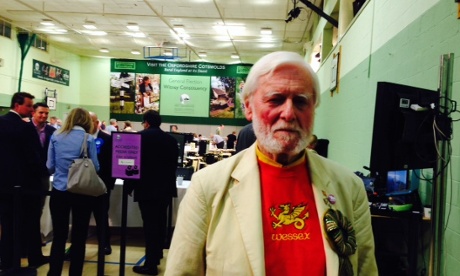
While we wait for Cameron to appear at his count, Bex, 75, is hoping not to come last in Witney. The Wessex Regionalist candidate is the most seasoned campaigner in the room, having fought eight general elections and byelections since 1979. He wants bottom-up regional government for Wessex – harking back to Alfred the Great and Athelston.
“Bottom-up government not top down diktat,” he says. Last time, the environmental campaigner and former architect garnered 62 votes. “I hope I get a lot more this time, but I’m not expecting to,” he said with a smile.
This is from the Independent on Sunday’s Jane Merrick.
It is actually possible that Nick Clegg will have more red lines than he has MPs.
— Jane Merrick (@janemerrick23) May 7, 2015
Holly Watt sends this from Nuneaton:
One Conservative in the hall saying they are now “quietly confident”
of holding Nuneaton. Should be getting turnout figures soon.
DUP leader at Westminster Nigel Dodds has arrived at the Kings Hall count in Belfast. He looks pleased, perhaps due to the knowledge that his party could yet wield some influence on the formation of the next government given the national exit poll.
Dodds has told the Guardian he is confident “the DUP will play a pivotal role in this next parliament”. While cautious about the national exit poll and the projection of seats, Dodds said his party would play a key role after all the votes are counted. He also expressed confidence that he will hold on to his North Belfast seat despite a strong challenge from Sinn Féin’s Gerry Kelly.

Updated
Labour’s general secretary, Ian McNicol, is also taking to Twitter to dismiss the exit poll.
Exit polls have been wrong in the past. I think this one is too. Read @SpenceLivermore’s blog → http://t.co/NPpyeI5VZu
— Iain McNicol (@IainMcNicol) May 7, 2015
Adam Boulton points out that, with just three results in, the Lib Dems have lost three deposits already.
LibDems lose 3/3 £500 deposits so far, under 5% of vote. Didn't lose any in 2010.
— Adam Boulton (@adamboultonSKY) May 7, 2015
As the night wears on, Channel 4’s Alternative Election Night raises some interesting questions. Is it the contrast on my TV, or has Paxman been spray tanned? Why do the outside broadcasts have a five second delay, like Doncaster is on the moon? When will they bring out a hapless, blibbering idiot for Paxman to yell at? Did David Mitchell choose that shirt/tie combo in the dark? Where has Richard Osman been all these years?
My favourite Osman fact of the evening so far – if the electorate was made up entirely of people who like steak and kidney pudding (or dogging), UKIP would have a massive majority. You won’t get that kind of cutting-edge insight with Dimbleby. Most random moment so far: Blur’s drummer Dave Rowntree talking us through the methodology of exit polling. Assume later we’ll be hearing Graham Coxon’s insights on the long term fiscal implication of Tory cuts, whilst Alex James wangs on about cheese.
BBC report: "Rumours coming in that George Galloway has lost his seat."
— BuzzFeed UK Politics (@BuzzFeedUKPol) May 7, 2015

Danny Alexander 'has lost his seat', Lib Dems says
This is from the Scottish Daily Mail’s political editor.
Senior LibDem source: Danny Alexander has lost. #ge2015
— Alan Roden (@AlanRoden) May 7, 2015
Asked on ITV if Ed Miliband should resign if the exit poll proves correct, David Blunkett, the Labour former cabinet minister, said he hoped not.
He also offered what might be the first public contribution to the Labour post-mortem.
If we have lost this election, we have lost it from 2010, when in the six months after 201o we failed to nail the lie that Labour, the Labour government, had been responsible for the global meltdown, and everything that happened in the US, France, Greece, Italy, Portugal, Ireland, was the Labour government’s fault. It was such a nonsense. But the coalition got away with peddling that. I think we’ve got to think seriously about about avoiding a situation where we rush into something that might damage us in the long term.
-
Blunkett says Labour’s failure to “nail the lie” that it was to blame for the crash cost it the election.
Updated
With the Lib Dems projected to win just 10 seats, one Twitter account is tallying up how many deposits the party could lose. It currently stands at £1,500. A poll suggested last week Nick Clegg’s party could lose as much as £26,000 in deposits.
£1500
— LibDem Deposits (@LibDemDeposits) May 7, 2015
Nick Clegg’s close ally and the former Lib Dem leader of Sheffield city council, Paul Scriven, is at the Sheffield count. He says the exit poll “looks completely rogue”.
“You take a look at the YouGov poll and I think that gives a completely different picture,” he said, adding that it went against “everything we’re hearing from our activists around the country”.
He was asked whether such a result would make Clegg’s position as leader untenable. “I don’t think it is going to be that result,” he said. “So we’re hypothesising.
“I think we need to all take a breath and wait until the evening gets a bit more firm.”
He denied that tactical voting for Clegg by natural Conservative party supporters would play a large role in the outcome of the election in Sheffield Hallam, something Monday’s Guardian/ICM poll in the constituency pointed to. He said people were “very clear and focused about what they needed to do – to go out and vote for a strong MP”.
Scriven made the headlines earlier this week when he tweeted that Clegg had told him that David Cameron privately said the Conservative party would not get a majority.
Updated
Nick Clegg is on course to hold his seat, the BBC reports.
Sheffield hallam forecast to stay Lib Dem #justaforecast - exit data suggesting LDs have 38% share - down from 53% #giantouchscreen
— emily m (@maitlis) May 7, 2015
Here’s Spencer Livermore, Labour’s general election campaign director, on the exit poll.
I’ve been involved in a lot of elections and, I have to say, I am sceptical of this BBC exit poll: http://t.co/3ffWV746gD
— Spencer Livermore (@SpenceLivermore) May 7, 2015
He has also expanded on this in a blog.
Updated
Ed Balls reacts to the exit poll, saying it’s early days yet and that much can change as the ballot counts come in throughout the night.
Updated
This is what Ed Balls said earlier, explaining how Ed Miliband could still become prime minister.
If the exit poll is out by even 10 seats - let alone 20 or 30 - suddenly David Cameron cannot get a majority for a Queen’s Speech. Then constitutionally it would fall to the leader of the opposition to become prime minister and see if he can get a Queen’s Speech through the Commons.
And here is the Sunday Times’s Tim Shipman on Balls’s claim.
I'm a great fan of Ed Balls but to pretend that Miliband can be PM on 239 seats and 77 seats behind is utterly barking
— Tim Shipman (@ShippersUnbound) May 7, 2015
Updated
According to the Press Association, Plaid Cymru and Labour sources say the vote is too close to call in Ynys Mon, where Labour had a 2,461 majority in the 2010 election.
Natalie Bennett, the Green party leader, said the exit poll should be treated with “extreme caution”. But she would be pleased with gaining a second seat in parliament, she said.
If we have doubled our parliamentary representation and we are sending perhaps Darren Hall in Bristol West to join the brilliant Caroline Lucas in Brighton Pavilion as a strong group of Green MPs in Parliament - then that will be a good result for the Green party.
Promising signs so far for Ukip ... but have the Tories decapitated the party in East Kent?
In South Thanet, where Nigel Farage hopes to make the personal political breakthrough he has longed for all his life, Tory sources seem quietly confident their man, Craig MacKinlay, has dashed those hopes – possibly with the help of Labour voters eager to keep the Ukip leader out.
Elsewhere in the country though Ukip’s deputy leader, Paul Nuttall, is still keeping his fingers crossed for the man he may replace if Farage fails to win.
Lord Mandelson has been speaking to ITV.
- Mandelson said Ed Miliband would find it “very difficult” to be prime minister if exit poll correct.
Mandelson on whether Ed could be PM if exit poll right: "On these numbers and the exit poll very difficult indeed, I don't see that" #GE2015
— Matt Foster (@mlpfoster) May 7, 2015
- He said Labour had been “squeezed by two nationalisms”.
Mandelson says Labour's been "squeezed by 2 nationalisms" in #GE2015, SNP in Scotland & "English nationalism whipped up" by PM #opinionroom
— David Torrance (@davidtorrance) May 7, 2015
Matthew Taylor writes that Labour is maintaining it will take seats in London despite the shock exit poll. A spokesman for the party in the capital, where Labour had been polling 12% – 14% ahead of the Tories, said: “We’ve had 10,000 volunteers out across London today and we’re confident we’ll make gains across London. Nationally, it’s been close all the way through, exit polls have been wrong in the past.”
Updated
Social Democratic and Labour party tally men and women are confident
their leader Alasdair McDonnell will hold the South Belfast seat. They say overall turnout is up to around 60% and in three polling stations McDonnell is far ahead of his rivals – in tallies seen by the Guardian.
Privately one senior Ulster Unionist party figure concedes McDonnell is on course for re-election albeit with a reduced majority.
Police are investigating an allegation of voter fraud in the Glasgow East constituency. I understand that there has been an allegation of personation, where an individual votes under someone else’s identity. I have asked count officials for further details.

Labour are firming up their line on the exit poll. A party source says:
We are sceptical of the BBC poll. It looks wrong to us.
Results aside, the emerging star so far tonight is easily John Curtice, representing the British Polling Council on BBC1. He’s evidently panicking about the veracity of the exit poll, and it’s paying a heavy toll on his appearance.
At 10pm, he was perfectly presentable. At 10.30pm, he’d started to look a little more ragged. At 11pm, his hair was all over the place, as if – as someone on Twitter put it – he’d brushed it with a balloon. Next time we cut back to him, there’s a very good chance that he’ll be on fire, or curled up in his suit jacket and whispering into his shoes. It’s going to be a long night, John. Pace yourself.
Updated
On Sky Ed Balls says the exit poll is completely at odds with the polls seen during the campaign.
Even if the exit poll is right, David Cameron would have lost his coalition majority. He would be “clinging on”, he says.
If it is wrong by 10 seats, David Cameron would not be able to put together a majority and get a Queen’s speech through the Commons, and Ed Miliband would have to become prime minister.
I think this election is still wide open.
Ed Miliband has had the best campaign of all the leaders.
Updated
I'm hearing that the sampling is looking positive for @nataliemcgarry #snp in Glasgow East #GE2015
— Libby Brooks (@libby_brooks) May 7, 2015
Here is a live stream from the count in Sunderland Central where Labour held the seat. Lab 50%, Con 23, Ukip 19, Grn 4, Lib Dem 3
Updated
The ConservativeHome journalist Peter Franklin has been speculating on what the Lib Dem parliamentary party might look like if the exit poll turns out to be true.
If only 10 Lib Dem survivors I'd guess: Carmichael, Clegg, Farron, Lamb, Laws, Hughes, Cable, Russell, Webb, Davey
— Peter Franklin (@peterfranklin_) May 7, 2015
Updated
The BBC/Sky/ITV exit polls gets revised as the night goes on.
According to Sky’s Faisal Islam, the data that came in after 9pm did not alter the calculations.
Exit poll final interviews from 9-10pm haven't changed this projection... Still Con ahead Lab by 77 seats, SNP sweeping all. #GE2015
— Faisal Islam (@faisalislam) May 7, 2015
Updated
Hear that ballot boxes only recently arrived at @edballsmp count so rumour re losing his seat seems to be just that - a rumour
— Nick Robinson (@bbcnickrobinson) May 7, 2015
At one point it was assumed that the rise of Ukip would harm the Conservatives more than any other party. Nigel Farage, the Ukip leader, thinks it will turn out the other way round.
My prediction for tonight is that #UKIP vote will prove to be a huge boost to Conservative Party, not that it was our intention. #GE2015
— Nigel Farage (@Nigel_Farage) May 7, 2015
Ed Balls on ITV: the exit poll jars with all the pols we have seen in recent days. Even if it's right the Con/LD majority has been wiped out
— Chris Ship (@chrisshipitv) May 7, 2015
Senior Scottish Labour source tells @Telegraph: "We are in contention in a lot more seats than the BBC exit poll shows."
— Ben Riley-Smith (@benrileysmith) May 7, 2015
Nigel Farage is set to lose in South Thanet, according to Labour sources.
Labour source at South Thanet count reckons ukip third, with Tory/labour fighting it out for win. #GE2015
— Owen Bennett (@owenjbennett) May 7, 2015
Andrew Neil is now interviewing Michael Gove on the BBC. If the poll is right, David Cameron will have won a remarkable victory, Gove says. But it is not a victory if you did not win a majority, says Neil.
Here is a picture of one of those sixth-form runners who helped Sunderland hold on to its first-to-declare record.

Alastair Campbell, Tony Blair’s former spin doctors, is telling the BBC that if David Cameron cannot form a government that gains a majority, then Ed Miliband will have the right to form a government.
He won’t eat his hat, but he will eat his kilt if the SNP gain 58 seats in Scotland.
Sunderland has held on to its crown as the fastest-declaring city in every UK general election since 1992.
Bridget Phillipson was announced as the Labour MP for Houghton & Sunderland South at 10.48pm – four minutes faster than in 2010.
She laid into the Tories’ “failed long-term economic plan” in her victory speech, saying David Cameron’s party had “failed the north-east and failed Britain”. But she said it remained to be seen what the national outcome would be. She is presumably aware of the exit poll.
The big shock here is that the Ukip candidate, Richard Peter Elvin, came second with more than 8,000 votes – a triumph compared to his 1,022 votes in 2010 and perhaps a sign of things to come as other results trickle in from around the country.
In Belfast, Henry McDonald analyses the DUP’s chances of influencing a new government:
If the national exit poll is correct and the election outcome marks the return of the Con-Lib Dem coalition then this may lessen the chance of the Democratic Unionist party exerting influence on the new government. David Cameron may not need the votes of the eight or possibly nine DUP MPs. But DUP sources at the Kings Hall count in Belfast insist that a coalition government with 326 seats is unstable and Cameron may still have to call on Nigel Dodds for further backing.
All counts for the four Belfast constituencies are under way, with the first of them – east Belfast – declaring first between 2.30am and 2.45am. The first declaration from Northern Ireland is expected to be around 1am from Foyle.

Updated
Here are the Houghton and Sunderland South results in full.
Bridget Phillipson (Lab) 21,218 (55.13%, +4.79%)
Richard Elvin (UKIP) 8,280 (21.51%, +18.82%)
Stewart Hay (C) 7,105 (18.46%, -2.97%)
Alan Robinson (Green) 1,095 (2.84%)
Jim Murray (LD) 791 (2.06%, -11.86%)
Lab maj 12,938 (33.61%)
7.01% swing Lab to Ukip
Electorate 68,316; Turnout 38,489 (56.34%, +1.02%)
I’ve posted this result here, because it is the first one of the night, but I won’t be posting all the results here. They will be on our separate results page.
Labour has held Houghton & Sunderland South. Ukip has come second.
Labour is on 55%, up 5 percentage points. Ukip was on 22%, up 19%.
John Curtice says this result is in line with what his exit poll suggested.
John Curtice, the psephologist in charge of the BBC/Sky/ITV exit poll, says 22,000 people have been interviewed for it.
The SNP has done at least as well as the poll suggests, he says.
The Lib Dems are due to get around 8% of the vote, he says. So, although they have collapsed in terms of seats, they have not collapsed so much in terms of votes.
He says it looks as if the Greens will gain at least one seat. But they are not saying which.
And they will not say which seats Ukip will win.
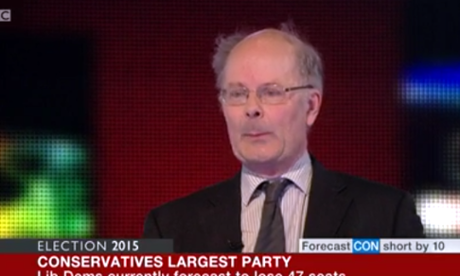
Updated
The YouGov figures reflect polling carried out today, but it is not a proper exit poll.
YouGov has not done an exit poll. A re-contact survey today simply gave us no reason to change our final numbers from yesterday.
— YouGov (@YouGov) May 7, 2015
Jonathan Freedland has posted a snap analysis of the exit poll. Here is an excerpt:
If this one turns out to be similarly accurate, there will be inquests aplenty. Labour will surely spend the coming hours contemplating the fate of its leader, who – this poll says – was roundly rejected in both England and Scotland. The Lib Dems will spend the night contemplating the bizarre prospect of having been simultaneously wiped out – and looking forward to a return to government. Their projected tally of 10 seats should be a disaster of epic proportions – and yet, on the exit polls, it would almost be enough to see them renew their coalition vows with the Conservatives.
As for Scotland, the exit polls confirmed that this was the revolution some had foretold – in which Scotland turned collectively yellow, becoming the land of the Scottish National party.
Updated
If you missed the moment the exit poll from the BBC, ITV and Sky News was announced, here it is again:
Updated
This is from Sam Freedman, a former adviser to Michael Gove. His tweets are normally quite sensible.
Extraordinary rumours swirling - most incredible is that Tories think they might have got Balls in Morley and Outwood. Surely not.
— Sam Freedman (@Samfr) May 7, 2015
As dramatic exit polls suggest that the SNP could sweep to power in all but one of Scotland’s 59 constituencies, Dr Murray Stewart Leith, senior lecturer in politics at the University of the West of Scotland, has urged parties to treat the results with caution.
I’m dubious about it because it deviates so strongly from all of the other polls we’ve had,” he said. “We’ve had more polls taken over the course of this campaign than any previous election.
Of course, polling has been wrong in the past, but as a science it’s become more exact. It’s a social science, so we’re always going to be slightly off, but even given the most extreme margin of error this poll is giving a significant gain to the Conservatives across the UK that not even their most ardent supporters thought was possible.
And in Scotland, with 58 seats going to the SNP, even the nationalists are treating this one with huge caution. I think the SNP would be ecstatic if they broke 50 honestly – this is at odds with absolutely everything the evidence has told us so far.
Updated
Senior Welsh Labour source says if exit poll is right it could mean an ‘English’ swing & thus spell bad news for the future of the Union.
— Adrian Masters (@adrianmasters84) May 7, 2015
This is the line from Labour:
It has been close all the way through – and exit polls have been wrong in the past. YouGov figures are very different from the BBC’s. The coalition came into the election with a majority of 73 and even if the BBC exit poll is right, that has all but been wiped out. Who forms the next government is who can carry the confidence of the House of Commons.
Updated
YouGov poll suggests Tories on course for 284 seats, Labour 263
YouGov has released a new poll that has given very different figures from the exit polls.
YouGov Exit Poll: CON - 284 LAB - 263 SNP - 48 LDEM - 31 UKIP - 2 GRN - 1 #TheVote
— Britain Elects (@britainelects) May 7, 2015
And here are the figures side by side.
Exit polls comparison (BBC vs. YouGov) Cons: 316 vs. 284 Lab: 239 vs. 263 Lib Dem: 10 vs. 31 SNP: 58 vs. 48 UKIP: 2 vs. 2”
— John O'Brennan (@JohnOBrennan2) May 7, 2015
Caroline Davies is in Witney, David Cameron’s constituency, where counters are getting ready for a long night. She sends this report:
The first of the ballot boxes arrived at 10.15pm at the Windrush leisure centre in Witney, David Cameron’s West Oxfordshire constituency. In the last general election, he polled 33,973 – 58% – and a majority of 22,740. The Liberal Democrats were second with 19.4%.
It’s an archetypal leafy constituency of consistently blue hue since its creation in 1983. Its first ever MP was Douglas Hurd, who was cabinet minister under both Margaret Thatcher and John Major.
Then there was Shaun Woodward in 1997. But he defected to Labour two years later. Cameron has been MP since 2001.
Updated
Harriet Harman, Labour’s deputy leader, also told the BBC that, if the exit poll was right, it meant the coalition goverment had lost its majority.
Updated
Phoebe Greenwood is in Uxbridge, the seat Boris Johnson is contesting for the Tories, as the ballot boxes arrive for the count.
Updated
Gove hints Cameron would want a second coalition
Here is more from what Michael Gove told David Dimbleby earlier.
- Gove said, if the poll was right, the Conservatives would have “clearly won”.
- He said David Cameron would have “considerable authority”.
-
He hinted that Cameron would want a second coalition. He said Cameron would want a “strong, stable and secure government”.
And here are the quotes.
I believe it could be right. If it is right, the Conservatives have clearly won this election, and Labour have clearly lost it. We have not had an incumbent government increase its majority like this since 1983 and it would be an unprecedented vote of confidence in David Cameron’s leadership and in particular in the message that we have reinforced throught this campaign, which is that if people want to secure our economic recovery, they have to make sure that David is in Downing Street ...
If this exit poll is correct, that gives the prime minister considerable authority. He would have clearly won. And we should all wait for the prime minister to say tomorrow on what basis he proceeds and on what basis he wants to ensure that we have a strong, stable and secure government that we argued for and that it seems the country has backed.
Pound surges on exit poll
The pound surged by 1% against the US dollar to $1.54 after the exit poll was published.
Chris Beauchamp, a senior market analyst at IG, said the much better-than-expected performance by the Tories electrified markets, sending sterling 150 points up against the US dollar to $1.54 – and pushing up FTSE futures.
Beauchamp said:
The exit poll certainly comes as a surprise, putting the Conservatives well ahead on 316. IG’s market had the Conservatives at 291 in the minutes before the poll was released, so it appears the ‘incumbency effect’ is playing its part as people weigh up their choices in the privacy of the voting booth. Crucially, Mr Cameron is expected to still be short of a majority, but it looks like any putative anti-Tory coalition will have a harder job on its hands blocking any Queen’s speech authored largely by the Conservatives.
A strong Conservative element to the next government sends the message that the economic policies of the past five years will continue, removing concerns about an early end to austerity.
Beauchamp makes the point that this makes a referendum on whether Britain should stay or leave the EU much more likely. “We could see the pound drop back as this realisation sinks in,” he said.
Pound surges 1% against the US dollar to $1.54 after exit poll shows Conservatives are largest party #GE2015 pic.twitter.com/2NdbUn6Ans
— Graeme Wearden (@graemewearden) May 7, 2015
Updated
Harriet Harman, Labour’s deputy leader, says even if the exit poll is correct, there would still be a question as to whether the Tories could form a majority.
She won’t go as far as Paddy Ashdown, she says, but she has known exit polls to be wrong before.

Updated
Exit poll analysis
The exit poll commissioned by the BBC, ITV and Sky News, and carried out by Gfk-NOP and Ipsos Mori, has the Conservatives on 316 seats, by far the largest party. Labour are predicted to win 239 seats.
The numbers are in stark contrast to pre-election polls. And based on these numbers, the current Conservative-Lib Dem coalition government would have the numbers to continue in office.
Beyond the two main parties, the exit poll has the SNP winning 58 seats, the Lib Dems 10, and Ukip and the Greens both on two seats. If the results confirm the exit poll, the sum of support that Cameron could expect in parliament would tally up to 336 seats.
Meanwhile, those parties that would vote a Conservative government down – Labour + SNP + SDLP + Plaid Cymru + Greens – would add up to only 306 seats.
If the results confirm the exit poll, the most contrasting result with pre-election polls would be the gap between the Tories and Labour, and the collapse of the Lib Dems, who were expected to hold on to about half their seats.
Less surprising would be the result of the Scottish National party. Since last year’s independence referendum, the SNP has commanded a 20-point lead over Labour in poll after poll. So when it came to Nicola Sturgeon’s party, the question was only ever about how many of Scotland’s 59 seats would it eventually gain.
Updated
V senior @UKIP sources in Thanet south tell BBC turnout high but worried about tactical voters out to block @Nigel_Farage ie labour #ge2015
— Robin Brant (@robindbrant) May 7, 2015
Senior @Conservatives sources in Thanet south tell BBC it's 'too close to call', but confident vote 'holding up' #ge2015
— Robin Brant (@robindbrant) May 7, 2015
Ashdown says he will "eat [his] hat" if exit poll turns out to be correct
Paddy Ashdown, the former Lib Dem leader and head of the party’s election campaign, has just told the BBC that he would “publicly eat [his] hat” if this poll turns out to be true.
Updated
SNP says treat exit poll with 'huge caution'
Nicola Sturgeon, the SNP leader, says the exit poll should be treated with “huge caution”.
I'd treat the exit poll with HUGE caution. I'm hoping for a good night but I think 58 seats is unlikely! #GE15
— Nicola Sturgeon (@NicolaSturgeon) May 7, 2015
Lib Dems dismiss exit poll
A senior Lib Dem source in Nick Clegg’s camp said:
Our initial thoughts on the exit poll are that it doesn’t match any of our internal intelligence and we find it quite extraordinary that not a single bit of evidence has pointed to this so far. Labour losses and Tory gains seem extraordinary. For the SNP to take all but one seat in Scotland would also be extraordinary. We are going to take a loss, we’ve always known that and it’s not going to be an easy night but we think 10 is right at the bottom end of our expectations.
Updated
Pound surges 1% against the US dollar to $1.54 after exit poll shows Conservatives are largest party #GE2015 pic.twitter.com/2NdbUn6Ans
— Graeme Wearden (@graemewearden) May 7, 2015
Gove says, if poll right, Tories have 'clearly won this election'
Michael Gove, the Conservative chief whip, tells the BBC that if this poll is correct, “the Conservatives have clearly won this election, and Labour has clearly lost it”.
Updated
John Curtice: If exit poll is correct predicted Labour tally of 239 seats would represent party’s worst result since 1987 #bbcelections2015
— Nick Sutton (@suttonnick) May 7, 2015
According to these figures, the Conservatives and the Lib Dems together would have 326 seats - just enough for a majority.
The exit poll says the DUP are on course to get 8 seats. So, if they joined up with the Tories and the Lib Dems, that would take the figure to 334.
Labour and the SNP would have 297 seats.
The BBC has now released the rest of the figures, including Plaid Cymru and the Greens.
Conservatives: 316
Labour: 239
SNP: 58
Lib Dems: 10
Plaid Cymru: 4
Greens: 2
Ukip: 2
According to these figures, the Conservatives are on course to gain nine seats. And Labour are on course to lose seats, and end up 77 seats behind the Conservatives.
Exit poll says Tories on 316, Labour on 239
Here are the exit poll figures.
Conservatives: 316
Labour: 239
SNP: 58
Lib Dems: 10
Ukip: 2
As we await the exit poll from the main broadcasters, Channel 4’s Alternative Election Night has kicked off, pairing up David Mitchell and Jeremy Paxman for nine hours of hard news, electoral commentary, biting satire and Gogglebox. Paxo left Newsnight for this new foray into awkward autocue stand-up, so we’re tentatively hopeful it will offer some light relief from the joyless election dustbowl on the BBC, particularly in the small hours.
However due to Ofcom rules, Channel 4’s Alternative Election Night can’t talk about the election until the polls close. So the first hour has been mostly laboured gags about not being able to talk about the election. A 10pm start would have been considerably less painful.
David Dimbleby has the exit poll in his hands. But he can’t read it out til 10pm.
Updated
Labour says it has had 10,000 volunteers out on the streets of London today in an effort to get its vote out. The party has been consistently ahead of the Tories by 12% – 14% in the capital and hopes that its superior “ground war” will convert that lead into a raft of new seats. Labour currently has 38 of the capital’s 73 MPs, the Tories 28 and the Lib Dems seven.
An early test of this theory will be Battersea, which is due to declare at 2am. The party needs to overturn a near 6,000 majority to oust Conservative MP Jane Ellison. If Labour is anywhere near it will be an ominous sign for the Tories, but if a recent poll from Lord Ashcroft putting the Tories 12 points clear proves accurate, Labour could be in for a long night.
After Battersea, look out for Bermondsey and Old Southwark and Hornsey and Wood Green due at 3am, Enfield North at 3.30am and Ealing Central and Acton & Finchley and Golders Green at 5am.
Updated
Earlier the Spectator’s Isabel Hardman wrote a blog saying the Tories suspect Ed Miliband could offer the Lib Dems electoral reform to win their support in a hung parliament. But Labour are dismissing this idea, she reports.
Update: Labour sources pouring cold water on idea of PR as an offer to Lib Dems http://t.co/282bOWot8w
— Isabel Hardman (@IsabelHardman) May 7, 2015
“They cling on to it like a chalice but I don’t think anybody else is that arsed, to be honest wi’ ye,” said a Sunderland taxi driver of his city’s proud record of being the first to declare a result in every general election since 1992.
Within three minutes of the polls closing at 10pm, the first ballot boxes are being sprinted into a vast sports complex three miles from Sunderland city centre. A team of 100 sixth-formers have been recruited from two local schools as runners, delivering the boxes from 121 polling stations across Wearside to 200 well-drilled counters, including local bank tellers hand-picked for their speed and accuracy.
The fastest ever declaration was 10.43pm in 2001. In 2010, Houghton and Sunderland South declared at 10.52pm, followed by Washington and Sunderland West at 23.25pm, then Sunderland Central at 11.26pm. They are aiming to beat that this year, aided by lighter ballot papers (80gsm instead of 100gsm) and faster routes through traffic.
Updated
The Sunderland seats are expected to be the first to declare. In a recent Guardian article Dave Smith, the council’s chief executive, explained why the council was so quick.
UPDATE: Dave McGuinness says Newcastle fancy their chances too.
@AndrewSparrow massive rivalry between Newcastle & Sunderland to try and declare first apparently Newcastle City Council fancy their chances
— Dave McGuinness (@mcguinness_d) May 7, 2015
Updated
Nigel Farage is still trying to get the Kippers out.
30 minutes left! Go and #VoteUKIP for a REAL shake up of the political establishment! #GE2015 #IVOTED
— Nigel Farage (@Nigel_Farage) May 7, 2015
Here are some more reports of polling station queueing.
Large queues form outside of Holy Trinity Church on Boar Lane in Leeds #leeds #electionyorks http://t.co/KkIJJr4ENT pic.twitter.com/l7vbhhbg8T
— YorkshireEveningPost (@LeedsNews) May 7, 2015
Huge queues now outside Spa Rd polling station in Bermondsey. You will be allowed to vote if you're in line before 10pm.
— Ben Johnson (@drbenjohnson) May 7, 2015
1 hour left to vote, and queues outside some polling stations are 50 minutes long http://t.co/h8WDGNicNH #GE2015 pic.twitter.com/LWCkH8YoS9
— Business Insider UK (@BI_Europe) May 7, 2015
good lord, a 40 minute queue outside a polling station in Cheetham Hill http://t.co/PVuHicuH4i
— jamie k (@jkbloodtreasure) May 7, 2015
Long queues at polling stations in Hove. Suspect turnout is going to be high this time.
— Andy Chiles (@Just_Andy_C) May 7, 2015
Updated
In Norwich some people have been having to wait up to an hour to vote.
Polling station at jessopp road Norwich where people have waited up to an hour to vote pic.twitter.com/0PL2CWds89
— Andrew Sinclair (@andrewpolitics) May 7, 2015

Betfair, 9pm: Ed Miliband odds-on favourite at 10/11 for next PM, pulling away slightly from David Cameron 11/10.
— Fraser Nelson (@FraserNelson) May 7, 2015
Our correspondent Josh Halliday has done a brief video interview with the Sunderland returning officer - the man masterminding the city’s attempt to smash its own declaration record of 10:42pm.
Updated
Here is some more background election reading.
And, if you want something to watch while we wait for 10pm, I’d recommend some of John Harris’s Anywhere but Westminster election videos. Here’s his final one.
Updated
Here’s a Guardian/Observer graphic showing what success might look like for the main parties.
Every man and his dog seems to be coming up with an election forecast this time round. This one, from an independent analyst who writes the Number Cruncher Politics blog, may make Labour a little nervous.
NCP final call roundup and prediction: CON 302 LAB 249 SNP 51 LIB 23 http://t.co/Tfknp8cMP1 #GE2015 #ELECTION2015 pic.twitter.com/LfX5K0N6SF
— NumbrCrunchrPolitics (@NCPoliticsUK) May 7, 2015
Number Cruncher is out of line with most other forecasters because his model assumes that the polls understate the chances of the Tories doing well. (And he is a he, although he does not use his name.) He explains more here.
Updated
According to ConservativeHome’s Mark Wallace, in some areas the Tories are having problems with VoteSource, their voter contact database.
Hearing from a variety of seats where VoteSource is borked that campaign teams are left relying on old paper canvassing returns.
— Mark Wallace (@wallaceme) May 7, 2015
If, as I wrote this morning http://t.co/LojHIl1o9L, your plan is to win by smart targeting, your database breaking is bad news.
— Mark Wallace (@wallaceme) May 7, 2015
@melindiscott It's the voter contact database. Who we've canvassed, who is a Tory voter and therefore whose door needs knocking on today
— Mark Wallace (@wallaceme) May 7, 2015
@melindiscott Apparently that last part - printing out the sheets so you can knock on supporters' doors to get out the vote - is breaking
— Mark Wallace (@wallaceme) May 7, 2015
I'm told VoteSource is working fine in South Thanet - evidently the problems aren't everywhere. ( cc @LabourList)
— Mark Wallace (@wallaceme) May 7, 2015
Here is a sample of “only two more hours to vote” tweets from the political parties.
This is the closest election for a generation. Make sure your voice is heard. #VoteLabour
— Ed Miliband (@Ed_Miliband) May 7, 2015
Just 2 hours left to make your voice heard and secure a brighter future for Britain. Make sure you #VoteConservative. pic.twitter.com/oIa5VNPRLx
— David Cameron (@David_Cameron) May 7, 2015
Two hours until polling stations close at 10pm. Please get out and vote! http://t.co/pDMqSEBmYG #VoteGreen2015 pic.twitter.com/ElZd2QEIRb
— The Green Party (@TheGreenParty) May 7, 2015
90 minutes remain to #voteSNP and help us end Westminster austerity cuts. Polls close at 10pm #GE15 pic.twitter.com/YxPwoYFk6G
— Peter Murrell (@PeterMurrell) May 7, 2015
There's just an hour & a half until polls close. Here's why you should vote #libdems #GE2015 pic.twitter.com/slr2kRMrFD
— Liberal Democrats (@LibDems) May 7, 2015
If you are interested in how the BBC/Sky/ITV exit poll is conducted (see 8.03pm), here is a short reading list.
- And this is for the real specialists – an article on the 2010 poll in the Journal of Elections, Public Opinion and Parties (pdf). It includes this – the formula used to convert predicted vote shares into probabilities that a particular party would win a seat.
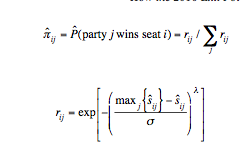
Being Guardian readers, you won’t need an explanation because I’m sure it’s all quite clear to you.
Updated
Key declaration times
Updated
What channel to watch
My colleague Claire Phipps posted earlier a useful guide to what’s happening on election night. It includes her guide to where you can watch the results. Here are the options for UK viewers.
- BBC1: The magisterial David Dimbleby captains the live results show from 10pm, with Nick Robinson, Emily Maitlis, Vine and Andrew Neil alongside. From 7am on Friday, Huw Edwards takes over, with the BBC promising he will “stay live on air” until we know what’s happening, which presumably is also its zombie invasion plan.
- ITV: Political editor Tom Bradby presents, with Julie Etchingham and Nina Hossain, and we are assured there will be no commercial breaks, which is a relief for those worried they might miss the Sheffield Hallam result for a “have you had an accident that wasn’t your fault?” advert. ITV also promises a Commons calculator, which had better be more exciting than it sounds.
- Sky News: It’s Adam Boulton, of course, with political editor Faisal Islam, broadcasting from “a specially created studio”, which sounds slightly unnecessary as you’d have thought they already had a few. Eamonn Holmes, hoping to turn in early, is in Sunderland. Dermot Murnaghan comes on board at 5am on Friday.
- Channel 4: It’s Alternative Election Night here – though not that alternative as it has Jeremy Paxman, who said, while dying a little inside: “Elections matter. But that doesn’t mean the coverage has to be dull. I hope there’ll be room for both insight and laughter.” David Mitchell, Cathy Newman and Gary Gibbon are also around. And there’s a special election-themed Gogglebox in which the word “posh” will be heard a lot.
- More 4: The real alternative election night, with a live screening of a Donmar Warehouse production, The Vote, which plays out in real time the last 90 minutes of polling station action. Or just go and hang out in your own polling station, but don’t blame me if you don’t see Judi Dench.
Updated
Only two more hours to go.
The polls have been open since 7am and you can follow all the polling day action on our earlier live blog (as well as see some nice pictures of dogs).
It has been an election that has exhausted Fleet Street’s entire stock of knife-edge/too-close-to-call-cliches and, appropriately enough, the Guardian’s final seat projection has Labour and the Tories both getting exactly the same number of seats – 273.
My colleague Alberto Nardelli has a more detailed analysis here. Essentially, he says that the Tories are on course to get most votes, that it’s a toss-up (to raid the cliche cupboard again) as to which of the main parties gets most seats, but that it is hard to see how David Cameron could remain as prime minister.
Quite soon we’ll know for certain. The polls close at 10pm, and at that point the BBC and other broadcasters will release the results of their joint exit poll. It is called an exit poll, but it is not just an ICM/YouGov-type job (professional as they are). It is a highly sophisticated forecast, produced by the country’s leading psephologists, based on data from 140 polling stations. Last election at 10pm it got the final Conservative result exactly right, and with the Lib Dems and Labour it was out by two and three seats respectively. In other words, it is worth taking very seriously.
For real results, we’ll have to wait a bit longer, but not much. The first is due from Houghton & Sunderland South at around 11pm. A full list of declaration times is here.
I’ll be covering the main results as they come in, and I’ll be bringing you the best reaction, comment and analysis, not least from our network of thousands of political insiders all over the UK (or Tweetdeck, as it is otherwise called). For added firepower, many Guardian colleagues will also be contributing posts to the blogs, with news and analysis.
Any general election is obviously thrilling but tonight we’re going to see, potentially, three separate narrative unfold.
1 - The election results, obviously, which will decide the makeup of the House of Commons and – either quickly or slowly, more on this later who forms the next government.
2 - Potential coalition negotiations. Any sit-down talks are not going to start until Friday, but in 2010, when as soon as the exit poll pointed to a hung parliament, Labour effectively opened coalition talks with Lib Dems live on air, with leading figures like Lord Mandelson hinting at possible concessions that his party could offer. It would be surprising if we don’t see the same thing start happening tonight. For example, assuming that the exit poll does not predict a surprise Conservative majority, we’re likely to get some idea of what the Tories might offer Nick Clegg. Those £12bn welfare cuts; by 6am, they could be out of the window.
Even if the Lib Dems lose around half their seats, as people expect, they could still be in a position of power because, in a hung parliament, the Lib Dems and the DUP would be the two “swing voter” blocs – potentially capable of supporting either a Conservative or a Labour government. There is going to be a ferocious debate in the Lib Dems about what they do as a party. In TV studio and concession speeches at election counts, that debate may kick off tonight.
3 - Inquests and leadership manoeuvring. Election defeats always trigger into what went wrong, and they often lead to resignations and leadership contests. It is polite to wait at least until the next morning before attacking the party leadership, but in the age of Twitter people are not always so patient. Here’s that famous tweet from Rachel Johnson, Boris’s sister, after it became clear last time that the Tories were not going to win an election.
It's all gone tits up. Call for Boris
— Rachel Johnson (@RachelSJohnson) May 7, 2010
She won’t be daft enough to do the same tonight (although, if she does, we’ll post it here asap), there is bound to be some internal party dissent breaking out.
We’ll be blogging right through the night until 7am. Then we’ll launch a fresh blog covering either the installation of a new prime minister or, more probably, some dramatic power-grabbing haggling.
If you want to follow me on Twitter, I’m on @AndrewSparrow
Updated