Evening summary
Today marked the start of the second week of the election campaign proper, and Labour became the first main party to launch its election manifesto. As such, the day was dominated by the party’s fiscal pledges, as well as the Conservatives’ attempt to unpick them.
The big picture

With its manifesto Labour has tried to bill itself as the party of fiscal responsibility. During the manifesto’s launch in Manchester, Ed Miliband challenged the Conservative claim that he would not tackle the deficit by unveiling a “budget responsibility lock” which he said will guarantee every policy announced by his party will be fully funded and involve no extra borrowing. The first line of Labour’s first budget, it was also revealed, will declare that it “cuts the deficit every year” and every subsequent budget will have to abide by this commitment which will be verified by the OBR.
Though it is uncertain whether voters will believe Labour’s promises on the economy (the Conservatives are still viewed my most as the trusted party on this issue), the verdict on Milband’s speech and Q&A as a whole was highly positive. Political journalists and commentators seemed impressed by his self-assurance and charisma. Here’s an extract from that speech:
I am ready, ready to put an end to the tired old idea that as long as we look after the rich and powerful we will all be OK.
Ready to build a country that works for working people once again.
Ready to put into practice the truth that it is only when working people succeed, that Britain succeeds.
If you elect me your prime minister in just over three weeks’ time:
I will work for that goal. I will fight for that goal. Every single day. In everything I do. In every decision I make.
Our opponents will tell you this is as good as it gets for Britain.
It isn’t. I know Britain can be better.
The British people know Britain can be better.
Let’s make it happen together.
What happened today
-
Labour announced five new policies in its manifesto: raising the minimum wage to more than £8 by October 2019, helping train passengers and commuters with a fully funded fare freeze, supporting the squeezed middle with a firm commitment not to raise the basic or higher rate of income tax, national insurance or VAT, protecting tax credits in the next parliament, and introducing a new National Primary Childcare Service to help working parents (see 11:22). We’ve got expert analysis of Labour’s manifesto: for defence see 12:58, for environment and energy see 13:01, for business see 13:03, and for personal finance see 13:07.
-
In his speech, Miliband said the Conservatives are now “the irresponsible party in British politics” after making unfunded spending commitments worth around £20bn (see 11:40).
-
George Osborne issued a response to the Labour manifesto on behalf of the Conservatives, stating that Labour had no credible economic plan. David Cameron later added that voters should not trust Ed Miliband with the economy.
-
Paul Johnson, the Institute for Fiscal Studies director criticised the vagueness of Labour’s plans to get rid of the deficit on current spending, while Chris Ham, chief executive of the King’s Fund health think tank, applauded the party for its positive vision for health and care (but still questioned its refusal to commit to £8bn additional funding for the NHS see 18:12).
-
Ed Balls appeared on the Today programme where he strongly criticised George Osborne for making an unfunded commitment to spend an extra £8bn on the NHS, saying he was treating the electorate “with contempt”. He also rejected Jim Murphy’s suggestion that, under Labour, there would be no further cuts in Scotland after 2015-16.
-
John Swinney, Scotland’s deputy first minister, responded that Balls’ interview has “blown a massive hole” in Labour’s campaign in Scotland (see 10:29). Meanwhile, Nicola Sturgeon said the Scottish Labour leader had been “hung out to dry”, proving that his party is “no more than a branch office of Westminster Labour” (see 16:44).
-
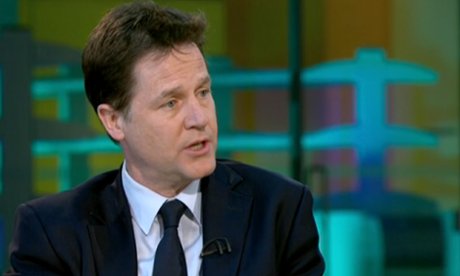
Nick Clegg was interviewed by Evan Davis on BBC1, where he said the Lib Dems would not back Tories if they cut welfare by £12bn. He also said the Lib Dems could not do a deal with Labour unless it provided a clearer deadline for getting rid of the deficit on day-to-day spending.
-
A Guardian/ICM poll put the Conservatives six points ahead of Labour. An Ashcroft poll released shortly afterwards put the two parties tied at 33%.
-
Anti-nuclear protesters tried to temporarily close down the Clydeside home of the UK’s nuclear submarines.
-
Nigel Farage hosted a Q&A in Purfleet at a venue that doubles up as a gentlemen’s lapdancing club, where he was received by more than 800 supporters.
-
The Green Party launched their national poster campaign in Brighton.
Quote of the day
“Forget the longest suicide note in history; whoever wrote this would have died of boredom first” – Damian McBride, the former Gordon Brown spin doctor, on the Labour manifesto.
Hero of the day
Yanek Zylinski, the man claiming to be a polish prince, who challenged Nigel Farage to a duel with swords “in a way that an 18th-century Polish aristocrat and an English gentleman would traditionally do”.
Villain of the day
Respect supporter Amar Rafiq, who allegedly assaulted Ukip candidate Owais Rajput by asking why Owais had blocked him on social media and saying “you can’t even speak English properly”.
Tomorrow’s agenda
Tomorrow the Conservatives launch their manifesto. Many are eager to see what the Tories’ pledge as they’ve been the most secretive about the details of their promises. A scoop by my colleague Nicholas Watt today revealed that the party appear to be drawing up plans to steal the thunder of their opponents by outflanking Labour and the Liberal Democrats over plans to exempt workers on the minimum wage from paying income tax. That will undoubtedly provide much fuel for debate.
That’s all from me today. Join us again at 7am, when me and my colleagues will keep you updated on all the latest political developments. The Guardian daily live election blog will run until May 7 – and possibly later, so there’s much to look forward to (or dread, depending on which way you look at it).
Updated
Labour’s manifesto is all about rebuilding the party’s reputation, our economics editor Larry Elliot writes, pointing out that while many of the party’s commitments are feasible and economically relevant, the final two pledges are there for purely political purposes.
It is not unusual for voters to trust the Conservatives more than Labour over the running of the economy. What has been striking during this parliament has been the size of the Tory lead. So the budget responsibility lock in line one of Labour’s manifesto is an attempt to confront this weakness head on. It is the equivalent of Gordon Brown in 1997 promising to keep the top rate of income tax at 40% and to stick to Ken Clarke’s spending plans.
The Guardian is working with the pollsters BritainThinks to conduct focus groups throughout the election with 60 voters in five key marginals. Each has an app to feedback what they are noticing in the campaign in real time. This is what they are saying about Labour’s manifesto launch and reactions to it:
Nicola Sturgeon is to appear on ITV’s The Agenda with Tom Bradby at 11.10pm tonight. As the show is pre-recorded, I have a copy of what she will be saying. Here are some key points:
Sturgeon says it is not inevitable that Scotland will see another referendum:
Scotland does accept the outcome of the referendum…The election on the 7th is not about independence. If you vote for the SNP you are not voting for independence you are not even voting for another independence referendum. You are voting to make Scotland’s voice heard in that system that has so often in the past tended to side-line and ignore Scotland. I think Scotland will be independent one day, I think that is the direction of travel but it won’t be me that decides that.
Sturgeon says Scotland’s fiscal position is improving:
The figure of £7.6bn [spending gap] is a complete red herring. .. It would take no account of the fiscal agreement and framework. Scotland’s fiscal position is improving. Full fiscal autonomy even if we could agree on it this year would take several years to fully implement. What I would argue is for the powers first to grow our economy more effectively.
Sturgeon says borrowing powers for Scotland would have to be negotiated:
That would be part of the fiscal framework that would have to be negotiated. But full fiscal autonomy would come with borrowing powers but the 7.6bn figure is one that we shouldn’t get fixated upon… There are a number of things that would have to be negotiated not least what Scotland’s contribution to the UK, defence, contribution to interest payments. We would be required to make contributions to the UK government.
Sturgeon says she is offering a hand of friendship to the Labour Party but she doesn’t think the country can afford more austerity:
Minority government can be stable and effective and successful and we have proven that so I guess we know how can contribute to making a minority government work.
We have a vested interest as long as we are part of that system to make sure it works as well as possible. What I am trying to say is look, here is a hand of friendship and not be secretive about my support for independence.
I don’t think the country can afford more austerity. I would be seeking to build alliances with parties like Plaid Cymru and the Greens and back benchers…I could never ever support a Tory government. I grew up in the west of Scotland when Mrs Thatcher was Prime Minister and saw first-hand the damage she did to the community I grew up in.
Sturgeon says under SNP plans it would take 2-3 years longer to eliminate the deficit:
We are putting forward alternative plans for modest spending increases for the next parliament for half a per cent in real terms per year. It would take 2-3 years longer to completely eliminate the deficit under that plan…
Under what I am proposing the deficit as a share of income would reduce year on year but it would take longer to completely eliminate. It would go beyond the next parliament to completely eliminate. I think that’s a price worth paying for some investment in public services.
Updated
Contrary to my earlier post that Damian McBride appeared to be dismissing Labour’s manifesto because he called it “boring”, he’s been in touch to point out that that’s not actually the case.
On the contrary, @nadiakhomami and @andrewsparrow - I'm a big fan of the LAB manifesto precisely cos it's so boring! http://t.co/6yJjaqa57u
— Damian McBride (@DPMcBride) April 13, 2015
Here’s the full quote:
Forget the longest suicide note in history; whoever wrote this manifesto would have died of boredom first.
But let me stress: that is no bad thing. Give me a manifesto that is boring but deliverable any day, rather than a screed of commitments made to be broken, and secret plans hidden from public view.
More from Thurrock: Farage received a strong show of support, but worth noting that all the questions were vetted beforehand.
#UKIP have sold 1,300 tickets for tonight's rally. The venue (below the strip club) is pretty packed out pic.twitter.com/2BmgSCx5fc
— Sebastian Payne (@SebastianEPayne) April 13, 2015
Nigel Farage has the crowd in his hand - huge cheers for scrapping the Barnett formula, for "believing in Britain" pic.twitter.com/BPWabTUbvq
— Sebastian Payne (@SebastianEPayne) April 13, 2015
Every question at Ukip event has been pre-submitted. No roaming microphones. No chance of the unexpected.
— Ben Riley-Smith (@benrileysmith) April 13, 2015
I’m back. My colleague Rowena Mason has been in Thurrock for Nigel Farage’s Q&A. She just sent me this:
Ukip leader Nigel Farage packed out a former darts world championship venue in Thurrock - the Circus Tavern - which boasts a gentlemen’s lap dancing club as part of its complex.
He got standing ovations, whoops and cheers for pledges to bring down immigration and keep out immigrant with life threatening diseases such as HIV. He also focused heavily on promises about lowering the cost of living and standing up for working people - using rhetoric similar to Labour. “Are you feeling the economic boom in Thurrock?” he asked. “No!” the room chorused.
The party has a good chance of winning the seat as it is a three way marginal split almost evenly between the Ukip candidate Tim Aker, incumbent Tory MP Jackie Doyle Price and Polly Billington, a Labour former aide to Ed Miliband.
Asked about the ICM for the Guardian poll showing UKIP on 7% nationally, Farage said the polling company had got his party “wrong almost every time”.

“There is a very big squeeze being put on UKIP with the presentation of a binary choice,” he said. “But neither of the big parties are going to be able to form a government.... We will do well if people who want change go out and vote for change.”
Updated
Clegg identifies Lib Dem 'red lines' for coalition with Labour or Tories
With most polls pointing to a hung parliament, journalists during the election have been avidly hunting for “red lines” - the non-negotiable demands that would stop one party doing a deal with another. And Evan Davis did rather well tonight, because he managed to extract two from his interview with Nick Clegg. They were still slightly fuzzy red lines, but they add some clarity to our understanding of Lib Dem thinking.
-
Clegg said the Lib Dems could not do a deal with Labour unless it provided a clearer deadline for getting rid of the deficit on day-to-day spending. Ed Miliband says Labour would do this by 2020 at the latest. Clegg said this was not good enough, and he urged Davis to get Miliband to give him a firm date when Davis interviews him next week. Clegg said:
In exactly the same way that I could never countenance recommending to the Liberal Democrats that we enter into a coalition with the Labour party that isn’t serious about balancing the books, rather than the specious stuff they’ve come up with today, which still is totally opaque about when they will actually balance the books ...
-
Clegg said the Lib Dems would not do a deal with the Tories if they wanted to go ahead with their planned £12bn welfare cuts.
Equally I would not recommend to the Lib Dems that we go into coalition with the Conservatives if they insist on a plan which is a remarkable departure from what we’ve done in this coalition
They’re asking for £12bn over two years. We’ve made £20bn over half a decade. They want to ask the poorest to make those additional sacrifices at the same time saying to the richest that they don’t need pay an extra penny through the tax system to balance the books. That is downright unfair.
When Davis pressed Clegg on where a compromise might be reached between the Tories’ proposed cuts of £12bn, and the Lib Dems’ proposed welfare cuts of £3bn, Clegg would not come up with a figure. But he said the Lib Dems would insist on forcing the rich to make an extra contribution to balancing the books, which would not happen under Tory plans at the moment.
It is also worth pointing out that “red line” coalition talk may be academic. Given the difficulty Clegg would have getting a coalition deal through his party (and Ed Miliband and David Cameron would face similar problems), a less formal kind of pact, which would leave the Lib Dems free to vote against the government on non-critical issues, may be more likely anyway.
I’m handing back to Nadia now for the rest of the night.
Updated
Here is some Twitter comment on the interview from journalists.
Clegg getting a bit rattled over @evanhd line of questioning about the influence of his privileged international background.
— David Hughes (@DavidHughesPA) April 13, 2015
Nick Clegg to @EvanHD, drawing what sounds like a red line for any Lib Lab Coalition: a date for balancing the books. Will he regret that?
— Paul Waugh (@paulwaugh) April 13, 2015
So, Clegg is producing a welfare red line 4 the Tories, no to £12bn, and a deficit red line 4 Labour that is more than what they said today
— James Forsyth (@JGForsyth) April 13, 2015
After all the interviews and radio shows - something new ! Clegg speaks fluent Dutch (tonight's Evan Davis interview)
— steve hawkes (@steve_hawkes) April 13, 2015
(We did actually know that Clegg spoke Dutch, but it was interesting to see a clip of him doing so.)
Clegg doesn't like using the term "red line". But Osborne's £12 bn off welfare and nothing through tax sounds like it could be a rode lijn.
— David Hughes (@DavidHughesPA) April 13, 2015
(Isn’t Google Translate wonderful?)
Q: You seem very plausible. But some people won’t believe you because of tution fees. How does that feel?
Clegg says he accepts some people will think that. But it galls him to see Ed Miliband not apologise for crashing the economy, and David Cameron make a promise on immigration he cannot keep.
And that’s it. The interview is over.
I will post a summary of the new points soon.
Q: If your party is obliterated in the election, will it have been worth it?
Clegg says that is hypothetical. He does not think the Lib Dems will be obliterated.
Q: But you have lost members. Has it been worth it?
Yes, says Clegg. See 7.36pm.
Clegg says he has an old-fashioned belief that, if you do the right thing, people will give you credit.
Q: And you will think that on May 8 even if you lose half your MPs?
Clegg says he thinks it was the right thing to do. He thinks the Lib Dems need to keep the government in the centre ground.
Q: Where does the red line come, between the Tories’ proposed £12bn cuts and your proposed £3bn cuts?
Clegg says it is not just a matter of a number. It is what they plan to do. Do the cuts hit the disabled.
The Lib Dems would insist on the rich paying more, he says.
Q: So what would you agree to?
Clegg says he is no slouch when it comes to welfare cuts.
The Lib Dems think they could achieve cuts of £3bn.
But £12bn would be four times what is spent on unemployment benefit.
Updated
Q: Could you work with the Tories again?
Clegg says, if the people produce an election result that points to that, he will see if he can make it work.
He makes the point about not working with the Tories if they want to go ahead with welfare cuts worth £12bn. See 7.36pm.
Q: Will the Lib Dems legalise cannabis?
Clegg says decriminalisation is different. As a parent, he is anti cannabis. But the system needs reform.
Q: The forecasts say the population will grow to 70m. Are you comfortable with that?
Clegg says he does not think there is one magic figure that should be a target.
Davis says he will take that as a yes.
Q: Do you regret the nationalist tenor of some of the national debate?
Clegg says he does. He worries that, if you look at what Ukip are saying, and what “significant parts of the Conservative party” are saying, they want to turn the UK in on itself.
Q: There is a feeling that globalisation works, though, for people like you, but not for other people.
Clegg says that is a silly thing to say. Just because his mother is Dutch, why should he not be able to understand people’s concerns. He thinks there is good immigration and bad immigration.
He says he personally insisted on the reinstatement of exit checks in the coalition agreement.
Davis shows a clip of Clegg giving an interview in Dutch at the last election.
Q: In 2010 you said that you were aware as a youngster that things worked better in the Netherlands. Do you still think that?
No, says Clegg. But in the 1970s and 1980s, when Britain was in conflict, the more consensual approach in the Netherlands seemed better.
Q: So who changed it? Thatcher, Blair or John Major?
Clegg says it was not any single figure. Over time, the UK became a more competitive economy.
He says that he feels, although Britain has much to teach the world, it can also learn from other countries. For example, we can learn from the ways other countries promote vocational education.
Q: Do you think there is a difference between the wy the Conservatives and Labour would treat coalition partners?
Clegg says he does not know. He has not been in coalition with Labour. He says Labour has always struck him as a tribal party.
Q: Do you trust David Cameron?
Clegg says he has a good working relationship with him. He says he is like many people who work with people they do not agree with. Perhaps there are people in the BBC Evan Davis does not agree with.
Q: Did you feel betrayed by Cameron during the AV referendum. The Tories exploited your unpopularity.
Clegg says Cameron’s behaviour was “shoddy”. See 7.36pm.
Evan Davis is asking Nick Clegg if he is proud of the government’s record.
Clegg says he is. He rattles through a list of achievements.
Well, hell yes, I am proud of it, he says.
The weekend after the election, there was a real threat that the UK could follow Greece. There could be higher unemployment, he says. He would not want that on his conscience.
Nick Clegg's Evan Davis interview - Key quotes
And here are some key quotes from the programme that the BBC has just released.
-
Clegg says the Tories know they will not win the election.
Evan Davis: [After the AV referendum] did you feel betrayed by David Cameron at any stage?
Nick Clegg: It was shoddy it was unnecessary I didn’t think they needed to win the argument by being quite so personal. I wish the referendum had been fought on its merits. What I have learnt about the Conservatives and you can see it in this election campaign. When they think they’re about to lose their grip on something that they like, usually power, they can lash out, they’re doing it in this election campaign because they realise they’re not going to win it.
-
Clegg says he wants to reform drug laws.
ED: Will cannabis be legal if the Lib Dems have your way?
NC: If you are anti-drugs, which of course I am, I have three little children, I don’t want them to be hooked on drugs; I think you should be pro-reform because the war on drugs and everybody knows this, is not working. Imprisoning people who need hospital treatment and allowing criminals to go free surely isn’t a logical way of doing things.
-
Clegg says the Lib Dems would not do another deal with the Conservatives if they insisted on cutting welfare by £12bn.
ED: One of the big dividing lines between you and the Conservatives is over welfare cuts?
NC: I wouldn’t accept £12bn of welfare cuts. In exactly the same way that I could never countenance recommending to the Liberal Democrats entering into a coalition with the Labour party that isn’t serious about balancing the books rather than the specious stuff they’ve come up with today … equally I would not recommend to the Lib Dems that we go into coalition with the Conservatives if they insist on a plan which is a marked departure from what we’ve done in this coalition … They’re asking for £12bn over two years. We’ve made £20bn over five. They want to ask the poorest to make additional sacrifices whilst not asking the richest to pay an additional penny through the tax system to balance the books.
-
Clegg says going into coalition has been worth it for the Lib Dems.
ED: You’ve lost members, you’ve lost MEPs and you’ve lost an enormous number of council seats. Has it been worth it?
NC: Yes, of course it has and any Liberal Democrat will tell you that … we took the decision as a democratic party. And we decided that notwithstanding the impact on our short term political popularity it was the right thing for the country. And a time when people are so cynical about politics, and so fed up with politicians isn’t it a good thing that a party, a plucky brave party put country before party and I have an old fashioned belief that if you do the right thing, that there are plenty of fair minded folk out there who will recognise that … was every decision a decision I would relish? Of course not. But is the country better now than it was when we found it on an economic precipice in 2010, you bet.
Clegg says Lib Dems would not back Tories if they cut welfare by £12bn
The Nick Clegg inteview was recorded in advance, and it looks as though we have already got a news line.
-
Clegg says Lib Dems would not back Tories if they tried to cut welfare by £12bn.
.@nick_clegg tells @EvanHD he couldn't accept coalition with Tories if they insist on £12 billion of cuts to welfare #leaderinterviews
— Andrew Woodcock (@AndyWoodcock) April 13, 2015
Updated
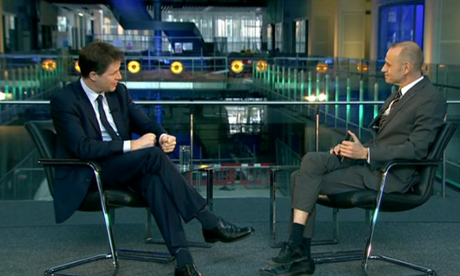
Here’s the set.
The set for tonight's interview with Nick Clegg...BBC1 at 7.30pm then more on Newsnight at 10.30 pic.twitter.com/qR1M83naq9
— Ian Katz (@iankatz1000) April 13, 2015
Hi, it’s Andrew Sparrow, taking over now from Nadia.
I will be covering Evan Davis’s BBC1 interview with Nick Clegg.
It is the first of the BBC’s main election interviews.
We have a video of David Cameron being heckled in Alnwick, Northumberland today.
The Guardian’s John Crace has written that Ed Miliband’s newfound self-belief. Could this be a sign of charisma? I’ve included a segment of John’s article below.
In a studio just along from the set of the Rovers’ Return, the shadow cabinet snuggled up to one another at the back of the stage as they awaited the arrival of Ed Miliband. One or two turned around to check out the backdrop of ‘Better Plan, Better Future’; they didn’t appear wholly convinced.
Then in strode Ed to a standing ovation. “Thank you,” he said. “Thank you.” “Thank you”. “Thank you.” “Thank you.” “Thank you.” He hadn’t actually said or done anything at this point, but somehow this was a different Ed. A few Tory wobbles and some better than expected opinion polls over the weekend have done wonders for his confidence. He now looked almost American; it remains to be seen whether that’s a good look.
Updated
It appears Gordon Brown’s former spin doctor isn’t the biggest fan of Labour’s manifesto.
Damian McBride on Labour manifesto: "Forget the longest suicide note in history; whoever wrote this would have died of boredom first"
— Fraser Nelson (@FraserNelson) April 13, 2015
This is interesting. Is Nick Clegg ruling out working with the Conservatives? (Of course compromises will be made in the event of a hung parliament, but are Tories willing to go back back on this pledge?)
Nick Clegg to say he will not work with the Tories again if they insist on £12bn worth of welfare cuts. A red line is drawn.
— Patrick Wintour (@patrickwintour) April 13, 2015
The Lib Dems are using Buzzfeed as an election campaigning tool. The party have just published an article entitled “If General Elections Were Held In Game Of Thrones”, in which they imagine what the election poster of each party would look like if we were living in the fictional world of Westeros. By the looks of it, they might have breached the website’s community rules...
@elenacresci And our community rules.
— Jim Waterson (@jimwaterson) April 13, 2015
Happiness is more of a predictor of election results than the economy, according to a new study published today by the London School of Economics. As the Huffington Post reports, the research uses data from different EU countries in elections from the 1970s and 2012 to suggest that “voters judge elected officials at the ballot box in terms that go beyond GDP”. The study’s author George Ward said:
One of the most well-known findings in economics, particularly by people themselves working in and around politics, is that the electoral success of the government is tied to the state of the economy.
What the data suggest, though, is that it’s not just the economy that matters - governments seem to have a broader incentive to ensure the wider wellbeing of voters.
The economy is important to people’s wellbeing, of course, but it’s not the only factor. The analysis points towards an electoral payoff/dividend for politicians if they focus their attention on a broad range of factors influencing people’s happiness, rather than concentrating solely on ensuring a buoyant election-year economy.
Former cabinet secretary and mental health reform advocate Lord O’Donnell told the Huffington Post that it was “bizarre” David Cameron did not talk more about wellbeing.
Chris Ham, chief executive of the King’s Fund health think tank, has applauded Labour’s manifesto for its positive vision for health and care, but questioned the party’s refusal to commit to £8bn additional funding for the NHS.
As the Press Association reports, Ham said Labour’s manifesto “outlines a positive vision for a 21st century health and care system based on much closer integration of health and social care” and “marks a decisive break with the policies of the recent past in its rejection of markets and competition”. But he said it was “hard to see how” Labour’s plans to dismantle the Health and Social Care Act could be achieved without “disruptive structural changes to the NHS”, adding:
The big question is about funding, with Labour now the only one of the three main parties not to have pledged to find the 8 billion a year in additional funding called for in the NHS five-year forward view. Given this is the minimum requirement if the NHS is to continue to meet patient needs and maintain standards of care, this leaves a significant gap at the heart of its plans.
Updated
The latest Guardian/ICM survey (a phone poll) has the Conservatives ahead by six points. Meanwhile, a YouGov poll (an internet survey) for the Sun published on Sunday night showed a three-point Labour lead. A series of internet polls last week had Labour’s lead ranging from three to six points. But a ComRes phone poll released a few hours later had the Tories ahead, albeit by one point.
Phone polls use randomised samples, while internet polls are to some extent self-selecting – respondents have to sign up to a panel but cannot choose the poll they respond to.
There are also other differences in methods adopted by phone and online polls. Including for example, how figures for past voting behaviour, undecided voters and different levels of certainty to vote are weighted and filtered.
All polls carry a margin of error and levels of confidence. For example, a poll of 1,000 people has a margin of error of about +/- three points and a confidence interval of 95%. In theory, this means 95 times out of 100 the results of one poll will be within three percentage points of what the result would be if the entire British population was surveyed.
But there is always an element of uncertainty.

Unite general secretary Len McCluskey is due to visit Wales tomorrow for a two-day election tour aimed at “sending the Tories packing because they offer no hope for the people of Wales”. McCluskey’s tour will see him visit the target seat of Cardiff Central where Labour is challenging the Lib Dems, as well as the E-Cycle centre, formerly Remploy, at Tonypandy, which, Unite says, “was set up with Welsh government support after the coalition pulled the plug on Remploy across the UK throwing disabled workers onto the scrapheap”. I have a copy of what McCluskey will say:
David Cameron hear this now - your attacks on the NHS in Wales are an attack on our NHS across these lands, on every NHS employee who works tirelessly to care for people in need, on every man, woman and child for whom our NHS is the best and most decent thing about our country. Hear this too, we are sending you notice - pack up your smears, fears and attacks on our people because you are not wanted in Wales.
Updated
Ed Miliband looked like he was ready for Number 10 at Labour’s manifesto launch, according to the Guardian’s political editor Patrick Wintour. Wintour says the manifesto launch was Milibandism in the raw – egalitarian, pro-market regulation, and deeply concerned about the poor, the irresponsibility of the super rich and climate change.
It was one of his most forceful speeches since becoming Labour leader in 2010. Ed Miliband declared he had been tested and was ready for No 10 Downing Street – and presented a manifesto that was stamped with his personal brand of egalitarian politics.
One shadow cabinet member said they had never seen him so focused and confident. “He has an intellectual frame, he has an argument, he is comfortable in his skin. When he says he is ready, he really thinks he is. The self-doubt has gone.”
Updated
According to the Thurrock Gazette, Nigel Farage will be hosting a Q&A in Purfleet tonight. Farage, alongside Ukip’s Thurrock candidate Tim Aker, will host the free-to-attend event at the Circus Tavern from 6.30pm. A quick look at the venue’s website informs me that the complex doubles up as a, er... gentlemen’s lapdancing club.
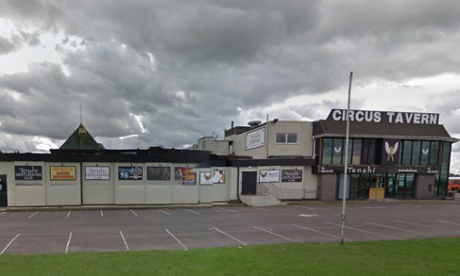
.@Nigel_Farage is speaking at @UKIP meeting later at what appears to be The Bing #ge2015 pic.twitter.com/L4Z5ZVrLav
— Robin Brant (@robindbrant) April 13, 2015
Updated
Here’s a video of the Lib Dems’ Ed Davey on Sky News earlier, insisting that his party will have a detailed plan to balance the books in their manifesto.
Yes. The answer’s yes. The answer’s yes. The answer’s yes. Yes. Yes.
Will the Lib Dems have a detailed plan to balance the books? http://t.co/gcMhtDv3Sj
— Sky News (@SkyNews) April 13, 2015
Anand Menon, professor of European politics and foreign affairs at King’s College London, has written about Labour’s vagueness on EU reform. He says the EU is an issue on which Labour hopes it will not have to do much but watch the Conservatives tear themselves apart. In other words, a vote for Labour means the political agenda will not be dominated by the EU.
Above and beyond a defence of membership, the manifesto makes little in the way of pledges about policy towards the EU. There is a vague promise to impose budget discipline on EU spending – but 28 member states are involved in budget negotiations, and one country’s waste is another’s vital interest.
The claim that “we will secure reforms to immigration and social security rules” is ambitious. A Labour government would run into precisely the same difficulty as the current one if it tries to tamper with the right of freedom of movement enshrined in the EU treaty. Tinkering with social security rules is the most that could be expected here.
In contrast to the rhetoric of the Conservatives in government, the manifesto stresses the need to maintain EU level protections for workers.
Finally, the manifesto promises that Labour will “open up EU decision making”. It’s a nice objective, but I can’t help but suspect that practical action will be somewhat lacking from the agenda of a Labour government.
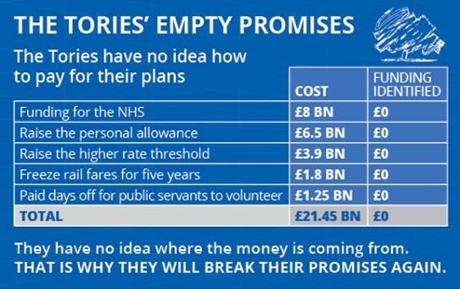
Labour’s Harriet Harman has issued a statement ahead of the Conservative Party manifesto launch, accusing the party of “making panicky promises”.
Labour has shown how every promise in our manifesto is fully funded and paid for with no additional borrowing. The challenge for the Tories is to show where the money comes from for the over £20 billion of unfunded and unbelievable promises they have made so far.
At the last election the Tories promised to protect the NHS and improve living standards, but since 2010 wages are down £1,600 a year and our NHS has gone backwards.
Now the Tories are making panicky promises with absolutely no idea how they will pay for them. At the same time they have an extreme plan to double the pace of spending cuts next year. It’s now clear that to make their sums add up the Tories will end up breaking their promises – raising VAT again and putting our NHS at risk.
Below is a list of the Conservatives’ unaccounted for promises according to Labour:
Updated
The Conservatives have produced a full rebuttal of Labour’s manifesto, which they’ve just sent to me. They say that Labour’s manifesto opens the door for a £3,000 tax rise on every working family by ruling out a rise in the rate of income tax and National Insurance without ruling out reducing the threshold at which these rates are paid. Furthermore, they say, Labour have left the door open to bringing back the fuel duty escalator.
For all the rhetoric today, this is a manifesto for more taxes, higher borrowing – and the SNP holding the purse strings. It is a recipe for economic chaos that would wreck our recovery and take us back to square one.
They reference Paul Johnson of the IFS, who spoke earlier today of the vagueness of Labour’s spending plans, to argue that Labour would continue to borrow every year, and add that the manifesto paves the way for a Labour-SNP deal.
Labour admit on p.17 that they have no intention of balancing Britain’s overall budget – as the IFS have pointed out today. This means they would still be running a deficit by 2020 – and leaves them room to find agreement with the anti-austerity platform of the SNP.
Labour say nothing on p.18 on what they would do about the thresholds at which income tax and National Insurance are paid – just that they will not raise the rates. This opens them up to agreement with the SNP on the tax front – Alex Salmond told the New Statesman in March 2015 that his party would push for ‘progressive tax measures’ if they were in a position of power at Westminster.
Labour say on p.78 they will only commit to a ‘minimum’ nuclear capability if they are elected – and do not commit to building the 4 new submarines we need to maintain full nuclear defences. They are already softening the ground for a deal with the SNP, who want to scrap Trident.
The Conservatives also maintain that a number of Labour’s policies, such as the housing budget, investment in roads, investment in the NHS, English votes for English laws and water bills, are poorly put together, and that “glaring omissions” such as any mention of Simon Stevens’ plans for the NHS, their pledge to make single rail tickets cheaper, renegotiating a better deal with the EU, the green belt and the armed forces, show that Miliband is unable to keep his promises. Other policies they say Labour dropped include:
- Abolishing quarterly reporting for businesses
- Holding an annual competition audit
- Ensuring every ministerial office has an apprentice
- Holding an inquiry into construction industry blacklisting
- Banning shift segregation by nationality
- Getting more women into careers in science, engineering, IT and maths
- Tackling modern slavery in the UK
- Establishing a Women’s Justice board
- Elected transport authorities
- Targets to minimise road deaths and road injuries
- Mandatory safety requirements for Heavy Goods Vehicles
- Compulsory cycle safety training
- Targets for the number of apprenticeships created by HS2
Hello, I’m taking over from Andrew Sparrow for the time being. I’m on Twitter @nadiakhomami and I’ll be reading your comments below the line as well, so you can let me know if you’ve seen anything I haven’t.
Nicola Sturgeon has predictably responded to Ed Balls and Chuka Umunna’s correction of Jim Murphy’s claims about no further spending cuts in Scotland.
Sturgeon said the Scottish Labour leader had been “hung out to dry”, proving that his party is “no more than a branch office of Westminster Labour”:
The truth is out about Labour spending cuts. Jim Murphy’s false claims in the TV debates have been rubbished by his own party bosses at Westminster, who have hung him out to dry.
Labour would impose swingeing spending cuts on Scotland and the rest of the UK, carrying on with austerity where the Tories left off - that is the core aspect of the manifesto they have published. It sweeps away Jim Murphy’s pretence, and leaves him devoid of any credibility in this campaign.
Ed Miliband, Ed Balls and Chuka Umunna have just confirmed that Labour in Scotland continue to be no more than a branch office of Westminster Labour. That is why so many voters in Scotland are moving away from Labour and choosing the SNP, and we will continue to work hard to earn people’s trust.
Updated
The BBC’s Robert Peston is on form today. Earlier he posted this blog, explaining why Labour is reluctant to talk about the fact that its plans would allow it to spend much more than the Conservatives.
A good number of economists would argue that Labour’s approach would not only protect funding of important public services but would also reinforce the momentum of growth in the economy.
So why isn’t Labour making that case?
It is for two reasons.
First, they fear that most voters don’t agree with economists that public spending delivers economic growth.
And second, the Tory approach would accelerate the reduction of the national debt as a share of national income or GDP, and Labour does not want its commitment to reduce the national debt slower than the Tories up in lights - since they know that many voters are concerned about the doubling of the national debt to a record 80% of GDP since the Crash.
And he has also written this post, explaining Labour’s plans in more detail, and arguing that “Ed Miliband and Ed Balls have opted for a policy of constrained discretion rather than absolute constraint.”
That’s all from me, Andrew Sparrow, for the moment. My colleague Nadia Khomami is now taking over. But I will be back later to cover the first BBC1 election interview programme, with Evan Davis interviewing Nick Clegg at 7.30pm.

Here’s the election photo of the day from Stefan Rousseau, the Press Association’s chief political photographer.
ELECTION Photo du Jour: Ed Miliband unveils Labour’s election manifesto in Manchester. By Stefan Rousseau/PA pic.twitter.com/YyZu65UmfQ
— Stefan Rousseau (@StefanRousseau) April 13, 2015
Brian May, the Queen guitarist and a founder of the Common Decency campaign, has been urging people in Brighton Pavilion to vote for the Green candidate Caroline Lucas. He said:
What we are saying is: do not assume that your vote will be wasted, get up off your ass and vote.
Secondly, don’t vote for a party, vote for someone you personally believe in, someone who will have a decent conscience and will represent your views in Parliament.
Number three - tell everyone else to vote as well, because it’s so important.

Updated
Ashcroft poll says Labour and Tories tied on 33%
Lord Ashcroft has just released the results of his latest poll. They are rather different from the ICM figures.
Ashcroft National Poll, 10-12 April: CON 33%, LAB 33%, LDEM 9%, UKIP 13%, GRN 6%. Details on @ConHome, 4pm.
— Lord Ashcroft (@LordAshcroft) April 13, 2015
My colleague Nicholas Watt has a good scoop.
The Conservatives appear to be drawing up plans to steal the thunder of their opponents by outflanking Labour and the Liberal Democrats over plans to exempt workers on the minimum wage from paying income tax.
A text intended for a senior aide to George Osborne, which has been passed to the Guardian, suggests the Tories are planning to make a fresh announcement on the minimum wage and tax in their manifesto due to be launched on Tuesday.
The text was sent by a No 10 aide on Sunday afternoon as the Tories made preparations for the launch of the Labour manifesto in Manchester. Ed Miliband pledged at the manifesto launch to accelerate a rise in the minimum wage to ensure it stands at £8 an hour by time of the 2020 election.
The Scrap Trident Coalition has hailed today’s blockade of the Faslane nuclear base as a huge success. The gates to the weapons base were blocked from 7 am until 13.30 pm. In total, 34 people have been arrested breach of the peace for lying in the gateways, or malicious mischief for painting. At 3pm the remaining protesters still in position around the gates relinquished the blockade voluntarily.
A spokesperson described it as one of the most effective blockades in recent years. “It has been wonderful to have the presence of people ranging in age from 5 to over 80, to have a member of our own parliament sitting down with us, and so many others from diverse backgrounds.
“Trident is a hot topic at the general election and this gives us hope that at last we can tackle the British state’s addiction to monstrous and mindless violence.”
Nigel Dodds might be the kingmaker in a hung parliament but hardly anyone outside Northern Ireland knows who he is.
A Comres poll has found that only 3 out of ten Britons are aware that Dodds is the leader of the Democratic Unionist party at Westminster.
The poll of 2,057 adults for lobbying companies Stratagem and PLMR was conducted before the ITV leaders’ debate almost two weeks ago, which the DUP chief was excluded from along with all the other Northern Irish parties.
Only two per cent of people had heard of Dodds and knew “a lot” about him, while eight per cent knew a little about him. However 76% of the British public have heard of Nicola Sturgeon, Scotland’s new first minister, according to the poll.
Elin Twigge of PLMR, a London-based firm, said: “Nigel Dodds is a name we should all get used to and fast; in less than a month he could be the most important person in Westminster.”
A good point well made as the DUP could be returning to the Commons with up to 9 seats after 7 May.

Updated

Updated
In a post for The Conversation, Filipa Sá, an economics lecturer, says that Labour’s pledge to reduce the cap on tuition fees from £9,000 to £6,000 “could increase applications by between 5% and 9%”.
Here is a round-up of some of the most interesting Twitter reaction I’ve seen to the Guardian/ICM poll.
Oh well, at least ICM for the Guardian and @YouGov for the Sun can't be accused of telling clients what they want to hear!
— Lewis Baston (@lewis_baston) April 13, 2015
If the ICM poll is right, and UKIP’s vote has slumped whilst the Green vote has surged, then Labour *are* in trouble. But I don’t see that
— Mark Ferguson (@Markfergusonuk) April 13, 2015
Big clue this ICM poll has interesting sample—it has C2s backing Tories by 42-21% & DEs Tory by 39-34…so C2DEs 41/28 Tory. Usually 40/29 Lab
— May2015 Election (@May2015NS) April 13, 2015
Not sure I've ever seen a paper write up their own poll quite as critically as today's Guardian does.
— Philip Cowley (@philipjcowley) April 13, 2015
Anyone reading *anything* into a Tory six-point poll lead (ditto last week's six-point lead for Labour) ought to know better.
— Ian Jones (@ian_a_jones) April 13, 2015
Twyman's Law: any statistic that looks interesting or surprising is almost certainly wrong
— Andrew Cooper (@AndrewCooper__) April 13, 2015
I am Joe Twyman and I approve of this message. https://t.co/uotwpsX5fc
— Joe Twyman (@JoeTwyman) April 13, 2015
This, from our archive, seems pertinent: Interpreting new polls via @Election4castUK http://t.co/YtX8xxnRCW #GE2015
— LSEge2015 (@LSEge2015) April 13, 2015
Here’s Anthony Wells at UK Polling Report on the Guardian’s ICM poll.
The worst thing you can do in analysing polls of voting intention is to get excited at polls that show something exciting and different and ignore those that show the same old pattern. Occassionally the unusual poll will herald a genuine movement in public opinion – after all, whenever there is a change, one poll has to pick it up first. More often than not, the unusual poll will turn out to be a freak result, the product of unusual sampling or methods. If there is genuinely a change in public opinion, other polls will pick it up sooner or later, so it’s always wise to withhold your judgement.
Today we have one of those unusual polls, and we have the overexcitement you’d expect. ICM’s monthly poll in the Guardian has topline figures of CON 39%(+3), LAB 33%(-2), LDEM 8%(nc), UKIP 7%(-2), GRN 7%(+3) (tabs). This is pretty odd all round – a storming six point lead for the Tories, up on thirty-nine percent; the Greens and UKIP equal on seven percent.
Wells also points out that we had a Populus poll this morning. I missed it earlier, so here are the figures.
Latest Populus VI: Lab 33 (-), Con 33 (+2), LD 8 (-), UKIP 15 (-1), Greens 5 (-1), Others 6 (-1). Tables here: http://t.co/vhjmoiOqkN
— Populus (@PopulusPolls) April 13, 2015
With Jim Murphy seemingly contradicted by not one but two colleagues today, opponents have not been slow to capitalise. We’ve already reported on Nicola Sturgeon (see 10.47am) and John Swinney’s (see 10.29am) response to the Today interview with Ed Balls.
Now the Scottish Liberal Democrats have responded to “Jim Murphy being Chuka’d under the bus by his colleagues” (after Ummuna said that “ the leader of the Scottish Labour party will not be in charge of the UK budget” - see 1.30pm), with party President Sir Malcolm Bruce saying: “The left hand of Labour doesn’t know what the other left hand is doing. In their frenzied attempts to try and restore some economic credibility they have only demonstrated their economic incompetence.”
Meanwhile, Scottish Labour say they are not planning to respond to Ummuna’s remarks, though one can imagine that they are fuming given that it plays directly to that “branch office” narrative of the relationship between Scottish Labour and Westminster colleagues that Murphy has been trying so hard to reshape.
As far as the earlier Balls remarks are concerned, a Scottish Labour spokesperson insists that the pair are indeed on the same page: “Jim Murphy and Ed Balls have always been very clear that we will balance the books in a fair way - through tax rises on the wealthiest few, making work pay to increase tax revenues, and making sensible savings.
“Jim has said this several times before and the Tories and Nationalists have reacted this way each time. They are doing it again because their own plans for fiscal austerity and for unfunded NHS spending are falling apart.”
And here’s a Guardian video with an extract from Ed Miliband’s speech.
Here’s Jonathan Freedland and Hugh Muir talking about Labour’s manifesto launch in today’s Guardian three-minute election video.
Guardian/ICM poll gives Tories 6-pt lead
The Guardian has just released its latest ICM poll. My colleague Tom Clark has the details.
A new Guardian/ICM poll has produced a surprise Conservative lead of six points, taking David Cameron’s party to 39% with Labour on 33%.
While most recent polls show the race is tied or that Labour is in a slight lead, the telephone poll conducted between Friday and Sunday reports that the Conservatives have gained three points while Labour is down by two points in the last month.
ICM’s figures say that support for the Liberal Democrats is unchanged, on 8%. Ukip drops back two points to 7%, which leaves them tied for fourth place with the Green party, who are also on 7%, recovering by three points after having fallen to just 4% in March.
Updated
As the Press Association reports, David Cameron has also been taking part in his first on-camera walkabout of the campaign
David Cameron has staged his first on-camera walkabout of the campaign - and was urged to avoid “name calling” tactics against Ed Miliband.
The prime minister took to the streets of Alnwick, in the Berwick-upon-Tweed constituency, in a bid to woo voters, where one woman told him: “I don’t like the name calling in politics ... Be a good boy.”
Cameron bought some sausages at Turnbull’s butchers in the town and chatted with shoppers during the 15 minute stroll.
But he was also serenaded by a man with a ukulele who sang that he should “fuck off back to Eton”.
Perhaps Cameron was inspired to hold a walkabout by the various complaints at the end of last week about how contrived and sanitised all his public events were, not least in this terrific article by Marina Hyde.

Updated
Cameron says Labour's economic responsibility stance is 'a con'
David Cameron has said that voters should not trust Ed Miliband with the economy.
Ed Miliband still won’t apologise for the fact that the last Labour government spent too much, borrowed too much, taxed too much, and crashed our economy in a most appallingly dramatic fashion. Frankly if you cannot learn the lessons of the past you cannot possibly provide the leadership for the future.
Cameron also claimed that Milband’s claim to stand for economic responsibility was “a con”.
When people hear Ed Miliband today they will think this is not a conversion to responsibility. It is not a conversion, it is a con.
Nick Clegg has had a run-in with protesters in Carshalton. My colleague Frances Perraudin has more details.
Local NHS campaigners outside a hospital in Carshaltan come to greet Clegg as he arrives. Lots of pushing. pic.twitter.com/WuQSrOUnrl
— Frances Perraudin (@fperraudin) April 13, 2015
The intention was to meet Liberal Democrat supporters outside the St Helier hospital in Tom Brake’s constituency of Carshalton and Wallington, but Nick Clegg was instead greeted by angry protesters.
Some were there to campaign against NHS cuts, and others – including Lib Dem councillor Nick Mattey – were there to protest against plans to open further waste incinerators in the area.
Clegg spoke to a small group of friendly supporters for a few minutes in a field facing the hospital, while his guards struggled to keep the demonstrators at bay.
The Lib Dem leader was then whisked into his official car and driven away, no more than five minutes after arriving.
Updated
In the world of election live blogs, the competition is definitely getting more intense. Newsnight has just launched one. It’s a rolling analysis blog, with updates from Newsnight correspondents, who are today writing about the Labour manifesto. I’m afraid to say it’s rather good.
The Guardian’s picture desk have compiled their highlights of the day so far.

Updated
Osborne says Labour has no credible economic plan
George Osborne, the chancellor, has issued a response to the Labour manifesto on behalf of the Conservatives. He said Labour had no credible economic plan.
Today Ed Miliband failed to provide a credible economic plan and nobody will be fooled.
There were no new ideas for Britain, and if you read the small print independent experts like the IFS have confirmed he would run a deficit every year.
That means more borrowing, more debt and higher taxes.
Britain doesn’t want to go back to the chaos of the past, and tomorrow the prime minister will set out a clear plan full of new ideas for a brighter future.
Carl Emmerson, the deputy director of the Institute for Fiscal Studies, was on the World at One talking about Labour’s plans. He repeated the arguments used by his boss, Paul Johnson. (See 12.37pm and 12.57pm.) Asked about Scotland, and whether there would be a need for further cuts in Scotland after 2016, Emmerson said there would be no need for further cuts if Labour borrowed as much as its ruled allowed. But he suggested this was unlikely.
If the Labour party is talking about serious cuts to unprotected services, if they are meaningful ones, when they talk about year on year cuts, then it would be hard to see how they would be able to escape cuts in Scotland.
Here’s Danny Alexander, the Lib Dem chief secretary to the Treasury, on the Labour manifesto.
Labour is still struggling to face up to the economic facts of life. They still believe that you can borrow your way out of debt. They have no clear timetable to finish the job of balancing the books. They’ve opposed all Liberal Democrats have done to turn the economy around and their whole approach remains riddled with inconsistency. Every single economic prediction they have made has been wrong. However they dress it up, their plans would mean borrowing £70bn more and would drag austerity out for years to come.
Libby Brooks has some more news from the Trident protests at the Faslane nuclear base, where there have been 12 arrests.
Hundreds of protesters have closed the base for around four hours now and campaigners believe that it will take the police another few hours to clear activists from the entrance to the south gate of the base.
Patrick Harvie, co-convenor of the Scottish Greens and MSP for Glasgow, was among those taking part. He said: “Trident is an obscenity. Through direct action and through the ballot box we can make the case for the UK to play a new role on the world stage. By choosing to disarm Trident we can re-skill workers on the Clyde to provide defence of the strategically important northern seas, and diversify our economy for social good.”


Updated
Umunna says Jim Murphy won't be in charge of Labour's budgets
On the Daily Politics Chuka Umunna, the shadow business secretary, was asked about Jim Murphy’s claim that a Labour government would not need to make further cuts after 2016. Ed Balls rejected Murphy’s proposition earlier (see 9.22am), and Ed Miliband did the same in his Q&A (see 11.56am). But Umunna was even more blunt.
The leader of the Scottish Labour party will not be in charge of the UK budget. The leader of our country, the next prime minister Ed Miliband, will be in charge of the UK budget. And he’s just answered the question when that was put to him: Will there be cuts over the course of this parliament, not just in the first financial year but in the following financial years? And he was absolutely clear there will be a need for further consolidation and cuts throughout the rest of the parliament.
And here’s a take on this from the Spectator’s James Forsyth.
Chuka Umunna’s brutal line that leader of the Scottish Labour party doesn’t set UK Budget, suggests party beginning to write off Scotland
— James Forsyth (@JGForsyth) April 13, 2015
The BBC’s Nick Robinson has described Ed Miliband’s speech at the manifesto launch today as “one of the most powerful speeches I’ve seen him make”.
Updated
Clegg says Labour manifesto is 'deeply mendacious'
Nick Clegg said today the Labour manifesto was “not worth the paper it’s written on”. Here’s the full “vodka” quote. (See 10.32am.)
The Labour party saying they have no plans for additional borrowing is like an alcoholic who consumes a bottle of vodka every day, saying they have no plans to drink more vodka. It’s a dangerous addiction and the Labour party have no plan and no date by which to clear the decks, wipe the slate clean and deal with the deficit.
But Clegg is being criticised for using this simile. This is from Emily Robinson who, according to her Twitter profile, works for Alcohol Concern.
Given his claim to take mental health issues seriously I find @nick_clegg remarks regarding alcoholics inappropriate http://t.co/s5v0sZIZDq
— Emily Robinson (@EmilyRobinson1) April 13, 2015
And this is from Matthew Hulbert who, according to his Twitter profile, is a Lib Dem candidate.
I hope @normanlamb will berate @nick_clegg for using the analogy it's 'like an alcoholic vowing not to drink.' #MentalHealth #GE2015
— Mathew Hulbert (@HulbertMathew) April 13, 2015
And this is what Clegg said in response to this criticism, according to my colleague Frances Perraudin.
I’m making a serious point in a forceful, if colourful, way. You’ve had a Labour manifesto today, which is deeply mendacious, claiming to people that they’re not going to make additional borrowing when that’s exactly what they’re going to do.
They’re claiming they’ve discovered fiscal probity and discipline when they haven’t and I’m saying that it’s as implausible as somebody who drinks a lot who claims that, because they’re not going to drink a bit extra, somehow they’ve cracked their problem.
I’m a human being and I’m just trying to illustrate in as simple terms as possible that it is a totally implausible claim that their plans don’t involve additional borrowing.
Updated
Nigel Farage has been challenged to a duel with swords by a man claiming to be a Polish prince, the Press Association reports. Yanek Zylinski, in a video posted to YouTube, criticised the Ukip leader’s “idiotic” blaming of immigrants for traffic jams on the M40. Zylinski called on Farage to meet him in Hyde Park in central London to resolve the matter “in a way that an 18th-century Polish aristocrat and an English gentleman would traditionally do”.
Perhaps Zylinski would have more luck if he challenged Farage to a drinking contest.

Updated
Expert analysis: personal finance
The cost of living, rather than tax, is the centrepiece of a manifesto that promises a cap on gas and electricity bills, a new focus on water bills, a freeze on train fares and a pledge to put a ceiling on rent rises hitting the millions more now renting privately.
These pledges are popular, while costing virtually nothing to an incoming government hamstrung by a huge deficit. In areas the government directly controls - income and spending taxes - the manifesto is less radical. Core tax rates and tax credits will remain fixed, apart from the return of the 50% top rate band and the revival of a 10% rate axed by the previous Labour government in 2007, but with no mention of personal allowances.

The deeply unpopular utility companies - energy bills are up £300 since 2010 - come in for tougher treatment than perhaps expected, with a freeze not just in bills, but a plan to break up the ‘big six’ energy providers. The water companies, which in parts of the country (especially the south west) are more hated than the energy companies, also face a Labour clampdown, with a pledge to launch a new national affordability scheme.
After years of runaway prices, the property market features more heavily than in almost any Labour manifesto for a generation. A ceiling on “excessive rent rises”, legislation to make three-year tenancies a norm and a ban on letting agency fees form Labour’s appeal to the 11 million people now renting privately.
Updated
Michael Gove, the Conservative chief whip, has been responding to the Labour manifesto launch. This is what he told the BBC.
It’s got no credibility at all. We know every page in Labour’s manifesto will be subject to signoff by Alex Salmond and Nicola Sturgeon. Labour cannot get into Downing Street except on the coattails of the Scottish National party, so every promise they make today is subject to veto or endorsement by the SNP. Labour proposals are not funded and they are not underwritten by the credibility of delivering a strong economy.
The Conservatives have got their Sturgeon-masked protesters out in force to back up this claim.
The bold @christopherhope is periscoping Gove and the Sturgeons. pic.twitter.com/QXMmmHbcuV
— Jamie Ross (@JamieRoss7) April 13, 2015
Updated
Expert analysis: business
This from the Guardian’s business reporter Sean Farrell:
The only new policy affecting business is that the minimum wage will increase to more than £8 by October 2019 from £6.50 now for workers over 21. Even that is a revision of an existing promise to raise the minimum wage to £8 by the end of the parliament in May 2020.

Labour says the minimum wage will increase by at least twice the rate in this parliament and make a full-time worker on the minimum wage £800 better off than under the Tories. Miliband has said the economy needs rising wages to increase tax receipts and reduce social security spending.
The rest of Labour’s business policies include extra powers for the Green Investment Bank, limiting votes on takeovers to those who already hold the shares, requiring fund managers to disclose how they vote on executive pay, and installing employee representatives on company remuneration committees. Labour says it wants the City to take a long-term view of a company’s prospects instead of seeking short-term returns.
Zero-hours contracts, which offer workers little or no guaranteed hours, will be more strictly limited. Labour has also promised to introduce a “gold standard” system of vocational training to improve skills.
Updated
Expert analysis: environment and energy
The green economy already employs more people than teaching and is growing fast. This makes the million job pledge achievable, especially if Labour can give investors more stability than the outgoing coalition, which rowed over wind farms. More jobs could come from the overhaul of the coalition’s troubled Green Deal home energy efficiency programme, with Labour promising zero-interest loans.
Freeing the Green Investment Bank to borrow could create further jobs by funding new green energy projects. Labour backs fracking but would tighten regulations, though not enough to satisfy many opponents. Labour says it will “prioritise” flood protection and produce an “ambitious” adaptation programme, but does not promise extra funding.
The UK has been successfully sued over its illegally high air pollution and Labour will create new local powers, but the challenge has defeated previous governments. The current cull of badgers, aimed at cutting TB in cattle but derided by many scientists as ineffective, would be shut down by Labour.
Expert analysis: defence

What is missing is a commitment to maintaining defence spending at 2% of GDP, the government pledge made at last year’s Nato summit. Without that commitment, the Ministry of Defence is one of the most vulnerable government departments to cutbacks.
A Labour government would face tough choices: cuts in the “the best armed forces in the world” that could see army numbers drop from 82,000 to 60,000; fewer planes on two new aircraft carriers; or a more modest Trident nuclear renewal programme.
On the latter, the present plan is for four new submarines, which the military claims is necessary to maintain at least one submarine on patrol at all times, the Continuous At-Sea Deterrent (CASD). But Labour has said it is prepared to look at three submarines, provided it could be shown that CASD would still be maintained.
Updated
IFS says people who vote Labour won't know what cuts they might be voting for
Here are some more quotes from the IFS director Paul Johnson’s interview on the Daily Politics.
-
Johnson said that, because Labour’s plans were so vague (see 12.37pm), voters would not know what they were voting for.
[Not having a firm timetable for getting rid of the deficit] gives them an enormous amount of flexibility; it allows them to say well we would be cutting very little, but also that we would be cutting. But it really makes a big difference, there’s a huge difference between £18bn of cuts over the next three years and no cuts. Literally we would not know what we were voting for if we were going to vote for Labour.
-
He said getting rid of the deficit for current spending by the end of the next parliament was “not a terribly big hurdle”.
Cutting the deficit if we get anything approaching the kind of economic growth that the Bank of England and the Office of Budget Responsibility expect, is not a terribly big hurdle. The expectation is on any reasonable set of fiscal plans the deficit would go down over time.
-
He said Labour’s pledge just to cut the deficit for current spending, not overall spending, would allow it to carry on borrowing around £30bn a year for investment (based on the current level of investment spending).
Updated
Expert analysis: immigration and crime
Our specialist correspondents have been poring over the Labour manifesto to tease out new commitments and explain what exactly they mean.
This in from our home affairs editor Alan Travis:
Labour displays its humanitarian credentials by promising to end the indefinite detention of irregular migrants in places such as Yarl’s Wood and the scandal of the Syrian refugee programme which has only seen 143 vulnerable people relocated under the UN scheme in the past year. A total of 3,462 people were in immigration detention at the end of last year mostly waiting for removal – 397 of them had been detained for longer than 6 months, and 18 for longer than 2 years.
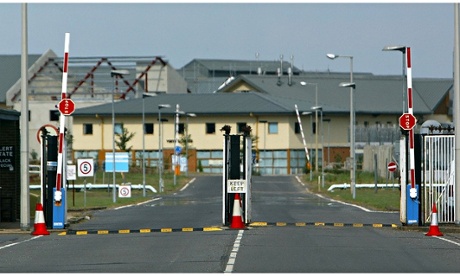
Labour’s commitment to employing 1,000 more border staff is designed to ensure faster removals rather than longer detention. The pledge not to lock up pregnant women and the victims of trafficking and sexual abuse is also long overdue.
But the manifesto makes no explicit commitment on the future of the net migration target which has dominated the coalition government’s approach to immigration policy and ended in failure. Net migration is at 298,000 – three times the 100,000 target set by David Cameron. Instead the manifesto talks of ‘smarter controls’.
Updated
IFS says Labour has given 'no additional clarity' about whether its plans involve extra cuts
On the Daily Politics Paul Johnson, the Institute for Fiscal Studies director, said that, because Labour won’t say when it hopes to get rid of the deficit on current spending, we don’t really know what their plans would involve.
The Labour party have repeated what they have said over the last several months, which is that they want to get to get to current budget balanced as soon as they can in the next parliament. Now, it really, really matters how soon that is. If they want to get there within three years, which is sort of what they might be thought to have signed up to in the fiscal responsibility charter earlier this year, that’s a really significant amount of spending cuts or tax rises over the next three years. If they are happy to wait til the end of the parliament, which is also sort of consistent with what they signed up to, then actually we don’t need any spending cuts over the next five years. So, which one of those paths really, really matters. And we’ve got no additional clarity today about whether we would be signing up to additional spending cuts or tax rises or not.
(But that is not entirely fair. According to the IFS assessment, Labour could only avoid cuts after 2016 by taking the slow approach to deficit reduction. But Ed Miliband effectively ruled that out. He said there would be further cuts after 2016. See 11.53am.)
The BBC has announced the podium positions for Thursday’s challengers’ debate:
Lots drawn for podiums for Thu's Cameronless BBC1 leader debates (l to r) Miliband, Wood, Bennett, Sturgeon, Farage #figures
— John Plunkett (@johnplunkett149) April 13, 2015
Updated
Ed Miliband's speech and Q&A - Verdict from the Twitter commentariat
It will take a while for journalists to pore over the manifesto - it runs to 86 pages, and it is relatively dense - but the verdict on his speech and Q&A is already in, and it is highly positive. Political journalists and commentators are impressed. This is what they are saying on Twitter.
From the BBC’s Nick Robinson
.@Ed_Miliband delivers speech he should have given at his Party Conference - it addresses Labour's two key weaknesees - the deficit and him
— Nick Robinson (@bbcnickrobinson) April 13, 2015
From Newsnight’s Ian Katz
Miliband so buoyant he doesn't want to stop taking questions. He'll be taking questions from Andorran media soon #GE2015
— Ian Katz (@iankatz1000) April 13, 2015
From PoliticsHome’s Paul Waugh
Much better speech today from Miliband than last yr's conference speech. Given today more ppl may be listening, may matter more
— Paul Waugh (@paulwaugh) April 13, 2015
Miliband really enjoying himself today. Robust, confident, relaxed. His 'Let-Bartlet-Be-Bartlet' allies will be pleased
— Paul Waugh (@paulwaugh) April 13, 2015
From the Sunday Times’ Tim Shipman
This is a good and combative performance by Miliband but answering fiscal credibility 3 weeks before an election is not where you want to be
— Tim Shipman (@ShippersUnbound) April 13, 2015
From the BBC’s Vicki Young
Ed Miliband oozing confidence at Labour manifesto launch. Knows today is a significant opportunity to speak directly to voters. #GE2015
— Vicki Young (@VickiYoung01) April 13, 2015
From the Observer’s Daniel Boffey
One of the strongest speeches have heard from Miliband (manifesto launch). Don't much like the slogans but he appears up for the fight..
— Daniel Boffey (@DanielBoffey) April 13, 2015
From the Independent’s Steve Richards
Miliband's confident performance at manifesto launch is not surprising. He's been close to heart of elections, tax and spend, for 2 decades.
— steve richards (@steverichards14) April 13, 2015
From the BBC’s Lucy Manning
Confident performance from Ed Miliband but as journos asked will voters be convinced on econ credibility? Has he left that pitch too late?
— lucy manning (@lucymanning) April 13, 2015
From the BBC’s Sam Macrory
That manifesto launch matched Miliband's better conference speeches. Do more people watch manifesto launches than conference speeches?
— Sam Macrory (@sammacrory) April 13, 2015
From the Guardian’s Rafael Behr
Miliband does seem genuinely to be enjoying this. Not many voters watching but will earn a bit of kudos from political corrs.
— Rafael Behr (@rafaelbehr) April 13, 2015
But you can’t keep everyone happy. This is from the Sun’s Tom Newton Dunn.
A free press is "incredibly important" says Ed Miliband, but he only took one question from a national newspaper. Even ignored Mirror.
— Tom Newton Dunn (@tnewtondunn) April 13, 2015
Here is the full text of the speech that Ed Miliband gave at the launch.

Miliband ends by thanking the audience for all the support they have shown him.
As he makes clear, he is addressing the Labour activists in the audience, not the journalists (who haven’t generally been particularly supportive).
But there is more campaigning to do, he says. If you have any DIY planned between now and the election, put it off.
Change only happens because of ordinary people, he says.
And that’s it. The Q&A is over.

Q: There is no mention of protecting the green belt in the manifesto. Would you protect it?
Miliband says Labour would keep planning laws as they are, but put development on brownfield land first.
Q: Do you support Tory plans to raise the 40p tax threshold?
Miliband says he wants to reduce the number of people paying the 40p rate.
But he will only make promises he can fund.
Yesterday George Osborne was asked 18 times how he would the £8bn for the NHS. He could not announce it.
It is a sign of desperation.
The Tories made a pledge on rail fares, even though Patrick McLoughlin, the Conservative transport secretary, had said that Labour was going to do it and that it was a bad idea.
Updated
Q: What do you want to achieve in an EU renegotiation? And why should other EU leaders make concessions if you are not threatening to leave?
Miliband says we have had a “natural experiment” on this over the last two years. David Cameron tried to block Jean-Claude Juncker. And he lost 26 votes to 2. Why? Because other EU leaders realised he was just interested in solving the problems of the Conservative party. And you know what? Angela Merkel was not elected to solve the problems of the Conservative party.
Engagement will get better results, he says.
Q: Do you agree with a cap on media ownership? And does this, and your pledge to implement Leveson, explain media hostility to you?
Miliband says it is incredibly important that we have a free press, and that they can write what they like about his. “And they certainly have.”
But victims must be protected from the press.
And, on media plurality, he says it has always been Labour’s case that protecting this is important.
Miliband says cuts would continue after 2016 under Labour
Q: The IFS says you could meet your targets without any more cuts after 2016. Do you rule out having no further cuts after 2016?
Miliband says he does. There will have to be cuts, he says.
Q: Which of these promises would not have been in the 1997 manifesto?
Miliband says the questioner, the BBC’s Allegra Stratton, should have asked what policies would not have been in the 2010 manifesto, which he wrote. But that would have been a harder question, so he won’t answer it.
He says since 1997 there has been a greater recognition of the importance of regulation, and holding vested interests to account.
The world is very different from 1997. He is going into the election saying there will have to be cuts outside protected areas. Tony Blair and Gordon Brown did not do that, he says.
Updated
TNS poll has SNP 28 points ahead of Labour in Scotland
The Guardian’s Scotland reporter Libby Brooks brings news of a poll showing that the SNP has stretched its lead over Labour, with 52% of voters now backing Sturgeon’s party. However 29% of certain voters have not made up their mind who to plump for.
The SNP has nearly doubled its lead over Labour in Scotland, with more than half of adults who are certain to vote in the general election (52%) saying that they would vote SNP, compared with 24% supporting Labour.
This 28-point lead recorded by TNS is nearly double the figure from last month, when the parties scored 46% and 30% respectively. The Conservatives scored 13% (down 1 percentage point), the Liberal Democrats 6% (up 3) and the Greens 3% (down 1). Support for UKIP in Scotland is almost negligible.
But Tom Costley, Head of TNS Scotland cautioned: “It’s important to remember that the campaign is really only beginning and 29% of those who say they are certain to vote have not made up their minds who to vote for. It will be interesting to see what difference the campaigns of the various parties make to people’s intentions by polling day.”
In the event of a hung parliament, 44% of Scottish voters would prefer a Labour-led government compared with 15% opting for a Tory-led government. The most popular option is a Labour-SNP coalition, with 25% of voters backing it and nearly a third (31%) of Labour voters preferring this option.
Updated
Q: How are you going to get HMRC to raise an extra £7.5bn from tax avoidance and tax evasion? They have only prosecuted one person in relation to HSBC.
Miliband says he wants a review of the way HMRC works. Small businesses are angry about the way they get pursued aggressively, while big firms are allowed to cut deals with HMRC.
Updated
Q: What will you do to stop the SNP surge in Scotland?
Miliband says the general election is a choice between a Labour and Conservative government. He is proud of the offer he is making to the Scots, and the whole of the UK, on social justice, he says.
He says the SNP say they won’t introduce cuts. But their plans would involve cuts of £7.6bn, he says.
In Scotland there are “many, many people” still making up their minds, he says.
Q: The IFS says your plans are very vague, and do not spell out whether you would have cuts worth £18bn, or nothing at all?
Miliband says there would be cuts in non-protected areas. But it is important to build an economy that works for working people.
Labour will do as much as it can to improve living standards. The more it can improve living standards (thereby boosting Treasury revenues), the less need there will be for cuts, he says.
Q: Will you admit that Labour spent too much?
Miliband says Labour should have regulated the banks more tightly. But Labour spending did not cause the crash. David Cameron even backed Labour spending plans. The Tories say the deficit caused the crisis. That’s not true. It is the crash that caused the deficit.
Asked about Scotland, Miliband repeats the argument used by Ed Balls this morning. (See 9.22am.) Whether or not there would be further cuts in Scotland would depend on other decisions, he says.

Miliband says Tories 'make Green party look fiscally responsible'
Miliband says something very interesting happening in British politics.
On Friday the Tories announced a plan to freeze rail fares that would cost £3bn. Then, on Saturday, they announced an unfunded £8bn for the NHS. And that is on top of the tax cuts worth £10bn, again unfunded, that they are proposing. That adds up to unfunded spending commitments worth around £20bn, he says.
The Conservatives are now “the irresponsible party in British politics”, he says.
With due respect to the Green party, they are making the Green party look fiscally credible.
Updated
Q: Why won’t you say when Labour will get rid of the deficit?
Miliband says it will happen as soon as possible in the next parliament. But it is important to make promises you can keep. He does not want to make the mistake that George Osborne made of setting a date for deficit reduction he could not keep.
Miliband's Q&A
Ed Miliband is now taking questions.
He starts by saying that it is important to have a media that asks difficult questions. He asks Labour supporters not to jeer the reporters who ask unhelpful questions.
Q: Why should people trust you when you will not say what taxes you will raise and what services you will cut?
Miliband says Labour has been very clear about its plans. He says Tony Blair never went into an election promising cuts. His plans are more binding than those of other parties.
Q: Isn’t this too late, though?
That’s a different question, Miliband says.
He says he has always been clear that the next Labour government would not be able to spend its way to social justice.
Miliband ends his speech by saying he has been tested over the last five years. But it is right that he has been tested, he says.
Now it is time to make Britain better.
More Labour manifesto highlights
Here are more Labour manifesto highlights.
Labour will pause and review the Universal Credit programme
— Patrick Wintour (@patrickwintour) April 13, 2015
"Labour is renewing our traditions as the party of work family and community. We are also the party of equality. "
— Patrick Wintour (@patrickwintour) April 13, 2015
"Labour remains committed to a minimum credible independent nuclear capability delivered through a continuous at sea deterrent".
— Patrick Wintour (@patrickwintour) April 13, 2015
Labour are planning a major overhaul of the rail system. Page 26 of the manifesto pic.twitter.com/HqrcBczVVj
— Jack Blanchard (@Jack_Blanchard_) April 13, 2015
And here’s an extract from Ed Miliband’s speech that the party has sent out. The full text isn’t available yet.
I am ready, ready to put an end to the tired old idea that as long as we look after the rich and powerful we will all be OK.
Ready to build a country that works for working people once again.
Ready to put into practice the truth that it is only when working people succeed, that Britain succeeds.
If you elect me your prime minister in just over three weeks’ time:
I will work for that goal. I will fight for that goal. Every single day. In everything I do. In every decision I make.
Our opponents will tell you this is as good as it gets for Britain.
It isn’t. I know Britain can be better.
The British people know Britain can be better.
Let’s make it happen together.
Labour's 'five new policies' - details
Labour says there are five new policies in the manifesto. This is how they sum them up in the news release they have just sent out.
- Raising the minimum wage to more than £8 by October 2019 – accelerating increases to guarantee they reach this level before the end of the next parliament.
- Helping train passengers and commuters with a fully funded fare freeze.
- Supporting the squeezed middle with a firm commitment not to raise the basic or higher rate of income tax, national insurance or VAT.
- Protecting tax credits in the next parliament, to back working families.
- Introducing a new National Primary Childcare Service to help working parents.
They are not all new. For instance, I can’t see anything new in the promise not to raise taxes. But there is new detail on some of the other measures. Here is the added detail the party has sent out. I’ve taken the quotes from the Labour release.
1 - Raising the minimum wage
Today, we are setting out the detail of that pledge: we will give the Low Pay Commission the clear task of raising the minimum wage to more than £8 by October 2019 – accelerating increases and guaranteeing the NMW increases by at least twice as much as it has under the Tories.
It will mean someone working full time on the National Minimum Wage being £800 a year better off compared to continuing with the rate of rise under the Tories.
2 - Rail fare freeze
Instead of an uncosted Tory plan they have no idea how they will pay for, Labour will deliver a fully funded rail fares freeze for one year, a strict cap on every route for any future fare rises, and a new legal right for passengers will be created to access the cheapest ticket for their journey.
The cost, of just over £200 million, will be fully funded by switching spending within the existing transport budget from delaying road projects on the A27 and A358 for which the economic case is still uncertain.
3 - Not raising taxes
We will not raise the basic or higher rate of Income Tax, National Insurance or VAT. Nor will we extend VAT to food, children’s clothes, books, newspapers or public transport fares. Instead, we will cut taxes for working families by bringing in a lower starting 10p rate of income tax by reversing the Tories’ Marriage Tax Allowance.
4 - Protecting tax credits
Labour will protect tax credits that working families rely upon so they rise in line with inflation from next year, not cut them as the Tories plan.
5 - Setting up a national primary childcare service
The Tories have let down working families by scrapping the legal requirement to provide after-school or breakfast clubs and allowing numbers to fall with only half of parents able to find suitable term-time childcare to fit with their working hours. Only 17 local authorities in England able to provide after-school clubs at all primary schools.
Today Labour is announcing a new National Primary Childcare Service, underpinning a legal right to guaranteed access to wrap-around childcare in breakfast or after-school clubs from 8am-6pm.
This will increase the amount of affordable wrap-around childcare by delivering it through CRB-vetted volunteers and using the lower overheads of primary schools. And it will increase the amount of high quality childcare by providing a route for talented people from arts, sports or music organisations to bring their skills and expertise into primary schools.
The NPCS will be a not-for-profit organisation acting as a hub to match primary schools with volunteers and a range of quality extracurricular sports, art and music activities before and after school. It will be paid for by ending Government funding for the New Schools Network, an organisation set up to promote the Free Schools programme.
Updated
Miliband tells Tories: 'You can't fund the NHS with an IOU'
Ed Miliband is speaking at the manifesto launch now.
He starts by stressing the fiscal responsibility commitment.
What a contrast with the Conservatives. In recent days you have seen them throwing spending promises around with absolutely no idea where the money is coming from ... You can’t fund the NHS with an IOU and the Conservative party needs to learn that lesson.
That road leads to broken promises, he says.

Updated
Labour manifesto highlights
My colleague Patrick Wintour has been tweeting some highlights from the manifesto.
There is a big blue Labour passage - work family community trust mutual obligation common good
— Patrick Wintour (@patrickwintour) April 13, 2015
Labour believes in rewarding work and contribution to social security so we will not cut tax credits Sent from my iPhone specially for you
— Patrick Wintour (@patrickwintour) April 13, 2015
Rail fares will be frozen next year a strict fare cap rise will be introduced on every route. Sent from my iPhone specially for you
— Patrick Wintour (@patrickwintour) April 13, 2015
Freeze energy bills till 2017 ensuring bills can fall not rise Sent from my iPhone specially for you
— Patrick Wintour (@patrickwintour) April 13, 2015
Labour will protect the principle of media plurality so that no media outlet can get too big Sent from my iPhone specially for you
— Patrick Wintour (@patrickwintour) April 13, 2015
Labour will ban MPs from holding paid directorships and consultancies Sent from my iPhone specially for you
— Patrick Wintour (@patrickwintour) April 13, 2015
Public sector operators will be allowed to take on rail lines and challenge private companies on a level playing field
— Patrick Wintour (@patrickwintour) April 13, 2015
Labour would protect media plurality
Labour will protect the principle of media plurality so that no media outlet can get too big Sent from my iPhone specially for you
— Patrick Wintour (@patrickwintour) April 13, 2015
At the event Labour is now showing a video of Ed Miliband’s greatest rhetorical hits.
Labour's manifesto launch
Harriet Harman, the deputy Labour leader, is the first to speak at the manifesto launch.
The Labour manifesto is rooted in the idea that Britain can do better. It is a contrast to the Conservative party’s negative approach, she says.
Ed Miliband has “shaped the political weather”.
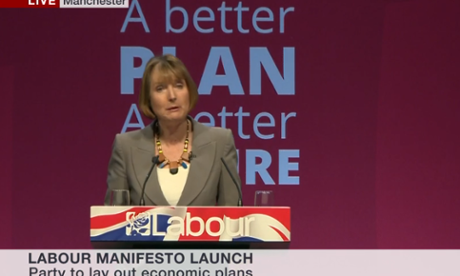
Labour proposes raising minimum wage to £8 by October 2019
Labour announce that minimum wage will be raised to £8 by October 2019 - faster timetable than previously promised.
— George Eaton (@georgeeaton) April 13, 2015
Ed Miliband has been tweeting about the Labour manifesto.
And here is what he says about it on Instagram.
And here it is. Our 2015 election manifesto. The whole thing will be online soon, but here’s a preview of the cover. It’s a simple but powerful idea: Britain succeeds when working people succeed. And it will be at the heart of everything a Labour government will do.
We are a great country, but we can be even better: https://t.co/JAGtr6hwPY pic.twitter.com/sP4L6yh6lv
— Ed Miliband (@Ed_Miliband) April 13, 2015
Nick Robinson, the BBC’s political editor, is still recovering from his tumour operation, but he has been well enough to write a blog about why manifestos are important. Here’s an excerpt.
Here’s another thing the manifestos tells you - how any party sees its strengths and weaknesses. Every document unveiled this week will be a mix of the three Rs - retail offer, radicalism and reassurance.
It is getting the right balance between those three that gives politicians a headache.
Labour is already briefing that reassurance about the party’s greatest perceived weakness - their seriousness about tackling the deficit - will feature on page one.
The prominence they’re giving to their promise to be prudent is new. The detail which we have so far been told about is not.
The Tories have parked no less than SIX Sturgeon/Salmond vans outside the Labour manifesto launch. pic.twitter.com/BpIpu0R0Ns
— Jamie Ross (@JamieRoss7) April 13, 2015
There are broadly five new policies in the Labour manifesto - mainly in field of labour market.
— Patrick Wintour (@patrickwintour) April 13, 2015
Nicola Sturgeon, the SNP leader and Scottish first minister, has also commented on the Ed Balls interview (see 9.22am), my colleague Libby Brooks reports. Sturgeon said:
Labour are offering more cuts. We heard Ed Balls on the radio this morning directly contradicting Jim Murphy about cuts in Scotland. I think that’s the wrong choice. Yes, we need to get the deficit down but we also need investment in economic growth, to protect our public services and help people out of poverty. There is a clear alternative to austerity with the SNP.
Asked about the IFS projection of a £7.6bn shortfall should Scotland get full control of its tax and spending - and Labour’s attack today on the SNp’s flagship policy of full fiscal autonomy costing every person in Scotland £1400 - she dismissed it as “nonsense”, saying: “The only cuts on the horizon for Scotland are those that the Tories and proposing and Labour are backing”.
Sturgeon has been at a building site launching the SNP’s business manifesto. (See 10.29am.) George Osborne is famous for his high-vis jacket photo opportunities, but Sturgeon has gone one step further, by taking the wheel of a dumper truck.
.@NicolaSturgeon: if Labour in gov't is left to own devices there will be more cuts for Scotland #GE2015 pic.twitter.com/3ilztqkoTH
— Libby Brooks (@libby_brooks) April 13, 2015
Helen Pidd has sent more from the campaign trail in Bradford West, where one of George Galloway’s supporters has been accused of assaulting a Ukip candidate.
Police are always busy in Bradford during election time. After hustings in the cathedral on Sunday night, a Ukip parliamentary candidate claims he was assaulted by one of George Galloway’s supporters.
Owais Rajput, who is contesting Bradford East for Ukip, said he was verbally and physically assaulted by Amar Rafiq, who attended Galloway’s wedding the day after his spectacular byelection win in Bradford West in 2012.
Ukip’s Harry Boota, a massage oil entrepreneur who is fighting Galloway in Bradford West, said he called West Yorkshire police following the incident.
He said: “We had finished the hustings and a guy called Amar Rafiq came up and started giving Owais a bit of verbal abuse, asking why Owais had blocked him on Twitter or Facebook or something and saying ‘you can’t even speak English properly’.”

According to Boota, Rafiq then “grabbed Owais by the shoulders and pushed him as if to say, ‘get out’.” Rajput was “very shaken”, he added.
A spokesman for West Yorkshire police confirmed the force had received a complaint. He said: “We are investigating a report of an assault which allegedly took place following an event at Bradford Cathedral on Sunday evening.”
Respect, Galloway’s party, has sought to distance itself from Rafiq after he was charged with harassing Galloway’s former secretary, Aisha Ali Khan.
Rafiq, who sometimes spells his name Amer, appeared at Bradford magistrates court on 3 March alongside another Bradford man and is set to stand trial on 26 May. He is currently on unconditional bail.
Galloway’s spokesman, Ron McKay, said: “To make it absolutely clear Rafiq is not a Respect member.”
Natalie Bennett, the Green party leader, and Caroline Lucas, who is seeking re-election as the Green MP for Brighton Pavilion, have launched the Greens’ national poster campaign in Brighton.
Bennett said:
More people than ever will have a chance to vote Green at this election. Our message is clear: don’t vote for second best, vote for what you believe in.
A Green vote at this election is one for an economy that works for everyone – where multinational companies and rich individuals pay their fair share and wages are enough to build a life on. It’s a vote for an NHS which is run for all of us- not for private profit. And it’s a vote for real action on climate change.
In #Brighton with @natalieben and @CarolineLucas for the launch of our billboards #votegreen2015 #teamcaroline pic.twitter.com/CuZZAMECKu
— The Green Party (@TheGreenParty) April 13, 2015
Updated
In Manchester it looks as if the journalists have finally been brought in from the cold.
Labour getting ready for manifesto launch in Manchester as SNP stretch lead pic.twitter.com/dQzs2oHt6F
— Patrick Wintour (@patrickwintour) April 13, 2015
Nick Clegg, the Lib Dem leader, says Labour claiming to be giving up borrowing is like an alcoholic claiming to be giving up vodka.
Miliband's claim that Labour won't borrow more is like an alcoholic saying they'll give up vodka, says Clegg. pic.twitter.com/P2XiAmhlyp
— Frances Perraudin (@fperraudin) April 13, 2015
Swinney says Balls has 'blown a massive hole' in Labour's Scotland campaign
John Swinney, Scotland’s deputy first minister, is claiming that Ed Balls’ Today interview (see 9.22am) has “blown a massive hole” in Labour’s campaign in Scotland. He put out this statement:
For the last week, Jim Murphy has been ducking and diving trying to hide his party’s cuts plans – now Ed Balls has shone a light on Labour’s true intentions and blown a massive hole in his own party’s campaign.
Despite Jim Murphy’s attempts, nothing can hide the fact that earlier this year Labour trooped through the lobbies with the Tories to vote for another £30bn in cuts that we simply can’t afford – and Ed Balls’ comments today have destroyed Mr Murphy’s anti-cuts pretence once and for all.
Swinney and Nicola Sturgeon, the SNP leader, have been visiting a building site in Glasgow where they’ve launched the SNP’s business manifesto. This is what the Press Association has filed about it:
Nationalists want measures guaranteeing prompt payment to small businesses to be put into law, along with the early devolution of control over air passenger duty (APD) to Scotland, in a bid to boost tourism.
They would also press for the HS2 high-speed rail line to connect with Scotland, and for more investment in the expansion of high-speed broadband technology.
To help the energy industry, the SNP would attempt to secure changes to the transmission charging regime for power generators, and would keep pressure on the UK Treasury to support the North Sea oil and gas sector.
Nationalist MPs would also make a “strong case” for the UK to remain part of the European Union, should a referendum on this be held.

Updated
The Conservatives are in action at the Labour launch too. They’ve got their “Ed Miliband in the pocket of the SNP” poster vans out.

More evidence of unhappy journos at the Labour launch.
Incredible scenes. A group of about six journalists, including me, have been locked out of the manifesto launch. pic.twitter.com/GJLy4qPo81
— Jamie Ross (@JamieRoss7) April 13, 2015
The security guard didn't have a complete list of accredited journalists and just panicked and locked the gate.
— Jamie Ross (@JamieRoss7) April 13, 2015
The situation is: Labour told us to come to this gate, but the staff only know of one entrance and it's not this. Now there is panic.
— Jamie Ross (@JamieRoss7) April 13, 2015
"Sometimes we're just at the mercy of the venues," says a Labour staffer trying to diffuse the situation. It's getting quite cold now.
— Jamie Ross (@JamieRoss7) April 13, 2015
All very interesting, but I’m not sure this really counts as an “incredible scene”.
This explains why Ed Balls has been banging on about Coronation Street. (See 10.10am.)
The shadow cabinet arriving for the Labour Manifesto launch -- at the studios where Coronation St was once filmed. pic.twitter.com/qPVl7Q3GyW
— Peter Hunt (@BBCPeterHunt) April 13, 2015
But the journalists are the launch aren’t happy.
Labour certainly know how to treat journalists. At their manifesto launch we've been told to wait here. It's freezing pic.twitter.com/OPIoyX5HR5
— Christopher Hope (@christopherhope) April 13, 2015

Ed Balls has been giving further interviews, and revealing his TV viewing secrets too.
Off camera @edballsmp displays a frightening amount of Corrie knowledge and reveals family dog used to howl at theme tune ! #hound news
— norman smith (@BBCNormanS) April 13, 2015
Labour manifesto mainly written by Marc Stears, Miliband's speechwriter, and Cruddas aide Jonathan Rutherford. http://t.co/r5mwpXBJSE
— George Eaton (@georgeeaton) April 13, 2015
What stories are cutting through with the voters?
What do the real voters think? We have 60 in five key seats giving their view throughout the campaign as part of our polling project with BritainThinks. They each have an app and are telling us their reaction to issues and policy announcements as they crop up.
Our focus group on what weekend stories they care about …
On the Tories’ personal attacks on Ed Miliband …
On the Tory pledge to raise inheritance tax threshold …
On promises to increase NHS funding …
Labour aide says to expect policy announcement on "improving family finances" at manifesto launch http://t.co/r5mwpXBJSE
— George Eaton (@georgeeaton) April 13, 2015
In response to Ed Balls’ interviews, the Conservatives are saying that Labour’s plan to balance the budget only for day-to-day spending, and to not include investment spending in this pledge, means borrowing will continue to rise under Ed Miliband.
Do Labour think public will forget a record deficit and five years of opposing every saving we've made just because of a last minute stunt?
— Tory Treasury (@ToryTreasury) April 13, 2015
Desperate last minute claim of fiscal responsibility shows just how much ground labour know they need to make up on the economy
— Tory Treasury (@ToryTreasury) April 13, 2015
Whatever they say on the morning of their manifesto, Labour's plan is for higher taxes, higher borrowing and more debt #sameoldlabour
— Tory Treasury (@ToryTreasury) April 13, 2015
Paul Johnson, IFS: Labour 'don’t want to get rid of the deficit... They would be happy with a deficit of £25bn to £30bn' (Marr, 29/03/15).
— Tory Treasury (@ToryTreasury) April 13, 2015
According to Newsnight’s Allegra Stratton, the Labour’s manifesto front page was a last-minute addition.
Am told that fiscal charter / responsibility front page was added to the Labour manifesto last Friday. Late overhaul, acc to some sources
— Allegra Stratton (@BBCAllegra) April 13, 2015
Here is the first page she is referring to.
Every one of the policies in our manifesto is paid for: Here's the first page of the Manifesto we launch tomorrow. pic.twitter.com/1ylWIiGMHE
— Douglas Alexander (@Douglas4Paisley) April 12, 2015
And here is the manifesto cover.
Our manifesto is a plan to reward hard work, share prosperity and build a better Britain (and says so on the cover) pic.twitter.com/CSaJTBlFzh
— Douglas Alexander (@Douglas4Paisley) April 13, 2015
The Liberal Democrat campaign bus has just arrived in Maidstone and the Weald, which the party has named today as a target seat.
Internal polling from January, released to journalists on the battle bus, puts former Times journalist and Lib Dem candidate Jasper Gerard four points behind Tory incumbent Helen Grant, with 30.2% and 34.5% respectively, a result that is within the margin of error.
According to the polling, Grant is unusually unpopular for an incumbent, with a rating of -5.3%, presumably because of a series of gaffes - including suggesting, while on holiday in Brazil, that Brits could avoid the passport crisis by taking a ‘staycation’.
The Liberal Democrats have kept the fact that they are aiming to take the seat reasonably quiet until now, wary that the Tories will get their act together. But they’ve now decided it’s time to draw attention to the area, in the hope that it will boost the name recognition for their candidate, who has a popularity rating of +21.2%.
The polling shows that 20% of the Labour vote has already switched to the Lib Dems, and for the party to win it needs to squeeze the Labour vote further.
A quarter of people in the constituency were undecided as to how they would vote and seemed to feel favourably towards Jasper Gerard in January’s polling.
A party strategist said that for the Lib Dems to win a seat they need a base vote, a good local party and either a popular challenger or an unpopular incumbent - Maidstone ticks those boxes.
“We’re not going to sweep to victory,” he said. But they’re hopeful.
Ed Balls' morning interviews - Summary and analysis
Interviews about spending plans are rarely described as “gripping”, but that is the phrase Robert Peston, the BBC’s economics editor, used this morning after listening to Ed Balls, the shadow chancellor.
Gripping that @edballsmp refusing to match @George_Osborne unfunded pledge to spend £8bn more on NHS
— Robert Peston (@Peston) April 13, 2015
Why? Because political interviews mostly consist of politicians saying what you expect them to say, but when they don’t, and when a figure like Balls is saying something counter-intuitive, that’s when it all starts getting exciting. It can also make a difference. One of the key moments in the 1997 general election campaign was when Gordon Brown went on the Today programme and announced that Labour was committed to not raising the basic or top rate of income tax for a full five years (something that at that stage even the Tories were not promising, I think).

Lynton Crosby has been promising the Tories a “crossover moment” - meaning a moment when the Tories start overtaking Labour in the polls. Peston is excited because this morning Balls has performed a different crossover. With the Conservatives (supposedly the party of fiscal rectitude) committed to an unfunded £8bn increase in NHS spending, Labour (supposedly the party of irresponsible spending) is refusing to match this.
But is this a potential breakthrough moment, as important as that 1997 pledge? Probably not. Although it is undoubtedly significant, I can think of three reasons why it is worth keeping this in perspective.
1 - Counter-intuitive declarations are only effective if voters believe them. As Patrick Wintour explains in the Guardian today, the polls suggest that, whatever George Osborne and Balls say, voters still trust the Tories more on the economy.
2 - Labour is trying to have it both ways on the NHS. Although Balls is not formally committing himself to spending an extra £8bn on the NHS (which is the sum NHS England says it needs), he is also strongly hinting he will find the money. See below.
3 - Balls’ comments about not making unfunded commitments is not new. He has been saying this for some time.
That’s the background. Here is what he actually said.
-
Balls strongly criticised Osborne for making an unfunded commitment to spend an extra £8bn on the NHS, saying he was treating the electorate “with contempt”. He said:
I think this goes to the heart of trust in politics and the election choice. You had George Osborne yesterday asked 18 times by Andrew Marr where he would find the £8bn from and he couldn’t say ... I’m not going to treat the British people with the contempt that I think the Conservative party did this weekend.
-
Balls rejected Jim Murphy’s suggestion that, under Labour, there would be no further cuts in Scotland after 2015-16. In a Scottish leaders’ debate on Tuesday last week, and in another debate yesterday, Murphy, the Labour leader in Scotland, suggested that there would be no further cuts after next year, saying the Institute for Fiscal Studies had said they would not be required under Labour’s plans. Balls said Murphy was responding to claims that Labour had signed up to cuts worth £30bn. Cuts in non-protected budgets would affect Scotland, Balls said.
We will have cuts in our non-protected areas, outside health and education, as part of getting the deficit down, alongside tax increases for people on the highest incomes, the top rate going up to 50p. Those spending cuts are, of course, UK wide. But what we’re going to do is have sensible spending cuts outside [protected] areas.
- But he also suggested that increased spending in Scotland could compensate for those cuts.
Yes, there will be cuts outside [protected] areas across all these budgets which will apply in England and in Scotland. But alongside that in our manifesto today we are also setting out ways in which, financed by tax changes, for example the mansion tax for the national health service, we can increase spending on our priorities. That will deliver, in 2015-16, £800m extra for Scotland, because that is their share of that money which is going for the bank bonus tax, for youth jobs, for more childcare, or for the NHS. Whether or not the overall Scottish budget is cut depends upon whether or not that £800m which is financed and extra is more than or less than our [unprotected] cuts. And that will depend on the scale of the [unprotected] cuts.
-
Balls said cuts for Scotland would be worse under the Conservatives or the SNP.
I can’t say to Scotland that you are going to be exempt from spending cuts in the unprotected areas. But they are sensible and they are absolutely in marked contrast to what the Tories are proposing, because they want to have double the spending cuts next year, and also the SNP, because what we exposed last week is the SNP both won’t match our manifesto pledges, but also their fiscal autonomy within the UK is actually fiscal austerity. It would mean a massive cut to spending in Scotland.
-
He said Labour would “do what it takes” to save the NHS. Although he would not formally commit Labour to spending the required extra £8bn on it, he strongly implied that Labour would find the money.
If I roll up and say ‘£8bn, I’m not going to tell you where the money is going to come from’, that would be irresponsible and that is what the Tories did this weekend. I’ll save the NHS but I’m not going to make promises until we can show where the money is going to come from.
Updated
Could George Galloway hold Bradford West?
The Guardian’s northern editor Helen Pidd has spent much of her time in Bradford over the last week covering the deeply divisive race in Bradford West, where the Respect party leader George Galloway took the seat from Labour in a 2012 by-election.
Last week’s hustings descended into frenzy when Galloway called his Labour opponent, Naz Shah, a liar over details of the marriage arranged for her when she was a teenager and produced a document he claimed was her “nikah”, marriage certificate.
Helen has penned this fascinating portrait of a constituency where the local Labour party is in disarray and personality politics may yet keep the controversial Galloway in the Commons.
Could George Galloway hold Bradford West? He has lost many young activists but retains significant support. My report http://t.co/H5cOVaHf7K
— Helen Pidd (@helenpidd) April 13, 2015
(To those who assume Galloway is a busted flush because of stuff on here, remember Twitter is not representative, and is not Bradford West)
— Helen Pidd (@helenpidd) April 13, 2015
Also: Galloway may win not just because he's him, but because Labour is a mess in Bradford West. Cllrs not properly supporting Naz Shah.
— Helen Pidd (@helenpidd) April 13, 2015
Updated
YouGov poll gives Labour a 3-pt lead
Here are today’s YouGov GB polling figures.
Update: Lab lead at 3 - Latest YouGov/The Sun results 12th April - Con 33%, Lab 36%, LD 7%, UKIP 13%, GRN 5%; APP -14 http://t.co/NT2ThDolq9
— YouGov (@YouGov) April 13, 2015
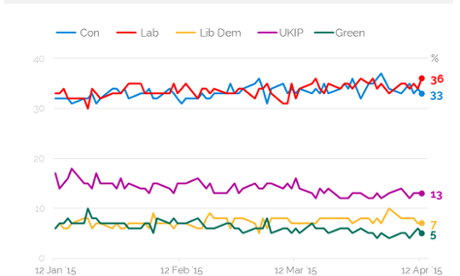
Q: Labour candidates would expect you to say you can find the £8bn.
Balls says it is not that easy. There is a deficit of £90bn.
Labour will do what it takes on the NHS.
But there will be a budget responsibility lock on the manifesto. Labour will not promise spending unless it can show where the money will come from.
He says the Tories would raise VAT. But Labour does not want to raise VAT.
No one is going to believe Tory promises of £8bn, when the Tories cannot show where the money will come from.
And that’s it. I will post a summary of this interview, and the others Balls has given, this morning.
Q: Would you find the extra £8bn for the NHS?
Balls says he is determined to find the money. Labour founded the NHS. It will protect it. But he will not announce spending plans that are unfunded.
Q: You used to be promising an extra £2.5bn for the NHS on top of what the Tories were offering. That now implies £10.5bn.
Balls says Webb is assuming that the Tories would be able to find the £8bn.
He says Labour will do everything it can to find that money (the extra £8bn for the NHS).
But he cannot spend the money before he has worked out how to raise it.
The Tories are making unfunded commitments on rail fares, and volunteering, and the NHS. That is treating the electorate with contempt.
Q: Do you plan any cuts?
Yes, says Balls. He lists a string of proposed cuts.
Q: So why is Jim Murphy saying you don’t need to make further cuts?
Balls says Murphy was responding to claims that Labour had signed up to cuts worth £30bn.
Q: Murphy said there did not need to be further cuts? But are you saying there will be cuts in Scotland.
Yes, there will be cuts outside non-protected areas that will apply in England and Scotland, says Balls.
But Labour is also setting out ways of raising money, through measures such as the mansion tax. That will deliver £800m extra spending for Scotland. Whether or not that is more than the cuts in Scotland depends on how the cuts in non-protected areas work out, he says.
He says he cannot say Scotland will be exempt from spending cuts in non-protected areas. But they will be sensible cuts, he says.
That is unlike the Tory plans, and the SNP plans, he says. SNP plans for full fiscal autonomy would harm Scotland.
Ed Balls' Today interview
Justin Webb is interviewing Ed Balls.
Q: When do you intend to get rid of the deficit?
Balls says by the end of the parliament, but earlier if he can.
It will depend on what happens to the economy, he says.
Yesterday he said he wanted to raise £7.5bn from tackling tax evasion and tax avoidance. If he can hit that target by the middle of the parliament, he can get rid of the deficit more quickly.
Q: You want to get rid of the deficit on current spending. But what about the deficit on spending including investment?
Balls says the Tories want an overall surplus, not one on current spending. That is extreme, he says. It will lead to a rise in VAT or a cut in NHS spending.
Q: So your plans could still involve a deficit at the end of the parliament?
Balls says his aim is to get the national debt falling.
Updated
Good morning. I’m taking over now.
Ed Balls will be in the Today programme in a moment. I will be covering the interview in detail.
This is what he said earlier, in a BBC Breakfast interview, about NHS spending.
I’ll save the NHS but I’m not going to make promises until we can show where the money will come from – that’s the irresponsible approach. It’s actually become the George Osborne approach...
I want, consistent with getting the deficit down, to do more for the NHS. But if I roll up and say ‘£8bn, I’m not going to tell you where the money is going to come from,’ that would be irresponsible and that is what the Tories did this weekend.
My colleague Damien Gayle watched Ed Balls’s appearance on BBC Breakfast earlier, and has filed this report of his strongest comments – including another rebuttal that Labour caused the global financial crisis:
“We have got to get the deficit down but we have also got to show in this manifesto that everything is paid for,” Balls said.
“We are only spending money where we can identify where it’s going to come from,” he added.
Continuing his party’s strategy to cast off their reputation as a party of fiscal irresponsibility, Balls denied accusations that his predecessors in government had blundered into massive debts.
“There was a global financial crisis, it happened all over the world started in America, it didn’t get started by the previous government,” he said.
But following the Conservative party’s pledge to find £8bn a year to fund shortfalls in healthcare, Balls was also forced to deny that the Tories had taken over Labour’s mantle as the party of the NHS.
“We founded the NHS,” he said. “We will do what it takes to save the NHS.” But, he added, “we are not going to make any unfunded and uncosted commitments.”
He said: “Our manifesto is clear, we will cut the deficit every year and the only promises we will make are promises where we know where the money is going to come from.”

Updated
Holmes introduces Martin, a coalminer’s son from Nottingham, who asks Balls why so many working class “lads” feel abandoned by the party?
Balls says it’s the Tories who will raise VAT again, that he doesn’t understand why he thinks the Tories wouldn’t clobber the working classes - Labour’s mansion tax will only apply to those with homes worth £2m.
Martin says Ukip have got the balls on immigration, not Ed Balls. And with that, the short interview is over.
Updated
Ed Balls on Sky's Sunrise programme
Ed Balls is being interviewed by Eamon Holmes.
Q: Are you requiring big leap of faith from voters?
A: No, people need to know what we’re promising to do and that our sums add up. Tories always allege Labour got country into financial crisis, but it isn’t true - it was a global problem.
Everything in manifesto is costed and paid for, and will be audited by the Office for Budget Resposibility.
Updated
Anti-Trident protesters at Faslane
Meanwhile, Libby Brooks has also filed this about anti-nuclear protesters who are trying to temporarily close down the Clydeside home of the UK’s nuclear submarines.
Hundreds of anti-nuclear protesters are risking arrest this morning as they attempt to close down the Faslane near Helensburgh for the day. The Scrap Trident blockade is being organised by a coalition of 15 peace, political and pro-independence groups and follows last Saturday’s rally in Glasgow’s George Square, where up to 4,000 demonstrators were addressed by First Minister Nicola Sturgeon Green party co-convenor Patrick Harvie is expected to attend to protest alongside local SNP MSPs.
Organisers welcomed yesterday’s letter from Roman Catholic bishops in Scotland to their parishioners urging them to use their vote in May’s general election and warning them that “nuclear weapons represent a grave threat to the human family”.
All the Faslane gates are now blocked. #scraptrident pic.twitter.com/V5jXsurfNv
— Patrick Harvie (@patrickharvie) April 13, 2015
Jim Murphy to attack SNP’s plans for fiscal autonomy
The Guardian’s Scotland reporter Libby Brooks is covering Labour’s campaigning in Fife today, and she has sent this report on the party’s expected attack lines:
The Scottish Labour leader will this morning use a campaign event in Glenrothes, Fife, to say that the SNP’s plans for full fiscal autonomy will cost £1,400 for every man, woman and child in Scotland. The figure is arrived at by divided the £7.6bn projected by the IFS as the shortfall that would result next year from Scotland taking control of tax and spending by the population of Scotland.
After yesterday’s chaotic BBC Scotland leaders’ debate, in which Murphy accused Nicola Sturgeon of making up economic policy “as she goes along”, he is expected to say: “The choice at this election couldn’t be clearer - investment in the future of young Scots, and an end to austerity with Scottish Labour, or losing £1,400 per person for our schools and hospitals with Nicola Sturgeon’s plans for full fiscal autonomy.
“Nicola Sturgeon can dodge questions in television studios, but she can’t hide from the facts. Since dropping this Barnett bombshell last week, she has tried to hide from the truth, but she can’t run from revelations that the SNP’s economic plan would mean austerity max for Scotland.”
Meanwhile, the SNP leader Nicola Sturgeon and finance minister John Swinney will be at a construction site in Glasgow’s riverside development to launch the SNP’s business manifesto.

Updated
Here’s a roundup of what the Twitter commentariat are saying this morning:
Today Labour, tomorrow the Conservatives, launch the first draft of their coalition negotiation demands.
— Stephen Pollard (@stephenpollard) April 13, 2015
On the train to Manchester for the launch of Labour's election manifesto. What shall I ask Ed Miliband? #GE2015 pic.twitter.com/ASz9tgY3oL
— Christopher Hope (@christopherhope) April 13, 2015
A 6.1% CON to LAB swing in England and Wales as in today's YouGov, would on a theoretical uniform swing see 77 LAB gains from CON
— Mike Smithson (@MSmithsonPB) April 13, 2015
Ed Balls accuses Conservatives of "doctoring" the tape in which he says scrapping non dom rules might mean lower tax take
— Ross Hawkins (@rosschawkins) April 13, 2015
Miliband & Cameron should swap parties if Labour's developed an austerity fetish while the Cons spend like Viv Nicholson
— Kevin Maguire (@Kevin_Maguire) April 13, 2015
Ed Balls is doing the rounds on the morning breakfast shows, softening the ground before Labour’s manifesto launch in Manchester at 11am. We’ll bring you a summary of what he says, but he is likely to hammer home how the first line of the manifesto pledges to make no unfunded spending commitments. The first line.
Morning briefing
Good morning, and welcome to the Guardian’s election live blog, with – only! – 24 days of campaigning left to go, can you believe it? We are bringing you live coverage every day from 7am till late, kicking off with our all-you-need-to-know morning briefing, designed for those hardened politicos who nonetheless like to get the occasional night’s sleep. Let us get inky fingers as we flick through the morning papers and trawl the political websites, so you don’t have to.
I’m Mark Smith, getting things started today, before handing over to Andrew Sparrow later this morning. We’re on Twitter @marksmith174 and @AndrewSparrow, and reading your comments below the line.

The big picture
As we enter week two of campaigning proper, the tent-pole policy pledges are coming thick and fast. From non-doms to inheritance tax, from the NHS to the personal tax allowance, the parties are clubbing each other with promises.
- Today’s big event is Labour’s manifesto launch in Manchester, at which Ed Miliband will challenge the Tory claim it would not tackle the deficit by unveiling a “budget responsibility lock” and guarantee all its policies are fully funded.
- The Tories suffered a blow on Sunday when the Institute for Fiscal Studies warned that Cameron’s pledge to raise the inheritance tax threshold on family homes to £1m would disproportionately benefit richer people. David Cameron tried to reset the faltering Tory campaign by declaring that he was championing the “Conservative dream”.
- Nick Clegg announced yesterday that the Liberal Democrats are to soften the effect of the mansion tax on properties worth more than £2m, as the party moves to reassure voters in southern England seats alarmed by the original proposal.
- The Green party would consider banning the Grand National and other horse and greyhound races as part of an animal protection drive should it form the next government, its leader Natalie Bennett has suggested.
The big issue

Labour’s “budget responsibility lock”, which the party says will guarantee every policy announced by Ed Miliband will be fully funded and involve no extra borrowing, is the core of the party’s manifesto offering.
Delighted that @UKLabour’s manifesto launch is in Manchester today! (Here’s the front cover) pic.twitter.com/zffQI3SDgC
— Lucy Powell (@LucyMPowell) April 13, 2015
At the launch event – which this blog will cover live from 11am – Ed Miliband will outline the key planks, which are:
- Every policy outlined in the manifesto will be funded with no additional borrowing. All the major parties will in future have to submit their tax and spending commitments to the Office for Budget Responsibility for auditing – a request that has been rejected by Osborne.
- The first line of Labour’s first budget will declare that it “cuts the deficit every year”. Every subsequent budget will have to abide by this commitment which will be verified by the OBR.
- There will be “strong, fair fiscal rules” to ensure the national debt falls and a surplus is secured as soon as possible in the next parliament.
With what the Guardian’s chief political correspondent Nicholas Watt calls “one of the boldest moves by a Labour leader since Tony Blair amended clause IV in 1994”, Miliband hopes to wrongfoot George Osborne and blunt the key Tory campaign message: that the party is fiscally irresponsible and would return to credit-card governing. As Watt writes:
Labour believes that the chancellor, who failed on nearly 20 occasions on Sunday to explain how the Tories would fund a commitment to provide an extra £8bn a year to the NHS by 2020, is tripping up by making unfunded commitments. Labour also points out the Tories have failed to explain how they will deliver £12bn of welfare cuts, which account for nearly half of the planned £30bn fiscal consolidation in the next parliament.
This second week of the election campaign will be defined by whether the public believes Miliband’s fiscal pledge, and how successfully the Conservatives can unpick any holes in Labour’s seemingly watertight promise. The Tories have already moved their manifesto launch to tomorrow – ostensibly to avoid a media clash with Labour – but it also gives George Osborne the chance of a line-by-line rebuttal of Ed Balls’ economic plan.
Today’s diary
-
8.10am - Ed Balls is the big interview on BBC Radio 4’s Today programme.
- 9am - Nick Clegg leads Lib Dem campaigning in Maidstone, Kent.
- 10am - Green party launches its national billboard campaign in Brighton.
- 11am - Labour launches its election manifesto in Manchester.
Must reads
Patrick Wintour in the Guardian analyses Labour’s attempt to reinvent itself as the party of fiscal restraint, and says voters’ instinctive trust of the Tories to be prudent may be wavering.
Labour’s polling shows swing voters want to hear this Labour message as much as demands for greater responsibility for the world’s richest 1%. But there are risks for Labour in trying to emphasise its fiscal responsibility. The public’s view of Labour profligacy is deeply ingrained, and may not be turned around in the three campaigning weeks left before the election.
Equally, the Conservatives clearly feel their record as stewards of the public purse is so entrenched that they can afford to make unfunded spending pledges. The British, it is argued, know the Tories are not the party of increased tax and spending.
If the Tories say a tax cut or a spending pledge can be made without blowing a hole in the public finances, the voters instinctively trust them. Yet that may be changing, and the media may be becoming more sceptical. Andrew Neil, interviewing David Gauke, a Tory Treasury spokesman, wanted to know the location of the Tory money tree, and Andrew Marr asked George Osborne 18 times where he was finding his £8bn for the health service.
It’s a lie to say the Tories rescued the economy, says Richard Layard in the Times, who remembers what many columnists in the Conservative-supporting press fail to: the global financial crisis.
Labour caused the deficit”; “We took over in a crisis”; “We made things better by our new long-term plan”. These are the Conservatives’ three main economic claims. But do they stand up to scrutiny?
The deficit was caused by the worldwide financial crisis and the ensuing recession which slashed tax receipts — and not by Labour. Until the crisis, the average deficit in Labour’s first 11 years was 1.2 per cent of GDP. This compares with average deficits of 5.1 per cent under the previous Conservative government. While that government increased the debt relative to GDP, Labour cut it.

Is Samantha Cameron too much of a hippy for the Tories to win, asks Peter McKay in the Mail, seemingly straight-faced, with reference to her recent attendance at a ‘psychedelic’ rock gig in east London’s trendy Shoreditch.
Samantha Cameron is liked by 54 per cent of voters, says a poll. This is double the proportion who chose Miriam Clegg or Justine Miliband. Mrs Cameron, 44 next Saturday, impresses men and women alike — as well as voters who back parties other than the Conservatives.
However, a female Tory supporter of my acquaintance offers a different perspective, saying: ‘I blame Samantha Cameron for pushing Dave away from traditional Conservative views into hippy-dippy, New Agey-thinking, which they think will win over non-traditional Tories.
If today were a song, it would be …
California Dreamin’ by The Mamas and The Papas
Well, Conservative Dreamin’ would also feature a blue sky, wouldn’t it?
Non-election news story of the moment

Can’t wait for series five of Game of Thrones to start tonight? Well, neither can many other people it seems. The first four episodes have leaked online, causing consternation at Sky and HBO. The show (the plotlines of which will be familiar to ardent fans of political theatre) is the most pirated in the world.
Updated