Jamie Grierson's evening summary
Milifans. To debate or not to debate? Career-defining, I mean country-defining pitches. Plinth stones. Red lines, lots of red lines. Bus breakdowns. Mysterious back pain. A Celtic rebellion. Poorly larynxes. Brain freezes. Coalitions - deal or no deal? West Ham or Aston Villa? Pumped up! Long-term economic plans or better plans. Brains for Labour, hearts for the Tories. Tough on immigration, tough on landlords, tough on tax avoidance, tough on top-earners, tough on crime. Polls, polls, polls. Has it been a fun campaign? Hell yes!
The big picture

The polls open in just under eight hours. Britain’s politicians have travelled across the length and breadth of the country, either welcomed or shunned by the public, to bring the election campaign to a frantic close. It’s now over to the electorate to do their part. It looks like Britain is heading for a second hung parliament in succession with polls showing Labour and the Conservatives tied. The moment of truth is nearly upon us.
What’s been happening
- Britain is heading for a second hung parliament in succession after the most drawn-out election campaign since the war appeared to be ending in near deadlock with Labour and the Conservatives tied at 35% each according to the preliminary results of the final Guardian/ICM campaign poll.
-
David Cameron ended a marathon 36-hour eve-of-election tour across Britain by offering a promise and a warning to the British people as they go to the polls in an election he says “will define this generation”. The prime minister, who was sounding tired after a twelve-stop tour across England, Wales and Scotland, promised to redouble “with a passion” the work of the last five years in delivering apprenticeships and helping the elderly.
- David Cameron has claimed that Ed Miliband is preparing a “con trick” to enter No 10 even if Labour wins fewer seats than the Tories on Thursday – but his claim appeared to be at odds with the former cabinet secretary who oversaw the 2010 coalition negotiations.
- Vince Cable, the Liberal Democrat business secretary, has described his party’s opposition to an in/out referendum on the EU in 2017 as “an issue of the very highest importance”, exposing tensions in the party over whether it will have to concede the referendum as the price for a second coalition deal with the Conservatives.
- Police and election officials in Scotland have issued warnings to polling stations and local commanders after radical nationalists urged voters to photograph their ballot papers and follow ballot boxes to count centres on Thursday night. Some pro-independence campaigners allege that last September’s independence referendum result was fixed – a claim repeatedly rejected by the Scottish National party leader, Nicola Sturgeon. Activists claim that voting in Thursday’s general election could also be rigged, in an effort to prevent SNP votes being properly counted.
Laugh of the campaign
This came today in the form of #JeSuisEd. Miliband’s supporters leapt to the Labour leader’s defence in the face of the Sun’s front page, which recycled that old bacon sarnie pic, by posting photos of their own unsightly battles with bacon butties.
#JeSuisEd pic.twitter.com/2vbO07AHfL
— Vote Me. Get Awesome (@RetroAperture) May 6, 2015
Quote of the campaign

This is a real career-defining … country-defining election that we face in less than a week’s time.
David Cameron’s critics quickly seized upon this slip of the tongue, suggesting the prime minister had unintentionally revealed that he was more concerned about his own job prospects than the future of the UK.
Hero of the campaign

Lucy Howarth delivered a damning verdict on the election campaign - in its early days - when the six-year-old had a head/desk moment during Cameron’s visit to her school in Westhoughton near Bolton.
Tomorrow’s agenda
VOTE!
That’s it for me for today. It has been a pleasure. Join the Guardian’s election team tomorrow morning, as we bring you the latest updates on polling day.
Updated
You may have noticed the blog is running a little later tonight - we’ve just enjoyed the campaign so much we can’t let go. I’ll be signing off at 11pm so stick with us and keep the comments coming in below the line.
YouGov’s president Peter Kellner has predicted the Tories will beat Labour by 21 seats - going against his firm’s most recent and final poll that puts both parties neck and neck at 34%.
Peter Kellner’s final seat prediction - http://t.co/BMsbPpuVaX pic.twitter.com/TFmg7vFUf0
— YouGov (@YouGov) May 6, 2015
Polling day front pages are in
Tomorrow’s front pages are in. They’re dominated by endorsements or a flurry of photo-finish poll results.
Some say back the Tories, others say back Labour. One of them says back Ukip. Another says back the SNP. It’s now over to the voters.
We lead on the Guardian/ICM poll that shows Labour and the Tories tied at 35%
Thursday's Guardian front page: It couldn't be closer #tomorrowspaperstoday #bbcpapers #GE2015 pic.twitter.com/WyHrqo3j6D
— Nick Sutton (@suttonnick) May 6, 2015
The Sun has its own poll with similar hair’s breadth result
Thursday's Sun front page: Well Hung #tomorrowspaperstoday #bbcpapers pic.twitter.com/eLgfFbexsQ
— Nick Sutton (@suttonnick) May 6, 2015
The Times claims the Queen will be “centre stage” if Cameron tries to hang on to power after the election without the backing of enough MPs
Thursday's Times front page: Queen to take control of election aftermath #tomorrowspaperstoday #bbcpapers #GE2015 pic.twitter.com/jN1YRr6ELz
— Nick Sutton (@suttonnick) May 6, 2015
The Mirror calls on voters to back Labour and send Tories packing.
Thursday's Daily Mirror front page: Send 'em Packing #tomorrowspaperstoday #bbcpapers #GE2015 pic.twitter.com/ULeMMGislD
— Nick Sutton (@suttonnick) May 6, 2015
The Telegraph focuses on Cameron’s warning against allowing a Labour-SNP government
Thursday's Telegraph front page: Don't do something you'll regret #tomorrowspaperstoday #bbcpapers #GE2015 pic.twitter.com/JTYoIcJ4Gi
— Nick Sutton (@suttonnick) May 6, 2015
Daily Express sticks with Ukip
Thursday's Daily Express front page: Vote to keep Britain Great #tomorrowspaperstoday #bbcpapers #ge2015 pic.twitter.com/FpWWN9me8o
— Nick Sutton (@suttonnick) May 6, 2015
The National unsurprisingly backs the SNP
Thursday's The National front page: Today...Let's colour Scotland yellow #tomorrowspaperstoday #bbcpapers #GE2015 pic.twitter.com/jmE7Icywqm
— Nick Sutton (@suttonnick) May 6, 2015
A less prominent mention on the FT
Thursday's FT: Oil price jump quickens sell-off in international debt markets #tomorrowspaperstoday #bbcpapers pic.twitter.com/JMREfqfLSZ
— Nick Sutton (@suttonnick) May 6, 2015
The Mail doesn’t splash on the election but still saves some space on the page to plug a tactical voting guide
Thursday's Daily Mail front page: Gagging of mother forced to hand baby to gay dad #tomorrowspaperstoday #bbcpapers pic.twitter.com/PeiwXYc6Cx
— Nick Sutton (@suttonnick) May 6, 2015
The Scotsman focuses on the close tie between the reds and blues in the polls
Thursday's Scotsman front page: Final election polls put it neck-and-neck #tomorrowspaperstoday #bbcpapers pic.twitter.com/Tjsj3XnPwF
— Nick Sutton (@suttonnick) May 6, 2015
And finally, I genuinely don’t understand the Daily Star’s Sex Pistols inspired front page. But it does mention the election.
Thursday's Daily Star front page: Never mind the ballots...here's the Daily Star Party party #tomorrowspaperstoday pic.twitter.com/SZYWjh8x5j
— Nick Sutton (@suttonnick) May 6, 2015
Cameron and Miliband issue final messages before polls open

David Cameron and Ed Miliband will tomorrow issue final calls to back their respective parties when the polls open. It would be quite the story if the were to do anything else.
Miliband will say “the stakes are high” in the crucial hours between 7am and 10pm and backing Labour will prevent five years of the Tories turning into a “Tory decade”.
He will say:
It’s the closest election for a generation. It’s the most important election for a generation. It is the clearest choice that has been put before the British people for a generation.
We have hours left to change the direction of our country, to build a Britain that succeeds because working people succeed.
Tell your friends, tell your family, tell your neighbours how important their choice is for all of you. For your families, for your NHS, for your country - vote Labour.
The prime minister will say the choice “is clear” - Britain has the chance of a strong, stable Government if voters back the Tories. All other options will “end in chaos”, he will say.
So as you enter the voting booth, remember these simple things: you can stop Ed Miliband being held to ransom by Nicola Sturgeon and the SNP.
You can ensure strong and stable Government. You can secure our economy and the Union. You can ensure I am back at work as your Prime Minister on Friday.
But you can only achieve these things if you vote Conservative. The country’s future depends on the choice you make.
Labour and Tories tied in YouGov final call poll for the Sun and the Times
Echoing the results of the Guardian/ICM poll published earlier today, YouGov’s final call poll for the Sun and the Times has Tories neck and neck at 34% (the Guardian/ICM had both parties at 35%).
YouGov Final Call poll for The Sun/The Times: Con 34%, Lab 34%, LD 10%, UKIP 12%, GRN 4% - http://t.co/BMsbPpuVaX
— YouGov (@YouGov) May 6, 2015
Sticking with Ukip, my colleague Ben Quinn has this update from Nigel Farage’s campaign trail.
Ukip leader Nigel Farage has insisted that his party’s vote is “rock solid” and claimed that it was on course for an election breakthough with the help of many “shy” Ukip supporters who have gone below the radar on polling.
Nigel Farage at his eve of poll rally in Broadstairs https://t.co/5Vssl4MujJ
— Ben Quinn (@BenQuinn75) May 6, 2015
In an eve of election address to hundreds of party activists in the seaside town of Broadstairs, where he seeking to win the east kent seat of South Thanet, Farage was cheered as he worked through a “greatest hits” of Ukip causes: immigration controls, Europe and an end to what he described as England’s subsidisation of Scotland.
Name-checking one of the town’s most famous sons, Edward Heath, the Tory Prime Minister who took the UK into what was then the European Economic Community, Farage said: “I would like to think that Broadstairs as a battleground is a place where we can begin to take back our country.”
He urged those present to take part in a “final push” tomorrow, wear Ukip colours and appealed for volunteers to turn up at the party’s office in the centre of Ramsgate.
“The Ukip vote is rock solid and I have a gut feeling there are lots of folks out there who are actually shy about telling pollsters who they feel,” he added.

Ukip leader Nigel Farage has pulled out of answering questions from readers of PinkNews, the online newspaper for the gay, lesbian, bisexual and transgender community.
Farage, who is standing for South Thanet in the election, previously agreed to answer questions that were selected by the PinkNews editorial team and sent to the Ukip leader.
The questions include a range of LGBT and non-LGBT issues, including gay blood bans, health tourism and the treatment of Ukip by the media.
PinkNews founder and chief executive Benjamin Cohen said:
It is disappointing that Nigel Farage, having agreed to answer the questions of PinkNews readers has now at the last minute pulled out. As someone seeking to secure a national mandate, he does himself no favours to turn down the opportunity to address a significant proportion of the electorate. Unless of course, Nigel Farage doesn’t care about LGBT voters? Surely not.
How do I vote in the UK general election? What you need to know
More people have registered to vote than ever before. Between the middle of March and the deadline to register, nearly 2.3 million signed up, including more than 700,000 18- 24 year olds. Many voters will be voting in a general election for the first time.
You don’t need your polling card or ID in order to vote, and mark your preference on the ballot paper with a cross.
Read the handy guide below for more details:
Charlie Brooker is giving his joyously cynical take on the election campaign now on his Election Wipe special on BBC Two.
Our BritainThinks focus group’s verdict on the campaign
On the eve of the election, what do the real voters think? We have 60 in five key seats giving their view throughout the campaign as part of our polling project with BritainThinks. They each have an app and are telling us what they think of stories as they crop up.
Below are some of their thoughts, from floater voters, newspaper endorsements and local leaflets:
My colleague Rowena Mason was in Leeds for Miliband’s final rally speech. Here’s her verdict.
That was very much a core vote message from Ed Miliband, promising to end zero hours contracts, food banks, greedy hedge funds, dominance of Tory donors, and low wages. His pitch - as it has been consistently for the last few days - has been to urge a vote for Labour to stop a government of the rich and install a government for working people. He even took a swipe at “Calamity Clegg” for collaborating with the Tories - someone he could find himself negotiating with in the not too distant future of there is no obvious victor. The main aim appeared to be to galvanise his party faithful to knock on extra doors and get out the vote tomorrow, which could make all the difference to the result. He said he was very proud of them all for taking part in the biggest ever “people driven campaign” and promised to fight to the last breath to deliver for them. That is a sign he won’t go down without a battle of the outcome is unclear.

Updated
And he’s done it! Nick Clegg arrives in John O’Groats after setting off from Lands End 40 hours ago. He travelled by bus though, not by bicycle.
1,000 miles and 40 hours later, Nick Clegg completes his "odyssey". Next stop: the polls. pic.twitter.com/yu0ttzEC97
— Ben Riley-Smith (@benrileysmith) May 6, 2015
Miliband's final rallying cry to vote Labour - verdict

The Labour leader, just like the rest of us, can only sit back now and watch the swingometer as the results come in.
His final rallying cry in Leeds to vote Labour is over. Dozens queued to watch the man derided as a North London geek and he gave delivered a suitably self-assured crescendo to a campaign performance that surprised some of his fiercest critics.
Here are some key quotes from Miliband’s final speech, perhaps you could chisel them into a stone plinth as an election memento.
-
We’re fighting for a Britain where we reward the hard work of every working person, not just those that get the six-figure bonuses.
- And we know what kind of prime minister David Cameron is. He’s a prime minister who’s strong at standing up to the weak but always weak standing up to the strong.
- This party believes that those with the broadest shoulders should always bear the greatest burden.
- David Cameron believes that if the people on top do well, wealth will trickle down and all of Britain will prosper. We have a different idea. We believe that Britain succeeds when working people succeed.
-
For five years this country has been run for the richest and most powerful. But tomorrow is your day. Tomorrow it’s your voice that counts. Tomorrow you have the power to make Britain work for working people.
Ed Miliband exits with Justine to standing ovation. That's his work done. pic.twitter.com/kbG8m9ye2N
— Rowena Mason (@rowenamason) May 6, 2015

Finishing his final rally speech of the election campaign, Miliband issues an impassioned call on voters to back Labour.
Use your power for you, your family, and our NHS. Use your vote. Use your vote to vote for Labour and together we can put working families first.
The Labour leader builds up to his final rallying cry before the polls open in less than 12 hours.
For five years this country has been run for the richest and most powerful. But tomorrow is your day. Tomorrow it’s your voice that counts. Tomorrow you have the power to make Britain work for working people.
Miliband says the election comes down to a “clash of two completely different ideas”.
David Cameron believes that if the people on top do well, wealth will trickle down and all of Britain will prosper. We have a different idea. We believe that Britain succeeds when working people succeed.
Miliband says he will now aim to host six million conversations on the doorstep before the polls close tomorrow.
This has been the biggest people-driven campaign in history. At the start of this campaign I said that we wanted to have 4 million conversations in 4 months. To take our message to the village halls, community centres and workplaces across our country. Friends, thanks to your hard work, your commitment, your passion, we’ve smashed through that target. Today we hit 5 million conversations. Tomorrow it will be 6 million conversations.
Miliband says Britain needs a Labour plan and spells out some of the key policies he has rehearsed throughout the campaign.
We’ll reward hard work, he says. We believe in security at work. We’ll ban zero hours contracts, if you do regular hours in a Labour Britain you get a regular contract.
Miliband says Labour will ensure young people have opportunities to fulfil dreams. We’ll reverse mistakes of “Calamity Clegg”, he says, and cut tuition fees to £6,000.
The Labour leader says Labour will abolish the cruel, unfair bedroom tax in every corner of the UK.
The Labour leader goes a bit panto as he asks the crowd if they support David Cameron with the NHS.
Do we support him with the national health service?
No!
Miliband is now attacking the Tories record. He hits out at high food bank use, zero hours contracts.
David Cameron has ducked and dived, evaded and avoided. He wants to hide the truth. We know he’s planning to double the cuts next year. The most extreme cuts from a political party for a generation.
Miliband says Labour is fighting for all working people, not just those on six figure salary.
We’re fighting for the precious NHS, Miliband says, fighting for a more fair and tolerant Britain. This is the Britain I believe in.
Ed Miliband delivers his final rally speech

The Labour leader is making his last address at a rally in Leeds before the polls open in less than 12 hours.
Emerging to a round of applause after a warm-up speech from Broadchurch actor Shaun Dooley, Miliband starts by thanking fellow Labour politicians Hilary Benn, Rachel Reeves and Paula Sherriff, who are all present.
I enjoyed this from PA’s Kate Ferguson.
My favourite election fact of the day - dogs are allowed to come to the polling station, but ponies and horses must be tethered outside.
— kateferguson (@kateferguson4) May 6, 2015
What about cats?
Sticking with Miliband, the Labour leader is gearing up for his final election rally in Leeds and supporters are queueing up to cheer him on. My colleague Rowena Mason has posted these images.
The giant queue of people in Leeds waiting to see Ed Miliband give his final campaign rally pic.twitter.com/hjJPfq4eN1
— Rowena Mason (@rowenamason) May 6, 2015
I've seen the inside of the Ed Miliband rally venue and I don't think all these people are going to squeeze in pic.twitter.com/gyYj6kvGd9
— Rowena Mason (@rowenamason) May 6, 2015
In a wonderful riposte to the Sun’s front page, in which the paper urges voters not to back Ed Miliband by recycling a 12-month old photo of the Labour leader eating a sandwich, Twitter users have posted dozens of images of themselves battling with bacon butties with the hashtag #JeSuisEd
This act of solidarity must make Miliband feel all warm inside.
Here are a few highlights:
#JeSuisEd pic.twitter.com/2vbO07AHfL
— Vote Me. Get Awesome (@RetroAperture) May 6, 2015
#JeSuisEd pic.twitter.com/TXgycPMPJP
— joe heenan (@joeheenan) May 6, 2015
#jesuisEd pic.twitter.com/gF19pKWC4Q
— Natasha Hodgson (@NatashaHodgson) May 6, 2015
#JeSuisEd pic.twitter.com/V16OpoEbzz
— Bethany Black (@BethanyBlack) May 6, 2015
My colleague Rowena Mason reports that Labour is preparing to fight any attempt by David Cameron to declare victory on Friday as leader of the largest party even if he does not have enough seats to command a majority.
She writes:
Miliband has spent the last two days repeatedly dodging questions about what he will do if he narrowly comes second, refusing to answer the question at least seven times. “I’m going to leave the commentary to others. My focus is not on the politicians but on the British people,” he said at a meeting of supporters in Pudsey, West Yorkshire.
But Labour aides have made clear they take the same position as constitutional experts and the former cabinet secretary Lord O’Donnell, who say there is no law giving the leader of the largest party the right to govern. “The rules are the rules,” one Labour adviser said – regardless of the political argument about legitimacy that Cameron may make.
Labour aides believe it will be clear by the end of Friday whether Cameron has no chance of getting a Queen’s speech through the Commons. In that situation, they would call for him to resign, even if he tries to claim only a Conservative-led bloc would have legitimacy.
The prime minister has posted his final rally speech in Carlisle on Soundcloud for you all to enjoy/loathe/share/ignore - delete as appropriate.
Britain's on the brink of something special - let's finish the job. My speech at tonight's big rally in Carlisle: http://t.co/GezZ3FGj7L
— David Cameron (@David_Cameron) May 6, 2015

David Cameron has appealed for more time to build a better Britain as he insisted the election will “define a generation” in his final election address in Carlisle.
The Press Association reports:
In a final rallying cry before the polls open tomorrow, the prime minister said he was not a “demented accountant” obsessed with eradicating the deficit - but aimed to make life better for hard-working people.
Rounding off a frantic 36-hour tour that aimed finally to break the deadlock with Labour, Mr Cameron told activists in the crucial marginal of Carlisle: “It comes down to a choice of leadership. Whether you want me to continue leading our country and taking it forward, or whether you want Ed Miliband to go back to the start and waste all the work of the last five years.
“Do you want the people who are fixing the economy, or the people who wrecked our economy?”
Watched by wife Samantha, Mr Cameron said if he was returned to power he would keep growing the economy, getting people back into work and boosting childcare.
By contrast Mr Miliband could only govern if he was “held to ransom” by Nicola Sturgeon and the SNP. “I don’t raise this as some irrational fear. I raise it because people are raising it with me day after day,” he said.
Brandishing the infamous “no money left” note from Liam Byrne that has been a constant prop through the campaign, Mr Cameron said values of “public service” were what defined him.
Two very senior figures from major trade unions affiliated to the Labour Party have told Channel 4 News that if the Tories get more seats than Labour this Friday – but not a majority – then Ed Miliband should immediately go for an anti-Tory pact with the Liberal Democrats.
One source told Channel 4 News that Miliband should even consider making the Liberal Democrats an offer on electoral reform.
Senior union figures tell me if Tories get most seats, Miliband should at once offer anti-Tory pact to Lib Dems, & even think of deal on PR
— Michael Crick (@MichaelLCrick) May 6, 2015
“The trade unions wouldn’t like another government the same as the last five years,” one leader told political correspondent Michael Crick. He added, “the Liberal Democrats have some very positive trade union policies - in some cases more positive than Labour.”
Such voices are likely to be very powerful when the Labour Party’s National Executive Committee meets this Saturday, especially when all the party’s major unions are represented on the NEC.
Updated
Here’s the election campaign’s final photo of the day from Stefan Rousseau, PA’s chief political photographer:
ELECTION Photo du Jour: David & Sam Cameron visit High Woods housing development in Lancaster. By Stefan Rousseau/PA pic.twitter.com/ALvYB21psL
— Stefan Rousseau (@StefanRousseau) May 6, 2015
Cameron stages final election rally in Carlisle
The prime minister is making his final pre-election address to supporters in Carlisle. There won’t be a dry eye in the house, surely?
Here’s some early photos and reaction coming in from journalists on Twitter.
From the Guardian’s Nicholas Watt
They like him in Carlisle. Last rally pic.twitter.com/tNirizdGMc
— Nicholas Watt (@nicholaswatt) May 6, 2015
PA’s James Tapsfield
Distinctly less "pumped" performance from Cameron so far. Seems to have opted to finish with a calmer delivery mode
— James Tapsfield (@JamesTapsfield) May 6, 2015
Sunday Politics presenter Richard Moss
David Cameron in final #GE2015 rally urges party members in Carlisle to put in one final push. pic.twitter.com/XuLnTTKirV
— Richard Moss (@BBCRichardMoss) May 6, 2015
And Bloomberg’s Svenja O’Donnell
Cameron's last stand in Carlisle: no tie? Tick. Sleeves rolled up? Tick. Pumped up? Tick. #GE2015
— Svenja O'Donnell (@SvenjaODonnell) May 6, 2015
Updated
Whether you’re in the safest of seats, or one of the swing constituencies that could decide the next government, we’d like you to help us document the election where you live. Are politicians still canvassing in your area or is there no sense that voting day is only two weeks away? We’d like to see your photos and hear any stories that reflect the election in these last few days.
British general election: share what's happening where you are via @GuardianWitness http://t.co/E6MfTsUWwF pic.twitter.com/MoocMhOs8o
— Guardian politics (@GdnPolitics) May 6, 2015
Absent Miliband issues final plea to Scottish voters

With Nick Clegg in Scotland on the final leg of his Yellow Bus odyssey from Land’s End to John O’Groats, and David Cameron due to make a flying and cursory visit later this evening, Ed Miliband will be the only main UK party leader not to visit Scotland on the final day of the campaign.
He may feel there’s not much more he can do to salvage an honourable defeat for Scottish Labour at this late, so he sent Scottish voters a wee note, heavy on sentiment, labour movement history and heartfelt appeals.
He told voters:
On the eve of the tightest general election in a generation my message to the people of Scotland is this: I understand the patriotism and pride you feel in your nation. I know you want change. And I know you want a more socially just and fairer country. That’s what I want too.
David Cameron is clear. If he has just one more MP than Labour he’ll try and stay in power. Any seat the SNP win from Labour in Scotland makes that more likely, and we’ll suffer five more years of cuts, food-banks and falling living standards.
The one vote David Cameron doesn’t want you to cast is a vote for Labour. The only way to get a Labour government on Friday is to vote Labour on Thursday.
Updated
Back in Ukip country, in Nigel Farage’s target constituency of South Thanet, my colleague Ben Quinn has this report.

Tensions have been boiling over a little bit in South Thanet, the constituency where Ukip leader Nigel Farage is bidding to win a seat in parliament.
Dan Thompson, a local artist and opponent of Ukip, claims that he was hit in the face by a man who drove up to him shortly after speaking to Farage on the street in the seaside town of Margate.
There’s no suggestion that the alleged attacker, whose car was flaying a Ukip flag, was in any way connected to the Ukip leader, but Thompson has accused Ukip of bringing “hatred” to the constituency,
Will Scobie, the Labour parliamentary candidate in the constituency, described the incident as “an attack on democratic freedom”.
“I now ask the electorate to send a clear message tomorrow that Ukip is not welcome in South Thanet.”
Earlier, Farage himself was involved in an (entirely verbal) face-off with an anti-Ukip protestor, Gary Perkins, who followed him and a press pack through the centre of Ramsgate.
In front of the cameras, Perkins challenged Farage on the list of comments by Ukip candidates who have subsequently been suspended, including the latest one in which a candidate threatened to shoot a rival.
“We are a party that believes live and let live,” said Farage, as the conversation came to an end.
Their exchanges can be viewed here:
A Ukip spokesman said: “These are allegations made by people who are fervent anti-Ukip activists. And we must remember they are only allegations. But we condemn any intimidation or violence towards anybody, whether involved in this election or otherwise. We hope that all involved in this election of all parties condemn all the violence, vandalism and intimidation that has bedevilled this campaign across the country”.
A spokesman from Kent Police said: “Kent Police received a report of an assault which allegedly took place in the Northdown Road area of Margate on Wednesday 6 May. Initial enquiries are on-going.”
Updated
Sticking in Scotland, my colleague Severin Carrell has this report on warnings issued by police and election officials to polling stations after radical nationalists urged voters to photograph their ballot papers.
He writes:
Some pro-independence campaigners allege that last September’s independence referendum result was fixed. They claim that voting in Thursday’s general election could also be rigged, in an effort to prevent Scottish National party votes being properly counted.
Police and electoral officials placed the campaigners’ claims “in the context of conspiracy theories after the referendum”.
In a campaign dubbed Operation Scallop on Twitter and Facebook, the campaigners have urged voters to wait until the final hour of polling on Thursday so they can track their ballot papers from polling stations to count centres, in an attempt to prevent them being tampered with.
Looking to the Highlands, my colleague Frances Perraudin has interviewed chief secretary to the treasury, Danny Alexander.
She writes:

The Liberal Democrat battle bus has just stopped at the Tomatin whisky distillery in the constituency of Inverness, Nairn, Badenoch & Strathspey, where the chief secretary to the treasury, Danny Alexander, is battling with the SNP to keep his seat. Nick Clegg and Alexander were given a brief tour and did a whisky tasting, before the Lib Dem leader boarded the bus again for the long journey to John O’Groats.
Alexander spoke to journalists about the question of whether a government of the second largest party could ever be legitimate. He repeated Clegg’s line that the second party should only form a government if the first party has exhausted its efforts to do so.
“What we have said is we believe it is right that we should talk first to whichever party has the strongest mandate from the voters, whichever party has the most seats and votes, and that is what we will do,” he said.
I asked him if the Liberal Democrats would be willing to negotiate with both parties at the same time, which they did in 2010 and which seems to slightly go against Clegg’s repeated line that the largest party needs to be given the “time and space” to form a government.
Alexander said: “That would depend on how the talks unfolded.”
“So we will just have to play it the way that seems most sensible given the result the British people hand down. I think people will expect us to handle that process responsibly and we will, exactly as we did in 2010,” he added.
In Ramsgate, a plucky Nigel Farage has taken on a heckler, who accused the Ukip leader of being “sexist, racist, homophobic and a banker”.
Our video team has posted this clip.
Reaction to the latest Guardian/ICM poll showing Labour and Tories neck and neck is already coming through on Twitter.
Political blogger Sunny Hundal
Panic time at CCHQ. Polls start to converge, in Labour's favour! ICM today: CON - 35% LAB - 35% (+3) UKIP - 11% LDEM - 9% GRN - 3%
— Sunny Hundal (@sunny_hundal) May 6, 2015
Guardian’s home affairs editor Alan Travis
Guardian/ICM poll is first of campaign that has not had a Tory lead - also 73% 10/10 certain to vote - could be highest turnout for 18 years
— Alan Travis (@alantravis40) May 6, 2015
Polling analyst Mike Smithson
The ICM 3% increase for LAB looks good for EdM and worrying for CON. Tonight's poll is first from firm since Jan that CON not ahead
— Mike Smithson (@MSmithsonPB) May 6, 2015
Labour and Tories neck and neck in final Guardian/ICM poll
Labour and the Conservatives are heading into Thursday’s general election neck and neck, tied at 35% each according to the preliminary results of the final Guardian/ICM campaign poll.
Ed Miliband’s party has pulled back three points on the previous campaign poll, published nine days ago, with the Conservatives remaining unchanged.
Labour’s recovery goes hand in hand with a squeeze at the political fringe: Ukip and the Greens both slip back two points, to 11% and 3% respectively.
The Liberal Democrats are unchanged on 9%, a buoyant Scottish National party climbs one to a Britain-wide score of 5%. Plaid Cymru are on 1%, and other minor parties are also on 1%.
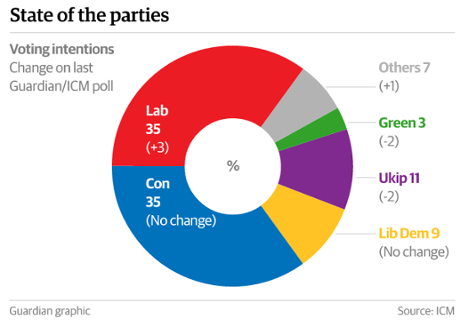
The survey is ICM’s preliminary prediction poll, with a larger than normal sample size, and will be updated on polling day, after additional interviews being conducted into Wednesday night are fed into the data.
Updated
The view from Middle England: 'If the Scottish get in with Labour ... we're done for' – video
Here’s John Harris’s final pre-election report, which is humorous, revealing and even a little sad all at the same time.
My colleague Rowena Mason has been with Labour leader Ed Miliband as the closing stages of the election campaign unfold. He’s been in Garforth, west Yorkshire, meeting some of those so-called Milifans.
Ed Miliband arrives in Garforth to chants of Ed, Ed, Ed pic.twitter.com/z4UjRKJAKj
— Rowena Mason (@rowenamason) May 6, 2015
Some ordinary people actually gathering to get a glimpse of Miliband in Garforth cafe. But only supporters inside... pic.twitter.com/iWR2mwhCX6
— Rowena Mason (@rowenamason) May 6, 2015
School kids begging for selfies with Ed Miliband - he stops for a couple pic.twitter.com/wpT6I5pgJt
— Rowena Mason (@rowenamason) May 6, 2015

Editor of Politics Home Paul Waugh has written this detailed account of a day with Boris Johnson, mayor of London and Tory candidate for Uxbridge and South Ruislip.
Of particular interest is Johnson’s concession that he would not be able to both run a big-spending cabinet post and be mayor.
The wild-haired Tory hopeful says:
The thing about London is it is already a major department of state. It’s difficult to see how I…I could not run a big spending department at the same time as the mayoralty. I don’t see how that works, unless you sort of amalgamate it into ‘London and…’ But it’s not going to happen.
At UK Polling Report Anthony Wells has a useful blog about the key election battlegrounds.
Brave man, he has also posted his predictions.
I generally hold to the pollsters’ maxim of snapshot not prediction, so I avoid predictions like the plague for most of the Parliament as the polls may yet change. In 2010 I waited until after the final polls were done before getting off the fence, but it gave me very little time to actually write anything, so this year I’ve done it up front. Obviously if Wednesday’s final polls do show the Conservatives eeking out a small lead I’ll reconsider and make my prediction more Conservative – when the facts change, I changed my mind. As it is though, my personal best guess is Conservatives around 277 seats, Labour around 267, the Lib Dems around 29 and the SNP around 52. I’ll revisit those once we have the final polls.
That’s all from me. My colleague Jamie Grierson is taking over now for the rest of the day.
Updated
Daily Politics trust debate - verdict
The final Daily Politics debate in this at-times illuminating series was about “trust” and if the wriggling by today’s participants to dodge questions was reflective of the broader political system, then it’s clear why trust has become such an inflammatory issue among the electorate. If it was former Tory leader William Hague on net migration targets, Labour’s Harriet Harman on post-election deals, Lib Dem’s Baroness Brinton on so-called red lines, Ukip’s Diane James on proportional representation or SNP’s Alyn Smith on the likelihood of another Scottish independence referendum - all five attempted at some point to shift the focus from the topic at hand and apparently without a sniff of irony when considering this was supposed to be debate on trust.
Amid the defensive manoeuvring, there were a few telling and amusing moments.
Harman refuses to rule out discussions with SNP or other parties
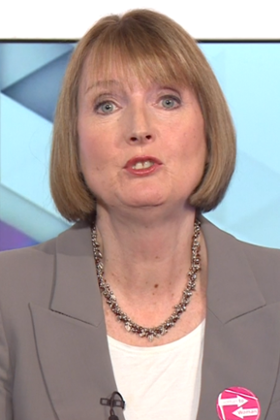
What the deputy Labour leader didn’t say when asked if her party would hold talks with the SNP before or after a minority Labour government presented a Queen’s speech perhaps said more than she intended or realised. Presenter Andrew Neil repeatedly pressed Harman on whether a Labour minority government would enter discussions with the nationalists. She blindly ignored the question, rather than opting for any form of deflection.
Q: If you form a minority government, you’re saying there will be no nods and winks, no private discussions in run up to a Queen’s Speech or afterwards with other parties? With the SNP?
We have said what will be in our Queen’s Speech and what will be in our budget.... What we’ve done is said this will be our Queen’s Speech and we’re not going to negotiate away things we’ve said are in the country’s interest. We’ve said absolutely clearly, no coalition, no tying, no negotiation.
And finally Harman claimed, again without a hint of irony, that:
People want clarity, not shady deals.
Telling lies is a bad thing - Harman
There was an interesting - although not particularly contemporary - exchange between presenter Jo Coburn and Harman about the influence New Labour had on the politics of spin. Coburn suggested spin surged to “industrial” levels after 1997. Harman did not agree and had a “bears in woods” moments when she explained lying was bad.
It was very important for us to narrow down and focus on what we were saying about the health service, about the minimum wage, about jobs. We had been a bit of a shambles with everybody saying different things. What we then did is we said, with the British people, if we are asking them to vote Labour we need to be clear with them and consistent with our promises.... Telling lies is a bad thing but having a coherent message is a good thing.
Andrew Neil’s killer putdown of the day
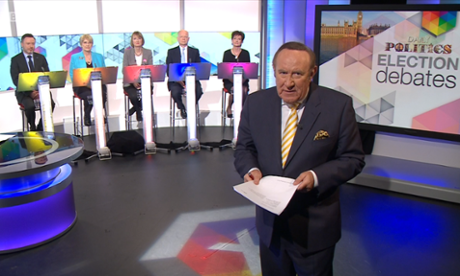
During a discussion about politicians being suspended or even sent to prison with the Lib Dem’s Baroness Brinton, Neil unleashed the acerbic wit that has brought these debates to life over the past few weeks.
Baroness Brinton: Sometimes people forget politicians are human as well.
Neil: What’s the evidence of that?
Labour may have lost the pledge stone
During a discussion about Ed Miliband’s pledge stone, it emerged Harman - who defended its use as a “very good idea” - has no idea where the divisive gimmick has been stored. Asked by Coburn where it was, the deputy Labour leader appeared a little dazed.
Q: Have you lost it?
No we’ve not lost it. I can tell you where the pink bus is?
Updated
This is quite useful.
here's a round-up of every seat prediction I could find for tomorrow's UK general election; shout if I've missed any. pic.twitter.com/5AAkKQ0QZm
— bat020 (@bat020) May 6, 2015
There have been almost no coverage of the local elections taking place tomorrow, despite the fact that more than 9,000 council seats are up for election, making this the biggest contest in the regular four-year local election cycle.
If you are interested, there is a very helpful briefing about the elections here (pdf), on the Political Studies Association website. It has been written by the local election experts Colin Rallings and Michael Thrasher.

Ed Miliband hinted at two further red lines as he spoke in Pudsey, west Yorkshire, after saying he would not lead a government unless it abolished non dom status.
Asked whether he would lead a government unless it abolished the bedroom tax and the health and social care act, he said he would make those things happen as prime minister.
However, he continued to be vague when asked about whether he could lead a government if he comes second, saying: “I’m going to leave the commentary to others. My focus is not on the politicians but on the British people.”
There was also little news on the whereabouts of the Edstone. Miliband is not sure whether it is in London yet but he is sure “it is in safekeeping”
Updated
The Guardian’s picture editors have launched a gallery of the best images of the final day of campaigning. Though obviously there will be some cracking polling day images tomorrow to look out for.
Today’s Jim-Murphy-pulls-a-funny-’playing-with-children’-face is this one:

Updated
Gary Lineker has joined those having a go at the Sun over its front page.
I'll keep who I vote for to myself, but I doubt I'll be influenced by the manner in which someone eats a bloody sandwich.
— Gary Lineker (@GaryLineker) May 6, 2015
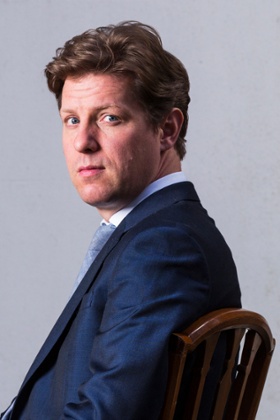
There’s been grudging praise for Ed Miliband from Fraser Nelson editor of the Tory-backing Spector magazine.
Speaking on the Spectator’s latest politics podcast, the View from 22, Nelson conceded that Miliband has “performed very well” during the campaign.
“Slips and tombstones aside, on the whole he [Miliband] came across as energetic, plausible, persuasive, a decent man,” Nelson said.
“I don’t take any joy in saying these things, but by and large I think the Labour campaign has been better than the Conservative one.”
Cameron by contrast has been a disappointment, Nelson said. “Voters just don’t think he [Cameron] wants it. And he isn’t connecting oddly in the way that even Ed Miliband is managing to connect.
Updated
No matter the election result, Trident is here to stay
Amid all the uncertainties of the general election, one thing is predictable. Britain’s nuclear weapons system is not only here to stay, it will be upgraded.

Both the Labour and Tory leaderships have said they would replace the fleet of four Trident ballistic missile submarines, a project that is likely to cost well over £100bn over its 30-year lifespan.
A new study tracing the development of Britain’s nuclear weapons project rightly points to what the authors call “the beliefs, culture, and identity, issues which have led Britain to develop and retain a nuclear capability for nearly seventy years”.
[However] British governments have over the years cut the number of missiles and warheads on the four Trident submarines. Michael Fallon, current defence secretary, told MPs earlier this year that the number of warheads on board each submarine had been reduced from 48 to 40.
Opinium poll gives Tories 1-pt lead
Opinium has released its final poll.
FINAL Opinium poll for #GE2015: @Conservatives hold onto their 1 point lead http://t.co/Zy7DiS2mvJ pic.twitter.com/QZj6cTNrXy
— Opinium Research (@OpiniumResearch) May 6, 2015
Ukip leader Nigel Farage has reacted to Nick Clegg’s refusal to be part of a government that campaigned for getting out of Europe, pointing out this would impact any Tory-Lib Dem coalition.
He told the Guardian:
Nick Clegg seems to have revealed that if there’s another Con-Lib coalition, Mr Cameron will have to campaign for an ‘in’ vote during an EU referendum, if indeed he intends to give the British people a say at all, which is still in doubt.
But what Clegg’s statement really belies is his arrogance towards the British public. It shouldn’t, and won’t be for the government to decide about coming out of the EU. It should be the will of the British people in a free and fair referendum, as soon as possible.
Vince Cable's attack on the Tories's proposed EU referendum - snap analysis

David Cameron has said that he would only form a government if he could have a referendum on the EU. Nick Clegg has made it clear that this is not a formal “red line” issue for the Lib Dems, and that the party could potentially sign up to a coalition committed to a referendum. But Vince Cable has said that the Lib Dems are “strongly opposed”, and suggested that, if this is not a form a formal red line, it might just as well be.
What’s going on? Four points may help to explain this.
1 - Cable is essentially right. The Lib Dems are a profoundly pro-European party. The SDP wing was founded by people who left the Labour party partly over the issue of Europe, and Clegg himself is a former EU bureaucrat with a cosmpolitan background married to a Spaniard. There is deep unease across the party about the prospect of a referendum that could lead to Britain voting to leave
2 - There has been a split over this. Clegg decided not to make this a red line issue. But other figures in the party are using different language. For example, Cable, whose comments today echo what he told the Lib Dem spring conference, and Ed Davey, the energy secretary, who told the Observer recently that “another deal between the Lib Dems and Tories that would involve backing an in/out EU referendum “incredibly difficult” to envisage.” (Perhaps this is a sophisticated “good cop, bad cop” routine, but more probably it is just an old-fashioned split.)
3 - Not making this a red line is tactical. The Lib Dems decided that this issue was so utterly important to the Tories that, in return for agreeing to a referendum, the Lib Dems could potentially obtain very substantial concessions if they do form a coalition. Putting the EU referendum on the table gives the Lib Dems maximum bargaining power.
4 - There is an argument in Lib Dem circles that, if an EU referendum is inevitable, having it in 2017, with the Lib Dems exerting some influence, might be not be the worst option. My colleague Patrick Wintour covered this in a good analysis yesterday. Here’s an excerpt.
Clegg’s decision to put Europe into the negotiating pot has shocked businessmen who previously regarded him as one of the most reliable pro-European politicians at Westminster.
However Business for New Europe, the main pro-Europe business group, is not going to criticise Clegg since some of its members believe a 2017 referendum controlled by the Lib Dems, and with a Conservative prime minister fundamentally well disposed to Europe, is a better bet than an an in/out referendum held in 2020 led by a full-blooded Eurosceptic Tory leader. If there is to be a day of reckoning, it is better now, it is argued.
Updated
Cable says Lib Dems are 'strongly opposed' to the Tories' proposed EU referendum
Here are the key quotes from Vince Cable on the Conservatives’ proposed EU referendum.

- Cable said having an EU referendum in 2017, as the Tories propose, was “a very, very bad idea”.
- He said that the Lib Dems were “strongly opposed” to this referendum and that, although he would not describe that as a formal red line for the party, it was an issue of “the very highest importance” to the party.
-
He said that David Cameron had been “stampeded” into this by the Conservative right.
We think that the idea of a 2017 referendum is a seriously bad idea. We are not opposed to referendums in principle. We have already agreed in parliament that, should the treaty arrangements change, the British people should be consulted. But we think it’s a very, very bad idea that, at a time when the British economy is still recovering and we need to concentrated all our efforts there, we’re going to spend two year navel-gazing about our future in Europe, and we don’t know what the outcome would be.
All kinds of potential uncertainties are being created for people who want to invest their money building factories here, as business secretary a point often made to me by Japanese, Indian, American and other companies. “We just need to know where you are”, and being part of the European single market is part of the certainty that they demand.
So I think it is potentially very damaging. My party is strongly opposed to it. And we will take a strong position on it should this issue arise in any negotiation in the parties ...
[Opposing the referendum] is an issue of the very highest importance [for the Lib Dems]. We have been consistently making the case in recent weeks, indeed over the last two to three years, that this referendum idea that David Cameron has been stampeded into by his own rightwing is a very bad idea for Britain. It is not a party issue in that sense. A lot of Conservatives share our reservations, quite apart from the Labour party.
Updated
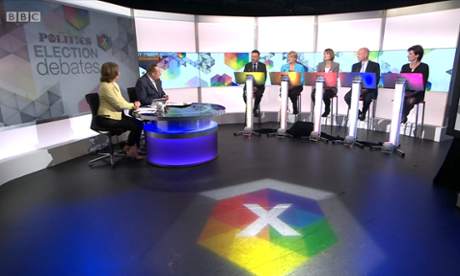
Good afternoon, Jamie Grierson here. I’m tuning in to the Daily Politics debate on BBC Two now. It’s all about “trust in politics” – or perhaps lack thereof – so expect expenses, cash-for-access (and maybe even plebs) to crop up.
The former Tory leader William Hague, deputy Labour leader Harriet Harman, Lib Dem’s Sal Brinton, Ukip’s Diane James and the SNP’s Alyn Smith are all featuring. I won’t post a minute-by-minute account, rather flag up stand-out moments.
Updated
Cable says he would like to see tax credits and child benefit protected.
Q: You said in February that there was no taboo to working with the SNP.
Cable says the Lib Dems have now ruled out a relationship with the SNP, because they want to break up the UK, just as they have ruled out a relationship with Ukip.
Cable says that he is a politician of the left. Working with the Tories was not easy, he said. He did not feel “comfortable” about it. But he said personal preferences were not what mattered.
Updated
Cable says that Labour had some responsibility for the financial crash, but says that the crash was not caused by Labour spending too much.
Vince Cable says having an EU referendum in 2017 is 'a seriously bad idea'
Vince Cable, the Lib Dem business secretary, is on Radio 4’s Election Call now.
Q: Will the Lib Dems make sure that, if there is another coalition with the Tories, they won’t allow this EU referendum go ahead.
Cable says the Lib Dems think a referendum in 2017 is “a seriously bad idea”. To spend two years “navel-gazing” on Europe, without knowing what the outcome would be, would be bad for business. It is “potentially very damaging”. The Lib Dems would take “a strong position” on this.
Q: Would it be a red line?
Cable says he is not going to use that phrase.
Q: The Lib Dems would veto it?
Cable says he is not saying that.
But “it is an issue of the very highest importance”.
-
Cable says having an EU referendum in 2017 is “a very bad idea”.
Cable’s stance on this is very different from Nick Clegg’s, because Clegg has pointedly refused to rule out backing the Tories’ EU referendum plans, and he has never criticised them in these terms. As Toby Helm has reported in the Observer, the Lib Dems are deeply split on this.
Updated
Three-minute election: When Kirstie Allsopp met Grayson Perry – video
On election’s eve, Guardian columnist Jonathan Freedland discusses the campaign with two special guests: TV presenter Kirstie Allsopp and artist Grayson Perry.
Which of them was tempted to shift tribes? Who finds hope a bit depressing? Why are those people in mansions voting Labour, and what makes Allsopp so angry? Is Ed Miliband in touch with ordinary people, and what’s David Cameron’s biggest fault? And will anyone stop talking after three minutes …
This is interesting - the speech Ramsay MacDonald gave in the Commons when he took power in 1924, despite Labour not being the largest party. He said Labour would have to be less partisan than otherwise, and he accepted that he would lose votes on some issues.
Labour’s Alastair Campbell has been making the same point at Gus O’Donnell (see 1.27pm) on Twitter - only rather more bluntly.
Hey up @David_Cameron did you read this before you signed it off? Time to memorize the last four lines pic.twitter.com/TIJrvbGLxR
— Alastair Campbell (@campbellclaret) May 6, 2015
O'Donnell says Cameron signed off rules saying largest party does not automatically form government
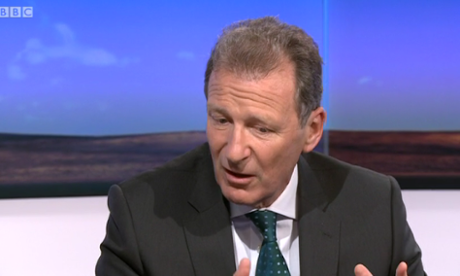
On the Today programme this morning Gus O’Donnell (or Lord O’Donnell, as he is now), the former cabinet secretary, made it clear that there is nothing illegitimate about the second largest party in the Commons forming a government provided it can command the confidence of the Commons. Tories are challenging this idea, and it is due to become a central issue of debate after the election.
On the Daily Politics O’Donnell repeated this line and added some new points.
-
O’Donnell said that David Cameron himself had signed off on the rules that say the government does not have to be led by the largest party.
One thing I should say about the cabinet manual. People keep saying it is my cabinet manual. It is the government’s cabinet manual. It is the cabinet’s cabinet manual in particular, and the preface is there signed by the prime minister, David Cameron.
-
He said he would be out arguing this case on the media. Explaining what he would be doing on Thursday night, he replied:
I’ll be in London at various studios trying to ensure that those interpretations that come out of the exit poll at one minute past 10 are actually in line with what’s in the cabinet manual, and people aren’t saying “Oh well, I think I’ve got a chance because I got this number of seats or whatever.”
(It could be a tough battle - O’Donnell v the collective might of the Tory press.)
- He conceded that the cabinet manual was “incomplete” and that it did not provide guidance for all possible circumstances, such as what might happen if no government could pass a Queen’s Speech.
- He confirmed that, if a second election ends up being held in November, the Fixed-term Parliaments Act means all future general elections would be held in November. Because of the weather, this would be very bad news for campaigners.
Updated
There are some perks to being on the Lib Dem battlebus (modest ones).
Clegg has just given journos on the bus Henderson's relish crisps (a Sheff delicacy). He gave them to the cabinet too pic.twitter.com/LeMSHPfM2V
— Frances Perraudin (@fperraudin) May 6, 2015
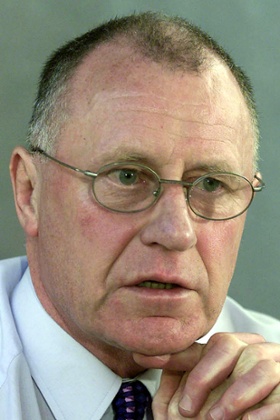
Dennis Canavan, the former Labour MP, has backed the SNP. Canavan sat in the Scottish parliament for eight years as an independent MP (after Labour would not let him stand as a candidate) and was a leading pro-independence campaigner last year. He said:
Many traditional Labour voters have been sickened by the sight of Labour in bed with the Tories, and not just during the referendum campaign.
Labour is also in cahoots with the Tories by supporting the benefit cap and more savage cuts in essential services while spending billions of pounds on weapons of mass destruction like Trident.
Although I do not endorse every aspect of SNP policy, I am asking people to vote SNP in this General Election because all the unionist parties have lost the plot and are completely out of touch with the people of Scotland.
Updated
Labour has got a 13-point lead over the Conservatives in London, according to the Evening Standard.
Ed Miliband enters his final day of campaigning with Labour 13 points ahead among Londoners, according to research conducted by YouGov for the Evening Standard. Labour is up two points in a fortnight to hit 46 per cent — its best share since November 2013.
David Cameron’s Conservatives are up one point to 33 per cent, while Nick Clegg’s Liberal Democrats are up one point to be third with nine per cent.
The three parties’ gains come at the expense of Ukip and the Greens — both squeezed hard in the run-up to polling day, which could produce some surprise results in key battlegrounds.
Tory battle buses have arrived at building site nr Chester Zoo. Looks like they could be building Jurassic Park here pic.twitter.com/gZWfsIz4xX
— Sebastian Payne (@SebastianEPayne) May 6, 2015
Ed Miliband is making three campaign stops in the north of England today. At the first, in Colne, Pendle, he received a pretty rapturous reception. Sure, they were all Labour supporters but he still managed to pack out a theatre in a small Lancashire town with hundreds of people in the middle of a very rainy day. His speech was all about urging swing voters to resist the siren voices of the Tories and calling on his party faithful to drop everything, even DIY and social engagements, to knock on that extra door before the end of tomorrow.
When the media started asking questions, he answered almost every one, no matter the subject, by hammering home his core message about the choice between a Tory government for the rich and a Labour government for working people.

Making hand prints and high-fiving toddlers in a Greenock nursery this morning, Jim Murphy was once again campaigning with all the energy and enthusiasm of a man who is not facing a massive poll defeat tomorrow. Say what you like about Murphy, and many people do, but he is a true pro at this game.
Asked about Ed Miliband’s monstering by the Sun this morning - in Scotland the bespoke front page is of Gordon Brown as Labour’s emergency life-belt - he said: “If politics is reduced to a contest over who can eat a sandwich with the greatest sense of etiquette then our politics has descended into new depths of triviality. But you can’t stop people trivialising an enormous decision, just as you can’t stop some people backing different parties north and south of the border for the same purpose.”
Insisting that he had confidence in “our robust and well-organised ground operation” in his own constituency and across Scotland, he reiterated that many voters had yet to make up their minds.
Asked about the results of the Guardian’s latest focus group in the constituency of Glasgow East, which found voters feeling that Miliband had “abandoned Scotland” by ruling out post-election discussions with the SNP, he said:
We should never in the name of nationalism confuse party with country ... We should never confuse those people who love the SNP with those who love our country.
There are many scottish voices and accents, he added. “There is no one Scottish voice and the nationalists shouldn’t pretend that there is.”
Murphy confirmed that he would be at his own constituency count tomorrow night, but would not be attending the main Glasgow count, a telling logistical decision given the heavy losses Labour faces in the city it once called its own.

Nick Clegg, who is on the last leg of his epic Land’s End to John O’Groats campaign tour, has just been visiting Jo Swinson in East Dunbartonshire.
He gave a speech to supporters in Bearsden, just outside Glasgow, saying that, although the party was “written off” at the beginning of the election campaign, they would be the “surprise story of the election”.
We are going to do so much better than anybody thinks. I’ve seen it for myself in seats across the country these last few weeks.
There’s a momentum building behind our candidates in those seats where we are there in numbers, getting our message across loudly and proudly.
His speech was twice interrupted by hecklers. “Liar,” shouted a man in a passing car. “Come on SNP,” called a passing jogger.
The party boasts that the deputy prime minister has visited 54 constituencies and travelled 8,367 miles – the equivalent of the length of the Nile and Amazon rivers combined together – since the end of March.
Clegg thanked party campaigners for delivering more than 50m leaflets, knocking on more than 4m doors and putting up more than 30,000 stake boards.
Speaking to journalists, he repeated that he liked campaigning because it gave him a chance to tell the Lib Dem side of the story without it being “clouded or misrepresented.”
Clegg said the Conservative party had given up pretending to be a party of the whole UK.
The Conservative party has now mutated into an English party chasing Ukip votes in Southern England. It has got barely any representation in Scotland ... David Cameron has given up even pretending to seek a mandate as prime minister for the whole of the United Kingdom.

In his speech in Colne (see 11.36am) Ed Miliband said he was asking people to vote for Labour, not just for the party, but for themselves.
He has set out the same message in a post on Facebook. Here’s an excerpt.
I’m not asking you to vote simply for Labour tomorrow. I’m asking you to vote for yourself and your family, to vote to reward hard work again for everyone in our country, to vote to build a future for all our young people, to vote to rescue our NHS, and, above all, to vote for a country where we put working families first. That’s what’s on the ballot paper.
I’m not simply asking you to reject the Conservatives but to reject their plan to put the rich and powerful first, to reject a plan to double the cuts next years and devastate our NHS, to reject a plan for a recovery that only reaches the City of London, to reject a plan that leaves young people having a worse life than their parents.
Nigel Farage has suggested that a failure by him to win the East Kent constituency of South Thanet would mark the end of the road for his decades-long search to get elected.
The Ukip leader was in a characteristically chirpy mood as he strolled through the centre of Ramsgate this morning, stopping at one point to debate an anti-Ukip activist who followed him and a press pack through the seaside town.
However, he was also willing to expand on what the future might hold for him and his party after voting on Thursday. Asked if multiple second place finishes in seats across the country but no actual MPs would count as a success, he replied “no”, adding that the main aim was to get members into parliament.
The number of second places we get long term is very important but I think actually our biggest potential as a party going forward is going to be in the midlands and the north in those Labour areas.
As for his own personal battle to get elected, Farage told reporters: “I am not in the same position as Mr Cameron is in, I have not got a safe seat I have to win this seat. I am leader of the party and I need to get elected because if I don’t I am for the chop.”
“We have not done polling for a long time, the last we did suggested we were comfortably ahead. I am reasonably confident but I am taking nothing for granted.”
Asked if he would stand again if he failed to win the South Thanet seat, where he has been neck and neck with his Tory rival, Farage said: “It’s the final count down.”
Windy conditions for Ukip https://t.co/TtHbhGndpa
— Ben Quinn (@BenQuinn75) May 6, 2015
On the question of who should be the next leader of Ukip, Farage said that “you would think” that the next leader of the party should be an MP.
The Ukip leader’s “low point” of the campaign was, he said, being in front of a studio audience which appeared to overwhelmingly hold supportive views on unilateral nuclear disarmament which he had not heard for decades. But he was also disappointed that immigration had not featured more during the campaign, and again sought, as he has done in recent days, to link the issue of illegal migration to a potential security threat to the UK from ISIS.
Another sign of how he viewed the way forward for Ukip was the growing importance which he attached to electoral reform. “We have got totally negative politics in this country and I am beginning to think that is a product of the first past the post system,” he said.
Euphoria among press photographers as Nigel Farage poses under this doorway with scrawled graffiti #ge2015 pic.twitter.com/OVlQ9wdx8I
— Ben Quinn (@BenQuinn75) May 6, 2015
Updated
Talking of Andrew Neil, a Daily Politics outside broadcast has just been disrupted by a protester.
For more on the election coverage in the rightwing press, this Huffington Post article is good. It quotes Andrew Neil, the BBC presenter and former Sunday Times editor, saying we have seen the press “at [its] partisan worst”.
Ed Miliband’s ‘first TV appearance’ - video
Our multimedia team have got hold of some ITV Meridian news video footage showing a young Ed Miliband at a rent protest at Oxford university in 1991. Miliband, then calling himself Ted, argues against a 27% rise in rents for students. The Labour leader says he was delighted to see the clip when it was unearthed 24 years later.
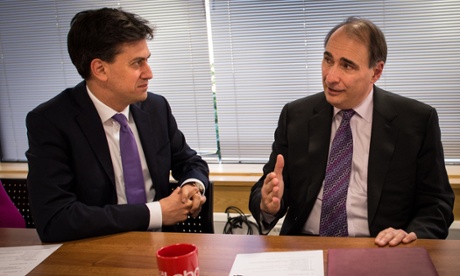
David Axelrod says Tory press more powerful and more aggressive than Fox News

David Axelrod, the American political consultant and Obama adviser who has been working for Labour during this campaign, has given an interview to Michael Goldfarb from Politico. It’s well worth reading in full, but here are the key points.
-
Axelrod says the Tory press in the UK is more powerful and “much more aggressive” than Fox News in the US.
POLITICO: But what about the press? You say it has disproportionate power here. Do you think Britain’s conservative print media is more powerful than Fox News?
DA: Yeah, I do. I do think the parties approach media as partisan players. So you see parties disseminating messages through the print media in a way that is unusual ...
DA: Fox is certainly very conservative, skews to the Republican side, but there isn’t a kind of lockstep between them and the Republicans. Fox tries to drive the Republican agenda more than reflecting it.
Here there are relationships between the parties and media outlets that are deeper so you see a lot of themes being previewed in the media in a way that you don’t see in the states.
-
He dismisses suggestions that Ed Miliband could “fold” and let the Tories in if there is not a decisive result on Friday.
POLITICO: Finally, we’re heading for a hung Parliament and what is likely to be a bruising fight outside the voting booth for who forms the next government. There are echoes of Bush v Gore in this. Do you think Miliband, like Gore, will fold his hand when pressed by the Conservatives?
DA: The one thing that people consistently have done is underestimate Miliband’s mettle. You learn about people in a campaign.
Anyone who underestimates Ed Miliband does so at their own peril.
-
Axelrod says the Tories have made two key mistakes during the campaign.
I think the Tory campaign has not been a particularly good one on the whole. They put too much truck in two things.
One: They felt that the recovery of the macro economy translated into a sense of progress and security in the lives of everyday people and that simply wasn’t true. The second, they thought that caricature of Miliband would carry through the election.
-
But he acknowledges that the Tories made a shrewd move when they pushed for multi-party debates.
The one thing they did that was particularly shrewd was they insisted that all the parties participate in the debate. They didn’t do that out of a sense of equity and fairness. They did it because they wanted to give the Scottish National Party a platform and the result is the situation you see today.
Updated

Q: You have talked about getting rid of non-dom status as a red line. Is that an admission that you won’t win a majority?
Miliband says he is focusing on winning.
These chances only come along every five years.
Updated
Q: Some people think you are too leftwing. Why should you be prime minister on Friday?
Because the British people deserve a prime minister who will put working people first, Miliband says.
He says David Cameron will focus on the rich and the powerful, but he, Miliband, will concentrate on doing his best for working people.
Q: Have you done enough? Will you be the next prime minister?
Miliband says that he is confident, but that it is now a decision for the British people.
Miliband's Q&A
Q: Papers like the FT say you are not ready to be prime minister. Are you ready?
Yes, says Miliband.
He will be focusing on the choice facing people. People need to be under no illusions about what five more years of David Cameron would mean: the NHS getting worse, young people being worse off than their parents, living standards falling.
Miliband criticises Clegg for defending non-dom status
Miliband is running through Labour’s key campaign pledges.
Labour will abolish non-dom status, he says.
We expect David Cameron and Nigel Farage to defend non-dom status.
But Nick Clegg is defending it too, he says.
That’s why we need a Labour government.
-
Miliband criticises Nick Clegg for defending non-dom status.
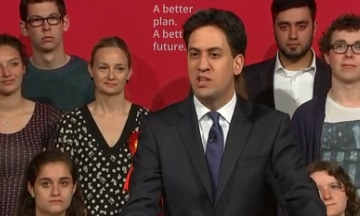
Miliband says Labour has had 5m doorstep conversations with voters
Miliband says Labour has had the most people-driven campaign in its history.
He says he set an unreasonable demand: 4m doorstep conversations from activists.
Labour has met that target, he says. In fact, it has beaten it.
- Labour has had 5m doorstep conversations with voters, Miliband says.
Updated
What do the real voters think? We have 60 in five key seats giving their view throughout the campaign as part of our polling project with BritainThinks. They each have an app and are telling us what they think of stories as they crop up.
Here are some of their views on the eve of polling day, on issues from the likelihood of another coalition to the tactics parties use to sweeten voters up.
Ed Miliband's speech
Ed Miliband is giving a speech in Colne. You can watch a livestream of it below.
He says he is not asking people just to vote Labour. He is asking people to vote for themselves, for a country that works in the interests for the working people, and for the NHS.
And he is not just asking people to reject the Tories. He is asking people to reject their plan for cuts, their idea that the recovery just depends on the City of London, and their plan that will involve young people having fewer opportunities than their parents.
Updated
Nicola Sturgeon has predicted “a watershed election” for the Scottish National party, as it stands on the brink of winning most seats in a general election in Scotland for the first time in its history.
The SNP leader addressed a crowd of around a hundred supporters and dozens of press photographers and camera crews in heavy drizzle for her final campaign rally outside the National Gallery of Scotland at the Mound in central Edinburgh, with the party poised to win a large majority of Scotland’s 59 Commons seats.
Before signing autographs and posing with supporters for selfies – now a ritual at all Sturgeon campaign events, she told the crowd: “The SNP is in a wonderful position in this election.”
To cheers and applause, followed later by chants of “SNP, SNP” and a capella renditions by supporters of “Caledonia” and “Scotland the Brave” she added: “We’re in touching distance if we continue to work hard, today and tomorrow, of doing something the SNP has never done in our history, we are within touching distance of winning a Westminster election.”
She continued:
I want to ask you today to keep going because we keep nothing for granted, not a single vote or a single seat. When we ask people across this country for their vote, we ask them for something very, very precious. And it’s our duty to work as hard as we possibly can to prove to them that when they put their trust in us, we will not let them down. And that’s my promise.
Asked if she planned to start talks with other parties, she repeated her challenge to Labour to combine in an anti-Tory pact.
Given we’re just on the eve of poll now, I’ll let the Scottish people do the talking tomorrow in the polling stations and at the ballot boxes, then the politicians on Friday morning have a duty to respect the outcome.
And if the voters across the UK decide not to give Labour or the Tories a majority then that means they want the parties to work together. My message has been the same right through the campaign: if there’s an anti-Tory majority on Friday morning, we should work together to keep the Tories out.

Updated
The Green party leader was joined by activist and writer Jack Monroe for her final push to help win Bristol West. Natalie Bennett and Monroe spoke to voters close to Bristol University’s main site – the party is confident of taking a huge chunk of the student vote.
Bennett said: “We’re hearing huge enthusiasm. The momentum is definitely with us. You can really feel the energy.”
Asked if the Green surge in Bristol West would simply let Labour in by taking votes away from the Lib Dems, who hold the seat, Bennett said:
The Lib Dems are clearly third. People have a straight choice – vote Greens or Labour. I think people are going to vote for what they believe in, policies like making the minimum wage a living wage, bringing the railways back into public ownership, having a publicly-owned and run NHS, climate change.
Bennett claimed the Greens approach to transport – congestion is a huge issue in the city centre – and tuition fees (there are two major universities in the city) were winning votes here.
But she added:
A lot of other people get that we need real change. Society can’t keep going with the rich getting richer and the poor getting poorer.
And will it be a huge disappointment if the party does not win a second parliamentary seat? Bennett argued that the party got one in 100 votes in 2010, this time it may get one in 20 or more. “We’ve made huge advances. We’ve started the Green surge. After this the Green surge is going to keep going.”
Jack Monroe campaigning for the Green Party in Bristol. http://t.co/OywlqarbCn
— steven morris (@stevenmorris20) May 6, 2015
Russell Brand says he’d decided to endorse Labour before Ed Miliband interview

Russell Brand has just launched a blogpost where he addresses criticism of his late endorsement of Ed Miliband, after years of saying voting was a waste of time.
The broadcaster and activist says:
Ultimately what I feel, is that by not removing the Tories, through an unwillingness to participate in the “masquerade of democracy”, I was implicitly expecting the most vulnerable people in society to pay the price on my behalf while I pondered alternatives in luxury.
He also explains that the Miliband interview was not a “Damascene moment”. Brand says: “I did not tumble back in a white beam of enlightened reverie, scales falling, realising that the Westminster machine, with a different pilot will serve ordinary people. **We decided to endorse Labour before we approached them for the interview.** [Brand’s own emphasis]
My position will not have changed on May 8th, I’ll be doing my best to amplify movements I believe in, from housing, to trade unions, football fan campaigns, social enterprises, digital activism, student occupations, organic agriculture, crypto-currencies; the same things I’m doing today, the things I’ve been learning about for the last 18 months; since I said I don’t vote on the telly.
My recommendation that people vote Labour is an optimistic punt that the degeneration of Britain will be slowed down and the lives of the most vulnerable will be a little more bearable than they’d’ve been under the Tories. Nothing more ambitious than that.
You can read Brand’s full blogpost here.
Today’s rightwing papers are a collector’s item for students of the “Tory press”. My colleague Jane Martinson has written about them here.
Here’s an extract.
If reading the more rightwing papers over the last few weeks has been a bit like receiving daily earbashings from an increasingly hysterical man on a street corner, now he is waving his arms in your face shouting “The end is nigh”.
TNS poll gives Tories 1-pt lead
And there is a TNS poll out too. Here is an extract from the news release.
A new poll by TNS UK shows that voter intention figures are as follows:
- LAB 32% (-1), CON 33% (-1), LIB DEM 8% (+1), UKIP 14% (-1), GREEN 6% (+1), OTHER 6% (+1)
Using data from the last seven TNS polls, voter turnout is predicted to be 69% across Great Britain, with Scotland somewhat above the average at 71%. TNS data suggests a turnout of only 56% among 18-34 year olds, much lower than the 82% predicted for those aged 65+.
Commenting, Dr Michelle Harrison, Head of Political and Social at TNS said, “With polling day around the corner the polls suggest that Labour and the Conservatives have reached stalemate.
“Despite several campaigns to increase the registration rate of younger people, it seems likely that many won’t vote - even when the election is on a knife edge.”
And here are the tables (pdf).
YouGov poll says Tories and Labour tied on 34%
Here are today’s YouGov GB polling figures.
Update: Cons & Lab tied - Latest YouGov / The Sun results 5th May - Con 34%, Lab 34%, LD 9%, UKIP 12%, GRN 5%; APP -9 http://t.co/hOWjZfXfA7
— YouGov (@YouGov) May 6, 2015
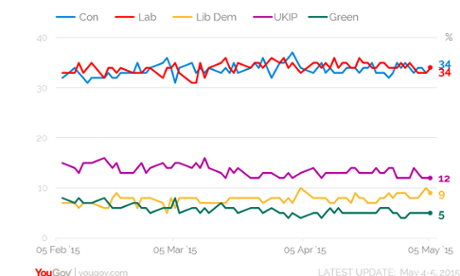
According to this article, by Todd Hartman for The Conversation, many journalists will be focusing on the wrong marginal seats on election night. Using Lord Ashcroft’s constituency polling data, he has compiled his own list of the most marginal constituencies.
Ed Balls, the shadow chancellor, has issued this response to David Cameron’s Today interview.
David Cameron is ducking and weaving because he still cannot admit the truth. His pledge to cut £12 billion from social security means cutting child benefit and tax credits again.
Tory plans would mean 4.3m families losing an average of £1,000 a year in child benefit. And a family on £23,000 with one child would lose £1,600 a year in tax credits.
Northern Ireland leaders' debate
The BBC hosted a televised leaders’ debate in Northern Ireland on Tuesday evening.
There was only one leader there, however: the Ulster Unionist party leader Mike Nesbitt.
Sinn Féin was represented by Martin McGuinness, the NI deputy first minister; the Democratic Unionist party by deputy leader Nigel Dodds; the SDLP by former leader Mark Durkan; and the Alliance party by its deputy leader and first MP, Naomi Long.
Dodds, potential kingmaker in the Commons, if the DUP come back to parliament with up to 9 seats, clashed with McGuinness, who repeated his call for a regional only referendum on same sex marriage and criticised the DUP for being opposed to gay marriage equality.
Dodds branded McGuinness a “hypocrite” for demanding a DUP apology for the gay community while he, the DUP candidate said, had offered no apology for IRA murders during the Troubles.
Meanwhile McGuinness has blamed dissident republicans for a series of attacks on cars belonging to Sinn Fein in Derry city over night.
The cars belonged to Sinn Féin councillors Colly Kelly and Sandra Duff and two men, 17 and 23, have been arrested on suspicion of criminal damage.
Dissident republican sources however have told the Guardian they are not behind any orchestrated campaign against Sinn Fein representatives and members.

There is some interesting polling on hung parliament options from YouGov in the Times’s Red Box morning briefing.
Asked what they would favour if the election resulted in “a constitutional mess with no party having clear legitimacy to govern”, 58% said a second election, and 42% opted for “back-room horse-trading to get something that might work”.
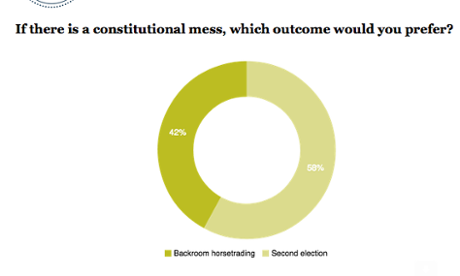
But another question found that opposition to minority governments is not, perhaps, as strong as some people think.
Polling suggests that people prefer a majority government over a hung parliament - but maybe that’s because they imagine their own preferred party being the majority (YouGov’s Stephan Shakespeare writes). Using First Verdict, I presented 3,667 people with a forced choice between “a clear Labour victory” and “a cobbled-together pact of several other parties” - and it split 45 per cent to 55 per cent. Between “a clear Conservative victory” and that pact of “several other parties” the split was an almost identical 47 per cent to 53 per cent.
So indeed, by a tiny margin, people actually prefer a coalition to a majority rather than the “wrong” party winning outright.
Nick Clegg is on LBC now. He says that he thinks the success of the Lib Dems will be “the surprise story of the election” and that he thinks the national polls aren’t picking this up.
Asked if Nick Clegg could be deputy prime minister in a coalition with Labour, Harriet Harman refuses to answer. But she gives an alternative version of the “won’t discuss hypotheticals” answer. She says if you were at the Olympics, and just limbering up for the 100m, you would not start imagining coming third.
The last piece of UK economic data before polling day has just been released, and it shows that growth in Britain’s service sector hit an eight-month high in April.
Service sector firms, from IT companies to hotels, reported that demand rose last month, despite worries about the general election.
The survey, from Markit, a data provider, suggests that the UK economy could grow by as much as 0.8% in the second quarter of 2015, having slipped to just 0.3% in January-March.
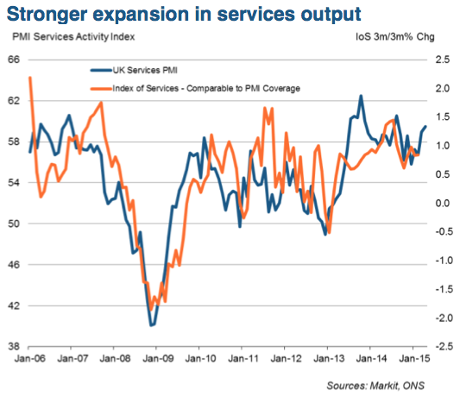
Markit had previously reported that growth across UK factories and builders had slowed last month; for all the talk of a manufacturing renaissance, Britain remains very dependent on services.
Chris Williamson, chief Economist at Markit, says:
“Fears of the economy slumping amid election jitters are allayed as an upturn in service sector activity has helped offset sharp slowdowns in both manufacturing and construction.”
Big jump in UK services PMI, a strong indicator for UK GDP, when other data pointed to faster slowdown. A Tory boost 24hrs before #GE2015
— Joshua Raymond (@Josh_CityIndex) May 6, 2015

Harriet Harman, Labour’s deputy leader, is being interviewed on LBC.
Asked how much the Labour pledge cost, and where it is now, she says she does not know.
But she says it is important to publicise Labour’s pledges. When Labour introduced pledge cards in 1997, and when it put its pledges on mugs, people thought those were bad ideas. But now everyone accepts them as good initiatives.
Updated
David Cameron's Today interview - summary and analysis

That may well be the last major interview David Cameron gives before tomorrow’s election. And we still don’t know where those £12bn welfare cuts are going to come from. The finest interviewers in the land have all tried to get an answer from him on this, but they have all failed. At some point that’s worth an inquest. For British journalism, it is major collective malfunction.
That aside, the interview was quite lively and reasonably informative. John Humphrys pressed Cameron well on the right of the SNP to sit and vote in the Commons (another issue on which Cameron has not been pressed particularly hard - “they’re as British as you and me”, Humphrys told Cameron) and we may have got a hint about Cameron’s thinking for Friday morning.
Here are the key points.
-
Cameron hinted he would try to form another coalition with the Lib Dems if he does not win a majority, saying that his priority would be to provide “a strong and stable government”. He made this point when Humphrys asked how many more seats than Labour he would need to be able to say that a Labour-led government would be illegitimate. Cameron did not address that, but he said this:
All I would say is that people know with me that in 2010 we didn’t win a majority, and I put the country first. I formed the first coalition government for 70 years because I wanted to provide strong and stable government for Britain, and I will always put the country first and always do what I can to provide that strong and stable government.
At one stage it was said that Cameron would prefer to govern as a minority government than to form a second coalition. If that was the case, this answer suggests he has changed his mind. Perhaps - and this is pure supposition - Cameron is thinking that if Ed Miliband is going to make the case that his prospective minority government would be legitimate, it would be better to trump that not with an alternative minority government, but with a full-on coalition.
Cameron’s language is also quite similar to Nick Clegg’s yesterday, and the story of the weekend may turn out to hinge on whether the Cameron/Clegg gut preference for a coalition can prevail against the centrifugal forces pulling the other way (eg, the 1922 committee and the Lib Dem left).
-
Cameron seemed to concede that Boris Johnson’s decision to talk about “Ajockalyspse Now” was offensive. Johnson, the Conservative mayor of London, used the phrase in an interview with the Sunday Times. He said:
It’s Ajockalypse Now. People are looking at Ed Miliband and they’re getting bad visuals of him popping out of Alex Salmond’s sporran like a baffled baby kangaroo.
Asked about this, Cameron said:
Boris is Boris and he has a colourful way of expressing himself ... Boris like me is a passionate believer in the United Kingdom ... That’s not my language, that is Boris’s language.
When it was put to him that this was offensive, Cameron did not dispute this. He replied:
It is humour. It is Boris. It is not my way of expressing myself.
- Cameron defended his decision to accuse Ed Miliband of being engaged in a “con trick” with voters. Cameron said this was a fair description, because Miliband said he would not do a deal with the SNP, even though he would only be able to become prime minister with their backing. Cameron accepted that SNP MPs would be as legitimate as other MPs, but he said he was entitled to warn of the dangers they posed to the UK.
Tomorrow’s front page: Miliband trying to con way into No10, says PM #tomorrowspaperstoday pic.twitter.com/no5QJIEwCK
— The Times of London (@thetimes) May 5, 2015
-
He said that the Conservatives were not “making up” concerns about the influence of the SNP on a minority Labour government. They were reflecting concerns they heard on the doorstep, he said.
It is not something I’m making up. It is something we are getting on the doorstep, day after day.
-
He rejected Lord Forsyth’s suggesting that his anti-SNP rhetoric was boosting nationalist support in Scotland.
I don’t accept that. I’m fighting the nationalists in Scotland
- Cameron said he would make the union more secure if elected by extending devolution to Scotland and Wales.
-
He defended Sir John Major’s decision to speak out about the existence of a “pretty substantial underclass” and the state of education. Asked about this, Cameron said:
I think John Major is absolutely right to make these points, and that is why our education reforms have got 1m more children in good or outstanding schools.
When he was told Major had said we could not be proud of Britain’s place in global educational league tables, Cameron replied:
We’ve got far more to do ... Am I satisfied with what we have today? No I’m not. That’s why I want another five years of standards, discipline and rigour in our schools.
Updated
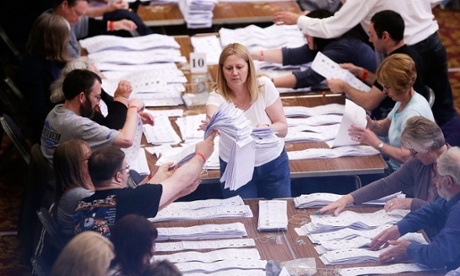
Need to know how late to stay up tomorrow night? My colleague Alberto Nardelli has put together this essential guide to the constituency results worth staying up for, and their approximate timings.
Highlights include:
Nuneaton: 1am is the first Tory-held marginal that is expected to declare. Five years ago, the Conservatives won the seat with a small majority. Labour now leads in the polls and this is the kind of seat Miliband’s party needs to pick up if they are to win the election. If Labour does not win here, it could an early warning that it could be an uncomfortable night for Labour.
Eastleigh, Yeovil, Bermondsey and Old Southwark: 2am-3am we will get a first impression of how many seats the Lib Dems might end up losing. Clegg’s party is expected to retain all three of these (it is is defending the first two against the Tories, while in London, Simon Hughes is up against Labour). Defeats here and the Lib Dems are heading for a bad night.
Renfrewshire East and Paisley & Renfrewshire South: 3am Jim Murphy, leader of the Scottish Labour party, and Douglas Alexander, Labour’s campaign chief and shadow foreign secretary, will find out if they held on to their respective seats. Polls have both losing out to the SNP: a loss of one or the other will be one of the most talked about events of the night. Meanwhile, Dunbartonshire East will set the tone for the Lib Dems’ night in Scotland: will tactical voting by the Tories help the party avoid near wipeout north of the border?
Cornwall North, Dorset Mid and Poole North, Torbay, and St Austell & Newquay: from 5.30am Attention shifts to the south. In south-west England, outcomes from tight Lib Dem v Tory races are expected after 5.30. By the time we get these results, they will probably matter most in determining whether or not the Conservatives will be the largest party and the size of the Lib Dem contingent in the next parliament (the party has 15 seats in the region).
Updated

Boris Johnson makes direct plea for Guardian readers to vote Tory - video
The mayor of London, talking to the Guardian’s Robert Booth, makes an appeal to “moderate, one nation, Blairite, middle-of-the-road, Guardian readers” to vote Conservative tomorrow.
I think the expression on Twitter might be, ‘I’ll just leave this here …’
You can read Boris’s full exhortation here.
Updated
Q: Do you regret saying you would not serve a third term?
Cameron says he gave a straight answer to a straight question.
Two five-year terms is a good period to be in office for, he says.
He says he feels more passionate about the next five year. He wants to build on what has been achieved.
If we had an Ed Miliband government backed by the SNP, we would go back to “square one”.
And that’s it. I’ll post a summary soon.
Q: You won’t tell people where the welfare cuts will fall?
Cameron says it is half of what was cut in the last parliament.
Q: That is irrelevant. You could argue that makes the next step harder.
Cameron says he has already set out plans to freeze benefits.
Q: That does not get you anywhere near £12bn.
Cameron says the Tories have a track record.
Q: This is about trust. People are entitled so you either don’t know what you are going to do, which is reckless, or you are just not saying.
Or they might say I have a track record, says Cameron.
He says the universal credit system is a massive change to the benefit system.
He was talking to someone about this in an Asda supermarket at 12.30 (I think that is 12.30am.)

Q: John Major said recently we have a substantial underclass.
Cameron says Major was right to make these points. That is why the government has got more children in good schools.
Q: Major says we cannot be proud of where we stand in education tables around the world.
Cameron says there is more to do. That is why he needs another five years.
Updated
Q: You said you would bring the country together. But you have not done that, have you?
Remember what we inherited, says Cameron, and that note saying there was no money.
He says he has got the deficit down, created more jobs and turned the economy round.
Inequality is down. Child poverty is down, he says.
Is there more to do? Of course, he says, answering his own question again.
Q: This will dominate the next two years if you win. Business leaders are worried about this.
Cameron says the British Chambers of Commerce backed the idea of a renegotiation and referendum.
If we just stick our head in the sand, we will drift towards exit.
Q: Are you prepared to walk away if you do not get a better deal?
Cameron says he has said what he wants. If he does not get what he wants, he will consider other options.

Q: You would take another risk with the EU?
Cameron says he would get a better deal for Britain from Brussels.
Q: You cannot be sure of these things. Jean-Claude Juncker has excluded major treaty change.
Cameron says Juncker has not ruled out treaty change.
Cameron says he wants to stop EU citizens coming to the UK to claim benefit. These changes would make a “real difference” to immigration.
He says he believes, in politics, you have to address the big questions. He did that with Scotland. They came up with the right answer. Now he thinks we should trust people with the EU.
Updated
Q: You took the easy option. You bought off the Scots.
Cameron rejects that. He says he did not take the easy option. He held a referendum.
Q: If you had not had a referendum, we would not be in this situation now.
Cameron says he is passionate about the UK. He is delighted Scotland voted to stay.
Q: Lord Forsyth says you are stoking nationalist feelings in Scotland, putting the union at risk.
Cameron says he does not accept that.
What would he do on Friday to make sure the UK stays together? Answering his own question, he says he would extend devolution to Scotland and Wales.
Q: If you respected the Scots, you would not have people like Boris Johnson talking about Ajockalypse Now, and Alex Salmond’s sporran.
It is Boris, says Cameron. It is humour. It is not the way he would express himself.
Q: How many more seats than Labour will you need to form a legitimate government?
Cameron says that will be determined by the voters.
Q: No it won’t.
Cameron says people know he will always put the country first. That is what he did in 2010.
Q: You said a party without the most seats might be illegitimate. But Gus O’Donnell said that is not the case.
Cameron says the problem with Ed Miliband relying on the SNP is that they want to break up the UK.
Q: SNP voters are as British as you and me.
Cameron says Nicola Sturgeon says she will hold the government to ransom. She wants £190bn more borrowing.
Of course they have a right to come to parliament.
But he has a right to warn of the dangers.
This is not something he is making up, he says. These concerns are being expressed on the dooorstep.
David Cameron's interview on the Today programme

John Humphrys says he is in Crickhowell with David Cameron.
Q: How are you going to form a government without a majority?
Cameron says he is still fighting for a majority. The Tories have 303 seats. He just needs another 23 to get a majority.
Q: But people have a right to know what happens if you don’t get one?
Cameron says that is a fair question. The alternative to a Tory majority is a weak Labour government propped up by the SNP.
Updated
David Cameron has been visiting a farm in Brecon.
Cameron visiting farm in Brecon. It's starting to rain pic.twitter.com/mZYe2cslyX
— James Tapsfield (@JamesTapsfield) May 6, 2015
Cameron holding 'kitchen summit' with Tory candidate pic.twitter.com/5JrOuywdNc
— James Tapsfield (@JamesTapsfield) May 6, 2015
They have not exactly been mobbed by press.
The world's most pointless media pen has self-destructed pic.twitter.com/R9y4MYhFB5
— James Tapsfield (@JamesTapsfield) May 6, 2015
Good morning. I’m taking over from Claire now.
David Cameron will be on the Today programme shortly. I’ll be covering that in detail.
The Guardian’s Steven Morris is in Bristol, where the Green party is launching its pledge card. Here it is:
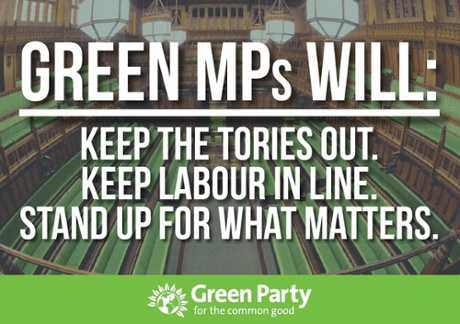
He reports:
The Greens leader, Natalie Bennett, is starting off the last day of her campaign in Bristol West, which the party hopes they can take from the Lib Dems.
She is visiting the Fareshare project – aimed at helping get the most vulnerable out of food poverty – with Jack Monroe, the food writer, Guardian columnist and activist.
Bennett said: “In less than 24 hours people in Britain have a chance to vote for real change, and to elect more Green MPs into the House of Commons.
“Those Green MPs will do all they can to keep out the Tories, and they’d hold a Labour minority government to account on issues like austerity, climate change and investment in our health service.
“One of the defining issues of this election is the gaping gap between rich and poor in this country. We have 117 billionaires in the same country where 1 million people need food banks to feed their families.
“Only the Greens are putting forward the bold solutions we desperately need to tackle inequality in Britain. That means a living wage of £10 an hour by 2020, a welfare state that truly supports people and a tax system which ensures that the richest individuals and largest corporations pay their fair share.”
Monroe, who changed allegiance from Labour to the Greens, said: “Hundreds of thousands of people in this country are struggling to get by – yet the establishment parties are offering more austerity and more cuts to our public services.
“The Green party is different. They want an economy that works for everyone, not just those at the top.
Darren Hall, the Green party’s home affairs spokesperson and candidate for Bristol West, claimed the party had the momentum in the city.
Gus – now Lord – O’Donnell, the former cabinet secretary who was instrumental in the 2010 coalition negotiations, has been talking about the process on the Today programme. Specifically, what on earth will happen on Friday if neither the Tories nor Labour has a majority?
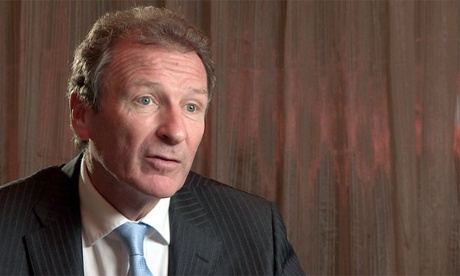
The cabinet manual (pdf) has the answers, O’Donnell says:
Those are the rules and they’re very clear: the ability of a government to command the confidence of the House of Commons is central to its ability to govern.
All elections have their issues about legitimacy … in the last election it was a coalition. They hadn’t won, independently, every single country.
Many MPs don’t win a majority in their constituencies, he points out. But that’s the system we have.
There will be questions [on Friday] about whether it’s ‘fair’ that Ukip and Greens got lots and lots of votes and very few seats … We’ve had two referenda [in the last five years]: one on a voting system and people voted very clearly for first-past-the-post; the second in Scotland, where they voted very clearly to stay with the union.
At the moment the people have answered those two questions.
Can David Cameron stay in Downing Street after Thursday if he doesn’t win a majority, or put together a swift, stable majority?
He could – it would be a political judgment on his part.
The prime minister remains prime minister after the election, and the prime minister could take a queen’s speech to the house even if he remains well short on numbers.
If it goes to the Commons and he’s defeated by a large margin, there will be questions about why do that?
But the queen will not intervene, O’Donnell insists:
The queen will open parliament, that’s her job … I would expect the queen to read the speech.
If at the end of that there’s a motion of no confidence and that’s lost, then a new government will be formed.
Interestingly, O’Donnell says in that case the new government would not bring forward a second queens speech but would find some other way to set out its programme.
The Guardian’s home affairs editor, Alan Travis, has put together this helpful article on the cabinet manual and what it tells us about how a new government can be formed.
Updated
Ukip's Paul Nuttall: 'no coalition with Tories'
Paul Nuttall, the Ukip deputy leader, has just been interviewed on the Today programme. He was asked about the suspension of a Ukip candidate who threatened to shoot his Tory rival.
The Ukip candidate for North East Hampshire, Robert Blay, was recorded saying that the Conservative candidate, Ranil Jayawardena, was “not British enough to be in our parliament”.

Nuttall said the comments were “pretty woeful”:
We’ve suspended him immediately … but we don’t have the monopoly on this … Since January there’s been 319 people from all the other political parties either convicted or stood down.
It’s not a feature [of Ukip], it’s the same for all political parties … [That] never appears in the national press – with us it constantly gets picked up.
Nuttall was asked about Ukip’s plans for Friday, in the event that David Cameron might be looking for support for a minority Conservative government:
There’ll be no coalitions, there’ll be no pacts … If there is a loose deal, our red line is this: we want a full, free, fair referendum on our membership of the European Union by the end of this year.
Why wait till 2017? We have a simple red line: we want that referendum.
The problem with Mr Cameron’s promise of a referendum [in 2017] is … he’s promised before and gone back on it.
He was evasive on the question of whether Ukip would be prepared to allow a Conservative government to fail if it could not secure a referendum this year:
We’re campaigning on positive issues … We’re not damaging the Conservative party – the Conservative party has damaged itself …
Whatever government is in power, if you get more Ukip MPs elected, we can ensure we put in place the changes we really want.
Updated
Morning briefing
Finally: the last campaign live blog. But hold those sighs because we’re back tomorrow with the polling day live blog. Then the results live blog. And then the let’s-make-a-government live blog.
I’m Claire Phipps, kicking off our live coverage of this last 24 hours of campaigning. Andrew Sparrow will be along later to take you through the rest of the day.
I’m on Twitter @Claire_Phipps, so do feel free to come and share your thoughts there or in the comments below.
The big picture
Party leaders are criss-crossing the country today, drumming up last-minute votes and defying any accusations of complacency or chillaxing. Because they are normal folk who eat takeaway chicken and commission battle buses to take them from Lands End to John O’Groats:
Some @NandosUK for the #WinningHere @LibDems tour bus. I hope you approve @alex_brooker and @TheLastLeg pic.twitter.com/QSdn6Lvmv3
— Nick Clegg (@nick_clegg) May 5, 2015
Latest polling has Labour and the Conservatives pretty much tied. A Populus poll for the Financial Times had them both on 33%.
Here’s the Guardian’s poll of polls:
David Cameron has been campaigning overnight, warning nightshift workers and insomniacs that Ed Miliband is a “very dangerous” person who is trying to use a “con trick” to force his way into No 10.

Miliband, one has to hope, has grabbed something approaching sleep ahead of speeches in four locations today.
Will any actual news break through the bustle and bluster today? Because there is news:
- The Guardian leads this morning with a list of “very, highly or extremely controversial” potential cuts to benefits drawn up by civil servants in response to warnings that the next government would struggle to keep welfare spending below a legal cap of about £120bn a year. The cuts proposed by officials at the Department for Work and Pensions include abolishing statutory maternity pay and barring under-25s from claiming incapacity benefit or housing benefit. Money could also be raised by increasing the bedroom tax.
- A Ukip candidate has been suspended for threatening to “put a bullet in” his Tory rival.
- Sir John Major has said the Tory party’s relationship with ethnic minority voters is “not remotely goodish”.
- Nick Clegg has drawn another red line, insisting the Lib Dems wouldn’t be part of a government that advocated leaving the EU. On Tuesday Clegg waggled the threat of a second election in front of the electorate, warning:
The last thing Britain needs is a second election before Christmas. But that is exactly what will happen if Ed Miliband and David Cameron put their own political interest ahead of the national interest.
- In the final week of the campaign, the Tories received £1.36m in donations. Labour got £131,242.
- You can read Jamie Grierson’s summary of Tuesday’s campaign news here.
Diary
No stop will be left unpulled-out today. No rest will be had. Much caffeine will be inhaled. And that’s just your live bloggers. Ho ho.
As for the rest of them:


- David Cameron is interviewed on the Today programme at 8.10am and later heads to Carlisle.
- Ed Miliband is in Yorkshire and Lancashire, before winding up at a rally in Leeds this evening.
- Nick Clegg continues his Lib Dem battle bus dash from Lands End to John O’Groats: today he reaches Kendal, Glasgow and Inverness, before hitting his final destination around 8pm.
- Nigel Farage is canvassing in Ramsgate, Kent. Deputy Ukip leader Paul Nuttall is on the Today programme at 7.10am.
-
Nicola Sturgeon is in Edinburgh this morning, ahead of first minister’s questions at Holyrood.
- Ruth Davidson , the Scottish Conservative leader, makes a speech in Edinburgh at 9.45am.
- At 9am, the Scottish Green party calls for return of railways to public ownership at Waverley Station, Edinburgh.
- At 11am, Jim Murphy, the Scottish Labour leader, visits Greenock.
- Natalie Bennett, the Green party leader, will give a speech in Bristol.
- Leanne Wood, the Plaid Cymru leader, is in Carmarthen.
- Boris Johnson is on LBC radio at 9.30am.
- Lord (Gus) O’Donnell, the former cabinet secretary who oversaw coalition negotiations last time around, also pops up on the Today programme, at 7.30am.
The big issue
Today, everyone would like to tell you how (not) to vote. David Cameron, writing in the Times, says:
A vote for Ukip is a vote for Ed Miliband. A vote for the Liberal Democrats is a vote for Ed Miliband.
Oh, and a vote for the SNP is a vote for Ed Miliband.
Theresa May is writing in the Express, saying that “a vote for any other party” is a vote for Ed Miliband. Essentially, everything apart from a Conservative vote is a vote for Ed Miliband. OK?
But hold on. The Express has a gasp-inducing exclusive that Nigel Farage thinks you really rather ought to vote for Ukip:
DAILY EXPRESS: Why you must vote for UKIP #tomorrowspaperstoday #bbcpapers pic.twitter.com/jcKZG4hrWs
— Neil Henderson (@hendopolis) May 5, 2015
There might be bit more surprise to be mustered in the news that Boris Johnson thinks that “moderate, sensible, one-nation, middle-of-the-road Blairite Guardian reader[s]” should cast their votes in the Tory box.
So what is the undecided voter to do? You could try the Guardian’s guide to what the parties are offering you. You could read their manifestos (quickly). Or you could just see what the media would like you to do. Let’s do that:
tl;dr: newspaper endorsements in a word(ish)
Guardian Tories tawdry; Labour hope; Lib Dems/Greens/SNP: not the answer. Verdict: Labour.
Telegraph Tories stability; Labour chaos; Greens/SNP/Lib Dems/Plaid Cymru quarrelsome. Verdict: Conservative.
Times Tories sensible; Lib Dems constructive; Labour wilfully blind. Verdict: Conservative-Lib Dem coalition.
Daily Mail Tories renewed determination; Labour preposterous; SNP unthinkable. Verdict: Conservative.
Independent Tories some success; Lib Dems force for progress; Labour unready; Greens disappointment; SNP wrecking ball. Verdict: Conservative-Lib Dem coalition.
Daily Express Tories success; Labour socialist; Lib Dems disaster; Ukip magnificent. Verdict: Ukip.
The Sun Tories prosperity and happiness; Labour socialist lunacy; SNP wreckers. Verdict: Conservative.
Scottish Sun Tories confusion and fear; Labour old-school dinosaurs; SNP phenomenon. Verdict: SNP.
Herald Verdict: ¯\_(ツ)_/¯
Scotland on Sunday SNP reinvigorated; Tories unsubtle and reductive; Lib Dems in play; Labour proven record. Verdict: ¯\_(ツ)_/¯
Observer Tories wrong-headed; SNP patchy; Greens effective; Labour courageous. Verdict: Labour.
Sunday Telegraph Tories excellent; Ukip beacon; Labour disingenuous. Verdict: Conservative.
Sunday Times Labour disaster; Lib Dems deserve to survive; Tories best chance. Verdict: Conservative.
Mail on Sunday Tories powerful; Labour calamity; Ukip demagogic; SNP dangerous. Verdict: Conservative.
Independent on Sunday Verdict: ¯\_(ツ)_/¯
Evening Standard Labour divisive; Tories good for London. Verdict: Conservative.
I haven’t yet spotted an out-and-out endorsement editorial from the Mirror. I’m going to mark it down as “vote Labour”. But do let me know if you spot a link.
Read these
- In the Times, Alice Thomson says we ought to be a bit kinder to our MPs:
Of the last intake of Tory MPs in 2010, nearly a quarter are now separated or divorced. Many are struggling to make ends meet, usually expected to live in two places, with a resentful spouse keeping everything together while they vote late in Westminster and hold surgeries at weekends. They know they can’t complain.
- In the Daily Mail, Sarah Vine gives the spouse’s verdict on five years of being married to a cabinet minister (that’s Michael Gove):
The civil service is a complete misnomer. It is neither civil nor a service. It regards elected members as a minor inconvenience and their so-called policies as an occupational hazard. Thus most of their energies are directed to thwarting the wishes of ministers …
If you really want to get something done, forget MPs and ministers. The people with the true power are a group of 20-something women: the private secretaries. They are the ones doing the work while everyone else does the shouting. Even the permanent secretaries respect them — which is saying something.
- In the Financial Times, Martin Wolf questions the Tory record on the economy:
Whatever one thinks of the fiscal policies of the coalition, a weak and unbalanced recovery from a huge recession is not a vindication. The UK faces really big economic challenges. It confronts equally huge questions about its place in the world and in Europe, as well as its own constitutional future.
Neither main party offers convincing responses to these challenges. Have no illusion: real competence is not on offer, either in economics or, in truth, much else.
- And with surely the scoop of the day is the Herald, which has tracked down the woman photographed with Alex Salmond in 1999 and popularly known as “Solero girl” (much to the chagrin of Buzzfeed’s Jamie Ross, who has been on her trail for some time). She is Kate Adamson, who now lives in Melbourne. And she’d like you to vote SNP.
Sorry @JamieRoss7 we've tracked down @AlexSalmond 's Solero girl - and she prefers a Zoom http://t.co/PC7wPA9Izb pic.twitter.com/d2nK64qn6x
— Herald Scotland (@heraldscotland) May 5, 2015
The day in a tweet
I wonder what an election without extreme newspaper propaganda would be like? I presume it would be too confusing for all of us.
— Robin Ince (@robinince) May 6, 2015
If today were a box set, it would be…
24. Counting down an hour at a time, dogged types working through the night, a plot chock-full of cliffhangers, and nobody ever needing to go to the bathroom.
The key story you’re missing when you’re election-obsessed
Today is the deadline for Israel’s prime minister Binyamin Netanyahu to put together a coalition to govern, following elections in March. By this morning, Netanyahu is obliged by law to have put together a new government or step aside as prime minister.
Updated