Evening Summary
With Labour launching its manifesto yesterday, the focus shifted today to the Conservatives and the Greens. Here’s the low-down on what took place.
The big picture

The Conservatives’ manifesto launch was a move away from the rigid discipline and negative nature of the Lynton Crosby school of electioneering, which we have been seeing so much of from the Tories in the last few weeks. During his speech, which took place in Swindon, David Cameron spoke repeatedly about his desire to deliver the “good life” for all people. He said the Conservatives have put the country on solid ground and laid solid foundations, but that the next five years are about building on that. Britain should be a country where a good life is there for everyone willing to work for it, he said. It is the “bright light in the North Sea that has exceeded expectations, decade after decade, century after century”.
The biggest example of Cameron’s attempts to reinvigorate the Tory spirit was the resurrection of Margaret Thatcher’s “right to buy” policy. This extension of the scheme will see 1.3m families in housing association properties have the right to buy their homes. It is the Conservatives last-ditch appeal to lower-income swing voters in the key seats. It is Cameron saying we are the party of working people, not Labour.
But the prime minister will be disappointed to see that the latest Guardian projection has the combined Labour and SNP share of seats on 326. As my colleague Alberto Nardelli wrote earlier, this is an all time high in our daily series - and more significantly: it’s a majority. Meanwhile the combined Tory-Lib Dem share has dropped below 300 seats, and even by coopting all possible sources of support (Ukip’s four seats and the DUP’s nine), David Cameron is - as things stand - well short of the bare minimum he would need to win a confidence vote in parliament. As the election gets nearer and nearer, Cameron’s options for remaining in Downing Street are dwindling. The question is whether his return to aspirational politics will encourage a shift in public opinion.
What happened today
-
Alongside the Right to Buy, the Conservative Party manifesto was full of fresh promises including 30 hours a week of free childcare for working families and scrapping tax on the minimum wage. Cameron also repeated his party’s “ambition” to bring down immigration to the tens of thousands rather than the hundreds of thousands, and accused Labour of failing to have a proper economic plan. He said:
All our commitments are fully funded as part of our fiscal plan. That is the difference between the parties. They haven’t even reached, as it were, the foothills. They haven’t even got to base camp. In fact, I think they’re stuck at Gatwick trying to work out what sort of suncream to buy. They haven’t really done the work and they’ve had five years to do it. This is a total contrast.
- Housing experts strongly criticised the Conservative plan to extend the right to buy to housing association tenants. Shelter said this “would be yet another nail in the coffin for affordable housing”. (See 10.49am.) Ed Miliband said the policy was a deceit, because it was not properly funded. And Nick Clegg described the policy as “a poor cover version of one of Margaret Thatcher’s 1980’s hits”. He went on: “I think it’s a measure of how the Conservatives have run out of new ideas”.
- Nursery providers questioned the Conservative plan to give working parents 30 hours for free nursery care, and health care experts said it was difficult to see how the party’s pledges on health care, including a seven-day GP service and enhanced focus on prevention, would be affordable. The Bar Council also said the Tory justice pledge would be a “cold comfort” to those needing legal aid.
- The Green Party launched its manifesto in Dalston, east London. The party insisted its policies are both practical and fair as it targeted the twin priorities of ending economic austerity and highlighting the environmental crisis. Natalie Bennett, announcing the manifesto alongside the party’s sole MP, Caroline Lucas, said voters could “transform British politics” by voting Green in sufficient numbers on 7 May. “This is a new kind of politics, the end of politics as usual, the business as usual politics that accepts politics and society being run for the benefit of the few, not the many,” she said.
- Nicola Sturgeon defended the SNP’s desire for an independent Scotland to belong to Nato even though it is opposed to nuclear weapons. “I don’t agree that that is inconsistent with taking a non-nuclear position. Nato has got 28 member states at the moment and 25 of them don’t have nuclear weapons, so it’s actually normal within Nato for countries not to possess nuclear weapons,” she said.
- Lord Ashcroft published 10 new polls from marginal constituencies - all Conservative-held seats – that showed the Tories on course to hold five and Labour on course to gain three, with two tied.
- Jim Murphy, the Scottish Labour leader, attacked the Tory manifesto pledge to extend EVEL to financial matters – “ including an English rate of Income Tax, when equivalent decisions have been devolved” - as “a brutal betrayal of Scotland and the Smith consensus.” In a separate statement, Murphy said he is “absolutely” confident the Scottish Labour party remains in charge of decision-making in Scotland after Ed Miliband, Ed Balls and Chuka Umunna publicly contradicted his spending plans yesterday.
Quote of the day
“They [Labour] are no more the party of fiscal responsibility than Kim Kardashian is a poster girl for modesty” - Michael Gove on Labour’s manifesto.
Laugh of the day
Two today - courtesy of the man who has his priorities firmly in place, and Channel 4 News’s Michael Crick.
From a bedroom window in North Warwickshire: "I'm making love to the wife but please put a poster in the letter box". There's commitment.
— tom_watson (@tom_watson) April 14, 2015
. @MichaelLCrick to boat dweller on the election: "Are you a floating voter?" Boat man: "That's not very funny." #channel4news
— polly curtis (@pollycurtis) April 14, 2015
Hero of the day
Ruth Davison, director of policy at the National Housing Federation, who pointed out that while extending Right to Buy will see some people being able to buy their own home, these are people already living in good secure homes on some of the country’s cheapest rents. “The policy won’t help the millions of people in private rented homes who are desperate to buy but have no hope of doing so, nor the three million adult children living with their parents because they can’t afford to rent or buy,” she said.
Villain of the day
Chamali Fernando, the Conservative parliamentary candidate for Cambridge, who said that mental health patients could wear colour-coded wristbands to identify their conditions.
Tomorrow’s agenda
The Liberal Democrats and Ukip launch their manifestos tomorrow. Nick Clegg will seek to paint his party as the only valid option for a stable and trusted coalition. Nigel Farage will say that his party is the only one who will cut through the rhetoric and see-sawing around immigration and Britain’s membership of the EU.
That’s it from me for today. Join me and the rest of the Guardian’s election team tomorrow morning, as we bring you the latest news, reaction, analysis, pictures, video, and jokes from the campaign trail. We will continue to do this every day until the UK goes to the polls on 7 May.
Updated
Labour is to launch a women’s manifesto tomorrow, and the party claims it will set out:
- New plans to consult on allowing grandparents – who want to be more involved in caring for their grandchildren – to share in parents’ unpaid parental leave, so enabling them to take time off work without fear of losing their job.
- A plan to help the 60% of low paid workers who are women with a minimum wage of more than £8 by October 2019, as well as promoting the Living Wage.
- Say they plan to tackle discrimination at work, by abolishing the employment tribunal fee system, as well as requiring companies with more than 250 employees to tackle their hourly gender pay gap, and by strengthening the law on maternity discrimination.
- Pledge 25 hours free childcare for working parents of three and four-year-olds, as well as protecting the Sure Start budget, and say they will guarantee a wraparound of childcare at primary schools that will be delivered through a new National Primary Childcare Service.
- The party says it will take action on violence against women and girls by: preventing unacceptable attitudes and behaviour through age appropriate compulsory sex and relationship education; and appointing a new commissioner to set minimum standards on tackling violence against women and girls.
- Plans to retain the use of all women shortlists for Labour Party Westminster parliamentary selections, and also set a goal for 50% of ministerial appointments to public boards to be women.
Ahead of the launch, the party sent this photo of their image projected onto the Houses of Parliament:
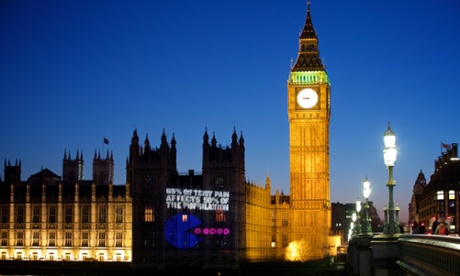
Gloria de Piero, Labour’s Shadow Minister for Women and Equalities, said:
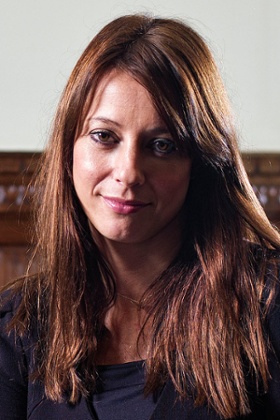
When 50 per cent of the population is being hit by 85 per cent of the pain, it is clear the Tories plan is failing women and failing working families.
Updated
The Lib Dems said they are horrified at the remarks of a Conservative candidate who is reported to have said people with mental health problems could wear wristbands to identify their illness (see 17:41pm).
Norman Lamb, the Lib Dem health minister, said it was a “frankly outrageous suggestion” by Chamali Fernando the Tory candidate, adding: “This follows the launch of a manifesto where the Tories are again threatening to reduce benefits for people who reject forced mental health treatment.”
“It seems like once again we’re seeing the same old Tories with archaic attitudes to mental health that will only entrench stigma and make people’s lives more difficult.” Lamb said.
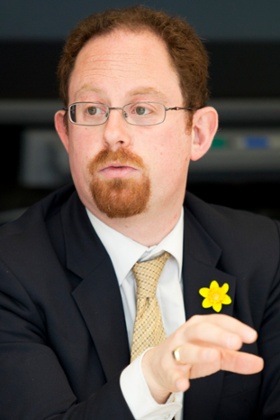
Julian Huppert, Fernando’s Lib Dem rival who is defending a 6,792 majority in the city, said: “I hope Chamali regrets her comments and will think carefully about her attitude to mental illness in the future.”
Fernando has said her comments had been distorted for political ends and her party insisted she was not making the “draconian” suggestion of compulsory wristbands.
Updated
Plaid Cymru leader Leanne Wood has done a Q&A interview for BBC Radio 1’s Newsbeat, in which she said setting a deadline for sorting out Britain’s budget deficit is pointless and that she wants to see austerity policies scrapped and more investment in public services.
Wood accused the Tory-led government in Westminster of trying to “balance the books on the backs of the poor”. She said that although the Welsh nationalists are only contesting 40 seats in the election, she believes her party can play a role in the event of a hung parliament. Among policies she would be looking to implement would be increasing the minimum wage to around £8 an hour as well calling time on what she calls the “austerity experiment”. She said:
If you invest in job creation you get more people in work in decent paid jobs, and that would bring more money into the tax pot.
We are not saying the deficit shouldn’t be reduced, but it should be done in a way that takes care of people and makes sure that people have work.
An artificial deadline is the bit which I have a problem with - because you just focus on balancing the books and you disregard everything else.
Then what we see is those with the least suffering the most and that’s something we want to bring an end to.”
I’ve taken the quotes from PA.
The Guardian is working with the pollsters BritainThinks to conduct focus groups throughout the election with 60 voters in five key marginals. Each has an app to feedback what they are noticing in the campaign in real time. This is what they are saying about Tory manifesto launch:
The Conservatives have sent out a campaign email from David Cameron promoting their key manifesto pledges, including that “Everyone earning the Minimum Wage will be lifted out of income tax altogether.” As the Spectator’s Isabel Hardman writes, this isn’t quite true.
Cameron was quite careful in his speech today to say that the Tories will make sure ‘no-one on the Minimum Wage who works 30 hours a week pays any income tax on their wages’. If you’re working 40 hours a week on minimum wage pay, you will continue to pay income tax.
The Guardian’s George Monbiot writes that Labour’s manifesto is “the longest till receipt in history”. It is costed and funded, ordered and itemised, and will electrify anyone who is aroused by the high wild cry of accountancy, he says.
Labour has allowed the Conservatives to frame its politics. Frames are the mental structures through which we perceive the world. The dominant Tory frame, constructed and polished across seven years by its skilled cabinet makers, is that the all-important issue is the deficit. The financial crisis, it claims, was caused not by the banks but by irresponsible government spending, for which the only cure is austerity.
In reality, the deficit should rank somewhere in the low hundreds on the list of political priorities. It’s a con; an excuse for redrafting the social contract on behalf of the elite. But Labour has meekly acquiesced to this agenda, disputing only the extent of its application. By accepting your opponents’ frame, you reinforce their power, allowing them to pull the entire polity into their own arena. No Labour capitulation has been as extreme and catastrophic as the one with which it begins this year’s manifesto.
A pledge to eliminate the deficit, no rise in VAT, immigration cut to the tens of thousands – the Conservative manifesto launch sounded very familiar.
Why? Because many of the pledges announced by David Cameron are very similar – and some are identical – to those he made before the 2010 election.
And why has he had to repeat the same promises? Because he broke them over the past five years.
Here’s Michael Gove on Sky News. He seems to be doing the rounds.
Watch Michael Gove defend the #ConservativeManifesto Right To Buy policy in a fiery exhange with @adamboultonsky http://t.co/DXgcvOoNNR
— Sky News Tonight (@SkyNewsTonight) April 14, 2015
Natalie Bennett has just appeared on Channel 4 News, where she said we need to recycle the wealth in our society.
In response to the IFS saying an increase in taxes would drive wealth creators away, Bennett insisted we have to rebalance the economy. There’s a new transparency being forced on tax havens, she said. There’s a shift in public opinion because the status quo isn’t sustainable.
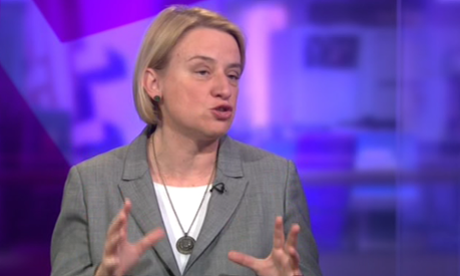
Bennett was asked if she hates the rich more than she loves the planet. In response, she referenced the book The Spirit Level, maintaining that in more equal societies, everybody, including the rich are better off. “We need the deal with the problems in our society,” she said.
Asked why the Green Party in Germany are doing better than the UK Green Party, Bennett said the UK’s first past the post system is “utterly bankrupt”, adding: “We’re offering a model of a different kind of Britain.”
Finally, Bennett denied the Green policy of freeing all caged farm animals would kill big farm businesses. “Factory farming is imposing massive externalised costs, such of antibiotics resistance”, she said. “We see around Europe real issues with nitrogen pollution. We can’t continue to bear those costs. We only have one planet.”
Updated
Sky News’ political editor Faisal Islam has tweeted a graph illustrating the dip in house building over the course of the last parliament.
1. Housing definitively now an election issue with clear party divides on approaches. But not simple right/left divides.
— Faisal Islam (@faisalislam) April 14, 2015
2. simply hasn't been honest self-appraisal of the five year house building record over past parliament. pic.twitter.com/Y0AHjjTVXG
— Faisal Islam (@faisalislam) April 14, 2015
3. double dip in GDP was revised away. But doubledip in house building definitively happened: why? pic.twitter.com/Y0AHjjTVXG
— Faisal Islam (@faisalislam) April 14, 2015
Michael Gove was just on Channel 4 News, where he emphasised that the Tories will be able to support people who go to work and want their children looked after, and make it easier for anyone who wants to own a home of their own.
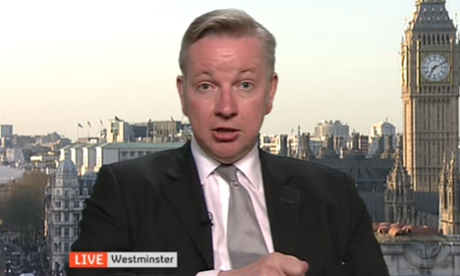
Jon Snow asked how the Conservatives plan to fund all their promises. Gove said “the sums are funded”. The Conservatives invested an extra £7bn in the NHS over the last parliament, and are investing an extra £2bn on top of that in this parliament, he said. “That’s coming from same trajectory we’ve set out.”
Snow brought up the incident of Boris Johnson saying last month that selling off housing association homes will involve massive subsidies. “Not true, Boris was today tweeting about how good and smart the policy was,” Gove said.
This has the stink of social cleansing, Snow said. You end up purging the city of the people who do the work on the ground because there is not enough low paid housing. Gove said this is wrong. They will build a home for every home sold, and there are currently properties in London owned by local authorities worth over a million pounds which should not be there for the wealthy.
Gove also refused to accept that the Tories would have to form a coalition and compromise on some of their promises. He said the legal cocktail of Labour and SNP would result in more taxes and borrowing.
Brilliant @Conservatives policy on the Right to Buy, and a good way of ensuring it is funded.
— Boris Johnson (@BorisJohnson) April 14, 2015
Updated
Though Ukip’s manifesto is not being launched till tomorrow, Ukip Northern Ireland have already released theirs, as my colleague Rowena Mason has spotted.
Ukip general election manifesto launch tomorrow but Ukip Northern Ireland seems to have jumped the gun slightly: https://t.co/9EO9ug3y3d
— Rowena Mason (@rowenamason) April 14, 2015
Meanwhile, the Lib Dem campaign bus has broken down in Brixton. Reports are in that this is due to an electrical fault.
Lib Dem battlebus appears to be broken down on Brixton Hill pic.twitter.com/67Cpw0erJi
— James Titcomb (@jamestitcomb) April 14, 2015
The stricken bus in south London. pic.twitter.com/LzS9EwpZUP
— David Hughes (@DavidHughesPA) April 14, 2015
Updated
Zac Goldsmith is still being asked if he will stand down as a PCC over his party’s ambiguous stance on Heathrow expansion. He says he wants journalists to stop being “spoon fed by a Lib Dem twerp”.
@paulwaugh Not what I said! You're allowing yourself to be spoon fed by a LibDem twerp. Green light for expansion = a byelection. Simple
— Zac Goldsmith (@ZacGoldsmith) April 14, 2015
Kim Rose, the Ukip parliamentary candidate who had to report to police over claims he tried to woo potential voters by handing out sausage rolls at a party event in which snooker star Jimmy White was invited to play pool, has been told he will face no further action. Rose, who is standing in Southampton Itchen in Hampshire, said:

The policeman phoned me up and said ‘Kim, I know you have done a lot of charity things, but you have entered the political world now - stay away from the sausage rolls.’
He told me not to give out any sausage rolls to anybody because if somebody makes a report they have to arrest me. Quite frankly, I’ve kept away from bakeries. If I see a bakery I walk the other way.
I’ve treated a couple of customers in the shop to coffee and a gingernut, but it was nothing to do with politics.
You couldn’t make it up.
Updated
But perhaps Labour should look a little closer to home in search of broken promises.
Fig A: The advertised hateful mug. Fig B: The actual hateful mug delivered. Another broken promise from @UKLabour pic.twitter.com/C7ov2hgY9I
— Huw Lemmey (@spitzenprodukte) April 14, 2015
Here’s a list of all of Nick Clegg’s broken promises, according to Labour:
Nick Clegg voted:
For an increase in VAT despite warning of a Tory ‘VAT bombshell’ and saying he had no plans to raise VAT.
For higher tuition fees despite promising to abolish them.
For a damaging top down reorganisation of the NHS despite saying that he would protect and improve the National Health Service.
For the Bedroom Tax despite saying he now wants to reform it.
Against a Mansion Tax even though he promised to introduce one in the 2010 Liberal Democrat manifesto and said he couldn’t understand why the Tories were against it.

The Labour Party has released a statement maintaining that the Lib Dems should not be trusted ahead of their manifesto launch tomorrow. Labour says Nick Clegg has voted against the Conservatives on fewer occasions than any other member of his party (nine times out of a possible 1239).
Lucy Powell, vice-chair of Labour’s general election campaign, said:
You can’t trust the Lib Dem manifesto. They have broken their promises and backed the Tories all the way.
Nick Clegg’s promises for the future are fundamentally undermined by his actions in government. He promised to scrap tuition fees and then trebled them. He promised not to increase VAT but then voted through a VAT rise on everyday working families. He promised to be on the side of working people, but working people are £1,600 a year worse off since the Lib Dems joined the Tories in government.
At every turn, Nick Clegg has been too weak to stand up to the Tories. Now we learn that Nick Clegg is the Lib Dem MP who has voted against the Government on the fewest occasions and that he voted with the Tories 97 per cent of the time.
On unqualified teachers, the disastrous NHS reorganisation and slashing Sure Start, Nick Clegg backed David Cameron over working people.
Updated
The Conservatives aren’t the only party making pledges about the BBC licence fee. The Green party wants to scrap the licence fee and fund the BBC through general taxation in a move its manifesto says would cost £1.6bn this year and £3.2bn a year for the remainder of the next parliament, my colleague Jasper Jackson reports. The manifesto commits the party to: “Maintain the BBC as the primary public service broadcaster, free of government interference, with funding guaranteed in real terms in statute to prevent government interference.”
Updated
Here’s chief executive of the Nuffield Trust Nigel Edwards’ statement on the Conservatives’ manifesto pledge to spend an extra £8bn on the NHS and provide a seven-day service in full:
Even with this additional money, the NHS will have to find unprecedented levels of efficiency savings within five years just to break even.
In this context it is difficult to see how all of the improvements set out in the manifesto would be affordable, however welcome they may be.
For instance, the party is absolutely right to aspire to seven-day access to NHS hospital and GP services by 2020. But providing a seven-day NHS service in hospitals will either mean big changes to the way services are run across the country or significantly more money.

Without further funding, seven-day hospital services will probably require centralisation, involving the downgrade and closures of local services such as emergency surgery or maternity units.
What’s more, seven-day GP working and an enhanced focus on prevention will mean spreading the already extremely strained primary care workforce even further.
It is hard to see how these changes could happen without extra funds that go beyond 8 billion minimum set out in the manifesto.
It would be useful to have had clarity on which of the these proposals were immediate priority improvements and which are contingent on an as yet unrealised long-term economic plan.
Richard Taunt, director of policy at think-tank the Health Foundation, also said the additional £8bn is the “absolute minimum” the NHS will need to cope with growing pressures over the next five years.
However, three areas need clarity - Where will the money come from? How will they pay for service improvements? How will they support the NHS to improve productivity?
We urge political parties making any funding commitment to explain exactly where they will find the money. In particular we would welcome clarity on whether this money will come from cuts in other department budgets, which could ultimately have an impact on the NHS.
And Chris Ham, chief executive of the King’s Fund, echoed these sentiments, pointing out that “with social care services under huge pressure, it is essential that increased spending on the NHS does not come at the expense of further cuts to social care budgets”. He added:
Following on from Labour’s wide-ranging vision for reforming the NHS, the Conservative Party’s election prescription offers a mixture of incremental change and practical initiatives to improve services for patients.
While commitments to pool budgets and integrate services locally are welcome, the manifesto is silent about the unprecedented challenges facing social care.
I’ve taken the quotes from the Press Association.
Updated
It’s a good thing David Cameron decided to present a more positive message today, as a new Comres/ITV poll shows that around half of Britons - 46% to be precise - think the Conservatives showed themselves to be the nasty party following defence secretary Michael Fallon’s personal attacks on Ed Miliband. In fact, 51% of Britons disagreed that Ed Miliband beating his brother to be leader of the Labour Party shows he has a bad moral character, with 23% agreeing. Below are some more polling results:
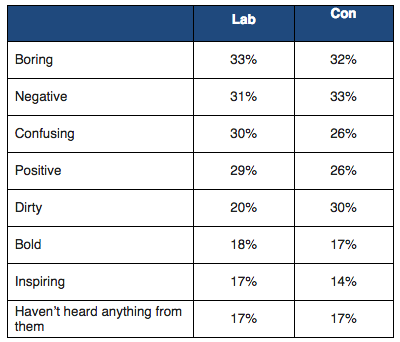
Q: In the past couple of weeks, how would you describe the election campaigns and what you have seen and heard from each of the following parties?
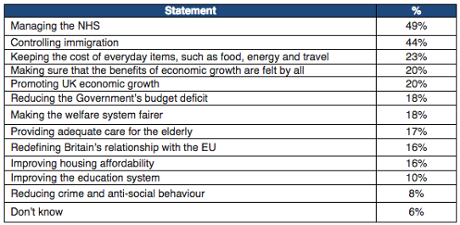
Q. Which of the following do you think should be the biggest priority for the Government at the present time?
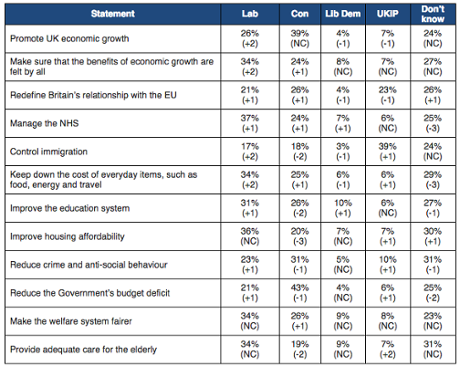
Q: Which party do you trust most to…
Q. In the past couple of weeks, how would you describe the election campaigns and what you have seen and heard from each of the following parties?
Q. Do you agree or disagree with the following statements?
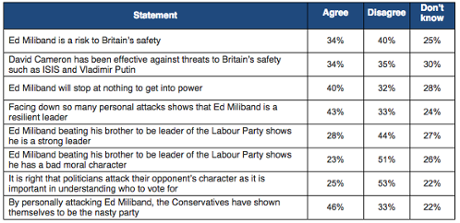
Findings worth noting: the Conservative campaign is more likely to be described as “dirty” than the Labour campaign (30% and 20% respectively), while both the Conservative and Labour campaigns are described as boring and negative by a third of Britons. Meanwhile, only 17% of Britons describe the Labour election campaign as ‘inspiring’, and only 14% of Britons say the same about the Conservative campaign.
Also, the NHS remains the biggest priority for Britons (49%) with immigration in second place on 44%. This means immigration has fallen as a priority by five points since January compared to the NHS, which is down one point.
Libby Brooks also reports that Scottish Conservative leader Ruth Davidson has responded to the Tories’ right to buy pledge, saying it will help a whole new generation of families to buy a home.
It’s worth remembering that the right to buy was abolished by the Scottish government last year, with the legislation coming into force in August 2016, so Cameron’s flagship policy has little traction north of the border.
Scottish Conservative leader Ruth Davidson described the move, driven by the SNP and Scottish Labour, as “hypocrisy of the worst kind”.
Davidson told the Guardian: “David Cameron’s announcement will not only see a whole new generation of families benefit from home ownership down south, but will also see millions of pounds flow to local authorities to build more affordable homes.
“In contrast, this time next year, families in Scotland will be banned from any similar kind of leg up. Helping people onto the property ladder is about encouraging aspiration and providing security for families. Banning it is simply big-state ideology.”
Campaigners are calling for Chamali Fernando, the Conservative parliamentary candidate for Cambridge, to stand down, after she said that mental health patients could wear colour-coded wristbands to identify their conditions, the Independent is reporting. During an event hosted by campaign group Keep Our NHS Public in Cambridge, Fernando said that wristbands which disclose a person’s illness could help barristers, such as herself, to better aid the public. She went on to suggest that a different coloured wristband for each mental health condition could improve the system. A petition has since been launched calling for Fernando to step down over her remarks.
Wristbands for those with mental health conditions has to be craziest policy I’ve heard - from @whereis007 pic.twitter.com/ljkRtfqdCR
— Richard Taylor (@RTaylorUK) April 13, 2015
Jim Murphy has strongly attacked the Tory manifesto pledge to extend EVEL to financial matters – “ including an English rate of Income Tax, when equivalent decisions have been devolved” - as “a brutal betrayal of Scotland and the Smith consensus,” my colleague Libby Brooks reports.
The Scottish Labour leader said: “With a single sentence in their manifesto the Tories have shown how little they understand Scotland”, suggesting that the proposal amounted “the official barring of Scottish Labour MPs from the UK budget.”
Describing it a “desperate and craven attempt to win over Ukip voters at the expense of the UK tax system”, Murphy said the proposal - which appears to imply to devolution of income tax to Wales and Northern Ireland too - was “short-term, divisive, unnecessary and it won’t work”.
Murphy warned that Scotland was now in danger of being caught “in a classic pincer movement” between the Tories and the SNP: “a Tory party that wants to cut Scotland out of the UK budget and the SNP that wants to cut Scotland out of UK taxes”.
“We now have a Tory party committed to an England only tax system and the SNP hell bent on Scotland only taxes.”
Hello, I’m taking over from Andrew Sparrow now. I’m on Twitter @nadiakhomami and I’ll be keeping an eye on your comments below the line as well, so get in touch if you think there’s something we should be covering but haven’t.

Some leading organisations have this afternoon cast doubt on some of the Conservatives’ manifesto policies. Health thinktank the Nuffield Trust has said it is difficult to see how the party’s pledges on health would be affordable. The Trust welcomed David Cameron’s proposals for a seven-day NHS, but said such a move would mean either “big changes” to how services are run or “significantly more money”, as the £8bn extra funding would only enable the NHS to “stand still”. The Trust’s chief executive Nigel Edwards said:
Seven-day GP working and an enhanced focus on prevention will mean spreading the already extremely strained primary care workforce even further. It is hard to see how these changes could happen without extra funds that go beyond £8bn minimum set out in the manifesto.

The Bar Council said the Tory justice pledge would be a “cold comfort” to those needing legal aid. Alistair MacDonald QC, Chairman of the Bar, pointed out that both the Conservatives and Labour have failed to commit to restoring access to justice for the hundreds of thousands of individuals and families left excluded by legal aid cuts.
The Conservatives have pledged to ‘continue to provide access to justice in an efficient way’. This promise is made by a party which, in government, passed legislation which massively reduced the scope of legal aid. Such a promise will therefore be cold comfort to a single parent battling for custody against an abusive partner, a retired person challenging their benefits payments or a person seriously injured in an accident at work or on the roads. In addition, recent hikes in court fees risk pricing parties, such as small businesses seeking to claim monies they are owed, out of justice.
However, today’s manifesto re-affirms plans to ensure that all publicly-funded advocates working on serious sexual offence cases receive specialist training, which we welcome. The legal profession has been working closely with the Coalition Government to develop this training and we hope to be able to take forward plans which have been under discussion.
Updated
Zac Goldsmith, the Conservative candidate in Richmond Park and campaigner against Heathrow expansion, has got back to me about the Lib Dem claim that he should stand down because the Conservative manifesto does not rule out Heathrow expansion. (See 4.11pm.) He said his Lib Dem opponent was “just being mischievous”.

That was not a pledge. That was me saying I would not want to stand on a manifesto that was ambiguous on this issue. And I would prefer not to. There are plenty of things in the manifesto that I do not like. And there are plenty of things that I do like. That’s what happens with manifestos.
My pledge on Heathrow was clear. From day one I have always used the same terminology; if my party does a U-turn on Heathrow, I will resign and trigger a byelection. Full stop.
That’s all from me, Andrew Sparrow, for today. My colleague Nadia Khomami is taking over now for the rest of the day.
Updated
A Conservative manifesto reading list
Here’s a Conservative manifesto reading list.
Inherited wealth is a huge factor in the concentration of property-wealth in ever fewer hands. This is what happens: middle-aged couple inherit large family home. They then sell it and reinvest the money in several buy-to-let properties, outbidding in the process several first time buyers who are as a result forced to rent a home instead ...
If the prime minister really wanted to encourage home-ownership he would be jacking up inheritance tax. If, on the other hand, he wants to champion the right to inherit wealth free of tax then he should stop talking about a great property-owning democracy. He cannot succeed at both policies simultaneously.
- The Newsnight rolling blog, which includes Allegra Stratton on the manifesto launch.
My view on the manifestos, now we have heard the two big ones: David Cameron didn’t meet the moment quite like Ed Miliband did - but his manifesto was meatier.
I think the childcare offer is very generous. I have covered childcare quite a bit and not heard people considering this kind of roll-out.
The Prime Minister’s speech was fluent and there was more foreign policy - Tories love suggesting Miliband vs Putin is risible.
But as one Tory source said to me at the launch afterwards: “Dave is very good at the bullet points, the shopping list, but less good at the grand sweep.”
-
The Prospect panel on the Tory manifesto, including this from YouGov’s Peter Kellner.
The Conservatives at the moment are trying to win back votes they have lost to Ukip, not just in the seats where Ukip are challenging them but in the Conservative/Labour marginals. If you look at the people who are typically drawn to Ukip they tend to be older, poorer and more likely to feel aggrieved that the Tories are perceived as the party of the rich. Their manifesto is essentially angled at two groups; older voters who have switched to Ukip, to whom the inheritance tax policy (to make family homes worth up to £1m exempt) will appeal in some seats; and young struggling families. The Tories have lost quite a lot of support among families, young mothers in particular, and policies such as the extension of “right to buy” home ownership and the offer of 30 hours free childcare per week might help them retrieve those votes.
In terms of political tactics these are smart moves, but my reservation is that both parties have left it a bit late to try and address their underlying weaknesses. They might have been wise to put their key manifesto policies out six months ago, as it is maybe too late now for them to make a big difference.
Latest map of the main leaders' campaign visits, for @pressassoc. Note how Miliband is focusing on northern England. pic.twitter.com/rLvKiF4XrC
— Ian Jones (@ian_a_jones) April 14, 2015
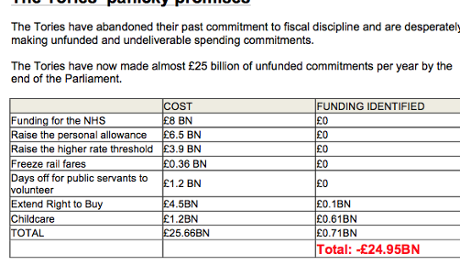
Labour claim Tory unfunded spending commitments worth almost £25bn
Any proper political news event demands a dossier, and today the Labour party have produced one, attacking the Conservative manifesto. Here it is (pdf). And here is the cover.
It quotes Paul Johnson, the Institute for Fiscal Studies director, saying the Tories have not explained where their cuts will fall (see 1.43pm) and it highlights the Conservatives’ refusal to rule out extending the scope of VAT (see 12.26pm).
But the main argument is that many Conservative promises are unfunded. They claim the Conservatives have made unfunded commitments worth almost £25bn.
The Lib Dem candidate in Richmond Park, Robin Meltzer, is calling for Zac Goldsmith to stand down as a Conservative candidate because the Conservative manifesto does not rule out Heathrow expansion.
Meltzer points out that Goldsmith said this in 2012.
I think if we enter the next election with a manifesto which does not rule out expansion of Heathrow I think the Conservative party will be very badly defeated in areas beneath the flight path.
I personally would not want to stand as a Conservative candidate on a manifesto that is ambiguous on this issue.
But today’s manifesto is ambiguous. It just says the party will respond to the report from Howad Davies commission on airport expansion when it reports after the election.
Meltzer said:
The Davies commission was established at the insistence of George Osborne and David Cameron in response to their critics in the business community who were demanding action on airport capacity.
The decision of the two party leaders to defer the publication until after the election was taken out of respect for the coalition agreement. The Liberal Democrats argued that the parties should seek a fresh electoral mandate opposing Heathrow expansion rather than allow the Davis Commission to pre-empt the outcome.
David Cameron and the pro-expansion Tories around George Osborne have used that as cover to end their one- Parliament flirtation with being an anti-Heathrow expansion party and this has left Zac Goldsmith outsmarted.
He should honour his interview with the BBC in 2012 and stand aside as the Conservative candidate – how can he possibly stand on a manifesto which goes completely against not only his own views on this matter but also what he assured residents would be the case?
Zac Goldsmith has utterly failed to influence his own party; this manifesto proves that they just do not listen to him. He would provide no break whatsoever on a Conservative majority government intent on expanding Heathrow airport. Only by having Liberal Democrat MPs in the next government can we continue to keep Heathrow expansion off the table.
I’ve asked Goldsmith for a comment, and will let you know what he says.
UPDATE AT 5.18PM: Zac Goldsmith has responded. See 5.18pm.
Updated
Here’s Harriet Harman, Labour’s deputy leader, on the Conservative manifesto.
There is nothing more dangerous to the NHS than saying you will protect it, without being able to say where the money will come from.
And their flaky election bribes from housing to childcare will leave working people paying the price in higher taxes. Their manifesto confirms that the Tories have £25bn of promises which they have no way of paying for, while refusing to rule out extending VAT to areas such as food and children clothes. That means higher taxes for every working person in this country.
Yesterday Labour showed that it was the party of change and the party of responsibility with a fully funded manifesto that does not require any extra borrowing. The Conservative manifesto today shows once again that working people can’t afford five more years of the Tories.

Labour launched its BAME (black, Asian, minority ethnic) manifesto today. Here’s the Guardian’s preview story. And this is from the Press Association.
Ed Miliband vowed to tackle the “scourge” of anti-Semitism and Islamophobia “head on” as he launched the party’s black and minority ethnic mini-manifesto.
The Labour leader said “huge advances” in equality had been made “but the work is not yet done” as he addressed an audience of Labour supporters in Leicester.
Black young people are twice as likely to be jobless while long-term unemployment has rocketed by nearly 50% under the coalition, according to Labour.
“We are a long way from the equality we need as a country,” Miliband said during the event at the City’s Peepul Centre.
“We are going to look at every aspect of the way government works. We are going to have a race equality strategy for every part of the way government works and we are going to look at those barriers and we are going to break them down.”
He added: “We need to confront the scourge of anti-Semitism and Islamophobia head on with strong action on hate crimes.
“For the first time ever we are going to make sure that when people commit hate crimes they are clearly marked on the criminal records of those who commit them. And, tough new sentencing guidelines which ensure aggravated criminal offences based on hate crime are properly dealt with by the courts.”
The party is fielding 52 black and minority ethnic candidates at the General Election.

Crisis, the homelessness charity, has criticised the Conservatives’ right to buy plan. This is from Jon Sparkes, its chief executive.
The proposed extension of right to buy is deeply worrying since it will mean a further decline in our already dwindling supply of affordable housing. This is not the way to tackle the housing crisis: we need more affordable housing not less.
The Lib Dems are pointing out that Boris Johnson, the Conservative mayor of London, expressed scepticism about extending the right to buy to housing association tenants only last month, at a mayor’s question time. He said:
If I may say so, obviously one of the issues with extending the right-to-buy to housing associations in the way that I think you are thinking of is that it would be potentially extremely costly to this body. We would have to make up the difference. Housing associations are private bodies, as we all know. It would involve massive subsidies. We would need to get the funds to support that.
You can watch it here. The key quotes comes at 17m 35s.
Lord Scriven, a Lib Dem election spokesman, said:
Boris Johnson has confirmed what we already expected - the Tories’ ‘Right to Buy’ announcement is yet another unfunded spending commitment from a party whose economic credibility is disappearing by the day.
Updated
Conservative election manifesto - Nicholas Watt's analysis
It is an open secret at Westminster that David Cameron has felt constrained by the rigid discipline - and dour nature - of the Tory election campaign drawn up by the campaign chief Lynton Crosby.
The prime minister finally broke out of the Crosby straightjacket in Swindon as he spoke repeatedly of how a future Conservative government would deliver the “good life”.
A series of clear offers - on child care, extension of the right to buy and a guarantee that workers on the minimum wage would be exempt from paying income tax - were designed to show there is light after five years of austerity.
Tory sources laughed off suggestions that they had grabbed a series of voter friendly policies off the shelf in response to a difficult week in which senior party figures complained that the party had become unremittingly negative. “You don’t just pluck a couple of billion off the shelf,” one senior Tory said, as the party made clear that the manifesto announcements were the results of months of thinking.
But the prime minister’s tone was markedly different to the language he deployed at launch of the Tory campaign in nearby Chippenham two weeks ago. Speaking a few hours after he had taken the rare step for a prime minister of criticising his opponent on the steps of Downing Street, Cameron highlighted what has been dubbed the “Crosbyisation” of the Tory party with his grim warnings of the “chaos” posed by Labour.
Wind forward two weeks and Crosby, who appeared to monitored the manifesto launch from London, was able to tick his campaign message boxes as Cameron dutifully delivered the dire warnings about Labour. But then it was back to the Sunny Dave who overtook David Davis in the 2005 Tory leadership contest as he adopted the tone of Ronald Reagan’s upbeat Morning in America.
“With five more years we can turn the good news in our economy into a good life for you and your family,” the prime minister said in some of his final remarks.
Sunny messages do not, however, come free as Labour has pointed out after working out that the Tories have racked up more than £20bn in unfunded spending commitments. This has led, as Gordon Brown’s former spin doctor Damian McBride has argued, to the curious spectacle of a governing party on the right spending at will and an opposition party on the left reining in its fiscal commitments.
George Osborne is convinced that the Tories have built up enough credibility over the last five years to give them the space to make generous, if unfunded, promises. Many Tories fear that the chancellor may have made one of the most deadly mistakes in politics - under estimating his opponents.
Lunchtime summary
- David Cameron has offered voters a fresh wave of election promises including 30 hours a week of free childcare for working families and scrapping tax on the minimum wage as he launched the Conservative party manifesto for “buccaneering Britain”. As Rowena Mason reports, the prime minister’s new pledges, which also include the right to buy housing association properties, appear designed to appeal to lower-income swing voters in the key seats that the Conservatives need to hold at the election. Cameron also surprisingly repeated the Conservative party “ambition” to bring down immigration to the tens of thousands rather than the hundreds of thousands, despite the clear failure of the party to meet this target over the last five years.

-
Cameron has accused Labour of failing to have a proper economic plan. Speaking at his manifesto launch, he said Labour could not say how much it would cut the deficit by, when it would eliminate the deficit, and much it would raise from tax rises and from spending cuts.
All our commitments are fully funded as part of our fiscal plan. That is the difference between the parties. They haven’t even reached, as it were, the foothills. They haven’t even got to base camp. In fact, I think they’re stuck at Gatwick trying to work out what sort of suncream to buy. They haven’t really done the work and they’ve had five years to do it. This is a total contrast.
He also claimed that a Labour government dependent on SNP support would be a “horror”.
- Housing experts have strongly criticised the Conservative plan to extend the right to buy to housing association tenants. For example, Shelter said this “would be yet another nail in the coffin for affordable housing”. (See 10.49am.) Ed Miliband said the policy was a deceit, because it was not properly funded. And Nick Clegg has described the policy as “a poor cover version of one of Margaret Thatcher’s 1980’s hits”. He went on: “I think it’s a measure of how the Conservatives have run out of new ideas”.
- The Conservatives have admitted that their plan to legislate to exclude people on the minimum wage from income tax will also benefit higher-rate tax payers. (See 1pm.)
-
Nursery providers have questioned the Conservative plan to give working parents 30 hours for free nursery care. Neil Leitch, chief executive of the Pre-school Learning Alliance, said:
Although in theory any steps taken to improve the availability of childcare are positive, we would seriously question how feasible this pledge is in practice. At the moment, government funding does not cover the cost of delivering 15 hours of childcare for three- and four-year olds, and so it has been left to providers and parents to make up the shortfall. It is difficult to see, therefore, how plans to double the current offer without addressing this historic underfunding can be implemented without leading to even higher childcare costs, or risking the sustainability of the sector altogether.
- The Green party has insisted its policies are both practical and fair as it formally launched a manifesto targeting the twin priorities of ending economic austerity and highlighting the environmental crisis. As Peter Walker reports, he party’s leader, Natalie Bennett, announcing the manifesto alongside its sole MP, Caroline Lucas, said voters could “transform British politics” by voting Green in sufficient numbers on 7 May. “This is a new kind of politics, the end of politics as usual, the business as usual politics that accepts politics and society being run for the benefit of the few, not the many,” she said.
-
Nicola Sturgeon has defended the SNP’s desire for an independent Scotland to belong to Nato even though it is opposed to nuclear weapons. Speaking on Radio 5 Live, she said:
During the referendum we said if Scotland was an independent country we would seek membership of Nato. I don’t agree that that is inconsistent with taking a non-nuclear position. Nato has got 28 member states at the moment and 25 of them don’t have nuclear weapons, so it’s actually normal within Nato for countries not to possess nuclear weapons.
-
The Office for National Statistics said inflation, as measured by the consumer prices index, held at zero in March, unchanged from February, - or fell marginally, if calculated to two decimal placed. As Katie Allen reports, statisticians said that if the change in March was calculated to two decimal places, then prices were 0.01% lower than a year before. This would be the first fall on record in consumer price inflation.
Updated
At a news conference earlier Patrick O’Flynn, Ukip’s economic spokesman, tried to play down the impact of a statement by Nigel Farage at the weekend suggesting Ukip supporters should vote tactically in seats where Ukip cannot win. Asked about the comment, O’Flynn said.
[Farage] simply recognised in some seats some voters may indulge in tactical voting.
Actually the seats he has in mind are places like Great Grimsby, Dudley North, Heywood and Middleton where, if you’re a previously Tory-inclined voter, you absolutely know if you vote Tory you’ll be helping Labour get into power - whereas if you vote Ukip, Ukip can win the seat and keep Labour out.
But as leader of Ukip and as the leadership team for Ukip, the message is 100% we support every Ukip candidate, we’re maximising the votes for every Ukip candidate in the country and we’re getting back fantastic reports about the reception people are getting even in some of the seats that weren’t our top targets - places like Mid Norfolk or Northamptonshire South. We’re right in the running, right in the mix.
An independent candidate will be on the ballot in Hampstead and Kilburn despite dying, the Press Association reports.
Former Eurovision contestant Ronnie Carroll has died days after successfully getting on the General Election ballot paper for Hampstead and Kilburn.
The independent candidate will stay on the ballot paper and the election will go ahead as normal without him.
The seat is the most marginal in England, won by Labour’s Glenda Jackson by just 42 votes in 2010.
Carroll, who was 80, was on the statement of nominations as “The Eurovisionary Carroll”. Sophy Dury and Bill Dury were listed as nominees for his candidacy.
He contested the 1962 and 1963 Eurovision Song Contest, making him the only Briton to compete two years running.
Carroll had contested elections before, winning 29 votes in the Haltemprice and Howden by-election - despite campaigning for a record score of 0.
Here is some more Twitter comment on the Conservative manifesto.
Raid on pension tax-breaks of high earners raises £2bn plus, of which £1bn for inheritance tax & rest for childcare #ConservativeManifesto
— Robert Peston (@Peston) April 14, 2015
Tory manifesto announces reintroduction of special Migration Fund in areas of high pressure on public services, abolished by Tories in 2010
— David Goodhart (@David_Goodhart) April 14, 2015
The Conservatives seem to think the main problem with the electoral register is that it doesn't have enough expats on it. (Manifesto p 49)
— David Boothroyd (@220_d_92_20) April 14, 2015
And this, on the Green manifesto, is worth noting.
The Green Party making their manifesto unsearchable is either genius way of avoiding scrutiny / great way of pissing off hacks.
— Jim Waterson (@jimwaterson) April 14, 2015

Expert analysis: health and social care
The Tories’ pledge to give the NHS the “at least an additional £8bn by 2020” demanded by NHS England boss Simon Stevens earned them positive coverage when it was unveiled last weekend, though George Osborne’s inability to identify exactly where the money would come from took some of the shine off. It also leaves Labour isolated as the only one of the three main parties not guaranteeing the money – a risky position which may yet produce discomfort for Ed Miliband. However, lots of extra dosh is in some ways the easiest NHS promise to make.
It will be much trickier to deliver the seven-day a week access to a GP between 8am and 8pm and, especially, to make England the first country in the world to provide the “truly 7-day NHS” the manifesto talks about. Such pledges make good soundbites. But serious NHS-wide staffing problems – the real shortages of GPs, nurses, radiologists, A&E doctors and many other types of health professionals – make them almost impossible to deliver.
In Pravda-esque fashion the manifesto also glosses over the fact that all the key NHS treatment waiting time targets have deteriorated sharply under the coalition. It offers no prospect of relief any time soon for an increasingly-overstretched NHS except backing Stevens’ Five Year Forward View blueprint to sort it all out by 2020 and hoping that further integration of health and social care also helps keep people out of hospital.
IFS says Tories gave 'absolutely no detail' on the 'really big cuts' they would make
Paul Johnson, the director of the Institute for Fiscal Studies, told Sky News that David Cameron provided “absolutely no detail” on the “really big cuts” they would make.
One thing the prime minister didn’t make too much of but did say, was that he was reaffirming a commitment to getting the overall budget into surplus by 2018. That implies something really dramatic - and we’re talking tens and tens of billions of pounds worth of spending cuts or tax increases even before you start to think about some of the promises that we’ve heard on the National Health Service, on increasing the personal tax allowance.

So what you got was a lot of the good stuff of course - more money for childcare, more money for the health service and so on - but absolutely no detail on the bad stuff, which is there’s going to have to continue to be really big cuts on welfare spending, really big cuts in local government spending, really big cuts in all the other bits of spending which haven’t been specifically protected.
Updated
Expert analysis: defence and security
Defence has traditionally been a Conservative strong point and David Cameron has set out to claim it once again, with the manifesto devoting much more space and detail to security than Labour’s. It sets out a whole host of commitments, from renewal of Trident to maintenance of the army at 82,000.
The problem is that, like Labour, the Conservatives refuse to commit to spending 2% of GDP on defence, instead opting only for vague wording that it is meeting the 2% target at present. This failure to make a 2% commitment almost certainly means severe defence cuts post-election and, given Cameron has said the army will not fall below 82,000, hard choices are going to be made at the Ministry of Defence.
On surveillance and intelligence - and also counter-terrorism - the manifesto seeks to position the Conservatives as the party that can be trusted with security, with Cameron explicitly suggesting that that the other parties cannot.
Here are two verdicts on David Cameron’s manifesto launch.
Cameron’s decision to break from his party’s narrow and negative script was undoubtedly the right one. The optimism and compassion that led some voters to believe he was a different kind of Conservative leader was on display today. But that it felt so novel was evidence of the opportunities the Tories have wasted to date.
One of the biggest surprises in the #ConservativeManifesto: not one but *five* mentions of the Big Society.
— Ian Jones (@ian_a_jones) April 14, 2015
Expert analysis: education and schools
It’s important to remember that the Conservative education proposals only affect England, although those affecting higher education – such as the visa clampdown on overseas students – have ramifications across the UK’s national boundaries and into the EU.
Of the policies affecting state schools, all had been announced ahead of the manifesto launch. The most recent was last week’s announcement that pupils who can’t reach appropriate levels in literacy and maths at the end of primary school will have to retake similar assessments in their first year at secondary school. It’s a policy that puzzles almost everyone in education. The obvious conclusion is that it allows a future Conservative government to claim to have reduced rates of illiteracy and innumeracy among 11-12 year olds.
Far and away the most important policy affecting schools is the pledge to maintain per pupil funding at its current level. This is one Conservative policy that could be more generous than Labour’s, if inflation remains low. But it will still mean very steep real term cuts of around 10% for all state schools, regardless, and the source of much pain in coming years.
For universities, Conservatives will keep the status quo that has stuffed their mouths with cash from £9,000 tuition fees. A future government will have to pick up that bill but in the meantime universities are in the midst of a building war to recruit undergraduates that will cause collateral damage of its own in the next decade.
Updated
The Conservatives say their plan to give working parents 30 hours of free childcare a week would cost £350m a year. But Labour claims it would cost £1.2bn.
Here’s today’s Guardian three-minute election video, with Jonathan Freedland and Polly Toynbee discussing the Tory manifesto launch.
It has been hard to find anyone in the housing sector with a good word to say for the Conservatives’ right to buy plan. But CCHQ have found someone.
CCHQ push comment from One Million Homes, org run by wife of Conservative MP Charlie Elphicke: http://t.co/jRJS5b0yVd pic.twitter.com/fSa5ar5jsH
— Jim Waterson (@jimwaterson) April 14, 2015
Expert analysis: energy and the environment
Onshore wind power has expanded significantly in the last five years, in the face of opposition from many shire Tories and 30% of the public. Ending new public subsidies and giving local people the final say will sharply cut new developments. But the manifesto also pledges “to cut [carbon] emissions as cost-effectively as possible” and onshore wind is the cheapest clean energy available. The manifesto firmly backs new nuclear and fracking as part of its energy plans.
Like halting wind farms, the free vote on hunting via a government bill will be popular in the shires. On banning the use of wild animals in circuses, critics say the Conservatives had ample opportunity to do this in the parliament. The “Blue Belt” to protect marine life around the UK and its overseas territories is new will be welcomed by conservation groups, though the last government established just 27 of the 127 marine conservation zones around England recommended by its consultation.
Finally, the manifesto pledges that “our public forests and woodland are kept in trust for the nation”. The last government abandoned an attempt to sell them off.

Updated
Conservatives offer working parents 30 hours of free childcare - Details

The Conservatives have also sent out more details of their promise to provide working parents with 30 hours of free childcare a week. Here is an excerpt from their briefing.
The new childcare offer will start in 2017. A Conservative government will start building capacity in the sector from this year, including capital funding for new nursery provision in schools. It will be available to all families where all parents work - even those who work part time. It will be additional to existing entitlements, including tax free childcare and universal credit. And the additional hours will save parents up to £2,500 a year - on top of the £2,500 they save from existing provision.
A Conservative government will increase the hourly funding rates paid to providers in different parts of the country, and will consult on the appropriate level and design of the uplift ...
The new offer of 30 hours free childcare will be available from 2017. It will be available where all parents in the household are working at least eight hours a week at the minimum wage.
The new 30 hours entitlement policy will cost just under £350 million a year once fully implemented. This will be paid for by reducing the tax relief on pension contributions for people earning more than £150,000.
Updated
Expert analysis: the economy
The document repeats George Osborne’s budget pledge for a fresh £30bn-worth of spending cuts over the next two years, and warns that “failing to control our debt would be more than an economic failing; it would be a moral failing”.
There follows a red book-style canter through various planned infrastructure projects (upgrading the A303, electrifying the Midland mainline), as well as promises to mount a Red Tape Challenge; maintain spending on science and technology; resist cutting public investment; and support the idea of powerful new city mayors.
Other pledges, such as helping businesses to create 2m new jobs, and encouraging firms to pay the Living Wage when they can afford it, are largely beyond the direct powers of government.
Rather than offering a smorgasbord of new economic policies, much of the Conservatives’ appeal in this area effectively rests on a claim that they will simply prove better managers than Labour: or as the manifesto puts it, “only the Conservatives have the vision, the optimism, the ambition and the discipline to transform Britain”.
Updated
Expert analysis: immigration, crime and justice
The only new home affairs policy is the promise of a new semi-custodial “short, sharp, spell” in jail to change the behaviour of prolific offenders. Even that carries strong echoes of Willie Whitelaw’s similar “short, sharp shock” for young offenders that he introduced 36 years ago.
As expected the manifesto keeps but downgrades the annual net migration target of “tens of thousands” to “an ambition” and “a priority”. The decision to downgrade perhaps finally recognises that Britain has been a country of high net migration for nearly 20 years now regardless of who is in power. Perhaps the most pernicious measure is to introduce an income threshold for the non-EU spouses of EU citizens living in Britain.
The civil liberties issues have been well trailed and will require a Conservative majority government to implement. The manifesto renews the commitment to scrap the Human Rights Act and replace it with a British bill of rights that will ‘break the formal link’ between the British courts and the European Court of Human Rights.
On counter-terrorism and extremism, there is a clear commitment to reintroduce the ‘snooper’s charter’ communications data bill and to introduce Theresa May’s measures to ban non-violent hate groups. However some key elements of May’s recent extremism speech outlining her wish list, such as new extremism officers in prisons, are missing.

Updated
Jim Murphy says that he is “absolutely” confident the Scottish Labour party remains in charge of decision-making in Scotland after a difficult 24 hours when senior shadow cabinet ministers appeared to publicly contradict his spending plans.
Insisting that he and the shadow chancellor Ed Balls in particular were “singing from the same hymn sheet”, Murphy denied that he was feeling bruised after yesterday’s events which saw Balls appear to contradict Murphy’s suggestion that there would be no further cuts in Scotland after 2015-16 under Labour in an interview on Radio 4’s Today programme.
Later, speaking on the Daily Politics, the shadow business secretary Chuka Umunna put it even more bluntly, stating: “The leader of the Scottish Labour party will not be in charge of the UK budget,” in what was interpreted as a direct rebuke to Murphy as Ed Miliband attempted to rebrand Labour at his mainfesto launch as the party o fiscal repsonsiblity.
Speaking after a campaign visit to a nursery near Cumbernauld, Murphy argued: “You’re comparing what Ed Balls did say and what I didn’t say. I’ve been clear from the beginning that we’ve got to make savings. Ed and I have both been very clear that we have to balance the books, but it isn’t all about cuts. It’s a different approach to how we run our economy.”
Asked how damaging these statements were following Murphy’s own efforts since his election to counter to charge made by his predecessor Johann Lamont that the Westminster party treated Scotland like “a branch office”, he replied: “People can say that, but look...the size of the budget is determined by the Labour party as a whole. How the money is spent in Scotland is a decision for the Scottish Labour party. When it comes to devolved policies on health and education you’ll see in our manifesto later in the week just how we’ll spend this money. That’s a decision for the Scottish Labour party and no one else.” He added that he was “absolutely” confident that this remains the case.

Last month YouGov ran a poll to find out whether people thought extending the right to buy to housing association tenants (the policy announced by the Conservatives today) last month. Some 39% of respondents said it was a bad idea, 34% said it was a good idea, and the rest did not have a view.
Here’s a link to the chart.
Extending right to buy top of Conservative agenda today, but it's not clear cut winner, even with their own voters: https://t.co/7DU1Fi5sMR
— Joe Twyman (@JoeTwyman) April 14, 2015
Higher earners will benefit from tax free minimum wage law, Tories admit
The Conservatives have sent out more details of their plan to ensure that people on the minimum wage do not have to pay income tax. They are going to call it the tax free minimum wage law.
Higher-rate tax payers could also benefit, according to the briefing note the party has issued. In fact, even though it is being pitched as a law for those on the minimum wage, you could equally describe it as an anti-fiscal drag law. It would be nice to see a distributional impact; it could turn out that Telegraph readers (who are obsessed by fiscal drag, if the paper’s coverage is anything to go by) could be the real beneficiaries.
Here is an extract from the Tory briefing.
This new law will be applied from the first budget after the general election. The change will update the 1977 ‘Rooker-Wise’ amendment which first forced governments to uprate tax thresholds in line with inflation, and will mean that the personal allowance will automatically be uprated each year in line with the minimum wage, rather than just inflation, meaning the personal allowance will increase more quickly.
Future governments will still be able to uprate the personal allowance at a slower rate if they choose to, but crucially the tax free minimum wage law would force them to put this to a vote in parliament and to score it explicitly as a tax rise in the budget ‘red book’. This will prevent future governments from using so-called ‘fiscal drag’ – the fact that wages tend to grow faster than prices – as a stealth tax. And of course future governments will be able to uprate the personal allowance more quickly than the minimum wage if they have a funded plan to do so.
The basic rate limit (the gap between the personal allowance and the higher rate Threshold) will continue to be automatically uprated with inflation, so that the full gains of faster personal allowance uprating will automatically be passed on to higher rate taxpayers.
As a result, the higher rate threshold at which people start paying 40p tax – which is equal to the personal allowance plus the basic rate limit – will automatically rise faster than inflation. Separately, the Conservatives have made a commitment to go even further on the higher rate threshold in the next parliament, increasing it to £50,000 by April 2020.
Expert analysis: business
From business reporter Sean Farrell:
The Conservatives want to show they don’t just represent the City when it comes to business. George Osborne’s pet project to connect up Northern cities is one such item.
Apprenticeships show the Tories care about the young and help for entrepreneurs helps shore up the small business vote.
Expert analysis: transport
There is plenty of detail on the improvements to railways to be delivered under a Conservative government: but virtually all of it is work already announced, under way or indeed nearing completion - more Network Rail’s project book than a political manifesto.
But the £15bn on new road schemes (already announced) could be targeted further by other parties should the Tories lose. The rail fare “freeze” pledge lasts an entire parliament rather than Labour’s solitary year, although for a “freeze” read an increase in line with RPI - a rate that has exceeded inflation as normally defined, as well as pay rises, during the last parliament.
There’s no further commitment on keeping down fuel duty for drivers, which motoring organisations had hoped for. And on the toxic question of a new runway in the South East, the Conservatives promise only to “respond” to the Airports commission that David Cameron established when it delivers its report.

Updated
Here is a Guardian video of David Cameron launching the Conservative manifesto.
Expert analysis: tax
The current minimum wage rises to £6.70 an hour from October 2015, which equates to £12,194 on a 35-hour week, or £13,936 for someone working 40 hours. This suggests that the Conservatives will have to bring forward their pledge to increase the personal allowance to £12,500 by 2020 - at a potentially huge cost.
Currently the personal allowance is set at £10,600, and raising it to £11,000 will alone cost £1.5bn, according to Treasury costings. There is some suggestion that the Conservatives are basing their pledge on a 30-hour working week for someone on minimum wage, which is neatly just below the £10,600 current personal allowance threshold.
But Cameron is careful to say that he is lifting more working people out of income tax. Most will still have to pay National Insurance, which is levied on incomes above £8,060 at a rate of 12%.
Critics also argue that the benefit of further increases in the personal allowance is largely taken by earners higher up the salary scale. Many part-time workers picking up less than £10,000 a year will see no benefit.
Updated
Labour says Tory right to buy plan could push up the cost of housing benefit by £3.7bn
Labour has sent out a briefing note about what it says are flaws in the Conservatives right to buy policy. (See 9.03am.)Here are the key points.
- Labour says the Tory plan would leave a £3.7bn black hole in Treasury finances. That is because councils would be selling homes with a social rent, and replacing them with homes with an affordable rent (which is more expensive). This could increase the housing benefit bill by £3.7bn, it says.
- It says government figures show only £100m was raised from council house sales last year - suggesting that the target of £4.5bn a year is unrealistic.
-
It says the Tories are wrong to say their £1bn brownfield regeneration fund could fund 400,000 new homes. That money would not even pay for the bricks for 400,000 homes, it says. (To be fair, the Tories are just talking about the £1bn “unlocking” the building of 400,000 new homes.
Lib Dems dismiss Tory manifesto as 'a short-term political con'
Here’s Danny Alexander, the Lib Dem chief secretary to the Treasury, on the Conservative manifesto.

This Tory manifesto is a short-term political con not a long-term economic plan – it keeps their massive cuts secret and their promises unfunded.
Their plans for finishing the job of deficit reduction solely on the backs of the poorest and by cutting public services reveal their true colours.
And that’s not all, the Conservatives are now embarking on an unfunded spending spree that would make even Gordon Brown shudder – which can only be paid for by even more cuts.
Updated
The Chartered Institute of Housing has launched a scathing attack on the Conservatives’ right to buy plans. This is from Gavin Smart, its deputy chief executive.
Extending right to buy to housing associations is not going to tackle the housing crisis – in fact it could make things worse for people on lower incomes who are already struggling to access a decent home at a price they can afford.
Individual tenants might benefit from the opportunity to own a home, but we would be very concerned that it would result in a dramatic loss of vital social and affordable housing. The Conservatives say that forcing councils to sell off their most valuable properties would fund this extension plus 400,000 new homes over five years – we fear the figures simply won’t stack up. And it could have a huge impact on councils’ ability to build new homes, particularly in more expensive areas like London and the south east, where it might actually make more sense for them to borrow against the value of these properties so they can fund more homes.
The Conservatives say each home sold under the extended right to buy would be replaced on a one-for-one basis – but we know this is not happening under the current scheme. Our research has shown that most authorities only expect to be able to replace half or fewer of the homes they sell under right to buy. And government figures show that between April 2012 and last September councils started or acquired 2,298 homes using right to buy receipts – just one for every 11 sold.
The Tory manifesto includes a commitment for a free vote on fox hunting.
Tory manifesto: " we will give parliament the opportunity to repeal the hunting act with a free vote"
— Andrew Sinclair (@andrewpolitics) April 14, 2015
Tory manifesto leaves open option of extending VAT, Labour says
Labour says the Conservative manifesto does not rule out extending the scope of VAT. It just says the Tories “commit to no increases in VAT, national insurance contributions or income tax”. Labour’s manifesto explicitly ruled out extending VAT to cover “food, children’s clothes, books, newspapers or public transport fares”, and Labour sources suggest the Tories are keeping this open as an option.
TUC says Tory plans will effectively outlaw strikes
The TUC says the Tory plans for tighter rules on strike ballots will effectively outlaw strikes. This is from Frances O’Grady, the TUC’s general secretary.
The Conservative plans on industrial action ballots will make it almost impossible for unions to call a legal strike. No other mainstream political party in the democratic world has suggested such a fundamental attack on this basic human right.
David Cameron has admitted that Britain needs a pay rise, but he wants to stop workers doing anything about it.
This is from Unions Together, the 14 unions that are affiliated to Labour.
Not a single mention of those on zero-hours, or those in low pay by David Cameron. Says it all #PartyOfTheRich pic.twitter.com/VtYEIwKrKh
— Unions Together (@unionstogether) April 14, 2015
For those interested in press conference management.
Somewhat perplexed as to why Tories don't trust journalists to hold microphone themselves when quizzing @David_Cameron at manifesto launch
— Rebecca Keating (@RebeccaKeating) April 14, 2015
Nick Robinson has the answer.
@RebeccaKeating @David_Cameron Old Downing Street trick. Stops follow ups
— Nick Robinson (@bbcnickrobinson) April 14, 2015
Here is Cameron’s speech as a wordle.
David Cameron's Tory manifesto speech pic.twitter.com/eOLL4Z7l7Z
— John Stevens (@johnestevens) April 14, 2015
Here is the Conservative manifesto (pdf).

Updated
Cameron is wrapping up now, he says.
Britain is on the brink of doing something special. Don’t let Labour wreck it, he says.
Q: You have been very clear on giveaways, but you are not saying any more about where the £12bn welfare cuts will come from. How can you be so clear about the nice stuff, but so vague about the nasty stuff?
Cameron says cutting the welfare budget is important. The other parties have not matched this.
He says the Tories have identified some measures, like freezing benefits and stopping young people getting housing benefit.
More generally, he says the Tories have set out their fiscal plans.
But Labour will not say how much they will borrow. They have not even reached basecamp.

Q: Housing experts say government has a terrible record at replacing homes sold through right to buy?
Cameron says this is a vital change. People criticised Thatcher’s policy. They were sitting in homes they owned saying other people should not have the right to buy their own home.
Under this policy, homes would be replaced at both ends. Councils would have to sell off expensive homes, so that would generate the revenue to build more homes. In London there was an example of a council home being sold, and raising enough money to build 12. And housing association homes that are sold will have to be replaced.
Updated
Q: You were expecting to be further ahead at this stage. Do you accept that you underestimated Ed Miliband?

Cameron says he believes the only poll that counts is the one on polling day. But he could point you to the poll in today’s Guardian showing the Tories six points ahead - if he could find it, he jokes (implying we buried it).
Updated
.@jameschappers asks what in this manifesto will attract back those flirting w UKIP. Speech was certainly not focused on immigration or EU
— Anushka Asthana (@SkyAnushka) April 14, 2015
Q: Do you think Ukip voters are coming home to the Conservative party? And what is in this manifesto for them?
Cameron says there is a choice for people at this election.
He says Labour has not learnt anything from the last five years. Their manifesto gives them the leeway to borrow too much again. And it won’t take many prods form Nicola Sturgeon and Alex Salmond to get them to do this.
Q: Are you saying Ed Miliband is a threat to security?
Cameron says there will be tough decisions to be taken, and voters need certainty.
For example, you need four Trident submarines. Labour cannot say that. You need four to have one on patrol at all times. What happens if you don’t have one? You can’t buy one on eBay.
Labour do not always put the needs of the intelligence services first, he says.
Q: In January in parliament you said unfunded commitments could wreck the NHS. So why have you made an £8bn unfunded commitment?
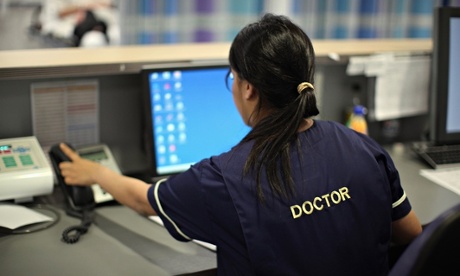
Cameron says his promise is funded as part of the Conservatives’ economic plan. The Tories have a “clear and balanced” plan. Labour does not.
It cannot say how much it will cut the deficit by, when it will eliminate the deficit, and much it wants to come from tax rises and from spending cuts.
Labour have not even reached basecamp. They are still at Gatwick.
Updated
Q: People see the Conservatives as the party of the rich. Isn’t it a bit late to portray yourself as the party of working people?
Cameron says he has a track record going back over the whole parliament of measures that help working people.
Labour has attacked every single saving, and every single welfare reform. But now they say they support cuts. That is “incredible”, he says.
The manifesto is a “detailed blueprint for the future”, he says.
Q: Why doesn’t the manifesto commit to spending 2% of GDP on defence?
Cameron says the manifesto makes various commitments, such as renewing Trident, not reducing the size of the armed forces, and an £160bn, inflation-busting equipment budget.
As for other matters, they will be decided later.
Yet Labour has offered total silence on this, he says.
Labour has written a thin manifesto. The SNP will produce a more detailed list, that they will try to impose on Labour.
If you want to stop the “horror” of that, you have to vote Conservative, he says.
Cameron says Labour’s “death-bed conversion” to fiscal responsibility is unconvincing.
Cameron's Q&A

Q: [From the Guardian’s Nicholas Watt] All this mention of the Good Life, is this a return to the sunny Cameron of pre-2010? And do you see you and Samantha as the Tom and Barbara, or Margot and Jerry?
Cameron says he will leave that last one to Samantha.
He wants to finish the job he started, he says.
Updated
So after a tight-lipped austere Labour manifesto, a Tory one stuffed with goodies & promises. World turned upside down...
— Andrew Marr (@AndrewMarr9) April 14, 2015
Very Aristotelian from Cameron, keeps talking about the things that make up the 'good life'
— James Forsyth (@JGForsyth) April 14, 2015
The Good Life manifesto. #Cameron #GE2015 pic.twitter.com/AvyPNWUhef
— Stephen Khan (@StephenKhan) April 14, 2015
Cameron says he loves his country with all his heart.
Five years ago he asked the electorate to allow him to save the country from ruin.
Now he is asking for five more years to be allowed to finish the job, he says.
Let us finish what we’ve begun, he says.
Cameron says Tories will legislate to ensure minimum wage not covered by income tax
Cameron says the Tories are committed to raising the income tax allowance to £12,500 by 2020.
But today he can announce a further pledge.
As the minimum wage goes up, the income tax allowance will go up too, he says.
The Tories will legislate for that.
That will guarantee that people on the minimum wage do not pay income tax.
Yes, the tax-free minimum wage under the Conservatives.
Cameron says this is similar to the Rooker-Wise amendment (named after two Labour MPs) that guaranteed that benefits would rise with inflation.
It shows the Tories are not just the party of no income tax, he says. They are the party of no income tax, he says.
Updated
Cameron says Tories will offer parents 30 hours per week of free childcare
Cameron says raising a family should not be a permanent struggle with the bills.
Childcare costs are the key issue for many parents.
The government has already made childcare tax free.
Today it will go further - a lot further.
Using money from cuts to pension tax relief for the rich, the Tories will offer 30 hours of free childcare to parents. That is worth £5,000, he says.
Updated
Cameron says Tories committed to 'property-owning democracy'
Cameron says he wants to take more people out of income tax, to raise the higher rate, and to open more schools.
And there are three new commitments in the manifesto, he says.
Having a good life is about having a home of your own.
That is why the Conservatives have been committed to a property owning democracy for decades.
He is now setting out details of the help to buy plan (see 9.03am) and to create a £1bn brownfield regeneration fund, designed to unlock the construction of 400,000 new homes.

Cameron says he did not come into politics to be some kind of accountant.
He wants to give people a better chance in life.
For him, the best moments of the last five years have not been summits. They have been the meetings with people getting the keys to their own home, or getting a job.
That is why the next five years are more important than the last five years.
Having put the economy on its feet, it is now time to finish the job, he says, and give people the chance of a better life.
Updated
Cameron says economic security is at the heart of almost everything.
By 2018 the Tories will be running a surplus, he says.
We have had over 2m apprentices. We will have 3m more, he says. And 50,000 more start-up loans for businesses, because it is businesses that create jobs.
The Tories will build an northern powerhouse, he says.
Striking that @David_Cameron stresses what he sees as existential threat from IS
— Robert Peston (@Peston) April 14, 2015
Really long ISIS section Cameron's speech. Doing a "The phone goes off in the middle of the night. Who do you want picking up?" pitch.
— Conor Pope (@Conorpope) April 14, 2015
Cameron says Tories will not risk Britain's security
Cameron says the Tories will hold an EU referendum.
Strong leadership is not denying people a choice, he says.
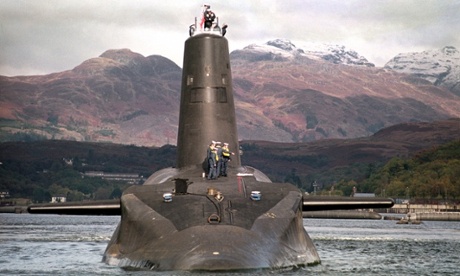
And there is a choice to renew Trident. The Tories want not three submarines, but four. It is the ultimate insurance policy.
The manifesto also offers proposals to combat extremism, and stop people joining Islamic State.
The Tories would give the security services the power they need.
Other parties are wary of giving offence, and upsetting those concerned about civil liberties.
But, he says, he has met the relatives of terrorist victims. He has had to make the judgment calls. And the Conservative party will not risk the nation’s security, he says.
Updated
Cameron says security matters more than anything else.
He has helped go after Islamic State, and he has led the drive to impose sanctions on Russia.
He pays tribute to “our brilliant, brave armed forces”.

Cameron says it is a matter of leadership. And he sees that around the cabinet table. When people said we should change course economically, George Osborne said no. When people opposed her plans, Theresa May said no and did not give in. And when he was urged to ditch his welfare reform plans, Iain Duncan Smith said no too.
That is why the Conservatives can offer competence, not chaos.
Updated
Cameron says the Conservatives have put the country on solid ground, and laid solid foundations.
But the next five years are about building on that foundation, he says.
Britain should be a country where a good life is there for everyone willing to work for it.
It is the “bright light in the North Sea that has exceeded expectations, decade after decade, century after century”.
Britain has the people to overturn what is inevitable. It is a “buccaneering, can-do country” and it can do it all over again.
That is what he means when he says we are on the brink of something special, he says.
So don’t let Labour drag us back to square one.
The photographers go bananas as Cameron holds up manifesto. This scene will probably be on your front pages tomorrow. pic.twitter.com/7mD1CDEstM
— BuzzFeed UK Politics (@BuzzFeedUKPol) April 14, 2015
Updated
David Cameron says Tories are the 'real party of working people'
David Cameron is speaking now.

He says they are at a technical college conceived and raised under the government.
At the heart of the manifesto is a simple proposition: we are the party of working people, offering you security at every stage of your life, he says.
The Conservatives are “the real party of working people in our country today”.
Updated
May says she has watched David Cameron take difficult decisions over the last five years. She says there is no one better placed to take the decisions to keep Britain safe.

Updated
Political Scrapbook, a leftwing website, isn’t impressed.
Could Tory manifesto sound any more Big Brother? "We have a plan for every stage of your life". Ugh. (via @paulwaugh) pic.twitter.com/x4vqUXNiEb
— Political Scrapbook (@PSbook) April 14, 2015
Iain Martin, a conservative commentator, agrees.
Tory manifesto: "We have a plan for every stage of your life." Isn't that the Chinese Communist party?
— Iain Martin (@iainmartin1) April 14, 2015
Updated

Theresa May, the home secretary, is speaking at the Conservative manifesto launch now. She says she has excluded more hate preachers than any other home secretary.
This manifesto launch is a cabinet relay. Osborne hands over to Theresa May
— Isabel Hardman (@IsabelHardman) April 14, 2015
Conservative manifesto - early highlights
Here are some early highlights from the Tory manifesto. Journalists have only had it in their hands for a few minutes.
Tory manifesto promises an English 'veto over English-only matters, including on income tax'
— James Forsyth (@JGForsyth) April 14, 2015
So that's clear then. Veto for English MPs @Conservatives pic.twitter.com/dajlied6cS
— Nicholas Watt (@nicholaswatt) April 14, 2015
Tory manifesto promises new law to ensure that no one working 30 hours on the minimum wage pays income tax.
— George Eaton (@georgeeaton) April 14, 2015
Tory manifesto includes promise of a new law so that the tax threshold automatically rises with the minimum wage pic.twitter.com/yXmguhrlLA
— Jack Blanchard (@Jack_Blanchard_) April 14, 2015
Tory manifesto says Tory government will develop a strategy to 'tackle the infiltration of extremists into our schools and public services'
— James Forsyth (@JGForsyth) April 14, 2015
Tory manifesto contains 30 hours free childcare and tax free minimum wage. Doesn't contain any mention of how they pay for tax cuts #GE2015
— Jason Beattie (@JBeattieMirror) April 14, 2015
Tory manifesto promises to "end any new public subsidy" for onshore wind and give public final say on turbine applications
— Rowena Mason (@rowenamason) April 14, 2015
Tory manifesto admits David Cameron has broken his promise on immigration. Now officially downgraded to an "ambition" pic.twitter.com/z2QE2EfsqP
— Jack Blanchard (@Jack_Blanchard_) April 14, 2015
Updated
And here's the full Tory manifesto summary pic.twitter.com/3JguTIItBS
— Paul Waugh (@paulwaugh) April 14, 2015
George Osborne is speaking at the launch now.

Updated
Here is an extract from the video being shown at the launch.
Conservative manifesto launch
Nicky Morgan, the education secretary, is speaking at the Conservative manifesto launch.
She says the manifesto offers ideas for the next generation.
Updated
JLL, a property management company, has criticised the Conservatives right to buy plan. This is from Adam Challis, its head of residential research.
The expansion of right-to-buy may be good politics, but represents terrible policy. This is exactly the kind of short-termist thinking that the countries’ 4.7m households in social housing don’t need, not to mention the same number again of aspiring owners in private renting. Right to Buy benefits a select few while condemning the vast majority to longer waiting lists and fewer choices. At a time when we are building barely half the homes this country needs, we need a government that is interested in genuine solutions to the housing crisis rather than cheap vote-winners.
The press seats are rubbish. How am I supposed to take a hot Vine from here? pic.twitter.com/BDLfMFkQED
— Jamie Ross (@JamieRoss7) April 14, 2015
The Conservative manifesto launch is about to start. My colleague Marina Hyde is there.
A lot of reactolite sunglasses at the Tory manifesto launch. When I get to the bottom of this, so will you.
— Marina Hyde (@MarinaHyde) April 14, 2015
Good news. The BBC’s Andrew Marr joined Twitter yesterday.
Stop press. Palaeolithic hack surrenders, joins Twitter
— Andrew Marr (@AndrewMarr9) April 13, 2015
Except I shouldn't have said'stop press' obviously
— Andrew Marr (@AndrewMarr9) April 13, 2015
And he has been tweeting about the Conservatives’ right to buy plans.
Housing association right to buy: losers are those not yet in social housing – younger, poorer... And less likely to vote
— Andrew Marr (@AndrewMarr9) April 14, 2015
Shelter says Tory plan is 'another nail in the coffin' for affordable housing
Shelter, the housing charity, has also condemned the Tory plan. This is from its chief executive, Campbell Robb.
This would be yet another nail in the coffin for affordable housing. We have already seen an outright failure to replace like for like the homes sold under right to buy, with only one new affordable home built for every five sold.
Extending the scheme to housing associations may benefit a lucky few, but does little to help the millions of private renters struggling to cope with sky high housing costs and instability. And, with the current track record, will mean there’s even fewer affordable homes left for future generations.
At a time when more and more people are struggling to find an affordable place to live, the next government’s priority has to be building more affordable homes, not selling off the few we have left.
The New Local Government Network, a local government thinktank, is also opposed to the Conservative policy. This is from its director, Simon Parker.
Forcing councils to sell-off their highest value properties is simply bad policy. Money should not be taken from hard-strapped local authorities to fund a central pot to compensate housing associations for the Conservatives’ decision to introduce Right to Buy with high discounts to their tenants.
National Housing Federation says Tory right to buy policy is 'deeply unfair'
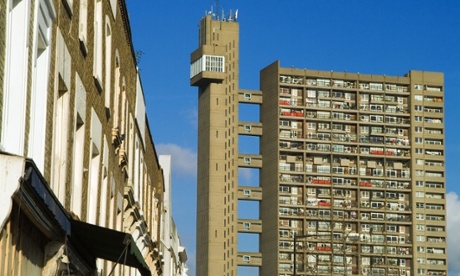
The National Housing Federation has strongly criticsed the Conservatives right to buy proposal. This is from Ruth Davison, its director of policy.
While extending Right to Buy will see some people being able to buy their own home with help from the taxpayer, these are people already living in good secure homes on some of the country’s cheapest rents. It won’t help the millions of people in private rented homes who are desperate to buy but have no hope of doing so, nor the three million adult children living with their parents because they can’t afford to rent or buy. To use public assets to gift over £100,000 to someone already living in a good quality home is deeply unfair. Little wonder then that 60% of the public believe that it would be unfair for social housing tenants to get a discount to buy their home while private renters do not.
Beyond questions of fairness, the public simply don’t buy that it will help people struggling with their housing costs. Just 16% think extending Right to Buy to housing associations is good way to tackle the affordability crisis, in comparison to 46% who want the Government to give more public money to housing associations and councils to build more affordable homes that will benefit more people.
Housing associations are private social enterprises that exist for the benefit of the community, who already build homes of all types – for sale, private and social rent and shared ownership. As well as depriving future generations of decent affordable housing, the Conservative party are planning to raise £17.5 billion over the life of the next parliament from the sale of high value properties to fund the discount - no paltry sum in times of austerity and figure that could grow into the tens of billions as more become eligible. This £17.5 billion is enough to finance nearly one million new shared ownership homes open to everyone, not just the lucky few already well housed in secure social homes.
Updated
My colleague Jill Treanor has been at the Grant Thornton business hustings this morning. She has sent me some of the highlights.

- Vince Cable, the Liberal Democrat business secretary, highlighted an economic indicator - sales of vans - to defend the coalition’s track record. These are 30 year highs, he said, showing that progress is being made in the path from rescue to recovery.
- Chuka Umunna, shadow business secretary, quickly attempted to allay concerns by business leaders that a new Labour government would destabilise the prospects for business. He told business leaders gathered at the British Museum that he believed in “continuity where ever possible, change where absolutely necessary” as he set out Labour’s opposition to leaving the European Union.
- Nick Boles - standing in for Matt Hancock - for the Conservatives said some “big global corporations are taking the mickey” in relation to tax avoidance. To the audience of accountants and business bosses he suggested they ask a nurse before adopting a tax avoidance strategy. If she gets angry then you probably shouldn’t do it, he said.
- Cable said entrepreneurship was completely destroyed by big companies paying little tax and highlighted the tax evasion strategies by HSBC’s Swiss division was “unacceptable”. The next government would look for ways to clamp down on such practices.
-
Umunna said that, to understand the risk posed by an in/out referendum on the EU, you had to take risks in the markets at the time of the Scottish referendum and multiply it by 10. He said, though, that while the EU was popular with business it was less so on the doorstep.
Updated
Bennett says the Greens would halve the support for private pensions. At the moment they are costing the government a huge amount, she says.
And that’s it. The press conference is over. They seemed very keen to wrap it up quickly.
Bennett says her manifesto represents a model for “an end to Thatcherism”.
And she says they have not handed out printed copies of the manifesto because they are the Green party, and it’s available on the website.
Updated
Green party Q&A
Q: What cuts would you accept?
Lucas says the Greens would support cuts in Trident, or in the road building programme.
But cuts to the welfare budget would be unacceptable, she says.
Bennett says the disabled have been very badly hit by this government.
She says it is hard to say what the Greens would or would not do in a hung parliament at this stage.
Updated
Here is the Green manifesto in full (pdf).
And here is a mini version (pdf).
Lucas says the Greens would not support a Conservative government. But they would consider supporting a Labour government on a case-by-case basis.
Caroline Lucas, the Green’s first MP, is speaking now.
She says tackling climate change is not a luxury that can only be tackled in the good times. It is a necessity. But it is also an amazing opportunity. Who would not want to live in a home that is always warm and dry.
Around 9,000 people a year die because they cannot afford to heat their home. That is a national scandal, she says.
Cold homes cost the NHS £1.3bn a year. And 2m children are growing up in cold homes. but over the last two years home insulation programmes have fallen by 80%.
The Greens are proposing a huge home insulation programme, she says. This would create 100,000 jobs. For every £1 spend on home insulation, the economy benefits by £1.27, she says.
Bennett says she was the only leader in the leaders’ debate to talk about climate change. The others could not even find time for those two words.
She says we have the politics we do because voters feel pushed by first-past-the-post into choosing the lesser of two evils.
But on May 7 the chance for real change is in voters hand.
If they vote for what they believe in, they can create a “peaceful, political revolution”.
Natalie Bennett promoting the 'Green surge'. Says party now has 59,000 members. More than Ukip or the Lib Dems. pic.twitter.com/D2YMwylfYf
— Ned Simons (@nedsimons) April 14, 2015

Bennett says privatisation has meant the cutting of pay, and of the quality of services. And it has meant profits being shovelled into private hands.
The Green proposing bringing the railways back into public hands, she says.
Updated
Bennett says the Greens are the only party to say the minimum wage should immediately be lifted to the level of the living wage. And it should reach £10 an hour by 2020, she says.
Updated
Bennett says in 2010 around 1 in 100 voter chose the Greens. Now it is around 1 in 20.
It is the party’s first election as a parliamentary party, she says.
Green party manifesto launch
Natalie Bennett, the Green party leader, is now speaking at the Green manifesto launch.
No one in the world’s sixth richest country should fear not being able to put food on the table, she says.
She says Green politics accept the physical limits of our natural world.
This is the end of business as usual politics, she says.
The Greens propose the end of “the disastrous policy of austerity”.
Updated
And here is some of the most interesting Twitter reaction I’ve seen to the Conservative right to buy plan.
From the Daily Mirror’s Kevin Maguire
Why not extend discounted "Right to Buy" to tenants of private landlords? Govt doesn't own all Housing Association properties
— Kevin Maguire (@Kevin_Maguire) April 14, 2015
From the FT’s Giles Wilkes
No one in my timeline is defending Right To Buy. More sign of my liberal bias. I clearly don't follow enough misanthropic lunatics
— Giles Wilkes (@Gilesyb) April 14, 2015
From the FT’s John McDermott
Since I'm in a generous mood, one thing to u/s about the #righttobuy "policy": it's really two policies. 1. RTB for HA tenants [1/2]
— John McDermott (@johnpmcdermott) April 14, 2015
And 2. Selling off more expensive council homes, as per this report: http://t.co/8yblTzmsx0. One could have one without the other. [2/2]
— John McDermott (@johnpmcdermott) April 14, 2015
From Anthony Painter
HA right-to-buy is in the category 'pub chat idea' rather than 'manifesto pledge'. Labour should be careful of being dismissive though.
— Anthony Painter (@anthonypainter) April 14, 2015
From Declan Gaffney
Selling off the family silver is embarrassing, but selling off someone else's family silver verges on the disreputable. #righttobuy
— Declan Gaffney (@djmgaffneyw4) April 14, 2015
From the Times’s Michael Savage
What does new RTB do to social mix of cities? Better-off buy up in wealthy areas, new social housing built in (cheaper) poorer ones? #GE2015
— Michael Savage (@michaelsavage) April 14, 2015
From Labour’s David Lammy, a potential candidate for London mayor
Tory Right to Buy extension might be good politics but it's awful policy. UK's 10 mill private renters cast further adrift & deserve better
— David Lammy (@DavidLammy) April 14, 2015
From Chris Bryant, the shadow culture minister
Before anyone gets excited about RTB, average number of families claiming right to buy each year under Cameron has fallen by two thirds
— Chris Bryant 2015 (@ChrisBryant4MP) April 14, 2015
From Tim Montgomerie, the ConservativeHome founder
The right-to-buy policy needs a housebuilding policy alongside it - otherwise it repeats the errors of the 1980s http://t.co/I42Lz13b8f
— Tim Montgomerie ن (@montie) April 14, 2015
From Nick Faith, the former communications chief at Policy Exchange, the centre-right thinktank
Extending Right to Buy has support among leading Labour thinkers - read @frankfieldteam piece from 2012. http://t.co/QZBoikeWwB
— Nick Faith (@nickfaith82) April 14, 2015
From Gavin Barwell, who is seeking re-election as a Conservative MP
Twitter full of Labour types opposing Right to Buy for housing association tenants. They want you dependant on the state for your housing
— Gavin Barwell (@BackBarwell) April 14, 2015
Here are two blogs about the Conservative right to buy plan that are worth reading.
The first thing to say is that this is profligacy on a scale that is reckless beyond imagination. Any suggestion that there is a shred of prudence in this is impossible to sustain.
Nor can there be any pretence that there is any logic to this plan. If Thatcher’s plan was to boost private ownership and a private rental market when the state was dominating the supply of rental property it was a poorly reasoned logic, but at least there was some logic to it. Now there is none: it is social housing that is in desperately short supply and this policy will simply deny opportunity to millions who need it in the future.
Third, the random largesse of this plan is offensive. I am in favour of redistribution of wealth but not random redistribution.
It is estimated that one third of ex-council homes sold since 1980 are now in the hands of private landlords who are able to charge much higher rents, often supported by housing benefit, than the former social rents. Coincidentally, more than one quarter of Tory MPs are private landlords.
Senior Tories like Iain Duncan Smith, who a couple of months ago floated the idea of gifting social homes to tenants who moved into employment, are the most ardent advocates of forcing housing associations to offer their homes for sale to tenants at large discounts – perhaps around £30,000.
Yet as commentators have pointed out, the government is on dodgy legal ground by extending the Right to Buy to housing associations since they are independent housing agencies and not part of the state housing apparatus. Despite receiving considerable state subsidies since 1974, housing associations now raise most of their funding for new housing from the private financial sector. This was supported by the Thatcher, Major and Blair governments since it kept this substantial housing investment off the national balance sheet as borrowing.

I’ve just arrived at the venue for the Greens’ manifesto launch, due to begin imminently (though, by the emptiness of the room it might take a bit longer). No sign yet of Natalie Bannett and Caroline Lucas, who will be jointly hosting.
It’s at the Arcola, a fantastic community theatre in Dalston, east London. For all the talk of the Green surge, from memory the room this launch is taking place in doesn’t seen any bigger than the one where I saw their 2010 event. Only about half a dozen media here so far.
And it’s certainly more relaxed than events connected to the major parties. Rather than having to go through endless security checks I wandered in from the street and was immediately handed a press release and directed to the trays of pastries. No one even asked me what paper I was from.
The manifesto itself has been heavily trailed and contains few immediate surprises, emphasising the Greens’ modern twin arguments about an end to austerity and a more sustainable economy.
Updated
Going back to the Ashcroft poll, here are the results, with seats listed according to where they are on this list of Labour target seats compiled by Lewis Baston for Progress last year (pdf).
Ashcroft polled 10 seats held by the Conservatives
These are the Labour gains.
Milton Keynes South (69th)
Crewe and Nantwich (86th)
Finchley and Golders Green (89th)
And these are the ones the poll suggests the Conservatives will hold.
Harlow (81st)
Dover (75th)
Dudley South (74th)
North East Somerset (72nd)
Cleethorpes (71st)
Ashcroft also found two seats tied: Rossendale and Darwen (70th), and South Ribble (77th).
Updated
Newsnight’s Allegra Stratton has more on who might benefit from the Conservative plan to make it easier for housing association tenants to buy their home.
Newsnight Index @chrishanretty has crunched census data re RTB. Housing Assoc tenants less likely to vote Tory than priv renters, right now
— Allegra Stratton (@BBCAllegra) April 14, 2015
Top 5 seats w housing assoc: Hackney South + Shoreditch Liverpool, West Derby; Poplar + Limehouse Liverp'l, Walton Liverp'l, Riverside
— Allegra Stratton (@BBCAllegra) April 14, 2015
So, according to @chrishanretty this does appear to be a raid into Labour's territory
— Allegra Stratton (@BBCAllegra) April 14, 2015
YouGov poll gives Labour a 1-pt lead
Here are today’s YouGov polling figures.
Update: Lab lead at 1 - Latest YouGov / The Sun results 13th Apr - Con 33%, Lab 34%, LD 8%, UKIP 13%, GRN 6%; APP -12 http://t.co/kZOXSRm341
— YouGov (@YouGov) April 14, 2015
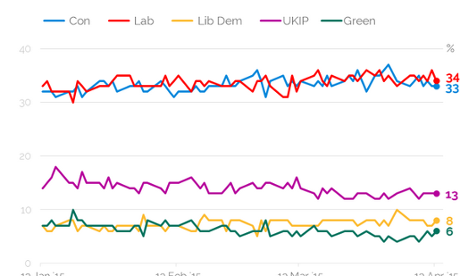
Here is the front cover of the Conservative manifesto
This is the cover of our manifesto. At its heart is a simple proposition: security at every stage of your life. pic.twitter.com/qOQxJGAndo
— David Cameron (@David_Cameron) April 14, 2015
And here’s Newsnight’s Allegra Stratton’s take on it.
Notes on Tory front page: 3 potential successors (Javid, May, Osborne); perfect gender split: 3 + 3. Featuring the BACK of Osborne's head.
— Allegra Stratton (@BBCAllegra) April 14, 2015
Guardian seat projection suggests Labour and SNP on course for a majority
The latest Guardian projection has the combined Labour and SNP share of seats on 326. This is an all time high in our daily series - and more significantly: it’s a majority.
Meanwhile the combined Tory-Lib Dem share has dropped below 300 seats, and even by coopting all possible sources of support (Ukip’s four seats and the DUP’s nine), David Cameron is - as things stand - well short of the bare minimum he would need to win a confidence vote in parliament.
This follows the release of Lord Ashcroft’s latest batch of constituency polls, in 10 marginals that hadn’t been polled before.
As with previous constituency polling there isn’t a clear pattern, and the overall swing across all the seats is broadly in line with national polls.
However, in none of the three seats where Labour is ahead (and would gain from the Conservatives) - Crewe and Nantwich, Finchley and Golders Green, and Milton Keynes South - was the gain implied by a uniform national swing (UNS).
This of course means that there are other seats in the Ashcroft list where the Tories lead and would hold - and the margin from Labour in some of these is greater than that implied by a UNS.
But the factor to consider about all of these seats is this: they are all Conservative-held constituencies, and for each one the Tories lose to Labour, they need to make two gains elsewhere.
As the election rapidly nears, Cameron’s possible paths to remain in Downing Street are getting narrower by the day.
Updated
Richard Coles, the Radio 4 Saturday Live presenter and vicar, has used Twitter to condemn the Tory right to buy plan as a “right to steal”.
So a Housing Association, like @WHOMES_HR on whose board I sit, goes to the market, raises finance, does deals with contractors and...(1/3)
— Richard Coles (@RevRichardColes) April 14, 2015
....builds urgently needed units for people to live in at social rents and then the government forces us to sell them off at a 35%...(2/3)
— Richard Coles (@RevRichardColes) April 14, 2015
.... discount. That's #righttobuy ? Sounds like Right to Steal to me.
— Richard Coles (@RevRichardColes) April 14, 2015
Libby Brooks has filed more on the fallout from yesterday’s mini Labour spat, when Scottish leader Jim Murphy was seemingly slapped down by business secretary Chuka Umunna over the party’s spending plans.
I’ll be asking Jim Murphy for clarification of his claim that Scotland would not face cuts under a Labour government after a bruising day for the Scottish Labour leader yesterday when this position was rejected publicly by senior members of the shadow cabinet including Ed Balls and Chuka Umunna.
Scottish Labour told the Guardian it did not want to discuss Umunna’s comments and last night it was revealed that Murphy had turned down an interview request from STV’s flagship politics show Scotland Tonight to discuss the confusion.
Overnight, Murphy’s opponents have continued to pile in as Westminster colleagues - unwittingly or otherwise - reinforced the narrative that Scottish Labour is little more than a “branch office” of the main party which Murphy has tried so hard to counter over recent months.
Scottish Conservative leader Ruth Davidson joined in the criticism, saying Murphy had “had the rug pulled from under his feet by a panicking and shambolic party which seems to have given up on Scotland”, providing the Scottish Mail with their splash this morning.
Tomorrow's Scottish Daily Mail: Labour accused of abandoning Scotland to the SNP. #tomorrowspaperstoday #GE2015 pic.twitter.com/bvAt1dwGsv
— Alan Roden (@AlanRoden) April 13, 2015
Updated
Nicola Sturgeon, the SNP leader and Scottish first minister, is taking part in a phone-in on Radio 5 Live.
Nicola Sturgeon is taking your questions now on Your Call. You can listen here: http://t.co/gvlkGDms7N @bbc5live
— John Pienaar (@JPonpolitics) April 14, 2015
I will not be covering it in full, but I’m listening to it and will post the highlights.
Updated
Conservative right to buy plans - Full details
This is what the Conservatives are saying about their right to buy plan in their briefing note for journalists.
Under the reinvigorated Right to Buy, local authority tenants who have been a public sector tenant for over five years are currently eligible to buy their home. Tenants in houses get a 35% discount, increasing by 1% for every extra year you have been a public sector tenant. Tenants in flats get a 50% discount which goes up 2% every year. Discounts for both houses and flats are currently capped at the lower of 70% or £102,700 in London and £77,000 across the rest of England. This summer the qualifying period for Right to Buy will be reduced from five years to three. There are some housing association tenants who have a “preserved” Right to Buy. These tenants live in houses which were local authority owned, but transferred to a housing association while they were living there.
There are around 800,000 housing association tenants who have a limited ‘Right to Acquire’ created by the 1996 Housing Act. Maximum discounts for those who currently have only the Right to Acquire are capped at between £9,000 to £16,000, depending on area, meaning most tenants can’t afford to buy, and sales are extremely limited. A Conservative government will give them the full Right to Buy discount. There are also around 500,000 housing association tenants who currently lack any right to buy their own home. A Conservative government will legislate to give them a Right to Buy. government will fund the extension of the Right to Buy, allowing the replacement of stock bought by tenants with new affordable housing on a one for one basis. This will increase the construction of affordable housing, delivering a knock-on benefit to the economy from higher house building, and expand the overall stock of housing.
Funding
A Conservative government will legislate to require local authorities to manage their housing assets more efficiently, by selling off expensive properties – only when they become vacant – which will then be replaced with normal affordable housing. Local authority properties that rank among the most expensive third of all properties of that type in their area - including private housing - will be sold off and replaced with new affordable housing on a one for one basis. But this will only happen as they fall vacant. Nobody will be forced to move.
Around 15,000 local authority properties which meet these criteria fall vacant each year. These homes will be sold and replaced with normal affordable housing. This will affect around 0.4 % of all affordable housing in England each year, or four in every thousand homes.
In total there are over 210,000 local authority properties which meet these criteria, or around 5.2% of all affordable housing in England. The sale of these properties would raise £4.5 billion a year. This would be re-invested in paying off local authority debts held against the sold expensive housing, replacing sold stock with new affordable housing on a one for one basis, extending the Right to Buy, and creating the Brownfield Regeneration Fund. Government will consult on and whether to cap expensive properties by region or by smaller housing market areas.
Lib Dems say Tory right to buy plan would only benefit 'the lucky few'
And this is what the Lib Dems are saying about the Tory right to buy plan. It’s a statement from Brian Paddick, a Lib Dem election spokesman.
This proposal will lead to longer waiting lists for homes and fewer social houses.
It does nothing to tackle the country’s affordable housing needs and will only benefit the lucky few.
Independent estimates suggest this could cost at least £5.8bn, nowhere near covered by forcing councils to sell off yet more housing stock, as the Conservatives suggest. That means it will have to be paid for by even more cuts hitting the most vulnerable in society.
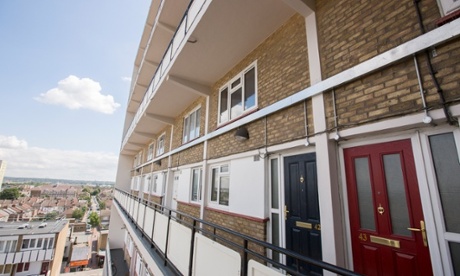
Updated
Labour says Tory right to buy plan is 'uncosted, unfunded and unbelievable'
Labour has dismissed the Conservative right to buy proposal as “uncosted, unfunded and unbelievable”. This is from Emma Reynolds, the shadow housing minister.
This is yet another uncosted, unfunded and unbelievable announcement from the Tories.
Having exhausted the magic money tree, the Tories now want people to believe that they can magic up billions of pounds a year from selling off a few council homes. Last year that raised just over £100m, while this policy costs £4.5bn a year.
Under David Cameron home ownership is at its lowest point for three decades – there are over 200,000 fewer home owners since 2010.
Labour will help people own their own home, that’s why we support Right to Buy. But in the 21st Century that means building homes and not forgetting the vast majority of people that want to buy their own home but currently rent privately or live with their parents.
Labour’s manifesto set out a better plan for all local first time buyers to get priority access to homes built. We will ensure Britain builds the homes working people need, getting at least 200,000 homes built a year by 2020, backed by a comprehensive plan - the first in a generation - and a £5bn Future Homes Fund to support the building of homes for first time buyers.
Updated
Good morning. I’m taking over from Mark.
Lord Ashcroft has published 10 new polls from marginal constituencies. They are all Conservative-held seats. The figures show the Tories on course to hold five, Labour on course to gain three, and two tied.
The swings vary from a 7.5% Conservative to Labour swing, in Crewe and Nantwich, to a 3.5% Labour to Conservative swing, in North East Somerset.
Updated
Here’s a snapshot of some of the Twitter commentariat’s view on the Tories’ resurrection of right to buy:
The @Conservatives flagship manifesto policy on right-to-buy is on offer only in England - housing policy devolved in Wales etc
— David Cornock (@davidcornock) April 14, 2015
On right to buy replacement home pledge, Shelter say 26,184 social rented homes sold through RtB since it was revived, only 2,712 replaced
— Ross Hawkins (@rosschawkins) April 14, 2015
Govt says 200k affordable houses built in total; doesn't mean homes won't be replaced, does mean cd be delay between sale & build
— Ross Hawkins (@rosschawkins) April 14, 2015
Housing Associations would need compensation for any loss incurred by sales under #rightobuy between £5 and £20bn - Ruth Davison #r4today
— Jamie Angus (@grvlx001) April 14, 2015
I understand Labour concerns about Tory RTB policy. Problem is, it sounds like they don't want people to own their own homes.
— Craig Woodhouse (@craigawoodhouse) April 14, 2015
Theresa May defends Tories' personal attacks on Miliband
My colleague Damien Gayle has been listening in to Theresa May’s appearances on the TV and radio this morning, where she has been defending the Conservatives’ much-criticised strategy of calling Ed Miliband a backstabber.

Piers Morgan backed the home secretary into a corner on ITV’s Good Morning Britain by presenting her with a clip of her speech in 2002 when she warned that the Tories were in danger of being thought of as the “nasty party”.
May said: “I think it’s important for people to look at the characters and the track record of the two people they have got to choose between. There is a very clear choice between David Cameron and Ed Miliband.”
May said that when the issues involved were as important as national defence and the update of Britain’s Trident nuclear weapons programme “the character of the individual who is actually at the top of government is an important issue, particularly when you are looking at an issue like the nuclear deterrent.”
Pushed as to whether she personally believed Miliband was a backstabber, the home secretary replied: “Yes.”
May was on much more comfortable ground when discussing the flagship Tory policy of extending right to buy to housing association properties, reeling off a string of prepared answers which she reprised minutes later on Sky News.
Updated
More of what Lucas told the Today programme has popped up on the Press Association, filling in the gaps in my earlier post.

Lucas said the party wanted to tackle the cold homes crisis and have a free nationwide retrofit insulation programme, concentrating on areas where fuel poverty was most serious.
“We believe that if we invest in insulating people’s homes we can get their fuel bills down on a permanent basis, so we are not just talking about the short-term fuel freeze that the Labour party supports - we want to properly get fuel bills down permanently, but it would also get our climate change emissions down and it would also create hundreds of thousands of jobs.”
The coalition government, she said, had a “woeful record” on energy insulation, adding that over the last two years the number of energy efficiency measures being installed in UK homes had fallen by 80%.
Her party, she said, wanted an end to austerity, adding: “We don’t believe that yet more public spending cuts is the best way out of the economic crisis that we face.”
Updated
Caroline Lucas interviewed on Today
I just caught the tail end of the Green MP Caroline Lucas’s interview on the Today programme.
Lucas was asked on what basis the Greens would support a Tory or Labour government. She said the party would not back a Tory budget under any circumstances, but it could deal with Labour on a case-by-case basis.
Pressed on what kind of spending cuts the party might sanction, Lucas said it would back a Labour government in ditching its road-building programme, Trident, or HS2.
Asked if she would characterise the party as libertarian, Lucas said that labels were not helpful, but that the Greens were committed to redistribution, social justice and recognised that we have finite resources.
.@Carolinelucas rules out backing Conservative budget & says will deal with Labour on ‘case-by-case’ basis #GE2015 pic.twitter.com/STGUCWKimX
— BBC Radio 4 Today (@BBCr4today) April 14, 2015
Updated
The Guardian’s Scotland reporter Libby Brooks has sent this note on what Labour and the SNP will be campaigning on today.
SNP leader Nicola Sturgeon is campaigning in New Lanark today, arguing that the launch of the Tories’ “cuts manifesto” across the border underlines why Scotland needs an SNP alternative.
“People in Scotland have always known to expect harsh, ideological cuts from the Tories – and today’s cuts manifesto is likely to be more of the same. But that Labour have been so quick to meekly fall into line with George Osborne’s plans just goes to show how far they have moved away from their roots.
“People in Scotland are crying out for a real alternative to another five years of cuts which are punishing the working poor and vulnerable people – and the SNP is the only party committed to putting an end to austerity.”
As talk of tactical voting continues to dominate the election debate in Scotland, Liberal Democrat leader Willie Rennie will be campaigning in Pittenweem, Fife, where he will accuse the Tories of “talking up” the SNP, suggesting that it might suit the Conservatives if the SNP took seats from his party and from Labour.
But, as David Cameron launches his manifesto down south, Ruth Davidson will insist her party is only interested in winning votes for its own candidates.

Updated
Morning briefing
Hello and welcome to the the Guardian’s election live blog on Tuesday 14 April. Every day until the UK goes to the polls on 7 May, we are blogging from 7am until late to bring you the latest news, reaction, analysis, pictures, video – and hell yeah, maybe even some funny stuff – from the campaign trail.
I’m Mark Smith, a web news editor, and I’ll be with you until the Guardian’s king of political blogging Andrew Sparrow cranks up his liveblogging machinery later this morning. We’re on Twitter (@marksmith174 and @AndrewSparrow), and reading your comments below the line.
We’re now in the teeth of manifesto launch week, and after the Labour launch yesterday, today focus shifts to the Conservatives and the Greens.
The big picture

On Manifesto Monday Labour unveiled its promise to the voters in Manchester, where a confident Ed Miliband declared he was ready to serve as prime minister and sought to portray Labour as the party of fiscal responsibility.
Miliband’s key promise was to unveil a “Budget Responsibility Lock” to reassure voters that Labour understands the need to stabilise the public finances. He said a Labour government would cut the deficit in every year and national debt would fall as a surplus is delivered on the current budget “as soon as possible in the next parliament”.
The Labour leader’s powerful and passionate pitch was almost unanimously well-received – even among his most ardent critics in the press. But the party will have been disappointed at a Guardian/ICM poll that showed the Tories taking a surprise six-point lead over Labour.
(The Guardian’s data editor Alberto Nardelli has explained why differing methods of measuring voter intentions – the ICM poll for the Guardian was done over the phone, rather than online – throw up different outcomes.)
- For a full summary of all yesterday’s political and campaign news, click here.
The big issue

Today it’s the Conservatives’ time in the sun (and Sun). David Cameron will attempt to kick some life into the Tory campaign by resurrecting Margaret Thatcher’s working-class vote-winner – the “right to buy”. His unabashed extension of the scheme for 1.3m families in housing association properties will be at the centre of an aspirational manifesto that will be officially launched in the West Country at 11am.
Cameron will say:
Conservatives have dreamed of building a property-owning democracy for generations. The next Conservative government will extend the right to buy to all housing association tenants in this country. So this generation of Conservatives can proudly say it: the dream of a property-owning democracy is alive — and we will fulfil it.
Fraser Nelson in the Spectator, argues that caution is a luxury that David Cameron cannot afford and extending right-to-buy is his “big bazooka” to grasp C1 and C2 voters:
In theory, this policy will give 1.3 million households a very good reason to vote Tory – if they can get their head around the policy in time. There are only three-and-a-bit weeks to go until polling day. Cameron will need to start explaining and selling the policy immediately: he has very little time to lose.
There are 2.5 million housing association homes, of which 1.3 million have tenants who have lived there for three years or more so would qualify for right-to-buy when it comes into affect in April 2016. And yes, this would cost – but it’d be funded by forcing councils to flog 15,000 of their priciest homes each year as they become vacant: £4.5bn a year and £18bn over a five-year parliament. The idea is to raise enough cash to build a new house for every one sold – but this time remembering not to concentrate social housing in deprived parts of town.

Today’s diary
Here are the main things on this blog’s radar today:
- Theresa May, the home secretary, is doing the rounds on radio and TV early this morning, including BBC Breakfast at 7.10am and Radio 4’s Today programme at 8.10am, to talk up the Tory manifesto
- 8.30am: Ukip is hosting a media briefing entitled “Protecting our green and pleasant land” in London
- 10am: The Green party launches its manifesto in Dalston, east London
- 11am: The Conservative party launches its manifesto in Swindon, Wiltshire
- 11am: Scottish Labour leader Jim Murphy is campaigning in Cumbernauld
Not many parties launch their manifesto in Dalston, but then not many parties are like the Greens so a plugette for @LovingDalston.
— Patrick Wintour (@patrickwintour) April 14, 2015
Must reads
Matthew d’Ancona, in the Guardian, says today’s Conservative manifesto is the last chance for the Tories to give voters a stake in Britain.
If they hang on to power, it will be in a manner remote from Thatcher’s victory 28 years ago. Not a single MP, nor the most fervent of activists, expects a majority of 102. What the Tories are seeking is enough voters who, whatever their feelings about Cameron personally or the party generally, believe they have a stake in the recovery and – crucially – what a Conservative-led government would do with it.
Rachel Sylvester, writing in the Times (paywall), says the Tories desperately need a positive song to sing.
David Cameron will today publish the Conservative manifesto but even before the party’s programme for government has been set out, the internal rows and recriminations have begun. The prime minister’s buzzword will be “security” as he promises to make the Tories the “party of working people”. There will be pledges on childcare, the NHS and housing as he attempts to make his election pitch more positive.
On the campaign trail, though, the mood is one of insecurity about the party’s failure to make a consistent breakthrough in the polls. With just over three weeks till polling day, anxiety is turning into anger about a negative and unimaginative message that candidates say is backfiring on the doorstep.
Polly Toynbee on why voters could be forgiven for being puzzled by the party manifestos – the Tories and Labour have swapped clothes.
As ack-ack fire strafes the election skies, some policies fly and others crash to earth. That Tory inheritance tax promise lost its wings within hours, as the Institute for Fiscal Studies (IFS) showed only the richest would gain and 90% of families would get nothing. The three days off work to volunteer went into a tailspin as no minister could say how those days of missing nurses or teachers could be paid for. The Tory manifesto tomorrow has been redesigned to soften its image, if not the content of its hard-edged spending cuts, while Labour moves the other way, toughening up its tone on fiscal responsibility. Neutralise your negatives: that’s the aerial war game.
If today were a song …
… it would be Our House, by Madness.
Our house, in the middle of our street
Our house, in the middle of our ...
I remember way back then when everything was true and when
We would have such a very good time such a fine time
Such a happy time
And I remember how we’d play simply waste the day away
Then we’d say nothing would come between us two dreamers
Non-election news story of the moment
The perjury trial of Andy Coulson, David Cameron’s former director of communications, has been pushed back until after the election. The case was due to start at the high court in Edinburgh on 21 April, but on Monday the Judiciary of Scotland announced a new start date of 11 May.
Updated