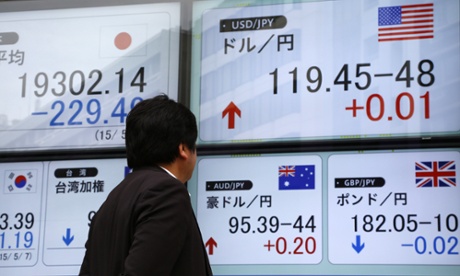
Has “fallout Friday” come early? As the queues form outside polling stations up and down the country, share prices have already fallen sharply, with the FTSE 100 down more than 100 points, and sterling lower against the dollar and the euro. Are traders already getting cold feet about the idea of a prolonged period of post-election uncertainty?
The answer is, mostly, no: and it matters, because in 2010 both the Conservatives and the Liberal Democrats used the threat of financial market turmoil, and a potential buyers’ strike by bondholders, to justify an “emergency” coalition, whose raison d’etre was to tackle the deficit.
It’s absolutely true that financial markets hate uncertainty, and this general election has bucketloads. But the turmoil has roiled markets from Mumbai to Frankfurt – where the yields, or interest rates, on German government bonds have shot up.
Janet Yellen, the Federal Reserve chairman, mused on Wednesday night that share prices might be a wee bit too high; global oil prices have jumped, raising doubts about the pace of world economic growth; and Greece is still trying to negotiate its way out of bankruptcy by Monday. That’s plenty for City traders to chew over, even before the ballot boxes are closed.