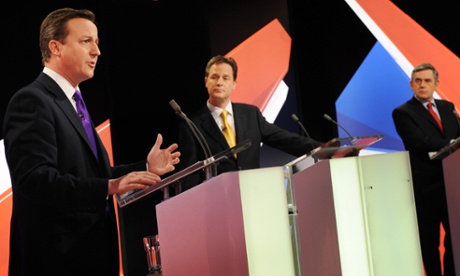
If any event between now and election day is to break the polling deadlock, it is most likely to be one of the TV debates that will take place over the next four weeks.
Five years ago, the impact of the first debate was substantial, as the shortlived phenomenon known as Cleggmania swept the nation. Britain agreed with Nick. Some people even went as far as asking if Clegg was Britain’s Obama.
The Lib Dems were polling at 20% before the debate (see graphic below); after it, ICM recorded a 10-point jump for Clegg’s party. David Cameron’s Conservatives fell from 37% to 33% after the debate, and Gordon Brown’s Labour from 31% to 28%.
But three weeks later, on election day, the Lib Dems won only 23% of the vote, just three points more than before the first debate. The Tories won 36% – down one from the pre-debate poll – while Labour ended up on 29%, off two percentage points.
Overall, based on these figures alone, the debates were not earth-changing events. However, this time could be different.
The 2015 debates will add greater uncertainty to the campaign
So why could the debates that kick off on Thursday with the Cameron and Miliband interview and Q&A actually make a difference?
First, most of the events that excite the imagination of commentators don’t reach large parts of the public. In the week ending 20 March, fewer than one in three voters noticed stories about the budget, according to polling by Populus.
Top Ten Most Noticed news stories this week #TTMN | #Budget2015 most noticed news of the week pic.twitter.com/EDUh3gS7tO
— Populus (@PopulusPolls) March 20, 2015
The previous week only 6% noticed announcements about the TV debates.
Top Ten Most Noticed news stories this week #TTMN | Fracas involving Top Gear presenter Jeremy Clarkson most noticed pic.twitter.com/E3GKEuq5Yq
— Populus (@PopulusPolls) March 13, 2015
Even fewer noticed the debate about the debates.
But millions will watch this year’s debates if 2010’s figures are anything to go by. Many will get acquainted with the leaders of the smaller parties for the first time.
Second, the election is close. Labour and the Conservatives are effectively tied in the polls, and, according to the Guardian’s latest polling projection, a handful of results could determine which of the main parties gains the upper hand.
Thedata from 2010 shows us that the debates did generate real movement in the polling, even if much of that was erased by the day of the election.
That explains why Cameron is so keen not to have any debates close to polling day – having them some distance out arguably reduces any risk of him performing badly and suddenly falling in the polls.
In an election that is closely fought and involves a large number of parties, even small movements like those in 2010 could be sufficient to influence the overall outcome of the vote on 7 May.