The election on the front pages
Election coverage forms the basis for the front pages of a number of Wednesday’s papers, which are coming in now.
The Daily Telegraph splashes on a letter signed by 100 business leaders backing the Conservatives and warning that a Labour victory would threaten Britain’s economic recovery.
Wednesday's Telegraph front page: 100 business chiefs: Labour threatens Britain's recovery #tomorrowspaperstoday pic.twitter.com/ZpgEOdZIAo
— Nick Sutton (@suttonnick) March 31, 2015
The Financial Times reports that Ed Miliband will announce plans on Wednesday that would, in effect, outlaw most zero-hours contracts.
Wednesday's FT front page: Miliband puts clampdown on zero-hours at heart of policy #tomorrowspaperstoday #bbcpapers pic.twitter.com/9ZJLu7FXVJ
— Nick Sutton (@suttonnick) March 31, 2015
The Times reports, in a secondary story on its front page, that George Osborne is braced for an economic update shortly before the election that could show that the economic recovery is slowing.
Wednesday's Times front page: Schools fear Easter terror exodus #tomorrowspaperstoday #bbcpapers pic.twitter.com/HHd6YwkxvD
— Nick Sutton (@suttonnick) March 31, 2015
Evening Summary
The second day of the general election campaign got off to a boisterous start today as David Cameron appeared on several breakfast shows to outline his proposals for a future government. This set the cogs in motion for a day of non-stop clashes over over who will spend, cut, borrow, and even lie the most should they get elected to power.
The big picture
This morning, Cameron announced that his party would create 2 billion new jobs in the next parliament. He claimed that his coalition government created 1,000 jobs per day - a claim that was dissected by my colleague Angela Monaghan - and will continue to do so over the next five years.
Here he is in Sainsbury’s HQ, where, he said, 480 jobs are being created.

What happened today
- Cameron’s claim that he would create 2 billion new jobs in the next parliament was based on the assumption that job creation would continue at the same pace as the previous parliament. This belief was challenged by union leaders, with Frances O’Grady, the TUC general secretary, stating:
It is hard to see how the Conservatives will create an additional two million jobs over the course of the next parliament. Imposing savage spending cuts on the public sector will suck demand out of the economy and make hundreds of thousands of public servants redundant.
- New figures released today showed that growth has been revised upwards, that consumer confidence is at a 12-year high and that disposable income has reached pre-cash levels. While the Tories took this as a sign that their approach is working, Labour maintained that what we should be talking about is living standards, which working people feel have deteriorated under the coalition.
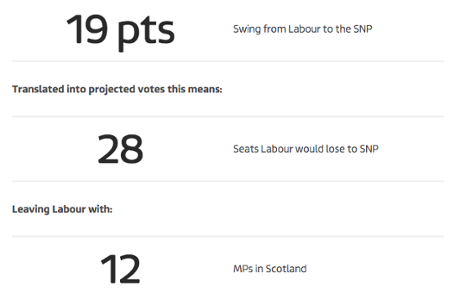
- A new ITV/ComRes poll showed a 19 point swing from Labour to the SNP in Scotland. The research, which questioned voters in all 40 constituencies which Labour held north of the border, found 30% of people who had voted for the party five years ago are now planning to back the SNP in May. This could see the SNP win 28 of the constituencies.
- Cameron refused to rule out taxing disability benefits and said that his party would try to squeeze more efficiencies from the NHS. He also said he would “safeguard” the personal independence payment, the new benefit being brought in to replace disability living allowance.
- Nick Clegg said the Lib Dems would spend £3.5bn more on mental health, and accused the Conservatives of trying to pretend they were committed to finding another £8bn for the NHS to find Simon Stevens’ plan when they weren’t.
- David Cameron will be the last to speak when the party leaders meet for their only head-to-head clash of the general election, having been pencilled in to be the final participant to give a closing statement. Green party leader Natalie Bennett will speak first.
- Nigel Farage, the Ukip leader, accused Cameron of “wilful dishonesty” over immigration. A new poster, unveiled in Dover, under the White Cliffs, said “Immigration is three times higher that the Tories promised”.
- Nicola Sturgeon said the SNP would not support a minority Labour government in on a “confidence and supply” basis if it went ahead with Trident renewal.
- Sir Malcolm Bruce, the Lib Dem deputy leader, signalled that, if the Lib Dems were to back an in/out EU referendum after the election, they would insist on EU nationals and 16 and 17-year-olds being able to vote as a condition for voting for the legislation.
The big issue
The party leaders will line up alongside each other on Thursday evening for the first TV debate. Yesterday the order was confirmed as – from left to right – Natalie Bennett (Green), Nick Clegg (Lib Dem), Nigel Farage (Ukip), Ed Miliband (Labour), Leanne Wood (Plaid Cymru), Nicola Sturgeon (SNP) and David Cameron.
Today, a complicated grid was produced detailing the order the party leaders will speak. The seven will each get the chance to make an opening statement. There will then be four questions during the two-hour programme, with each leader getting a minute to answer before it opens up for an 18-minute debate. This will be followed by closing statements at the end. Hopefully, our only chance of seeing all the leaders go to head-to-head won’t be as much of a mess as it sounds.
As my colleague John Plunkett writes:
None of the four questions, or the opening or closing statements, will be answered in the same order twice according to a grid devised by the production team at ITV Studios to be as fair as possible to each leader.
After an opening statement of a minute or so from each party leader, there will be four topics of discussion which will begin with another one-minute answer from each leader before an 18-minute studio debate, moderated by ITV News anchor Julie Etchingham.
So that’s 25 minutes on each topic in a two-hour live show with one commercial break. The topics will include the economy, the NHS, immigration and the future of the UK.
The upshot of the arrangements, confirmed on Tuesday, appears to confirm the worst fears of critics who feared a seven-way debate, rather than a head to head with Ed Miliband which David Cameron resisted, would be a “disjointed, incoherent cacophony”.
Quote of the day
“I’m not having talks with anyone. I barely have time to talk with my wife.” - David Cameron, when asked by Sky’s Eamon Holmes if he was in secret talks with Nick Clegg about forming another coalition.
Laugh of the day
The BBC probably meant “psych out”, but the image of Cameron as an undercover Frank Underwood-type character is amusing.
.@BBCBreakfast has just accused @David_Cameron of engaging in 'a bit of psycho campaigning' #ge2015
— Robin Brant (@robindbrant) March 31, 2015
Hero of the day
Paul Johnson, the Institute for Fiscal Studies director, who just a day after refuting Tory claims about Labour tax plans, said that the Conservative claim to be able to raise £5 billion from tackling tax avoidance is “very flaky”. Paul showed why it’s crucial for the parties’ constant rhetoric to be cut with some common sense and facts.
Villain of the day
Reality TV star Joey Essex, who attended Nick Clegg’s speech and admitted he thought his surname was “Leg” and that the Liberal Democrats were called the “Liberal Democats”. Though a middle-of-the-ground all cat party is a fun thought, Essex’s proud ignorance is reflective of a greater disenfranchisement among young people.
What we’ll be talking about tomorrow
Ukip will be calling for assurances from David Cameron that he does not have a secret deal with the Lib Dems over the EU referendum. George Osborne is due to give a speech. Ed Balls will be visiting Glasgow, where he will be joined by Scottish Labour leader Jim Murphy, Nick Clegg will be visiting East Dunbartonshire, and Samantha Cameron will be visiting a school in Rochester and Strood.
Thanks for sticking with our Guardian election live blog. That’s all from me today. Join us again tomorrow, when our politics team will bring you live coverage of the campaign from 7am till late. We will continue to do this every day until 7 May, and possibly later.
Labour candidate Graham Jones has requested that the independent parliamentary standards authority (Ipsa) formally investigate whether the Conservative party chairman, Grant Shapps, charged inflated amounts for office stationery he claimed on parliamentary expenses. My colleague Frances Perraudin reports:
Jones, who wrote to Ipsa before parliament was dissolved, points to one claim on 5 December 2007 of £426.53 for 5,000 A6 postcards, printed by PrintHouse Corporation. He argues that such stationery can be found elsewhere for as little as £150.
In a letter to Peter Davis, the compliance officer for Ipsa, Jones – who is fighting to retain his seat in Hyndburn – writes: “It seems to be increasingly clear that Grant Shapps did not get value for taxpayers’ money when purchasing this stationery.
“This raises an important question: did Grant Shapps act in an improper manner in claiming for a seemingly inflated invoice for office stationery from a company that he and his family owned and operated?”
The FT’s Janan Ganesh has written about the importance of personality politics in the general election.
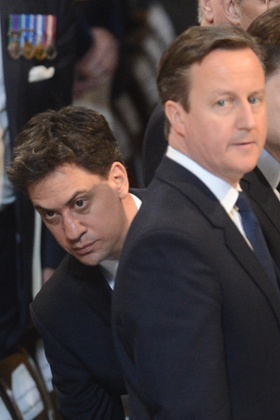
Still, the election matters, but not for the reason Mr Cameron implies. Pitted against each other are two mildly different policy programmes but two drastically different personalities. In their cast of mind, he and Mr Miliband are as dissimilar as any two people who have vied for the premiership in recent decades.
We are meant to resent the focus on personality in politics. This is priggish. Personality does so much to determine a government’s performance that, if anything, we do not talk about it enough. In a country as centralised as Britain, the government of the day is a magnification of the prime minister’s character. By contrast, a manifesto says what a party would do in a world of favourable circumstances and zero disruption. We take these documents too seriously.
Ganesh continues to say that Cameron is serious but bloodless and Miliband is passionate but flaky.
Updated
Norman Lamb on Lib Dem u-turn on tuition fees: “All of us in our lives make mistakes.”
He also said he would consider his family if he ever needed to decide on whether to run for Lib Dem leader.
Norman Lamb: "I'm always being asked if I'll run for leader." I'm guessing by a very concerned wife. #AskLibDems
— Tim Stanley (@timothy_stanley) March 31, 2015
An audience member lets @normanlamb what he thinks of the libdem pledge. Have your say LIVE on @bbcthree #AskLibDems pic.twitter.com/IXnMyA4oMK
— BBC Free Speech (@BBCFreeSpeech) March 31, 2015
.@normanlamb comments on the representation of women in the Liberal Democrats. #AskLibDems LIVE on @bbcthree pic.twitter.com/jPbgpMCYTs
— BBC Free Speech (@BBCFreeSpeech) March 31, 2015
Updated
James said she disagrees with Farage on legalising handguns.
Audience question: Do you feel uncomfortable listening to people speak foreign languages on trains? #AskUKIP
— BBC Free Speech (@BBCFreeSpeech) March 31, 2015
James said she doesn’t, but she has no view on her party leader Farage saying he did.
And here’s James’ response to whether Ukip attracts xenophobic views.
Does UKIP attract people with xenophobic views or is that an unfair statement? #AskUKIP LIVE on @bbcthree pic.twitter.com/Vs99jvHf2S
— BBC Free Speech (@BBCFreeSpeech) March 31, 2015
"[The media] has managed to expose people with views we don't want in the party. I'm grateful for that." Diane James #AskUKIP
— BBC Free Speech (@BBCFreeSpeech) March 31, 2015
"I went into a coffee shop on the way here. I was served by a couple of Eastern Europeans. It was absolutely fine." Diane James #AskUKIP
— BBC Free Speech (@BBCFreeSpeech) March 31, 2015
Updated
Ukip’s Diane James is on the show and the Lib Dems have sent Norman Lamb.
BBC 3’s Free Speech programme currently has representatives from the Lib Dems and Ukip on for its #AskLibDems and #AskUkip segment. Apparently Clegg and Farage both declined the invitation to appear.
Updated
The Huffington Post have made a list of all the election tools that can help people decide who to vote for.
It might be useful. As the Manchester Evening News reported today, a poll by students at the University of Manchester of more than 1,500 people found that around 60% could not give the correct definition of GDP - despite being given a number of choices.
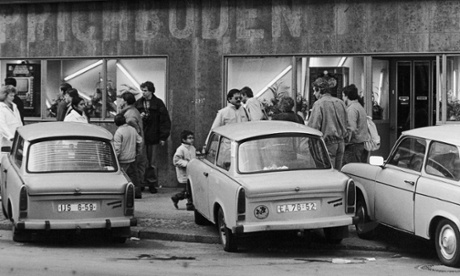
Some even thought it meant the old Communist state of East Germany (GDR).
Updated
Tomorrow’s Guardian editorial is about the press’s hostile coverage of Ed Miliband. It points out that because of the Labour leader’s tough stance on press regulation, we should expect more of the same in the run up to the election.
Remember Red Ed? Back in 2010, he stalked the land, knifing his brother, eating babies and hating Britain like his father did, rarely off the front pages. Then, for several years during which Labour led in the opinion polls, he seemed to disappear from view entirely. Recently, though, Red Ed has made an unmistakable return. Today it is hard to open some newspapers without finding him at the heart of the rightwing version of the election narrative.
Some of the time, Red Ed is portrayed as a bogeyman – grabbing your taxes or plotting with the union bosses to turn Britain into North Korea. Other times he is dismissed as hopeless – held to ransom by the SNP or a figure of derision for opposing British exit from the EU. The contrast reflects a culture that is uncertain whether politics is marked by importance or impotence. But there is no mystery about the timing of the return of Red Ed. Raw partisan politics requires the monstering of Mr Miliband on behalf of the Conservative party. David Cameronstarted the campaign this week in a notably personal attack. Several parts of the media are ready to follow suit. Fairness and independent judgment count for little when the future government of this country is at stake.
Chuka Umunna appeared on Sky News earlier to claim that British people don’t want a referendum on the EU. David Skelton writes in the New Statesman that Labour’s refusal to even consider a referendum on Britain’s membership of the EU “is a betrayal of its history and an embarrassment to its radical tradition”.
Updated
The Kings Fund have launched a handy election tracker that breaks down all the major parties’ policies on health.
A Lib Dem candidate in Redcar said Nick Clegg’s visit may be a “double-edged sword”.
Redcar Liberal Democrat candidate: Nick Clegg visit may be a 'double-edged sword' http://t.co/EE0Ava1TyD #GE2015 pic.twitter.com/NeLqeqegAH
— ITV News Tyne Tees (@ITVtynetees) March 31, 2015
The party quickly put out a statement on his behalf.
After LibDem candidate tells @PaulBrandITV Clegg visit would not 'do us many favours' LDHQ put out this on his behalf pic.twitter.com/vGkNAMgMvW
— John Stevens (@johnestevens) March 31, 2015
Miliband also spoke on BBC North West Tonight, where he was asked whether George Osborne had stolen his thunder with his plans for local government and NHS devolution in northern cities - a plan that has been welcomed by Labour-run councils in Greater Manchester. Miliband responded:
George Osborne is a totally unconvincing friend of the North West. Let me explain, 75% cuts greater in the north of England than in the rest of the country.
Miliband says recovery is limited to the city of London
Ed Miliband has echoed Ed Balls’ statement that ordinary working people are not feeling the benefits of the recovery. During his visit to Manchester, Miliband told ITV Granada Reports:
What the figures actually show is that wages are lower now than they were in 2010 and that’s what people feel.
David Cameron and George Osborne want to say the economy is fixed, the economy is fine, if they want to keep saying that during the next five weeks fine let them say that.
What I think people see is a recovery that may have reached the city of London but hasn’t reached them.
People are worse off not better off than five years ago, that’s what people tell me, that’s what the facts show.
And we will put it right. Let’s have that discussion. We are going to build a recovery that goes beyond the city of London.
Miliband also cited the NHS, tax avoidance and the mansion tax as live issues “on the ballot paper” and said that his own house may be liable for his proposed mansion tax.
The think tank Progress has published some advice on how to survive the election campaign. It mentions some memorable moments from past campaigns:
The political parties run their war books, in the surefire knowledge that their plans will not survive the first contact with the enemy. The compelling drama of any campaign comes in the spontaneous events. The war of ‘Jennifer’s ear’ knocked Labour’s campaign off course in 1992. In 1997 John Major’s helicopter dash around the United Kingdom in a single day, to ‘save the union’, unleashed a final bout of energy from a campaign which looked beaten from the start. The CCHQ press officers’ mobiles had their ringtones set to play ‘Mission Impossible’.
In 2001 the campaign is only remembered for John Prescott punching Craig Evans in Rhyl. In 2005, Tony Blair handed Gordon Brown an ice cream in Gillingham, in an unscripted moment of chumminess. Labour won the Kent seat with a majority of 254.
What do you think this campaign could be remembered for?
Updated
Guardian writer John Crace has written a new sketch about Ukip unveiling their new immigration poster earlier today in Dover.
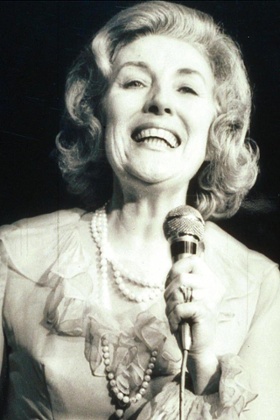
Welcome to Vodafone France. In St Margaret’s, four miles east of Dover, you can’t just see France on a clear day, you are connected to it. I don’t know. They come over here and take over our phones: I always knew we were better off with a decent landline. Still, if you close your eyes and listen carefully you can still hear the voice of Vera Lynn echoing off the white cliffs. Just along the beach are the houses where Ian Fleming and Noël Coward once lived. And in the Coastguard pub car park is a new Ukip immigration poster waiting to be unveiled.
Shortly before 11am, a bodyguard self-sculpted to look a bit like a rough-trade Jamie Redknapp corralled 15 local Ukip supporters into standing beneath the mobile poster van. Each had been given a placard to turn round when given the command. One had to be reminded he was holding his the wrong way up: another, a woman in her 70s wearing a Peruvian knit cardigan, looked as if she might be moonlighting from the Lib Dems. “How dare you!” she said with a laugh. “And the cardy is Moroccan.”
Updated
Here’s Scottish Labour leader Jim Murphy on the ITV/ComRes Scotland poll:

This poll shows some improvement for Scottish Labour, but we aren’t getting carried away with ourselves.
We are back in the fight but we are still the underdogs. If this poll is repeated on election day it could hand the keys to Downing Street back to David Cameron.
Between now and polling day we will set out our positive alternative to failed Tory austerity. We will call time on exploitative zero hours contracts, invest in our NHS and tax the bank bonuses to get young Scots off the dole and back into work. That’s an agenda that will improve the lives of working class families across Scotland.
We need to do everything we can to stop the Tories being the largest party across the UK. A vote for anyone other than Labour risks the Tories being the biggest party and returning to government. That would be a disaster for Scotland.
He’s right, Labour are making some progress in the share of votes. But time is of essence.
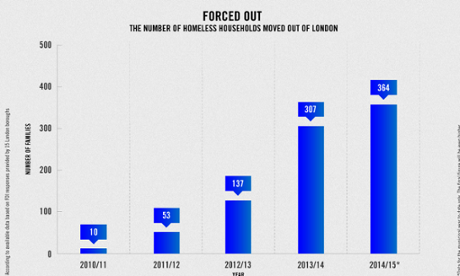
Vice have published data about the number of people being forced to leave London due to social housing shortages, welfare reforms and gentrification.
The data, gleaned from a series of FOI requests submitted by the Green Party over the last five years, shows that the number of families with children forced out of London rose from ten in the municipal year 2010/11, to 307 in 2013/14. Dan Hancox writes:
While the sample is incomplete, the pattern is clear: according to our data, over 35 times more families are having to move out of London this year compared to five years ago.
The Lib Dems have a new ad:
Sinister much? I really thought something bad was going to happen to that car. Glad you’re okay, kid.
A simple breakdown of the poll results from ITV:
SNP campaign director Angus Robertson on his party’s lead over Labour:

This latest poll is another welcome indication of the strong backing for the SNP we are seeing in communities across Scotland as Labour continues to pay the price for working hand in glove with the Tories during the referendum - and for lining up with them at Westminster to vote for George Osborne’s plans for another 30 billion of cuts.
While this poll is very welcome, we are taking absolutely nothing for granted and we will work harder than ever to win people’s trust on May 7 so we can deliver jobs and investment, instead of yet more Westminster austerity cuts.
New ITV/ComRes poll shows 19 point swing from Labour to the SNP in Scotland
The SNP could win almost three-quarters of Labour’s seats in Scotland, according to a new ITV/ComRes poll. This means a swing to the nationalists of 19 points. As the Press Association reports:
The research, which questioned voters in all 40 constituencies which Labour held north of the border, found 30% of people who had voted for the party five years ago are now planning to back the SNP in May.
Although 49% of the people questioned - and 48% of SNP voters - want Ed Miliband to be the next prime minister, the ComRes poll for ITV News found strong support for Nicola Sturgeon’s party.
In the 40 battleground seats - Eric Joyce’s Falkirk constituency was not included in the research - 43% of people said they would be voting SNP compared with 37% for Labour.
This could see the SNP win 28 of the constituencies if there was a uniform swing to the nationalists.
The poll put support for the Tories at 13% across the 40 seats, with the Liberal Democrats, Scottish Greens, Ukip and other parties each on 2%.
Updated
Marcus Roberts, the deputy general secretary of the Fabian Society, has written a piece for us in which he says Cameron’s attacks on Miliband may end up helping Labour. Roberts writes:

In 1983 Margaret Thatcher did not stand outside Number 10 and attack Michael Foot as a weak leader. She knew better than to lower herself to the same level as a weak opponent.
Which is what makes the prime minister’s latest round of personal attacks on Ed Miliband so interesting. Cameron’s language towards him is increasingly searing, having just launched his campaign accusing Miliband’s Labour of being “hypocritical holier-than-thou, hopeless, sneering socialists” alongside frequent attacks on his “weakness”.
But the fact that Cameron feels the need to attack Miliband as much as he talks up the economy tells us something important about the prime minister’s own confidence, or lack thereof.
According to bookmakers William Hill, this election might be one of the biggest political betting events of all time. A spokesman for the company said the election is set to double the turnover of the Scottish referendum, which resulted in more than £10 million worth of bets, making it the most popular political booking event at the time.
The current odds for 7 May:
Hung Parliament 1/5
Labour minority 5/2
Conservative minority 7/2
Conservative majority 9/2
Con-Lib Dem Coalition 5/1
Coalition involving SNP 7/1
Coalition involving Ukip 8/1
Lab-Lib Dem coalition 8/1
Lab majority 16/1
Coalition involving Greens 33/1
Con-Lab coalition 33/1
Ukip majority 100/1
Lib Dem majority 500/1
Any other outcome 25/1
Time to invest in one of those “calm down dear” chopping boards?
“@steve1anderson: Election fever grips the Capital pic.twitter.com/6PQohViwwk” via @steve_hewlett #loveit #GE2015
— Mark Fox (@MarkFoxNews) March 30, 2015
Drug law reformers criticise Labour's "medieval tactics"
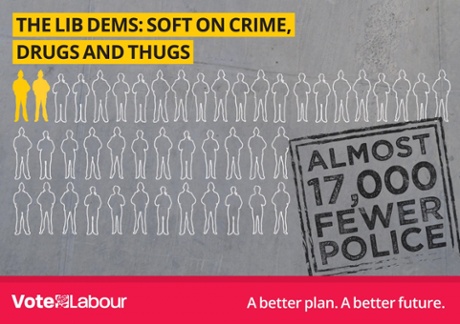
Drug law reformers have accused Labour of adopting medieval tactics and underestimating the intelligence of voters by putting out an official leaflet declaring: “The Lib Dems: soft on crime, drugs and thugs.” As our home affairs editor Alan Travis reports:
Danny Kushlick, of the Transform drugs charity, expressed anger about Labour’s leaflet. “You wait for five years and turns out drugs don’t warrant a considered policy, they’re just a stick to beat opponents with,” he said.
“We weren’t expecting them to take a progressive position, but this is positively medieval – imprisonment for possession. And it’s working-class people from Labour heartlands who’ll suffer. They should be ashamed of themselves.”
Remember - Nick Clegg pledged to end the imprisonment of 1,000 people a year for possessing drugs solely for personal use. Labour’s leaflet is below.
Updated
Lord Scriven has written to Conservative Party chairman Grant Shapps to push the party to reveal further details about their proposed £12bn worth of welfare cuts. As the Press Association reports, the Lib Dem politician wrote:
Your party have been talking about finding 12 billion of welfare cuts for 449 days, and yet you have consistently refused to spell out where they are coming from.
If you can’t tell us what the cuts will be, after 449 days’ work on it, it is completely unrealistic to imagine that just a few days after the general election that you will be able to magic them up.
The only credible conclusion to draw is that your plan to make 12 billion of welfare savings will result in even deeper, needless cuts to key public services, like the police, schools, and adult social care.
Your refusal to come clean on where you will find the remainder of your welfare savings means that you are seeking to deceive the British public over the scale of cuts you are planning on public services.
The question is, are the Tories’ not telling the electorate what the cuts will be because they can’t, or because they don’t want to?
Ed Miliband’s battle bus stopped off in Manchester earlier, where the Labour leader apparently received a “warm response”. Some photos of him arriving in the city below.
Windswept supporters in Manchester wait for @Ed_Miliband at the Battle Bus. That's dedication! pic.twitter.com/tiUyBizuxd
— Jason Farrell (@JasonFarrellSky) March 31, 2015
.@Ed_Miliband receives a warm welcome at Manchester Piccadilly pic.twitter.com/qCcEVUETnv
— Ian Beckett (@ian_beckett) March 31, 2015
Ed Miliband on the campaign trail at Manchester Piccadilly #GE2015 pic.twitter.com/XDUaKP4Vo4
— Laura Wilshaw (@laurajwilshaw) March 31, 2015
Welcoming @Ed_Miliband into Manchester today #winNW2015 #burynorthontour pic.twitter.com/iMXNifbbyd
— Ella (@EllaWatson3) March 31, 2015
Good afternoon, Nadia here. Stay tuned for all of this evening’s political developments, as the second day of the general election campaign comes to an end. I’m on Twitter @nadiakhomami and I’ll be reading your comments below the line as well, so you can let me know if you think there’s something I’ve missed.
Here’s what promises to be a rather therapeutic start to your evening. London creative marketing agency Brand & Deliver has launched Election Fight Night, a new computer game that gives players the opportunity to pick a leader and use him or her to beat all the other major party leaders to a pulp. It uses a format not dissimilar to the classic computer game Street Fighter. The agency’s CEO Ben Gallop said:
Though it’s largely just a bit of fun, we anonymously log how many players choose each party, so who knows, we might even predict the election results.
Cameron is currently leading with 38% support.
Afternoon summary
- Sir Malcolm Bruce, the Lib Dem deputy leader, has signalled that, if the Lib Dems were to back an in/out EU referendum after the election, they would insist on EU nationals and 16 and 17-year-olds being able to vote as a condition for voting for the legislation. Ukip denounced this as an attempt to rig the referendum. (See 4.12pm.)
- Lord Ashcroft has announced that he is retiring from the House of Lords. (See 4.21pm.)
-
Ed Miliband has called for a female James Bond. (See 4.44pm.)
That’s all from me for today.
My colleague Nadia Khomami is now taking over for the rest of the night.
The Scottish Green party has asked STV to hold all-party talks after the broadcaster again refused to include the Greens in its Scottish election leaders debate next week, Severin Carrell reports. Patrick Harvie, the SGP MSP and co-convenor, has told STV’s head of news Gordon Macmillan there had been a “huge reaction” against their exclusion, with a 10,000 signature petition and all-party support for the Green’s right to take part. STV insists it is right to invite only the Conservative, Labour, Lib Dem and SNP leaders because the broadcasting watchdog Ofcom has ruled the Scottish Greens are a minority party.
Miliband calls for a female Bond
At last! Some news from Ed Miliband. An aide said I was right about him doing some debate prep today (see 3.49am), but Miliband has also been on a visit to Magic Radio studios, where he met the actress and former Bond girl Rosamund Pike. Miliband said she would make a great Bond.
I think she’s a great British actress, she’d make a great Bond. This is 2015, I think we can move with the times.
From the Press Association copy I’m reading, it is not clear whether this was a Labour pledge.

Miliband also spoke about his taste in music.
I’m a bit of an 80s fan, I like bad taste - things like A-ha Take On Me. I’m aware of both Ed Sheeran and Sam Smith. I’ve heard them on radio and both of them are huge exports - they’re great artists. It’s brilliant we have a great number of great British artists, it makes us incredibly proud.
The bookmakers Coral have released their odds on who they think will win Thursday’s leaders’ debate (with winning defined as coming top in the YouGov poll). Nigel Farage is the favourite. Here are the full odds: 7-4 Nigel Farage, 11-4 Ed Miliband, 7-2 David Cameron, 6-1 Nicola Sturgeon, 9-1 Nick Clegg, 11-1 Natalie Bennett, and 25-1 Leanne Wood.
IFS praises government's record on job creation
A Tory source has been in touch to point out that, even though Paul Johnson, the Institute for Fiscal Studies director, may have been unflattering about the Conservative plan to raise £5bn from a crackdown on tax avoidance (see 1.55pm), he was very positive about the government’s record on job creation. Johnson told Sky News earlier:
The economy has done incredibly well in terms of job creation over the last several years given how slow growth has been. We have something like 2m more people in work, it is pretty remarkable and a lot better than many economies. Going forward, well if we continue down that route, then yes we will continue to have more job creation ...
Most jobs that have been created, most of the additional people in work, are not immigrants. There are a lot of additional immigrants in work but most of the additional people in work are not immigrants and I am sure that will be the case going forward.
Lord Ashcroft retires from the Lords
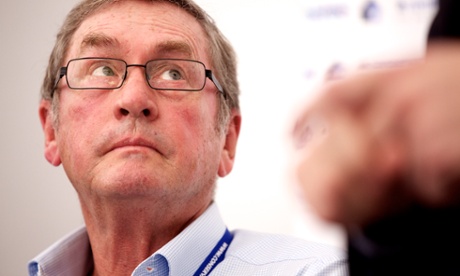
Lord Ashcroft, the Conservative former deputy chairman who is now best know in politics for commissioning copious polling, has announced he is retiring from the House of Lords.
He has published this statement on his website.
Earlier this year Baroness D’Souza, the Lord Speaker, said that any Member of the House of Lords who can “no longer contribute meaningfully” should retire. She added that since the House has close to 800 members, “retirement at the right time should be seen as a condition of membership of the House of Lords – a duty as well as a right”.
I agree with the Speaker, and have concluded that my other activities do not permit me to devote the time that membership of the Lords properly requires.
Accordingly, I have today written to the Clerk of the Parliaments giving notice of my resignation from the House of Lords with immediate effect, pursuant to Section 1(1) of the House of Lords Reform Act 2014.
I will continue my involvement in politics through Lord Ashcroft Polls and my political publishing interests: Conservative Home, Biteback Publishing and Dods.
In the Financial Times today (subscription) Kiran Stacey says that the Lib Dems are ready to back David Cameron’s plans for an in/out referendum on EU membership after the election, but only in return for certain concessions.
In return for backing a referendum, the Lib Dems are likely to demand concessions, including a say over the timing of the vote, the question asked, and who is allowed to participate.
An ally of Mr Clegg said: “If they want to enlist us in doing something so monumentally stupid, they will have to be extremely generous and persuasive.” Mr Clegg’s ally said the Lib Dems were likely to demand the vote be opened up to under-18s, that the party helps craft the question, and that EU migrants get a say.
A Lib Dem minister said: “Those groups both got a vote in the Scottish referendum — I think they would expect a vote if there was also one on our membership of the EU.”
On the World at One Sir Malcolm Bruce, the Lib Dem deputy leader, seemed to back this.
We have obviously made it clear that we are not keen on having a willy-nilly referendum with no context. But if there is to be a referendum, we certainly think that young people should have the vote. We would like them to have the vote in all elections, as they did in the Scottish referendum, so we would certainly legislate for that. As far as European citizens are concerned, they live here, they work here, they are paying their taxes here. And they are on the electoral register. Frankly, it seems to be that it would be unfair, and probably unconstitutional, to deny them the right to vote in any such referendum.
But Patrick O’Flynn, the Ukip MEP, told the same the idea that excluding EU nationals would be unconstitutional was “nonsense”.
This referendum is a chance for British people to vote on how they are governed and by whom and I think we are seeing the lid lifted on the way establishment politics is done in this country. We know from very well-connected journalists ... that David Cameron is plotting coalition two. And now we are beginning to see what Nick Clegg’s conditions are. We are beginning to see that they are planning a rigged referendum, changing the franchise, allowing people with a huge vested interest to vote.
I see people have been complaining BTL about there being too many pictures of David Cameron.
I would have been happy to use pictures of Ed Miliband, but he has not been out in public so far today. The only pictures in the file are of him leaving his house this morning. I guess he is rehearsing for Thursday’s debate.

Updated
Nick Clegg has conceded that he is not going to win the TV debate on Thursday.
Nick Clegg tells us he's not going to 'triumph' in the debates on Thursday, which favour 'newcomers'. #hewasthefutureonce
— Tamara Cohen (@tamcohen) March 31, 2015
Clegg on TV debates: I'm not going to triumph in these debates - that's just self-evident. I enter with quite sober realistic expectations.
— Tom Knowles (@tkbeynon) March 31, 2015
And it has emerged that “plucky” has become Clegg’s favourite word. He has been using it a lot today to describe the Lib Dems.
Entering coalition was "plucky, brave thing to do", Clegg tells Panasonic workers. That word "plucky" again. pic.twitter.com/vf5IyPhfHe
— David Hughes (@DavidHughesPA) March 31, 2015
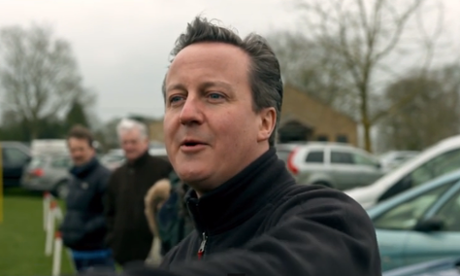
The Conservatives have released their first party political broadcast. It features a series of parents talking about their hopes for their children, culminating with David Cameron, who is shown watching his son play football and having a meal at home.
Here is the photo of the day from Stefan Rousseau, the Press Association’s chief political photographer.
ELECTION Photo du Jour: David Cameron meets staff at Sainsbury’s HQ in London. By Stefan Rousseau/PA pic.twitter.com/NkFu0kJpBP
— Stefan Rousseau (@StefanRousseau) March 31, 2015

Left Unity, the new-(ish) leftwing party, is fielding 10 candidates at the election. At its campaign launch, the film director Ken Loach said people should “fear” the Conservative Party. This is from the Press Association.
Left Unity, a broad left party formed in 2013 and co-founded by Loach, chose the venue to launch its general election manifesto in a bid to highlight the number of large buildings sitting empty in London.
The acclaimed Sweet Sixteen director said: “I think people should fear the Tories and Ukip as an extreme example of the Tories. I mean, we know there are going to be more benefit cuts, crueller sanctions.”
He added: “There’s a cruelty aboard. And there’s a fear aboard. And there’s a genuine hunger amongst people. So that’s why I think people should fear the Tories and Ukip.”
He said Ukip represent “all that’s mean spirited”.
Loach, who was joined by scriptwriter Paul Laverty, addressed press and squatters inside the central London building.
He said there is “huge anger and alienation and fear and hunger” which is not represented in “our political discourse”.
He said the party stands against imperialist wars and stands for the interests of people.
“It is so important we keep these ideas alive,” he said.
Through Heat we also learn that David Cameron and Ed Balls have one thing in common - or another thing, besides their shared antipathy towards coalition government. (See 9.21am.)
Asked whether he had any phobias, Cameron told Heat: “I’m not very keen on rats, we had one in our kitchen once, it came in through the cat flap. It was horrible, and I kind of found it in the middle of the night.”
And, in a personal interview in the Evening Standard, Balls also said he has a phobia about rats. “Can’t even look at them,” he said.
The Standard interview also reveals that Balls must be about the last person in the world to use a Nokia.
Heat magazine has published some excerpts from its interview with David Cameron. He told Heat he couldn’t multi-task.
This is what he said when asked what music he listened to while running.
I’m a man, I can’t do two things at once! [Laughs] I cannot listen to music and run. I don’t know how people do it. I like getting out of here and I like getting outside, I love fresh air. I love getting out in the fresh air and going for a run and I want to kind of empty my head and get a bit of frustration out so I don’t want something blaring away in my ear.
Cameron also claimed he was distantly related to the Kardashians.
George Osborne has been making pizzas on the campaign trail today. And Nick Clegg has been making pancakes, on a visit to a Panasonic test kitchen in Cardiff.

Ruth Davidson, the leader of the Scottish Conservatives, has accused the SNP of a “tax grab on Scottish home buyers”, revealing new figures showing that the SNP’s stamp duty replacement would have hit Scottish homebuyers for £30 million more than the UK system last year, Libby Brooks reports.
Posing alongside mock for-sale signs detailing the new figures in Edinburgh, where homebuyers would have accounted for nearly half the difference, Davidson said: “When the SNP launched its plans to replace stamp duty, we were told that it did not plan to raise any more tax than the system it inherited. But these figures show that the Scottish government is actually planning to raise an extra £30m from house buyers. It’s a tax grab on Scottish home buyers. This is the first tax that the SNP government has taken control over at the Scottish Parliament, and it’s clear its first instinct is to hike taxes, not cut them.”
Ironically, John Swinney, the SNP Scottish finance minister, himself was accused of falling into line with Tory tax cuts in January after he announced changes to the the land and building transaction tax (LBTT), flagship legislation that he previously described as emblematic of the SNP’s approach to a more progressive taxation system in Scotland.
Swinney’s revisions were announced after George Osborne described the differences between LBTT and his own stamp duty changes as an early example of “tax competition in action” between the countries.

Lunchtime summary
-
David Cameron has put the economy at the heart of today’s Conservative election campaign, using a series of morning interviews to claim that his party would create 2m more jobs in the next parliament.
Under @Conservatives employment is at a record high & we’ll create 2 million more jobs by 2020 pic.twitter.com/W4R1zGgP5Q
— Nicky Morgan (@NickyMorgan01) March 31, 2015
His claim is based largely on a back-of-the-envelope assumption that job creation could continue at the same pace as over the last five years, and it has been dismissed by union leaders (although not so aggressively by Labour, who may be understandly cautious about being seen as anti job creation). This is from Frances O’Grady, the TUC general secretary:
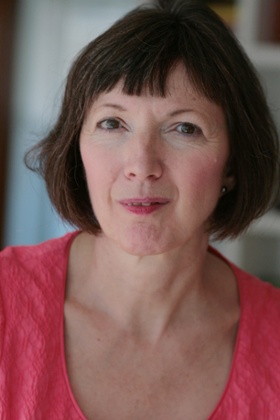
It is hard to see how the Conservatives will create an additional two million jobs over the course of the next parliament. Imposing savage spending cuts on the public sector will suck demand out of the economy and make hundreds of thousands of public servants redundant.
- The Conservatives have welcomed figures showing that growth has been revised upwards, that consumer confidence is at a 12-year high and that disposable income has reached pre-crash levels as proof their approach is working. (See 11.20am.) But Labour has said that it would welcome a debate about living standards, because the coalition’s record in this area is so poor. (See 1.27am.)
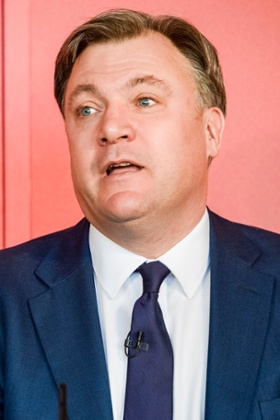
- Ed Balls, the shadow chancellor, has said that Labour would cut business rates for small firms in its first budget. It would fund the measure by reversing a cut in corporation tax that is just about to come into force. He said this was justified because the government has spent £7bn cutting the main rate of corporation tax to the benefit of larger firms while revenues from business rates rose by £3bn, at an average cost to firms of 1,500 a year. But the Tories claimed raising corporation tax could cost 100,000 jobs. (See 11.40am.)
- Cameron has refused to rule out taxing disability benefits. He has also hat the Conservatives would try to squeeze more efficiencies from the NHS than already planned. (See 9.21am.)
-
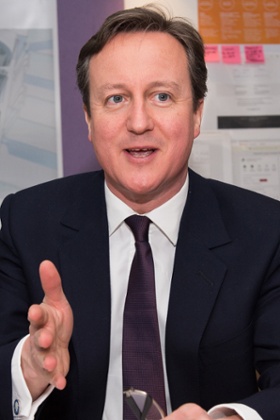
Paul Johnson, the Institute for Fiscal Studies director, has said the Conservative claim to be able to raise £5bn from tackling tax avoidance is “very flaky”. Only 24 hours after the IFS said Tory claims about Labour tax plans were unfounded, Johnson told Sky News:

Conservatives have said we’re going to get £5bn from tax avoidance measures. Now that’s a very flaky number. Where do you get £5bn from tax avoidance? We don’t know. Given the scale of spending cuts they’ll otherwise require they must be at least thinking about tax rises.
-
Nigel Farage, the Ukip leader, has accused Cameron of “wilful dishonesty” over immigration. (See 12.20pm.)
Updated
Jim Murphy, the Scottish Labour leader, is anticipating a big swing away from the SNP late in the day, Severin Carrell reports.
Jim Murphy, the Scottish Labour leader, has insisted his party can close an apparently unshiftable 17 point gap with the SNP by election day, denying that the SNP vote is too solid to erode.

He told reporters as he visited a community cafe to promote Scottish Labour’s £175m anti-poverty project: “The election is only 24 hours old; there are weeks to go. Lots of people are for the first time beginning to think about the general election.
“When I was elected [Scottish leader] I said the polls will turn big and the polls will turn late, when people are confronted by the choice facing them. Lots of people are thinking about last year’s disagreement [on independence] rather than this year’s decision.”
He added: “There are lots of ways to protest about David Cameron, but there’s only one way to replace him.”
Updated
At his speech earlier Ed Balls, the shadow chancellor, said he was surprised the George Osborne wanted to make living standards and growth a campaign issue. (See 11.20am.) Balls said:
A small upward revision today in the GDP figures doesn’t change that overall record. This has been a disappointing recovery and it didn’t have to be this way.
If the Conservatives want to go round and say ‘Our plan is working, look at the GDP figures; our plan is working, look at the figures on disposable income’ then we say bring it on because the reality is that this is the toughest squeeze on people’s living standards in a parliament since the early 1920s.


Tina Stowell, the Conservative leader of the Lords, could end up reading out the first Queen’s Speech after the election, it has emerged. Peter Riddell, the former Times journalist and director the Institute for Government, outlined this when he briefed lobby journalists about possible coalition scenarios this morning
He has said that he thinks there will not be a state opening of parliament if there’s a minority government, but that it would be a low key affair with the leader of the House of Lords, Tina Stowell, reading a paired back version of the Queen’s speech. As lord privy seal, Stowell stands in for the monarch in the Lords on certain ceremonial occasions.
“It would be lower key to avoid the Queen being dragged into a highly contested situation and it would be, after three or four weeks. By God it would be contested,” Riddell said.
Riddell also said that he thought that “lawyers and judges are not overly keen to be involved” in the process of forming a government. The only parts of the process that are actually enshrined in law are in the fixed term parliaments act, which is ambiguous in parts.
TNS poll gives Tories 1-pt lead
TNS UK has released a poll giving the Conservatives a one-point lead.
The full voter intention figures are as follows: LAB 32% (0) CON 33% (0) LIB DEM 8% (+1) UKIP 16%(-1) GREEN 5% (+1) Other 7% (0) ...
With several of weeks of campaigning ahead, the latest TNS research also shows that almost three quarters (72%) say they have a ‘good deal’ or ‘some interest’ in politics, with 28% saying they have no interest in politics.
When asked about the likely outcome of this General Election there is uncertainty, with a third (31%) saying they don’t know who will be running the country after May 8th. However, while the two main parties are neck-and-neck in the latest TNS poll, over a third (36%) think the Conservatives will either have an outright majority or be the biggest party, compared with 28% for Labour.

My colleague Severin Carrell has sent me this about a possible SNP reshuffle - or non-reshuffle.
Alex Salmond has personally reassured his long-standing colleague and ally Angus Robertson that he will not seek to replace him as the SNP’s Westminster leader if Salmond returns to the Commons at the election, the Herald reports.
Speculation that the SNP and Salmond want him to replace Robertson as Westminster party leader have escalated in recent days, even though Robertson and Salmond have repeatedly said the former first minister had no plans to do so.
Salmond has become a fixture of TV politics show couches in recent weeks, giving several magazine interviews, with both the Spectator and the New Statesman (both made infamous by his taste for pink champagne), where the former party leader and first minister has set the SNP agenda on the chances of deals with Labour and ultimatums over the Queens speech.
Asked if he would still be leader after May 7, The Herald quotes Robertson saying: “I’m delighted to serve as the Westminster leader of the Scottish National Party and will happily continue doing so.”
My colleague John Plunkett has filed more on the ITV debate on Thursday - and the complicated speaking grid that has been produced. (See 11.50am.)
TV’s leaders debate on Thursday will be a complicated affair as producers bend over backwards to ensure it will be fair and balanced to all seven party leaders taking part.
The consequence of this bid for impartiality, which began with the drawing of lots to decide the podium order, is a remarkably complicated looking question and answer grid which is likely to prompt comparisons with The Thick Of It.
None of the four questions, or the opening or closing statements, will be answered in the same order twice according to a grid devised by the production team at ITV Studios to be as fair as possible to each leader.
After an opening statement of a minute or so from each party leader, there will be four topics of discussion which will begin with another one-minute answer from each leader before an 18-minute studio debate, moderated by ITV News anchor Julie Etchingham.
So that’s 25 minutes on each topic in a two-hour live show with one commercial break. The topics will include the economy, the NHS, immigration and the future of the UK.
The upshot of the arrangements, confirmed on Tuesday, appears to confirm the worst fears of critics who feared a seven-way debate, rather than a head to head with Ed Miliband which David Cameron resisted, would be a “disjointed, incoherent cacophony”.
Only Thursday night will tell.
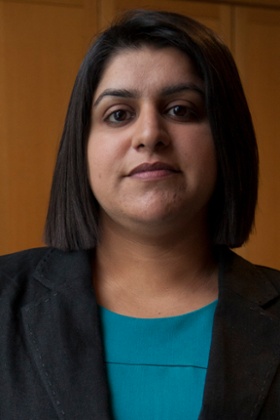
Shabana Mahmood, the shadow Treasury minister, has joined the list of Labour figures saying they would not buy one of the party’s “controls on immigration” mugs. Asked about this on the Daily Politics just now, she said:
It does not sound like a mug that I would be buying.
Chuka Umunna and Sadiq Khan gave similar answers yesterday - although, like Mahmood, they did not criticise the party policy on immigration.
But Ed Balls, the shadow chancellor, plans to buy one.
Shadow Chancellor Ed Balls said he's going to buy a controversial Labour immigration mug... pic.twitter.com/iqtnlbYZx7
— Joe Watts (@JoeWatts_) March 31, 2015
Ed Balls on Labour's immigration mug: “I’ve not got one, but I want to buy one and have it in my constituency campaign office.” @SkyNews
— PoliticsHome (@politicshome) March 31, 2015
.@edballsmp not remotely abashed about Labour's Immigration mug. After the elxn 'I can do a toast in that mug' #SkyNews
— Paul Waugh (@paulwaugh) March 31, 2015
Updated
Guess who’s wearing HM cufflinks?

Yup, it is the prime minister, photographed at the Sainsbury’s HQ earlier.
I presume he did not have the nerve to wear them yesterday, when he visited Buckingham Palace.
Naff or stylish? What do you think?
Ukip accuses Cameron of "wilful dishonesty" over immigration
Nigel Farage, the Ukip leader, has been unveiling a new poster in Dover, under the White Cliffs.
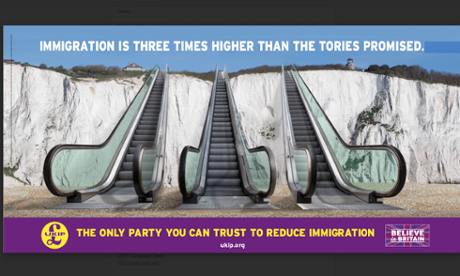
And these are the key points:
-
Farage accused David Cameron of “wilful dishonesty” over immigration.
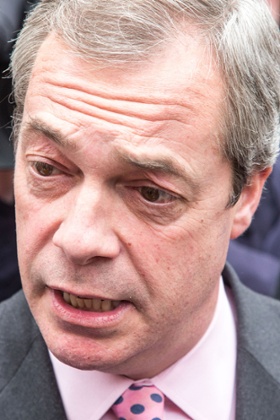
When Cameron made that promise he was being wilfully dishonest because he knew the truth and I think now the British public five years on know the truth - that you actually cannot have an immigration policy, you can’t set targets of any kind at all, you can’t attempt to control who comes into Britain, all the while you’re members of European Union.
-
He said Ukip would like immigration levels to return to “normality”, which he defined as net migration of around 30,000 a year.
I’m saying a net level of about 30,000 a year is roughly what we had for 50 years from 1950 almost until the turn of the century. It was a level at which the country was comfortable and that integration was possible and it didn’t, crucially, compress the wages, push down the wages of ordinary people.
He also found time for a visit to a pub - although he did not order a pint.
Nigel Farage in the pub... drinking coffee. "I'm just not giving you the pleasure of you seeing me drinking a pint" pic.twitter.com/idg9jP3a1e
— Rohit Kachroo (@RohitKachrooITV) March 31, 2015
And he also came out with a vintage example of Faragespeak - “off his chump”.
Nigel Farage, at the coast: "Have you seen this surfer down there? He must be off his chump!"
— Michael Deacon (@MichaelPDeacon) March 31, 2015
Updated
Matthew Weaver: Does David Cameron talk to his wife Samantha or not? In a blokey exchange earlier with Sky’s Eamon Holmes, Cameron was asked if he in is secret talks with Nick Clegg about forming another coalition. He replied: “I’m not having talks with anyone. I barely have time to talk with my wife, never mind anyone else.”
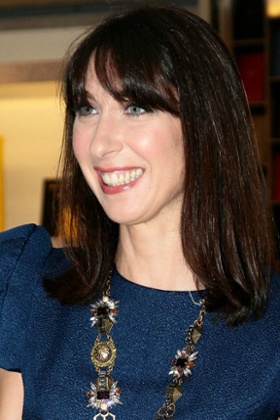
Yet five minutes later Cameron was giving a very different message to Susanna Reid and Kate Garraway asking the questions from the more feminine setting of the Good Morning Britain sofa.
On the subject of ruling out serving a third term, Cameron was asked whether Samantha had urged him to put family before country. He said: “Not at all. She is absolutely behind me and thinks it is very important we win this election, because the plan is working. She sees, and we talk about this a lot, that businesses are growing and expanding ... We have turned the country around and she wants me to finish the job.”
Updated
The GMB union says David Cameron’s jobs claim (see 12.05pm) “completely lacks credibility”. This is from Paul Kenny, the GMB general secretary.
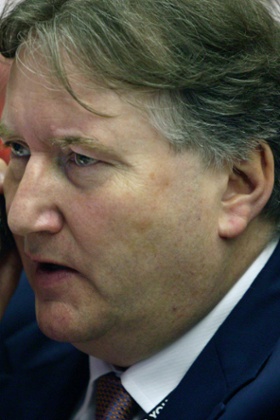
Cameron’s claim completely lacks credibility. The circumstances that gave rise to many new jobs in this parliament are not likely to be repeated in the next one.
Many of those new jobs are directly linked to the 3.2m in population since 2007 which led to additional economic activity as would be expected. However GDP per head is still 1.5% below 2007 levels.
Updated
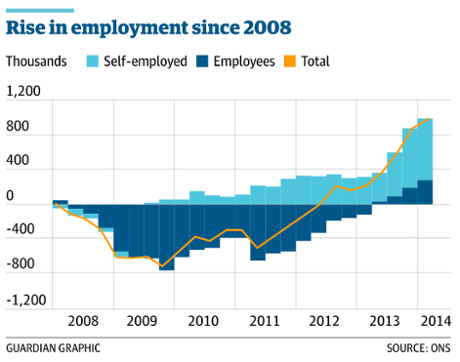
That holds up reasonably well, but Angela is more sceptical about Cameron’s claim that the Conservatives would create another 2m jobs over the next five years.
This, of course, is nothing more than a claim. Employment is forecast to rise in the UK, but it is impossible to know by how much, partly because it will be up to businesses whether or not they create jobs.
For the record, this is what the Conservatives say about Cameron’s pledge to create 2m more jobs, and why the party believes it is credible, in the briefing note released overnight.
A Conservative government will help business create two million new jobs in the next parliament if elected in May, David Cameron and George Osborne will announce today, maintaining the average of over 1,000 jobs a day being created.
The pledge comes as Treasury estimates show Britain starting to overtake Canada on the road to full employment. Britain’s employment rate is expected to reach 72.6 per cent in the second quarter of 2015 - Canada’s current rate is 72.5 per cent. The commitment to creating a further 2m jobs during the next parliament would take the UK past Germany and Japan on current levels.
2m jobs will mean doubling the Office of Budget Responsibility’s forecast for the next parliament – just as the 1.9m jobs created in the past five years is twice what the same organisation predicted in June 2010. It will be crucial in reducing the number of people on out of work benefits from its current level of around 4m.
The briefing paper does not give many details as to why voters should believe the Conservatives, not the OBR, beyond saying that the OBR has been wrong before, but it does argue that the OBR forecasts “do not take into account Conservative tax and welfare policies, including raising the personal allowance to £12,500, freezing working age benefits and creating 3 million apprenticeships”. The Conservatives would ensure continues jobs growth by “backing business, keeping jobs taxes low, cutting red tape, investing in infrastructure and making sure work pays”, it says.
Updated
ITV reveals who speaks in what order in Thursday's leaders' debate
ITV has released details of what order the seven party leaders taking part in Thursday’s debate will speak.
The seven will each get the chance to make an opening statement. There will be four questions during the two-hour programme, with each leader getting a minute to answer before it opens up for an 18-minute debate. Then there will be closing statements at the end.
Updated
Plaid Cymru rules out backing Conservatives
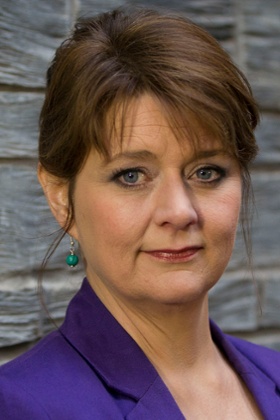
Leanne Wood, the Plaid Cymru leader, has categorically ruled out Plaid Cymru supporting a Conservative government. And it would not vote for Labour plans to implement austerity or renew Trident, she said.
There’s no way that we could support the Tories in government, absolutely not. Wales has never given a mandate for the Tories to rule over us and it’s highly unlikely that they will next time ...
She added:
While we won’t prop up a Tory government, we won’t back a Labour government to implement austerity and Trident replacement either. We would not be part of a formal coalition with a Labour government prepared to renew Trident. There is no way that Plaid Cymru MPs will ever vote to support the replacement of a system which would cost £100bn and which no government would ever realistically use.
Updated
Sajid Javid, the Conservative culture secretary, says Labour’s plan to reverse the planned corporation tax cut could cost 100,000 jobs.
Corporation tax will fall from 21 to 20% this April. And Labour have committed to reverse this – risking 100,000 jobs #youcouldntmakeitup
— Sajid Javid (@sajidjavid) March 31, 2015
I wonder how long that will survive the factcheckers.
More on Joey Essex. (See 9.29am.) Apparently he was impressed by Nick Clegg’s “honesty” and now realises that Clegg’s party isn’t called the Liberal Democats.
There is a joke about this on the Lib Dem website.
Updated
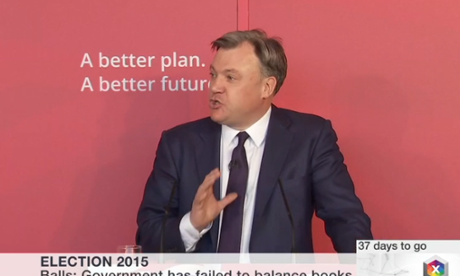
Ed Balls, the shadow chancellor, is speaking in Swindon, where he is confirming Labour’s plans to cut business rates for small businesses. He is announcing that this would be introduced in Labour’s first budget.
According to Sky’s Sophy Ridge, he’s adjacent to a graveyard.
Ed Balls is giving a speech on Labour's help for small business. In a graveyard. #GE2015 pic.twitter.com/OuvRWst7qr
— Sophy Ridge (@SophyRidgeSky) March 31, 2015
Osborne welcomes 'hat-trick' of economic good news
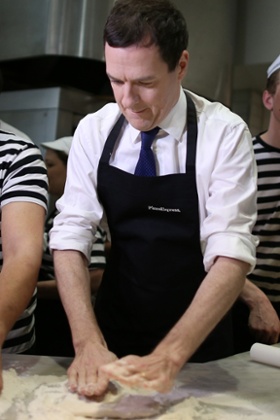
The Conservatives have welcomed three pieces of economic data that have come out today.
- Growth for 2014 has been revised upwards. The Office for National Statistics has revised upwards its estimate for GDP growth in the last quarter of 2015, from 0.5% to 0.6%. And it has upped its estimate for GDP growth during 2014 as a whole, from 2.6% to 2.8% - the highest since 2006.
- The ONS has released figures showing that real household disposable income (RHDI) per head in the final quarter of 2014 was 2.2% above its pre-economic downturn level.
This is what George Osborne, the Conservative chancellor, had to say about this.
Today we’ve got a hat-trick of good news about the British economy and with 37 days to go to the election, it’s another sign that changing course would put recovery at risk.
We’ve had a significant upgrade to GDP, the highest consumer confidence for over 12 years and confirmation that living standards are higher than they were at the last election. This is good news for families and businesses across the country.
So voters now face a stark choice: do we stick with a plan which is working, delivering growth and jobs, or do we put all that at risk with Ed Miliband whose policies of more spending, more borrowing and higher taxes will lead to economic chaos?
And here is Robert Peston, the BBC’s economics editor, on the figures.
Real household disposable income per head, consumption per head and GDP per head now all above where they were at last election
— Robert Peston (@Peston) March 31, 2015
Updated
What do you think should be in the party manifestos? We’re running an online survey and inviting readers to suggest ideas, with the aim of writing “readers’ manifestos” for each party.
Nick Clegg is also doing a high-viz photocall.
First hi-vis of the campaign trail. Nick Clegg visits a building site in Watford, where voters will one day live... pic.twitter.com/A4S56IDhxZ
— Tamara Cohen (@tamcohen) March 31, 2015
(Sorry, Tamara. David Cameron beat him to it. See 10.21am.)
Clegg is in Watford, which has the rare distinction of being a Lib Dem target seat. It’s a three-way marginal and the latest Ashcroft poll puts the Lib Dems just two points behind the Conservatives, who hold the seat. The Lib Dem candidate is Dorothy Thornhill, who has been mayor of Watford since 2002.
Plaid Cymru launches its manifesto
Plaid Cymru, the Welsh nationalist party, is launching its manifesto this morning. Leanne Wood, the Plaid leader, said that if Plaid held the balance of power in a hung parliament, it would fight to rebalance power and wealth away from Westminster.
People in Wales are rightly sceptical of the rhetoric of the establishment parties. The four Westminster leaders offer us nothing more than further swingeing cuts to our public services and no commitment to securing an economic recovery for all.
But this election provides Wales with an unprecedented opportunity. There will very likely be another hung parliament in May and the direction of the next government could come down to how strong a presence Plaid Cymru secures in Parliament at the election.
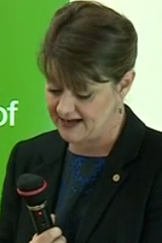
She added:
The people of Wales can have faith in us. If Plaid Cymru holds the balance of power, we’ll rebalance power and wealth throughout the UK. Away from the financial sector in the City of London and to communities such as those in Wales who need investment.
But Plaid suffered a bit of a setback this morning when Lord Elis-Thomas, a former party leader, said the party had failed to persuade the people of Wales they were a better option than Labour. He told the BBC:
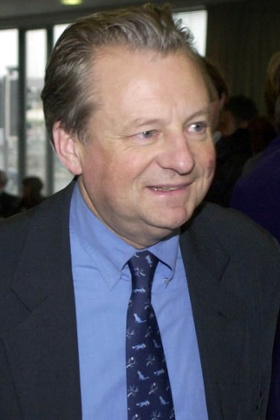
I have no issue with the decision of the Welsh people to vote for the Labour Party, because they clearly haven’t been convinced that we are a better alternative.
In Scotland the SNP have convinced them, it seems to me from the polls, and therefore that’s our responsibility, we have to have a better election than we’ve ever had before.
Updated
David Cameron has been visiting Sainsbury’s HQ in London.

The trip included the obligatory high-vis jacket pose.

Here is the Lib Dem election spokesman Lord Scriven responding to David Cameron’s failure to say where the proposed £12bn Conservative welfare cuts would come from.
It is time for the Tories to come clean about their plans to cut £12bn in working-age benefits from the welfare budget, which will hit 8m low income families.
The Conservatives might not think it’s ‘relevant’ to say whether they would tax disability benefits or restrict child benefit to the first two children but the people who rely on this support do.
Sturgeon says Trident would stop SNP backing Labour on confidence and supply basis
Nicola Sturgeon was interviewed on BBC Radio Scotland this morning. As my colleague Libby Brooks reports, she said the SNP would not support a minority Labour government in on a “confidence and supply” basis if it went ahead with Trident renewal.
Pushed by host Gary Robertson whether Trident was still a red line and precisely where that red line sat, Sturgeon clarified (at least to an extent).
She has said all along a formal coalition with Labour is highly unlikely. A less formal agreement of confidence and supply would need a formal agreement that the renewal of Trident wasn’t proceeding, she said.
If SNP support for Labour was on a vote by vote basis, “we don’t vote for things we don’t agree with and under no circumstances would we vote for renewal of Trident or spending money on renewal of Trident.”
“It’s still a red line in terms of any formal arrangement with Labour”, she insisted. “If it’s on a case by case basis we will never ever vote for Trident.”
Also, asked whether she would support a benefits cap of £26,000 per household, she failed to endorse her predecessor Alex Salmond’s support for a cap in principle, saying: “I don’t agree with the obsession with benefits caps. I want to look at how we lift people out of poverty.”

Updated
On Sky this morning David Cameron said that in 2010 Britain was on the brink and had a deficit forecast to be higher than Greece’s.
My colleague Alberto Nardelli has been fact checking this. Here’s his conclusion.
By a very narrow measure, with no context, Cameron can make that claim but it is just not comparing like with like and does not stand up to scrutiny.
Clegg launches Lib Dem mental health manifesto

Nick Clegg held a press conference at 7.30am this morning to release the Lib Dem “manifesto for the mind”. He said the Lib Dems would spend £3.5bn more on mental health.
And here are some of the other lines that emerged.
- Clegg accused the Conservatives of trying to pretend they were committed to finding another £8bn for the NHS to find Simon Stevens’ plan when they weren’t. He said the Lib Dems were committed to giving the NHS an extra £8bn by 2020, but that Labour had not made that pledge and the Tories “try to give the impression they have, but they haven’t”. (Listening to the David Cameron interviews this morning, it is clear he has a point. See 9.21am.)
-
Clegg praised Tim Farron, the favourite to succeed Clegg as leader who was recently criticised by Paddy Ashdown.
Clegg heaps praise on Tim Farron: "I'm a great fan of Tim." Says attacks by Cable, Ashdown etc are not in his name
— Matt Chorley (@MattChorley) March 31, 2015
And here’s Alastair Campbell, Tony Blair’s former spin doctor and now a prominent mental health campaigner, on Clegg’s “manifesto for the mind”.
Nick Clegg has been a force for good on mental health stigma but the reality is that MH services have gone backwards under the coalition
— Alastair Campbell (@campbellclaret) March 31, 2015
And here’s my colleague Patrick Wintour on the cost of a place on the Lib Dem battlebus.
It costs £12,000 inc VAT per seat for a Lib Dem election campaign bus season ticket. The price of democracy.
— Patrick Wintour (@patrickwintour) March 30, 2015
For that price, you would expect to get a peerage thrown in too.
Nick Clegg has been posing for a selfie with Joey Essex. No, I’ve never heard of him either, but apparently he’s a reality TV star, and the trendy people in the office tell me people will be interested.
.@JoeyEssex_ Really nice to meet you this morning. Sorry about the early start! Hope the programme goes well! pic.twitter.com/QOyyIUSc1I
— Nick Clegg (@nick_clegg) March 31, 2015
Cameron's morning interviews - Summary and analysis
Those weren’t the most revealing interviews ever. But we did learn a few things that were new. Here are the key lines from David Cameron’s morning interviews.

-
Cameron refused to rule out taxing disability benefits. This was one of the proposals in leaked Department for Work and Pensions proposals that emerged last week. Cameron was specifically asked on BBC Breakfast if he would embrace this idea. He pointedly did not refuse to rule it out, but he said he would “safeguard” the personal independence payment, the new benefit being brought in to replace disability living allowance. This is what he said in response to the question about taxing disability benefits.
What we’ve done through this parliament is we’ve actually improved the money that goes to the most disabled people in our country. We’ve replaced one benefit – disability living allowance – with a new benefit – personal independence payment – it’s working well, it is also going to lead to some savings over time and we haven’t created that benefit in order to undermine it. We want to enhance it and safeguard it.
-
He hinted that the Conservatives would try to squeeze more efficiencies from the NHS than already planned. This came in the Today interview, when he was asked if he would provide the extra £8bn cash that Simon Stevens, the NHS England chief executive, says the service needs by 2020-21. Stevens has published an NHS Five Year Forward View plan that says the NHS needs an extra £30bn by the end of the next parliament, but that £22bn could come from efficiency savings. Cameron implied even more money could come from efficiencies. Asked about funding the plan, he told Sarah Montague:
We have funded the first part of that, with £2bn extra in the coming year, and we have said that combined with efficiencies and the extra spending we are going to put in, we are confident we can achieve the Stevens plan in full.
But, when she pressed him why he would not confirm that he would spend an extra £8bn, he replied:
It depends how much you save from efficiencies.
-
He said that coalition government led to promises being “haggled away in backroom deals”. Majority govrnment was more accountable, he said.
Majority government is more accountable. What I put in my manifesto is the programme for the government. Nothing gets haggled away in backroom deals. And I think people want the clarity, that certainty, that accountability from the election and the outcome.
This is one thing on which he would agree with his great foe, Ed Balls.
-
Cameron claimed that he was not making plans for a minority government. Asked about a “plan B”, he replied:
For the next 37 days there is no plan B.
Note that: “for the next 37 days”. There will be plenty of time for a plan B after 7 May, he seemed to be implying. He also claimed he was not engaged in “secret talks” about a coalition.
I’m not having talks with anyone. I barely have time to have talks with my wife, let alone talks with anyone else.
- He claimed that pressure from his wife Samantha had nothing to do with him ruling out serving a third term.
-
He defended the Conservative claim that Labour plans would lead to taxes going up by £3,000 for working households. This is the allegation dismissed as unfounded by the Institute for Fiscal Studies yesterday. But Cameron said:
I think it’s a totally fair assumption. If Labour want to come forward now and change the assumptions and set out their own assumptions, then they can. But in the meantime, the best calculation available is the one that we have made.
- He claimed a Labour government would “pick people’s pockets” through higher taxes.
-
He said the Conservatives would create an extra 2m jobs over the next parliament. That was based on the rate of job creation over this parliament, he said. And he dismissed complaints that this was more than the Office for Budget Responsibility expected.
The Office for Budget Responsibility predicted half that number of jobs in the last parliament and we doubled what they predicted and we’re believing that we can do that again.
- He said Labour’s plans to raise corporation tax was “a crazy thing to do when the economy is growing”. Labour wants to reverse a planned cut in corporation tax to find money to cut business rates for small businesses.
- He claimed that he was running a positive campaign.
-
He said he would not try to persuade the SNP to work with a Conservative government. That was because they were committed to breaking up the UK, he said.
Updated
Severin Carrell, our Scotland correspondent, reports that Jim Murphy, the Scottish Labour leader, will press forward with a plan announced last week to spend £175m on a Scottish anti-poverty fund during a visit to a food bank in Edinburgh South, a marginal seat which the Scottish National party is threatening to take, later this morning.
Murphy will say at least 61 children a day used food banks in Scotland, with over 3,000 children using food banks in December alone.
Meanwhile, the Scottish Tories are planning to make fresh claims about the disproportionate impact of the Scottish government’s new property tax, which replaces stamp duty, that comes into force tomorrow, 1 April.
The Tories say that new data on the land and buildings transaction tax, which is the first new tax introduced by the SNP in government, “will reveal the true impact of those changes to homebuyers across the country.”
Updated
My colleague Nicholas Watt thinks David Cameron was less than frank in his Today interview when asked he he regretted passing Andrew Lansley’s health reforms. (See 8.22am.)
Clever @Sarah_Montague asks @David_Cameron if stop Andrew Lansley NHS reforms if had time again. Private views unsuitable for morn audience
— Nicholas Watt (@nicholaswatt) March 31, 2015
Here’s the full audio of Cameron’s interview on the Today programme:
Q: On Thursday you will stand next to Nicola Sturgeon in the debate. What will you do to convince here that the SNP should not vote down the Conservatives?
Cameron says he will not try to do that. He knows what the SNP stand for. They want to break up the UK. Labour won’t rule out an agreement with them. But he says he will.
Q: What will you do if you have a minority government but you cannot rule?
Cameron says he is fighting for a majority. All the alternatives would lead to “economic chaos”.
The country is ready for majority government. We have made coalition work, he says. But coalition government means things get taken into dark room, and get haggled away.
And that’s it. That was Cameron’s final interview of the morning (we think). I’ll post a summary soon.
Updated
Q: Where will you find the £12bn welfare cuts. You have explained £2bn, but not the other £10bn.
Cameron says he is saying the government needs to save £1 out of every £100 the government spends for the next two years. He would rather do that than put put taxes or borrowing.
In the last parliament the government saved £21bn from welfare. It needs another £12bn. It would freeze working-age benefits. That saving is 10 times as big as any saving proposed by the other parties.
He says the welfare cap needs to be lowered. Letting young people get housing benefit should be stopped.
Q: Is it right to say you won’t explain your plans until after the election?
Cameron says he has set out the outlines of his plan. The Labour plan has no numbers.
Q: Grant Shapps said, if Labour won’t tell us where they will raise money, we have to guess. So should people just guess where your welfare cuts will come from.
Cameron says Labour are free to explain where the cuts will come from.
The job is not finished, he says. Labour would put it all at risk.
Updated
Q: Do you regret passing Andrew Lansley’s Health Act?
Cameron says they have taken 20,000 bureaucrats out of the NHS. That meant more resources could be put into frontline services. As a result the NHS in England has performed better than in Wales.
Q: The King’s Fund said this had been disastrous.
Cameron says 15% more patients are being treated for cancer every year. Outcomes have never been better.
Q: Would you pass the Act if you had your time again?
Cameron says he made a choice, to take the bureaucracy out of the NHS and put it into frontline care.
He praises Jeremy Hunt for focusing on standards of care.
Updated
Q: Can you commit to spending the extra £8bn that the NHS needs?
Cameron says the government has already allocated £2bn. He says he is confident that the Simon Stevens plan (that requires an extra £8bn) can be met in full.
Q: Will you commit yourself to spending that extra £8bn a year?
Cameron says it depends how much money you raise from efficiency savings.
The government protected health spending, he says. He says Labour said [at the time of the last election] that was irresponsible.
You need a strong economy to protect the NHS, he says.
Q: So will you fund the £8bn?
Cameron says the Tories will set this out in their manifesto. They believe, with extra spending and efficiency savings, they would be able to fund the Stevens plan in full.
Updated
Q: You were asked last week what you regretted, and you said you promised to make politics more polite and failed.
Cameron says he was not being impolite yesterday.
His vision is a positive one, he says. He is talking about building more homes.
Cameron's Today interview
Sarah Montague is interviewing David Cameron.
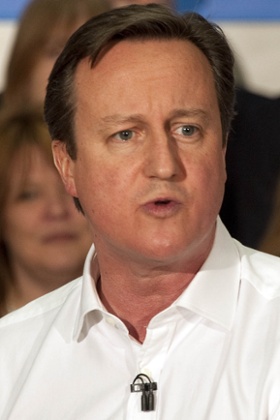
Q: Cameron said he wanted to let positive outweight the negative. But he started yesterday with a personal attack on Ed Miliband. Why?
Cameron says he was setting out a choice. His long-term economic plan would produce more jobs. He can’t think of anything more positive.
He makes no apology for setting out the danger Labour would pose.
Q: But you used your platform yesterday to attack Miliband, as if people should just vote Conservative for fear of the alternative.
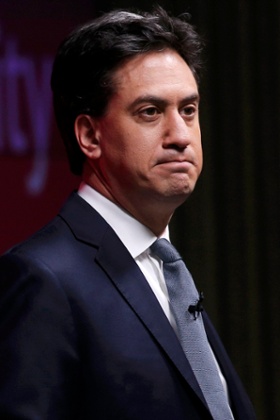
Cameron says he does not accept that.
Q: Was the tone wrong yesterday?
No, says Cameron. He was explaining the choice. He will defend his record. But Labour has opposed everything he had done.
Q: Your claim about Labour raising taxes by £3,000 was pulled apart as virtually absurd. Do you still stand by that?
Yes, says Cameron.
He says Labour has voted for adjustments, and said half should come from tax. That is equivalent to £3,000 for working households.
Updated
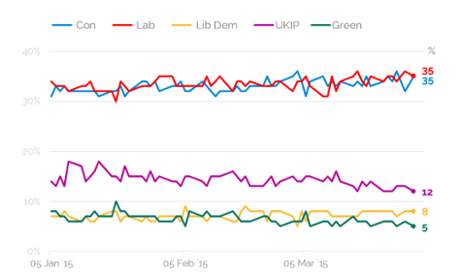
YouGov poll says Tories and Labour tied on 35%
Here are today’s YouGov polling figures.
Update: Con & Lab tied - Latest YouGov / The Sun results 30th Mar - Con 35%, Lab 35%, LD 8%, UKIP 12%, GRN 5%; APP-10 http://t.co/YegZcU9g92
— YouGov (@YouGov) March 31, 2015
Here’s the audio of Cameron on Good Morning Britain.
Q: You say you won’t serve a third term. So, if people like you, and there’s going to be a leadership battle, we should they vote for you?
Cameron says he will serve a full third term. But he won’t go on and on and on.
Q: Was it Samantha who did not want you to serve a third term?
No, says Cameron. She is absolutely behind him. She agrees it’s a job half done.
And’s that’s the ITV one over. I’m afraid it was pretty dull.
Q: Is it because you don’t know where the cuts will fall? Or do you know and aren’t saying?
Cameron says, where the Conservatives know where they want to cut, they have been clear about this.
Q: You have said you will cut £12bn from the welfare budget. Why won’t you tell people where that will come from?
Cameron says the Conservatives have been the most specific of all the parties about saying where the money for cuts will come from. The government needs to find £1 from every £100 it spends. It is better to do that than to put up taxes or increase borrowing.
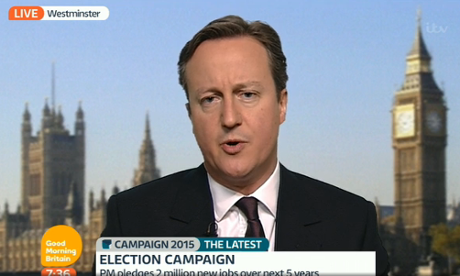
Q: You are running a negative campaign, aren’t you?
David Cameron says he is talking about his plans to create 2m jobs. You can’t be more positive than that.
But elections are a choice, and so he makes no apology for telling people about Labour’s plans to put up taxes, spending and debt.
Morning. I’m taking over from Claire now.
David Cameron is just about to start his third interview, on ITV’s Good Morning Britain.
Here’s the full audio of Cameron on Sky News.
Asked about his pledge not to serve a third term, Cameron says he was giving a straight answer to a straight question. He said he didn’t necessarily believe that all prime ministers go mad.
Cameron rejects the interviewer’s portrayal of him as Scrooge. He says the election is a choice between cutting welfare and a spending Labour party.
Updated
Cameron pledges to train three million apprentices in the next parliament. There is no reason why we can’t carry on creating a thousand jobs per day, he repeats.
Cameron says he is going to work flat out for a Conservative majority.
Cameron says the public want a majority government that “won’t get haggled away in backroom deals”.
Cameron's Sky News interview
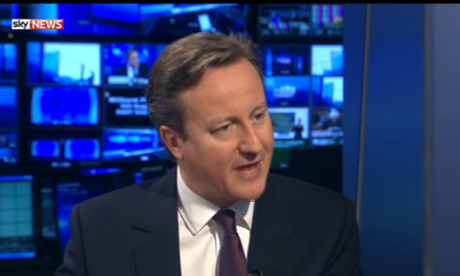
Next up Sky News. This time in the studio. Cameron is asked about his refusal to take part in head to head debates with Ed Miliband. The interviewer said it would have been better to debate with Miliband than “getting clubbed to death by Paxo”.
Cameron didn’t see it that way. He said it was right that interviewers had a chance to ask robust questions.
Cameron repeats the “stick to the plan” message.
Updated
Here’s the full audio of Cameron’s interview on BBC Breakfast.
Cameron again said the choice was between carrying on with the Conservative’s economic plan or opting for Labour which has refused to set out how it would make spending efficiencies.
PM clear on @BBCBreakfast - 2m jobs is something Cons "believe" they can create, not s/thing they're pretending they can guarantee
— Ross Hawkins (@rosschawkins) March 31, 2015
Updated
Presumably meant in the sense of trying to “psych out” his opponents, but this is unfortunate phrasing…
.@BBCBreakfast has just accused @David_Cameron of engaging in 'a bit of psycho campaigning' #ge2015
— Robin Brant (@robindbrant) March 31, 2015
What business can’t find a £1 of saving for every £100 of spending, Cameron said referring to the Conservative’s budget plans. On benefits savings, Cameron said in the next parliament the Conservatives would look for half as much savings on benefits as it had in this parliament.
Cameron refused to rule out privatising disability living allowance.
Cameron insisted that the Conservative’s claim about Labour’s tax bill was “fair” despite claims by the Institute for Fiscal studies that it was unhelpful. Cameron said the election was a choice between a government that will find savings and won’t pick your pocket, and a Labour party that would pick people’s pockets.
Cameron on BBC Breakfast
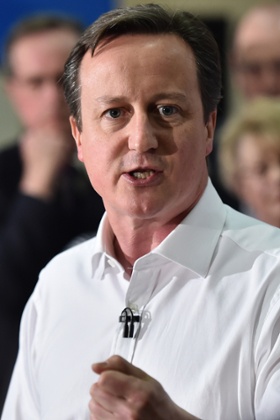
Cameron kicks off a round of breakfast interviews by claiming his coalition government created 1,000 jobs per day.
Asked about his claim on Monday that Labour would cost £3,000 a year to taxpayers, he told BBC Breakfast “we have made the necessary calculations”. Cameron said “we have seen the books”.
Updated
Morning briefing
Good morning and welcome back to the Guardian’s election live blog as we settle in for the long campaign. Knowing how you hate to miss a key pledge, candidate gaffe or mis-spelt party leaflet, we will be live blogging every day from 7am till late to bring you every question, answer and evasion from now until 7 May (and likely beyond).
I’m Claire Phipps, starting things off before Andrew Sparrow steps in later this morning. We’re on Twitter @Claire_Phipps and @AndrewSparrow, and reading comments below the line, too, should you want to give us a shout.
Here’s what you need to know this morning:
The big picture
It’s calculator apps at dawn, as the Conservatives and Labour clash over who will spend/cut/borrow the most should they get the keys to No 10. David Cameron will promise two million new jobs in his second term; Ed Balls will be wooing small businesses with a promise to cut rates in his first budget – paid for by reversing the most recent cut in corporation tax.
- As the Guardian reports on its front page this morning, David Cameron’s opening swipe that working families would face a £3,000 tax rise if Labour were elected met with a dismissive response from the Institute of Fiscal studies, which labelled the figure “unhelpful and of little value”. But the IFS also said there was “real uncertainty about what path Labour wants to follow for the public finances”.
- Personal digs abounded, with Cameron lamenting “the economic chaos of Ed Miliband’s Britain”, labelling the Labour leader a “Hampstead socialist” (surely the worst kind). Ukip said Nigel Farage would today accuse the prime minister of “wilful deception” over promises to cut immigration levels.
- Despite all the unpleasantness, the party leaders will line up alongside each other tomorrow evening for the first TV debate (we’re not counting last Thursday, given that Cameron and Miliband didn’t set eyes on each other). Yesterday the order was confirmed as – from left to right, in podium terms at least – Natalie Bennett (Green), Nick Clegg (Lib Dem), Nigel Farage (Ukip), Ed Miliband (Labour), Leanne Wood (Plaid Cymru), Nicola Sturgeon (SNP) and David Cameron (Conservatives):
“Clowns to the left of him” says a Tory source re the debate line up: http://t.co/dKc422qn1B pic.twitter.com/EiIZeklc2f
— Guido Fawkes (@GuidoFawkes) March 30, 2015
- For a masterclass in how to make a politician exceedingly uncomfortable while being smilingly polite throughout, take a look at Evan Davis’ Monday night Newsnight interview with a fidgety Grant Shapps, as the Tory party chairman is quizzed over the £3,000 figure, and asked whether the online marketing companies he set up are really the kind of business the Conservatives should be championing:
For a full round-up of yesterday’s key developments, cast your eye over this summary by my colleague Nadia Khomami.
And here’s our regular glance at who’s up, who’s down, and who’s keeping their balance in the middle:
Diary
- David Cameron surfs the sofas of the morning TV breakfast broadcasts, finishing off with a spot of radio on the Today programme at 8.10.
- At 7.30am, Nick Clegg will announce more than £2bn of extra funding for mental health over the next parliament; read the details of the pledge here.
- Also this morning, Nigel Farage is in Kent for the Ukip campaign poster launch.
- Plaid Cymru launches its manifesto; leader Leanne Wood is on the Today programme at 8.30am.
- Labour seems to be pretty quiet today, other than Ed Balls on cutting rates for small businesses. Miliband might well be preparing for tomorrow’s TV showdown. Farage – who’d have guessed? – told reporters he’d done nothing yet to get ready for the debate.
The big issue
There’s no escaping David Cameron today. He’ll be touring TV and radio stations this morning, having already sat down with the Daily Mail for an interview in which he promised to create “a job for everyone that wants one”, adding that the current government had “generated four private sector jobs for every public sector job lost”.
He added that he planned to put “rocket boosters” under the right-to-buy scheme, suggesting that in the Tory manifesto housing association tenants will win the right to purchase their homes.
On the SNP, he told the Mail:
They are different. They want to break up Britain. You cannot deal with these people …
And on money, aspiration and Conservatism:
There’s a very natural instinct to keep more of their own money to spend because you want to spend it on your family, you want to try and plan for a nice holiday, have a bit more put aside for Christmas, take the children on that trip you want to take them on.
That’s the most natural instinct in the world. Owning your own home – I’ll never forget the moment I got the first keys to my first flat and walked through the door. You just feel so excited that you own something and you’re going to take care of it.
He confirmed that his wife, Samantha Cameron, would be upping her role in the campaign:
She will be sometimes on her own, going to support candidates, some of the time with me, some of the time sorting out the children’s homework and her business and everything else she’s got to do.
She’ll take multi-tasking to a new level.
(Only women multi-task, have you noticed?)
We can expect some rather different questions and answers later on today when heat magazine – google it, highbrow politics readers – publishes its own interview with the prime minister. heat has already revealed that the PM knows all the words to Let It Go and promises further revelations such as “what sauce does he put on his chips?” Stay tuned.
Read these
- In the Times, Rachel Sylvester warns party leaders of the need to reach out beyond their traditional voters:
There is an interesting mixture of arrogance and insecurity in the failure by the Conservative and Labour leaders to reinvent their parties. On the one hand, both are so convinced of the strength of their own argument that they do not feel the need to win over non-believers; on the other, each also feels that their only task so close to an election is to secure the support they already have rather than trying to shake up the system.
The bitterness and negativity that will only intensify between now and May 7th derive from the fact that each party is going into battle from a position of weakness rather than strength. They are fighting fear with fear in the hope that by attacking their rivals they will protect themselves by turning attention away from their own faults.
- Kezia Dugdale, Scottish Labour deputy leader, writing in the Daily Record, goes on the offensive over Nicola Sturgeon’s call for Labour to work with the SNP:
If she was really honest, she’d admit another five years of the Tories is exactly what she wants in the hope that would provoke Scots to be “all in” for another independence referendum. The greatest gamble of all.
But here’s the truth. If you play in the SNP casino, it’s the Tories’ house that always wins.
- In the Guardian, Polly Toynbee is also thinking about Labour’s future in Scotland:
Burning with energy, blessed with an enviably able new leader, the SNP feels like the party of most Labour activists’ secret dreams … With motions on more generous benefits, land reform, no fracking, no austerity, no Trident, when Nicola Sturgeon says SNP support would give Labour ‘backbone and guts’, a good many English Labour party members might nod in agreement.
-
Patrick Strudwick, at Buzzfeed, has an extraordinary interview with Adrian Hyyrylainen-Trett, the Lib Dem candidate for Vauxhall and the first would-be MP to go public about his HIV+ status:
It’s everyone’s personal choice whether they speak publicly. I’ve come to a position in my own mind that it’s time someone talked about it. I couldn’t have done this five or six years ago.
The day in a tweet
A colourful take on what the country could look like on 8 May from US data site FiveThirtyEight. True, its founder Nate Silver didn’t quite call 2010 right; here’s his mea culpa for that one. Its revised forecasting model is explained here.
Lib Dem supporters look away now: the yellow swaths are predicted SNP seats.
Our predictions for the U.K. election: http://t.co/7NSj88FMJS #GE2015 🇬🇧🇬🇧🇬🇧 pic.twitter.com/C8W1JncRfz
— FiveThirtyEight (@FiveThirtyEight) March 30, 2015
If today were a novel, it would be …
Breakfast at Tiffany’s. The only breakfast you’re likely to get today that won’t be gatecrashed by the prime minister.
The key story you’re missing when you’re election-obsessed
It’s the final day of negotiations on Iran’s nuclear programme, as the midnight deadline approaches for a settlement in which Iran could accept restrictions on its nuclear capabilities in return for a lifting of UN sanctions.