Afternoon summary
- William Hague, the outgoing leader of the house, has suffered a humiliating rebuff on the final day of his parliamentary career when a Tory backbench rebellion saw off an attempt, engineered by Hague and the chief whip, Michael Gove, to start the ousting of the Speaker, John Bercow. As Patrick Wintour reports, a motion to ensure there was a secret ballot to elect the Speaker in the next parliament was defeated by 228 to 202. The result, prompting Bercow to fight back tears, was greeted by enthusiastic and rare applause in the chamber by Labour MPs who had managed to stave off the Tory ambush to bring in a secret ballot, a procedure that would increase the chances that Bercow would be removed.
- Downing Street has announced that David Cameron has asked the Queen to summon the new parliament to meet on Monday 18 May. That suggests he expects a new government to be in place by then, 11 days after polling day. The state opening of parliament, and the Queen’s Speech, has been set for Wednesday 27 May.
-
The Liberal Democrats are facing a police investigation over allegations that they received donations in breach of party funding rules. As the Press Association reports, the Electoral Commission said that it had passed details of the alleged breaches to the Metropolitan Police as they were potentially a “criminal matter”. The allegations relate to recent reports by The Daily Telegraph and the Channel 4 Dispatches programme. A Lib Dem spokesman said: “When the party was notified of the allegations, we immediately referred them to the Electoral Commission and have fully complied with their inquiries. We will continue to cooperate with any investigation.”
-
A Liberal Democrat candidate in a very close marginal seat has been arrested over allegations of child abuse. As Rowena Mason reports, Jason Zadrozny was fighting to win Ashfield against Labour shadow minister Gloria de Piero, who won by only 192 votes in 2010.
That’s all from this blog for tonight.
We’ll shortly be launching a new blog here covering the build-up to the Cameron/Miliband live interview/Q&A with Jeremy Paxman, the event itself, and all the best reaction and analysis.
Updated
This afternoon Downing Street said that David Cameron still had “full confidence” in Michael Gove, the chief whip, despite the effective defeat the government suffered in the vote on whether the next ballot to elect the Speaker should be held in private.

But, at the lobby briefing, Cameron’s spokeswoman refused to say whether Cameron thought John Bercow was going a good job. “That’s a view for MPs across the House to express,” she said.
Asked if Cameron was disappointed by the result, the spokeswoman said: “It was for the House to decide, and they have expressed their view.”
Updated
My colleague Henry McDonald is following the election campaign in Northern Ireland. One MP is making an issue of football.
Embattled Alliance Party MP Naomi Long is speaking up today for one of the major institutions in her East Belfast constituency - Glentoran Football Club. And in her sights is the online vendor Ticketmaster as villain of the piece. Tickets for the Irish Cup Final between Glentoran and Portadown next month can only be bought through Ticketmaster and Long fears this could lead to trouble at the big game.
“Unfortunately, and despite sterling work carried out by the club, we have seen past violence at this particular fixture. My fear is that with Ticketmaster selling Final tickets, a number of people who aren’t fans may travel to the game for the express purpose of seeking disorder and the current set-up would only help them achieve that,” the Alliance’s sole MP warms.
Long launches her own campaign for re-election this Monday in East Belfast where she is under pressure from the Democratic Unionist Party’s Gavin Robinson - no relation we might add to First Minister Peter Robinson.
Hague says Andrew Lansley has been an “intellectual powerhouse”.
And Hague says he regards passing the Disablity Act in 1995, when he was a welfare minister, as his most important legislative achievement.
He says he believes most MPs, in all parties, are sincere and hard-working. The reputation of parliament can be restored by the display of that.
Having watched the Youth Parliament, he is encouraged by the prospects for the future, he says.
Meeting young people is often the most encouraging part of the job of an MP, he says.
And that’s it. Sir George Young, the former leader of the Commons, is wrapping up now. He initiated the debate and he says he thinks the innovation of having a debate that allows leaving MPs to say goodbye has been a good one. He hopes the idea will be repeated.
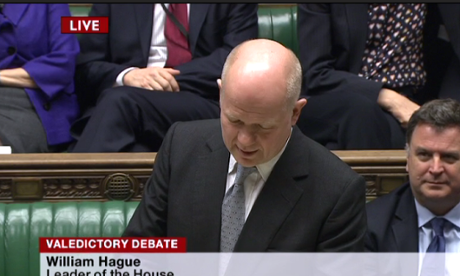
William Hague starts by thanking Gordon Brown for his speech, and his service to the country as prime minister.
Hague says he believes that women having more power will be one of the great achievements of the 21st century.
He is paying tribute to the MPs who have spoken in this afternoon’s farewell debate. They include Jack Straw. Hague says recent controversies about Straw will not overshadow the full contributions he has made.
He thinks Tessa Jowell for helping to stage the best ever Olympics in the world.
William Hague’s final speech
It’s Andrew Sparrow here, taking over from Peter.
And I’m just in time for William Hague’s final speech in the House of Commons.
Angela Eagle, as shadow leader of the house, is speaking in the Commons, noting that unlike most of the recent people speaking she does hope to be back. Overall, she has totted up in a notebook, the retiring MPs have put together 677 years of service in the Commons. “Obviously not in a linear way,” she adds, in case anyone was confused.
Another MP who has made his farewell speech is the Labour representative for Midlothian, David Hamilton. Various tweets have pointed me to this piece by his colleague, Gloria de Piero from earlier this year, about Hamilton’s now rare background before entering parliament.
Among the great details are that after being arrested for alleged assault during the 1984 miners’ strike a jury took just 25 minutes to acquit him. It later emerged the jurors had spent 15 of these electing a chairman.
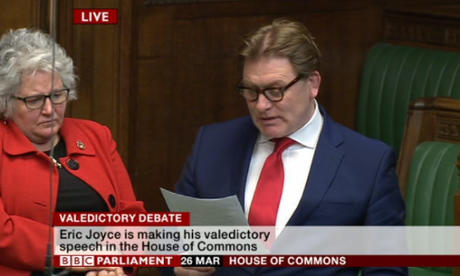
Among the still ongoing series of valedictory speeches is one by Eric Joyce, officially an independent. The MP for Falkirk resigned from Labour in 2012 in the wake of admitting charges of assault connected to a drunken incident in a Commons bar, in which a Conservative MP was headbutted. Not unexpectedly, Joyce is not seeking re-election.
PA has helpfully supplied the names of the Conservative and Lib Dem MPs who voted against the anti-Bercow motion, as I think we can accurately shorten it. They aren’t strictly rebels, as it was a free vote. But it’s fair to say they’re not currently much loved by the government whips.
The 23 Conservative MPs:
David Amess (Southend West), Bob Blackman (Harrow East), Peter Bone (Wellingborough), Graham Brady (Altrincham & Sale West), Conor Burns (Bournemouth West), Christopher Chope (Christchurch), Tracey Crouch (Chatham & Aylesford), Philip Davies (Shipley), David Davis (Haltemprice & Howden), Cheryl Gillan (Chesham & Amersham), Zac Goldsmith (Richmond Park), James Gray (Wiltshire North), Adam Holloway (Gravesham), Bernard Jenkin (Harwich & Essex North), Jeremy Lefroy (Stafford), Edward Leigh (Gainsborough), Julian Lewis (New Forest East), Jack Lopresti (Filton & Bradley Stoke), David Nuttall (Bury North), Jacob Rees-Mogg (Somerset North East), Sir Richard Shepherd (Aldridge-Brownhills), Martin Vickers (Cleethorpes) and Charles Walker (Broxbourne).
The 10 Liberal Democrat MPs:
Malcolm Bruce (Gordon), Lorely Burt (Solihull), Duncan Hames (Chippenham), David Heath (Somerton & Frome), Martin Horwood (Cheltenham), Dan Rogerson (Cornwall North), Bob Russell (Colchester), Jo Swinson (Dunbartonshire East), Stephen Williams (Bristol West) and Simon Wright (Norwich South).
Labour have had their say on the vote about rules to elect the Speaker, and you’d expect there’s a touch of gloating involved. They come from Angela Eagle, shadow leader of the house:

This is a humiliating defeat for David Cameron on the last day of this parliament. Instead of talking about ways to improve the lives of working people, in the last week all the prime minister has done is play petty partisan games and arrogantly talk about his retirement plans. In today’s vote decency and democracy prevailed.
Updated
Information about Lib Dem funding allegations passed to police
Not welcome news for the Lib Dems on the last day of parliament. The Electoral Commission says it has passed to the Met police information about the activities of Ibrahim Taguri, a Liberal Democrat chief fundraiser who stood down as a parliamentary candidate for the party earlier this month after he was caught on tape allegedly advising a fake donor on how to circumvent funding laws.
Taguri was alleged to have told an undercover reporter from the Daily Telegraph that he could make a donation to the Lib Dems via a cousin.
An Electoral Commission statement said matter centres on an alleged beach of section 61 of of the Political Parties, Elections and Referendums Act 2000, and thus fell beyond its remit. It added:
The Electoral Commission has therefore passed the information that it has received to the Metropolitan Police Service (MPS). The MPS have confirmed to the commission that they are also aware of the allegations and that they are considering them.
Further allegations by the Channel 4 programme Dispatches programme on 23 March seemed to be an alleged breach of the same law, and had also been passed to police, it added.
Updated

Lynton Crosby, the Tories’ election guru, was briefing MPs earlier today, the reason so many of them were about. My colleague Rajeev Syal has this on what he told them.
And yes, be warned – this will apparently be “the selfie election”:
Conservative Party officials believe that they need to win over just 11,223 voters in 69 seats to win the general election.
A senior Tory source, speaking on Thursday morning after a final pre-election meeting of the party’s MPs with the election guru Lynton Crosby, said that the race to win is so tight that victory will be fought over a small number of voters in key seats.
“We are going to be fighting a localised campaign, more so than ever before. We will be targeting voters with social media, direct mail, and a digital campaign, as well as on the doorstep.
“But we know that this election is about winning over 11,223 voters in 69 seats… We have that opportunity. Labour’s task, given the collapse of their vote in Scotland and the squeeze from the Greens and Ukip, is absolutely impossible,” the source said.
The meeting, which took place in the large Betty Boothroyd Room in Portcullis House, was essentially a technical meeting, the source said.
Conservative MPs, including cabinet members, were told they will receive daily e-mails from the Party’s headquarters, and will receive notifications on the five “issues of the day”, the source said.
These are not “lines to take”, he insisted, but briefings.
However, the source, who was authorised by the Party to speak to the media after the meeting, said that the campaign would be fought as local campaigns.
“We are fighting each seat, including all seats in Northern Ireland for the first time, and each seat will be fought locally,” he said.
He also agreed that this could become known as “the selfie election” as MPs become used to posing next to members of the public.
“Selfies are important. Photos are taken, and uploaded to Facebook, and reach many other voters,” the source said.
Updated
A much-emptied Commons is hearing speeches from other departing MPs, including Tessa Jowell, who of course harbours hopes of becoming Labour’s candidate for London mayor. One of Jowell’s claims is to be among the few MPs who does not have a home in her constituency. While she represents Dulwich and West Norwood in south London– not really a hardship posting – she lives in Highgate, north of the Thames.
Now the drama and fury of the Speaker debate is passing, thoughts will turn to tonight’s televised parallel questioning of Cameron and Miliband. Here, Marcus Roberts, deputy general secretary of the Fabian Society, discusses how the Labour leader can make the best of this encounter with the MP:
Ed Miliband knows he can beat David Cameron. Miliband has long prepared for the now elusive chance to go head to head with the PM.
But the closest Miliband will get to that moment is Thursday’s interview with Paxman and a studio audience, following on from Cameron’s own grilling, and 2 April’s “leader’s debate” – or multi-candidate pile-up as it might more accurately be described.
Nonetheless, Team Miliband will give these events their all, trusting in Miliband’s own formidable intellect and benefiting from lower media expectations than leaders might experience.
Behind the scenes, debate preparation is a flurry of briefing books, statistics memorisation and scenario responses. The amount of information party leaders are expected to know by heart is ridiculous: as if the prime minister must make decisions on the NHS or housebuilding budgets based on memory alone without recourse to notes or aides. But the standards by which victory will be judged include instant recall of minutiae and Team Miliband will prepare accordingly. Fortunately, the self-confessed baseball statistics geek should have no problem knowing his sums come the night.
The next challenge in debate preparation is wargaming the different question and answer scenarios. Candidates before the debates will go through dozens of question-response drills. For example: if asked about falling unemployment statistics, answer with a story that illustrates the youth unemployment problem; if asked about defence cuts, the answer must include reference to Putin’s Russia and concern over Islamic State, etc.
This is where mock debates can be both help and hindrance. Get the questioner’s line of attack right in advance and answering can feel like a walk in the park. But misjudge the tone or appear robotic as memory spits out pre-canned lines and the danger of not connecting with the audience is serious indeed.
My colleague Patrick Wintour has filed this story on the vote, up on the site soon:
William Hague, the outgoing Leader of the House, suffered a humiliating rebuff on the final day of his parliamentary career when a Tory backbench rebellion saw off an attempt, engineered by Hague and the chief whip Michael Gove, to start the ousting of the Speaker John Bercow. A motion ensure there was a secret ballot to elect the Speaker in the next parliament was defeated by 228 to 202.
The result, prompting Bercow to hold back tears, was greeted by enthusiastic and rare applause in the chamber by Labour MPs that had managed to stave off the Tory ambush aimed at ensuring there is a secret ballot , a procedure that would increase the chances that Bercow will be removed.
Hague was accused of “a grubby, squalid and nauseous” plot and was repeatedly told by Labour, and some Tory MPs, that he had been unwise to engineer a vote on such an important constitutional issue on the last day of parliament, and giving virtually no notice.
The debate was important because the Speaker will have an important role in how parliament is involved in any negotiations on a future coalition, but it also underscored the degree to which Bercow, a reforming Speaker, has alienated the government and many backbench Tory MPs. David Cameron was one of many government ministers that rushed back to the Commons to demand a secret ballot.
The plan to introduce a secret ballot was only tabled by government yesterday late on Thursday afternoon and was kept from Charles Walker, the chairman of the procedure committee, the relevant Commons body that had called for the issue first to be debated more than two years ago.
In a highly charged debate Walker brought Labour MPs to their feet in applause when he revealed the government chief whip Michael Gove gave him no notice of his plan to rush forward a debate on the future of the Speaker.
His voice cracking with emotion, Walker said: “ I have been played as a fool and when I go home tonight I will look in the mirror and see an honourable fool looking back at me, and I would much rather be an honourable fool in this, and any other matter, than a clever man.”
Updated
A valid point on Hague (8 June 2001 was the day after the Tory party he led won 165 seats to the 418 for Tony Blair’s Labour).
Can we stop with the worst point of Hague's career chatter.. pretty sure Friday 8 June 2001 hurt more.
— Harry Cole (@MrHarryCole) March 26, 2015
This, from the BBC, is the key extract from Charles Walker’s emotional and very powerful speech earlier.
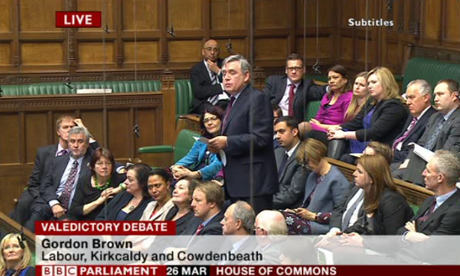
Like a magnificent but shy silverback gorilla making a rare foray from the shadows of his zoo enclosure to delight (and very slightly frighten) the tourists, Gordon Brown has just made his valedictory speech to the Commons. Here’s some extracts, sent on an email rather than typed from life:
When I stood for Parliament in 1983 I asked my constituents to elect me as a candidate of youth and fresh ideas. Of course by 2010 I had to change tack: I asked them to elect me as the candidate of maturity and experience.
But when I first arrived here in 1983 I was so unknown, so patently here just to make up the numbers and so clearly forgettable that The Times newspaper confused me with one of the many other Browns in Parliament - there were as many MPs named Brown as there were SDP or Liberal MPs - and published a photo of me when I was a student alongside a caption which said that I was born in 1926. ...
I leave this House feeling a huge amount of gratitude --- but also with some concern. For I sense that the UK today is fragile, at risk and we are potentially at a point of departure.
Countries at their best, their strongest, their truest, are more than places on the map, more than a demarcation of borders. Great countries stand on shared foundations. They are guided by unifying ideals. They move forward in common purpose. And so it must be with Britain.
And whether the future lies in greater devolution, a new form of federalism or home rule within the UK, in the constitutional revolution now under way I will fight, struggle, do battle and fight and fight again to renew and reconstruct for a new age the idea of Britain around shared values can bring us together and advance a common Britishness – a shared belief in tolerance, liberty and fairness that come alive in unique British institutions like the National Health Service and in common policies for social justice - ideas which we have given to the world, but now seem to be losing sight of at home: unifying ideas that we need to champion anew at the core of a common British national purpose that binds us together in a shared future...
And for me, the most moving mission statement defining our duties as MPs here is the declaration made nearly 100 years ago – on the day after they were elected - by MPs from Clydeside, that we should “abjure vanity and self-aggrandisement” and, as “humble servants of the people”, “have regard for the weak, those stricken by disease, those who have fallen in the struggle for life” and “bear in our hearts the sorrows of the aged, the widowed mother, and the poor, that their lives shall not be without comfort”.
And for this – and for showing me that when the strong help the weak it makes us all stronger - I will always be grateful to my parents who taught me these values of justice, my party who taught me how to fight for justice, and my constituents who taught me every day the rightness of justice.
For we must never forget that what politics at its best can do is imbue people with hope and inspire us all to be better. Wishful thinking about the future is the passive belief something might be done. Optimism is the instinctive belief that yes, something can be done. But hope is the active resolve that something must be done...
I have spoken today of what endures beyond anyone’s time in office, and thinking beyond the perils of things as they are to the wonders of things as they could be – and with hope unbroken, idealism unbowed, a desire to serve undiminished - I leave here as I came here, with an unquenchable faith in a future for our country that we can build and share together, a future where we help shape the world beyond our shores, a future where we always demand the best of ourselves. This is the future worth fighting for and this is the future that I will never stop fighting for.
If you’ve just joined us an are wondering why the live blog on the last day of parliament is obsessed by a vote on changing the way to elect the Commons Speaker, here’s a good place to start.
It is, in many ways, a point of very particular and arcane Commons procedure. But make no mistake, the government will be smarting over this. Someone – most fingers point to Michael Gove in the whips’ office - had hoped their clever ruse to help unseat John Bercow would send Tory MPs off to fight the election on a high. Instead the government is left looking both “grubby “ - the most commonly-used adjective of the debate – and inept. Many MPs agreed the Speaker should be elected by secret ballot. But they did not like this change being pushed through on no notice as a clear assault on Bercow.
The standout speech of an impassioned debate was from Charles Walker (see 12.53pm). Here’s the key passage in full again, addressing William Hague, who must surely wish his Commons career could have ended on a better note:
I have been played as a fool and when I go home tonight I will look in the mirror and see an honourable fool looking back at me and I would much rather be an honourable fool in this and any other matter than a clever man.
I hadn’t noticed Bercow being nearly in tears, but he had every right to be so. The Speaker is not a complete stranger to the occasional satisfied smile, but as MPs go on to other business of the day he looks like a man who’s just found £1,000 down the back of the sofa.
Bercow fighting back tears as vote is read out in parliament
— Kate McCann (@KateEMcCann) March 26, 2015
Extraordinary day in parliament as govt defeated over attempt to make it easier to oust John Bercow - big misjudgment again by the whips
— Rowena Mason (@rowenamason) March 26, 2015
Updated
Government loses vote over new election system for Speaker
After all that punishment for Hague, the vote is lost by 202 to 228. Lots of cheering among Labour MPs.
As we await the vote, the official No 10 Twitter feed has just posted this Reservoir Dogs tribute photo. Presume they draw lots over who is Mr Blue.
PM: The London Black Cab is iconic & I am pleased that there will be a state-of-the-art production facility in the UK pic.twitter.com/ck0xEPbAW9
— UK Prime Minister (@Number10gov) March 26, 2015
The MPs are now voting on the measure for whether the Speaker should be elected by secret ballot or, as now, public vote. BBC Parliament tells me we should have a result at 1.35pm. This one’s going to be interesting.
If the Govt lose this vote, Hague's reputation will hv bn trashed for nothing. His only consolation wd be Whips humiliated too
— Paul Waugh (@paulwaugh) March 26, 2015
Updated
Hague is still being verbally pummelled by an assortment of MPs. The initial reaction to Charles Walker’s speech echoes mine – it was an astonishing address, and a hugely dramatic moment. I was too busy typing to see at the time, but it transpires Walker got a standing ovation from some MPs.
Walker’s name is currently trending on Twitter, it seems. Not a common event.
Amazing cross party outrage at attempts by Govt to undermine the Speaker - and Charles Walker's speech one of the most powerful I've heard
— Chris Leslie (@ChrisLeslieMP) March 26, 2015
Charles Walker clip will be played + replayed but I'll always remember being here. 1 of most electric Parliamentary moments I've ever seen
— Paul Waugh (@paulwaugh) March 26, 2015
On the last day of Parliament, Charles Walker might have secured the award for its best speech (+ he's won a few best speech awards before).
— Sam Macrory (@sammacrory) March 26, 2015
Lunchtime summary
It’s been a busy old morning, and high time for a summary:
- David Cameron and Ed Miliband have been busy making campaign trips ahead of tonight’s first TV debate, at 9pm on Channel 4 and Sky News. This will not be a debate as such – the two leaders will take question separately.
Updated
My colleague Frances Perraudin has words on another bit of business in the Commons today – Labour MPs seeking to see secret police files gathered on them in the 1990s:
Labour MPs have demanded to see secret files that were gathered on them by undercover police in the 1990s even after they had been elected to parliament.
The calls were made in a commons debate prompted by claims in the Guardian by Peter Francis, a former undercover police officer, that he read secret files on 10 MPs during his 11 years working for the Metropolitan police’s special branch.
Francis said that Scotland Yard held files on MPs Harriet Harman, Peter Hain, Jack Straw, Diane Abbott, Jeremy Corbyn, the late Bernie Grant, as well as Ken Livingstone, the late Tony Benn, Joan Ruddock and Dennis Skinner.
Deputy Labour leader Harriet Harman asked the minister of state for justice, Mike Penning, to assure her that the government would allow her to see a full copy of the information gathered on her.
She said of her work in the 1990s: “I was campaigning for the rights of women, the rights of workers and the right to demonstrate. None of that was against the law, none of that was undermining our democracy. On the contrary, it was essential for our democracy.”
“The security services do an important job and the government of course should support them, but if they overstep the mark the government must hold them to account,” she said.
Labour’s Jack Straw, who is standing down as MP on Thursday, repeated a call for the files to be released and said that the allegations relate to a period when he was home secretary between 1997 and 2001.
“I not only knew nothing whatever about what appears to have been going on within the metropolitan police, but may also have been subject to unlawful surveillance myself as home secretary,” he said
Minister of state for justice Mike Penning, who responded to the questions from MPs in the absence of the home secretary Theresa May, said that the recently established Pitchford inquiry into undercover policing would look at Francis’s allegations and promised that he would work to share whatever documents he could with MPs, but warned that some information might have to be redacted.
During the debate, attended by all the serving MPs named by Francis in the Guardian report, Peter Hain said that the surveillance could have compromised the confidentiality between the MPs and a constituents.
“It is one thing to have a police file on an MP suspected of crime, child abuse or even cooperating with terrorism, but quite another to maintain one deriving from campaigns promoting values of social justice, human rights and equal opportunities which are shared by millions of British people,” he said. “Surely, Mr Speaker that means travelling down the road that endangers the liberty of us all.”
Updated
A storming, emotional speech by Charles Walker, the Tory MP who chairs the Commons procedure committee, whose recommendation it was that the Speaker be elected by secret ballot. Walker, it’s fair to say, is not happy at this idea being sprung on MPs on the last day of parliament, without even him being told.
Walker said he had gone to Hague’s own leaving drinks, and seen the chief whip, Michael Gove, yesterday, but did not learn of the planned vote before 6.30pm. Almost shaking with repressed emotion he tells Hague:
I have been played as a fool. And when I go home tonight I shall look in the mirror and see an honourable fool. And I would much rather be an honourable fool in this matter than a clever man.
Walker gets a huge round of applause. Hague surely cannot be enjoying this.
My colleague Rowena Mason has provided this handy explainer as to what, precisely, everyone is getting so excited about now in the Commons.
This morning’s vote has been an old-fashioned piece of parliamentary game-playing led by William Hague, the Tory leader of the House, on his last ever day as an MP in Westminster.
The intention appears to be to make it easier to oust John Bercow, who is loathed by many Conservative MPs because they view him as too sympathetic to the opposition. Labour are keen to keep him in place, not least because he annoys the Tories. Bercow himself was elected as a Tory MP in Buckingham but he is seen as having undergone a political journey towards the centre ground and is eyed with suspicion for having a Labour-supporting wife.
The amendment to the rules enabling a Speaker to be elected by private ballot, rather than openly, was quietly laid yesterday - the day before the last day of this parliament - and was due to be debated mid-morning. Many Labour MPs will have already disappeared to their constituencies after prime minister’s questions. However, Tory MPs are still in the Commons because they were warmly encouraged to attend a meeting with Conservative campaign strategist Lynton Crosby and chief whip Michael Gove at 10.30am. That is not the kind of pre-election that a Conservative MP will want to miss.
On hearing of the plot, a number of Labour MPs were outraged. They then tabled a series of urgent questions in the morning which appeared to be designed to delay the vote and allow time for more Labour MPs to scramble to attend the Commons.n Unsurprisingly, these were granted by the Speaker.
Such skulduggery is relatively rare in Westminster these days but seems to have got many MPs quite excited on what could be their last appearances in the Commons.
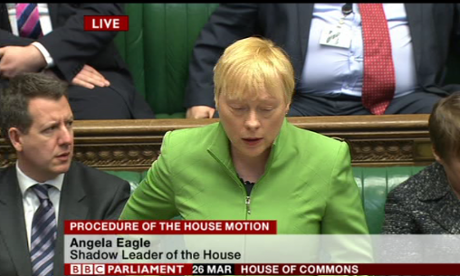
The shadow leader of the house, Labour’s Angela Eagle, is responding to the plans for a new way to elect the Speaker. It is, she says, “an appalling and shabby way to treat the house”.
Here she addressing MPs.
Away briefly from arcane if belligerent debates over how MPs elect the Commons Speaker, the government has another unwelcome legacy today: a rise in homelessness figures.
According to government data, 13,650 households were accepted as homeless by their local council in England from October-December 2014, 6% higher than in the same quarter last year. There was also a significant rise in cases prompted by the end of a private tenancy.
Matt Downie of the homelessness charity Crisis said:
Today’s figures show a troubling 6% rise in homelessness compared to the same time last year, with soaring numbers of people becoming homeless following the loss of a privately rented home.
More and more people are struggling to pay their rent in an increasingly insecure private rented sector. We know from our own research that housing benefit cuts are a central driver of this trend, with more than half of councils fearing worse is yet to come in the next two years.
This must be a wake-up call for all political leaders: the housing crisis will not solve itself. We desperately need more affordable homes as well as political action to fix our broken private rented sector. At the same time, we must have a safety net that genuinely reflects the reality of renting.
As we move onto other matters, here’s a few hastily-gathered tweets about Hague’s last-day ordeal:
Most of the Tories I respect are speaking out against Con whips stitch-up of the Speaker. Hague's worst stand in Parliament
— Kevin Maguire (@Kevin_Maguire) March 26, 2015
Hague accused of being 'grubby cowardly assassin'. It's going really well here
— ann treneman (@anntreneman) March 26, 2015
So the last big eve-of-election act of this parliament is an arcane internal row over their Speaker. Way to go out on a high, guys.
— Gaby Hinsliff (@gabyhinsliff) March 26, 2015
Hague is in the curious position of spending his last day of 25 or so years in the Commons hearing MP after MP alternately praise him as a great parliamentarian before saying his role in the new Speaker election plan will greatly tarnish his legacy. If the speeches so far are any indication, the government has little hope in getting this measure through.
The Tory MP Philip Davies, meanwhile, says the plan is “student union politics” dreamed up by the Tory whips’ office.
Hague is looking less chipper by the minute. Jacob Rees-Mogg gets up to first praise his Tory colleague as “a great parliamentarian” but then express his grave sadness that such a career in the Commons should end with this “jiggery pokery”. This could be the most modern piece of slang ever used by Rees-Mogg.
No one seems to be supporting Hague, and there’s some anger that Cameron is not here to make the case himself. Even David Davis gets up to say he backed the plan initially but now does not.
Here’s Hague in action, valiantly defending the clearly indefensible. The Labour MP Ben Bradshaw has just accused him of having “contempt for parliament”.
Julian Lewis, the Conservative MP who is vigorously opposing the motion, notes that there are all sorts of arguments in favour or against a secret ballot. But he adds:
What there is no case for at all is to stage a debate at the 11th hour at the last day, when people have been sent away to get on with campaigning.
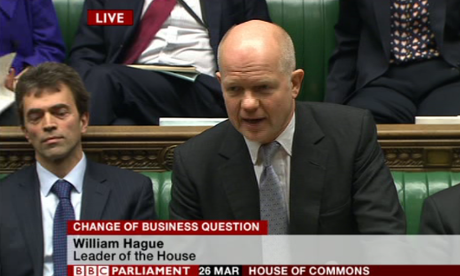
The criticism is still coming. Peter Bone, a fellow Tory, criticised Hague, while Labour’s Angela Eagle called the proposals “petty and spiteful” and “grubby and underhand”.
Jack Straw, another last-day boy, is also criticising Hague, while admitting he did not support Bercow to become Speaker. I wonder if Hague is secretly wishing he could be doing something more fun on his final day in the chamber. But maybe he just loves it.
Bercow, meanwhile, seems to be enjoying it all. In telling another MP to be quiet – I didn’t catch who it was – he told them:
It is better to be silent and look a fool than speak and remove all doubt.
[Later note: PA tells me the admonished MP was Tory Greg Barker]
Updated
Hague under fire over Speaker vote plans
It might be the last day of term in parliament, but they’re not just sitting around in their own clothes playing board games. William Hague, the leader of the house – who, let’s recall, is having his very last day in the Commons – is getting something of a kicking over the plans to change the rules on how the Speaker is elected, seen as ruse to get rid of John Bercow.
It began with Gerald Kaufman, who will be Father of the House in the next parliament, if re-elected:
Gerald Kaufman accuses @WilliamJHague of having 'descended to squalor.. sad, sad, sad!'. Hague says 'water off a duck's back' #dumpbercow
— James Chapman (Mail) (@jameschappers) March 26, 2015
Ed Miliband has been in Bermondsey, south London. There’s no press photos yet, but below is one tweeted by London Labour. While there he’s been speaking about this morning’s report by the Kings Fund thinktank on the coalition’s record on health (see 8.28am), according to quotes sent in by his press people. Here’s a taster, including some very Blair-esque verb-free sentences:
If anyone still underestimated the scale of the crisis facing the NHS then you just need to look at todays report from the Kings Fund. It talks of a “deteriorating” service. The NHS “operating at the very edge of its limits”.
This is the story of the NHS in crisis. Targets missed on A&E waiting times, cancer and hospital treatment. Staff under pressure and morale at rock bottom. GP’s under pressure and access to mental health services under threat. And in the words of todays report, all of this the direct result of David Cameron’s “damaging and distracting” health reforms.
There can be no doubt, David Cameron is to blame. He said we could trust him with the NHS, that it would be safe in his hands, but the verdict today is clear and unequivocal.
You just can’t trust the Tories with the NHS.
.@Ed_Miliband is in Bermondsey & Old Southwark talking with people about Labour's plan for the future. pic.twitter.com/EWn0Lu6FWb
— London Labour (@LondonLabour) March 26, 2015
Bercow: "I'm not going anywhere"
Everyone’s getting in a pugnacious mood ahead of tonight’s first debate, it seems. Responding to a point of order from the Labour MP Paul Flynn, John Bercow has made it plain he hopes – plans even – to remain the Commons Speaker:
Suffice to say I am in the chair and I am intended to remain in the chair, today and I hope subsequent to today. I’m not going anywhere.
Updated
Vince Cable hints Lib Dems will not support in/out EU referendum
Vince Cable and Chuka Umunna were not just complimenting the speaker at business department questions this morning. The former also hinted quite strongly that he – and, he claimed, the wider Lib Dems – took a very dim view of a possible in/out referendum on EU membership, saying it would be hugely damaging for the economy.
This is potentially very significant. David Cameron has made it pretty clear such a referendum is a non-negotiable part of any government programme he leads. Could it be a sticking point for a future coalition?
Umunna asked Cable whether he agreed that “the biggest uncertainty facing business in this country is his Tory Prime minister’s decision to flirt with EU exit and the biggest mistake for his party would be to go along with it”. Cable responded:
It would indeed be disastrous if we were to leave the European Union. There would be a prolonged hiatus before the referendum of held. There are many options which could follow it, all of which would be very very damaging for employment in this country and I and my party will certainly not go along with that.
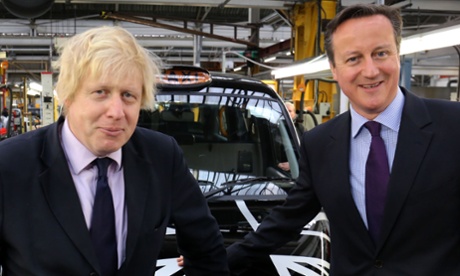
The current and future Tory leader? Who knows. But David Cameron and Boris Johnson joined forces to visit the London Taxi Company in Coventry, which has announced it is to create up to 1,000 new jobs.
While he was there, perhaps inevitably, Cameron was asked for his views on Jeremy Clarkson’s dismissal by the BBC. The prime minister was less supportive of his neighbour than previously:
It’s entirely a matter for the BBC. It’s never right not to treat your staff and people properly. So it’s their decision and I don’t think I should say anything more about it.
Updated
More pre-election love for John Bercow, among some MPs at least. After Vince Cable’s warm words for the speaker (see 10.19am) the shadow business secretary, Chuka Umunna, has just told him (quote from PA):
It is the last departmental questions of this parliament and can I say it has been good to see you in your place at all of them.
Updated
One of the many people not seeking re-election in May is Brooks Newmark. The MP for Braintree resigned as civil society minister late last year, and then stated he would not stand for parliament again, after it emerged he had sent explicit photos of himself via Twitter to what he thought was a young, female, Tory activist, but was in fact was a male reporter.
When the story appeared in the Sunday Mirror some questioned whether it amounted to entrapment. Newmark did not complain himself, but the new press regulator, Ipso, investigated nonetheless. Today it ruled that the Mirror’s tactics were legitimate.
The full ruling is here, but it seems the key point is the reporter in question, Alex Wickham, said he had been told that several MPs, Newmark among them, had approached a number of women via social media “on the pretext that the contacts were professional, but in fact were attempting to initiate inappropriate relationships”.
As mentioned before, we have another live blog examining the supreme court’s decision that Prince Charles’s “black spider” memos to government ministers should be released under freedom of information laws. But just to note that David Cameron has had his say – and he’s hinted the government might change the law. He said in a statement:
This is a disappointing judgment and we will now consider how to release these letters. This is about the principle that senior members of the royal family are able to express their views to government confidentially. I think most people would agree this is fair enough.
Our FOI laws specifically include the option of a governmental veto, which we exercised in this case for a reason. If the legislation does not make parliament’s intentions for the veto clear enough, then we will need to make it clearer.
Here’s a TV screenshot of Cable opening the final day of Commons business.
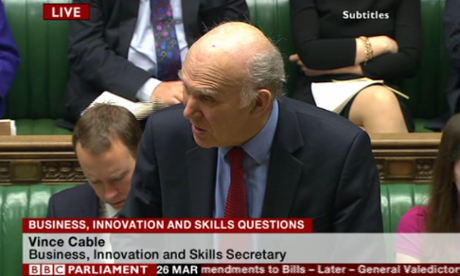
Parliament has started its final day of business before the election, PA reports. In opening remarks the business secretary, Vince Cable, has perhaps hinted he does not personally approve of the clever/grubby (delete as you see fit) plan to change the rules over how the Commons Speaker is elected.
As he starts speaking, Cable thanks John Bercow “for your impartial oversight of our proceedings” as Speaker.
Hello, everyone, this is Peter Walker taking over from Claire. For those missing him, Andrew will be here later for the Cameron-Miliband debate (or rather the debate that isn’t strictly a debate). I’ll be seeing you through the afternoon.
Supreme court backs Guardian over publication of Prince Charles letters to ministers
The supreme court has just delivered a ruling backing the Guardian in its 10-year legal battle to force the publication of Prince Charles’ lobbying letters to ministers.
There is a separate live blog on this: you can catch it here.
A quick round-up of Clegg’s other answers:
On tonight’s TV Q&A
Of course I would have liked to have been part of that … I wasn’t invited to be part of that.
He won’t watch tonight’s show, he says, as he’s taking part in a hustings in a Sheffield school.
On Prince Charles’ letters to ministers
The Supreme Court is due to rule any time now on whether they should be published – you can follow live updates on that here.
Clegg says he doesn’t think he’s ever had any letters from Prince Charles
Do I think that Price Charles is entitled to assume they would remain private? I think he probably is.
It’s perfectly legitimate to say that letters that were sent on the understanding that they were private should remain private, he adds.
On claims undercover police spied on MPs
If this is right it’s absolutely terrible … it absolutely appals me.
He hopes the inquiry into undercover policing set up by Theresa May will look into these reports too.
On Jeremy Clarkson
Pressed on what seems to be the biggest issue of the week, Clegg said he thought the BBC “as his employer” was “perfectly within their rights” to sack him.
He’s an incredibly effective entertainer but they’re two separate things.
I’m not sure Clegg is an avid Top Gear fan, though he rather halfheartedly agreed with LBC host Nick Ferrari that his sons watched it.
Clegg: Lib Dems should consider all-women shortlists
Clegg says that “if we don’t crack the problem” of the lack of female Lib Dem MPs at the coming election, the party should think about adopting the tactic adopted by other parties: namely all-women shortlists.
Clearly there are not nearly enough women MPs in the Liberal Democrats.
The way in which Westminster works is pretty offputting to any normal person, perhaps most especially to women.
Clegg denies an accusation from a caller that he and his party have taken an interest in mental health only now that an election is in the offing.
Can you change something from a standing start just like that … Of course not.
But it’s something I’ve been campaigning on all my political life.
I’d happily settle for two terms as prime minister, Nick Clegg says.
Might he go after the next term, he’s asked. Oh, let’s no go there.
And Clegg adds that “it’s literally never occurred to me” to bring his children (as Cameron did yesterday) to PMQs, “that ludicrous spectacle”.
Miriam and I have always been very adamant that we would talk with great pride and affection about our children … but we would never have our children on public display.
There’s no end-of-term party for the coalition, Clegg says.
Quizzed on HS2, Clegg says it is a “smart way” of unclogging the arteries of the national rail network, instead of the typical “patch and mend job”.
I don’t accept that all the monopoly of wisdom is on the side of those who oppose HS2.
Clegg: we get yelled at a lot
Back to Clegg. Does he feel disappointed or angry that his party is expected to lose a lot of seats on 7 May?
Clegg: For starters, I think we’re going to do a lot better than people predict … Where we get our side of the story across – which I think is a good story – we wouldn’t now have the economic recovery.
He mentions the other things, pupil premium and tax cuts, that he says have been the benefits of five years in coalition.
We get yelled at a lot and I take this with as much humour and good grace as I can.
Of course that means that some of our achievements, that we’re very, very proud of … gets a bit drowned out by that yelling from right and left.
A short interruption to our Call Clegg coverage – the Speaker vote could be a little later than predicted:
Bercow has granted 3 Urgent Questions on undercover cops, blood products + change to business. Allows his allies more time to circle wagons?
— Paul Waugh (@paulwaugh) March 26, 2015
It's Call Clegg time
Nick Clegg is in the LBC studio for his weekly Call Clegg phone-in.
The first caller wants to talk about the Penrose report, published yesterday, into the circumstances in which more than 3,000 people in Scotland were infected by hepatitis C and HIV via contaminated blood more than 30 years ago. (David Cameron apologised on behalf of the government for the failures of the time. But many victims and campaigners branded the report a whitewash.)
Clegg says Cameron was right to apologise. But he says the report was independent and the government has done what it was supposed to do.
Updated
Labour MP John Mann, interviewed on the Today programme this morning, was unimpressed by Matthew Hancock’s assertion that George Osborne had known about the decision to rule out a VAT rise before he appeared before the Treasury select committee and refused to rule it out himself.
Mann called it the “most serious breach ever” of the parliamentary select committee system.
This is the Press Association take on it:
George Osborne has been accused of the “most serious breach ever” of the parliamentary select committee system after he refused to rule out a future VAT rise a day before David Cameron announced such a pledge.
Although the Chancellor ducked five opportunities to forswear a VAT rise 24 hours earlier at the Treasury select committee, business minister Matthew Hancock revealed the decision had already been taken by the leadership.
Labour’s John Mann accused Osborne of misleading the committee in the “most serious breach of the select committee system ever” and claimed his “integrity is now in question”.
The Bassetlaw MP told BBC Radio 4’s Today programme that Hancock “let the cat out of the bag by showing that this was pre-set – that holds parliament into contempt”.
He said: “If the governor of the Bank of England or the financial regulator did that in front of our committee, I think they would have to resign because we are there in order to hold whoever is the government to account on a cross-party basis on what they are saying and what the facts are.
“For the chancellor of the exchequer to mislead the committee and then for it to be a political set-up the next day, what it does is it brings into disrepute the whole select committee system,” he added.
On Tuesday, Osborne told the committee: “We don’t need to increase VAT. I couldn’t be clearer. We do not need to increase VAT because our plans involve saving money on the welfare budget and government departments.”
But the chancellor declined at the time to give a “cast-iron guarantee” to match Labour’s pledge not to increase VAT over the five years of the next parliament.
1979: Tories raise VAT 1993: Tories raise VAT 2010: Tories raise VAT 2015: We can guess what will happen next pic.twitter.com/TiSTWKJPww
— The Labour Party (@UKLabour) March 24, 2015
Labour’s now rather redundant attack ad.
Updated
Some MPs are pushing back against efforts to change the rules for nodding through the Speaker in a move that many have interpreted as a concerted effort to oust John Bercow from his chair.
My colleagues Frances Perraudin and Nicholas Watt report:
Conservative MP Julian Lewis has written to MPs urging them to vote against a change to parliamentary procedures to make it easier for Tory opponents of the Commons Speaker, John Bercow, to unseat him after the election.
In a move described by the shadow leader of the Commons, Angela Eagle, as a “grubby” plot, leader of the House of Commons William Hague is set to use his last day as an MP after 26 years at Westminster to allow MPs to vote on whether a secret ballot should be held on Bercow’s future after the election in May.
The Tories, who agreed with the Liberal Democrats to hold the vote in government time today (the final day of parliament before the election) came under fire for underhand tactics after slipping out the motion on Wednesday evening. Many Labour MPs had by then returned to their constituencies to campaign.
“One need not be a particular admirer of the Speaker to realise that this is no way for decent people to behave,” wrote Lewis, who is Conservative MP for New Forest East in Hampshire.
Labour’s shadow arts minister, Chris Bryant, says he will be voting against:
I shall be voting against the shabby @WilliamJHague ambush attempt against the Speaker today.
— Chris Bryant (@ChrisBryantMP) March 26, 2015
The Kings Fund thinktank has published its assessment of the coalition’s record on health and it’s not enthusiastic. You can read the full write-up on the report from my colleague Denis Campbell here, but here’s a taster:
The NHS has declined so much since 2013 that patient care is at risk of deteriorating, treatment targets are routinely being missed and it is heading for a £2bn deficit, the King’s Fund will say on Thursday in its assessment of the coalition’s health record.
Patients will lose out as waiting times become more of a problem under whoever forms the next government, which will also have to write off hospitals’ fast-deepening debts or risk them laying off staff, thereby damaging care.
NHS performance in England held up well during the coalition’s first three years in power from 2010 but after that began going downhill, according to the thinktank.
The Sun teasingly suggests this morning that Baroness Warsi “has sparked Tory fears she may defect” to Labour.
It says Warsi is lined up to speak at an event organised by Labour candidate Jo Cox on Islamophobia, adding: “Tory insiders fear that Labour could try to lure the peer in a headline-grabbing coup.”
The quote by Warsi at the end of the piece is perhaps a guide to how seriously we should consider this potential floor-crossing:
Do you think I’m going to wake up one day, have an ideological bypass and wake up a socialist?

Updated
Conservative Matthew Hancock, business minister, was quizzed on BBC2’s Newsnight last night about when he – and George Osborne – knew that Cameron was going to rule out raising VAT in the next parliament. The chancellor had avoided making such a commitment when questioned on it by the Treasury select committee on Tuesday.
Hancock told Newsnight’s Emily Maitlis:
I heard about it earlier this week. It was a decision that we were going to rule it out.
The chancellor was in front of the Treasury select committee and there was obviously a decision not to announce a new policy in that forum but instead to announce it at prime minister’s questions …
Pressed by Maitlis on whether Osborne had been forced to fudge his replies to MPs on Tuesday, Hancock offered a slightly convoluted response:
He used the same formula that politicians sometimes use when they are saying that they don’t know whether they are or not going to, but he didn’t absolutely, categorically rule it out, no.
The Guardian’s Simon Jenkins suggests a solution to the prospect of Alex Salmond and the SNP “holding Labour to ransom” – give Salmond what he wants:
Miliband should call Salmond’s bluff. He should quickly offer the Scots Parnell’s home rule, warts and all. Salmond could take over his full budget, his welfare state and a currency tied to sterling. He should pay for his own pensioners, regiments and wind turbines. He can gather up his subventions and subsidies, as well as his MPs, and take the lot of them back over Hadrian’s Wall, leaving behind little more than a concept of citizenship and some joint services.
Miliband would have hardly any Scottish Labour MPs to object.
Tonight's TV Q&A in numbers
18
Minutes each that David Cameron and Ed Miliband will be quizzed by Jeremy Paxman
18
Minutes each that Cameron and Miliband will then face questions from the audience.
100
The size of the studio audience, which is demographically representative, and comprises one-third Conservative supporters, one-third Labour supporters and one-third undecided voters.
9.4million
The number of viewers who watched the first televised leaders’ debate in the 2010 campaign.
7
The number of leaders who will take part in the next televised event, the ITV debate in a week’s time.
1
Good morning – and with precisely six weeks to go until polling day, welcome to day four of the Guardian’s live election campaign blogs.
Every day until 7 May, we will be live blogging from 7am until late to bring you the latest updates on the campaign.
I’m Claire Phipps and I’ll be anchoring the blog for the first part of the day, before handing over to my colleague Peter Walker. Andrew Sparrow will be on board later today to take the liveblog through to the first big showpiece event of the campaign: Cameron and Miliband’s live Q&A.
Please do contact me on Twitter @Claire_Phipps or leave a comment below the line.
The big picture
Today parliament is prorogued, with many MPs taking their leave of the Commons. According to the Parliamentary Candidates UK site, 86 MPs are signing off today, including a host of familiar names:
- for Labour: Alistair Darling, David Blunkett, Hazel Blears, Glenda Jackson, Tessa Jowell, Frank Dobson and Peter Hain;

- for the Tories: Andrew Lansley, Francis Maude, Malcolm Rifkind and David Willetts;
- for the Lib Dems: Ming Campbell, Sarah Teather and Jeremy Browne;
- plus former PM Gordon Brown, who, according to the Mirror, will use his valedictory speech to warn that the Tories are pushing Scotland to the “point of departure”.
- and William Hague, who is using his last day to allow MPs to vote today on whether the customary vote to elect a speaker in the new parliament should be a secret ballot – a move seen by many to herald the end of John Bercow’s tenure.
Parliament is formally dissolved on Monday, but today fires the starting gun for the campaign (yes, apart from all the campaigning that’s been going on already), with the first leadership … I hesitate to say debate, because David Cameron and Ed Miliband will not face each other this evening. In “Cameron & Miliband Live: The Battle for Number 10” at 9pm on Channel 4 and Sky News, the leaders will be quizzed separately by Jeremy Paxman, before facing questions from a studio audience (this part of the show moderated by Sky’s Kay Burley).
More on that anon, but in our regular scoop-up of other news:
- Labour said it would ban the indefinite detention of asylum-seekers and immigrants.
- The annual British Social Attitudes survey revealed that just 29% of people want to be ruled by a coalition, in contrast to 62% who want a single party to govern.
- In a policy tit-for-tat, Cameron ruled out a VAT rise under a future Tory government, while Ed Balls retaliated with a pledge of no rises in national insurance and in the basic and higher rates of income tax.
And here is our regular round-up of the latest polling:
Diary
-
Nick Clegg holds his weekly Call Clegg phone-in on LBC radio at 9am (we’ll cover it here).
- Around 11.30am MPs will vote on a change to parliamentary procedures to decide whether the election of the Speaker, which takes place at the start of every parliament, should be held by secret ballot (aka the bye-bye Bercow vote).
- From 3pm, parliament is prorogued (here’s a nice guide to the pomp and absurdities, Black Rod, Norman French and all).
- At 9pm, the Cameron and Miliband Q&A is broadcast on Channel 4 and Sky News (again, covered live here).
- Also today the Guardian publishes part four of its Battleground Britain series, this time looking at the battle for Dewsbury. If you missed the start of the series, you can catch up here: Glasgow East, South Thanet and Taunton Deane.
The big issue
It’s the not-a-debate – expect Miliband to cast aspersions on the prime minister’s reluctance to face him head-on in tonight’s televised Q&A. My colleague Rowena Mason has put together a nifty guide, which you can read here. Here’s her take on what Paxman could ask:
Both will surely be grilled on their stagnant positions in the polls and why their campaigns do not yet seem to be striking a chord with the public. The leaders are also vulnerable on their respective failures to spell out exactly where and when they would make public spending cuts and tax rises in order to meet their goals of balancing the books.
They are certain to be asked about the explosive political situation in Scotland, which has led the Conservatives to run a scare campaign about a pact between Labour and the Scottish National party, and could see Miliband lose dozens of seats north of the border.
Eyes will also be on Paxman himself, of course, a self-confessed one-nation Tory who revealed this week that he was “tapped up” by the Conservatives to stand as their candidate in Kensington and Chelsea. And his stated views on the leaders ahead of tonight’s interviews:
Cameron is very effective with the media but you would expect that from a PR man, wouldn’t you?
I think [Ed] Miliband’s all right, he’s not a bad bloke but then they very rarely are.
We’ll have live coverage of and commentary on the Q&A; plus there’s an official hashtag, #BattleForNumber10, which uses up rather too many of the 140 characters, if you ask me.
Read these
- The Spectator Coffeehouse blog carries news that MPs are struggling with the social media general election – those with “MP” in their Twitter handles, anyway:
So from 00:01 on Monday 30 March [when parliament is dissolved], there are no Members of Parliament and consequently they have to give up the title ‘Member of Parliament’ or ‘MP’. Nothing can convey the impression they are MPs, causing a major headache for the hundreds of members who have the initials in their Twitter name.
- Jenni Russell in the Times (paywall) says many voters are oblivious to what politicians actually do and struggle to match the policies to the parties:
In this muddle, if electorates don’t recognise achievements or policy platforms, it’s personality and image that must cut through. That’s why tonight’s leaders’ interviews, and the public interrogations and debates to come, really matter.
- And the Guardian has news that police continued spying on Labour activists – including Harriet Harman, Peter Hain, Jack Straw and Diane Abbott – after their election as MPs.
The day in a tweet
Me and Paxo having fun shooting promos #BattleForNumber10 pic.twitter.com/ddsU6UKKP4
— Kay Burley (@KayBurley) March 25, 2015
If today were a song, it would be …
Don’t Speak, by No Doubt. At least, that’s what those edging John Bercow out of his chair are hoping.
The key story you’re missing when you’re election-obsessed
Richard III – or the remains of him, dug up from underneath a car park two years ago – will be buried with rather more ceremony than the first time, in a funeral today at St Martin’s cathedral in Leicester.