

Evening summary
Today was only the third day of the election campaign, and I’m sure you’ll agree, it feels like we’ve been here forever. The story that dominated the day was a Daily Telegraph letter signed by 100 business leaders in support of Conservative policies. The letter stated that a “Conservative-led government has been good for business” and warned that “a change in course will threaten jobs and deter investment … and put the recovery at risk”. This led to much debate and speculation by all parties and newspapers throughout the course of the day.
The big picture
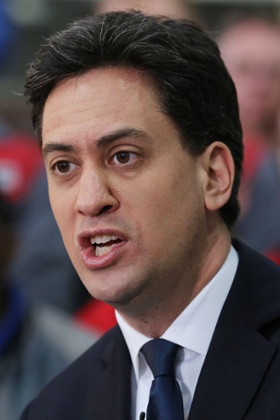
Ed Miliband made a speech at a factory in Huddersfield today, where he said that he wanted to revolutionise apprenticeships for young people, cut tuition fees, find more money for the NHS, and limit zero-hour contracts. He said:
Less than a week ago you may have heard the prime minister say that he couldn’t live on a zero-hours contract. Well, I couldn’t live on a zero-hours contract either. But I’ve got a simple principle; if it’s not good enough for us, then it’s not good enough for you, and it’s not good enough for Britain. And that’s the way I want to run the country.
Not only was this a sign that Labour are putting zero-hour contracts at the heart of their campaign, it also signalled an improvement in Miliband’s abilities as both a campaigner and a public speaker.

What happened today
- As mentioned above, a letter from more than 100 business leaders backing Conservative policies was published in the Telegraph. David Cameron welcomed the letter, calling it “a very clear message”, and George Osborne called it “unprecedented”. But Ed Miliband said it was unsurprising business figures wanted lower taxes. Labour also warned that one of the signatories, Paul Walsh, could damage the political impartiality of the Confederation of British Industry if he pressed ahead with rumoured plans to become its next president. Nick Clegg, meanwhile, said he agreed with the signatories about the need for stability, but added that it was the Tories who were a threat to that stability.
- Labour published their own 100 signatory letter about economic policy in the Mirror. The letter was signed “by shelf stackers, firefighters and retired farm hands”, as well as by business owners and public figures such as Wayne Hemingway, Trevor Beattie and Peter Duncan.
- Meanwhile, a survey of 50 leading economists showed that most of them think the government’s austerity policies have been bad for growth and jobs.
- A poll from Lord Ashcroft showed that Nick Clegg is on course to lose his seat in Sheffield Hallam. The deputy prime minister responded that he was going to win, and said that “the poll, as it happens, didn’t even mention the candidates names and our own polling where it does it always shows a significant uplift in our support.”
- In an interview with the Sun, David Cameron and George Osborne said a future Tory government would not raise income tax or national insurance.
As already stated, Ed Miliband said workers on zero-hour contracts should have the right to a regular job after three months. This was then criticised by the CBI, who said the UK’s flexible jobs market “has given us an employment rate that is the envy of other countries”.
- In a speech at a Britvic plant in Leeds, George Osborne admitted he would find it “very difficult” to live on a zero-hour contract and said the only way to end them is by creating more jobs. He also said that Labour’s plan to reverse a corporation tax shows why Britain has just 36 days left to save the economic recovery.
- Speaking in Glasgow, Ed Balls said a vote for the SNP was a vote for austerity, “first, because they have failed to back Labour’s fair tax changes across the UK... second, because the SNP remains wedded to a fiscal approach for Scotland which rejects the pooling and sharing of resources across the United Kingdom... and third, because a vote for the SNP means it is more likely David Cameron stays in Downing Street.”
- The Lib Dems set out steps to protect journalism from state interference in their election manifesto. Nick Clegg also said his party would triple statutory paternity leave to six weeks if they’re elected to government, and that they would carry out a review of the the British government’s flagship anti-radicalisation strategy, Prevent.
- Ukip complained about school pupils being exposed to pro-EU propaganda.
- A Daily Mail article claimed Ed Balls has “left the door open” to increasing the number of people paying the 40p higher rate of tax, which Labour dismissed as “nonsense”, while Nick Clegg refused to rule out cutting the 40p tax threshold, saying that his party’s priority was raising the amount you have to earn before you start paying income tax.
-
Finally, SNP sources revealed party leader Nicola Sturgeon is preparing to mount a detailed attack on David Cameron’s record on welfare cuts during tomorrow’s leaders debate.
Quote of the day
“I don’t mind if he is so lazy he would rather not go downstairs to make a cup of tea shortly before binge-watching Breaking Bad or whatever he does. I mind very much that he is instinctively and intuitively hostile to the liberating policy of home ownership.” - Boris Johnson, on Ed Miliband’s two kitchens.
Laugh of the day
“What’s the deputy prime minister up to today? Goldfish? Hamsters?” - Ed Balls, when bumping into hacks travelling with Nick Clegg in Scotland.
Hero of the day
Labour Peer Lord Levy, who appeared on Sky News to question what the total annual income of all the signatories to the Telegraph letter is. “One alone earned 12 million last year. Their total annual income probably goes to hundreds of millions. Their total wealth probably goes into billions... Have they mentioned Europe and the uncertainty that the Tories would get us in if we left the EU?”
Villain of the day
Jeremy Zeid, the Ukip candidate in Hendon, who was removed after he said in a Facebook post that Israel should “kidnap” Barack Obama.
The big issue
The Tories claim that a competitive tax rate is good for workers because it means more investment and more jobs. But though Britain’s current corporation tax rate is the lowest in all of G7, we are the least productive of the countries. Britain is regressing in terms of economic effectiveness.
As my colleague Larry Elliot writes:
The Government likes talking about the jobs it has created over the past five years. They can wax lyrical about the 1.8m net jobs created in the past five years.
Perhaps unsurprisingly, the Conservatives are a bit more reticent about the UK’s abysmal productivity record on their watch. Like the record balance of payments deficit – the fact that Britain appears to be going backwards in terms of economic effectiveness – is not something David Cameron and George Osborne wish to dwell upon.
Productivity in the UK is 27-31% below that in Germany, France and the US. The gap with the rest of the G7 is 17 percentage points – the widest since 1992. Only Japan among the leading western industrial nations has a worse record.
This is something the government should be addressing.
What we’ll be talking about tomorrow
Tomorrow is the big seven-way leaders debate. Stay with us as we keep you up to date with all the anticipation, excitement, dread and inevitable fallout. The latest Guardian projection now sees the Conservatives winning 276 seats, Labour 270, the SNP 50 and the Lib Dems 28. With Miliband’s surprising success at the last TV “debate”, could this all change tomorrow?
Thanks for sticking with our live blog. That’s all from me today. Join us again tomorrow from 7am. And don’t worry, we will continue to do this every day until 7 May, and possibly later.
You can explore the background of every signatory of the Telegraph letter yourself in our new interactive, entitled The Tory 100: Captains of industry, party donors (and a few tax avoiders). Signatories can be searched for by name or industry.
The Guardian’s Holly Watt and Rowena Mason have produced a detailed breakdown of all the signatories of the Telegraph letter. Some interesting observations below:
The former chairman of Marks and Spencer Lord Rose and JCB’s chairman, Lord Bamford, have both joined the House of Lords since Cameron became prime minister. They continue to publicly support the Conservatives.
A number of the signatories have attracted controversy in recent years. Rooney Anand, chief executive of the pub chain Greene King, lent his name to the letter. Greene King has been involved in a decade-long tax battle with HMRC over a tax scheme dismissed as “purely artificial” by the Tory MP Richard Bacon.
Margaret Hodge, chair of the Commons public accounts committee, cited the scheme used by Greene King as one of the most egregious examples of tax avoidance marketed by an accountancy firm. Greene King said it had been following advice from its accountants.
George Weston, chief executive of Associated British Foods and Wittington Investments, also signed the letter. Wittington, which owns Fortnum & Masons, has been accused of avoiding £10m of tax in the UK a year by using a Luxembourg holding company.
ABF was also accused of tax avoidance in Zambia, one of the poorest countries in the world. The charity ActionAid accused the company of paying “virtually no corporation tax” despite profits of $123m between 2007 and 2013.
ABF has denied avoiding tax in Zambia. Wittington and ABF have insisted they pay the correct amount of tax.
Another signatory is Matt Moulding, chief executive of The Hut Group. The group became involved in a row after the chancellor clamped down on VAT avoidance on products shipped from the Channel Islands because the system was being “used by large companies to undercut shops on our high street”.
The Hut Group had shipped goods worth around £500m before the clampdown. After Osborne closed the loophole, which cost £130m in lost UK tax receipts each year, The Hut began sending some goods on a 7,000-mile round trip via locations such as Chicago before the goods reached customers in the UK.
Asked to explain the long route, The Hut said its delivery process “prioritises speed of order and customer service”.
Aidan Heavey, the founder of Tullow Oil and another signatory, has given more than £60,000 to the Conservatives in recent years. Documents released under the Freedom of Information Act revealed that British ministers “lobbied heavily” for Tullow Oil after the company became involved in a row in Uganda over tax payments in 2011.
The then foreign secretary William Hague personally contacted Uganda’s president to “express his concern about the problems being experienced by Tullow.” A Foreign Office spokesman said at the time that Hague was supporting British businesses.
Another signatory is Mark Esiri, founder of the private equity firm Venrex. Esiri was involved in the sale of the stationery company Smythson, which employs Samantha Cameron.
Smythson was sold to a group of investors – including several Conservative donors – shortly before David Cameron was chosen to be leader of the Tory party in 2005. Samantha Cameron received a windfall of £430,000. Esiri is a long-term friend of the Cameron family.
63% of MPs are predicting a hung parliament, according to market research company Ipsos MORI.
The inevitability of coalition? MPs and candidates predict the election @IpsosMORI @HannahFMerritt #Election2015 pic.twitter.com/09DgBV6BJz
— benfowleruk (@benfowleruk) April 1, 2015
Same here, michaelsylvain. I find all these terms so reductive.
Here’s US presidential debates commission chair Fran Fahrenkopf discussing the significance of TV debates on Sky News. Fahrenkopf says:
Our polling shows 65-75% of the American people say that the debates are an important factor – not the only factor – but an important factor in how they eventually cast their votes. There’s no question they can [swing it from one candidate to another]. I think the American people are looking for body language, how individual candidates look each other in the eye, maybe question each other, what sort of dynamics take place in the debates. And of course one of the things that can really swing it is a mistake that’s made in the debates. That can have a devastating effect upon a candidate.
I wonder if that applies across the Atlantic. To be honest, it sounds like common sense. What I’m more curious about is whether any sort of dynamic can be established when there are seven different candidates on screen.
Updated
Interesting that Miliband is viewed as more genuine and in touch than Cameron.
As eyes turn to tomorrow's #leadersdebate, how are Cameron and Miliband viewed by the public? #GE2015 pic.twitter.com/OApw7xTXcy
— ComRes (@ComResPolls) April 1, 2015
Nick Clegg says Lib Dems will review government’s anti-radicalisation strategy
Nick Clegg has said his party will carry out a review of the the British government’s flagship anti-radicalisation strategy, Prevent, if his party remains in power. Clegg said that that there was a “strong feeling that Prevent does not enjoy the confidence of many of our Muslim communities”. As the Press Association reports:
The review is partly in response to concerns raised by former police chief superintendent Dal Babu, who warned that the strategy aimed at stopping people being drawn into extremism had become a “toxic brand”.
Mr Babu has claimed most Muslims are suspicious of the Prevent scheme and see it as something used for spying on them.
Mr Clegg told Muslim News: “As Leader of Liberal Democrats, I am committed to see a review take place early in the next Parliament so that we can try and involve everybody to make sure the Prevent programme does what it always was intended to do.”
News of police chief superintendent Dal Babu’s concerns was originally reported by us last month.
Updated
Meanwhile, Sebastian Payne in the Spectator asks why Osborne doesn’t admit to one his greatest successes - that of a 1.9 million rise in employment, even if it was accidental. “Instead of extolling this success, Osborne devoted his first speech of the campaign to negative campaigning,” Payne writes. Read the full article here.
Labour says it's the party of working people but Conservatives are party that increases the number of working people pic.twitter.com/3a9pjovfDa
— Tim Montgomerie ن (@montie) April 1, 2015
Updated
The Guardian’s John Crace has written a sketch about George Osborne’s speech in Leeds today. I’ve included the first couple of paragraphs below.
On the very day that 103 business leaders signed a letter to the Daily Telegraph thanking the Conservatives for their magnificent handling of the economy, George Osborne just happened to find himself dropping in on two of the companies whose head honchos had been signatories of the billet-doux. Truly God moves in mysterious ways; though it never hurts to make your own luck.
After necking a quick pint at Marston’s brewery in Wolverhampton at lunchtime, Osborne headed north to the Britvic soft drinks factory on the outskirts of Leeds. Here the chairman, Gerald Corbett, was so thrilled by the pace of the country’s economic recovery that he had shut down the entire plant for the afternoon to allow his staff to worship at the shrine of St George. “Thank you, thank you, Chancellor,” Gerry gushed. It was very much a first-names kind of day. “Thank you for visiting and for making me whole. You complete me. You are my rock. I can’t live, if living is without you…”
The age old question:
The first election leaflets have arrived in our house. Blur or Oasis? pic.twitter.com/XBRkeZQozn
— James Walsh (@jamesofwalsh) April 1, 2015
Nicola Sturgeon is planning a detailed attack on David Cameron's welfare record
My colleague Severin Carrell has just sent me the below. He reports that ahead of tomorrow night’s leaders debate, SNP leader Nicola Sturgeon has been given dossiers on the government’s welfare and spending cuts to allow her to prepare a detailed attack on David Cameron.
Nicola Sturgeon is preparing to mount a detailed attack on David Cameron’s record on welfare cuts, focusing heavily on benefit cuts for disabled people, the impact of the bedroom tax and the surge in foodbank use, SNP sources have disclosed. She is expected to accuse Cameron of pursing “austerity politics” repeatedly during the debate.
A highly focused former lawyer known for absorbing detailed briefing documents as a minister, Sturgeon has been given dossiers on welfare and spending cuts by her inner circle of government aides. One adviser said she was “absolutely immersing” herself in the briefing papers, and drilling questions and answers.
One close adviser said Sturgeon saw the debate – where she will be standing next to the prime minister, as a significant test, which could cement her reputation in Scotland if she succeeds in landing effective blows.
She is due to travel down for the broadcast at Salford, Manchester, soon after taking first minister’s questions at Holyrood, which remains in full session despite the general election. Of the seven party leaders in the debate, only she and Lianne Wood, leader of the Welsh nationalists Plaid Cymru, are not standing for Westminster.
Apart from outings on BBC Question Time, this will be the first time Sturgeon has had a prime time UK-wide platform. “It’s a noteable first in that sense, not just for herself but for our side of things generally,” the adviser said, before adding: “It’s uncharted territory.”

Updated
On the issue of productivity, Guardian economics editor Larry Elliott writes that Britain is going backwards in terms of economic effectiveness, a fact David Cameron and George Osborne do not wish to dwell upon.

In reality, the Government’s employment and productivity record are the two sides of the same coin. The economy could have had a better productivity record since 2010 but only if fewer people had been employed. Why? Because productivity is a measure of national output divided in one of two ways: by the number of people employed or by the amount those people produce per hour.
Output per hour worked is the better measure. Judged by this yardstick, productivity in the UK is 27-31% below that in Germany, France and the US. The gap with the rest of the G7 is 17 percentage points – the widest since 1992. Only Japan among the leading western industrial nations has a worse record.
Britain’s recent economic record explains why the productivity gap has opened up. In previous recessions, there has tended to be a big shake-out in the labour market, followed by a strong recovery in output, accompanied by rapid investment growth as businesses become more optimistic about their future prospects. Employment growth has lagged the pick-up in output growth, with the result that each worker produces more per hour. Productivity rose sharply.
This time it’s been different. The UK did not have the traditional V-shaped recession. It had a big plunge in output followed by a recovery aborted shortly after the coalition came to power. The economy then moved sideways for two years.
Click through to watch Labour Peer Lord Levy on Sky News asking what the Telegraph signatories’ annual income is.
Updated
Channel 4 News just interviewed Norman Pickavance, former HR director at Morrisons, and Lord Bilimoria, entrepreneur and cross-bench peer, about today’s Telegraph letter.
Lord Bilimoria, one of the signatories of the letter, said there are a lot of people on that list who are Labour supporters who signed because they think the cut in corporation tax is the best thing this government has done. He said more competitive businesses create more employment, which means more taxes and more funding for public services. He added that Labour’s policies of increasing taxes and borrowing are worrying to businesses.
Pickavance, meanwhile, pointed out that though Britain’s current [corporation] tax rate is the lowest in all of G7, we are the least productive, “so this jobs miracle isn’t working”. He said our economy is very fragile because of our productivity gap, and that productivity, innovation, and investment in skills are issues that haven’t been addressed by the Conservative government. He added that we need to focus on smaller businesses.
YouGov have redesigned their website for the election. Have a look, it’s quite sleek.
Nick Clegg has refused to rule out cutting the 40p tax threshold, one day after shadow chancellor Ed Balls came under pressure to do the same. While the Lib Dems have ruled out increasing VAT, national insurance and income tax, Clegg declined three times to rule out lowering the 40p tax threshold. As my colleague Frances Perraudin reports:

On Wednesday Clegg declined three times to rule out lowering the threshold for the 40p tax, saying that his party’s priority was raising the amount you have to earn before you start paying income tax.
“Because that means that even people who are 40p taxpayers, they are certainly no worse off and in some cases they are better off because the raising of the point at which they start paying income tax far outweighs what tax they might pay in the 40p bracket,” he said.
“That is the reason why we will continue with our emphasis of using every spare penny we have to give tax cuts to millions of people on middle and low incomes.”
On Sky News just now, Treasury minister David Gauke said a cut in corporation tax sends a signal that we [Britain] are open for business, and to reverse that is extremely dangerous. He added that a competitive tax rate is good for workers because it means more investment and more jobs.
Labour’s Chuka Umunna – who appeared on the show for a few seconds before his connection cut off - dismissed the Telegraph letter as “a coordinated effort between the Conservatives and business leaders published in a Conservative supporting paper”.
The Independent revealed earlier that one in five of the business leaders who signed the pro-Tory letter in the Telegraph were given honours by David Cameron and one third are Tory donors.
Among the 103 signatories of the letter, published on the front page of the Daily Telegraph this morning, are four Conservative members of the House of Lords – all ennobled by David Cameron.
The Prime Minister also doled out 18 MBEs, OBEs, CBEs and knighthoods to signatories of the letter over the last parliament.
A total of 32 of the signatories are Conservative donors, having donated a total of £9m to the party when family and company donations are taken into account.
Nine of those who signed the letter had given at least six-figure sums, with the smallest donation still well over a thousand pounds.
Mirror letter signed by 100 "working people" backs Labour
Labour have released their own 100 signatory letter about economic policy. Published in The Mirror, the letter is signed “by shelf stackers, firefighters and retired farm hands”, as well as by business owners and public figures such as Wayne Hemingway, Trevor Beattie and Peter Duncan, the paper’s political editor Jason Beattie reveals.
Letter to Mirror signed by 100 people backing Labour. Includes cafe workers, business leaders and celebrities #GE2015 pic.twitter.com/88lJqGJV2H
— Jason Beattie (@JBeattieMirror) April 1, 2015
I’ve typed out the letter for you below.
Dear Sir,
We all care about Britain’s economy and we all have a stake in the future.
We are all working people. Some of us run businesses, large and small. Some of us used to work on zero hours contracts, some of us still do.
We come from all walks of live, this is what Britain looks like.
We believe that the fundamental choice at this election is: who does this country work for? Does it work only for those at the very top or does it work for working people – those trying to make ends meet, working in British businesses across the country to create wealth and support their families?
A symbol of the failure of this Government’s economic plan is the proliferation of zero hour contracts which has helped fuel the low wage, low skill economy that is letting down working people and letting down Britain.
Britain only succeeds when working people succeed. We need a better plan for prosperity. We need a better plan and a better future. We need a Labour Government to put working people first.
More #ge2015 letters than the opening scene of Harry Potter
— Faisal Islam (@faisalislam) April 1, 2015
Updated
Is the Telegraph letter an endorsement of the coalition rather than the Tories?
Senior business figure tell me at least 1 signatory of Telegraph letter is a Lib Dem and letter wording endorses the coalition not Tories
— Sam Coates Times (@SamCoatesTimes) April 1, 2015
And a fair point...
Some Labour folk baffled why Tories deployed businessmen letter today. Gets drowned out by ITV debate tomorrow and Easter, then forgotten?
— Sam Coates Times (@SamCoatesTimes) April 1, 2015
A preview of tomorrow night’s leaders debate from Green party leader Natalie Bennett... are you excited yet?
.@natalieben previews the big #tvdebate taking place tomorrow night #leadersdebate pic.twitter.com/69yO4vf19J
— The Green Party (@TheGreenParty) April 1, 2015
Zac Goldsmith, the former Conservative MP for Richmond Park & North Kingston (remember - no Parliament, no MPs) is due to give a lecture at the RSA in central London tomorrow calling for citizens to be given more power and for MPs to experiment with direct democracy over the next parliament.
In a statement I’ve just received, Goldsmith says:
A significant cause of political disengagement is that our politics has spectacularly failed to adapt to the modern world. I believe we have reached a pivotal moment in our history where our democracy must evolve to survive, as it has had to at other times in the past.
I wonder what he’s got in mind.
Our political correspondent Rowena Mason has sent me this report from the Britvic plant in Leeds where George Osborne has just given a speech. Note that Osborne says the only way to end zero-hour contracts is by creating more jobs.
George Osborne has admitted he would find it “very difficult” to live on a zero-hour contract, even though the Conservatives do not think they should be banned or further restricted.
The chancellor also acknowledged that the contracts are a sign of job insecurity for workers, but said they were not as bad having no work at all.
He was questioned about the controversial employment practice while speaking at a Britvic plant in Leeds, after Labour leader Ed Miliband said there was now an zero-hour “epidemic”.
Speaking in nearby Huddersfield, he said he would get rod of “exploitative” zero-hours contracts and people should be entitled to convert their contracts into a regular job after only three months instead of a year - the previous timeframe set out by Labour
There has been a big political debate about how widespread the contracts are. The independent fact-checking organisation Full Fact said it was difficult to tell whether they are becoming more widely used or workers are now more aware what type of contract they are on. It said around one in 40 jobs is a zero-hour contract, not one in 50 as the Conservatives claim.
Asked whether he could live on a zero hour contract, Osborne said: “Of course it would be very difficult... There are some zero hour contracts that people want. I heard on the BBC at lunch a student talking about how they wanted that. But for people who want to work longer hours, for people who want job security, the answer is to create the jobs. Here are the business leaders of some of the biggest British businesses, small companies, companies around the whole UK, saying if you depart from the economic plan, jobs will be threatened, investment will be deterred and the recovery will be put at risk. That will put people out of work, and that is the greatest insecurity of all.”
This goes further than what David Cameron said in last week’s interview with Jeremy Paxman when he said he could not live on an “exclusive” zero hour contract, which the government is banning. This type of zero-hour contract ties an employee to one firm without guaranteeing any hours.
Updated
Some of you are saying you can’t find the BBC piece on economists claiming the coalition’s austerity policies have been bad for growth and jobs. Here’s a link to the BBC post and here is the original Centre for Macroeconomics survey.
The Conservatives and Lib Dems are currently attacking Labour for employing workers on zero-hour contracts themselves.
Revealed:Labour councils behind 21,798 zero hours contracts.1st on list: Doncaster Council- 300 staff on ZHCs in Miliband's own back yard
— CCHQ Press Office (@CCHQPress) April 1, 2015
Staff on zero hours contracts at Labour councils:738- Wolverhampton, 442- Liverpool, & 20,040 contracts used by 37 other Lab councils
— CCHQ Press Office (@CCHQPress) April 1, 2015
For Labour, it's a case of "do as I say not as I do" on zero-hours contracts pic.twitter.com/5ToEovUqyN
— Liberal Democrats (@LibDems) April 1, 2015
Labour have dismissed the attacks, maintaining that most of the zero-hour contracts were issued to students and interns. And who’s to say any of these contracts lasted for longer than three months? Below is a statement from Doncaster council on the issue.
Statement from Doncaster Council on zero hours contracts pic.twitter.com/Clp5PHdCrK
— Nick Sutton (@suttonnick) April 1, 2015
Updated
Though Sky New’s Sophy Ridge reported that Conservative Party Co Chairman Andrew Feldman is understood to have helped organise today’s letter from business leaders in the Telegraph, and has been emailing business leaders asking them to add their signatures today, the Tories are not admitting to this. Tory cabinet minister Sajid Javid also dodged the question earlier. But, as my colleague Rowena Mason points out to me, George Osborne today toured two places - Britvic in Leeds and Marstons in Wolverhampton - whose chairman Gerald Corbett and chief executive Ralph Findlay both signed the letter. Both visits were organised before the letter appeared in the Telegraph last night.
Good afternoon, Nadia here. I’m taking over from Andrew for the rest of the day, so do stay tuned for all of this evening’s political developments. I’m on Twitter @nadiakhomami and I’ll be reading your comments below the line as well, so you can let me know if you think there’s something I’ve missed.
Afternoon summary
-
George Osborne, the Conservative chancellor, has said that Labour’s plan to reverse a corporation tax shows why Britain has just 36 days left to save the economic recovery. In a speech he said:
Corporation tax is the main tax on business. Increase it and you increase the tax on investment on growth and on jobs. It is as simple as that. The policy decisions you take on business in the Treasury have a direct impact on people’s lives. If you start to hike business taxes and confidence is undermined then projects are shelved and investment doesn’t come here to this country, you create an anti-business environment that leads to lost jobs, higher unemployment and families without the security of work. These are not abstract economic risks, they are an assault on everyday working people. They are concrete reasons why we have 36 days to save Britain’s economic recovery.
- Ed Balls, the shadow chancellor, has set out three reasons why a vote for the SNP in Scotland is “a vote for continued Tory austerity”. (See 4.02pm.)
- Labour has dismissed claims that it plans to raise tax by extending the 40p tax bracket. (See 3.31pm.)
-
Nick Clegg has claimed that the business leaders who signed the anti-Labour letter in today’s Telegraph are mistaken if they think the Conservatives would guarantee stability. (See 4.21pm.)
That’s all from me for today.
My colleague Nadia Khomami is now taking over the rest of the day.

Wouter den Haan, professor of economics at the LSE and a co-director of the Centre for Macroeconomics, told BBC News this afternoon that it was “rare” for macroeconomics to agree as much as they did on the proposition that the coalition’s austerity policies had been bad for growth and jobs. (See 9.18am and 10.03am.)
We asked our panel members whether they agree that the austerity plans of the coalition government had a positive effect on the economy in the UK. And the result is that most people disagreed with that statement. If you leave out the people who neither agreed or disagreed, 81% disagreed or strongly disagreed. It is rare that macroeconomists are that unanimous about something.
He also said the economy was “still doing very poorly”.
The UK economy, even though it is recovering, is still doing very poorly. If you look at where we are relative to pre-crisis trends, we’re doing very badly. Wages are low, productivity is low. We have a fragile recovery.
DUP says it won't support minority government backing separatist measures
My colleague Henry McDonald has more news from Northern Ireland on what the DUP might or might not do in the event of a hung parliament.
Democratic Unionist MPs will not back any government after May 7 that is also captive to the SNP’s separatist agenda, first minister of Northern Ireland Peter Robinson warned today.
The DUP leader said his MPs would not support any administration that relied on the SNP or Plaid Cymru so long as these parties were advancing policies to break up the union.
“If a government was being propped up by a separatist party that was using its position in order to extract levers of separation then clearly we could not support that,” Robinson said.
He qualified his warning however by stating that “if the ask of any party that forms such a support group for a government party is for purely regional issues, then that is a very different matter indeed.”
Robinson also revealed in Belfast today that one of the DUP’s key demands from the larger UK parties would be to scrap any plans to introduce the bedroom tax into Northern Ireland.

Photograph: Charles McQuillan/Getty Images
Updated
The Fawcett Society is encourage people to report examples of sexism in election coverage. This is from Belinda Phipps, the Fawcett chair.
We see more coverage of the leaders’ wives and what female politicians look like than reporting of the views and campaigns of women in politics.
The media need to get real. More than half of the population of the UK is women and women can, and will, influence who forms the next government.
If you read a sexist election story in your local paper, see something online or hear something on the radio which offends, please let us know either by tweeting at #viewsnotshoes or email us at info@fawcettsociety.org.uk
The Fawcett Society will produce a report on what it finds, and use it to encourage fair reporting.
Clegg says Telegraph letter signatories wrong to think Tories would guarantee stability
Nick Clegg told reporters in East Dunbartonshire that he agreed with the signatories of the letter to the Daily Telegraph (see 8.46am) about the need for stability. But it was the Tories who were a threat to that stability, he argued.
I read the letter carefully, it talks about what this coalition government has done, and I think the signatories to the letter are completely right in saying that about the last thing that this country needs, now that we’re emerging from this long shadow of the economic crash in 2008, is a great lurch in one direction or another.
However I think they are very wrong in thinking that the Conservative party are somehow the guarantors of that stability.
George Osborne has been quite explicit, he has made no secret of it, that far from staying the course, the Conservatives want to lurch wildly off in a right-wing ideological direction.

Updated
Here are two more pictures from the campaign trail today.


In his speech in Glasgow Ed Balls said a vote for the SNP was a vote for continued austerity. He offered three reasons why. My colleague Libby Brooks set them out in the preview story filed overnight.
He also said that the government had failed to get rid of the deficit because of its failure on productivity and living standards.
In this parliament, weak earnings growth has led to tax receipts falling short.
National Insurance contributions in this parliament have been £27bn less than planned, while income tax revenues have fallen short by £70bn.
This is the key reason why, far from balancing the books, borrowing is set to be £76bn next year.
And it is why the government is now set to have borrowed a staggering £200bn more than they planned in 2010.

George Osborne is delivering a speech in West Yorkshire now. He says there are just 36 days left to save Britain’s economic recovery.
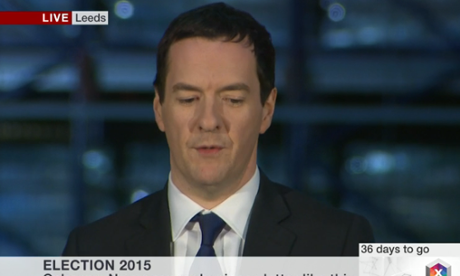
I’ll post a summary when I’ve seen the text.
In the meantime, my colleague Rowena Mason, who is at the event, reports that Osborne is taking his obsession with high-vis just a litte l
George Osborne's obsession with hi-vis has gone too far. I've been forced into a fluorescent wristband for press conf pic.twitter.com/UJNHpkTmrd
— Rowena Mason (@rowenamason) April 1, 2015
Labour says its Martin Freeman PPB was most seen online ever
Labour claims that its Martin Freeman election broadcast is the most-seen party political broadcast online. It made the boast in a news release saying that it is beating the other parties in social media. Here are the key points.
- Labour says 1.1m people watched its election broadcast with Martin Freeman online. The broadcast produced by the Tories this week has only been seen by 91,000 people online, it says. Labour says its broadcast is “now thought to be the most-seen party political broadcast ever online”.
- Labour says 475,925 people have “engaged” with its Facebook page in the last week, more than any other British political party.
-
It says more than 19,000 people have given money to the party online in the last month, including 10,680 new donors. Since the party’s campaign launch last Friday there have been 6,197 online donors, 3,225 of them new.
The party also says its activists have already had more than 2m face-to-face conversations with voters since January, including 150,000 conversations in a single weekend in March, and that it is well on course to hit its target of 4m by polling day.

Labour dismisses claims it wants to raise tax by extending 40p tax bracket
Ed Balls was today accused of ‘letting the cat out of the bag’ on tax rises after leaving the door open to trapping more middle-class workers in the 40p tax rate.
In an interview the shadow chancellor repeatedly refused to rule out trying to balance the books by lowering the amount workers have to earn before they pay the higher income tax rate.
The number of people paying 40p tax has already risen from about 2million to 5million in two decades, but the Tories have promised to lift the threshold if they are returned to power.
The Conservatives are pushing this hard.
The cat's out of the bag- a Labour govt. would hit hardworking people with income tax rises - don't let it happen http://t.co/B7IhwZdFp2
— CCHQ Press Office (@CCHQPress) April 1, 2015
Chancellor George Osborne said: "Ed Balls has let the cat out of the bag and confirmed a tax assault on middle earners. [1/5]
— CCHQ Press Office (@CCHQPress) April 1, 2015
But Labour are dismissing this as “nonsense”. A party source said:
Ed Balls was clear, and Labour’s position is clear: we want fewer people paying the 40p tax rate. We want to ease the burden on working families. Ed’s words make that very clear.
Updated
Here’s a Guardian video with an excerpt from Ed Miliband’s zero-hours contracts speech.
Ed Balls is worried that the Guardian is going Nat.
Question from audience to @edballsmp: I'm worried ppl down south are taken in by SNP, "even people writing in the Guardian" #GE2015
— Libby Brooks (@libby_brooks) April 1, 2015
Almost a third of Telegraph letter signatories are Tory donors, Labour say
Labour has released an analysis of the 103 business figures who have signed the letter to the Daily Telegraph criticising Labour’s stance on business. It shows that 32 of them are Conservative donors, another two are Tory peers, and other 21 have links to the party, such as having served on a Conservative advisory board, or having signed a letter backing the party in the past.
Clegg says he's going to hold his seat
Nick Clegg has now responded himself to the Ashcroft poll from Sheffield Hallam. He told reporters in Scotland:
I’m going to win. The poll, as it happens, didn’t even mention the candidates names and our own polling where it does it always shows a significant uplift in our support. And just if you look at the way people have voted rather than what they’ve said to Lord Ashcroft since 2010 people in Sheffield has consistently voted Liberal Democrat. Of the 16 local elections we’ve had since 2010, we’ve won 14 since 2010, so I’m confident, not complacent, but confident we’re going to win.
Earlier Clegg had lunch with some Scottish political journalists. My colleague Frances Perraudin, who is with him, was not impressed by the absence of women.
Clegg and Jo Swinson lunching with the Scottish lobby. Think Scottish political journalism may have a women problem. pic.twitter.com/oNVn3GYQwV
— Frances Perraudin (@fperraudin) April 1, 2015
Clegg is now visiting a play centre.
Clegg is visiting a soft play centre called 'Play Town' in East Dunbartonshire. pic.twitter.com/Fi10keczuf
— Frances Perraudin (@fperraudin) April 1, 2015
Updated
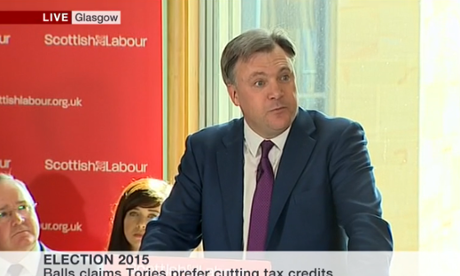
Ed Balls is speaking in Glasgow now.
Ed Balls: the inconvenient truth for the SNP is that there is no consensus in Westminster over austerity #GE2015
— Libby Brooks (@libby_brooks) April 1, 2015
Ed Balls: Tory cuts will mean £1.5bn cuts from block grant to Scotland in next 3 years
— Libby Brooks (@libby_brooks) April 1, 2015
Ed Balls: nobody is suggesting we shd avoid what Nicola Sturgeon describes as 'sensible deficit reduction' #GE2015
— Libby Brooks (@libby_brooks) April 1, 2015
I’ll post a summary once I’ve seen the full text.
Lunchtime summary
- A poll from Lord Ashcroft has shown that Nick Clegg is on course to lose his seat in Sheffield Hallam. (See 12.21pm, 12.37pm, 12.55pm and 1.55pm.)
-
Labour has hit back at a letter from more than 100 business leaders backing Conservative policies, describing it as a party political stunt and warning one of the signatories, Paul Walsh, that he could damage the political impartiality of the Confederation of British Industry if he pressed ahead with rumoured plans to become its next president.On a visit to a brewery in Wolverhampton, David Cameron welcomed the letter.
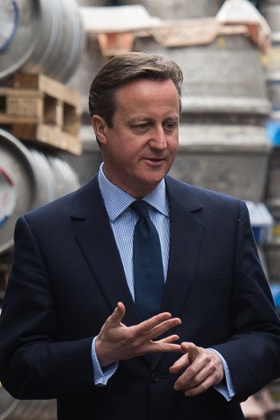
Today it is an unprecedented intervention by some of the business leaders in the best-known business, large and small, in our country saying the Conservative long-term plan is working, generating jobs. That is a very clear message from business leaders who, like me, care about jobs and wealth creation and prosperity and livelihoods in our country.
But Ed Miliband said it was not surprising business figures wanted lower taxes:
I understand the reasons why businesses want lower business taxes. And we’ve actually got a plan to cut business taxes for small and medium sized businesses because we think that’s where the priority lies.
Adding:
But it does also go to the wider choice at this election. The Conservatives really believe that if all of the few corporations and individuals at the top are doing well, the wealth will magically trickle down for everybody else. We have tried that experiment over the last few years and it hasn’t worked. We have seen falling living standards and falling wages and insecurity at work. I just have a different view about the way the country succeeds.
- A survey of 50 leading economists has shown that most of them think the government’s austerity policies have been bad for growth and jobs. (See 9.18am.)
-
Ukip has complained about school pupils being exposed to pro-EU propaganda. (See 10.56am.)
Updated
Frances Perraudin is currently on the Lib Dem battle bus in Scotland. She has been speaking to a spokesperson for the Liberal Democrats and to Labour’s candidate in Sheffield Hallam, Oliver Coppard.
A spokesman for Nick Clegg said the deputy prime minister is confident if winning Sheffield Hallam, but that he wasn’t complacent. He pointed to the 16 local elections that have been held in th constituency since 2010, 14 of which have been won by his party.
During the 2014 local elections in Hallam, the party increased its share of the vote to 38.7%, compared to 23.6% for Labour and 10.7% for the Tories.
“Labour are talking a good game, but they seem to be celebrating and measuring up the curtains in Sheffield Hallam when they won’t be successful,” he said.
He said the Ashcroft polling didn’t produce an accurate result because it didn’t give people the name of candidates. In the Lib Dems own polling, naming a candidate caused the party to poll 9% better than when candidates weren’t named.
Oliver Coppard, 33, said: “I’ve had a quick look [at the polling] and I’ve also logged into Twitter and it seems everybody in the world has had a quick look as well” .
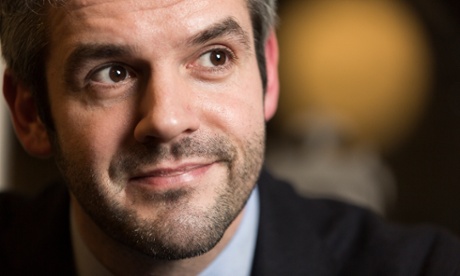
The Labour candidate added: “I’m pleased to seen that result, particularly from Lord Ashcroft, but it’s not a huge surprise to us and really it doesn’t make any difference to what we’re doing.
“I know it’s such a cliché, but frankly it’s true, the only poll that matters is on 7 May and we’ll just keep on knocking on doors and speaking to people about local issues until then.”
When asked how he thought Clegg would respond to the result, Coppard said: “It’s not for me to run Nick Clegg’s campaign. He’s never here, so I’m not sure really what he’s going to do. He’s certainly not been here yet in this election campaign and it’s been three days now.”
I asked him why Labour seemed to be polling so well in the constituency even though it is historically a Conservative seat. “This is my home, my community, this is where I was born and raised. And I think people are looking for somebody who they can trust to stand up for this community,” he replied.
“That’s what I’ll do if I’m the MP. I’ll make sure Sheffield Hallam is my priority and I don’t think even Nick Clegg could claim that over the past five years Sheffield Hallam has been his priority. His priority has been keeping the Lib Dems in government with the Tories and he’s neglected this area.”
Updated
Willie Rennie, the Scottish Lib Dem leader, told Radio Scotland today that the Lib Dems had shown they could work with a range of parties. As Libby Brooks reports, asked who he would prefer as coalition partner, he insisted it was up to the voters.
They have to determine the numbers. What we need to do is set down what our priorities are and but what we have shown is that we are prepared to work with other parties at local level. We’ve worked with the SNP in the Scottish government, we’ve worked with the Labour party in the Scottish government as well and the Conservatives at Westminster. What has been proven over the last five years is that you need the Liberal Democrats at the centre of government, to stop is veering off left or right with massive borrowing or massive cuts.
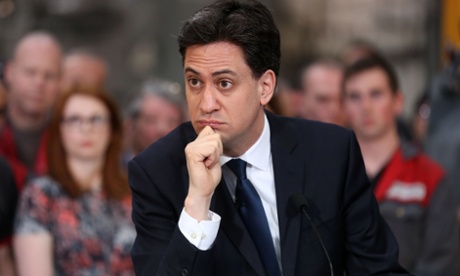
David Brown Gear Systems in Huddersfield, the factory where Ed Miliband delivered his zero-hours contracts speech, is telling journalists that it is not commenting on whether it uses zero hours contracts itself.
Updated
A spokesman for Nick Clegg has responded to the Ashcroft poll. He said:
We are confident of winning Sheffield Hallam. We are not complacent. We do not take any voters for granted. But we are confident of winning because Nick has been the local MP there for 10 years. He’s got a record in Sheffield that we are happy to defend and that his constituents appreciate.
In the light of the controversy about Labour’s controls on migration mug, the Conservatives are now producing their own spoof Labour mugs.
On the Daily Politics Vince Cable, the Lib Dem business secretary, dismissed the suggestion in the Ashcroft poll that Nick Clegg would lose his seat.
I’m absolutely certain Nick Clegg will win his seat and return as leader of the Liberal Democrats. One of the problems with the Lord Ashcroft polls is they don’t actually name the candidates. I think when the full position is revealed he will be back and he will return as our party leader, I have no doubt about it.


Boris Johnson proclaims one nation Conservatism

Boris Johnson, the Conservative mayor of London, was campaigning in Hendon this morning. He certainly provided good copy, but he also more or less set out his philosophy of Conservatism. He was in one nation Conservatism mode.
- Johnson said that he believed in “wealth creation for a moral purpose” and that this was at the heart of “one nation Conservatism”.
-
He said Labour did not believe free markets were fundamentally good.
The Conservatives view the free market economy as a thing that is fundamentally a force for good that must be used and helped and encouraged to pay for the poorest, the neediest, for welfare, for hospitals.
I think that Labour regards the capitalist system as being something fundamentally malign that needs to be punished and checked and corrected.
That was not the approach under Tony Blair. That’s why you are seeing this huge move now by formerly Labour business supporters to come out in favour of the Conservatives.
-
He said he accepted the case for state redistribution. Asked about Labour’s point that the wealth does not trickle down, he said:
It doesn’t necessarily trickle down. What happens is that the state redistributes it and that is a very great and powerful thing. The state has to intervene but the state cannot redistribute money if there is no money being generated.
-
He said what was significant about today’s letter in the Telegraph from business leaders was the fact that some previous Labour supporters had signed it.
You broadly expect many rich people, as it were, to be supporting the Conservatives. It was the number of former Labour backers ... they are very significant people.
- He brushed aside suggestions the Conservatives would be doing better with him as leader. Asked about this, he replied: “Thankfully that is not going to be an option.”
- He said Labour was now more leftwing than at any time since Michael Foot.
The main problem is not even that they would be the playthings of the SNP and that Ed Miliband would be peeking out of Alex Salmond’s sporran like a baby kangaroo. The main problem is that Ed Miliband and the Labour Party are now more left-wing than they have ever been at any time since Michael Foot. They literally want to take us back to the 1970s with an orgy of regulation and state socialism.
-
He joked about Ed Miliband’s two kitchens.
I don’t mind if he is so lazy he would rather not go downstairs to make a cup of tea shortly before binge-watching Breaking Bad or whatever he does. I mind very much that he is instinctively and intuitively hostile to the liberating policy of home ownership. We are the party of home ownership, of kitchen ownership. They are the party of hypocrisy and kitchen concealment.
He also said that if pepole voted Conservative, they would get broadband, but if they voted Ukip, they would get Miliband.
Updated
Ashcroft poll - Verdict from the Twitter commentariat
Here is some Twitter comment on the Ashcroft poll from journalists and commentators.
If Lab gain Sheffield Hallam, it will be largest majority overturned by major party (ever?). Clegg was 19,096 over Lab in 2010 @LordAshcroft
— Mark Gettleson (@MarksOutOf100) April 1, 2015
If Clegg loses his seat, but the LDs still have enough to enter coalition negotiations, just adds to the impending chaos of 2015 result
— roadto326 (@roadto326) April 1, 2015
Despite Clegg on the brink, Ashcroft poll underlines how LDs defy uniform read-out from national polls. Wd still stop Tories taking 4 seats
— Paul Waugh (@paulwaugh) April 1, 2015
Nick Clegg again predicted to lose Sheffield Hallam. His survival seems to depend on being rescued by tactical Tories & 6 pc Green vote.
— Patrick Wintour (@patrickwintour) April 1, 2015
Nick Clegg's fate lies in the hands of Tory voters' willingness to save him. Were you still up for Nick Clegg?
— Anthony Painter (@anthonypainter) April 1, 2015
Problem for Clegg in Sheffield is that he's a sitting duck for tactical voting. Will 16% Tory vote + 7% UKIP forgo chance to remove him?
— Iain Martin (@iainmartin1) April 1, 2015
Health warning on 'Clegg facing defeat' poll in Sheffield: @LordAshcroft isn't naming candidates. Name recognition worth several points?
— James Chapman (Mail) (@jameschappers) April 1, 2015
Not good for Clegg. But Tories giving him clear ride and he may get more from there.Lord Ashcroft does not name candidate. May help (or not)
— Philip Webster (@Pwebstertimes) April 1, 2015
Nick Clegg is in Scotland.
Clegg flight to Scotland into a strong headwind. Make of that what you will.
— David Hughes (@DavidHughesPA) April 1, 2015
We should find out what he has to say about the poll soon.
Just arrived in Scotland with @nick_clegg -will ask him what makes of @LordAshcroft poll suggesting he could lose his seat!
— Joey Jones (@joeyjonessky) April 1, 2015
But the hacks travelling with Clegg have bumped into Ed Balls.
Clegg media party bumps into @edballsmp at airport- he asks what Dpm up to today - "goldfish...? Hamsters?"
— Joey Jones (@joeyjonessky) April 1, 2015
Here is some more from what Ed Miliband said at his Q&A in Huddersfield.
-
Miliband said that the Telegraph letter from business leaders was not surprising.
On the Telegraph letter, Miliband says it is 'absolutely' what you would expect in a general election campaign
— Sam Lister (@sam_lister_) April 1, 2015
#labour leader @Ed_Miliband says he isn't surprised business wants to see lower business taxes / in response to the Telegraph letter #ge2015
— iain watson (@iainjwatson) April 1, 2015
Miliband says he is preparing for the debates by getting out to talk to voters
— Sam Lister (@sam_lister_) April 1, 2015
(That may be partly true, but he is also doing a lot of private preparation too.)
Lord Ashcroft’s latest crop of constituency polls looks at eight Lib Dem battlegrounds. As often the case with constituency-level polling where the hypothesis of uniform swing doesn’t apply, the results for each party are mixed.
Voting intention in the eight seats I have polled on the Lib Dem battleground. Full details on @ConHome at noon. pic.twitter.com/ddb0NdBb0N
— Lord Ashcroft (@LordAshcroft) April 1, 2015
It’s easy to get distracted by the one set of numbers that most stands out: Nick Clegg is still behind Labour in his constituency of Sheffield Hallam.
However, looking at the numbers in the other seven seats polled, the Lib Dems lead in four of these. In two, North Cornwall and Torbay, they were tied back in September, and in Cambridge they were behind but now lead by nine points.
And even in Hallam, the gap has narrowed since the seat was last polled by Ashcroft. Looking at the Conservative and Greens’ voting intention numbers (16% and 6% respectively), it looks increasingly likely that it will be the supporters of these two parties to ultimately decide Clegg’s fate.
The Tories’ share of the vote is up but mostly where Cameron’s party was already leading. Elsewhere the party is still failing to break the Lib Dem firewall.
With the possible exception of Camborne and Redruth, where the Tories have opened up a 13 point lead over Labour, all these races remain close.
Ukip’s recent drop in the national polls is confirmed in these figures too - Farage’s party is down across the board.
The latest Guardian projection now sees the Conservatives winning 276 seats, Labour 270, the SNP 50 and the Lib Dems 28.
Updated
Ashcroft poll suggests Clegg heading for defeat in Sheffield Hallam
Lord Ashcroft has published a fresh batch of polling from constituencies. And the most interesting finding is that Nick Clegg is currently on course to lose in his own seat, Sheffield Hallam.
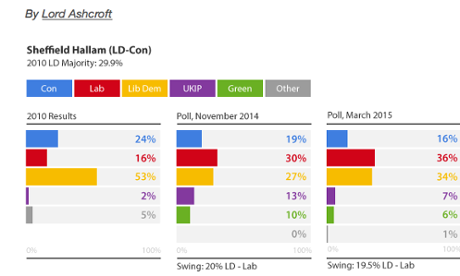
A previous Ashcroft poll also found Clegg behind Labour in Sheffield, but that was in November.
Ashcroft has released the results of polls in eight seats, all Lib Dem battlegrounds, where Ashcroft has polled before. In some seats the Lib Dems have strengthened their position, but in three others the Tories have made big gains.
Here’s an extract from Ashcroft’s commentary.
The upshot is that the Conservatives have consolidated their position in Camborne & Redruth, North Devon and St Austell & Newquay, where they lead by thirteen, seven and six points respectively. North Cornwall and Torbay, both tied in my previous polls, and St Ives, where I found a one-point Lib Dem lead, have all edged slightly in the Lib Dems’ direction – though the two parties remain within the margin of error of each other in all three.
The Lib Dems have established a clear lead in Cambridge, where Labour were a point ahead in September, though things still look uncomfortable for Nick Clegg in Sheffield Hallam, where I found him two points behind.
Miliband's zero-hours contract speech - Summary and snap analysis
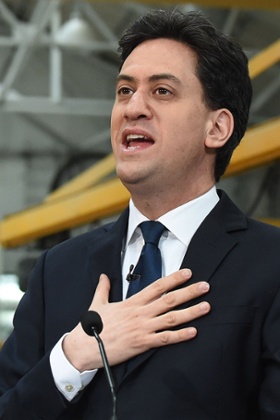
Ed Miliband is definitely getting much better as a campaigner. In the past his performance as a communicator has been a bit hit-and-miss, but recently he seems be much more polished at finding the language to sell his message. There was a good example at the Huddersfield event. Labour had already announced the policy, but Miliband deployed two effective soundbites to sell it.
-
Miliband said he was opposed to zero-hours contracts because he believed “if it’s not good enough for us, then it’s not good enough for you”.
Less than a week ago you may have heard the prime minister say that he couldn’t live on a zero-hours contract. Well, I couldn’t live on a zero-hours contract either. But I’ve got simple principle; if it’s not good enough for us, then it’s not good enough for you, and it’s not good enough for Britain. And that’s the way I want to run the country.
-
He challenged critics of Labour’s policy to say whether they could live on a zero-hours contract.
I challenge anyone who criticises us today, I challenge anyone in the Conservative party, or elsewhere in business, to say, will you volunteer that you could live on a zero-hours contract? If you say you can live on a zero-hours contract, well, let’s see you try. But I think the reality is that, whether it’s me or David Cameron or other people in our society, I don’t think it provides any kind of security for you and your family.
This was aimed at business organisations like the CBI, the IoD and the EEF, as much as the Conservative party. (See 9.51am.)
Updated
Meanwhile, David Cameron and George Osborne have just arrived in a brewery in Wolverhampton
Cameron & Osborne arrive at Marston brewery in Wolverhampton. Local Tory Paul Uppal defending 691 majority pic.twitter.com/lvanbj70v5
— James Tapsfield (@JamesTapsfield) April 1, 2015
Miliband's Q&A
Miliband is now taking questions.
Q: What is your view on private healthcare?
Miliband says he does not have private healthcare. The key thing is to improve the NHS.

Q: What is going to stop employers getting rid of employees after 11 weeks, before they have to offer people proper contracts?
Miliband says Labour will introduce a legal mechanism to stop that.
After 12 weeks, you will be able to show what hours you have been working.
Most employers do not use ZHCs, he says. They would support a crackdown.
Miliband repeats the point about not being able to live himself on a ZHC.
I challenge anyone who criticises us to say ... to say will you volunteer that you could live on a zero-hours contract.
Updated
Ed Miliband's speech in Huddersfield
Ed Miliband is speaking in Huddersfield now. (See 11.10am.)
He says he hopes he won’t contribute to too much low productivity today.
He will take questions, but he wants to start with a short speech. We need to be a country that supports young people. Labour would have a revolution in apprenticeships. It will say to young people, if you get the grades, you will get an apprenticeship. It will tells students they won’t be burdened with debt. Tuition fees will be cut. And Labour will also find more money from the NHS. It is the most precious institution in the country and it needs to be protected.
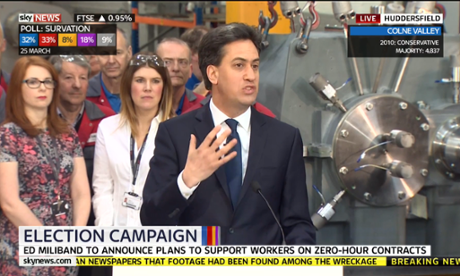
But there is one big question: Who our country works for? Miliband says zero-hours contracts are indicative of this. There has been an epidemic of ZHCs. They undermine living standards, and family life.
We have to to end the epidemic of zero-hours contracts.
He sets out the plans briefed overnight.
He says David Cameron said he could not live on a ZHC. He could not live on one either. But, if something is not good enough for him, it is not good enough for other people too.
Updated
Labour says prospective CBI chief should not have signed Telegraph anti-Labour letter
Chuka Umunna, the shadow business secretary, has been giving inteviews responding to the Telegraphy anti-Labour letter from business leaders. He has been making two points.
-
Umunna claimed the business figures who signed the letter were not necessarily representative.
We’ve got almost five million businesses in our country. At best you could say the people who signed this represent 0.002% of them.
-
He suggested that Paul Walsh, who is reportedly being lined up as the next CBI president, should not have signed it. Asked about the inclusion of Walsh’s name, he replied:
That was the one, I suppose ,that maybe did raise an eyebrow, in the sense that Sir Mike Rake, the current president of the CBI, has been very clear that they are a completely non-political organisation. He’s been very scrupulous to not be seen to be supporting a particular political party. And I don’t think you would have seen Sir Mike Rake signing this letter because he would have realised to claim impartiality, and sign a letter like this, would have been rendered any claim to independence rather untenable ... It is quite difficult to claim to be independent and impartial whilst at the same time being part of an exercise like this, organised and coordinated by the Conservative party in a Conservative-supporting newspaper.

Ed Miliband will soon be speaking at a factory in Huddersfield.
Inside the venue in Huddersfield for Ed Miliband's speech on zero hours - no apparent lack of productivity here pic.twitter.com/MclDs6u5IV
— iain watson (@iainjwatson) April 1, 2015
At Ed Miliband's only campaign visit today: a gearbox factory in Colne Valley (Con maj 4,837) near Huddersfield. pic.twitter.com/fIK1B7NoZ1
— Callum May (@callummay) April 1, 2015
The lectern is set. Ed Miliband will talk zero hours contracts in an hour at this Huddersfield factory. pic.twitter.com/LRkT5MW1wB
— Peter Hunt (@BBCPeterHunt) April 1, 2015
Cameron 'doesn't seem too nervous' about the debate, says his wife Samantha
Samantha Cameron, the prime minister’s wife, is campaigning today. She has been visiting a school in Kent for pupils with special needs, in her first election appearance without her husband in tow.

Asked how her husband was feeling about tomorrow night’s TV debate, she replied:
He doesn’t seem too nervous, but I have to say I’m very glad it’s him and not me.
Updated
A poll for TNS, conducted for The Herald’s Election 2015 supplement (paywall), has found that 46% of voters in Britain believe greater SNP influence in Westminster would be negative and 22% positive for the UK as whole, Libby Brooks reports. Some 32% were unsure.
Suggesting that Nicola Sturgeon, the SNP leader, was right in her conference speech last weekend to send a “message of friendship and solidarity” to voters in England and Wales, the poll also found that 29% of Labour supporters felt the SNP’s influence would be positive, compared with just 13% of Conservatives.
Ukip complain about school pupils being exposed to pro-EU 'propaganda'

Ukip had a typically colourful press conference this morning on the EU at which the party’s economics spokesman Patrick O’Flynn accused Brussels of trying to brainwash British young children through colouring books, Rowena Mason reports.
The point of the event was Ukip’s demand that EU migrants and 16/17 year olds are excluded from voting in a referendum on Britain’s EU membership. In addition, the party wants the question to be “fairly” constituted, suggesting something like: Do you think the UK should be a free sovereign democratic country?
O’Flynn also laid out concerns that the EU is trying to influence young people in its favour. “In the case of 16 and 17-year-olds, they are far more likely to have been exposed recently to very strident pro-EU views and not to have heard the Eurosceptic case at all,” he said at the Westminster venue.
“In the case of EU migrants there is obviously a vested interest potentially in how they will vote. We see this as an attempt by the Liberal Democrats to gerrymander the outcome. But we are also worried that David Cameron has a habit of letting the Liberal Democrats take the rap for certain un-Conservative things he might be planning to do.”
O’Flynn added: “There have been lots of stories about the extent of EU funding of publicity material that has gone into schools. We have had many reports anecdotally through our members of schoolchildren of secondary school age being exposed to overwhelmingly pro-EU views when the matter of the European Union is discussed and not really having the Eurosceptic or the anti-EU case put. Sixteen and 17-year-olds are much more likely to be in support of Britain’s membership with the European Union than the population in general. It is gerrymandering which is clearly intended to skew the result.”
He highlighted “literature from the European Commission or the European Parliament that’s been circulated in schools, which is heavily pro-EU slanted without any balancing on the other side.”
Ukip deputy leader Suzanne Evans said the literature included “colouring-in books on the Common Agricultural policy for primary schoolchildren right up to research projects at university level.” She went on: ”The amount of money the EU is putting into this propaganda and throughout the entire education system is enormous”.

O’Flynn also appeared to undermine Farage’s claim not to be doing preparation for the television leaders debates. He said the Ukip leader was not rehearsing with stand-ins but he was preparing in a “rigorous” way by studying briefing documents and figures. A senior Ukip aide denied this was the case, saying Farage did not want to prepare too much.
Updated
ONS figures show productivity growth weakest since WWII
The Office for National Statistics has released its latest productivity figures this morning. In a Guardian commentary, Larry Elliott says the statistics show that the government’s productivity record is the worst for 70 years.
Here’s an excerpt.
David Cameron has presided over an economy with the weakest productivity record of any government since the second world war, the Office for National Statistics said as it revealed output per workers fell again in the final three months of 2014.
In a separate blow to the government, two-thirds of leading UK economists said they believed George Osborne’s austerity strategy had been bad for the economy.
The ONS said productivity decreased by 0.2% between the third and fourth quarters of last year, leaving output per hour worked little changed on the previous year and slightly lower than in 2007, before the UK’s longest and deepest modern recession.
“These estimates show that the absence of productivity growth in the seven years since 2007 is unprecedented in the postwar period,” the ONS said ...
Weak productivity has been the flipside to strong employment growth, since the increase in the number of people working has not been matched by the hourly output of goods and services they have produced.
Cameron expected to win Thursday's TV debate, poll suggests
Red Box, the daily politics email briefing from the Times, contains some interesting polling on Thursday’s leaders debate. It shows that people expect David Cameron to win.
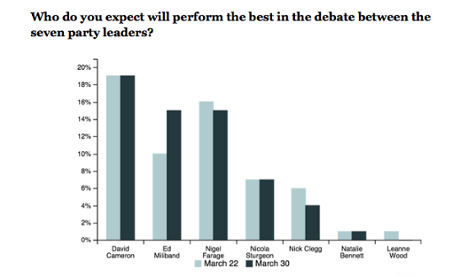
But, as YouGov’s Stephan Shakespeare writes in his Red Box commentary, it is also interesting to see how Ed Miliband’s ratings have gone up in the last week or so. This suggests “a genuine re-assessment” of Miliband is underway, Shakespeare says.
On BBC News just now Sajid Javid, the Conservative culture secretary, said the Telegraph anti-Labour letter from business leaders was highly significant.
Other commentators are more sceptical. Here are some of the more interesting tweets on it I’ve seen from journalists and commentators.
From the FT’s Giles Wilkes
Difficult to imagine anything LESS unprecedented than hordes of FTSE 100 bosses supporting Conservative economic policy.
— Giles Wilkes (@Gilesyb) April 1, 2015
"Bosses support Tory economic policies". In other shocking news, Greenpeace and Friends of the Earth edging towards supporting the Greens.
— Giles Wilkes (@Gilesyb) April 1, 2015
20p Corporation tax = "Britain open for business". 21p Corporation tax = "AAARRGH! FIDEL CASTRO IN THE TREASURY!" 30p in the 1990s...?
— Giles Wilkes (@Gilesyb) April 1, 2015
From the FT’s John Gapper
I wonder if, by kicking off its campaign with business policies, Labour intended to provoke the inevitable row early. If so, it's working.
— John Gapper (@johngapper) April 1, 2015
From Iain Martin
Big business is almost as unpopular as the political class. Only option for Labour: make a virtue of being attacked and really go for it.
— Iain Martin (@iainmartin1) April 1, 2015
From the FT’s John McDermott
Naive to think a Labour party led by Blair after the crash wouldn't have been critical of big companies. It'd just have been better at it.
— John McDermott (@johnpmcdermott) April 1, 2015
From the economist and blogger Chris Dillow
We...see the respectful attentions of the world more strongly directed towards the rich and the great, than towards the wise - Adam Smith
— Chris Dillow (@CJFDillow) April 1, 2015
From the blogger Flip Chart Rick
How much weight does the opinion of 100 business leaders carry these days? http://t.co/pgRq0OG1er
— Rick (@FlipChartRick) April 1, 2015
From the Guardian’s Patrick Wintour
In Feb country evenly divided on whether best to stand up to big business or have good relationship with it. http://t.co/sQ0Swvj6lK
— Patrick Wintour (@patrickwintour) April 1, 2015
This from Sky’s Sophy Ridge on the Telegraph anti-Labour business leaders letter.
Understand that Conservative Party Co Chairman Andrew Feldman helped organise today's letter from business leaders in the Telegraph
— Sophy Ridge (@SophyRidgeSky) April 1, 2015
Here’s John Prescott’s take on the Telegraph letter.
What that Telegraph front page should have said! pic.twitter.com/0Fxu7auUy0 via @SimonGosden #GE2015
— John Prescott (@johnprescott) April 1, 2015
And here are the full details of the Centre for Macroeconomics survey. (See 9.18am.)
Here is the chart the the survey response figures.
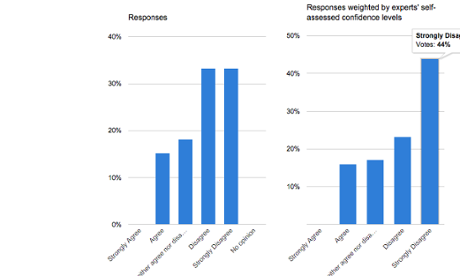
And here is an extract from the CFM write-up.
Many of the respondents begin by noting that it is far from clear what the counterfactual is and that austerity policies were significantly loosened in the second half of the term.
Nevertheless, the clear majority of our respondents disagree or strongly disagree with the proposition [that the coalition’s austerity policies have been good for jobs and growth]. Simon Wren-Lewis (Oxford) even goes so far as to ask whether ‘this is a joke’ before pointing out that by using numbers from the Office for Budget Responsibility (OBR), one can ‘derive a lowest estimate’ for the cumulative loss in activity of 5% of GDP (or £1,500 per capita) and ‘a best guess could be nearer to 10% of GDP.’ Ethan Ilzetzki (London School of Economics, LSE) strongly disagrees, noting that ‘interest rates were at historical low levels and there was no indication that the debt burden was a drag on growth.’ John Van Reenen (LSE) also strongly disagrees, although he says that austerity was correctly relaxed after 2011-12 as the ‘nascent recovery stuttered.’ He and Tony Yates (Bristol) both mention the zero lower bound on interest rates as an argument for less austerity.
Here’s Charlie Whelan, Gordon Brown’s former spin doctor, on the Telegraph letter from business leaders.
Outrageous that @BBCr4today leads with Tory paper story that big business is backing the Con's. Since when has that been news?
— charlie whelan (@charliewhelan) April 1, 2015
If 100 leading Trade Unionists wrote to the Daily Mirror supporting Labours economic policy would @BBCr4today lead the news on that story?
— charlie whelan (@charliewhelan) April 1, 2015
Labour should get into a big row with big business and not pretend they are friends.They would then be on the right side of public opinion.
— charlie whelan (@charliewhelan) April 1, 2015
Updated
According to Sky’s Faisal Islam, the Institute of Directors and the EEF, the manufacturers organisation have joined the CBI (see 8.19am) in attack Labour’s plan to curb the use of zero-hours contracts.
So three business organisations: CBI, EEF, IoD have also issued separate statements attacking the Labour move on zero hours contracts
— Faisal Islam (@faisalislam) April 1, 2015
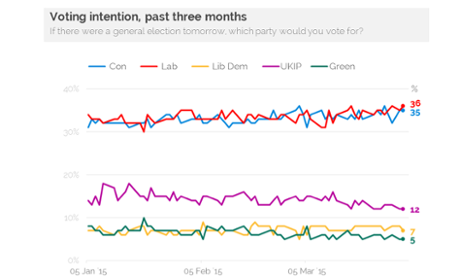
YouGov poll gives Labour 1-pt lead
Here are today’s YouGov polling figures.
Update: Lab lead at 1 - Latest YouGov / The Sun results 31st Mar - Con 35%, Lab 36%, LD 7%, UKIP 12%, GRN 5%; APP-16 http://t.co/x4gwkY2ddt
— YouGov (@YouGov) April 1, 2015

Economic experts say Osborne's austerity policies have been bad for growth and jobs

The Telegraph has a letter from business leaders defending the government. But, as Robert Peston revealed on the Today programme this morning, there are other “experts” with a different view on George Osborne’s record.
Peston reported on the findings of a survey of expert economists about whether Osborne’s austerity policies have been good for growth. As he reports on his blog, they said no.
The Centre for Macroeconomics, which groups leading economists from Cambridge University, LSE, University College London (UCL), the Bank of England and the National Institute of Economic and Social Research (NIESR), polled what it calls its 50 experts on whether the “austerity policies of the coalition government have had a positive effect on aggregate economic activity (employment and GDP) in the UK”.
Its result was a decisive no.
Two-thirds of the 33 economists who responded disagreed or strongly disagreed with the proposition that austerity had been good for the UK.
Now to be clear, this is not a scientifically robust poll of those who know best. But nor is the Telegraph’s letter - and those those who took part in the economists’ survey are no less distinguished in their field than the business signatories.
Among those who disagreed strongly that austerity had been a good thing, Oxford University’s Simon Wren-Lewis (never shy to express an opinion) asked if the question was “a joke”, adding that “the only interesting question is how much GDP has been lost as a result of austerity” (which he thinks could be as much as 10% of national income).
John Van Reenen of the LSE, who also disagreed with austerity, said “UK GDP is about 15% below where we would have expected on pre-crisis trends... Premature austerity has damaged UK welfare and, as I and others argued at the time, delaying consolidation would have left the UK in a much stronger position than it is today.”
Updated
George Osborne, the Conservative chancellor, claimed that the Telegraph letter from business leaders was “unprecedented”. (See 8.46am.)
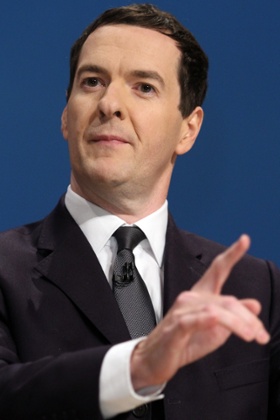
An intervention on this scale and with this clarity from Britain’s business leaders is unprecedented in any recent general election. Their message is positive: under David Cameron’s leadership, we have an economic plan that is working and creating jobs. Today that plan sees corporation tax cut again to 20 per cent, and a new diverted profits tax so those low taxes are paid.
He adds:
And the warning from Britain’s business leaders couldn’t be clearer: a change of course will threaten jobs, deter investment, send a negative signal about our country and put the recovery at risk. Britain now knows. No more ifs or buts.
Updated
Ed Miliband was on BBC Breakfast this morning. He was mostly talking about his plans to limit the use of zero-hours contracts, but he also mocked David Cameron for using his statement outside Number 10 on Monday to launch a personal attack on him.
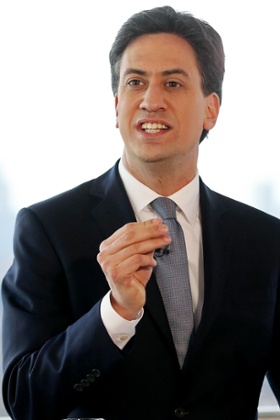
David Cameron is the guy – he stood outside Downing Street in the way no prime minister has done in the past ten elections, and he talked about me. Imagine, he has got five years he wants as prime minister, or maybe it’s three or four, and he actually talks about me. I don’t care about David Cameron throwing mud at me, what I care about is what’s going to happen to the British people in the next five years.
I’ve taken the quote from PoliticsHome.
Updated
Jim Murphy accuses SNP of 'overflowing with arrogance'
Here are the key points from the Today interview with Jim Murphy, the Scottish Labour leader.
-
Murphy said that the SNP was “overflowing with arrogance”.
You said that [the SNP are] brimming with confidence - I think they’re overflowing with arrogance.
-
He said he was confident Labour would turn the polls around in Scotland.
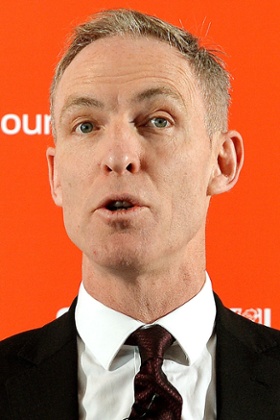
The SNP have been ahead in a string of polls; that’s partly, I think, because a lot of people, until the election had been called, were thinking about last year’s vote and the referendum and the nearer we get to the general election people are going to think [less] about last year’s disagreement and more about this year’s decision; which is do you want a Labour government or Tory government in power?
- He reaffirmed Labour’s determination not form a coalition with the SNP.
-
He insisted it was vital for Labour to be the largest party if it was going to form a government.
If the SNP gains [the number of seats the polls suggest] it diminishes the Labour party, it allows David Cameron to continue to lead the biggest party and get a chance to hold onto power. That’s the last thing Scotland can afford – a decade of David Cameron.
Murphy left James Naughtie stumped when he asked him when was the last time a party formed a government at Westminster without being the largest party. There was silence, as Naughtie could not remember. It was 1924, Murphy said.
-
He said if opinion did not change, Labour and the SNP would be working together - in opposition.
If these polls, these opinion polls, are repeated on election day in Scotland of course the SNP and Labour party will work together, we will work very closely together, but it will be on the opposition benches. We will be looking across at David Cameron as Prime Minister because that’s the consequence if these polls if they are repeated.
- He said David Cameron would not help Scotland.
First of all I think most people in Scotland think David Cameron’s the type of Prime Minister who when he sees a drowning man shouts at him to just swim harder. We can’t have a Prime Minister who just looks the other way when it comes to the country’s problems. We have been clear, The SNP have been clear, there is going to be no coalition with the Scottish National Party. What the Scottish Labour party wants is a coalition with the English Labour party and the Welsh Labour party to have a Labour government.
I’ve taken the quotes from PoliticsHome.
Updated
Telegraph anti-Labour letter from business leaders - Snap analysis
And here is the letter itself.
Dear Sirs,
We run some of the leading businesses in the UK. We believe this Conservative-led government has been good for business and has pursued policies which have supported investment and job creation.
David Cameron and George Osborne’s flagship policy of progressively lowering Corporation Tax to 20% has been very important in showing the UK is open for business. It has been a key part of their economic plan.
The result is that Britain grew faster than any other major economy last year and businesses like ours have created over 1.85m new jobs.
We believe a change in course will threaten jobs and deter investment. This would send a negative message about Britain and put the recovery at risk. In a personal capacity we therefore sign this letter.
And here are three points to note about the letter:

1) The letter does not directly back the Conservative party. It focuses on the record of the coalition, or the Conservative-led government as it calls it. Arguably, you could read it as an endorsement for the Lib Dems.
2) Corporation tax cuts are the only policies specifically singled out for praise. This makes the letter topical - because yesterday Labour was confirming its plans to reverse the latest corporation tax cut to find money to cut business rates for small firms - but it does beg the question why, if the other coalition policies were so good, they did not get a mention. Perhaps it was because corporation tax was the easiest issue around which the organisers of the letter could secure a consensus.
3) The letter does not mention Labour, or Ed Miliband, or explicitly attack their policies. Instead, it just implicitly criticises the corporation tax policy (see above) and argues against a “change in course”, which of course is what Labour is promising. It’s not exactly a fiery broadside. Again, that is probably because fewer business leaders would have signed if it was.
Updated
This one almost caught me out.
Ukip officials refuse to comment on late-night Nigel Farage visit to Ed Miliband's home. Lasted 3 hours, say sources
— Michael Crick (@MichaelLCrick) April 1, 2015
But, of course, it must an an April Fool.
Labour sources dismiss reports Ed Miliband met @Nigel_Farage last night
— norman smith (@BBCNormanS) April 1, 2015
I’m not sure April Fools should be allowed on Twitter. It’s an old media tradition, that only works because the notion of newspapers printing stories that they know to be untrue is so obviously ridiculous as to be funny.
Labour's plans to limit use of zero-hours
The CBI has criticised Labour’s plans to limit the use of zero-hours contracts. This is from John Cridland, the CBI director general:

The UK’s flexible jobs market has given us an employment rate that is the envy of other countries, so proposals to limit flexible contracts to 12 weeks are wide of the mark.
Of course action should be taken to tackle abuses, but demonising flexible contracts is playing with the jobs that many firms and many workers value and need.
These proposals run the risk of a return to day-to-day hiring in parts of the economy, with lower stability for workers and fewer opportunities for people to break out of low pay.
And the Conservative party is implying the plans are unnecessary. This is from a party spokesman.
Zero hours contracts account for just 1 in 50 jobs in our economy, this government has already banned the abusive ones - and all the while Labour presided over zero-hours contracts with no safeguards for 3 terms and 13 years while they were in power. Tony Blair even promised to ban them entirely as far as back as 1995 and then did nothing.
The fact is that three quarters of the new jobs since this government came to office are full time – these are families across the country getting into work with the security of a regular pay packet.
But the TUC has welcomed the plans. This is from Frances O’Grady, the TUC general secretary:
We welcome this commitment to deal with exploitative zero-hours contracts, which have allowed bad employers to effectively hire and fire staff at will.
Zero-hours workers are often too afraid to speak up for their rights for fear of losing work.
We need a fairer system that guarantees zero-hours workers decent rights at work and stops them from being treated like second-class employees.
Updated
Good morning. I’m taking over from Claire.
Jim Murphy, the Scottish Labour leader, is about to be interviewed on the Today programme. I won’t cover it minute by minute, but I will post the highlights when it’s over.
With a hat-tip to Buzzfeed’s Jim Waterson, who spotted the … I’m going to call it a glitch, the Telegraph website offers readers the opportunity to vote on whether Labour retains the confidence of big business:
This is what happens if you decide “No, they still have it”:

Rachel Reeves, the shadow work and pensions secretary, has been on ITV’s Good Morning Britain to discuss Labour’s announcement today that it put further limits on zero-hours contracts:
Particularly if you have got childcare responsibilities and a family, not knowing from week to week, day to day … whether you’re going to afford to pay the rent and bills and put food on the table, that’s just not good enough.
The prime minister says he couldn’t live on it, well if he couldn’t live on it we shouldn’t be asking fellow citizens to do so.
Well, we do say we want our politicians to be more “real”:
Ooh, the glamour - R4 Today i/v was pre-recorded in a van, in a Premier Inn car park at 6am in my Cookie Monster PJs pic.twitter.com/KvOpPVL10Y
— Ruth Davidson MSP (@RuthDavidsonMSP) April 1, 2015
Lord (Stuart) Rose is on the Today programme now. He’s one of the signatories to the letter in the Telegraph today. He’s also a Tory peer.
“The good news at the moment is we have this flourishing environment” for business, he says, adding: “I don’t accept at all” that workers are being exploited by companies over zero-hours contracts.
The creation of wealth is extremely important … to keep our country going.
It’s the wealth created by businesses that pays for things such as support for disabled people, Rose says.
The Guardian’s political editor, Patrick Wintour, points out something else the Today interviewers could have asked Rose:
Good to ask Stuart Rose ex M&S Boss why his govt commissioned report into NHS, finished months ago, is unpublished by govt he suppports
— Patrick Wintour (@patrickwintour) April 1, 2015
Rose report criticising management of NHS ‘put on back burner’ - http://t.co/0kbV3JZ5D8 http://t.co/JBolUQJCOD via @FT
— Patrick Wintour (@patrickwintour) April 1, 2015
Ruth Davidson, the Scottish Conservative leader, has just been on the Today programme, talking about the likely outcome of the election in Scotland:
The polls are still showing the influence of last year’s referendum, she says:
The SNP have managed to lock in a lot of that 45% [who voted yes last September]… and that is enough to win you an awful lot of seats.
As the primary yes force, they’ve absolutely been able to harness that … I think there will be SNP gains in Scotland.
Davidson said the Tories were best placed to capitalise on the 55% who voted no:
We as a party are also looking to build … we are the most pro-union party.
She said Labour and the Lib Dems were suffering from being “embarrassed, ashamed, whatever about [their] record”, though she did praise Nick Clegg’s party for stepping up to work in coalition, singling out Danny Alexander (who some predict could lose his seat on 7 May) who she said has done “very, very well”.
Pressed on whether minority government would be better than another coalition, she said:
Probably, on balance, would that be my preference? If the numbers work, then it probably would.
Updated
Morning briefing
Hello, and welcome to the Guardian’s election live blog, with – only! – 36 days of campaigning left to go. We are bringing you live coverage every day from 7am till late, kicking off with our all-you-need-to-know morning briefing, designed for those election fans who nonetheless like to get the occasional night’s sleep.
I’m Claire Phipps, starting this morning’s blog, before Andrew Sparrow takes over later on. We’re on Twitter @Claire_Phipps and @AndrewSparrow, and reading comments below the line, too, should you want to say hello, ask a question or point out an April Fool that we’ve blundered into.
The big picture
The story set to dominate the morning is the Telegraph’s story that 100 business leaders have penned a letter in support of a Conservative win – of which more later.
Here are the other stories to know about:
Labour
- Ed Miliband will say that workers on zero-hours contracts should have the right to a regular job after three months (Labour had previously said employees would win this entitlement after a year).
- On a day in which many of the parties head for Scotland, Ed Balls says that a vote for the SNP is not a vote for a mini-Miliband in Alex Salmond’s pocket, but a vote for the Tories:
There is only one way to end Tory austerity in Scotland and that’s by voting Labour.
Lib Dems
- The Lib Dems will set out steps to protect journalism from state interference in their election manifesto.
- Nick Clegg says his party would triple statutory paternity leave to six weeks if they get another stab at government.
Conservatives
- In a kitchen chat with the Sun (during a campaign, you can only be photographed in a kitchen, on a battle bus, or in hi-vis clothing. If you manage all three together, you win the election), David Cameron and George Osborne said a future Tory government would not raise income tax or national insurance, adding to last week’s surprise pledge not to hike VAT.
- Cameron also said he’d keep Osborne as chancellor if they stay in Downing Street:
The team is the team. You don’t want to change the person who has driven our economic performance, and has been at the helm of it.
A tax promise, Chelsea FC, and what really happened on Syria. Cameron and Osborne's 1st joint interview in tmrw's Sun pic.twitter.com/Gmw3nisGcR
— Tom Newton Dunn (@tnewtondunn) March 31, 2015
Ukip
- Jeremy Zeid, the party’s candidate in Hendon, was removed after he said in a Facebook post that Israel should “kidnap” Barack Obama. Ukip said he had stepped down because of health issues. I should give you a running total of misplaced Ukip candidates here, but I’ve lost count.
Other things we learned
- Ed Miliband is “aware of both Ed Sheeran and Sam Smith” and thinks “Rosamund Pike would make a great Bond”.
- David Cameron believes he is distantly related to the Kardashians.
- As yet there is no word on who Nick Clegg thinks should replace Zayn Malik in One Direction.
For everything else, catch up with Nadia Khomami’s round-up of Tuesday’s key moments here.
Diary


- At 8.30am Ukip’s economics spokesman Patrick O’Flynn and deputy chairman Suzanne Evans stage an event to demand “a free, fair EU referendum” and request assurances from Cameron that he does not have a secret deal on the issue with the Lib Dems.
- David Cameron and George Osborne spend the morning in the West Midlands.
- At 9.30 London mayor and would-be Tory MP for Uxbridge and South Ruislip, Boris Johnson, launches the Conservatives’ London campaign.
- Around the same time, Samantha Cameron will be visiting a school with another Conservative candidate, Kelly Tolhurst.
- Also at half nine, Scotland’s party leaders – first minister Nicola Sturgeon (SNP), Jim Murphy (Labour), Ruth Davidson (Conservatives) and Willie Rennie (Lib Dems) take questions at the Scottish Police Federation conference.
- Davidson will also be on the Today programme at 7.10am, with Murphy on at 8.10.
- It’s busy in Scotland today: at 1pm shadow chancellor Ed Balls, alongside Murphy, makes a speech in Glasgow.
- The Lib Dem battlebus heads to Scotland too, with Nick Clegg and Jo Swinson talking about plans to triple paternity leave for fathers.
- And the Greens will be campaigning in central Scotland, highlighting their pledge for public ownership of the railways.
The big issue
More than 100 business leaders have signed a letter, splashed over the front of the Telegraph today, saying the “Conservative-led government has been good for business” and warning that “a change in course will threaten jobs and deter investment … and put the recovery at risk”.
Wednesday's Telegraph front page: 100 business chiefs: Labour threatens Britain's recovery #tomorrowspaperstoday pic.twitter.com/ZpgEOdZIAo
— Nick Sutton (@suttonnick) March 31, 2015
This is familiar territory for the Telegraph, which has run similar letters before – including, coincidentally enough, on this day in 2010 – but will prompt a tussle this morning over Labour’s attractiveness to big businesses.
Shadow business secretary Chuka Umunna has already said of the letter:
No one will be surprised that some business people are calling for low taxes for big businesses. That’s nothing new.
The letter has been signed by at least five business leaders who previously backed Labour, including Sir Charles Dunstone, the chairman of Dixons Carphone and Talk Talk plc, and Duncan Bannatyne, a former star of Dragons’ Den.
The strength/weakness of such a long list of names is that it requires/encourages readers and rival media to hit google in search of a bit of background on this long list of illustrious business names. So, the first signatory: Rooney Anand. Here he is, in a Guardian article from last year, after his company, Greene King, lost a battle with HMRC over “a highly artificial tax avoidance scheme”.
At first glance, Baroness (Karren) Brady, Baroness Shields and Lord Rose jump out as Conservative peers.
Lord Bamford donated more than £1m to the Conservatives before the last election and was nominated for a peerage the same year, only to withdraw his name. But he got another go in 2013, when he joined the House of Lords.
Expect much more of this. The second job for today, of course, is to work out why some of the signatories are picked out in pink.
Read these

-
John Cassidy in the New Yorker gets a little overexcited about the “thrilling” UK election campaign:
Not only is the contest perilously close, it has more story lines than an episode of Downton Abbey.
(Although, to be fair, there was that episode where they decamped to the Scottish Highlands and everyone was ghastly to each other.)
- In the Times (paywall), Daniel Finkenstein wonders what it will take to produce a last-minute swing to the Conservatives such as was seen in 1992:
While parties can lose even when their candidate for prime minister is preferred to his main rival, and they can lose when they are thought stronger on the economy than their opponents, no one has ever lost when ahead on both leadership and the economy. Yet this time, the Conservatives look as if they might.
- A guide to what the Independent generously calls “the masterminds behind the scenes”.
- Emily Ashton at Buzzfeed has a tale of Stewart Jackson, the Tory incumbent in Peterborough, telling a gay constituent “to never bother me again”.
The day in a tweet
Surely the big news about this letter: http://t.co/aNLY3sKyPJ is that 100 senior business leaders don't think China is a "major economy"?
— Jonathan Portes (@jdportes) March 31, 2015
If today were a song, it would be…
0 to 100 (as long as Drake was referring to hours in contracts and open letter signatories).
The key story you’re missing when you’re election-obsessed
In the Nigerian election, opposition leader Muhammadu Buhari has swept to victory, ousting sitting president Goodluck Jonathan and inflicting the first defeat on an incumbent in the history of Africa’s biggest democracy.
Updated










It's almost as if the entire Tory narrative is some kind of lie constructed in order to try and sell something that's the opposite of genuine, isn't it?
That said, I fear the overuse of the godawful coinage "workingpeople" will make my head explode long before I get to vote. (A "workingpeople" is also known as a "hardworkingpeople". I prefer to think of people with fewer spurious adjectives appended to them. After all, you don't need an adjective to vote)