In February 1967, a humble young cotton farmer left his home in south-eastern El Salvador and made his way to Washington DC, where he eventually found work as a dishwasher.
Sigfredo Chávez’s odyssey was the first ripple of migration from the sleepy town of Intipucá to the US capital, a northwards tide that remains in full spate nearly 50 years later.
Thousands of local people have followed Sigfredo’s footsteps – around 5,000 Intipuqueños now live in or near Washington – and the town’s economy now largely depends on an estimated $2.5m a year in remittances from the US.
Meanwhile, Chávez has become a local hero whose bootstrap life story showed it was possible to start over, earn a good living in the US and send enough money home to build a town up from almost nothing. In 2006, Chávez’s nephew Oscar Romero – who works in Intipucá’s town hall – erected a statue memorializing him, as the town’s “first migrant”.
But not everyone in Intipucá agrees with this version of events: some say that the audacious plan to travel to the US was dreamed up not by Chávez, but by his then wife, Elba Salinas, who also travelled with him.

Hugo Salinas, a former mayor – and Elba’s nephew – argues that she has been erased from the town’s history and is campaigning to set the record straight.
“He left with Elba!” Salinas said. “After the monument to the first migrant went up in the plaza, I wanted to correct history; she was never mentioned. And she is as much the first migrant as Sigfredo was.”
Elba Salinas was a single mother in her early 20s when she met and fell in love with Chávez. According to her nephew, when Elba’s father refused to allow her to travel abroad, she ignored him and ran away to the US with Chávez.
Chávez supporters are unmoved. “Maybe Elba was the first woman to leave Intipucá,” sniffed Romero. “But she was not the first migrant.”
Jaqueline Portillo, the director of town cultural centre, said that the truth is unlikely ever to be known. Certainly, elements of the story seem to have been embellished in the re-telling: Chávez actually came from a wealthy farming family, so his self-made image may be a fabrication.
Furthermore, several other families have also made competing claims that their relatives were actually the town’s original migrant.
“The Chávez family kept better documentation of his trip than the family of the other migrants. So there’s simply more weight to the story of him being the first migrant,” she said.
Portillo and Hugo Salinas are now planning a celebration for the 50th anniversary of the first migration from the town – whoever made the journey. “I want to create a positive image of my town, because no one was collecting these personal stories,” Salinas said.
Much has changed since Sigfredo and Elba headed north. Intipucá has lost much of its young to migration: census data shows that Intipucá’s population has hovered at around 7,000 for the past 20 years; those who remain are mostly small children, returned migrants who have retired, and deportees from the US. Many two or three-storey homes built with remittance money sit empty except for a week in March, when richer locals return to celebrate the town’s patron saint.
Some of today’s emigrants enter the US legally on a family reunification visa. The less fortunate pay smugglers for the journey north. As elsewhere in El Salvador, most are fleeing grinding poverty or street violence which has now pushed the country’s death rate to the same levels as they were during the civil war 20 years ago.
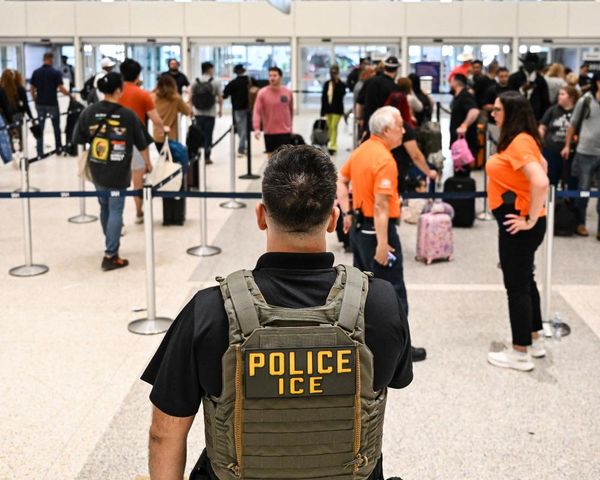
Recent crackdowns by US and Mexican migration authorities means that today’s undocumented migrants are forced to take ever-more perilous – and more expensive – routes. And if they do arrive in the US, they are unlikely to be hailed as heroes.
On a recent morning, Oscar Romero stood beneath the clay statue of his uncle, shown with a backpack slung over his shoulder.
“It’s the first monument to emigrants in the world! Nowhere else did people have the idea to praise their first migrant” he said.
“And by the way,” he added “My uncle was not an undocumented immigrant like those ones today. You can see he was facing the direction of the airport.”